

ISO 11117:2019/Amd 1:2026
(Amendment)Gas cylinders — Valve protection caps and guards — Design, construction and tests — Amendment 1
- Status
- Published
- Publication Date
- 02-Nov-2026
- Technical Committee
- ISO/TC 58/SC 2 - Cylinder fittings
- Drafting Committee
- ISO/TC 58/SC 2/WG 6 - Gas cylinder valves - Specifications and testing
- Current Stage
- 6060 - International Standard published
- Start Date
- 03-Nov-2026
- Completion Date
- 03-Nov-2026
Buy Documents
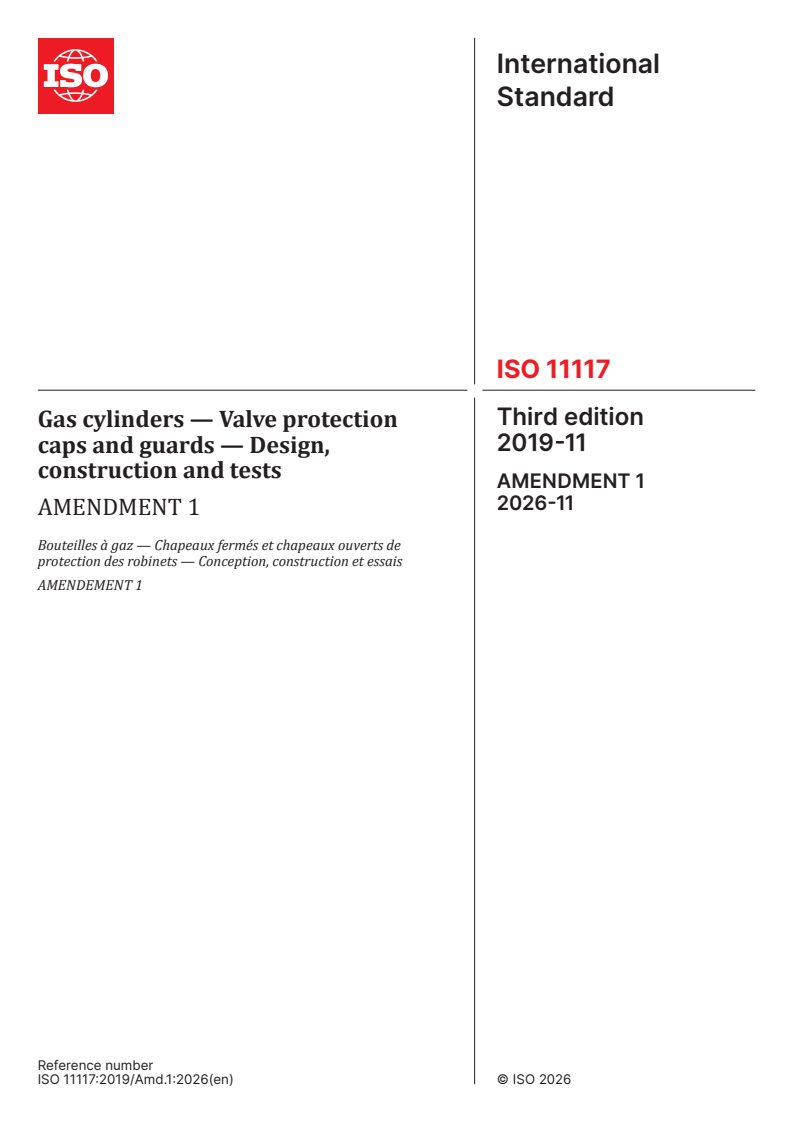

ISO 11117:2019/Amd 1:2026 - Gas cylinders — Valve protection caps and guards — Design, construction and tests — Amendment 1
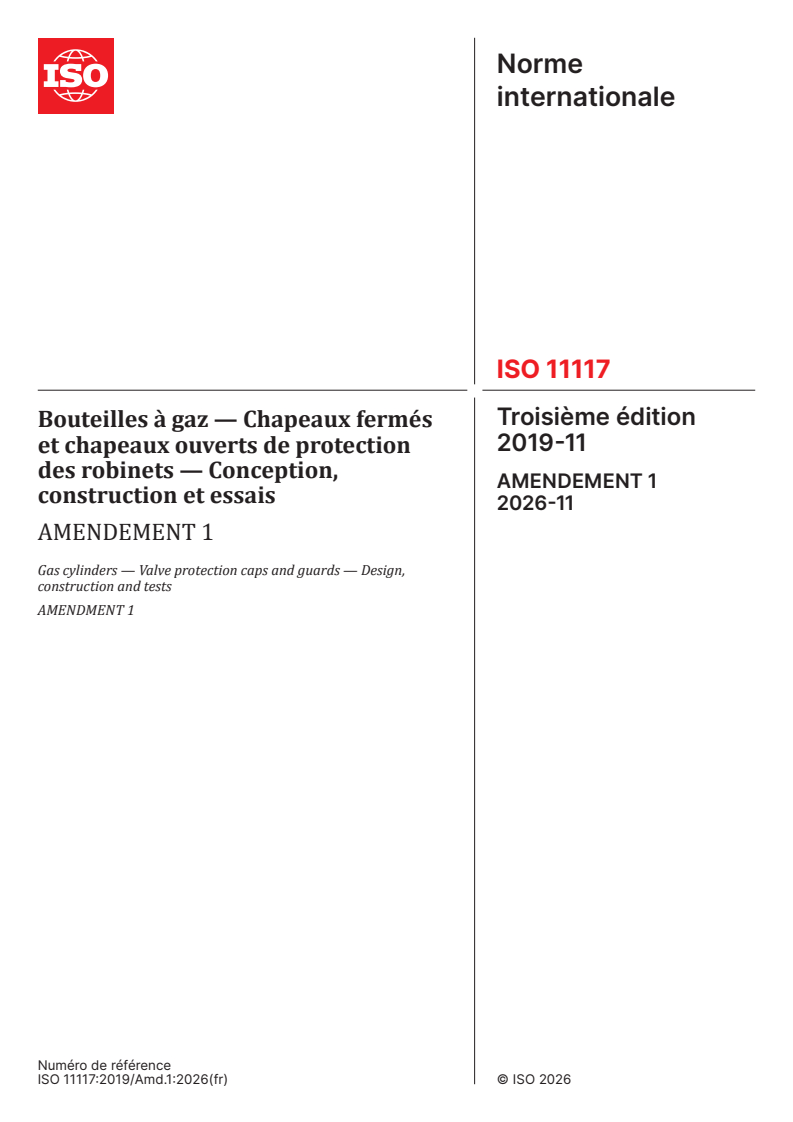

ISO 11117:2019/Amd 1:2026 - Bouteilles à gaz — Chapeaux fermés et chapeaux ouverts de protection des robinets — Conception, construction et essais — Amendement 1
ISO 11117:2019/Amd 1:2026 is an ISO amendment to the standard for gas cylinders - valve protection caps and guards. It updates design, construction and test provisions for these protective devices, with specific changes to thread dimensions, dimensional definitions and the way changes to valves are assessed. It is aimed at manufacturers, designers, test laboratories and others who work with valve protection caps and valve guards for gas cylinders.
What does ISO 11117:2019/Amd 1:2026 specify?
ISO 11117:2019/Amd 1:2026 specifies changes to ISO 11117:2019, which covers valve protection caps and valve guards for gas cylinders. The amendment revises selected clauses in the design, construction and test requirements so they can be applied consistently in practice.
The amendment is organized as targeted replacements in Clause 4, Clause 7 and Clause 9. It updates Figure 5, Tables 3 and 4, and several text paragraphs that affect how valve protection caps and valve guards are described, dimensioned and re-evaluated after design changes.
| Amendment location | What it covers |
|---|---|
| 4.3, Figure 5 | Dimensions of typical North American threads |
| 4.3, Table 3 | Dimensions of typical North American threads |
| 4.3, Table 4 | Tolerances of typical North American threads |
| 7.1 and 7.2 | Maximum dimensions and dimensional envelope for valve guards |
| 7.7.8 and 7.7.9 | When valve design changes require further evaluation or repeat of the drop test |
| Clause 9 | Removal of items b) and c) from the list |
What are the key requirements of ISO 11117:2019/Amd 1:2026?
ISO 11117:2019/Amd 1:2026 mainly refines how typical North American threads are defined and how valve changes are handled during assessment. In practice, these updates matter because they affect fit, interchangeability and the decision on whether a design change triggers renewed testing.
Thread dimensions and tolerances
Clause 4.3 replaces Figure 5, Table 3 and Table 4 with updated information for typical North American threads. The amendment gives the dimensions and tolerances used for valve protection cap or valve guard threads and cylinder neck ring threads.
For manufacturers, this means the thread form and its permitted variation need to match the updated figures and tables when designing or checking parts. For buyers and inspectors, it provides the reference used to judge whether a cap or guard fits the cylinder neck ring as intended.
Maximum dimensions and dimensional envelope
Clause 7.1 replaces the wording on maximum dimensions so it refers to either maximum dimensions or a maximum dimensional envelope. Clause 7.2 e) 2) expands the description of a valve guard dimensional envelope to include external dimensions and the arrangement of physical features.
In practice, this matters because a valve guard is not described only by a few linear dimensions. The external shape and feature layout can be part of the acceptance basis, which helps avoid ambiguity when comparing a design against the standard.
Further evaluation after valve changes
Clause 7.7.8 adds that changes to the valve design, such as material, connections or handwheel, do not by themselves require further evaluation for valve protection caps and valve guards. However, for valve guards, added or moved physical features on the protected valve, compared with the original test valve, require further evaluation to decide whether the drop test has to be repeated.
Clause 7.7.9 similarly states that additional valve design changes, including material, connections, handwheel, or changes to the position, arrangement or orientation of physical features, require further evaluation to decide if the drop test needs repeating.
For users, this is a practical decision rule. It helps determine whether an apparently small valve modification is acceptable under the original test evidence or whether new drop testing is needed.
Clause 9 editorial change
Clause 9 removes items b) and c) and renumbers the list that follows. This is a structural change to the document’s final requirements list.
What terms does ISO 11117:2019/Amd 1:2026 define?
The amendment uses several core terms from the parent standard.
- Valve protection cap - a protective device fitted to protect the valve of a gas cylinder.
- Valve guard - a protective device that shields the valve area, with its external features and envelope relevant to compliance.
- Cylinder neck ring - the cylinder feature used in the thread relationship shown in Clause 4.3.
- Dimensional envelope - the external dimensional outline used to define a valve guard’s allowed space and feature arrangement.
- Drop test - the test used to judge whether the protective device and protected valve arrangement performs adequately after changes.
- Physical features - external details such as gauges or filling connection locations that can affect whether further evaluation is needed.
Who uses ISO 11117:2019/Amd 1:2026?
ISO 11117:2019/Amd 1:2026 is used by gas cylinder and valve protection device manufacturers, product designers, quality managers, and test laboratories. It is also relevant to conformity assessment teams and purchasers who need to check that a valve protection cap or valve guard design follows the updated dimensional and test-evaluation rules.
What changed in ISO 11117:2019/Amd 1:2026 from the previous edition?
ISO 11117:2019/Amd 1:2026 is Amendment 1 to ISO 11117:2019. It updates the thread figures, tables and tolerances in Clause 4.3, clarifies how maximum dimensions and dimensional envelopes are described in Clause 7, revises the conditions for further evaluation after valve design changes in Clause 7.7.8 and 7.7.9, and removes items b) and c) from Clause 9.
What does the ISO 11117:2019/Amd 1:2026 document contain?
This amendment contains replacement text and replacement graphics rather than a full rewrite of the base standard. It provides an updated Figure 5 and revised Tables 3 and 4 for typical North American threads, which are used for design checking and fit verification.
It also contains revised instructions in Clause 7 on how to describe maximum dimensions and dimensional envelopes, especially for valve guards. These paragraphs support design definition and documentation when a product is assessed against the standard.
The amendment further includes updated guidance on when changes to a valve require more evaluation and when the drop test may need to be repeated. That makes the document useful for design changes, product approval work and test planning.
Relations
- Effective Date
- 12-Feb-2026
- Consolidates
ISO 24118-1:2023 - Paper and board — Stylus contact method — Part 1: Determination of surface roughness - Effective Date
- 07-Jan-2025
- Amends
ISO 11117:2019 - Gas cylinders — Valve protection caps and guards — Design, construction and tests - Effective Date
- 19-Oct-2024
Buy Documents
ISO 11117:2019/Amd 1:2026 - Gas cylinders — Valve protection caps and guards — Design, construction and tests — Amendment 1
ISO 11117:2019/Amd 1:2026 - Bouteilles à gaz — Chapeaux fermés et chapeaux ouverts de protection des robinets — Conception, construction et essais — Amendement 1
Get Certified
Connect with accredited certification bodies for this standard

BSI Group
BSI (British Standards Institution) is the business standards company that helps organizations make excellence a habit.

TÜV Rheinland
TÜV Rheinland is a leading international provider of technical services.

TÜV SÜD
TÜV SÜD is a trusted partner of choice for safety, security and sustainability solutions.
Sponsored listings
Frequently Asked Questions
ISO 11117:2019/Amd 1:2026 is a standard published by the International Organization for Standardization (ISO). Its full title is "Gas cylinders — Valve protection caps and guards — Design, construction and tests — Amendment 1". This standard covers: Gas cylinders — Valve protection caps and guards — Design, construction and tests — Amendment 1
Gas cylinders — Valve protection caps and guards — Design, construction and tests — Amendment 1
ISO 11117:2019/Amd 1:2026 is classified under the following ICS (International Classification for Standards) categories: 11.040.10 - Anaesthetic, respiratory and reanimation equipment; 23.020.35 - Gas cylinders. The ICS classification helps identify the subject area and facilitates finding related standards.
ISO 11117:2019/Amd 1:2026 has the following relationships with other standards: It is inter standard links to EN ISO 11117:2019/FprA1, ISO 24118-1:2023, ISO 11117:2019. Understanding these relationships helps ensure you are using the most current and applicable version of the standard.
ISO 11117:2019/Amd 1:2026 is available in PDF format for immediate download after purchase. The document can be added to your cart and obtained through the secure checkout process. Digital delivery ensures instant access to the complete standard document.
Standards Content (Sample)
International
Standard
ISO 11117
Third edition
Gas cylinders — Valve protection
2019-11
caps and guards — Design,
construction and tests
AMENDMENT 1
2026-11
AMENDMENT 1
Bouteilles à gaz — Chapeaux fermés et chapeaux ouverts de
protection des robinets — Conception, construction et essais
AMENDEMENT 1
Reference number
ISO 11117:2019/Amd.1:2026(en) © ISO 2026
ISO 11117:2019/Amd.1:2026(en)
© ISO 2026
All rights reserved.
This ISO publication is protected by copyright and is owned by ISO and/or its licensors.
The content of this ISO publication is provided under licence, not sold. Use is subject to the applicable licence terms issued by ISO,
an ISO member body, or an authorized third-party distributor.
Except as required for implementation or expressly permitted by a separate licence, no part of this ISO publication may be
reproduced, distributed, modified, used, or made available in any form or by any means – electronic or mechanical, including
photocopying, scanning, recording, or posting on internal or external digital platforms.
Any use beyond the scope of the granted rights is prohibited and may result in legal action.
ISO copyright office
CP 401 • CH-1214 Vernier, Geneva
Phone: +41 22 749 01 11
Email: copyright@iso.org
Website: www.iso.org
Published in Switzerland
ii
ISO 11117:2019/Amd.1:2026(en)
Foreword
ISO (the International Organization for Standardization) is a worldwide federation of national standards
bodies (ISO member bodies). The work of preparing International Standards is normally carried out through
ISO technical committees. Each member body interested in a subject for which a technical committee
has been established has the right to be represented on that committee. International organizations,
governmental and non-governmental, in liaison with ISO, also take part in the work. ISO collaborates closely
with the International Electrotechnical Commission (IEC) on all matters of electrotechnical standardization.
The procedures used to develop this document and those intended for its further maintenance are described
in the ISO/IEC Directives, Part 1. In particular, the different approval criteria needed for the different types
of ISO documents should be noted. This document was drafted in accordance with the editorial rules of the
ISO/IEC Directives, Part 2 (see www.iso.org/directives).
Attention is drawn to the possibility that some of the elements of this document may be the subject of patent
rights. ISO shall not be held responsible for identifying any or all such patent rights. Details of any patent
rights identified during the development of the document will be in the Introduction and/or on the ISO list of
patent declarations received (see www.iso.org/patents).
Any trade name used in this document is information given for the convenience of users and does not
constitute an endorsement.
For an explanation of the voluntary nature of standards, the meaning of ISO specific terms and expressions
related to conformity assessment, as well as information about ISO's adherence to the World Trade
Organization (WTO) principles in the Technical Barriers to Trade (TBT), see www.iso.org/iso/foreword.html.
This document was prepared by Technical Committee ISO/TC 58, Gas cylinders, Subcommittee SC 2, Cylinder
fittings, in collaboration with the European Committee for Standardization (CEN) Technical Committee
CEN/TC 23, Transportable gas cylinders in accordance with the Agreement on tech
...
Norme
internationale
ISO 11117
Troisième édition
Bouteilles à gaz — Chapeaux fermés
2019-11
et chapeaux ouverts de protection
des robinets — Conception,
AMENDEMENT 1
construction et essais
2026-11
AMENDEMENT 1
Gas cylinders — Valve protection caps and guards — Design,
construction and tests
AMENDMENT 1
Numéro de référence
ISO 11117:2019/Amd.1:2026(fr) © ISO 2026
ISO 11117:2019/Amd.1:2026(fr)
DOCUMENT PROTÉGÉ PAR COPYRIGHT
© ISO 2026
Tous droits réservés.
La présente publication de l’ISO est protégée par le droit d’auteur et demeure la propriété de l’ISO et/ou de ses concédants de
licence.
Le contenu de la présente publication de l’ISO est fourni sous licence, et n’est pas vendu. Son utilisation est soumise aux conditions
de licence applicables définies par l’ISO, un organisme membre de l’ISO, ou un distributeur tiers agréé.
Sous réserve des besoins liés à sa mise en œuvre ou d’une autorisation expresse prévue aux termes d’une licence distincte, aucune
partie de la présente publication de l’ISO ne peut être reproduite, distribuée, modifiée, utilisée ou mise à disposition sous quelque
forme ou par quelque moyen que ce soit – électronique ou mécanique, y compris la photocopie, la numérisation, l’enregistrement
ou la publication sur des plateformes numériques internes ou externes.
Toute utilisation hors du champ d’application des droits accordés est interdite et peut donner lieu à des poursuites judiciaires.
ISO copyright office
Case postale 401 • CH-1214 Vernier, Genève
Tél.: +41 22 749 01 11
E-mail: copyright@iso.org
Web: www.iso.org
Publié en Suisse
ii
ISO 11117:2019/Amd.1:2026(fr)
Avant-propos
L'ISO (Organisation internationale de normalisation) est une fédération mondiale d'organismes nationaux
de normalisation (comités membres de l'ISO). L'élaboration des Normes internationales est en général
confiée aux comités techniques de l'ISO. Chaque comité membre intéressé par une étude a le droit de faire
partie du comité technique créé à cet effet. Les organisations internationales, gouvernementales et non
gouvernementales, en liaison avec l'ISO participent également aux travaux. L'ISO collabore étroitement avec
la Commission électrotechnique internationale (IEC) en ce qui concerne la normalisation électrotechnique.
Les procédures utilisées pour élaborer le présent document et celles destinées à sa mise à jour sont
décrites dans les Directives ISO/IEC, Partie 1. Il convient, en particulier, de prendre note des différents
critères d'approbation requis pour les différents types de documents ISO. Le présent document
a été rédigé conformément aux règles de rédaction données dans les Directives ISO/IEC, Partie 2
(voir https://www.iso.org/directives).
L'attention est appelée sur le fait que certains des éléments du présent document peuvent faire l'objet
de droits de brevet. L'ISO ne saurait être tenue pour responsable de ne pas avoir identifié de tels droits
de brevet. Les détails concernant les références aux droits de brevet identifiés lors de l'élaboration du
document sont indiqués dans l'Introduction et/ou dans la liste des déclarations de brevets reçues par l'ISO
(voir www.iso.org/brevets).
Les appellations commerciales éventuellement mentionnées dans le présent document sont données pour
information, par souci de commodité, à l'intention des utilisateurs et ne sauraient constituer un engagement.
Pour une explication de la nature volontaire des normes, la signification des termes et expressions
spécifiques de l'ISO liés à l'évaluation de la conformité, ou pour toute information au sujet de l'adhésion de
l'ISO aux principes de l'Organisation mondiale du commerce (OMC) concernant les obstacles techniques au
commerce (OTC), voir le lien suivant: www.iso.org/avant-propos.
Le présent document a été élaboré par le comité technique ISO/TC 58, Bouteilles à gaz, sous-comité SC 2,
Accessoires de bouteilles, en collaboration avec le comité technique CEN/TC 23, Bouteilles à gaz transportables
du Comité européen de normalisation (CEN), conformément à l'Accord de coopération technique entre l'ISO
et le CEN (Accord de Vienne).
Il convient que l'utilisateur adresse to
...