

ISO 17516:2026
(Main)Cosmetics — Microbiology — Microbiological limits
- Abstract
This document specifies the acceptable quantitative and qualitative microbiological limits in finished cosmetic products. It is applicable to all cosmetics, and assists interested parties in the assessment of the microbiological quality of cosmetic products.
- Status
- Published
- Publication Date
- 05-Nov-2026
- Technical Committee
- ISO/TC 217 - Cosmetics
- Drafting Committee
- ISO/TC 217/WG 1 - Microbiological standards and limits
- Current Stage
- 6060 - International Standard published
- Start Date
- 06-Nov-2026
- Completion Date
- 06-Nov-2026
Buy Documents
ISO 17516:2026 - Cosmetics — Microbiology — Microbiological limits
ISO 17516:2026 - Cosmétiques — Microbiologie — Limites microbiologiques
ISO 17516:2026 is an ISO standard for the microbiological limits of finished cosmetic products. It specifies the acceptable quantitative and qualitative limits for all cosmetics and helps manufacturers, laboratories, and other interested parties assess microbiological quality and consumer safety.
What does ISO 17516:2026 specify?
ISO 17516:2026 sets the microbiological acceptance limits for finished cosmetic products and explains how to interpret test results against those limits. The document applies to all cosmetics and is organized into clauses 1 to 5, with one normative annex.
| Annex | What it covers |
|---|---|
| Annex A | Flowchart for interpretation of test results |
Clause 1 states the scope, Clause 3 defines the key microbiological terms, Clause 4 gives the principle behind the limits, and Clause 5 sets the limits themselves. Annex A supports day-to-day interpretation in the laboratory or quality function, where borderline or out-of-limit results need a consistent decision path.
What are the key requirements of ISO 17516:2026?
ISO 17516:2026 requires finished cosmetic products to meet both quantitative limits for general microbial load and qualitative limits for specified microorganisms. In practice, the standard is about showing that a product is microbiologically controlled for normal use, not about making cosmetics sterile.
Product safety and the principle behind the limits
Clause 4 states that cosmetics are not expected to be sterile, but their microorganisms must not harm consumer safety or product quality during intended or foreseeable use. This matters because the acceptance decision is based on risk to the user, not on sterility.
Different limits by product type
Clause 5 distinguishes between two product groups: products for general use and products specifically intended for children under three years of age, the eye area, or mucous membranes. The practical message is that the standard treats these higher-sensitivity uses more strictly, so product classification matters before testing and release.
Specified microorganisms shall be absent
Clause 5 requires absence of Escherichia coli, Pseudomonas paraeruginosa (also known as Pseudomonas aeruginosa), Staphylococcus aureus, and Candida albicans. For a manufacturer or buyer, this means the release decision is not only a count result - it also depends on checking for these named organisms.
Non-specified microorganisms are assessed by growth potential
Clause 5 allows non-specified microorganisms to be acceptable if they do not have the ability to grow in the product. In practice, this usually means supporting the decision with a risk assessment, preservative efficacy evidence, or proof that the formulation cannot support microbial growth.
Interpretation of counts needs method awareness
Clause 4 and Clause 5 note that out-of-limit results must be interpreted with the inherent variability of the plate count method in mind. That matters because a single result close to the limit should be read through the standard’s interpretation path, not treated as a simple yes/no number without context.
Annex A supports the result decision
Annex A provides a flowchart for interpreting test results. Laboratories and quality teams use it to turn microbiological data into a consistent acceptance decision, especially when results are borderline or unexpected.
What terms does ISO 17516:2026 define?
ISO 17516:2026 defines the main microbiological terms used to apply the limits.
- Product - the portion of an identified cosmetic product received in the laboratory for testing.
- Aerobic mesophilic microorganisms - mesophilic bacteria, yeast, and mould that grow aerobically under the conditions used in the referenced methods.
- Specified microorganism - an aerobic mesophilic bacterium or yeast considered undesirable because it can indicate hygienic failure or pose a skin or eye infection risk.
- Escherichia coli - the gram-negative rod used as one of the specified absence checks.
- Pseudomonas paraeruginosa - the organism also known as Pseudomonas aeruginosa, included as a specified microorganism.
- Staphylococcus aureus - the gram-positive coccus included among the specified absence checks.
- Candida albicans - the yeast included among the specified absence checks.
Who uses ISO 17516:2026?
ISO 17516:2026 is used by cosmetic manufacturers, contract laboratories, quality assurance teams, and buyers who need a microbiological acceptance basis for finished products. It is also relevant to teams deciding whether a product needs routine microbiological testing, how to classify the product for limits, and how to document release decisions. The document is especially useful where hygiene control, product safety, and shelf-life assessment meet.
What changed in ISO 17516:2026 from the previous edition?
ISO 17516:2026 is the second edition and cancels and replaces ISO 17516:2014. The changes stated in the document are that Clause 2 was added, the subsequent clauses were renumbered, and the bibliography was updated.
Which standards are used with ISO 17516:2026?
ISO 17516:2026 points readers to related ISO standards for risk assessment, GMP, sample preparation, enumeration, and organism detection.
- ISO 29621 - supports the risk assessment and identification of microbiologically low-risk products.
- ISO 22716 - provides Good Manufacturing Practices (GMP) guidance for cosmetic manufacture.
- ISO 21148 - gives general instructions for microbiological examination.
- ISO 21149 and ISO 16212 - support enumeration of aerobic mesophilic bacteria, yeast, and mould.
- ISO 18415, ISO 18416, ISO 21150, ISO 22717, and ISO 22718 - support detection of the specified microorganisms named in Clause 5.
- ISO 11930 - supports preservative efficacy studies used in risk-based justification.
What does the ISO 17516:2026 document contain?
ISO 17516:2026 contains a short, application-focused framework for microbiological limits in cosmetics. Clause 4 explains the principle behind the limits, and Clause 5 presents the limits for the two product categories and the specified organisms. Table 1 compares the limits by product group, while Annex A provides a flowchart for interpreting test results. The bibliography points to related standards and pharmacopoeial methods used in testing, counting, and result interpretation.
Relations
- Effective Date
- 12-Feb-2026
- Effective Date
- 27-Dec-2025
- Effective Date
- 13-Dec-2025
Buy Documents
ISO 17516:2026 - Cosmetics — Microbiology — Microbiological limits
ISO 17516:2026 - Cosmétiques — Microbiologie — Limites microbiologiques
Frequently Asked Questions
ISO 17516:2026 is a standard published by the International Organization for Standardization (ISO). Its full title is "Cosmetics — Microbiology — Microbiological limits". This standard covers: This document specifies the acceptable quantitative and qualitative microbiological limits in finished cosmetic products. It is applicable to all cosmetics, and assists interested parties in the assessment of the microbiological quality of cosmetic products.
This document specifies the acceptable quantitative and qualitative microbiological limits in finished cosmetic products. It is applicable to all cosmetics, and assists interested parties in the assessment of the microbiological quality of cosmetic products.
ISO 17516:2026 is classified under the following ICS (International Classification for Standards) categories: 07.100.40 - Cosmetics microbiology. The ICS classification helps identify the subject area and facilitates finding related standards.
ISO 17516:2026 has the following relationships with other standards: It is inter standard links to prEN ISO 17516, ISO 21219-21:2025, ISO 17516:2014. Understanding these relationships helps ensure you are using the most current and applicable version of the standard.
ISO 17516:2026 is available in PDF format for immediate download after purchase. The document can be added to your cart and obtained through the secure checkout process. Digital delivery ensures instant access to the complete standard document.
Standards Content (Sample)
International
Standard
ISO 17516
Second edition
Cosmetics — Microbiology —
2026-11
Microbiological limits
Cosmétiques — Microbiologie — Limites microbiologiques
Reference number
© ISO 2026
All rights reserved.
This ISO publication is protected by copyright and is owned by ISO and/or its licensors.
The content of this ISO publication is provided under licence, not sold. Use is subject to the applicable licence terms issued by ISO,
an ISO member body, or an authorized third-party distributor.
Except as required for implementation or expressly permitted by a separate licence, no part of this ISO publication may be
reproduced, distributed, modified, used, or made available in any form or by any means – electronic or mechanical, including
photocopying, scanning, recording, or posting on internal or external digital platforms.
Any use beyond the scope of the granted rights is prohibited and may result in legal action.
ISO copyright office
CP 401 • CH-1214 Vernier, Geneva
Phone: +41 22 749 01 11
Email: copyright@iso.org
Website: www.iso.org
Published in Switzerland
ii
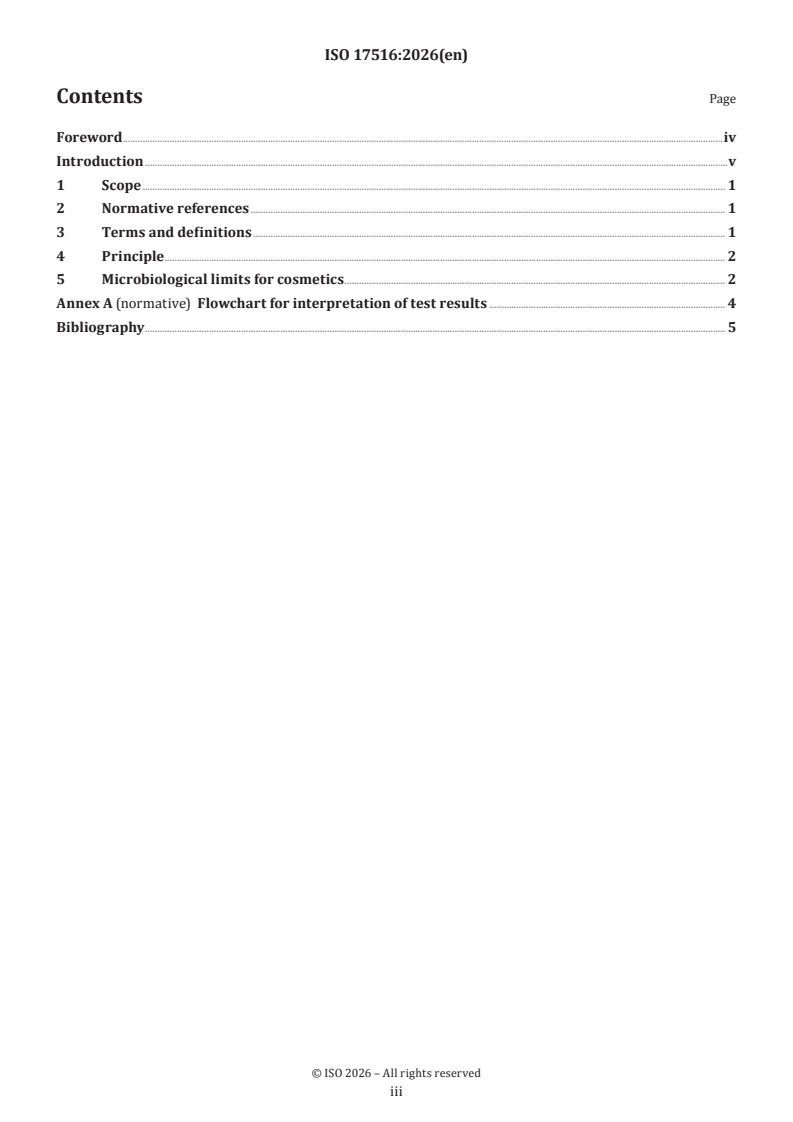
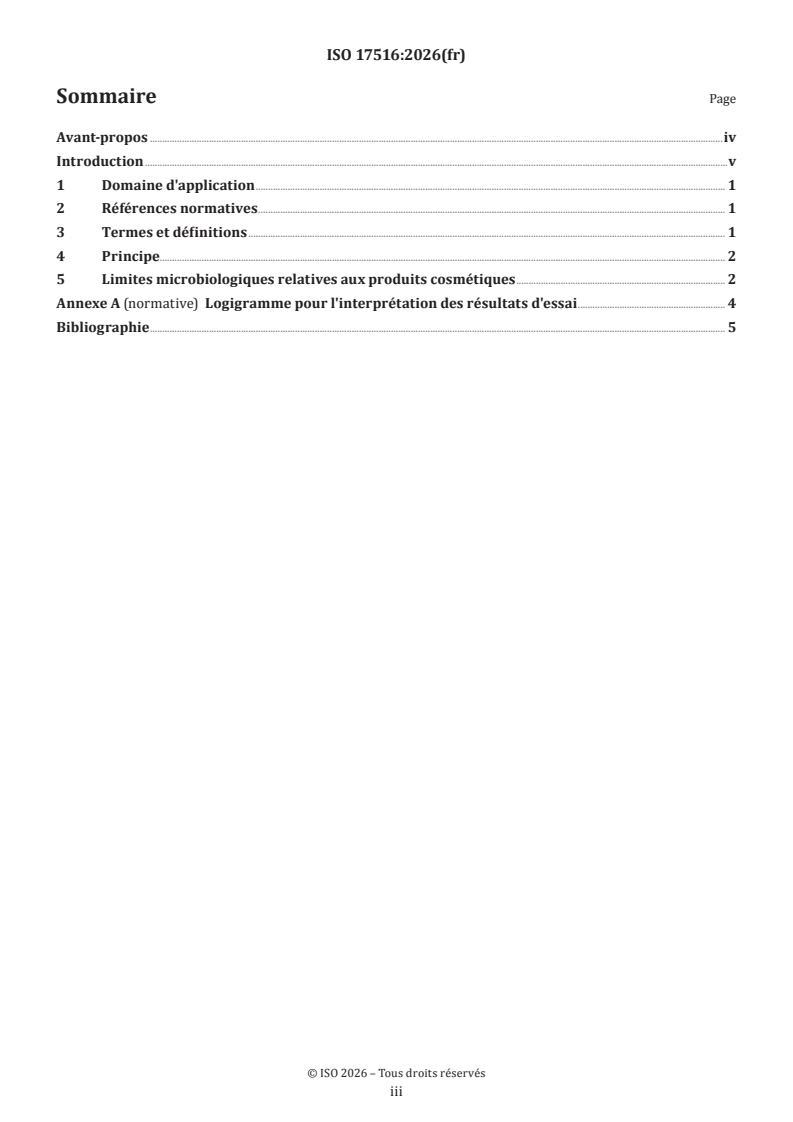
Contents Page
Foreword .iv
Introduction .v
1 Scope . 1
2 Normative references . 1
3 Terms and definitions . 1
4 Principle . 2
5 Microbiological limits for cosmetics . 2
Annex A (normative) Flowchart for interpretation of test results . 4
Bibliography . 5
iii
Foreword
ISO (the International Organization for Standardization) is a worldwide federation of national standards
bodies (ISO member bodies). The work of preparing International Standards is normally carried out through
ISO technical committees. Each member body interested in a subject for which a technical committee
has been established has the right to be represented on that committee. International organizations,
governmental and non-governmental, in liaison with ISO, also take part in the work. ISO collaborates closely
with the International Electrotechnical Commission (IEC) on all matters of electrotechnical standardization.
The procedures used to develop this document and those intended for its further maintenance are described
in the ISO/IEC Directives, Part 1. In particular, the different approval criteria needed for the different types
of ISO documents should be noted. This document was drafted in accordance with the editorial rules of the
ISO/IEC Directives, Part 2 (see www.iso.org/directives).
ISO draws attention to the possibility that the implementation of this document may involve the use of (a)
patent(s). ISO takes no position concerning the evidence, validity or applicability of any claimed patent
rights in respect thereof. As of the date of publication of this document, ISO had not received notice of (a)
patent(s) which may be required to implement this document. However, implementers are cautioned that
this may not represent the latest information, which may be obtained from the patent database available at
www.iso.org/patents. ISO shall not be held responsible for identifying any or all such patent rights.
Any trade name used in this document is information given for the convenience of users and does not
constitute an endorsement.
For an explanation of the voluntary nature of standards, the meaning of ISO specific terms and expressions
related to conformity assessment, as well as information about ISO's adherence to the World Trade
Organization (WTO) principles in the Technical Barriers to Trade (TBT), see www.iso.org/iso/foreword.html.
This document was prepared by Technical Committee ISO/TC 217, Cosmetics, in collaboration with the
European Committee for Standardization (CEN) Technical Committee CEN/TC 392, Cosmetics, in accordance
with the Agreement on technical cooperation between ISO and CEN (Vienna Agreement).
This second edition cancels and replaces the first edition (ISO 17516:2014), of which it constitutes a minor
revision.
The changes are as follows:
— Clause 2 has been added and subsequent clauses have been renumbered;
— the bibliography has been updated.
Any feedback or questions on this document should be directed to the user’s national standards body. A
complete listing of these bodies can be found at www.iso.org/members.html.
iv
Introduction
Every cosmetic manufacturer has a responsibility relative to the microbiological safety and quality of its
products to ensure that they have been produced under hygienic conditions. Cosmetic products are not
expected to be sterile. However, they shall not contain excessive amounts of microorganisms nor specified
microorganisms that have the potential to affect the product quality or consumer safety. Moreover, some
[1]
cosmetic products which are considered to have low microbiological risk (see ISO 29621 ) may not need to
be subjected to routine microbiological testing, and manufacturers can decide not to test if they can ensure
products meet this standard.
[2]
The manufacturer should follow the Good Manufacturing Practices described in ISO 22716 and take the
necessary precautions to limit the introduction of microorganisms from raw materials, processing and
[3] [4]
packaging. When necessary, microbiological testing may be performed using ISO 21148 , ISO 21149 ,
[5] [6] [7] [8] [9] [10]
ISO 1
...
Norme
internationale
ISO 17516
Deuxième édition
Cosmétiques — Microbiologie —
2026-11
Limites microbiologiques
Cosmetics — Microbiology — Microbiological limits
Numéro de référence
DOCUMENT PROTÉGÉ PAR COPYRIGHT
© ISO 2026
Tous droits réservés.
La présente publication de l’ISO est protégée par le droit d’auteur et demeure la propriété de l’ISO et/ou de ses concédants de
licence.
Le contenu de la présente publication de l’ISO est fourni sous licence, et n’est pas vendu. Son utilisation est soumise aux conditions
de licence applicables définies par l’ISO, un organisme membre de l’ISO, ou un distributeur tiers agréé.
Sous réserve des besoins liés à sa mise en œuvre ou d’une autorisation expresse prévue aux termes d’une licence distincte, aucune
partie de la présente publication de l’ISO ne peut être reproduite, distribuée, modifiée, utilisée ou mise à disposition sous quelque
forme ou par quelque moyen que ce soit – électronique ou mécanique, y compris la photocopie, la numérisation, l’enregistrement
ou la publication sur des plateformes numériques internes ou externes.
Toute utilisation hors du champ d’application des droits accordés est interdite et peut donner lieu à des poursuites judiciaires.
ISO copyright office
Case postale 401 • CH-1214 Vernier, Genève
Tél.: +41 22 749 01 11
E-mail: copyright@iso.org
Web: www.iso.org
Publié en Suisse
ii
Sommaire Page
Avant-propos .iv
Introduction .v
1 Domaine d'application . 1
2 Références normatives . 1
3 Termes et définitions . 1
4 Principe. 2
5 Limites microbiologiques relatives aux produits cosmétiques . 2
Annexe A (normative) Logigramme pour l'interprétation des résultats d'essai . 4
Bibliographie . 5
iii
Avant-propos
L'ISO (Organisation internationale de normalisation) est une fédération mondiale d'organismes nationaux
de normalisation (comités membres de l'ISO). L'élaboration des Normes internationales est en général
confiée aux comités techniques de l'ISO. Chaque comité membre intéressé par une étude a le droit de faire
partie du comité technique créé à cet effet. Les organisations internationales, gouvernementales et non
gouvernementales, en liaison avec l'ISO participent également aux travaux. L'ISO collabore étroitement avec
la Commission électrotechnique internationale (IEC) en ce qui concerne la normalisation électrotechnique.
Les procédures utilisées pour élaborer le présent document et celles destinées à sa mise à jour sont
décrites dans les Directives ISO/IEC, Partie 1. Il convient, en particulier, de prendre note des différents
critères d'approbation requis pour les différents types de documents ISO. Le présent document a
été rédigé conformément aux règles de rédaction données dans les Directives ISO/IEC, Partie 2 (voir
www.iso.org/directives).
L’ISO attire l’attention sur le fait que la mise en application du présent document peut entraîner l’utilisation
d’un ou de plusieurs brevets. L’ISO ne prend pas position quant à la preuve, à la validité et à l’applicabilité de
tout droit de brevet revendiqué à cet égard. À la date de publication du présent document, l’ISO n'avait pas
reçu notification qu’un ou plusieurs brevets pouvaient être nécessaires à sa mise en application. Toutefois,
il y a lieu d’avertir les responsables de la mise en application du présent document que des informations
plus récentes sont susceptibles de figurer dans la base de données de brevets, disponible à l'adresse
www.iso.org/brevets. L’ISO ne saurait être tenue pour responsable de ne pas avoir identifié tout ou partie de
tels droits de propriété.
Les appellations commerciales éventuellement mentionnées dans le présent document sont données pour
information, par souci de commodité, à l’intention des utilisateurs et ne sauraient constituer un engagement.
Pour une explication de la nature volontaire des normes, la signification des termes et expressions
spécifiques de l'ISO liés à l'évaluation de la conformité, ou pour toute information au sujet de l'adhésion de
l'ISO aux principes de l’Organisation mondiale du commerce (OMC) concernant les obstacles techniques au
commerce (OTC), voir www.iso.org/avant-propos.
Le présent document a été élaboré par le comité technique ISO/TC 217, Cosmétiques, en collaboration avec
le comité technique CEN/TC 392, Cosmétiques, du Comité européen de normalisation (CEN) conformément à
l’Accord de coopération technique entre l’ISO et le CEN (Accord de Vienne).
Cette deuxième édition annule et remplace la première édition (ISO 17516:2014), dont elle constitue une
révision mineure.
Les modifications sont les suivantes:
— l'Article 2 a été ajouté et les articles suivants ont été renumérotés;
— la Bibliographie a été mise à jour.
Il convient que l'utilisateur adresse tout retour d'information ou toute question concernant le présent
document à l'organisme national de normalisation de son pays. Une liste exhaustive desdits organismes se
trouve à l'adresse www.iso.org/members.html.
iv
Introduction
Chaque fabricant de produits cosmétiques est responsable de la sécurité microbiologique et de la qualité
de ses produits et doit s’assurer qu’ils ont été produits dans des conditions hygiéniques. Les produits
cosmétiques ne sont pas censés être stériles. Toutefois, ils ne doivent pas contenir de quantités excessives
de micro-organismes ni de micro-organismes spécifiés susceptibles d’affecter la qualité du produit ou
la sécurité du consommateur. De plus, il peut ne pas être nécessaire de soumettre certains produits
[1]
cosmétiques considérés comme présentant un faible risque microbiologique (voir l’ISO 29621 ) à des essais
microbiologiques de routine et les fabricants peuvent choisir de ne pas les soumettre à essai s’ils peuvent
assurer que leurs produits satisfont aux caractéristiques énoncées dans la présente norme.
[2]
Il convient que les fabricants respectent les bonnes pratiques de fabrication décrites dans l’ISO 22716 et
prennent les précautions nécessaires pour limiter l’introduction de micro-organismes issus des matières
premières, de la fabrication et du conditionnement. Si nécessaire, des essais microbiologiques peuvent être
[3] [4] [5] [6] [7] [8]
effectués en utilisant l'ISO 21148, l'ISO 21149, l'ISO 16212, l'ISO 18415, l'ISO 18416, l'ISO 21150,
[9] [10]
l'ISO 2
...