

ISO/IEC TS 17021-16:2026
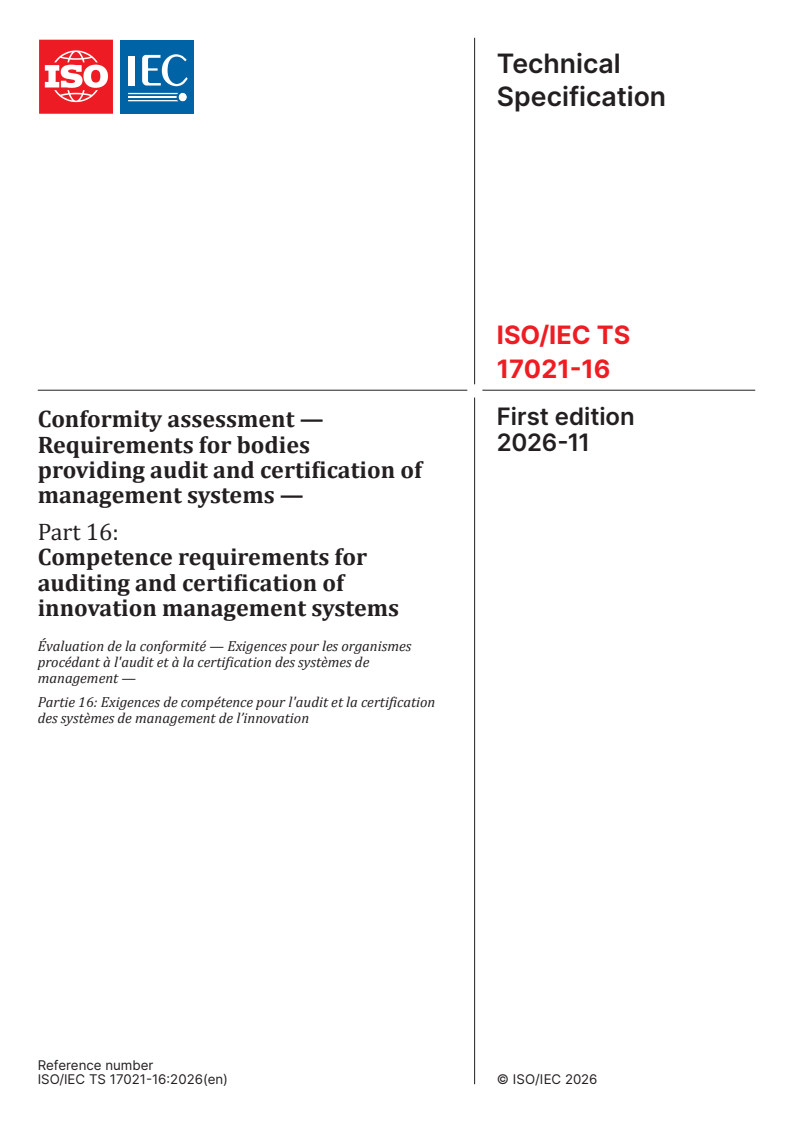
(Main)Conformity assessment — Requirements for bodies providing audit and certification of management systems — Part 16: Competence requirements for auditing and certification of innovation management systems
- Abstract
This document specifies additional competence requirements for personnel involved in the audit and certification process for innovation management systems (IMS) and complements the existing requirements of ISO/IEC 17021-1. NOTE This document is applicable to auditing and certification of an IMS based on ISO 56001.
- Status
- Published
- Publication Date
- 05-Nov-2026
- Technical Committee
- ISO/TC 279 - Innovation management
- Drafting Committee
- ISO/TC 279 - Innovation management
- Current Stage
- 6060 - International Standard published
- Start Date
- 06-Nov-2026
- Completion Date
- 06-Nov-2026
Buy Documents
ISO/IEC TS 17021-16:2026 - Conformity assessment — Requirements for bodies providing audit and certification of management systems — Part 16: Competence requirements for auditing and certification of innovation management systems
ISO/IEC TS 17021-16:2026 is an ISO technical specification for bodies that audit and certify management systems. It adds competence requirements for personnel involved in auditing and certification of innovation management systems (IMS), and it is intended for use with ISO/IEC 17021-1. The document is applicable to IMS audits and certification based on ISO 56001.
What does ISO/IEC TS 17021-16:2026 specify?
ISO/IEC TS 17021-16:2026 specifies additional competence requirements for the people who plan, carry out, review, and decide on IMS audit and certification work. It complements the general requirements in ISO/IEC 17021-1 and focuses on the knowledge needed for innovation management.
The document is organized into:
- Clause 1, Scope
- Clause 2, Normative references
- Clause 3, Terms and definitions
- Clause 4, Generic competence requirements
- Clause 5, Competence requirements for IMS auditors
- Clause 6, Competence requirements for other personnel
- Annex A, informative overview of knowledge for IMS auditing and certification
- Bibliography
Annex A ties the competence topics to certification functions, so a certification body can map knowledge to specific roles such as application review, audit team selection, report review, and certification decisions.
What are the key requirements of ISO/IEC TS 17021-16:2026?
ISO/IEC TS 17021-16:2026 sets competence expectations in two layers: generic requirements for certification functions and IMS-specific knowledge for auditors and other personnel. In practice, a certification body has to define competence criteria for its own functions and make sure the people involved meet them.
Clause 4: generic competence requirements
Clause 4 requires the certification body to define competence requirements for each function referenced in ISO/IEC 17021-1:2015, Table A.1. It must take into account ISO/IEC 17021-1 and the IMS-relevant requirements in Clauses 5 and 6.
This matters because competence is not limited to auditors. The body has to assign the right knowledge to each function it performs, not just to the audit team.
Clause 5: competence for IMS auditors
Clause 5 requires IMS auditors to know innovation management principles, the terms used in ISO 56001, and supporting innovation management standards developed by ISO/TC 279. It then adds knowledge in seven specific areas:
- uncertainty, risks and opportunities management
- strategic intelligence and foresight
- value proposition and value realization
- innovation intent and innovation strategy
- intellectual property and intangible assets
- innovation portfolio management
- innovation culture
These topics matter because IMS audits deal with emerging, uncertain contexts. Auditors need to understand how an organization turns insight into value, manages uncertainty, and aligns innovation work with strategy.
Clause 5.4: IMS-specific knowledge
Clause 5.4 explains what each knowledge area is for. For example, auditors need to understand how an organization monitors its external context, tests assumptions, manages learning from success and failure, and keeps a balanced innovation portfolio.
In practice, this helps the audit team judge whether the IMS supports informed decision-making and sustained innovation performance.
Clause 6: competence for other personnel
Clause 6 requires other personnel involved in certification activities to have the generic competence from ISO/IEC 17021-1, to understand ISO 56001, and to know the relevant terms and supporting standards. This applies to people who support the certification process even when they are not auditors.
That matters for consistency. Reviewers, selectors, and decision-makers need enough IMS knowledge to handle the certification process correctly.
Annex A: competence mapping
Annex A gives an overview of knowledge by certification function. It shows how the competence topics in Clauses 4, 5 and 6 map to:
- conducting the application review to determine audit team competence
- selecting audit team members and determining audit time
- reviewing audit reports
- making certification decisions
What terms does ISO/IEC TS 17021-16:2026 define?
ISO/IEC TS 17021-16:2026 uses the terms and definitions from ISO/IEC 17021-1 and ISO 56001. The following terms are central to the document:
- Innovation management system (IMS) - the management system for innovation; in this document, IMS means an innovation management system.
- Innovation management principles - the core ideas auditors must understand, including value realization, strategic direction, culture, and managing uncertainty.
- Strategic intelligence - the systematic monitoring of the external context to detect trends and inform innovation priorities.
- Foresight - the use of future-oriented insight to adapt innovation direction and decisions.
- Intellectual property (IP) - the protected knowledge and rights an organization may use to create long-term value.
- Intangible assets - non-physical assets connected with knowledge and innovation capability.
- Innovation portfolio management - the balancing and control of innovation initiatives against strategy and criteria.
Who uses ISO/IEC TS 17021-16:2026?
ISO/IEC TS 17021-16:2026 is used by certification bodies that audit and certify management systems, especially bodies working with IMS certification. It is also relevant to lead auditors, audit team members, report reviewers, and certification decision-makers.
Organizations seeking IMS certification benefit indirectly because the document sets the competence bar for the people evaluating them. Quality and conformity assessment professionals can use it to structure competence matrices, assign roles, and train staff for ISO 56001-based certification work.
Which standards are used with ISO/IEC TS 17021-16:2026?
ISO/IEC TS 17021-16:2026 directly refers to:
- ISO/IEC 17021-1:2015 - the general requirements for bodies providing audit and certification of management systems; this is the base standard that Part 16 complements.
- ISO 56001 - the innovation management system requirements standard; this provides the IMS framework the document is written for.
The document also requires knowledge of supporting International Standards on innovation management developed by ISO/TC 279. Its bibliography points readers to related standards and guidance, including ISO 19011, ISO 56000, ISO 56002, ISO/TR 56004, ISO 56005, ISO 56006 and ISO 56008.
What does the ISO/IEC TS 17021-16:2026 document contain?
ISO/IEC TS 17021-16:2026 contains a short technical specification with core competence requirements and one informative annex. Clause 5 is the main technical part for IMS auditors, while Clause 6 covers other certification personnel.
Annex A provides a knowledge matrix for IMS auditing and certification. It links knowledge areas to certification functions, which is useful for training, role assignment, competence evaluation, and certification process planning.
The document also includes a bibliography that points to auditing and innovation management standards for further context and guidance.
Buy Documents
ISO/IEC TS 17021-16:2026 - Conformity assessment — Requirements for bodies providing audit and certification of management systems — Part 16: Competence requirements for auditing and certification of innovation management systems
Get Certified
Connect with accredited certification bodies for this standard

BSI Group
BSI (British Standards Institution) is the business standards company that helps organizations make excellence a habit.

Bureau Veritas
Bureau Veritas is a world leader in laboratory testing, inspection and certification services.
DNV
DNV is an independent assurance and risk management provider.
Sponsored listings
Frequently Asked Questions
ISO/IEC TS 17021-16:2026 is a technical specification published by the International Organization for Standardization (ISO). Its full title is "Conformity assessment — Requirements for bodies providing audit and certification of management systems — Part 16: Competence requirements for auditing and certification of innovation management systems". This standard covers: This document specifies additional competence requirements for personnel involved in the audit and certification process for innovation management systems (IMS) and complements the existing requirements of ISO/IEC 17021-1. NOTE This document is applicable to auditing and certification of an IMS based on ISO 56001.
This document specifies additional competence requirements for personnel involved in the audit and certification process for innovation management systems (IMS) and complements the existing requirements of ISO/IEC 17021-1. NOTE This document is applicable to auditing and certification of an IMS based on ISO 56001.
ISO/IEC TS 17021-16:2026 is classified under the following ICS (International Classification for Standards) categories: 03.100.30 - Management of human resources; 03.100.70 - Management systems; 03.120.20 - Product and company certification. Conformity assessment. The ICS classification helps identify the subject area and facilitates finding related standards.
ISO/IEC TS 17021-16:2026 is available in PDF format for immediate download after purchase. The document can be added to your cart and obtained through the secure checkout process. Digital delivery ensures instant access to the complete standard document.
Standards Content (Sample)
Technical
Specification
ISO/IEC TS
17021-16
First edition
Conformity assessment —
2026-11
Requirements for bodies
providing audit and certification of
management systems —
Part 16:
Competence requirements for
auditing and certification of
innovation management systems
Évaluation de la conformité — Exigences pour les organismes
procédant à l'audit et à la certification des systèmes de
management —
Partie 16: Exigences de compétence pour l'audit et la certification
des systèmes de management de l’innovation
Reference number
© ISO/IEC 2026
All rights reserved.
This ISO publication is protected by copyright and is owned by ISO and/or its licensors.
The content of this ISO publication is provided under licence, not sold. Use is subject to the applicable licence terms issued by ISO,
an ISO member body, or an authorized third-party distributor.
Except as required for implementation or expressly permitted by a separate licence, no part of this ISO publication may be
reproduced, distributed, modified, used, or made available in any form or by any means – electronic or mechanical, including
photocopying, scanning, recording, or posting on internal or external digital platforms.
Any use beyond the scope of the granted rights is prohibited and may result in legal action.
ISO copyright office
CP 401 • CH-1214 Vernier, Geneva
Phone: +41 22 749 01 11
Email: copyright@iso.org
Website: www.iso.org
Published in Switzerland
© ISO/IEC 2026 – All rights reserved
ii
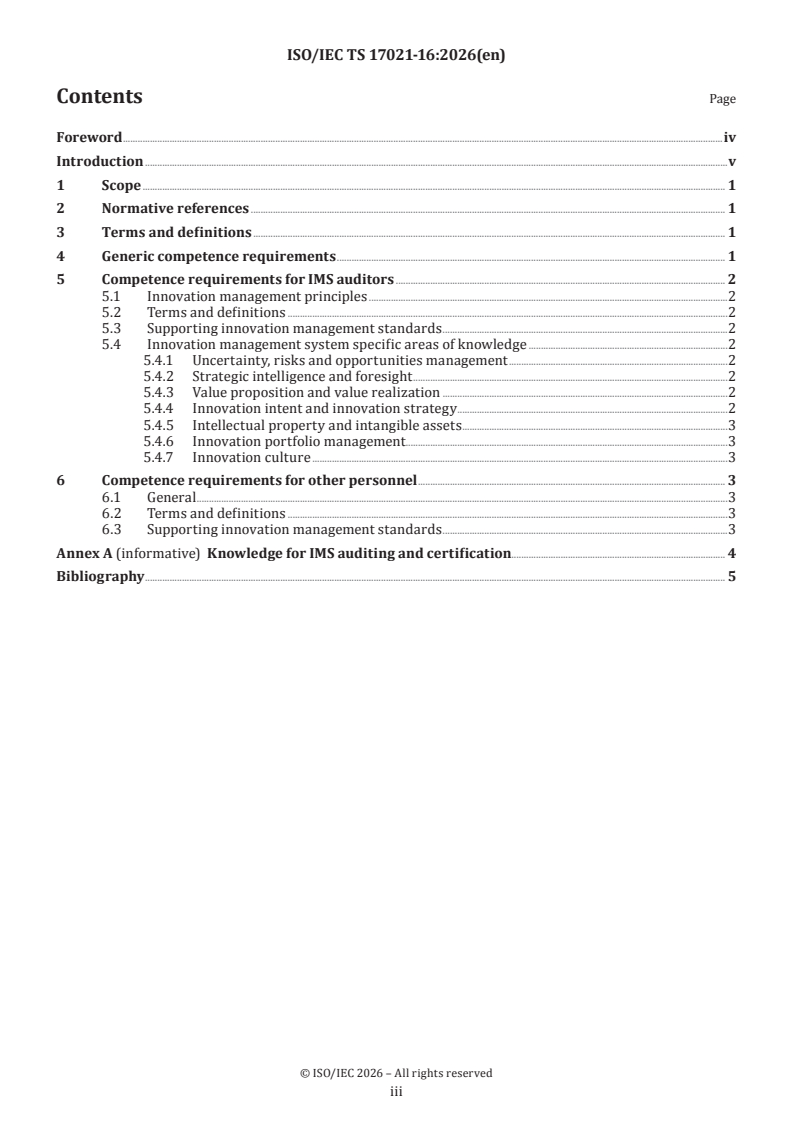
Contents Page
Foreword .iv
Introduction .v
1 Scope . 1
2 Normative references . 1
3 Terms and definitions . 1
4 Generic competence requirements . 1
5 Competence requirements for IMS auditors . 2
5.1 Innovation management principles .2
5.2 Terms and definitions .2
5.3 Supporting innovation management standards .2
5.4 Innovation management system specific areas of knowledge .2
5.4.1 Uncertainty, risks and opportunities management .2
5.4.2 Strategic intelligence and foresight .2
5.4.3 Value proposition and value realization .2
5.4.4 Innovation intent and innovation strategy .2
5.4.5 Intellectual property and intangible assets .3
5.4.6 Innovation portfolio management .3
5.4.7 Innovation culture .3
6 Competence requirements for other personnel . 3
6.1 General .3
6.2 Terms and definitions .3
6.3 Supporting innovation management standards .3
Annex A (informative) Knowledge for IMS auditing and certification. 4
Bibliography . 5
© ISO/IEC 2026 – All rights reserved
iii
Foreword
ISO (the International Organization for Standardization) and IEC (the International Electrotechnical
Commission) form the specialized system for worldwide standardization. National bodies that are
members of ISO or IEC participate in the development of International Standards through technical
committees established by the respective organization to deal with particular fields of technical activity.
ISO and IEC technical committees collaborate in fields of mutual interest. Other international organizations,
governmental and non-governmental, in liaison with ISO and IEC, also take part in the work.
The procedures used to develop this document and those intended for its further maintenance are described
in the ISO/IEC Directives, Part 1. In particular, the different approval criteria needed for the different types
of document should be noted. This document was drafted in accordance with the editorial rules of the ISO/
IEC Directives, Part 2 (see www.iso.org/directives or www.iec.ch/members_experts/refdocs).
ISO and IEC draw attention to the possibility that the implementation of this document may involve the
use of (a) patent(s). ISO and IEC take no position concerning the evidence, validity or applicability of any
claimed patent rights in respect thereof. As of the date of publication of this document, ISO and IEC had not
received notice of (a) patent(s) which may be required to implement this document. However, implementers
are cautioned that this may not represent the latest information, which may be obtained from the patent
database available at www.iso.org/patents and https://patents.iec.ch. ISO and IEC shall not be held
responsible for identifying any or all such patent rights.
Any trade name used in this document is information given for the convenience of users and does not
constitute an endorsement.
For an explanation of the voluntary nature of standards, the meaning of ISO specific terms and expressions
related to conformity assessment, as well as information about ISO's adherence to the World Trade
Organization (WTO) principles in the Technical Barriers to Trade (TBT) see www.iso.org/iso/foreword.html.
In the IEC, see www.iec.ch/understanding-standards.
This document was prepared by ISO Committee on Conformity Assessment (CASCO), in collaboration with
ISO Technical Committee ISO/TC 279, Innovation management.
A list of all parts in the ISO/IEC 17021 series can be found on the ISO and IEC websites.
Any feedback or questions on this document should be directed to the user’s national standards
body. A complete listing of these bodies can be found at www.iso.org/members.html and
www.iec.ch/national-committees.
© ISO/IEC 2026 – All rights reserved
iv
Introduction
ISO 56001 sets out the innovation management requirements for management systems applicable to any
organization, regardless of type or size, products and services provided, or the types of innovations and
innovation approaches used. Innovation management is particularly complex in that the intended results
are often within an emerging
...