


ISO/TS 30437:2023
(Main)Human resource management — Learning and development metrics
General Information
- Abstract
This document provides recommendations on how to measure learning. Since the selection of metrics depends on the reason to measure and the user of the metrics, and since a balanced set of metrics is important to avoid unintended consequences, the document begins with a framework for organizational learning and development (L&D), including five categories of users, four broad reasons to measure and three types of metrics. This framework is then used to recommend 50 metrics organized by user, type of metric and size of organization, and provide a description of each. The document concludes with guidance on reporting metrics, including a description of the different types of reports and guidance on their selection based on the user’s reasons for measuring. Metrics for both formal and informal learning are included. The guidance is intended for all types of organizations, including commercial and nonprofit, as well as for all sizes. No previous knowledge of L&D metrics is required, although those new to L&D measurement can consult the suggested references on matters of frameworks, metrics and programme evaluation to learn more.
- Status
- Published
- Publication Date
- 20-Jun-2023
- Technical Committee
- ISO/TC 260 - Human resource management
- Drafting Committee
- ISO/TC 260 - Human resource management
- Current Stage
- 9060 - Close of review
- Start Date
- 03-Sep-2026
- Completion Date
- 02-Sep-2026
Buy Documents

ISO/TS 30437:2023 - Human resource management — Learning and development metrics Released:6/21/2023

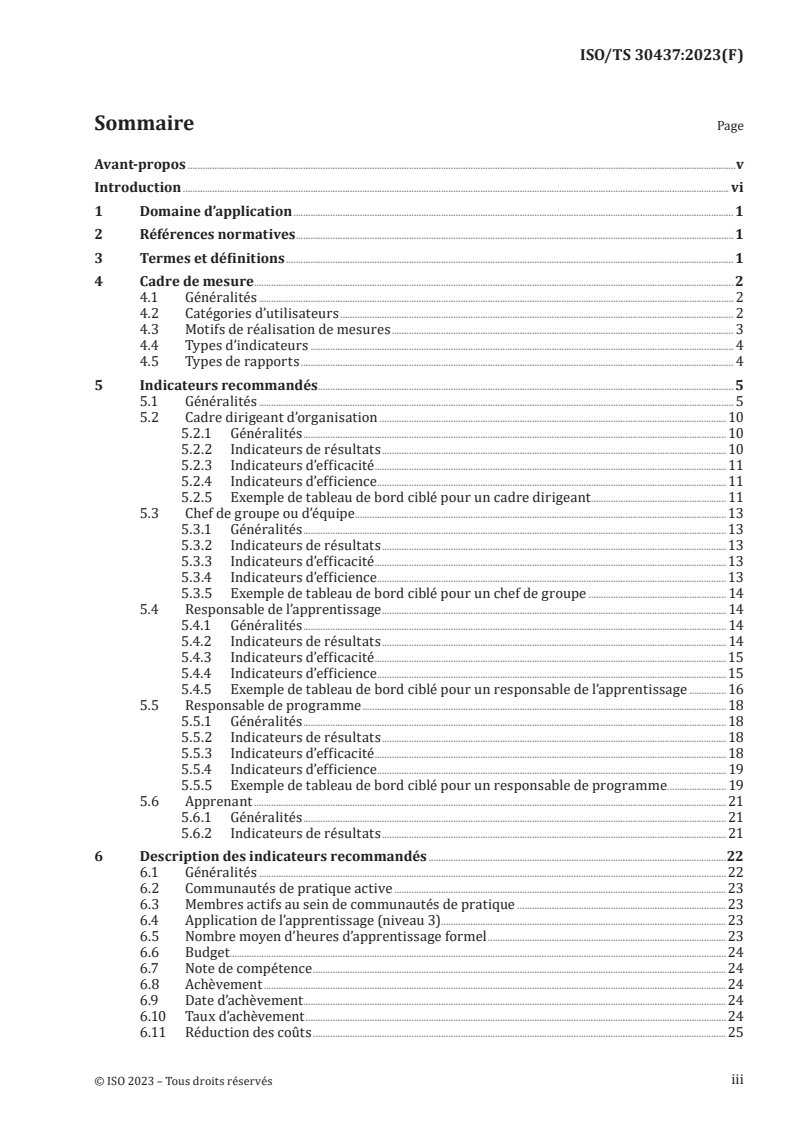
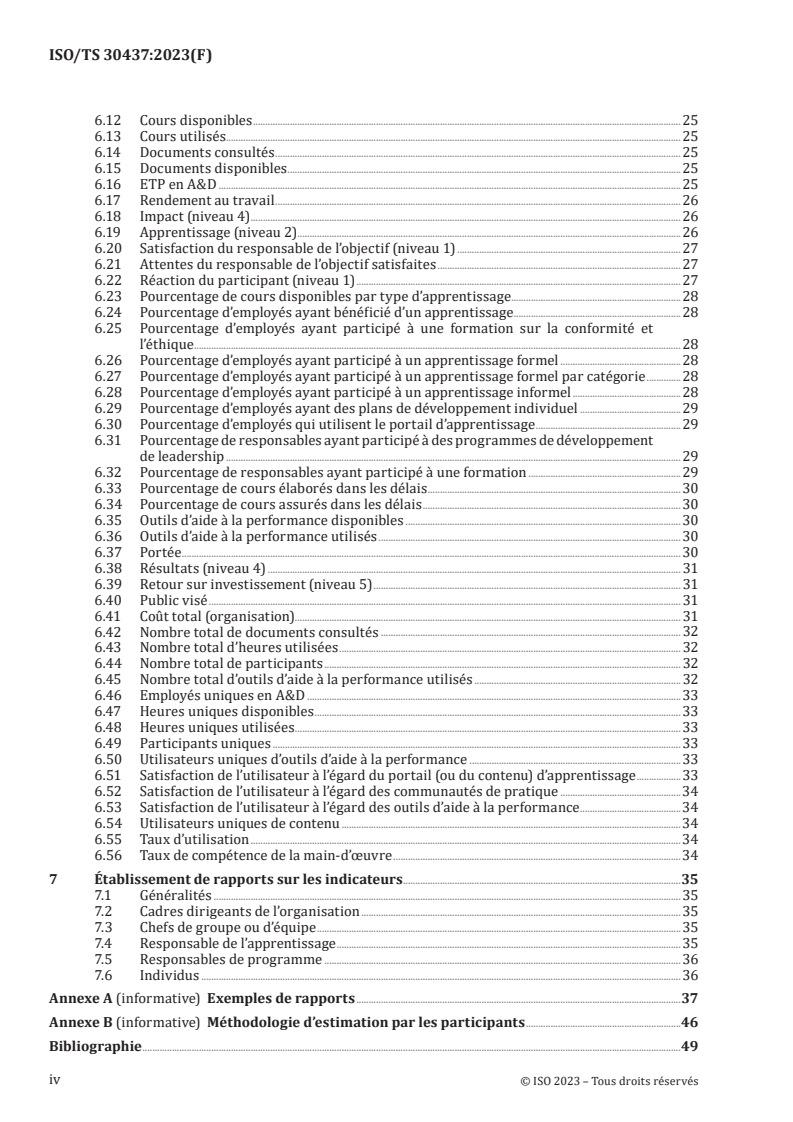
ISO/TS 30437:2023 - Management des ressources humaines — Indicateurs d’apprentissage et de développement/2/2023
Overview
ISO/TS 30437:2023 - Human resource management - Learning and development metrics provides practical recommendations for measuring learning across organizations. The technical specification sets out a measurement framework and recommends a balanced set of 50 L&D metrics (organized by user, metric type and organization size). It covers metrics for both formal and informal learning, describes each metric, and gives guidance on reporting and selecting report types based on why and for whom metrics are being collected.
Key topics
- Measurement framework: Defines five categories of users, four broad reasons to measure, and three types of metrics to ensure balanced measurement and avoid unintended consequences.
- User categories: Senior organization leader, group/team leader, head of learning, programme manager, and learner - each mapped to specific metric needs and scorecard examples.
- Types of metrics: Outcome, effectiveness and efficiency metrics (with examples such as completions, completion rate, competency rating, total cost, utilization, ROI).
- Recommended metrics: 50 described metrics (e.g., participant reaction, learning, application, impact, return on investment) with guidance on selection by organization size.
- Reporting guidance: Types of reports, report selection criteria tied to measurement purpose and audience, and practical advice for communicating results.
- Coverage: Applicable to all organization types (commercial and nonprofit) and all sizes; no prior L&D metrics knowledge required.
Practical applications
- HR and L&D leaders can use the framework to design balanced measurement programs that link learning to business outcomes and avoid metric-driven distortions.
- Heads of learning & programme managers can select recommended effectiveness and efficiency metrics to track course delivery, resource use, and learner outcomes.
- Senior leaders and team managers can use outcome metrics and scorecards to monitor strategic impact, workforce competency, and ROI.
- Practitioners and learners benefit from clear reporting formats and metric definitions to monitor participation, skills development and application of learning.
- Typical use cases: compliance tracking (e.g., percent of employees completing required training), measuring reach and utilization of learning portals, evaluating competency rates, and calculating learning programme costs and ROI.
Related standards and alignment
ISO/TS 30437:2023 is positioned within human resource management measurement practice and aligns with established multi‑level learning evaluation approaches (reaction → learning → application → impact → ROI). Organizations should combine this guidance with their internal governance, HR reporting standards, and programme-evaluation methods to build a robust L&D measurement system.
Keywords: ISO/TS 30437:2023, learning and development metrics, L&D metrics, human resource management, measurement framework, reporting metrics, formal and informal learning, ROI, competency.
Buy Documents
ISO/TS 30437:2023 - Human resource management — Learning and development metrics Released:6/21/2023
ISO/TS 30437:2023 - Management des ressources humaines — Indicateurs d’apprentissage et de développement/2/2023
Get Certified
Connect with accredited certification bodies for this standard

BSI Group
BSI (British Standards Institution) is the business standards company that helps organizations make excellence a habit.

Bureau Veritas
Bureau Veritas is a world leader in laboratory testing, inspection and certification services.

DNV
DNV is an independent assurance and risk management provider.
Sponsored listings
Frequently Asked Questions
ISO/TS 30437:2023 is a technical specification published by the International Organization for Standardization (ISO). Its full title is "Human resource management — Learning and development metrics". This standard covers: This document provides recommendations on how to measure learning. Since the selection of metrics depends on the reason to measure and the user of the metrics, and since a balanced set of metrics is important to avoid unintended consequences, the document begins with a framework for organizational learning and development (L&D), including five categories of users, four broad reasons to measure and three types of metrics. This framework is then used to recommend 50 metrics organized by user, type of metric and size of organization, and provide a description of each. The document concludes with guidance on reporting metrics, including a description of the different types of reports and guidance on their selection based on the user’s reasons for measuring. Metrics for both formal and informal learning are included. The guidance is intended for all types of organizations, including commercial and nonprofit, as well as for all sizes. No previous knowledge of L&D metrics is required, although those new to L&D measurement can consult the suggested references on matters of frameworks, metrics and programme evaluation to learn more.
This document provides recommendations on how to measure learning. Since the selection of metrics depends on the reason to measure and the user of the metrics, and since a balanced set of metrics is important to avoid unintended consequences, the document begins with a framework for organizational learning and development (L&D), including five categories of users, four broad reasons to measure and three types of metrics. This framework is then used to recommend 50 metrics organized by user, type of metric and size of organization, and provide a description of each. The document concludes with guidance on reporting metrics, including a description of the different types of reports and guidance on their selection based on the user’s reasons for measuring. Metrics for both formal and informal learning are included. The guidance is intended for all types of organizations, including commercial and nonprofit, as well as for all sizes. No previous knowledge of L&D metrics is required, although those new to L&D measurement can consult the suggested references on matters of frameworks, metrics and programme evaluation to learn more.
ISO/TS 30437:2023 is classified under the following ICS (International Classification for Standards) categories: 03.100.30 - Management of human resources. The ICS classification helps identify the subject area and facilitates finding related standards.
ISO/TS 30437:2023 is available in PDF format for immediate download after purchase. The document can be added to your cart and obtained through the secure checkout process. Digital delivery ensures instant access to the complete standard document.
Standards Content (Sample)
TECHNICAL ISO/TS
SPECIFICATION 30437
First edition
2023-06
Human resource management —
Learning and development metrics
Management des ressources humaines — Indicateurs d’apprentissage
et de développement
Reference number
© ISO 2023
All rights reserved. Unless otherwise specified, or required in the context of its implementation, no part of this publication may
be reproduced or utilized otherwise in any form or by any means, electronic or mechanical, including photocopying, or posting on
the internet or an intranet, without prior written permission. Permission can be requested from either ISO at the address below
or ISO’s member body in the country of the requester.
ISO copyright office
CP 401 • Ch. de Blandonnet 8
CH-1214 Vernier, Geneva
Phone: +41 22 749 01 11
Email: copyright@iso.org
Website: www.iso.org
Published in Switzerland
ii
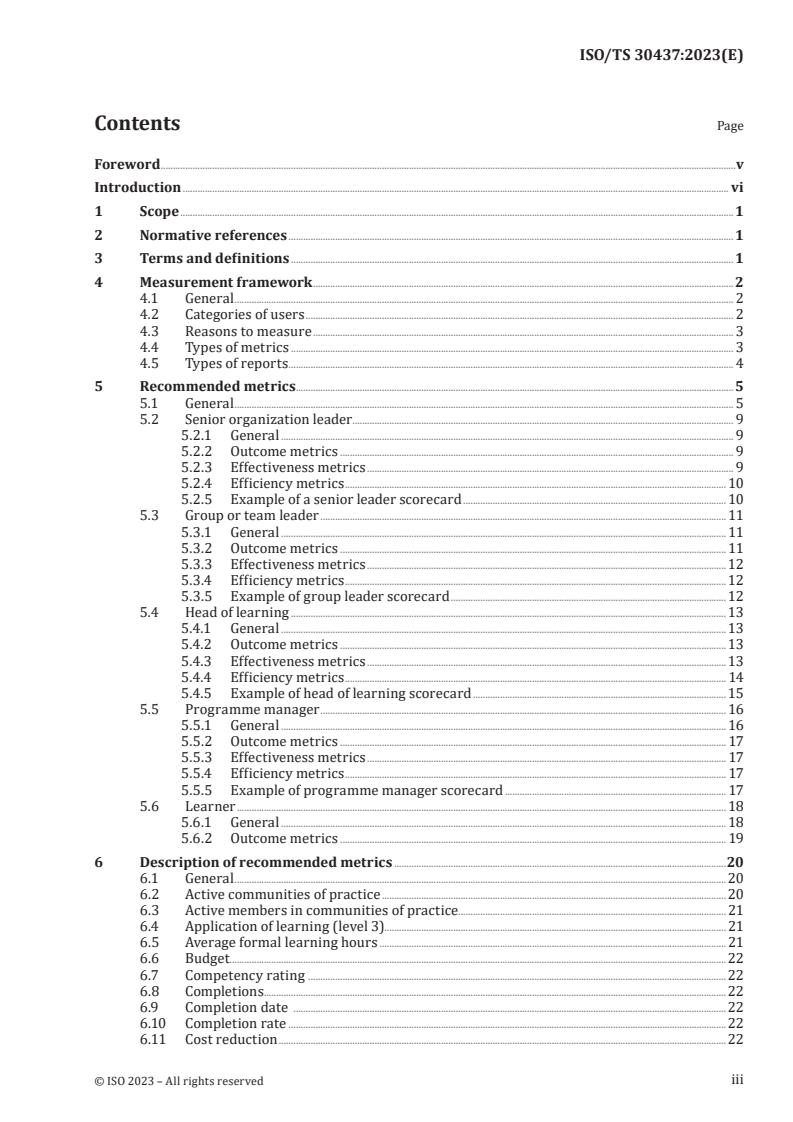
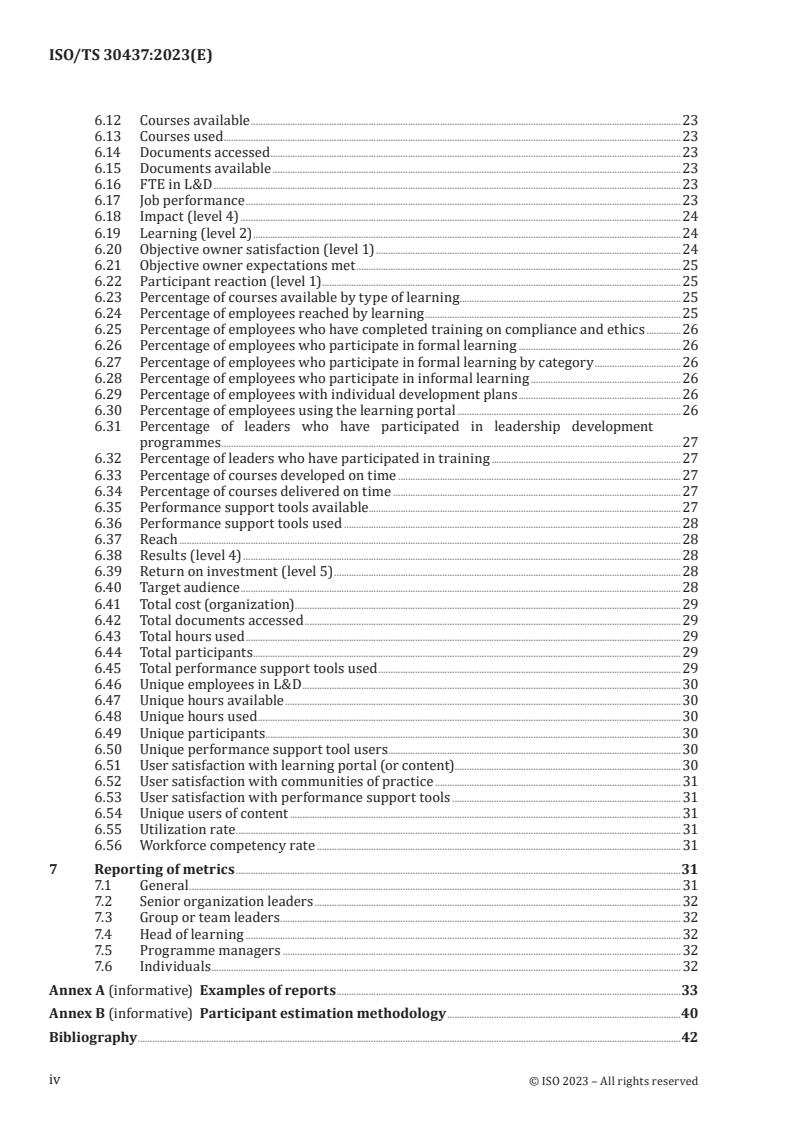
Contents Page
Foreword .v
Introduction . vi
1 Scope . 1
2 Normative references . 1
3 Terms and definitions . 1
4 Measurement framework .2
4.1 General . 2
4.2 Categories of users . 2
4.3 Reasons to measure . 3
4.4 Types of metrics . 3
4.5 Types of reports . 4
5 Recommended metrics . .5
5.1 General . 5
5.2 Senior organization leader . 9
5.2.1 General . 9
5.2.2 Outcome metrics . 9
5.2.3 Effectiveness metrics . 9
5.2.4 Efficiency metrics . 10
5.2.5 Example of a senior leader scorecard . 10
5.3 Group or team leader . 11
5.3.1 General . 11
5.3.2 Outcome metrics . 11
5.3.3 Effectiveness metrics .12
5.3.4 Efficiency metrics .12
5.3.5 Example of group leader scorecard .12
5.4 Head of learning . 13
5.4.1 General .13
5.4.2 Outcome metrics .13
5.4.3 Effectiveness metrics .13
5.4.4 Efficiency metrics . 14
5.4.5 Example of head of learning scorecard . 15
5.5 Programme manager . 16
5.5.1 General . 16
5.5.2 Outcome metrics . 17
5.5.3 Effectiveness metrics . 17
5.5.4 Efficiency metrics . 17
5.5.5 Example of programme manager scorecard . 17
5.6 Learner . 18
5.6.1 General . 18
5.6.2 Outcome metrics . 19
6 Description of recommended metrics .20
6.1 General . 20
6.2 Active communities of practice . 20
6.3 Active members in communities of practice. 21
6.4 Application of learning (level 3). 21
6.5 Average formal learning hours . 21
6.6 Budget.22
6.7 Competency rating . 22
6.8 Completions . . 22
6.9 Completion date . 22
6.10 Completion rate .22
6.11 Cost reduction . 22
iii
6.12 Courses available . 23
6.13 Courses used . .23
6.14 Documents accessed . .23
6.15 Documents available .23
6.16 FTE in L&D .23
6.17 Job performance . 23
6.18 Impact (level 4) . 24
6.19 Learning (level 2) . 24
6.20 Objective owner satisfaction (level 1) . 24
6.21 Objective owner expectations met . 25
6.22 Participant reaction (level 1) . .25
6.23 Percentage of courses available by type of learning . . 25
6.24 Percentage of employees reached by learning . 25
6.25 Percentage of employees who have completed training on compliance and ethics .26
6.26 Percentage of employees who participate in formal learning . 26
6.27 Percentage of employees who participate in formal learning by category .26
6.28 Percentage of employees who participate in informal learning . 26
6.29 Percentage of employees with individual development plans . 26
6.30 Percentage of employees using the learning portal . 26
6.31 Percentage of leaders who have participated in leadership development
programmes . . . 27
6.32 Percentage of leaders who have participated in training . 27
6.33 Percentage of courses developed on time . 27
6.34 Percentage of courses delivered on time . 27
6.35 Performance support tools available. 27
6.36 Performance support tools used .28
6.37 Reach .28
6.38 Results (level 4) .28
6.39 Return on investment (level 5) .28
6.40 Target audience .28
6.41 Total cost (organization) .29
6.42 Total documents accessed . 29
6.43 Total hours used .29
6.44 Total participants . .29
6.45 Total performance support tools used .29
6.46 Unique employees in L&D . 30
6.47 Unique hours available .30
6.48 Unique hours used . 30
6.49 Unique participants.30
6.50 Unique performance support tool users .30
6.51 User satisfaction with learning portal (or content) .30
6.52 User satisfaction with communities of practice . 31
6.53 User satisfaction with performance support tools . 31
6.54 Unique users of content . 31
6.55 Utilization rate . 31
6.56 Workforce competency rate . 31
7 Reporting of metrics .31
7.1 General . 31
7.2 Senior organization leaders . 32
7.3 Group or team leaders . 32
7.4 Head of learning . 32
7.5 Programme managers . 32
7.6 Individuals . 32
Annex A (informative) Examples of reports .33
Annex B (informative) Participant estimation methodology .40
Bibliography .42
iv
Foreword
ISO (the International Organization for Standardization) is a worldwide federation of national standards
bodies (ISO member bodies). The work of preparing International Standards is normally carried out
through ISO technical committees. Each member body interested in a subject for which a technical
committee has been established has the right to be represented on that committee. International
organizations, governmental and non-governmental, in liaison with ISO, also take part in the work.
ISO collaborates closely with the International Electrotechnical Commission (IEC) on all matters of
electrotechnical standardization.
The procedures used to develop this document and those intended for its further maintenance are
described in the ISO/IEC Directives, Part 1. In particular, the different approval criteria needed for the
different types of ISO document should be noted. This document was drafted in accordance with the
editorial rules of the ISO/IEC Directives, Part 2 (see www.iso.org/directives).
ISO draws attention to the possibility that the implementation of this document may involve the use
of (a) patent(s). ISO takes no position concerning the evidence, validity or applicability of any claimed
patent rights in respect thereof. As of the date of publication of this document, ISO had not received
notice of (a) patent(s) which may be required to implement this document. However, implementers are
cautioned that this may not represent the latest information, which may be obtained from the patent
database available at www.iso.org/patents. ISO shall not be held responsible for identifying any or all
such patent rights.
Any trade name used in this document is information given for the convenience of users and does not
constitute an endorsement.
For an explanation of the voluntary nature of standards, the meaning of ISO specific terms and
expressions related to conformity assessment, as well as information about ISO's adherence to
the World Trade Organization (WTO) principles in the Technical Barriers to Trade (TBT), see
www.iso.org/iso/foreword.html.
This document was prepared by Technical Committee ISO/TC 260, Human resource management.
Any feedback or questions on this document should be directed to the user’s national standards body. A
complete listing of these bodies can be found at www.iso.org/members.html.
v
Introduction
A well-conceived measurement and reporting strategy is necessary to ensure organizational and
individual development processes are managed efficiently and effectively to produce the desired
outcomes. This document provides a framework and the concepts, metrics, descriptions and guidance
necessary to create a basic measurement and reporting strategy.
ISO 30422 provides guidance on a systematic process model for learning and development (L&D) to
help managers and others ensure that L&D occurs in the most efficient and effective way to deliver
intended outcomes. While it includes a clause on evaluation, describing the reasons to measure and
the benefits expected to accrue from measurement, it does not include recommendations for specific
metrics or provide guidance on definitions, purpose or use.
ISO 30422 identifies the need to address both individual and organizational outcomes as well as the
efficiency and effectiveness of the L&D programmes (see ISO 30422:2022, Figure 1).
Figure 1 — Learning and development process
vi
This document follows that guidance by focusing on three types of metrics (efficiency, effectiveness
and outcome) deployed over five categories of user (senior organization leader, group or team leader,
head of learning, programme manager and individual) to measure learning. This framework is used to
provide specific guidance on how to measure L&D, including recommended metrics by user and by size
of organization. A list of recommended metrics and an example of their use in a scorecard are provided
for each user. In total, more than 50 metrics for formal and informal learning are described, including
formulae and worked-out examples where appropriate. Guidance is also provided for selecting the most
appropriate report to share the metrics. Four types of reports are described and illustrated by example,
including scorecards, dashboards, programme evaluation reports and management reports.
NOTE Small-to-medium organizations will possibly not have a dedicated learning department or head of
learning. Instead, there could be one or more employees throughout the organization with responsibility for
learning.
This document also incorporates guidance from ISO 30414. All eight of the learning-related metrics
from ISO 30414 are included.
Detailed guidance on the limited number of learning-related metrics from ISO 30414 can be found in
ISO/TS 30428. The L&D metrics described in ISO/TS 30428 are included in this document but greater
detail is provided in ISO/TS 30428.
vii
TECHNICAL SPECIFICATION ISO/TS 30437:2023(E)
Human resource management — Learning and
development metrics
1 Scope
This document provides recommendations on how to measure learning. Since the selection of metrics
depends on the reason to measure and the user of the metrics, and since a balanced set of metrics is
important to avoid unintended consequences, the document begins with a framework for organizational
learning and development (L&D), including five categories of users, four broad reasons to measure and
three types of metrics. This framework is then used to recommend 50 metrics organized by user, type
of metric and size of organization, and provide a description of each. The document concludes with
guidance on reporting metrics, including a description of the different types of reports and guidance on
their selection based on the user’s reasons for measuring.
Metrics for both formal and informal learning are included. The guidance is intended for all types of
organizations, including commercial and nonprofit, as well as for all sizes. No previous knowledge of
L&D metrics is required, although those new to L&D measurement can consult the suggested references
on matters of frameworks, metrics and programme evaluation to learn more.
2 Normative references
The following documents are referred to in the text in such a way that some or all of their content
constitutes requirements of this document. For dated references, only the edition cited applies. For
undated references, the latest edition of the referenced document (including any amendments) applies.
ISO 30400, Human resource management — Vocabulary
ISO 30414, Human resource management — Guidelines for internal and external human capital reporting
ISO 30422:2022, Human resource management — Learning and development
3 Terms and definitions
For the purposes of this document, the terms and definitions given in ISO 30400, ISO 30414 and
ISO 30422 and the following apply.
ISO and IEC maintain terminology databases for use in standardization at the following addresses:
— ISO Online browsing platform: available at https:// www .iso .org/ obp
— IEC Electropedia: available at https:// www .electropedia .org/
3.1
programme
course or series of courses with similar learning objectives designed to accomplish an organizational
objective or need
Note 1 to entry: Programmes can include different types of learning, such as instructor-led, e-learning and
informal learning. For example, a programme to improve leadership could begin with some e-learning to convey
basic concepts, continue with an instructor-led course to discuss and role-play and end with the provision of
performance support tools and coaching.
4 Measurement framework
4.1 General
In the case of L&D, there are multiple users of the metrics, multiple reasons to measure, more than 100
[9]
possible metrics and multiple ways to share the selected metrics. This document shares one possible
framework to facilitate understanding, selection and reporting of metrics. It also provides a common
basis for communication. The purpose of this framework is to make it easier to select, report and use
L&D metrics.
4.2 Categories of users
Measurement selection starts with the identification of users and the category of data aggregation
required by those users. This answers the question, “Who will use these metrics and what level of data
aggregation is required?”
Five categories of users are suggested:
— Senior organization leader: This category of user includes the chief executive officer (CEO), chief
financial officer (CFO), head of human resources (HR), board of directors and objective owners (e.g.
the head of sales, who has an objective to increase sales by 10 %). Data are aggregated across the
organization. Recommended metrics include measures such as percentage of employees reached by
learning, percentage of employees with an individual development plan, total cost of learning and
contribution to outcomes.
— Group or team leader: This category of user includes heads of business units or other units within
an organization. Data are aggregated across a group or team, which can be either a cohort taking a
learning programme or a group of unrelated individuals. Recommended metrics include measures
such as the number of participants, number of courses, hours spent in learning and satisfaction with
the learning.
— Head of learning: The head of learning in a large organization is typically a full-time position with
responsibility for all or most of the organization’s learning. In a small organization, the head of
learning can be the full-time or part-time person with responsibility for L&D. Data are aggregated
across the organization but used only by the head of learning and other senior L&D leaders. Examples
include metrics that are not of interest to the CEO but are managed at the department level (e.g.
percentage of courses completed on time, percentage of online content that is utilized, mix of virtual
versus in-person learning and percentage of informal versus formal learners).
— Programme manager: The programme manager is the person responsible for a specific learning,
training or development programme. The data are focused on individual programmes and not
aggregated across multiple programmes. The programme manager can use these data to manage
the programme on a daily or weekly basis to deliver planned results. Recommended metrics include
measures such as number of participants, completion rates, completion dates, application rates and
outcomes.
— Learner: The individual learner is also a consumer of learning data. In this case, the data are unique
to each learner. Recommended metrics include measures such as number of offerings available,
informal learning opportunities and competency assessments.
The recommended metrics in Clause 5 are organized by these five categories.
4.3 Reasons to measure
The next step is to identify the reasons to measure, which influence the selection and reporting of
metrics. There are many specific reasons to measure but four broad categories can be employed to
[9]
group these:
— Inform: Many users want a question answered. For example, “How many courses are offered?” or
“How many employees have taken at least one offering?” Others want to know if there are trends in
the data. For example, “Is usage trending up?” or “Is virtual learning gaining share?”
— Monitor: Users want to know if the value of a metric remains within a historically acceptable range.
This implies that the value of the metric is currently or has recently been acceptable and the objective
is to ensure it remains so. For example, “Does monthly participant satisfaction with learning remain
above 80 % favourable?” In contrast to “inform”, users have an opinion about the desired value of
a metric and are prepared to take corrective action if the value does not remain within the desired
range;
— Evaluate: Users want to know if the programme was efficient and effective and if the desired
organizational outcome was achieved. A post-programme review could uncover opportunities
for continual improvement or could indicate further work is required. Programme evaluation is
the focus of most books and articles on the measurement of learning. The Kirkpatrick and Phillips
approaches are two of the most commonly employed.
— Manage: Users want to use metrics to actively manage their programmes to deliver planned results
which are an improvement on what has been achieved in the past. The objective to improve the value
of a measure is what distinguishes managing from monitoring, where the objective was to keep the
value in the range it has been in the past. Managing requires setting specific, measurable targets
for each key metric upfront and then comparing actual results to plan each month to determine if
corrective action is necessary. This purpose requires special reports.
While much of the literature on L&D measurement is focused on programme evaluation, most L&D
measurement and reporting activity is focused on informing and monitoring. Programme evaluation
requires a higher level of analytical capability, often including statistics, while measuring to manage
requires the highest level of analysis and management capability.
The reasons to measure should be identified at the beginning of the measurement period for each user.
This helps to ensure that there is agreement on the measurement strategy by all parties. It also helps
to ensure that the most appropriate metrics are selected and that the metrics are shared in the most
appropriate type of report. (4.5 describes the different types of reports and Clause 7 sets out the most
appropriate type of report for each reason to measure.)
4.4 Types of metrics
Three categories of metrics (efficiency, effectiveness and outcome) have been suggested by various
[3,4,6,9]
authors and are used for this framework. The three types are applicable to all categories of users
and all organization types and sizes. Categorizing the metrics is important to ensure the selection of a
balanced set of metrics.
— Efficiency: These are quantity metrics such as number of courses or learners, costs, utilization rates
and percentage of employees actively involved with learning. Some efficiency metrics, for example,
a utilization rate or percentage on-time completion, require no further information to interpret: a
higher percentage is always better than a lower percentage. For most efficiency measures, however,
a comparison needs to be made to history, benchmark or plan to make a statement about efficiency.
Some efficiency metrics can be divided by another metric (e.g. cost per learner) and compared with
history, benchmark or plan to reach a conclusion about efficiency.
— Effectiveness: These are quality metrics that answer the question, “How good was the programme?”
Effectiveness metrics can help uncover issues with learning design, content or delivery, as well
[5] [7]
as application. Adopting the five levels from Kirkpatrick and Phillips, effectiveness metrics
include the participant’s reaction to the programme (level 1), the amount learned (level 2), the
degree of application on the job (level 3) and the return on investment (level 5). A programme is not
considered effective if participants react poorly to it, learn little, fail to apply what they learned or
if the programme's cost exceeds its benefit.
[5]
— Outcome (level 4): The Kirkpatrick approach calls level 4 “results” and refers to the change in the
organizational metric targeted by the learning. For example, if a learning programme is designed
to increase sales, then results are the increase in sales (e.g. 5 %). The Kirkpatrick approach focuses
on making a correlation between the learning and the organizational objective, seeking to show a
compelling chain of evidence that learning contributed to the results and met expectations. The
[7]
Phillips approach calls level 4 “impact”, which is defined as the isolated impact of learning on the
organizational goal. For example, if a learning programme contributed 20 % of the 5 % increase in
sales, then the impact of learning on sales would be 1 % higher sales (20 % × 5 % = 1 %). Annex B
illustrates the most common method of isolation. Outcome metrics are always tied directly to the
reason for the learning programme (e.g. increase sales or reduce injuries).
NOTE 1 Since the Kirkpatrick approach does not isolate the impact of learning, there is no measure of
isolated impact. Instead, results reflect the change in the organizational objective, which could also be due
to factors other than learning. Since isolated impact is not available with the Kirkpatrick approach, return
on investment (ROI) can only be calculated using the Phillips approach.
NOTE 2 Not all learning programmes are designed to directly improve organizational outcomes and
therefore do not have an organizational learning outcome measure. All programmes, however, do have a
learner outcome measure.
In this framework, the majority of L&D metrics are efficiency measures. Some add a fourth type of
metric called economy, which is cost and is captured under efficiency in the framework described.
4.5 Types of reports
The final element in a measurement strategy is the reporting, which is how most users actually receive
their learning metrics. The recommended report is based on the user and their reasons to measure.
There are four basic types of reports employed to convey the values of the selected learning metrics:
— Scorecards: These are the traditional reports for L&D, which look like a table and contain many cells
of data. Typically, metrics are shown in the rows and the time period (months, quarters or years) is
shown as the column heading.
— Dashboards: These reports typically include more aggregated data (e.g. year-to-date totals) and
fewer numbers than scorecards but instead include visual displays (bar or line graphs or pie charts).
Dashboards can also be interactive so that displays are updated automatically as the numbers
change. Unlike scorecards there is no standard format.
— Programme evaluation reports: These are special purpose reports used to share the results of a
completed programme or pilot. They follow a common structure, such as need for the programme,
expectations and planned outcomes, summary of implementation, comparison of actual results
to plan, summary of results and suggestions for further improvement. Unlike scorecards and
dashboards, programme evaluation reports are typically presentations or written documents.
— Management reports: These reports are specifically designed to help programme managers manage
their programmes and help the head of learning manage the department. These reports have a
common format, which is similar to the format used by the sales and manufacturing departments.
Columns typically include last year’s results, plan for this year, year-to-date (YTD) results, YTD
results compared with plan, forecast for the year and forecast compared with plan.
NOTE There are three types of management reports. The programme report is used by the programme
manager and head of learning to manage a programme. The operations management report is used by the
head of learning to manage measures selected for improvement. The summary management report is used
by the head of learning to brief senior organization leaders and manage at a high level.
Examples are provided in Annex A.
5 Recommended metrics
5.1 General
This clause sets out the recommended metrics to measure learning, organized by user, type of measure
and organization size. While there is no universal definition of small, medium or large organizations,
these categories are sometimes defined by the recognized authority within the country or region.
Tables 1 and 2 provide a summary of all the recommended metrics. In recognition of the ability of larger
organizations to report more metrics, many more metrics are recommended for large organizations
than for small and medium organizations.
A detailed description is provided for each metric in alphabetical order in Clause 6. Most metrics can
be analysed at an aggregate level and also segmented by business unit, region, gender, race, type of
employee or other category of interest.
Table 1 — Recommended metrics for large organizations
User
Pro-
Senior Group Head of gramme
leader leader learning manag- Learn-
Type of metric Metric name er er
Impact of learning (level 4) x x x x
Outcome met-
Workforce competency rate x x x x
rics
Individual competency x
Efficiency
metrics
Unique participants x x x x
Total participants x x x
Percentage of employees reached by learning x x x
All learning
Percentage of employees with individual devel-
opment plans x x
Total cost x x x x
Existence of individual development plan x
NOTE Italics indicate metric recommended by ISO 30414 and detailed in ISO/TS 30428.
TTabablele 1 1 ((ccoonnttiinnueuedd))
User
Pro-
Senior Group Head of gramme
leader leader learning manag- Learn-
Type of metric Metric name er er
Average formal training hours x x x
Percentage of employees who participated in
formal learning x
Percentage of employees who participate in
training by category x x
Percentage of employees who have completed
training on compliance and ethics x x
Percentage of leaders who have participated in
training x x
Percentage of leaders who have participated in
leadership development x x
Completion rate x x x x
Completion date x x
Hours used x
Courses used x x
Formal learning
Unique employees in L&D x x
Full-time equivalent (FTE) in L&D x x
Percentage of courses available by type of
learning x
Percentage of courses used by type of learning x
Percentage of courses developed on time x
Percentage of courses delivered on time x
Courses available x
Courses used x x
Unique hours available x
Unique hours used x
Total hours used x x
Utilization rate (instructors, classrooms) x
Percentage of employees reached by informal
learning x
Unique users of online content available
through the organization's portal or repository x
Unique documents available x
Unique documents used x x
Total documents accessed x
Informal learn-
Percentage of employees using the portal x
ing
Communities of practice x x
Active communities of practice (CofP) x
Active CofP members x
Performance support tools available x
Performance support tools used x x
Unique performance support tools users x
NOTE Italics indicate metric recommended by ISO 30414 and detailed in ISO/TS 30428.
TT
...
SPÉCIFICATION ISO/TS
TECHNIQUE 30437
Première édition
2023-06
Management des ressources
humaines — Indicateurs
d’apprentissage et de développement
Human resource management — Learning and development metrics
Numéro de référence
DOCUMENT PROTÉGÉ PAR COPYRIGHT
© ISO 2023
Tous droits réservés. Sauf prescription différente ou nécessité dans le contexte de sa mise en œuvre, aucune partie de cette
publication ne peut être reproduite ni utilisée sous quelque forme que ce soit et par aucun procédé, électronique ou mécanique,
y compris la photocopie, ou la diffusion sur l’internet ou sur un intranet, sans autorisation écrite préalable. Une autorisation peut
être demandée à l’ISO à l’adresse ci-après ou au comité membre de l’ISO dans le pays du demandeur.
ISO copyright office
Case postale 401 • Ch. de Blandonnet 8
CH-1214 Vernier, Genève
Tél.: +41 22 749 01 11
E-mail: copyright@iso.org
Web: www.iso.org
Publié en Suisse
ii
Sommaire Page
Avant-propos .v
Introduction . vi
1 Domaine d’application . 1
2 Références normatives .1
3 Termes et définitions . 1
4 Cadre de mesure . 2
4.1 Généralités . 2
4.2 Catégories d’utilisateurs . 2
4.3 Motifs de réalisation de mesures . 3
4.4 Types d’indicateurs . 4
4.5 Types de rapports . 4
5 Indicateurs recommandés . 5
5.1 Généralités . 5
5.2 Cadre dirigeant d’organisation . 10
5.2.1 Généralités . 10
5.2.2 Indicateurs de résultats . 10
5.2.3 Indicateurs d’efficacité . 11
5.2.4 Indicateurs d’efficience . 11
5.2.5 Exemple de tableau de bord ciblé pour un cadre dirigeant . 11
5.3 Chef de groupe ou d’équipe . .13
5.3.1 Généralités .13
5.3.2 Indicateurs de résultats . 13
5.3.3 Indicateurs d’efficacité . 13
5.3.4 Indicateurs d’efficience .13
5.3.5 Exemple de tableau de bord ciblé pour un chef de groupe . 14
5.4 Responsable de l’apprentissage . 14
5.4.1 Généralités . 14
5.4.2 Indicateurs de résultats . 14
5.4.3 Indicateurs d’efficacité . 15
5.4.4 Indicateurs d’efficience . 15
5.4.5 Exemple de tableau de bord ciblé pour un responsable de l’apprentissage . 16
5.5 Responsable de programme . 18
5.5.1 Généralités . 18
5.5.2 Indicateurs de résultats . 18
5.5.3 Indicateurs d’efficacité . 18
5.5.4 Indicateurs d’efficience . 19
5.5.5 Exemple de tableau de bord ciblé pour un responsable de programme . 19
5.6 Apprenant . 21
5.6.1 Généralités . 21
5.6.2 Indicateurs de résultats . 21
6 Description des indicateurs recommandés .22
6.1 Généralités .22
6.2 Communautés de pratique active . 23
6.3 Membres actifs au sein de communautés de pratique . 23
6.4 Application de l’apprentissage (niveau 3). 23
6.5 Nombre moyen d’heures d’apprentissage formel . 23
6.6 Budget. 24
6.7 Note de compétence . 24
6.8 Achèvement . 24
6.9 Date d’achèvement . 24
6.10 Taux d’achèvement . 24
6.11 Réduction des coûts . 25
iii
6.12 Cours disponibles . 25
6.13 Cours utilisés . 25
6.14 Documents consultés . 25
6.15 Documents disponibles .25
6.16 ETP en A&D . 25
6.17 Rendement au travail . 26
6.18 Impact (niveau 4) . 26
6.19 Apprentissage (niveau 2).26
6.20 Satisfaction du responsable de l’objectif (niveau 1) . 27
6.21 Attentes du responsable de l’objectif satisfaites . 27
6.22 Réaction du participant (niveau 1) . 27
6.23 Pourcentage de cours disponibles par type d’apprentissage .28
6.24 Pourcentage d’employés ayant bénéficié d’un apprentissage .28
6.25 Pourcentage d’employés ayant participé à une formation sur la conformité et
l’éthique .28
6.26 Pourcentage d’employés ayant participé à un apprentissage formel .28
6.27 Pourcentage d’employés ayant participé à un apprentissage formel par catégorie .28
6.28 Pourcentage d’employés ayant participé à un apprentissage informel .28
6.29 Pourcentage d’employés ayant des plans de développement individuel .29
6.30 Pourcentage d’employés qui utilisent le portail d’apprentissage .29
6.31 Pourcentage de responsables ayant participé à des programmes de développement
de leadership . 29
6.32 Pourcentage de responsables ayant participé à une formation .29
6.33 Pourcentage de cours élaborés dans les délais .30
6.34 Pourcentage de cours assurés dans les délais .30
6.35 Outils d’aide à la performance disponibles .30
6.36 Outils d’aide à la performance utilisés .30
6.37 Portée . 30
6.38 Résultats (niveau 4) . 31
6.39 Retour sur investissement (niveau 5) . 31
6.40 Public visé . 31
6.41 Coût total (organisation). 31
6.42 Nombre total de documents consultés . 32
6.43 Nombre total d’heures utilisées . 32
6.44 Nombre total de participants . 32
6.45 Nombre total d’outils d’aide à la performance utilisés . 32
6.46 Employés uniques en A&D .33
6.47 Heures uniques disponibles . 33
6.48 Heures uniques utilisées . 33
6.49 Participants uniques . 33
6.50 Utilisateurs uniques d’outils d’aide à la performance . 33
6.51 Satisfaction de l’utilisateur à l’égard du portail (ou du contenu) d’apprentissage .33
6.52 Satisfaction de l’utilisateur à l’égard des communautés de pratique .34
6.53 Satisfaction de l’utilisateur à l’égard des outils d’aide à la performance .34
6.54 Utilisateurs uniques de contenu .34
6.55 Taux d’utilisation .34
6.56 Taux de compétence de la main-d’œuvre .34
7 Établissement de rapports sur les indicateurs .35
7.1 Généralités . 35
7.2 Cadres dirigeants de l’organisation . 35
7.3 Chefs de groupe ou d’équipe . 35
7.4 Responsable de l’apprentissage .35
7.5 Responsables de programme . 36
7.6 Individus . 36
Annexe A (informative) Exemples de rapports .37
Annexe B (informative) Méthodologie d’estimation par les participants .46
Bibliographie .49
iv
Avant-propos
L'ISO (Organisation internationale de normalisation) est une fédération mondiale d'organismes
nationaux de normalisation (comités membres de l'ISO). L'élaboration des Normes internationales est
en général confiée aux comités techniques de l'ISO. Chaque comité membre intéressé par une étude
a le droit de faire partie du comité technique créé à cet effet. Les organisations internationales,
gouvernementales et non gouvernementales, en liaison avec l'ISO participent également aux travaux.
L'ISO collabore étroitement avec la Commission électrotechnique internationale (IEC) en ce qui
concerne la normalisation électrotechnique.
Les procédures utilisées pour élaborer le présent document et celles destinées à sa mise à jour sont
décrites dans les Directives ISO/IEC, Partie 1. Il convient, en particulier, de prendre note des différents
critères d'approbation requis pour les différents types de documents ISO. Le présent document a
été rédigé conformément aux règles de rédaction données dans les Directives ISO/IEC, Partie 2 (voir
www.iso.org/directives).
L’ISO attire l’attention sur le fait que la mise en application du présent document peut entraîner
l’utilisation d’un ou de plusieurs brevets. L’ISO ne prend pas position quant à la preuve, à la validité
et à l’applicabilité de tout droit de brevet revendiqué à cet égard. À la date de publication du présent
document, l’ISO n'avait pas reçu notification qu’un ou plusieurs brevets pouvaient être nécessaires à sa
mise en application. Toutefois, il y a lieu d’avertir les responsables de la mise en application du présent
document que des informations plus récentes sont susceptibles de figurer dans la base de données de
brevets, disponible à l'adresse www.iso.org/brevets. L’ISO ne saurait être tenue pour responsable de ne
pas avoir identifié tout ou partie de tels droits de propriété.
Les appellations commerciales éventuellement mentionnées dans le présent document sont données
pour information, par souci de commodité, à l’intention des utilisateurs et ne sauraient constituer un
engagement.
Pour une explication de la nature volontaire des normes, la signification des termes et expressions
spécifiques de l'ISO liés à l'évaluation de la conformité, ou pour toute information au sujet de l'adhésion
de l'ISO aux principes de l’Organisation mondiale du commerce (OMC) concernant les obstacles
techniques au commerce (OTC), voir www.iso.org/avant-propos.
Le présent document a été élaboré par le comité technique ISO/TC 260, Management des ressources
humaines.
Il convient que l’utilisateur adresse tout retour d’information ou toute question concernant le présent
document à l’organisme national de normalisation de son pays. Une liste exhaustive desdits organismes
se trouve à l’adresse www.iso.org/fr/members.html.
v
Introduction
Une stratégie de mesure et d’établissement de rapports bien conçue est nécessaire pour s’assurer
que les processus de développement organisationnel et individuel sont gérés de manière efficace et
efficiente pour produire les résultats souhaités. Le présent document fournit un cadre, ainsi que les
concepts, les indicateurs, les descriptions et les recommandations nécessaires à la création d’une
stratégie élémentaire de mesure et d’établissement de rapports.
L’ISO 30422 fournit des recommandations relatives à un modèle de processus systématique
pour l’apprentissage et le développement (A&D) visant à aider les managers et les autres parties
prenantes à garantir que l’A&D se déroule de la manière la plus efficace et efficiente possible afin
d’obtenir les résultats attendus. Bien qu’elle inclue un article concernant l’évaluation, qui décrit les
motifs de réalisation des mesures et les avantages attendus de ces mesures, elle ne contient pas de
recommandations relatives à des indicateurs précis ni n’apporte d’éclairage concernant les définitions,
les finalités ou les utilisations.
L’ISO 30422 identifie la nécessité de traiter les résultats tant à l’échelle de l’organisation que de
l’individu, ainsi que l’efficacité et l’efficience des programmes d’A&D (voir l’ISO 30422:2022, Figure 1).
Figure 1 — Processus d’apprentissage et de développement
vi
Le présent document suit ces recommandations en se concentrant sur trois types d’indicateurs
(efficience, efficacité et résultat) déployés au travers de cinq catégories d’utilisateurs (cadres dirigeants
d’organisations, chef de groupe ou d’équipe, responsable d’apprentissage, responsable du programme
et individu) afin de mesurer l’apprentissage. Ce cadre sert à apporter des recommandations spécifiques
relatives à la façon de mesurer l’A&D, y compris les indicateurs recommandés selon l’utilisateur et la
taille de l’organisation. Une liste d’indicateurs recommandés et un exemple de leur utilisation dans un
tableau de bord ciblé sont fournis pour chaque utilisateur. En tout, plus de 50 indicateurs d’apprentissage
formels et informels sont décrits, accompagnés de formules et d’exemples de calcul le cas échéant.
Des recommandations sont également données pour sélectionner le rapport le plus approprié afin
de présenter les indicateurs. Quatre types de rapports sont décrits et illustrés au moyen d’exemples,
tels que des tableaux de bord ciblés, des tableaux de bord génériques, des rapports d’évaluation de
programme et des rapports de management.
NOTE Il est probable que les organisations de petite et moyenne taille ne disposent pas de service
d’apprentissage dédié ni de responsable d’apprentissage. Il est possible qu’à la place un ou plusieurs employés
endossent la responsabilité de l’apprentissage à l’échelle de toute l’organisation.
Le présent document intègre également les recommandations de l’ISO 30414. Les huit indicateurs liés à
l’apprentissage tirés de l’ISO 30414 sont inclus.
L’ISO/TS 30428 fournit également des recommandations détaillées relatives au nombre limité
d’indicateurs liés à l’apprentissage de l’ISO 30414. Les indicateurs d’A&D décrits dans l’ISO/TS 30428
sont inclus dans le présent document, mais de plus amples informations sont fournies dans
l’ISO/TS 30428.
vii
SPÉCIFICATION TECHNIQUE ISO/TS 30437:2023(F)
Management des ressources humaines — Indicateurs
d’apprentissage et de développement
1 Domaine d’application
Le présent document fournit des recommandations relatives à la façon de mesurer l’apprentissage.
Comme la sélection d’indicateurs dépend du motif de réalisation des mesures et de l’utilisateur
des indicateurs, et qu’il est important d’utiliser un ensemble équilibré d’indicateurs pour éviter
toutes conséquences imprévues, le document commence par établir un cadre pour l’apprentissage
et le développement (A&D) au sein des organisations, qui comprend cinq catégories d’utilisateurs,
quatre grands motifs de réalisation de mesures et trois types d’indicateurs. Ce cadre sert ensuite à
recommander 50 indicateurs selon l’utilisateur, le type d’indicateur et la taille de l’organisation,
et à fournir une description de chacun d’eux. Le document se termine par des recommandations
relatives à l’établissement de rapports pour présenter les indicateurs, ce qui inclut une description des
différents types de rapports et des recommandations relatives à leur sélection en fonction des raisons
qui incitent l’utilisateur à réaliser des mesures.
Des indicateurs d’apprentissage aussi bien formel qu’informel sont proposés. Les recommandations
sont destinées à tout type d’organisation, qu’elles aient ou non un but lucratif, et quelle que soit leur
taille. Aucune connaissance des indicateurs d’A&D n’est nécessaire, même si les néophytes en mesure
d’A&D peuvent consulter les références proposées relatives aux enjeux des cadres, des mesures et de
l’évaluation de programmes pour en savoir plus.
2 Références normatives
Les documents suivants sont cités dans le texte de sorte qu’ils constituent, pour tout ou partie de leur
contenu, des exigences du présent document. Pour les références datées, seule l’édition citée s’applique.
Pour les références non datées, la dernière édition du document de référence s’applique (y compris les
éventuels amendements).
ISO 30400, Management des ressources humaines — Vocabulaire
ISO 30414, Management des ressources humaines — Lignes directrices sur le bilan du capital humain
interne et externe
ISO 30422:2022, Management des ressources humaines — Développement des compétences
3 Termes et définitions
Pour les besoins du présent document, les termes et les définitions de l’ISO 30400, l’ISO 30414 et
l’ISO 30422 ainsi que les suivants s’appliquent.
L’ISO et l’IEC tiennent à jour des bases de données terminologiques destinées à être utilisées en
normalisation, consultables aux adresses suivantes:
— ISO Online browsing platform: disponible à l’adresse https:// www .iso .org/ obp;
— IEC Electropedia: disponible à l’adresse https:// www .electropedia .org/ .
3.1
programme
cours ou ensemble de cours aux objectifs d’apprentissage analogues conçu pour atteindre un objectif ou
répondre à un besoin de l’organisation
Note 1 à l'article: Les programmes peuvent inclure différents types d’apprentissages, tels que des cours
magistraux, des apprentissages en ligne et des apprentissages informels. Par exemple, un programme visant
à améliorer le leadership pourrait commencer par des cours en ligne pour présenter les concepts de base,
se poursuivre par des cours magistraux pour débattre et mettre en pratique certains points et se terminer par
des séances de tutorat et l’utilisation d’outils d’aide à la performance.
4 Cadre de mesure
4.1 Généralités
Dans le cas de l’A&D, il y a plusieurs utilisateurs des indicateurs, de multiples raisons de réaliser des
[9]
mesures, plus de 100 indicateurs disponibles et plusieurs manières de présenter les indicateurs
sélectionnés. Le présent document propose un cadre possible pour faciliter la compréhension,
la sélection et l’établissement de rapports sur les indicateurs. Il fournit également une base commune
pour la communication. Le but de ce cadre est de faciliter la sélection d’indicateurs d’A&D, l’établissement
de rapports à leur sujet et leur utilisation.
4.2 Catégories d’utilisateurs
La sélection des mesures commence par l’identification des utilisateurs et de la catégorie d’agrégation
des données requise par ces utilisateurs. L’objectif est de répondre à la question suivante: «Qui utilisera
ces indicateurs et quel niveau d’agrégation des données est attendu?»
Cinq catégories d’utilisateurs sont proposées:
— Cadre dirigeant d’organisations: cette catégorie d’utilisateurs comprend le président-directeur
général (PDG), le directeur financier, le directeur des ressources humaines (RH), le conseil
d’administration et les responsables d’objectifs (par exemple, le directeur des ventes, qui a pour
objectif d’augmenter le chiffre d’affaires de 10 %). Les données sont agrégées à l’échelle de toute
l’organisation. Parmi les indicateurs recommandés figurent des mesures, telles que le pourcentage
d’employés ayant bénéficié d’un apprentissage, le pourcentage d’employés ayant un plan de
développement individuel, le coût total de l’apprentissage et la contribution aux résultats;
— Chef de groupe ou d’équipe: cette catégorie d’utilisateurs comprend les responsables des unités
organisationnelles ou d’autres unités au sein d’une organisation. Les données sont agrégées à l’échelle
d’un groupe ou d’une équipe. Il peut s’agir d’une cohorte suivant un programme d’apprentissage
ou d’un groupe d’individus disparates. Parmi les indicateurs recommandés figurent des mesures,
telles que le nombre de participants, le nombre de cours, les heures consacrées à l’apprentissage et
le niveau de satisfaction à l’égard de l’apprentissage;
— Responsable de l’apprentissage: au sein d’une grande organisation, la fonction de responsable
d’apprentissage est généralement un poste à temps plein qui endosse la responsabilité de la totalité
ou d’une majeure partie de l’apprentissage de l’organisation. Au sein d’une petite organisation,
cette fonction peut être attribuée à temps plein ou à temps partiel à la personne responsable de
l’A&D. Les données sont agrégées à l’échelle de toute l’organisation, mais elles sont uniquement
utilisées par le responsable de l’apprentissage et d’autres cadres dirigeants de l’organisation en
charge de l’A&D. Parmi les exemples figurent des mesures qui ne relèvent pas du giron du PDG,
mais qui sont gérées au niveau du service (par exemple, le pourcentage des cours achevés dans les
délais, le pourcentage de contenu en ligne utilisé, une combinaison d’apprentissage en ligne ou en
présentiel et le pourcentage d’apprenants informels et formels);
— Responsable de programme: le responsable de programme est la personne qui a la charge d’un
programme spécifique d’apprentissage, de formation ou de développement. Les données se
concentrent sur des programmes individuels et ne sont pas agrégées entre plusieurs programmes.
Le responsable de programme peut utiliser ces données pour gérer le programme sur une
base quotidienne ou hebdomadaire afin de délivrer les résultats prévus. Parmi les indicateurs
recommandés figurent des mesures, telles que le nombre de participants, les taux d’achèvement,
les dates d’achèvement, le taux d’application et les résultats;
— Apprenant: l’apprenant individuel est également un consommateur de données d’apprentissage.
Dans ce cas, les données sont propres à chaque apprenant. Parmi les indicateurs recommandés
figurent des mesures, telles que le nombre d’offres disponibles, les possibilités d’apprentissage
informel et l’évaluation des compétences.
Ces cinq catégories sont utilisées pour organiser les indicateurs recommandés dans l’Article 5.
4.3 Motifs de réalisation de mesures
L’étape suivante consiste à identifier les motifs de réalisation de mesures, qui influencent la sélection
des indicateurs et l’établissement de rapports à leur égard. Il existe de nombreuses raisons spécifiques
sous-jacentes à la réalisation de mesures, mais quatre grandes catégories peuvent être employées pour
[9]
les regrouper :
— Informer: de nombreux utilisateurs veulent obtenir une réponse à une question. Par exemple,
«Combien de cours sont proposés?» ou «Combien d’employés ont suivi au moins un cours?» D’autres
veulent savoir si des tendances émergent au sein des données. Par exemple, «L’utilisation tend-elle à
augmenter?» ou «L’apprentissage en ligne gagne-t-il du terrain?»;
— Surveiller: les utilisateurs veulent savoir si la valeur d’un indicateur reste dans une plage
historiquement acceptable. Cela implique que la valeur de l’indicateur est actuellement ou a
récemment été acceptable, et l’objectif consiste à s’assurer qu’elle reste dans cette plage. Par exemple,
«La satisfaction mensuelle des participants à l’égard de l’apprentissage reste-t-elle supérieure
à 80 %?» Contrairement à la catégorie «Informer», les utilisateurs ont une opinion concernant la
valeur souhaitée d’un indicateur et sont prêts à prendre des mesures correctives si la valeur ne se
maintient pas dans la plage souhaitée;
— Évaluer: les utilisateurs veulent savoir si le programme a été efficient et efficace, et si le résultat
organisationnel souhaité a été atteint. Une revue au terme du programme pourrait révéler des
axes d’amélioration continue ou indiquer la nécessité d’engager des efforts supplémentaires. La
plupart des livres et articles consacrés à la mesure de l’apprentissage portent sur l’évaluation des
programmes. Les approches de Kirkpatrick et de Phillips figurent parmi celles les plus couramment
employées;
— Gérer: les utilisateurs souhaitent utiliser des indicateurs pour gérer activement leurs programmes
afin d’obtenir les résultats prévus, ce qui implique d’améliorer les résultats atteints par le passé.
L’amélioration de la valeur d’une mesure visée est ce qui distingue la gestion de la surveillance, dont
l’objectif consiste simplement à maintenir la valeur dans la plage où elle se trouvait précédemment.
La gestion nécessite d’établir des objectifs spécifiques mesurables pour chaque indicateur clé en
amont, puis de comparer tous les mois les résultats obtenus par rapport au plan afin de déterminer
si une action corrective est nécessaire. Cet objectif suppose d’établir des rapports particuliers.
Bien qu’une grande partie de la littérature consacrée à la mesure de l’A&D soit axée sur l’évaluation des
programmes, la plupart des activités de mesure de l’A&D et d’établissement de rapports à ce sujet se
concentrent sur l’information et la surveillance. L’évaluation d’un programme exige un niveau supérieur
de capacité d’analyse, incluant souvent des statistiques, tandis que les mesures réalisées à des fins de
gestion nécessitent une capacité d’analyse et de gestion de pointe.
Il convient d’identifier les motifs de réalisation des mesures au début de la période de mesure pour
chaque utilisateur. Cette démarche permet de s’assurer que toutes les parties s’entendent sur la stratégie
de mesure à adopter. Elle permet également de veiller à ce que les indicateurs les plus appropriés soient
sélectionnés et qu’ils soient communiqués dans le type de rapport le plus approprié (le paragraphe 4.5
décrit les différents types de rapports et l’Article 7 définit le type de rapport le plus approprié pour
chaque motif de réalisation de mesures).
4.4 Types d’indicateurs
Le cadre présenté ici s’appuie sur trois catégories d’indicateurs (efficience, efficacité et résultat)
[3,4,6,9]
proposées par différents auteurs. Les trois types sont applicables à toutes les catégories
d’utilisateurs et à tous les types et tailles d’organisations. La classification des indicateurs joue un rôle
essentiel pour s’assurer de sélectionner un ensemble équilibré d’indicateurs.
— Efficience: il s’agit d’indicateurs quantitatifs, tels que le nombre de cours ou d’apprenants, les coûts,
le taux d’utilisation et le pourcentage d’employés participant activement à l’apprentissage.
Certains indicateurs d’efficience, par exemple le taux d’utilisation ou le pourcentage d’achèvement
dans les délais, ne nécessitent pas d’autres informations en vue de leur interprétation: un pourcentage
supérieur vaut toujours mieux qu’un pourcentage inférieur. Toutefois, pour la plupart des mesures
d’efficience, il est nécessaire de comparer les résultats avec des valeurs antérieures, des valeurs de
référence ou les valeurs prévues afin de tirer des enseignements à ce sujet. Certains indicateurs
d’efficience peuvent être divisés par un autre indicateur (par exemple, coût par apprenant) et
comparés aux valeurs antérieures, aux valeurs de référence ou aux valeurs prévues pour parvenir à
une conclusion en matière d’efficience.
— Efficacité: il s’agit d’indicateurs de qualité qui répondent à la question: «Quel était le niveau de
qualité du programme?» Les indicateurs d’efficacité peuvent permettre de déceler des problèmes de
conception, de contenu ou de mise en œuvre d’apprentissage, ainsi que d’application. Fondés sur les
[5] [7]
cinq niveaux de Kirkpatrick et de Phillips, les indicateurs d’efficacité comprennent la réaction
du participant au programme (niveau 1), la quantité de connaissances apprises (niveau 2), le degré
d’application à l’emploi (niveau 3) et le retour sur investissement (niveau 5). Un programme n’est pas
considéré comme étant efficace si les participants y réagissent mal, en tirent peu d’enseignements,
ne parviennent pas à appliquer ce qu’ils ont appris ou si le coût du programme dépasse ses bénéfices.
[5]
— Résultat (niveau 4): dans le cadre de l’approche de Kirkpatrick, le niveau 4 est désigné par le terme
«résultats» et fait référence au changement de l’indicateur organisationnel ciblé par l’apprentissage.
Par exemple, si un programme d’apprentissage est conçu pour augmenter les ventes, le résultat
correspond à une augmentation des ventes (par exemple 5 %). L’approche de Kirkpatrick vise à
établir une corrélation entre l’apprentissage et l’objectif organisationnel, en cherchant à montrer
au travers d’un ensemble de preuves irréfutables que l’apprentissage a contribué aux résultats et
[7]
ainsi répondu aux attentes. Dans le cadre de l’approche de Phillips, le niveau 4 est désigné par
le terme «impact», c’est-à-dire l’impact isolé de l’apprentissage sur l’objectif organisationnel. Par
exemple, si un programme d’apprentissage a contribué à hauteur de 20 % à l’augmentation des
ventes de 5 %, l’impact de l’apprentissage sur les ventes correspond à une hausse des ventes de 1 %
(20 % × 5 % = 1 %). L’Annexe B illustre la méthode d’isolement la plus répandue. Les indicateurs
de résultats sont toujours directement liés à la raison d’être du programme d’apprentissage (par
exemple, augmenter les ventes ou réduire les blessures).
NOTE 1 Comme l’approche de Kirkpatrick n’isole pas l’impact de l’apprentissage, il n’existe aucune mesure
de l’impact isolé. À la place, les résultats reflètent l’évolution de l’objectif organisationnel, qui pourrait
également être due à d’autres facteurs que l’apprentissage. L’impact isolé n’étant pas proposé par l’approche
de Kirkpatrick, le retour sur investissement (RSI) ne peut être calculé qu’à l’aide de l’approche de Phillips.
NOTE 2 Tous les programmes d’apprentissage ne sont pas conçus pour améliorer directement les résultats
organisationnels et ne permettent donc pas de mesurer les résultats organisationnels de l’apprentissage.
Toutefois, tous les programmes sont associés à une mesure des résultats pour l’apprenant.
Dans ce cadre, la majorité des indicateurs d’A&D sont des mesures d’efficience. Il arrive qu’un quatrième
type d’indicateur, baptisé économie, soit inclus. Il correspond au coût pris en compte dans l’efficience au
sein du cadre décrit.
4.5 Types de rapports
L’élément final d’une stratégie de mesure est l’établissement de rapports, qui constituent la manière
dont la plupart des utilisateurs reçoivent les indicateurs d’apprentissage. Le rapport recommandé
dépend de l’utilisateur et des motifs de réalisation des mesures. Il existe quatre types de rapports de
base utilisés pour communiquer les valeurs des indicateurs d’apprentissage sélectionnés:
— Tableaux de bord ciblés: il s’agit des rapports d’A&D classiques, qui ressemblent à un tableau et
contiennent de nombreuses cellules de données. En général, les indicateurs sont présentés dans les
lignes et la période (mois, trimestres ou années) est indiquée dans l’en-tête de la colonne;
— Tableaux de bord génériques: ces rapports comprennent généralement davantage de données
agrégées (par exemple, les totaux cumulatifs de l’année) et moins de nombres que les tableaux de
bord ciblés, au profit de représentations visuelles (graphiques linéaires, diagrammes à barres ou
diagrammes circulaires). Les tableaux de bord génériques peuvent également être interactifs de
sorte que les représentations sont mises à jour automatiquement selon l’évolution des chiffres.
Contrairement aux tableaux de bord ciblés, il n’existe pas de format standard;
— Rapports d’évaluation de programme: ces rapports ont une finalité particulière et sont utilisés pour
partager les résultats d’un programme ou d’un projet pilote terminé. Ils disposent d’une structure
commune, composée par exemple de la raison d’être du programme, des attentes et des résultats
prévus, d’un résumé de la mise en œuvre, d’une comparaison des résultats obtenus par rapport au
plan, d’une synthèse des résultats et de propositions d’améliorations. Contrairement aux tableaux
de bord ciblés et aux tableaux de
...