

ISO 25333:2026
(Main)Road sweepers — Environmental efficiency — Requirements on the test procedure for energy consumption
- Abstract
This document specifies a uniform, reproducible testing process for various drive units, chassis, constructions and attached parts as well as sweeping systems of the sweepers described in ISO 24147, with which a comparison of the energy consumption levels can be performed. This document defines either a representative test circuit or a test bench cycle with which the energy consumption levels of the sweepers can be evaluated and compared within the scope of reproducible measurement runs or test bench runs, or all of these.
- Status
- Published
- Publication Date
- 01-Nov-2026
- Technical Committee
- ISO/TC 195/SC 2 - Road operation machinery and associated equipment
- Drafting Committee
- ISO/TC 195/SC 2/WG 2 - Sweeper
- Current Stage
- 6060 - International Standard published
- Start Date
- 02-Nov-2026
- Completion Date
- 02-Nov-2026

ISO 25333:2026 is an International Standard from ISO for road sweepers. It specifies a uniform, reproducible test procedure for comparing energy consumption levels of sweepers described in ISO 24147.
ISO 25333:2026 is for manufacturers, test labs, and buyers or public purchasers who need comparable environmental efficiency results. The document covers both a representative test circuit and a test bench cycle, so results can be generated from measurement runs or simulated runs in a controlled way.
What does ISO 25333:2026 specify?
ISO 25333:2026 specifies how to test and compare the energy consumption of different sweeper configurations, including drive units, chassis, constructions, attached parts, and sweeping systems. It is written around road sweepers described in ISO 24147, and it supports comparison across reproducible test runs.
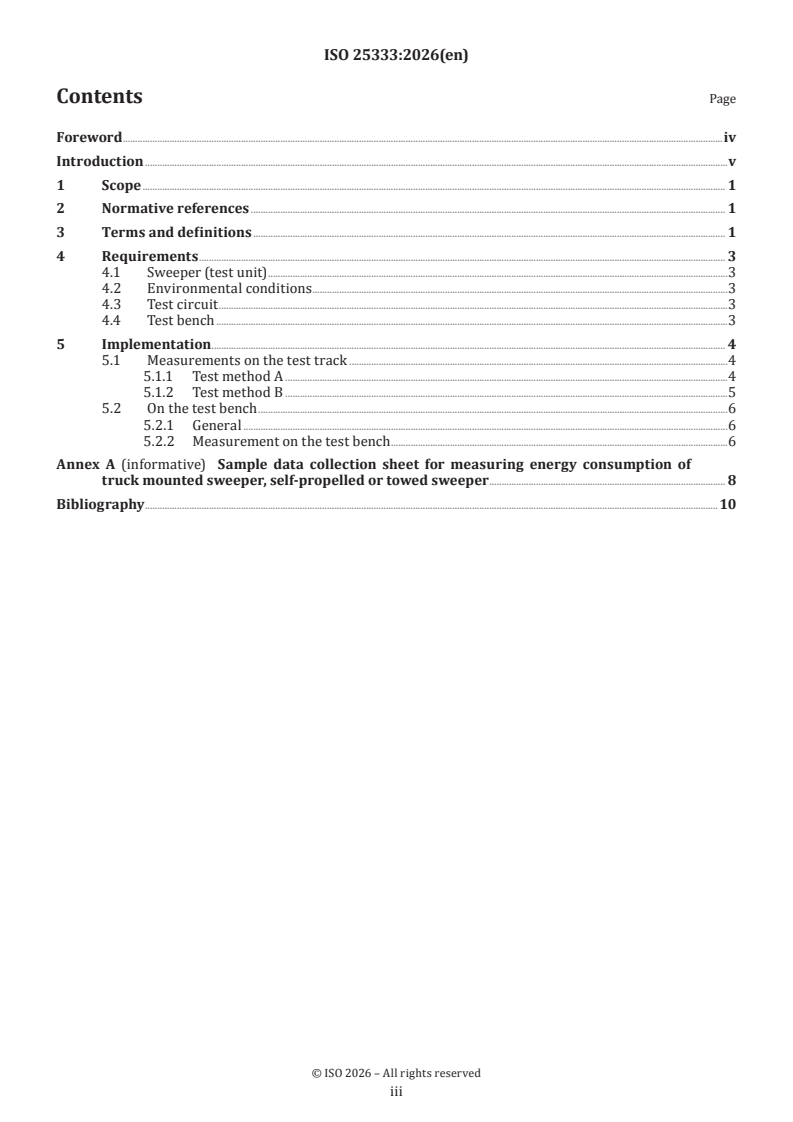
The document is organized into Scope, Normative references, Terms and definitions, Requirements, and Implementation, followed by an informative annex and a bibliography. Annex A gives a sample data collection sheet for recording vehicle data, measurement conditions, and results.
| Annex | What it covers |
|---|---|
| Annex A | Sample data collection sheet for measuring energy consumption of truck mounted, self-propelled, or towed sweepers |
What are the key requirements of ISO 25333:2026?
ISO 25333:2026 sets the test conditions, test track setup, test bench setup, and the two implementation methods used to generate comparable energy data. In practice, the standard is about keeping the vehicle condition, environment, and measurement method consistent enough that different sweepers can be compared fairly.
Sweeper condition and documentation
Clause 4.1 requires the sweeper to be tested in the prescribed operating condition from the operating instructions, and the steady-state must be reached before testing. The measurement systems must be installed according to the attachment manufacturer’s specifications, and the vehicle configuration must be documented, with Annex A giving a sample sheet.
For alternative drive systems, the energy consumption is recorded only from the installed energy storage device. The standard evaluates only the energy used for the test cycle, and it does not observe charging of the storage device or the state of charge (SOC).
Environmental and track conditions
Clause 4.2 defines the environmental window for testing, including four temperature ranges, air pressure, maximum wind speed, and a dry road surface. Clause 4.3 requires a level asphalt or concrete surface that matches a typical paved city road, with slopes limited to ± 2 % and curves of at least 15 m radius.
These conditions matter because they reduce hidden influences on fuel or energy use. If the test surface or weather varies too much, the results are harder to compare.
Test method A on the test track
Clause 5.1.1 uses a representative sweeper in mint condition and requires the sweeper to be set so that sweeping capacity reaches at least 70 % at 4 km/h. The test run combines idle, transport driving, and sweeping mode, and the settings must be fixed and documented before the run starts.
The method also defines the test material, the swept area, and the need to keep auxiliaries such as air conditioning and heaters switched off. Fuel consumption is measured with measuring turbines or comparable technology, and at least three runs are required with limited spread between the lowest and highest result.
Test method B on the test track
Clause 5.1.2 is a separate track method that measures fuel consumption while cleaning at the maximum cleaning speed. It requires at least 100 m of measurement distance, fuel flow meters on the supply and return lines, operating mass at start, and cleaning speed within ± 5 % of the target.
This method is aimed at a different operating pattern and is noted as typically applying to the Japanese market. For users, it provides another defined way to measure consumption when the sweeping task is organized differently.
Test bench implementation
Clause 5.2 describes a vehicle test bench approach intended to match the sweeping-mode result from the test track. The bench must be suitable for sweepers as described in ISO 24147:2023, Annex A, and it must represent energy recovery if the vehicle has that feature.
The bench method records torque and operating speed at 0.1 s intervals, requires conditioning to steady-state before the first run, and calls for four 10-minute runs. As on the track, at least three runs of the same type are required, with limited variation between the lowest and highest value.
What terms does ISO 25333:2026 define?
ISO 25333:2026 defines the key operating states and measured quantities used in the test procedure.
- Measuring turbine - a device that records fuel consumption by differential measurement in the fuel system.
- Measurement run - a test trip in which the sweeper operates in sweeping mode and transporting mode on the test circuit.
- Test bench run - a simulation of a measurement run on the test bench.
- Operating mass (OM) - the mass of the sweeper ready to drive, ready for operating and sweeping mode, with the usual equipment, empty hopper, specified fluids, and operator mass where applicable.
- Steady state - a condition where the operating fluids remain at a stable temperature during the measurement run or test bench run.
- Sweeping mode - the operating mode in which the sweeper performs cleaning or sweeping activities.
- Transporting mode - the driving mode used when the sweeper moves between work sites.
- Fuel consumption volume - the distance the sweeper can clean with 1 l of fuel, or the equivalent volume per hour.
Who uses ISO 25333:2026?
ISO 25333:2026 is used by sweeper manufacturers, test engineers, and laboratory staff who measure fuel or energy consumption. It also supports procurement teams, buyers, and public authorities that need comparable environmental efficiency data when evaluating different sweeper models.
The standard is relevant to road operation machinery and associated equipment, especially truck mounted, self-propelled, and towed sweepers. It helps users decide whether to use a physical measurement run or a simulation-style test bench run.
Which standards are used with ISO 25333:2026?
ISO 25333:2026 normatively references ISO 24147:2023, which provides the commercial specifications for sweepers. That reference is important because ISO 25333 builds its test procedure around the sweeper types and configuration information defined there.
Annex A also refers back to ISO 24147:2023 for hopper volume information in the sample data sheet.
What does the ISO 25333:2026 document contain?
ISO 25333:2026 contains a measurement framework, two track-based test methods, one test bench method, and a table of energy conversion values for common fuels and energy sources. Figure 1 defines the measurement run sequence, and Figure 2 shows an example of fuel flowmeter connection.
The document also includes Table 1 for converting fuel use into energy values, which supports reporting in kWh. Annex A provides a practical recording sheet for vehicle data, measurement conditions, and repeated runs, which is useful for testing, certification, and internal audits.
Get Certified
Connect with accredited certification bodies for this standard

DNV
DNV is an independent assurance and risk management provider.

TÜV Rheinland
TÜV Rheinland is a leading international provider of technical services.

TÜV SÜD
TÜV SÜD is a trusted partner of choice for safety, security and sustainability solutions.
Sponsored listings
Frequently Asked Questions
ISO 25333:2026 is a standard published by the International Organization for Standardization (ISO). Its full title is "Road sweepers — Environmental efficiency — Requirements on the test procedure for energy consumption". This standard covers: This document specifies a uniform, reproducible testing process for various drive units, chassis, constructions and attached parts as well as sweeping systems of the sweepers described in ISO 24147, with which a comparison of the energy consumption levels can be performed. This document defines either a representative test circuit or a test bench cycle with which the energy consumption levels of the sweepers can be evaluated and compared within the scope of reproducible measurement runs or test bench runs, or all of these.
This document specifies a uniform, reproducible testing process for various drive units, chassis, constructions and attached parts as well as sweeping systems of the sweepers described in ISO 24147, with which a comparison of the energy consumption levels can be performed. This document defines either a representative test circuit or a test bench cycle with which the energy consumption levels of the sweepers can be evaluated and compared within the scope of reproducible measurement runs or test bench runs, or all of these.
ISO 25333:2026 is classified under the following ICS (International Classification for Standards) categories: 27.015 - Energy efficiency. Energy conservation in general; 43.160 - Special purpose vehicles. The ICS classification helps identify the subject area and facilitates finding related standards.
ISO 25333:2026 is available in PDF format for immediate download after purchase. The document can be added to your cart and obtained through the secure checkout process. Digital delivery ensures instant access to the complete standard document.
Standards Content (Sample)
International
Standard
ISO 25333
First edition
Road sweepers — Environmental
2026-11
efficiency — Requirements on
the test procedure for energy
consumption
Balayeuses — Efficacité environnementale — Exigences relatives
à la méthode d’essai pour la mesure de la consommation
d’énergie
Reference number
© ISO 2026
All rights reserved.
This ISO publication is protected by copyright and is owned by ISO and/or its licensors.
The content of this ISO publication is provided under licence, not sold. Use is subject to the applicable licence terms issued by ISO,
an ISO member body, or an authorized third-party distributor.
Except as required for implementation or expressly permitted by a separate licence, no part of this ISO publication may be
reproduced, distributed, modified, used, or made available in any form or by any means – electronic or mechanical, including
photocopying, scanning, recording, or posting on internal or external digital platforms.
Any use beyond the scope of the granted rights is prohibited and may result in legal action.
ISO copyright office
CP 401 • CH-1214 Vernier, Geneva
Phone: +41 22 749 01 11
Email: copyright@iso.org
Website: www.iso.org
Published in Switzerland
ii
Contents Page
Foreword .iv
Introduction .v
1 Scope . 1
2 Normative references . 1
3 Terms and definitions . 1
4 Requirements . 3
4.1 Sweeper (test unit) .3
4.2 Environmental conditions . .3
4.3 Test circuit .3
4.4 Test bench .3
5 Implementation . . 4
5.1 Measurements on the test track .4
5.1.1 Test method A .4
5.1.2 Test method B .5
5.2 On the test bench .6
5.2.1 General .6
5.2.2 Measurement on the test bench .6
Annex A (informative) Sample data collection sheet for measuring energy consumption of
truck mounted sweeper, self-propelled or towed sweeper . 8
Bibliography .10
iii
Foreword
ISO (the International Organization for Standardization) is a worldwide federation of national standards
bodies (ISO member bodies). The work of preparing International Standards is normally carried out through
ISO technical committees. Each member body interested in a subject for which a technical committee
has been established has the right to be represented on that committee. International organizations,
governmental and non-governmental, in liaison with ISO, also take part in the work. ISO collaborates closely
with the International Electrotechnical Commission (IEC) on all matters of electrotechnical standardization.
The procedures used to develop this document and those intended for its further maintenance are described
in the ISO/IEC Directives, Part 1. In particular, the different approval criteria needed for the different types
of ISO document should be noted. This document was drafted in accordance with the editorial rules of the
ISO/IEC Directives, Part 2 (see www.iso.org/directives).
ISO draws attention to the possibility that the implementation of this document may involve the use of (a)
patent(s). ISO takes no position concerning the evidence, validity or applicability of any claimed patent
rights in respect thereof. As of the date of publication of this document, ISO had not received notice of (a)
patent(s) which may be required to implement this document. However, implementers are cautioned that
this may not represent the latest information, which may be obtained from the patent database available at
www.iso.org/patents. ISO shall not be held responsible for identifying any or all such patent rights.
Any trade name used in this document is information given for the convenience of users and does not
constitute an endorsement.
For an explanation of the voluntary nature of standards, the meaning of ISO specific terms and expressions
related to conformity assessment, as well as information about ISO's adherence to the World Trade
Organization (WTO) principles in the Technical Barriers to Trade (TBT), see www.iso.org/iso/foreword.html.
This document was prepared by Technical Committee ISO/TC 195, Building construction machinery and
equipment, Subcommittee SC 2, Road operation machinery and associated equipment.
Any feedback or questions on this document should be directed to the user’s national standards body. A
complete listing of these bodies can be found at www.iso.org/members.html.
iv
Introduction
As a result of the development of new drive unit concepts for sweepers, as well as the provisions from
procurement guidelines from different regions, there is a demand for universal processes and provisions for
determining the environmental effects of sweepers, with the objective of achieving a uniform evaluation of
the environmental efficiency.
The environmental effects in the utilization phase for sweepers are essentially determined by their energy
consumption from which the relevant CO emissions result.
In order to define appropriate characteristic numbers for the environmental effect of sweepers, it is
necessary to differentiate between sweeping mode and general trips, for instance, to and from the work site.
The objective is to be able to issue an environmental efficiency ID for various vehicle models.
In the future, manufacturers and users should be able to decide whether the consumption measurement is
carried out as a simulation or within the scope of measurement runs.
EXAMPLE In Europe, the Vehicle Energy Consumption calculation tool (VECTO) is used.
NOTE Table 1 contains, in addition to the statutory units, the unit Nm (normal cubic metres). This unit is only
mentioned as an aid in official and commercial transactions (e.g. import/export) with nations that use this unit. 1 Nm
3 3 3 3
of gas is the amount of a gas in a volume of 1 m at 1,013 25 bar and 0 °C. The conversion rate with m is 1 Nm = 1 m .
v
International Standard ISO 25333:2026(en)
Road sweepers — Environmental efficiency — Requirements
on the test procedure for energy consumption
1 Scope
This document specifies a uniform, reproducible testing process for various drive units, chassis,
constructions and attached parts as well as sweeping systems of the sweepers described in ISO 24147, with
which a comparison of the energy consumption levels can be performed.
This document defines either a representative test circuit or a test bench cycle with which the energy
consumption levels of the sweepers can be evaluated and compared within the scope of reproducible
measurement runs or test bench runs, or all of these.
2 Normative references
The following documents are referred to in the text in such a way that some or all of their content constitutes
requirements of this document. For dated references, only the edition cited applies. For undated references,
the latest edition of the referenced document (including any amendments) applies.
ISO 24147:2023, Road operation machinery and associated equipment — Sweepers — Commercial specifications
3 Terms and definitions
For the purposes of this document, the following terms and definitions apply.
ISO and IEC maintain terminology databases for use in standardization at the following addresses:
— ISO Online browsing platform: available at https:// www .iso .org/ obp
— IEC Electropedia: available at https:// www .electropedia .org/
3.1
measuring turbine
measuring device to record fuel consumption using differential measurement in the fuel system
3.2
measurement run
test trip
sweeper (3.8) run in the sweeping mode and transporting mode (3.7) on the test circuit
3.3
test bench run
simulation of a measurement run (3.2) on the test bench
3.4
operating mass
OM
mass of the sweeper (3.8) ready to drive and ready for the operating and sweeping mode with equipment
(and attachment) and empty hopper (3.9) and debris water storage in the most usual configuration as
specified by the manufacturer, and with the operator mass
Note 1 to entry: The mass of the operator can differ depending on the respective region.
Note 2 to entry: The mass of the operator is not included for pedestrian-controlled-sweepers.
Note 3 to entry: The operating mass of a combustion driven vehicle is the operating mass and full fuel tank(s) and all
fluid systems (i.e. hydraulic oil, transmission oil, engine oil, coolant, urea) at the levels specified by the manufacturer
and, when applicable, with full water tank(s).
Note 4 to entry: The operating mass of a battery electric vehicle is the operating mass and a fully loaded battery and
all fluid systems (i.e. hydraulic oil, transmission oil, coolant) at the levels specified by the manufacturer and, when
applicable, with full water tank(s).
Note 5 to entry: The operating mass of a plug-in hybrid electric vehicle is the operating mass and full fuel tank(s) and
fully loaded battery and all fluid systems (i.e. hydraulic oil, transmission oil, engine oil, coolant, urea) at the levels
specified by the manufacturer and, when applicable, with full water tank(s).
Note 6 to entry: The operating mass of a fuel-cell electrical vehicle is the operating mass and full hydrogen tank(s) and
all fluid systems (i.e. hydraulic oil, transmission oil, coolant) at the levels specified by the manufacturer and, when
applicable, with full water tank(s).
[SOURCE: ISO 24147:2023, 3.24, modified — "ready to drive and ready for the operating and sweeping mode"
has been added to the definition. The following has been removed from the definition: "full fuel tank(s) and
all fluid systems (i.e. hydraulic oil, transmissi
...