


EN 15368:2008+A1:2010
(Main)Hydraulic binder for non-structural applications - Definition, specifications and conformity criteria
Hydraulic binder for non-structural applications - Definition, specifications and conformity criteria
This European Standard applies to Hydraulic binder for non-structural applications in construction used as binder for preparation of mortar for masonry, rendering and plastering and other non structural construction products.
This European Standard specifies the definition and composition of Hydraulic binder for non-structural applications (HB). It includes physical, mechanical and chemical requirements and defines strength classes. EN 15368 also states the conformity criteria and the related rules. Necessary durability requirements are also given.
NOTE For normal applications the information given in this standard, and in the masonry specifications, EN 998-1 and EN 998-2, is generally sufficient. However, in special cases, an exchange of additional information between the producer and user can be helpful. The details of such an exchange are not within the scope of this standard but should be dealt with in accordance with national standards or other regulations or can be agreed between the parties concerned.
Terms of delivery or other contractual conditions, normally included in documents exchanged between the supplier and the purchaser of Hydraulic binder for non-structural applications, are outside the scope of this European Standard.
Hydraulisches Bindemittel für nichttragende Anwendungen - Definition, Anforderungen und Konformitätskriterien
Diese Europäische Norm gilt für hydraulisches Bindemittel für nichttragende Anwendungen, das als Binde-mittel für die Herstellung von Mörtel (Mauermörtel und Außen- und Innenputzmörtel) sowie die Herstellung anderer nichttragender Bauprodukte verwendet wird. Diese Europäische Norm legt die Definition und die Zusammensetzung von hydraulischem Bindemittel für nichttragende Anwendungen (HB) fest. Des Weiteren werden in der Norm die physikalischen, mechanischen und chemischen Eigenschaften sowie die Festigkeitsklassen festgelegt. Diese Europäische Norm enthält die Konformitätskriterien und die entsprechenden Festlegungen. Die erforderlichen Anforderungen an die Dauerhaftigkeit sind auch angegeben. ANMERKUNG Für übliche Anwendungen reichen die in dieser Norm sowie in EN 998-1 und EN 998-2 (Festlegungen für Mörtel im Mauerwerksbau) angegebenen Informationen in der Regel aus. In besonderen Fällen jedoch kann ein Austausch von zusätzlichen Informationen zwischen Hersteller und Abnehmer sinnvoll sein. Die Einzelheiten eines solchen Austausches sind nicht Gegenstand dieser Norm. Sie sollten in Übereinstimmung mit nationalen Normen oder anderen Bestimmungen behandelt werden oder können zwischen den Beteiligten vereinbart werden. Lieferbedingungen und andere Vertragsvereinbarungen, die üblicherweise in den zwischen dem Lieferanten und dem Käufer des hydraulischen Bindemittels für nichttragende Anwendungen ausgetauschten Dokumenten enthalten sind, sind nicht Gegenstand dieser Europäischen Norm.
Liant hydraulique pour applications non structurelles - Définition, spécifications et critères de conformité
La présente Norme européenne s’applique au liant hydraulique pour applications non structurelles utilisé dans la
construction pour préparer des mortiers pour maçonneries, enduits intérieurs et extérieurs, ainsi que pour fabriquer
d’autres produits de construction non structuraux.
La présente Norme européenne donne la définition et la composition du liant hydraulique pour applications non
structurelles (HB). Elle inclut des exigences physiques, mécaniques et chimiques et définit les classes de résistance.
L’EN 15368 stipule également les critères de conformité et les règles associées. Elle spécifie également
les exigences de durabilité nécessaires.
NOTE Pour des applications courantes, les informations données dans la présente norme et dans les spécifications
de maçonnerie, EN 998-1 et EN 998-2, sont généralement suffisantes. Toutefois, dans des cas spéciaux, un échange
d’informations supplémentaires entre le producteur et l’utilisateur peut se révéler utile. Les détails d’un tel échange ne relèvent
pas du domaine d’application de la présente norme, mais il convient de les traiter conformément aux normes nationales ou
autres règlements nationaux ; ils peuvent également faire l’objet d’un accord entre les parties concernées.
Les modalités de livraison ou autres conditions contractuelles faisant normalement partie des documents échangés
entre le fournisseur et l’acheteur du liant hydraulique pour applications non structurelles n’entrent pas dans le cadre
de la présente Norme européenne.
Hidravlično vezivo za nekonstrukcijsko uporabo - Definicija, specifikacije in merila skladnosti (vključno z dopolnilom A1)
Ta evropski standard velja za hidravlična veziva za nekonstrukcijsko uporabo pri gradnji, kjer se uporabljajo kot veziva za pripravo malte za zidavo, ometavanje in štukature ter druge nekonstrukcijske gradbene proizvode. Ta evropski standard določa definicijo in sestavo hidravličnih veziv za nekonstrukcijsko uporabo (HB). Vključuje fizikalne, mehanske in kemične zahteve ter opredeljuje jakostne razrede. EN 15368 tudi navaja merila za skladnost in sorodna pravila. Navedene so tudi zahteve za potrebno trajnost. Pogoji dobave ali drugi pogodbeni pogoji, običajno vključeni v dokumente, ki si jih izmenjata dobavitelj in kupec hidravličnega veziva za nekonstrukcijsko uporabo, niso predmet tega evropskega standarda.
General Information
Relations
Standards Content (Sample)
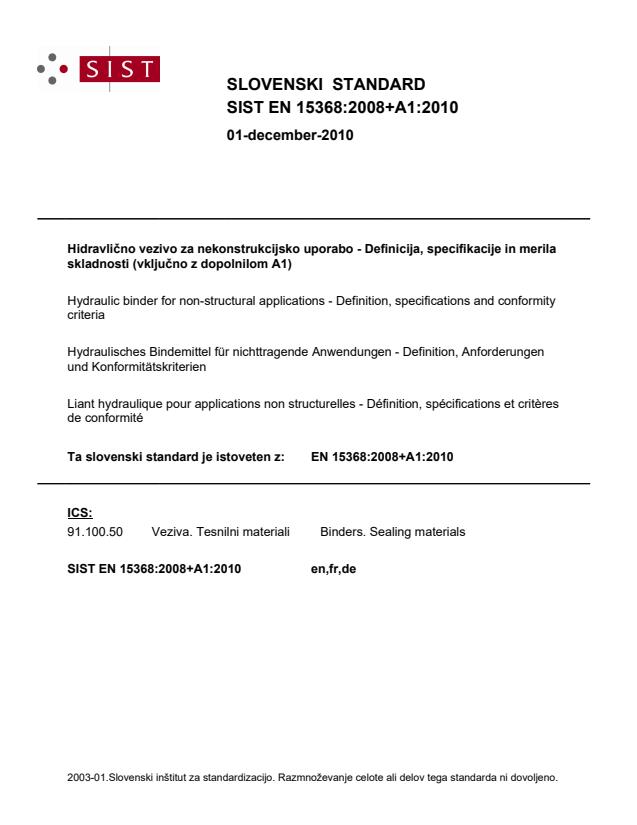
2003-01.Slovenski inštitut za standardizacijo. Razmnoževanje celote ali delov tega standarda ni dovoljeno.Hydraulisches Bindemittel für nichttragende Anwendungen - Definition, Anforderungen und KonformitätskriterienLiant hydraulique pour applications non structurelles - Définition, spécifications et critères de conformitéHydraulic binder for non-structural applications - Definition, specifications and conformity criteria91.100.50Veziva. Tesnilni materialiBinders. Sealing materialsICS:Ta slovenski standard je istoveten z:EN 15368:2008+A1:2010SIST EN 15368:2008+A1:2010en,fr,de01-december-2010SIST EN 15368:2008+A1:2010SLOVENSKI
STANDARD
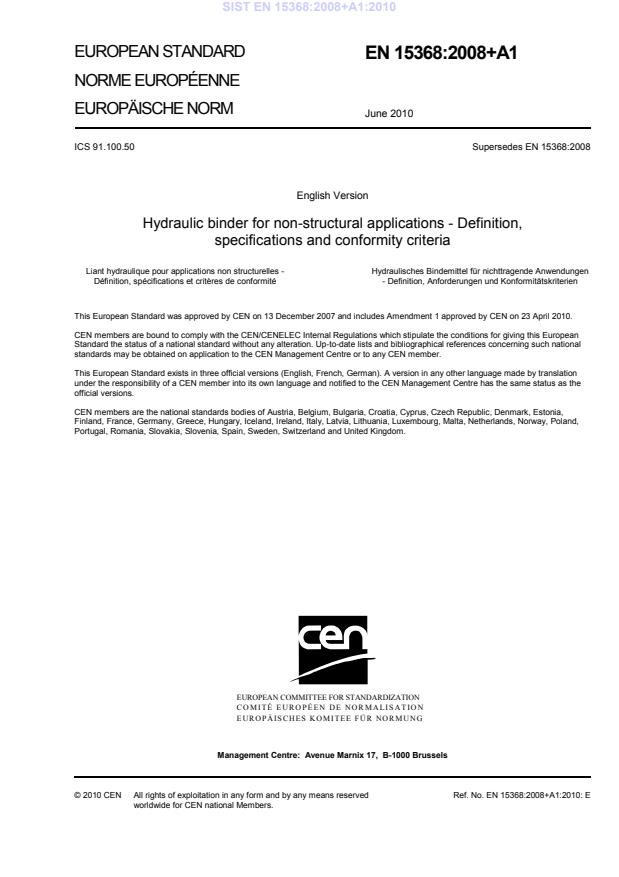
EUROPEAN STANDARD NORME EUROPÉENNE EUROPÄISCHE NORM
EN 15368:2008+A1
June 2010 ICS 91.100.50 Supersedes EN 15368:2008 English Version
Hydraulic binder for non-structural applications - Definition, specifications and conformity criteria
Liant hydraulique pour applications non structurelles - Définition, spécifications et critères de conformité
Hydraulisches Bindemittel für nichttragende Anwendungen - Definition, Anforderungen und Konformitätskriterien This European Standard was approved by CEN on 13 December 2007 and includes Amendment 1 approved by CEN on 23 April 2010.
CEN members are bound to comply with the CEN/CENELEC Internal Regulations which stipulate the conditions for giving this European Standard the status of a national standard without any alteration. Up-to-date lists and bibliographical references concerning such national standards may be obtained on application to the CEN Management Centre or to any CEN member.
This European Standard exists in three official versions (English, French, German). A version in any other language made by translation under the responsibility of a CEN member into its own language and notified to the CEN Management Centre has the same status as the official versions.
CEN members are the national standards bodies of Austria, Belgium, Bulgaria, Croatia, Cyprus, Czech Republic, Denmark, Estonia, Finland, France, Germany, Greece, Hungary, Iceland, Ireland, Italy, Latvia, Lithuania, Luxembourg, Malta, Netherlands, Norway, Poland, Portugal, Romania, Slovakia, Slovenia, Spain, Sweden, Switzerland and United Kingdom.
EUROPEAN COMMITTEE FOR STANDARDIZATION
COMITÉ EUROPÉEN DE NORMALISATION EUROPÄISCHES KOMITEE FÜR NORMUNG
Management Centre:
Avenue Marnix 17,
B-1000 Brussels © 2010 CEN All rights of exploitation in any form and by any means reserved worldwide for CEN national Members. Ref. No. EN 15368:2008+A1:2010: ESIST EN 15368:2008+A1:2010
Water soluble hexavalent chromium . 14Annex ZA (informative)
!!!!Clauses of this European Standard addressing the provisions of the EU Construction Products Directive"""" . 15Bibliography . 21 SIST EN 15368:2008+A1:2010
This European Standard specifies the definition and composition of Hydraulic binder for non-structural applications (HB). It includes physical, mechanical and chemical requirements and defines strength classes. EN 15368 also states the conformity criteria and the related rules. Necessary durability requirements are also given. NOTE For normal applications the information given in this standard, and in the masonry specifications, EN 998-1 and EN 998-2, is generally sufficient. However, in special cases, an exchange of additional information between the producer and user can be helpful. The details of such an exchange are not within the scope of this standard but should be dealt with in accordance with national standards or other regulations or can be agreed between the parties concerned. Terms of delivery or other contractual conditions, normally included in documents exchanged between the supplier and the purchaser of Hydraulic binder for non-structural applications, are outside the scope of this European Standard. 2 Normative references The following referenced documents are indispensable for the application of this document. For dated references, only the edition cited applies. For undated references, the latest edition of the referenced document (including any amendments) applies. EN 196-1, Methods of testing cement — Part 1: Determination of strength EN 196-2, Methods of testing cement — Part 2: Chemical analysis of cement
EN 196-3, Methods of testing cement — Part 3: Determination of setting times and soundness EN 196-6, Methods of testing cement — Part 6: Determination of fineness EN 197-1, Cement — Part 1: Composition, specifications and conformity criteria for common cements EN 413-2:2005, Masonry cement — Part 2: Test methods EN 459-1, Building lime — Part 1: Definitions, specifications and conformity criteria EN 459-2:2001, Building lime — Part 2: Test methods SIST EN 15368:2008+A1:2010
3.2 additives constituents which are added to improve the manufacture or the properties of the Hydraulic binder for non-structural applications, e.g. grinding agents, air-entraining agents, etc. 3.3 allowable probability of acceptance CR for a given sampling plan, the allowed probability of acceptance of Hydraulic binder for non-structural applications with a characteristic value outside the specified characteristic value 3.4 sampling plan specific plan which states the (statistical) sample size(s) to be used, the percentile Pk and the allowable probability of acceptance CR 3.5 characteristic value value of a required property outside which lies a specified percentage, the percentile Pk, of all the values of the population 3.6 specified characteristic value characteristic value of mechanical, physical or chemical property which in the case of an upper limit is not to be exceeded or in the case of a lower limit is, as a minimum, to be reached 3.7 single result limit value value of mechanical, physical or chemical property which - for/any single test result - in the case of an upper limit is not to be exceeded or in the case of a lower limit is, as a minimum, to be reached. 3.8 spot sample sample taken at the same time and from one and the same place, relating to the intended tests. It can be obtained by combining one or more immediately consecutive increments (see EN 196-7). 3.9 autocontrol testing continual testing by the manufacturer of Hydraulic binder for non-structural applications spot samples taken at the point(s) of release from the factory/depot. 3.10 control period
period of production and dispatch identified for the evaluation of the autocontrol test results. SIST EN 15368:2008+A1:2010
The quantity of organic additives on dry basis should not exceed 0,2 % by mass of the HB. When the content exceeds 0,2 % the actual amount and types of organic additives shall be declared.
5.3 Physical and mechanical requirements 5.3.1 Fineness (sieve residue) The residue on a 90 µm sieve shall be not more than 15 % by mass when determined in accordance with EN 196-6. 5.3.2 Initial setting time The initial setting time shall be not less than 60 min when determined in accordance with EN 413-2. 5.3.3 Soundness The expansion shall be not more than 10 mm when determined in accordance with EN 196-3.
5.3.4 Fresh mortar requirements The properties of air content and water retention of fresh mortar shall be measured in accordance with EN 413-2 on a mortar of standard consistence which shall have a value of penetration of (35 ± 3) mm using the plunger apparatus as the reference method. (The flow table test is the alternative method). The water retention shall be not less than 80 % and the air content shall be between 6 % and 20 %.
5.3.5 Compressive strength The compressive strength when determined in accordance with EN 196-1 or with EN 196-1 but using the compaction equipment and procedures given in 5.1.2.2.1 and 5.1.2.2.2 respectively of EN 459-2:2001, at fixed water/binder ratio of 0,50 shall have the values given in Table 2. Hydraulic binders for non-structural applications (HB) are divided into two strength classes based on the lower limit of the characteristic 28-d compressive strength, respectively equal to 1,5 and 3,0 MPa. A loading rate of (400 ± 40) N/s shall be used when testing specimens in compression. Should it not be possible to remove the prisms from the moulds after 24 h, it is permitted to remove them at 48 h. Where the prisms are demoulded at 48 h this shall be recorded. 5.4 Chemical requirements The properties of the HB shall conform to the requirements given in Table 2 when determined by the method indicated in this table. The physical, mechanical requirements and chemical requirements of HB are summarised in Table 2. SIST EN 15368:2008+A1:2010
5.5 Additional requirements Upon request the supplier shall declare the typical values for: a) Water demand to obtain the standard mortar (determined in accordance with Clause 5 of EN 413-2:2005); b) Bulk density of the dry binder, in kg/dm3 (recommended method in accordance with 5.8 of EN 459-2:2001); c) Chloride as Cl- (recommended method in accordance with EN 196-2). 6 Durability requirements In many applications, particularly in severe environmental conditions, the choice of Hydraulic binder for non-structural applications from this standard has an influence on the durability of mortar. The choice of HB type for different applications and exposure classes shall follow the appropriate standards and/or regulations valid in the place of use of the mortar.
7 Standard designation Hydraulic binder for non-structural applications conforming to this standard shall be identified with the designation “EN 15368 HB” ” followed by 1.5 or 3.0 to identify the strength class. EXAMPLE Hydraulic binder for non-structural applications EN 15368 HB 3.0.
8.2 Conformity criteria for physical, mechanical, chemical properties and evaluation procedure The declaration of conformity by the manufacturer shall be based on the evaluation of conformity of HB with this European Standard.
NOTE This standard does not deal with acceptance inspection at delivery. 8.3 Conformity requirements Sampling shall take place at the points of release of the Hydraulic binder for non-structural applications. Conformity of HB with the requirements concerning strength, physical and chemical properties in this standard is assumed if the requirements in Table 1 and 2 are met.
The evaluation procedure depends on the frequency of testing during the cont
...
Questions, Comments and Discussion
Ask us and Technical Secretary will try to provide an answer. You can facilitate discussion about the standard in here.
Loading comments...