


EN 15368:2008
(Main)Hydraulic binder for non-structural applications: definition, specifications and conformity criteria
General Information
- Abstract
This European Standard applies to Hydraulic binder for non-structural applications in construction used as binder for preparation of mortar or masonry, rendering and plastering and other non structural construction products.
This European Standard specifies the definition and composition of Hydraulic binder for non-structural applications (HB). It includes physical, mechanical and chemical requirements and defines strength classes. EN 15368 also states the conformity criteria and the related rules. Necessary durability requirements are also given.
NOTE For normal applications the information given in this standard, and in the masonry specifications, EN 998-1 and EN 998-2, is generally sufficient. However, in special cases, an exchange of additional information between the producer and user can be helpful. The details of such an exchange are not within the scope of this standard but should be dealt with in accordance with national standards or other regulations or can be agreed between the parties concerned.
Terms of delivery or other contractual conditions, normally included in documents exchanged between the supplier and the purchaser of Hydraulic binder for non-structural applications, are outside the scope of this European Standard.
- Status
- Withdrawn
- Publication Date
- 22-Jan-2008
- Withdrawal Date
- 15-Jun-2010
- Technical Committee
- CEN/TC 51 - Cement and building limes
- Drafting Committee
- CEN/TC 51/WG 6 - Definitions and terminology of cement
- Current Stage
- 9960 - Withdrawal effective - Withdrawal
- Start Date
- 16-Jun-2010
- Completion Date
- 16-Jun-2010
- Directive
- Harmonized Standard305/2011 - Regulation (eu) No 305/2011 of the European Parliament and of the Council of 9 march 2011 laying down harmonised conditions for the marketing of construction products and repealing council directive 89/106/eec
Not Harmonized89/106/EEC - Construction products

Relations
- Effective Date
- 18-Jan-2023
- Effective Date
- 08-Apr-2009
Get Certified
Connect with accredited certification bodies for this standard

DIBt (Deutsches Institut für Bautechnik)
German Institute for Building Technology.
DIN CERTCO
DIN Group product certification.

Aboma Certification B.V.
Specialized in construction, metal, and transport sectors.
Sponsored listings
Frequently Asked Questions
EN 15368:2008 is a standard published by the European Committee for Standardization (CEN). Its full title is "Hydraulic binder for non-structural applications: definition, specifications and conformity criteria". This standard covers: This European Standard applies to Hydraulic binder for non-structural applications in construction used as binder for preparation of mortar or masonry, rendering and plastering and other non structural construction products. This European Standard specifies the definition and composition of Hydraulic binder for non-structural applications (HB). It includes physical, mechanical and chemical requirements and defines strength classes. EN 15368 also states the conformity criteria and the related rules. Necessary durability requirements are also given. NOTE For normal applications the information given in this standard, and in the masonry specifications, EN 998-1 and EN 998-2, is generally sufficient. However, in special cases, an exchange of additional information between the producer and user can be helpful. The details of such an exchange are not within the scope of this standard but should be dealt with in accordance with national standards or other regulations or can be agreed between the parties concerned. Terms of delivery or other contractual conditions, normally included in documents exchanged between the supplier and the purchaser of Hydraulic binder for non-structural applications, are outside the scope of this European Standard.
This European Standard applies to Hydraulic binder for non-structural applications in construction used as binder for preparation of mortar or masonry, rendering and plastering and other non structural construction products. This European Standard specifies the definition and composition of Hydraulic binder for non-structural applications (HB). It includes physical, mechanical and chemical requirements and defines strength classes. EN 15368 also states the conformity criteria and the related rules. Necessary durability requirements are also given. NOTE For normal applications the information given in this standard, and in the masonry specifications, EN 998-1 and EN 998-2, is generally sufficient. However, in special cases, an exchange of additional information between the producer and user can be helpful. The details of such an exchange are not within the scope of this standard but should be dealt with in accordance with national standards or other regulations or can be agreed between the parties concerned. Terms of delivery or other contractual conditions, normally included in documents exchanged between the supplier and the purchaser of Hydraulic binder for non-structural applications, are outside the scope of this European Standard.
EN 15368:2008 is classified under the following ICS (International Classification for Standards) categories: 91.100.10 - Cement. Gypsum. Lime. Mortar; 91.100.50 - Binders. Sealing materials. The ICS classification helps identify the subject area and facilitates finding related standards.
EN 15368:2008 has the following relationships with other standards: It is inter standard links to EN 15368:2008+A1:2010, EN 15368:2008/FprA1. Understanding these relationships helps ensure you are using the most current and applicable version of the standard.
EN 15368:2008 is associated with the following European legislation: EU Directives/Regulations: 305/2011, 89/106/EEC; Standardization Mandates: M/114, M/116. When a standard is cited in the Official Journal of the European Union, products manufactured in conformity with it benefit from a presumption of conformity with the essential requirements of the corresponding EU directive or regulation.
EN 15368:2008 is available in PDF format for immediate download after purchase. The document can be added to your cart and obtained through the secure checkout process. Digital delivery ensures instant access to the complete standard document.
Standards Content (Sample)
2003-01.Slovenski inštitut za standardizacijo. Razmnoževanje celote ali delov tega standarda ni dovoljeno.Hydraulic binder for non-structural applications: definition, specifications and conformity criteriaVNODGQRVWLLiant hydraulique de construction - Définition, spécifications et criteres de conformitéHydraulisches Bindemittel für Bauwerke - Definitionen, Anforderungen und KonformitätskriterienTa slovenski standard je istoveten z:EN 15368:2008SIST EN 15368:2008en91.100.50ICS:SLOVENSKI
STANDARDSIST EN 15368:200801-marec-2008
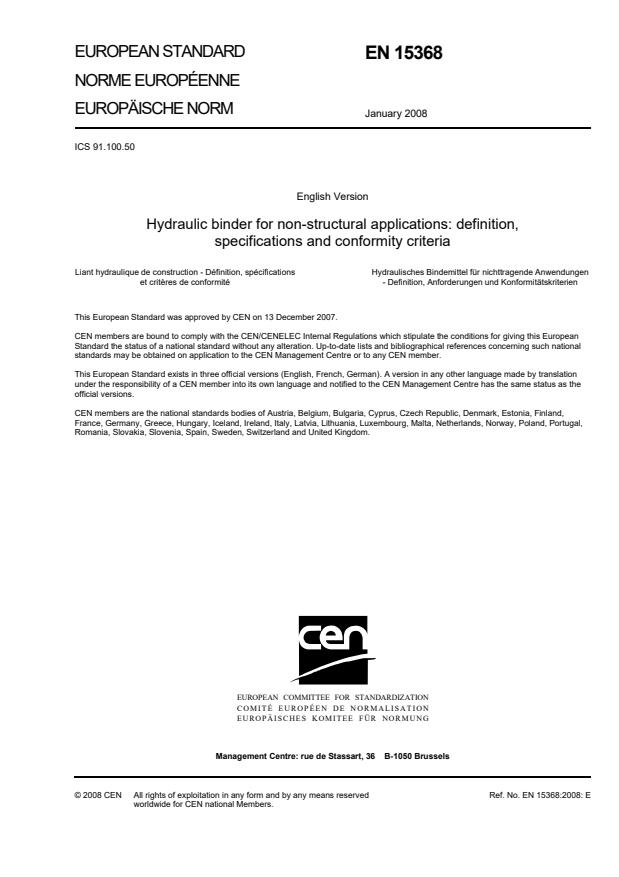
EUROPEAN STANDARDNORME EUROPÉENNEEUROPÄISCHE NORMEN 15368January 2008ICS 91.100.50 English VersionHydraulic binder for non-structural applications: definition,specifications and conformity criteriaLiant hydraulique de construction - Définition, spécificationset critères de conformitéHydraulisches Bindemittel für nichttragende Anwendungen- Definition, Anforderungen und KonformitätskriterienThis European Standard was approved by CEN on 13 December 2007.CEN members are bound to comply with the CEN/CENELEC Internal Regulations which stipulate the conditions for giving this EuropeanStandard the status of a national standard without any alteration. Up-to-date lists and bibliographical references concerning such nationalstandards may be obtained on application to the CEN Management Centre or to any CEN member.This European Standard exists in three official versions (English, French, German). A version in any other language made by translationunder the responsibility of a CEN member into its own language and notified to the CEN Management Centre has the same status as theofficial versions.CEN members are the national standards bodies of Austria, Belgium, Bulgaria, Cyprus, Czech Republic, Denmark, Estonia, Finland,France, Germany, Greece, Hungary, Iceland, Ireland, Italy, Latvia, Lithuania, Luxembourg, Malta, Netherlands, Norway, Poland, Portugal,Romania, Slovakia, Slovenia, Spain, Sweden, Switzerland and United Kingdom.EUROPEAN COMMITTEE FOR STANDARDIZATIONCOMITÉ EUROPÉEN DE NORMALISATIONEUROPÄISCHES KOMITEE FÜR NORMUNGManagement Centre: rue de Stassart, 36
B-1050 Brussels© 2008 CENAll rights of exploitation in any form and by any means reservedworldwide for CEN national Members.Ref. No. EN 15368:2008: E
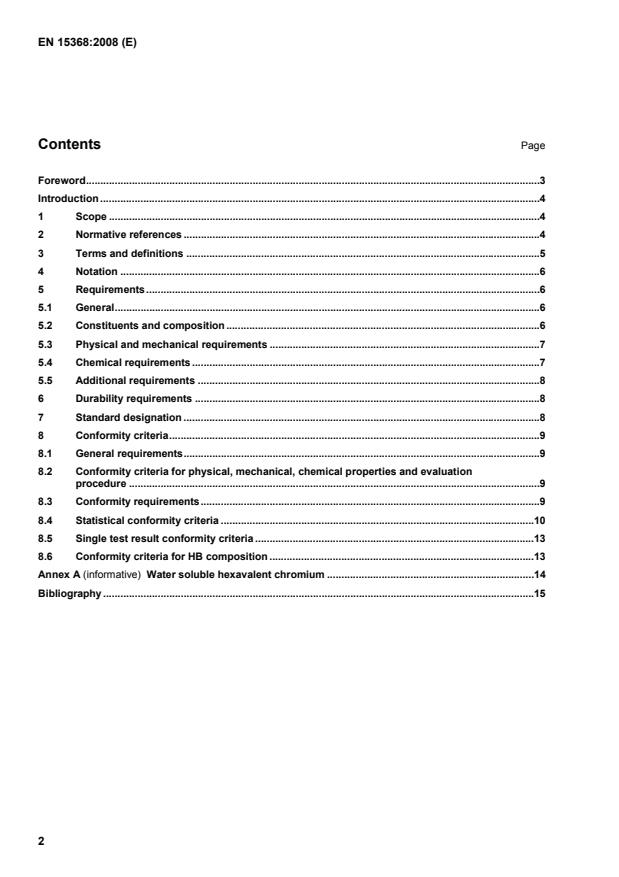
Water soluble hexavalent chromium.14 Bibliography.15
This European Standard specifies the definition and composition of Hydraulic binder for non-structural applications (HB). It includes physical, mechanical and chemical requirements and defines strength classes. EN 15368 also states the conformity criteria and the related rules. Necessary durability requirements are also given. NOTE For normal applications the information given in this standard, and in the masonry specifications, EN 998-1 and EN 998-2, is generally sufficient. However, in special cases, an exchange of additional information between the producer and user can be helpful. The details of such an exchange are not within the scope of this standard but should be dealt with in accordance with national standards or other regulations or can be agreed between the parties concerned. Terms of delivery or other contractual conditions, normally included in documents exchanged between the supplier and the purchaser of Hydraulic binder for non-structural applications, are outside the scope of this European Standard. 2 Normative references The following referenced documents are indispensable for the application of this document. For dated references, only the edition cited applies. For undated references, the latest edition of the referenced document (including any amendments) applies. EN 196-1, Methods of testing cement – Part 1: Determination of strength EN 196-2, Methods of testing cement – Part 2: Chemical analysis of cement
EN 196-3, Methods of testing cement – Part 3: Determination of setting times and soundness EN 196-6, Methods of testing cement – Part 6: Determination of fineness EN 197-1, Cement – Part 1: Composition, specifications and conformity criteria for common cements EN 413-2:2005, Masonry cement – Part 2: Test methods EN 459-1, Building lime – Part 1: Definitions, specifications and conformity criteria EN 459-2:2001, Building lime – Part 2: Test methods
3.2 additives constituents which are added to improve the manufacture or the properties of the Hydraulic binder for non-structural applications, e.g. grinding agents, air-entraining agents, etc. 3.3 allowable probability of acceptance CR for a given sampling plan, the allowed probability of acceptance of Hydraulic binder for non-structural applications with a characteristic value outside the specified characteristic value 3.4 sampling plan specific plan which states the (statistical) sample size(s) to be used, the percentile Pk and the allowable probability of acceptance CR 3.5 characteristic value value of a required property outside which lies a specified percentage, the percentile Pk, of all the values of the population 3.6 specified characteristic value characteristic value of mechanical, physical or chemical property which in the case of an upper limit is not to be exceeded or in the case of a lower limit is, as a minimum, to be reached 3.7 single result limit value value of mechanical, physical or chemical property which - for/any single test result - in the case of an upper limit is not to be exceeded or in the case of a lower limit is, as a minimum, to be reached. 3.8 spot sample sample taken at the same time and from one and the same place, relating to the intended tests. It can be obtained by combining one or more immediately consecutive increments (see EN 196-7). 3.9 autocontrol testing continual testing by the manufacturer of Hydraulic binder for non-structural applications spot samples taken at the point(s) of release from the factory/depot. 3.10 control period
period of production and dispatch identified for the evaluation of the autocontrol test results.
...