


EN 17837:2023
(Main)Postal Services - Parcel Delivery Environmental Footprint - Methodology for calculation and declaration of GHG emissions and air pollutants of parcel logistics delivery services
General Information
- Abstract
This document establishes a common methodology for the calculation, allocation and declaration of Greenhouse gases (GHGs) as well as air pollutant emissions related to any parcel delivery service.
It only covers a part of the entire retail value chain. The retail value chain usually consists of creating the product, storing the inventory, distributing the goods and making the product available for consumers.
This document includes only the distribution of goods but considers the entire value chain of the parcel transportation process flow, namely the collection and delivery rounds, the trunking and the operations due to processing and the physical handling of parcels. See Figure 1 below for a graphical illustration.
- Status
- Published
- Publication Date
- 26-Sep-2023
- Technical Committee
- CEN/TC 320 - Transport - Logistics and services
- Drafting Committee
- CEN/TC 331/WG 3 - Automatic identification of items - Addresses
- Current Stage
- 6060 - Definitive text made available (DAV) - Publishing
- Start Date
- 27-Sep-2023
- Due Date
- 12-Oct-2023
- Completion Date
- 27-Sep-2023

Overview
EN 17837:2023 is the European standard developed by CEN that specifies a common methodology for calculating, allocating, and declaring greenhouse gas (GHG) emissions and air pollutant emissions generated during parcel logistics delivery services. This standard addresses the increasing demand for accuracy, transparency, and comparability in the environmental reporting of parcel delivery operations, especially as e-commerce and consumer expectations continue to reshape the logistics sector. EN 17837:2023 supports organizations in disclosing parcel-specific environmental footprints, fostering more sustainable practices within the parcel logistics industry.
Key Topics
Scope of Environmental Impact Assessment
EN 17837:2023 covers the distribution segment of the retail value chain, focusing on the parcel transportation process flow including:- Collection and delivery rounds (first-mile and last-mile)
- Trunking transport between depots and hubs
- Operations at logistics sites, including processing and physical parcel handling
GHG Emissions and Air Pollutants Assessment
The standard provides step-by-step guidance to quantify both GHG emissions and air pollutants (e.g., carbon monoxide, nitrogen oxides, particulate matter, and sulfur oxides) for all parcel delivery transport modes.Allocation and Reporting Methodology
EN 17837:2023 sets rules for allocating emissions at the parcel level and outlines reporting frameworks. This ensures clarity for business customers and consignees, enabling benchmarking and improved sustainability reporting.System Boundaries and Data Requirements
The standard defines clear system boundaries-including transport operations (vehicle use, energy consumption), hub operations, and the inclusion of empty trips-and details required input data for consistent, robust calculation.
Applications
EN 17837:2023 is designed for broad use within the parcel logistics sector, including by:
Parcel Transport Service Organizers
Logistics providers can quantify and report the environmental footprint of their delivery services, comparing results across regions, services, and suppliers.Retailers and E-Commerce Platforms
Businesses can select delivery options based on transparent environmental data, supporting sustainable logistics decisions and responding to consumer demand for greener solutions.Consignors and Consignees
Parcel senders and recipients benefit from greater transparency around the environmental impacts of their deliveries-informing their own sustainability strategies.Sustainability and Environmental Managers
Professionals tasked with corporate sustainability reporting can use the standard’s methodology to integrate parcel delivery emissions data into larger ESG disclosures and carbon accounting.Policy Makers and Regulators
Authorities may reference EN 17837:2023 in procurement, regulatory frameworks, or sector guidelines to support harmonized sustainability metrics in logistics.
The standard promotes comparability and credibility of emissions data, enabling informed decision-making, customer communication, and industry benchmarking. It also encourages continuous improvement and the adoption of more sustainable business models within parcel logistics.
Related Standards
EN 17837:2023 aligns with and complements the following international standards:
- ISO 14083:2023 - Greenhouse gases – Quantification and reporting of greenhouse gas emissions arising from transport chain operations
- EN 16258 - Methodology for calculation and declaration of energy consumption and GHG emissions of transport services (freight and passengers)
- EN ISO 14064 (various parts) - Relating to GHG inventories and reporting
- EN ISO 14067 - Carbon footprint of products
By following EN 17837:2023, organizations can ensure their parcel delivery environmental footprint calculations are reliable, standardized, and compatible with broader environmental management systems and reporting frameworks.
Keywords: parcel delivery, environmental footprint, GHG emissions, air pollutants, logistics sustainability, parcel logistics, CEN standard, carbon accounting, e-commerce logistics, green delivery, sustainable transport.
Relations
- Effective Date
- 16-Oct-2024
Get Certified
Connect with accredited certification bodies for this standard

BSI Group
BSI (British Standards Institution) is the business standards company that helps organizations make excellence a habit.

Bureau Veritas
Bureau Veritas is a world leader in laboratory testing, inspection and certification services.

DNV
DNV is an independent assurance and risk management provider.
Sponsored listings
Frequently Asked Questions
EN 17837:2023 is a standard published by the European Committee for Standardization (CEN). Its full title is "Postal Services - Parcel Delivery Environmental Footprint - Methodology for calculation and declaration of GHG emissions and air pollutants of parcel logistics delivery services". This standard covers: This document establishes a common methodology for the calculation, allocation and declaration of Greenhouse gases (GHGs) as well as air pollutant emissions related to any parcel delivery service. It only covers a part of the entire retail value chain. The retail value chain usually consists of creating the product, storing the inventory, distributing the goods and making the product available for consumers. This document includes only the distribution of goods but considers the entire value chain of the parcel transportation process flow, namely the collection and delivery rounds, the trunking and the operations due to processing and the physical handling of parcels. See Figure 1 below for a graphical illustration.
This document establishes a common methodology for the calculation, allocation and declaration of Greenhouse gases (GHGs) as well as air pollutant emissions related to any parcel delivery service. It only covers a part of the entire retail value chain. The retail value chain usually consists of creating the product, storing the inventory, distributing the goods and making the product available for consumers. This document includes only the distribution of goods but considers the entire value chain of the parcel transportation process flow, namely the collection and delivery rounds, the trunking and the operations due to processing and the physical handling of parcels. See Figure 1 below for a graphical illustration.
EN 17837:2023 is classified under the following ICS (International Classification for Standards) categories: 03.240 - Postal services; 13.020.60 - Product life-cycles. The ICS classification helps identify the subject area and facilitates finding related standards.
EN 17837:2023 has the following relationships with other standards: It is inter standard links to prEN 17837. Understanding these relationships helps ensure you are using the most current and applicable version of the standard.
EN 17837:2023 is available in PDF format for immediate download after purchase. The document can be added to your cart and obtained through the secure checkout process. Digital delivery ensures instant access to the complete standard document.
Standards Content (Sample)
SLOVENSKI STANDARD
01-december-2023
Poštne storitve - Okoljski odtis pri dostavi paketov - Metode za izračun in navedbo
podatkov o emisijah toplogrednih plinov in onesnaževal zraka pri storitvah
logistične dostave paketov
Postal Services - Parcel Delivery Environmental Footprint - Methodology for calculation
and declaration of GHG emissions and air pollutants of parcel logistics delivery services
Postalische Dienstleistungen - Ökologischer Fußabdruck der Paketzustellung - Methodik
zur Berechnung und Deklaration von THG‑Emissionen und Luftschadstoffen von
Paketlogistik-Lieferdiensten
Services postaux - Empreinte environnementale de la livraison de colis - Méthodologie
pour le calcul et la déclaration des émissions de GES et polluants atmosphériques des
services logistiques de livraison de colis
Ta slovenski standard je istoveten z: EN 17837:2023
ICS:
03.240 Poštne storitve Postal services
13.020.60 Življenjski ciklusi izdelkov Product life-cycles
2003-01.Slovenski inštitut za standardizacijo. Razmnoževanje celote ali delov tega standarda ni dovoljeno.
EN 17837
EUROPEAN STANDARD
NORME EUROPÉENNE
September 2023
EUROPÄISCHE NORM
ICS 03.240; 13.020.60
English Version
Postal Services - Parcel Delivery Environmental Footprint -
Methodology for calculation and declaration of GHG
emissions and air pollutants of parcel logistics delivery
services
Services postaux - Empreinte environnementale de la Postalische Dienstleistungen - Ökologischer
livraison de colis - Méthodologie pour le calcul et la Fußabdruck der Paketzustellung - Methodik zur
déclaration des émissions de GES et polluants Berechnung und Deklaration von THG-Emissionen und
atmosphériques des services logistiques de livraison Luftschadstoffen von Paketlogistik-Lieferdiensten
de colis
This European Standard was approved by CEN on 7 August 2023.
CEN members are bound to comply with the CEN/CENELEC Internal Regulations which stipulate the conditions for giving this
European Standard the status of a national standard without any alteration. Up-to-date lists and bibliographical references
concerning such national standards may be obtained on application to the CEN-CENELEC Management Centre or to any CEN
member.
This European Standard exists in three official versions (English, French, German). A version in any other language made by
translation under the responsibility of a CEN member into its own language and notified to the CEN-CENELEC Management
Centre has the same status as the official versions.
CEN members are the national standards bodies of Austria, Belgium, Bulgaria, Croatia, Cyprus, Czech Republic, Denmark, Estonia,
Finland, France, Germany, Greece, Hungary, Iceland, Ireland, Italy, Latvia, Lithuania, Luxembourg, Malta, Netherlands, Norway,
Poland, Portugal, Republic of North Macedonia, Romania, Serbia, Slovakia, Slovenia, Spain, Sweden, Switzerland, Türkiye and
United Kingdom.
EUROPEAN COMMITTEE FOR STANDARDIZATION
COMITÉ EUROPÉEN DE NORMALISATION
EUROPÄISCHES KOMITEE FÜR NORMUNG
CEN-CENELEC Management Centre: Rue de la Science 23, B-1040 Brussels
© 2023 CEN All rights of exploitation in any form and by any means reserved Ref. No. EN 17837:2023 E
worldwide for CEN national Members.
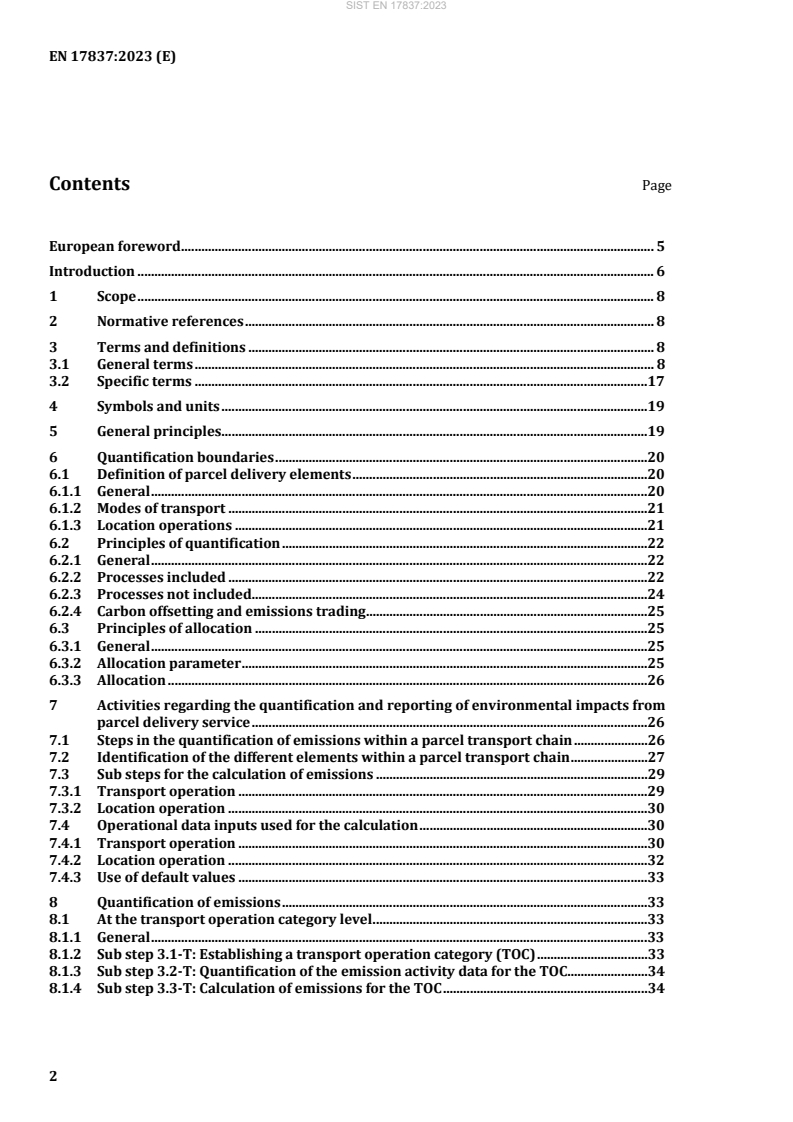
Contents Page
European foreword . 5
Introduction . 6
1 Scope . 8
2 Normative references . 8
3 Terms and definitions . 8
3.1 General terms . 8
3.2 Specific terms .17
4 Symbols and units .19
5 General principles .19
6 Quantification boundaries .20
6.1 Definition of parcel delivery elements .20
6.1.1 General .20
6.1.2 Modes of transport .21
6.1.3 Location operations .21
6.2 Principles of quantification .22
6.2.1 General .22
6.2.2 Processes included .22
6.2.3 Processes not included .24
6.2.4 Carbon offsetting and emissions trading .25
6.3 Principles of allocation .25
6.3.1 General .25
6.3.2 Allocation parameter .25
6.3.3 Allocation .26
7 Activities regarding the quantification and reporting of environmental impacts from
parcel delivery service .26
7.1 Steps in the quantification of emissions within a parcel transport chain .26
7.2 Identification of the different elements within a parcel transport chain .27
7.3 Sub steps for the calculation of emissions .29
7.3.1 Transport operation .29
7.3.2 Location operation .30
7.4 Operational data inputs used for the calculation .30
7.4.1 Transport operation .30
7.4.2 Location operation .32
7.4.3 Use of default values .33
8 Quantification of emissions .33
8.1 At the transport operation category level .33
8.1.1 General .33
8.1.2 Sub step 3.1-T: Establishing a transport operation category (TOC) .33
8.1.3 Sub step 3.2-T: Quantification of the emission activity data for the TOC.34
8.1.4 Sub step 3.3-T: Calculation of emissions for the TOC .34
8.2 At the Hub Operation Category level . 36
8.2.1 General . 36
8.2.2 Sub step 3.1-L: Establishing a Hub Operation Category (HOC) . 36
8.2.3 Sub step 3.2-L: Quantification of activity data for the HOC . 36
8.2.4 Sub step 3.3-L: Calculation of emissions for the HOC . 37
9 Allocation of emissions to parcel level . 38
9.1 Transport operation . 38
9.1.1 General . 38
9.1.2 Allocation parameters and units . 39
9.1.3 Allocation by transport operator . 42
9.1.4 Allocation by the transport service organizer . 43
9.2 Location operation . 43
9.2.1 General . 43
9.2.2 Allocation parameter. 44
9.2.3 Allocation by transport operator . 44
9.2.4 Allocation by parcel transport service organizer . 45
10 Approach to summing the results for each parcel transport chain element. 45
11 Reporting . 46
Annex A (informative) GHG emission factors . 47
A.1 General . 47
Annex B (normative) Allocation methods for combined parcel and passengers . 50
B.1 General . 50
B.2 Mass method . 50
B.3 Area method . 50
B.4 Default values . 51
Annex C (informative) Inclusion of empty trips into a TOC . 52
C.1 General . 52
C.2 Example for a simple case . 52
C.3 Example of a parcel collection and delivery round trip . 53
Annex D (informative) Template for declaration of categories of values used . 54
Annex E (informative) Example of available sources of default values . 56
Annex F (informative) Sample calculation example . 58
F.1 Calculation of air pollutant emissions . 58
F.1.1 Road transport-related air pollutant emission calculations . 58
F.1.2 Electricity-related air pollutant emission calculations . 61
F.1.3 Calculation of a parcel specific air pollutant emission values . 62
F.2 Calculation of 4 parcel specific GHG emission values . 66
F.2.1 General . 66
F.2.2 Identify HOCs and TOCs . 69
F.2.3 Quantify GHG emissions . 69
F.2.4 Allocate GHG emissions.72
F.2.5 Final Results to be reported .75
F.3 Calculation of parcel specific emission values for packaging materials .76
F.3.1 General .76
F.3.2 Identify HOCs and TOCs .76
F.3.3 Quantify GHG emissions.77
F.3.4 Allocate GHG emissions.77
F.4 Calculation of parcel specific emission values for cloud computing .78
F.4.1 General .78
F.4.2 Identify HOCs and TOCs .78
F.4.3 Quantify GHG emissions.78
F.4.4 Allocate GHG emissions.78
F.5 Calculation of parcel specific emission values for waste .79
F.5.1 General .79
F.5.2 Identify HOCs and TOCs .79
F.5.3 Quantify GHG emissions.79
F.5.4 Allocate GHG emissions.80
Bibliography .81
European foreword
This document (EN 17837:2023) has been prepared by Technical Committee CEN/TC 331 “Postal
services”, the secretariat of which is held by AFNOR.
This European Standard shall be given the status of a national standard, either by publication of an
identical text or by endorsement, at the latest by March 2024, and conflicting national standards shall be
withdrawn at the latest by March 2024.
Attention is drawn to the possibility that some of the elements of this document may be the subject of
patent rights. CEN shall not be held responsible for identifying any or all such patent rights.
Any feedback and questions on this document should be directed to the users’ national standards body.
A complete listing of these bodies can be found on the CEN website.
According to the CEN-CENELEC Internal Regulations, the national standards organisations of the
following countries are bound to implement this European Standard: Austria, Belgium, Bulgaria, Croatia,
Cyprus, Czech Republic, Denmark, Estonia, Finland, France, Germany, Greece, Hungary, Iceland, Ireland,
Italy, Latvia, Lithuania, Luxembourg, Malta, Netherlands, Norway, Poland, Portugal, Republic of North
Macedonia, Romania, Serbia, Slovakia, Slovenia, Spain, Sweden, Switzerland, Türkiye and the United
Kingdom.
Introduction
This document provides principles and rules for the quantification, allocation and reporting of
environmental impacts from parcel logistics delivery services.
Background
As the consumer product and retail sectors continuously grow and e-commerce increases, logistics
services are becoming ever more critical. Traditional logistics value chains and related business models
are also disrupted by trends in digitalisation and new fulfilment technologies. General considerations to
sustainability are growing in importance due to climate change, changing global supply chains and
increased stakeholder consciousness. Measuring the environmental impacts - along the entire value chain
from manufacturing to end of life treatment of retail goods - and implementing meaningful mitigation
measures is key in combating climate change.
To understand the environmental impacts of the e-commerce and parcel logistics and delivery sectors,
all activities in the parcel logistics and delivery service value chain should be looked at. To choose the
most effective mitigation strategies and to fully disclose the environmental impacts of parcel logistics and
delivery services, solid monitoring methodologies, data sets and standard accounting and reporting
approaches are essential.
Purpose
This Parcel Delivery Environmental Footprint (PDEF) standard aims to describe a consistent and
harmonized methodology for environmental footprinting across the supply chain of parcel logistics and
delivery services. In the first instance, it will focus on the accounting of Greenhouse gas (GHG) emissions.
At present there are a variety of standards and methodologies for emissions accounting publicly
available, but these do not focus on parcel specific accounting.
The PDEF seeks to account for the emissions of the full logistics service supply chain for a delivery
including all consequential transportation and operational activities. The standard allocates all emissions
towards each specific parcel delivered. This is achieved through the description of a standard set of data
points to be measured and a standard calculation and parcel specific allocation methodology.
The objective of this standard is to be consistent with ISO 14083 in its current working draft format .
While the PDEF is built on the existing platform of EN 16258 and is consistent with the current working
, it provides an extended scope with its nuanced parcel specific approach, covering
draft of EN ISO 14083
the entire parcel delivery value chain from collection to final delivery. Further, the PDEF also covers, as
an option, other air pollutants as well as operational and energy provision GHG emissions other than fuel,
This reflects the current need to provide more transparency about environmental impacts along complex
supply chains.
Use
The PDEF is designed to be widely applicable by parcel transport service organizers and accessible to a
diverse user group. Within this sector, it is recognized that parcel delivery service operations vary hugely,
from multi-national organizations operating multiple transport modes through to a small local operators.
Consequently, the standard balances the desire for absolute precision and scientific rigor with a degree
of pragmatism to achieve ease of use. Nonetheless, the requirements set out and guidance given are
aligned with existing standards and based on sound scientific methods.
ISO 14083:2023 Greenhouse gases — Quantification and reporting of greenhouse gas emissions arising from
transport chain operations
EN 16258 provides the basis methodology for calculation and declaration of energy consumption and GHG
emissions of transport services in the context of freight and passengers; ISO 14083 is building further on EN 16258
with inclusion of transport and hub operations
For example: EN 16258:2012, ISO 14064
Use of this standard will ensure that calculated emissions are fully accounted and allocated to a parcel. It
enables disclosures of parcel specific emissions to have greater consistency and comparability as a
foundation for more transparency enabling more sustainable parcel delivery services in the future.
Coverage
The normative part of this document covers GHG emissions associated with the transportation related
activities as well as the operational activities for a parcel to be delivered. In more detail, it includes:
— the use of vehicles (for all transportation modes) during the delivery phase in terms of core trunking
as well as first and last mile related transportation;
— all related operational and energy provision emissions from the use of and processes in logistics sites,
namely sites and buildings where the physical handling operations of parcels are carried out.
When quantifying GHG emissions, account is also taken of the GHG emissions associated with energy
processes for fuels and electricity used by vehicles and related operations infrastructure (including for
example production and distribution of fuels). In addition, empty mileage shall be considered too. As a
result, calculation results allow the consistent comparison of possible different energy sources by parcel
service providers, users, and other interested parties.
The present document also covers optional guidance on quantifying emissions related to:
— air pollutants (carbon monoxide, nitrogen oxides, particulate matters 2.5 and 10, and sulfur oxides)
associated with the use of vehicles for all transportation modes for exhaust and non-exhaust
emissions.
— other operational activities needed to fulfil the parcel delivery service, e.g. required packaging
materials (everything additional to the underlying parcel inherent packaging) provided by the parcel
transport service organizers;
— waste management from the sites of the parcel transport service organizers; and
— all related operational and energy provision emissions from related virtual processing (data
computing services).
It specifies general principles, definitions, system boundaries, calculation methods, parcel allocation rules
and data requirements, with the objective to promote standardized, accurate, credible and verifiable
declarations, regarding emissions quantified. It also includes examples on the application of the
principles.
Potential users of this document are any person or organization quantifying emissions related to a parcel
delivery service, especially parcel transport service organizers and parcel service users (e.g. consignors
and consignees).
This document presents the below elements:
— step by step guidance for quantifying emissions of parcel logistics services;
— calculation methodology for GHG emissions;
— calculation methodology for air pollutants (carbon monoxide (CO), nitrogen oxides (NOx),
particulate matters (PM) 2.5 and 10, and sulfur oxides (SOx);
— allocation rules per item (parcel); and
— reporting frameworks and data to be shared with business customers or consignees.
1 Scope
This document establishes a common methodology for the calculation, allocation and declaration of
Greenhouse gases (GHGs) as well as air pollutant emissions related to any parcel delivery service.
It only covers a part of the entire retail value chain. The retail value chain usually consists of creating the
product, storing the inventory, distributing the goods and making the product available for consumers.
This document includes only the distribution of goods but considers the entire value chain of the parcel
transportation process flow, namely the collection and delivery rounds, the trunking and the operations
due to processing and the physical handling of parcels. See Figure 1 below for a graphical illustration.
Key
C Collection Depot (Aggregation)
H Hub
T Transport
D Delivery Depot (Dis-aggregation/Distribution)
Figure 1 — Overview of parcel delivery operations
2 Normative references
There are no normative references in this document.
3 Terms and definitions
For the purposes of this document, the following terms and definitions apply.
ISO and IEC maintain terminology databases for use in standardization at the following addresses:
— ISO Online browsing platform: available at https://www.iso.org/obp
— IEC Electropedia: available at https://www.electropedia.org
3.1 General terms
3.1.1
allocation
partitioning the input or output flows of a process or a product system between the product system under
study and one or more other product systems
Note 1 to entry: In this context, partitioning of GHG emissions to the parcel.
[SOURCE: EN ISO 14040:2006, 3.17, modified — Note 1 to entry has been added.]
3.1.2
air pollution
presence of contaminant or pollutant substances in the air at a concentration that interferes with human
health or welfare or produces other harmful environmental effects
[SOURCE: https://www.eea.europa.eu/help/glossary/eea-glossary]
3.1.3
air pollutant
any pollutant agent or combination of such agents, including any physical, chemical, biological,
radioactive substance or matter which is emitted into or otherwise enters the ambient air and can, in high
enough concentrations, harm humans, animals, vegetation or material
Note 1 to entry: Air pollutants is a term which then describes an air pollutant for which acceptable levels of
exposure can be determined and for which an ambient air quality standard has been set. Examples include: carbon
monoxide, nitrogen dioxide, sulfur dioxide, and particulate matters.
Note 2 to entry: This document considers carbon monoxide (CO), nitrogen oxides (NOx), particulate matters
(PM2.5 and PM10) and sulfur oxides (SOx).
[SOURCE: https://www.eea.europa.eu/help/glossary/eea-glossary]
3.1.4
air pollutant activity data
quantitative measure of activity that results in the production or removal of air pollutants to or from the
atmosphere. For transport operations this is primarily the combustion of fossil fuels or other type of
energy consumption
3.1.5
booked transport service
agreement to carry goods in a specified manner between specified origin and destination locations
Note 1 to entry: For a cargo service this would be accompanied by the cargo unit’s gross mass (in (kg) or (tonne))
and the distance between dispatching and receiving locations (indicated as zip codes, IATA codes, UN LoCodes or
geo data) carried on the various chosen means of transport.
3.1.6
carbon dioxide equivalent
CO e
CO e (also written as carbon dioxide equivalent, CO equivalent or CO eq) is a metric measure that is used
2 2 2
to compare emissions from various greenhouse gases on the basis of their global-warming potential
(GWP), by converting amounts of other gases to the equivalent amount of CO
[SOURCE: Eurostat, https://ec.europa.eu/eurostat/statistics-
explained/index.php?title=Glossary:Carbon_dioxide_equivalent]
3.1.7
carbon offsetting
mechanism for compensating for carbon emissions of a process through the prevention of the release of,
reduction in, or removal of, an equivalent amount of GHG emissions outside the boundary of that process,
provided such prevention, removal or reduction are quantified, permanent and additional to a business-
as-usual scenario
[SOURCE: EN ISO 14067:2018, 3.1.1.7, modified]
3.1.8
cargo
collection / quantity of goods (carried on a means of transport) transported from one place to another
Note 1 to entry: Cargo can consist of either liquid or solid materials or substances, without any packaging (e.g. bulk
cargo), or of loose items of unpacked goods, parcels, unitised goods (on pallets or in containers) or goods loaded on
transport units and carried on active means of transport.
[SOURCE: EN 14943:2005, 3.151, modified]
3.1.9
collection and delivery round
journey normally, but not necessarily, starting and ending at the same location, with the purpose to
collect and/or deliver one or more consignment/parcel in different locations during the course of the
journey
3.1.10
consignment
separately identifiable amount of freight or parcel transported from one consignor to one consignee via
one or more modes of transport
Note 1 to entry: Although consignment and shipment are common terms often considered as synonyms, in this
document and other technical publications, a consignment is differentiated to a shipment. Indeed, a shipment refers
to a grouping of freight corresponding to the shipper needs, whereas a consignment refers a grouping of freight
according to a carrier or freight forwarder’s transport solutions.
[SOURCE: EN ISO 14064-3:2019, modified]
3.1.11
distance
distance between two locations (origin, destination) that could either be actual distance covered or
network or planned distance
3.1.11.1
actual distance
distance along the actual route taken by a vehicle
Note 1 to entry: Distance measured by an on-board device (odometer)
3.1.11.2
network distance
distance between two locations where there is a strict limitation in the possible routes due to the
available infrastructure options
3.1.11.3
planned distance
distance of the shortest route between two locations according to the respective infrastructure and
operational constraints for the journey and transport modes
3.1.11.4
shortest feasible distance
SFD
DEPRECATED: planned distance, network distance
transport distance (3.1.27) determined as the distance achievable by the shortest practical route
available according to the infrastructure options for a particular vehicle (3.1.35) type
Note 1 to entry: “Shortest practical route” implies that small detours from the shortest distance, for example to
avoid congested city centres or rural roads unsuitable for certain vehicle (3.1.34) sizes, can be included.
3.1.12
empty trip
section of the route of a vehicle during which no freight or parcel is transported
EXAMPLE (Re)positioning trips and empty backhauls are examples of empty trips.
3.1.13
energy
electricity, fuels, steam, heat, compressed air and other similar media
Note 1 to entry: For the purposes of this document, energy refers to the various types of energy, including
renewable, which can be purchased, stored, treated, used in an equipment or in a process, or recovered.
[SOURCE: EN ISO 50001:2018, 3.5.1]
3.1.14
energy carrier
substance or phenomenon that can be used to transfer energy or to operate chemical or physical
processes
EXAMPLE Such as electricity, combustible fuels, steam, heat and compressed air.
[SOURCE: ISO 13600:1997, 2.5, modified — EXAMPLE has been added.]
3.1.15
energy consumption
quantity of energy applied
[SOURCE: EN ISO 50001:2018, 3.5.2]
3.1.16
energy factor
factor relating activity data to energy consumption
3.1.17
energy provision emissions
GHG emissions released to atmosphere during the process of producing, storing, processing and
distributing an energy carrier for an equipment or vehicle operation
3.1.18
freight
goods being transported from one location to another
EXAMPLE Examples of goods are materials, commodities, parcels, etc.
[SOURCE: EN 14943:2005, 3.437, modified — EXAMPLE has been added.]
3.1.19
fuel consumption
quantity of fuel (as an energy carrier) used
Note 1 to entry: For reasons of simplification, this definition includes all energy carriers, such as electricity.
Note 2 to entry: Fuel consumption should be expressed in most commonly understood units for each type of fuel,
whilst respecting scientific principles for accuracy of the calculation; normally this would mean volume (litres or
gallons) for liquid fuels, mass for gaseous fuels and kWh for electricity.
Note 3 to entry: For transport using electric traction, the fuel consumption is the total quantity of energy supplied
minus any energy returned by the vehicle and subsequently transmitted back to the energy grid or to other vehicles,
when vehicles are used as distributed power sources. Energy is returned (to the contact line) when electric traction
has regenerative braking or other types of reused energy such as waste heat recovery systems. The energy
generated during braking may be stored on the vehicle in question, or in shared systems such as rail transport may
be made available to other consumers connected to the contact line.
3.1.20
fuel emission factor
factors that relate the emissions produced to the amount of a specific fuel that is consumed
Note 1 to entry: Depending on its nature, a fuel may have a factor for both operational and energy provision.
Note 2 to entry: Depending on the production process, what are nominally the same fuels at point of use may have
different energy provision emission factors.
Note 3 to entry: Fuel emission factors should include both emissions that result from the feedstock production,
transformation and distribution processes and, where applicable (e.g. some biofuels), a consequential approach to
induced land use change.
Note 4 to entry: See Annex A for details on Energy and Emissions Factors.
3.1.21
global warming potential
GWP
index, based on radiative properties of GHGs (3.1.22), measuring the radiative forcing following a pulse
emission of a unit mass of a given GHG in the present-day atmosphere integrated over a chosen time
horizon, relative to that of carbon dioxide (CO )
[SOURCE: EN ISO 14064-1:2019, modified]
3.1.22
greenhouse gas
GHG
gaseous constituent of the atmosphere, both natural and anthropogenic, that absorbs and emits radiation
at specific wavelengths within the spectrum of infrared radiation emitted by the earth’s surface, the
atmosphere, and clouds
Note 1 to entry: For a list of greenhouse gases, see latest Intergovernmental Panel on Climate Change (IPCC)
Assessment Report. In this standard, GHGs are limited to, carbon dioxide (CO2), methane (CH4), nitrous oxide (N2O),
hydrofluorocarbons (HFCs), perfluorocarbons (PFCs) and sulfur hexafluoride (SF6).
[SOURCE: EN ISO 14064-1:2019, 3.1.1, modified — Note 1 to entry, text added: In this standard, GHGs are
limited to, carbon dioxide (CO ), methane (CH ), nitrous oxide (N O), hydrofluorocarbons (HFCs),
2 4 2
perfluorocarbons (PFCs) and sulfur hexafluoride (SF ). Note 2 to entry has been removed.]
3.1.23
greenhouse gas activity
GHG activity
activity that results in a greenhouse gas (3.1.22) emission
EXAMPLE Consumption of energy, refrigerant leakage, methane slip
3.1.24
greenhouse gas activity data
GHG activity data
quantitative measure of GHG activity (3.1.23)
[SOURCE: EN ISO 14064-1:2019, 3.2.1, modified — “or GHG removal” deleted, EXAMPLE replaced and
moved to GHG activity.]
3.1.25
GHG emission intensity factor
value relating GHG emissions to an activity, also including a coefficient relating GHG activity data with the
GHG emission
EXAMPLE For example, expressed as:
— mass CO2e per tonne kilometre, or equivalent units, for (aggregated) parcel transportation;
— mass CO e per parcel for a depot parcel throughput.
3.1.26
load
quantity or nature, by mass, of whatever is being transported (cargo and/or parcel)
[SOURCE: EN 14943:2005, 3.564, modified]
3.1.27
load carrier
means for the creation of load or storage units with carrying function or with carrying and encasing
function or with carrying, encasing and closing function
EXAMPLE For example, pallet as carrying function; box pallet with carrying and encasing function; and
container with carrying, encasing and closing function.
3.1.28
load factor
ratio of the actual load to the maximum legally authorized load of a particular vehicle
3.1.29
logistic site
the area where parcels are processed, sorted, packaged, handled and/or stored at an intermediate
destination prior to being transferred to a means of transport
3.1.30
location operator
entity responsible for or managing a logistics site
3.1.31
means of transport
particular vessel, vehicle, or other mobile device used for the transport of parcel and/or freight
[SOURCE: EN 14943:2005, 3.631, modified]
3.1.31.1
air transport
any movement of goods and/or passengers carried out by a machine that can derive support in the
atmosphere from the reactions of the air other than the reactions of air against the earth’s surface
Note 1 to entry: Transport includes all flight stages (positioning, take-off, cruising, landing and parking) for drones
and aircraft movement between the place of loading and unloading
3.1.31.2
inland water transport
movement of goods and/or passengers carried out by any floating marine structure with one or more
surface displacement hulls, along a stretch of water not part of the sea
EXAMPLE Navigable rivers, lakes, canals and estuaries, which is suitable for navigation, primarily by inland
waterways vessels.
3.1.31.3
rail transport
movement of goods and/or passengers carried out by equipment capable of running on rails either under
its own power (tractive vehicles) or hauled by another vehicle (coaches, railcar trailers, vans and wagons)
between a place of loading and unloading
Note 1 to entry: Shunting and train formation processes may form part of the rail emissions, depending on the
detail of how the activities are organized and the entity that is responsible.
3.1.31.4
road transport
movement of goods and/or passengers carried out by any vehicles running on wheels and intended for
use on roads, on a given road network between a place of loading and unloading
3.1.31.5
sea transport
transport by sea, sea transport, or ocean transport, is defined as any movement of goods and/or
passengers carried out by vessels, including any floating marine structure with one or more surface
displacement hulls undertaken wholly or primarily at sea
3.1.32
operational emission
Emissions released to atmosphere as a result of equipment or vehicle operation
3.1.33
parcel
postal item containing goods with or without commercial value, other than an item of correspondence,
with a weight not exceeding 31,5 kg
[SOURCE: Cross border parcel delivery services regulation (EU 2018/644)]
3.1.34
postal item
item addressed in the final form in which it is to be carried by a postal service provider
Note 1 to entry: In addition to items of correspondence, such items also include for instance books, catalogues,
newspapers, periodicals and postal parcels containing merchandise with or without commercial value.
[SOURCE: Postal Services Directive; Directive 97/67/EC amended by Directive 2002/39/EC and
Directive 2008/6/EC]
3.1.35
process
activity involving the carriage of consignments or activities that enable or support the transport of
consignments, which consumes energy, material and refrigerants and/or generates waste and/or emits
GHG
3.1.36
refrigerants
gases used in refrigeration and air conditioning systems that are listed as greenhouse gases to the United
Nations Framework Convention on Climate Change with related emission factors
3.1.37
round trip
a group of sequential journeys that start and end in the same place
3.1.38
route
path (to be) taken to get from a starting point to a point of destination
[SOURCE: EN 14943:2005, 3.964, modified]
3.1.39
shipment
identifiable collection of one or more freight items (available to be) transported together from the
original shipper to the ultimate consignee
Note 1 to entry: A shipment may be transported in one or a multiple number of consignments.
Note 2 to entry: A shipment can be aggregated or disaggregated to different consignments according to the
requirements of the means of transportation on any one element of the transport chain, e.g. single bulk units and
packages can be aggregated on a pallet and such pallet can be handed over as a unit for aggregation in a container,
which in turn is treated as a consignment in a vehicle.
Note 3 to entry: Although consignment and shipment are common terms often considered as synonyms, in this
document and other technical publications, a consignment is differentiated to a shipment. Indeed, a shipment refers
to a grouping of freight corresponding to the shipper needs, whereas a consignment refers a grouping of freight
according to a carrier or freight forwarder’s transport solutions.
[SOURCE: ISO 26683-1:2013, 3.34, modified]
3.1.40
throughput
quantity of passengers or freight handled, sorted, cross-docked, or transferred within and between
modes at a location
3.1.41
transport
assisted movement of parcel and/or freight
Note 1 to entry: The term transport in general is used for movement supported by means.
[SOURCE: EN 14943:2005, 3.1157, modified]
3.1.42
transport operator
entity that carries out transport operations i
...