


EN 13757-4:2025
(Main)Communication systems for meters - Part 4: Wireless M-Bus communication
General Information
- Abstract
This document specifies the requirements of parameters for the physical and the link layer for systems using radio to remotely read meters. The primary focus is to use the Short Range Device (SRD) unlicensed bands. This document encompasses systems for walk-by, drive-by and fixed installations. As a broad definition, this document can be applied to various Application Layers.
- Status
- Published
- Publication Date
- 09-Dec-2025
- Technical Committee
- CEN/TC 294 - Communication systems for meters and remote reading of meters
- Drafting Committee
- CEN/TC 294/WG 5 - Radio meter data exchange
- Current Stage
- 6060 - Definitive text made available (DAV) - Publishing
- Start Date
- 10-Dec-2025
- Due Date
- 13-Feb-2026
- Completion Date
- 10-Dec-2025



Overview
EN 13757-4:2025 - Communication systems for meters, Part 4: Wireless M-Bus communication - defines radio-based physical layer and data link layer requirements for remote meter reading. The standard focuses on operation in Short Range Device (SRD) unlicensed bands and covers implementations for walk-by, drive-by and fixed installations. It is the national adoption of EN 13757-4 (2025) and forms the wireless foundation for smart metering and telemetry systems.
Key topics and technical requirements
This standard specifies mandatory and recommended parameters for reliable Wireless M-Bus operation, including:
- Physical layer specifications
- Channel properties, transmitter and receiver requirements
- Data encoding, preamble and synchronization patterns
- Multiple operating modes (Mode S, Mode T, Mode R2, Mode C, Mode N, Mode F) with mode-specific timing and sensitivity requirements
- Data Link Layer
- Frame formats (Frame format A and B), order of multi-byte fields, length/control/addressing fields
- CRC and error detection, Forward Error Correction (FEC) options
- Timing, access control, repeated/duplicate message handling
- Protocol extension features
- Control Information fields (CI-field) and extended link-layer constructs
- Transport and management functions: session numbers, access numbers, runtime delay, reception level reporting
- Security mechanisms referenced (e.g., AES-128 Counter Mode encryption for payload protection)
- Implementation details
- Field definitions (Manufacturer ID, Address fields), multi-layer interfacing and mapping to higher protocol layers
Practical applications and who uses this standard
EN 13757-4:2025 is essential for organizations implementing wireless meter communications, such as:
- Utility companies deploying smart metering, AMR/AMI and telemetry systems
- Meter and module manufacturers designing Wireless M-Bus devices for gas, water, heat and electricity meters
- System integrators and network operators building walk-by, drive-by, or fixed-read collection solutions
- Test laboratories and certification bodies validating compliance with physical/link-layer requirements
- Regulators and procurement teams specifying interoperability and RF-spectrum compliance within SRD bands
Related standards
- EN 13757 series (other parts address application-, transport- and management-layer aspects)
- Regional SRD/short-range radio regulations and national frequency allocation rules
EN 13757-4:2025 is a practical specification for secure, interoperable Wireless M-Bus deployments - covering RF behavior, link-layer framing, timing and error-control mechanisms critical to robust meter communications. Keywords: EN 13757-4:2025, Wireless M-Bus, communication systems for meters, SRD unlicensed bands, physical layer, data link layer, walk-by, drive-by, fixed installations, smart metering.
Relations
- Effective Date
- 14-Dec-2022
- Effective Date
- 09-Feb-2026
- Effective Date
- 09-Feb-2026
- Effective Date
- 28-Jan-2026
- Effective Date
- 28-Jan-2026
- Effective Date
- 28-Jan-2026
- Effective Date
- 28-Jan-2026
- Effective Date
- 28-Jan-2026
- Effective Date
- 28-Jan-2026
- Effective Date
- 28-Jan-2026
- Effective Date
- 28-Jan-2026
Get Certified
Connect with accredited certification bodies for this standard

BSI Group
BSI (British Standards Institution) is the business standards company that helps organizations make excellence a habit.

NYCE
Mexican standards and certification body.

ANCE
Mexican certification and testing association.
Sponsored listings
Frequently Asked Questions
EN 13757-4:2025 is a standard published by the European Committee for Standardization (CEN). Its full title is "Communication systems for meters - Part 4: Wireless M-Bus communication". This standard covers: This document specifies the requirements of parameters for the physical and the link layer for systems using radio to remotely read meters. The primary focus is to use the Short Range Device (SRD) unlicensed bands. This document encompasses systems for walk-by, drive-by and fixed installations. As a broad definition, this document can be applied to various Application Layers.
This document specifies the requirements of parameters for the physical and the link layer for systems using radio to remotely read meters. The primary focus is to use the Short Range Device (SRD) unlicensed bands. This document encompasses systems for walk-by, drive-by and fixed installations. As a broad definition, this document can be applied to various Application Layers.
EN 13757-4:2025 is classified under the following ICS (International Classification for Standards) categories: 33.200 - Telecontrol. Telemetering; 35.100.10 - Physical layer; 35.100.20 - Data link layer. The ICS classification helps identify the subject area and facilitates finding related standards.
EN 13757-4:2025 has the following relationships with other standards: It is inter standard links to EN 13757-4:2019, EN 60870-5-1:1993, EN 60870-5-2:1993, EN 13757-7:2025, EN 13757-1:2021, EN 13757-3:2025, EN 13757-3:2018, EN 13757-3:2013, EN 1434-3:2025, EN 1434-3:2015, EN 16314:2013. Understanding these relationships helps ensure you are using the most current and applicable version of the standard.
EN 13757-4:2025 is associated with the following European legislation: Standardization Mandates: M/441. When a standard is cited in the Official Journal of the European Union, products manufactured in conformity with it benefit from a presumption of conformity with the essential requirements of the corresponding EU directive or regulation.
EN 13757-4:2025 is available in PDF format for immediate download after purchase. The document can be added to your cart and obtained through the secure checkout process. Digital delivery ensures instant access to the complete standard document.
Standards Content (Sample)
SLOVENSKI STANDARD
01-februar-2026
Komunikacijski sistemi za števce - 4. del: Brezžično komuniciranje po M-vodilu
Communication systems for meters - Part 4: Wireless M-Bus communication
Kommunikationssysteme für Zähler - Teil 4: Drahtlose M-Bus-Kommunikation
Systèmes de communication pour compteurs - Partie 4 : Communication sans fil M-Bus
Ta slovenski standard je istoveten z: EN 13757-4:2025
ICS:
33.200 Daljinsko krmiljenje, daljinske Telecontrol. Telemetering
meritve (telemetrija)
35.100.10 Fizični sloj Physical layer
35.100.20 Podatkovni povezovalni sloj Data link layer
2003-01.Slovenski inštitut za standardizacijo. Razmnoževanje celote ali delov tega standarda ni dovoljeno.
EN 13757-4
EUROPEAN STANDARD
NORME EUROPÉENNE
December 2025
EUROPÄISCHE NORM
ICS 33.200 Supersedes EN 13757-4:2019
English Version
Communication systems for meters - Part 4: Wireless M-
Bus communication
Systèmes de communication pour compteurs - Partie 4 Kommunikationssysteme für Zähler - Teil 4: Drahtlose
: Communication sans fil M-Bus M-Bus-Kommunikation
This European Standard was approved by CEN on 10 November 2025.
CEN members are bound to comply with the CEN/CENELEC Internal Regulations which stipulate the conditions for giving this
European Standard the status of a national standard without any alteration. Up-to-date lists and bibliographical references
concerning such national standards may be obtained on application to the CEN-CENELEC Management Centre or to any CEN
member.
This European Standard exists in three official versions (English, French, German). A version in any other language made by
translation under the responsibility of a CEN member into its own language and notified to the CEN-CENELEC Management
Centre has the same status as the official versions.
CEN members are the national standards bodies of Austria, Belgium, Bulgaria, Croatia, Cyprus, Czech Republic, Denmark, Estonia,
Finland, France, Germany, Greece, Hungary, Iceland, Ireland, Italy, Latvia, Lithuania, Luxembourg, Malta, Netherlands, Norway,
Poland, Portugal, Republic of North Macedonia, Romania, Serbia, Slovakia, Slovenia, Spain, Sweden, Switzerland, Türkiye and
United Kingdom.
EUROPEAN COMMITTEE FOR STANDARDIZATION
COMITÉ EUROPÉEN DE NORMALISATION
EUROPÄISCHES KOMITEE FÜR NORMUNG
CEN-CENELEC Management Centre: Rue de la Science 23, B-1040 Brussels
© 2025 CEN All rights of exploitation in any form and by any means reserved Ref. No. EN 13757-4:2025 E
worldwide for CEN national Members.
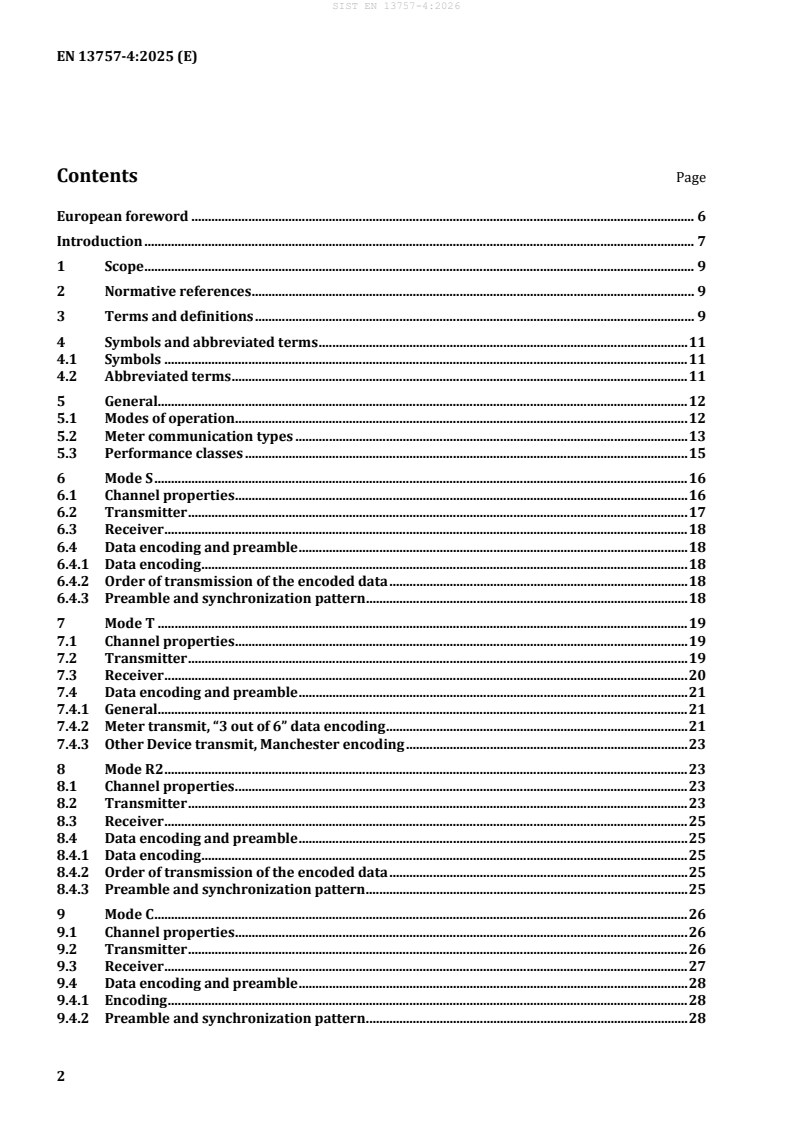
Contents Page
European foreword . 6
Introduction . 7
1 Scope . 9
2 Normative references . 9
3 Terms and definitions . 9
4 Symbols and abbreviated terms . 11
4.1 Symbols . 11
4.2 Abbreviated terms . 11
5 General. 12
5.1 Modes of operation. 12
5.2 Meter communication types . 13
5.3 Performance classes . 15
6 Mode S . 16
6.1 Channel properties . 16
6.2 Transmitter . 17
6.3 Receiver . 18
6.4 Data encoding and preamble . 18
6.4.1 Data encoding . 18
6.4.2 Order of transmission of the encoded data . 18
6.4.3 Preamble and synchronization pattern . 18
7 Mode T . 19
7.1 Channel properties . 19
7.2 Transmitter . 19
7.3 Receiver . 20
7.4 Data encoding and preamble . 21
7.4.1 General. 21
7.4.2 Meter transmit, “3 out of 6” data encoding . 21
7.4.3 Other Device transmit, Manchester encoding . 23
8 Mode R2 . 23
8.1 Channel properties . 23
8.2 Transmitter . 23
8.3 Receiver . 25
8.4 Data encoding and preamble . 25
8.4.1 Data encoding . 25
8.4.2 Order of transmission of the encoded data . 25
8.4.3 Preamble and synchronization pattern . 25
9 Mode C . 26
9.1 Channel properties . 26
9.2 Transmitter . 26
9.3 Receiver . 27
9.4 Data encoding and preamble . 28
9.4.1 Encoding . 28
9.4.2 Preamble and synchronization pattern . 28
10 Mode N . 28
10.1 Channel properties . 28
10.2 Physical link parameters . 30
10.3 Receiver sensitivity . 32
10.4 Data encoding and preamble. 32
10.4.1 Encoding. 32
10.4.2 Preamble and synchronization pattern . 33
11 Mode F . 33
11.1 Channel properties . 33
11.2 Physical link parameters . 33
11.3 Receiver sensitivity . 34
11.4 Data encoding and preamble. 35
11.4.1 Data Encoding . 35
11.4.2 Preamble and synchronization pattern . 35
12 Data Link Layer . 35
12.1 General . 35
12.2 Order of multi byte fields . 35
12.3 Frame format A . 36
12.4 Frame format B . 36
12.5 Field definitions . 37
12.5.1 General . 37
12.5.2 Multi byte fields . 37
12.5.3 Length field (L-Field) . 37
12.5.4 Control field (C-Field) . 37
12.5.5 Manufacturer ID (M-field) . 39
12.5.6 Address (A-field) . 39
12.5.7 Cyclic redundancy check (CRC-field) . 40
12.5.8 Control information field (CI-field) . 40
12.6 Timing . 40
12.6.1 Timing for installation messages . 40
12.6.2 Synchronous transmissions of meter messages . 41
12.6.3 Access timing . 43
12.7 Repeated or duplicate messages . 44
12.8 Forward error correction (FEC) . 44
12.8.1 Overview . 44
12.8.2 Datagram structure . 44
12.8.3 FEC Algorithm . 45
13 Connection to higher protocol layers . 46
13.1 The Control information field (CI-field) . 46
13.2 CI-fields for the Extended Link Layer . 48
13.2.1 General . 48
13.2.2 CI-field = 8C . 48
h
13.2.3 CI-field = 8D . 48
h
13.2.4 CI-field = 8E . 49
h
13.2.5 CI-field = 8F . 49
h
13.2.6 CI-field = 86 . 49
h
13.2.7 Communication Control Field (CC-field) . 50
13.2.8 Access Number Field (ACC-field) . 52
13.2.9 Manufacturer ID 2 (M2-field) . 52
13.2.10 Address 2 (A2-field) . 52
13.2.11 Session Number Field (SN-field) . 52
13.2.12 AES-128 Counter Mode Encryption . 53
13.2.13 Run Time Delay field (RTD-field) . 54
13.2.14 Reception Level field (RXL-field) . 55
13.2.15 Payload Checksum Field (PayloadCRC-field) . 56
13.3 CI-fields for the Transport Layer . 57
13.3.1 General. 57
13.3.2 Short Transport Layer . 57
13.3.3 Long Transport Layer . 57
14 Management functions for link control . 57
14.1 General. 57
14.2 Set Radio Parameters . 61
14.2.1 General. 61
14.2.2 Command . 61
14.2.3 Response . 64
14.3 Get Radio Parameters . 67
14.3.1 General. 67
14.3.2 Command . 67
14.3.3 Response . 67
14.4 Set limited radio parameters . 69
14.4.1 General. 69
14.4.2 Command . 69
14.4.3 Response . 71
14.5 Confirm Radio Parameters . 71
14.5.1 General. 71
14.5.2 Command . 71
14.5.3 Response . 72
14.6 Set manufacturer specific parameters . 73
14.6.1 General. 73
14.6.2 Command . 73
14.6.3 Response . 74
Annex A (informative) Frequency allocation and transmit power for the 868 MHz band . 75
Annex B (informative) Frequency allocation for the 169 MHz band . 76
B.1 Frequencies and allowed power levels . 76
B.2 Frequencies and corresponding maximum duty cycles . 76
Annex C (informative) Frame examples . 78
C.1 Example of a frame from a meter in mode S . 78
C.1.1 Conditions . 78
C.1.2 Block content . 78
C.1.3 Bit string . 79
C.2 Example of a frame from a meter in mode T1 . 79
C.2.1 Condition . 79
C.2.2 Block Content . 80
C.2.3 Bit string . 80
C.3 Example of a frame from a meter in mode C1 . 81
C.3.1 Conditions . 81
C.3.2 Block content. 81
C.3.3 Bit string . 82
Annex D (informative) Example of predictive reception of synchronous messages . 83
Annex E (informative) Timing diagrams . 84
Annex F (informative) Counter Mode Flow . 103
Bibliography . 104
European foreword
This document (EN 13757-4:2025) has been prepared by Technical Committee CEN/TC 294
“Communication systems for meters”, the secretariat of which is held by DIN.
This European Standard shall be given the status of a national standard, either by publication of an
identical text or by endorsement, at the latest by June 2026, and conflicting national standards shall be
withdrawn at the latest by June 2026.
This document supersedes EN 13757-4:2019.
EN 13757-4:2024 includes the following significant technical changes with respect to EN 13757-
4:2019:
— Update of referenced standards to the most recent versions;
— Including of sensors and actuators used as a part of providing metering services;
— Removal of Lowest Transmitter Class L and Lowest Receiver Class L , see 5.3, 6.3, 7.3, 8.3, 9.3 and
T R
10.3;
— Removal of Digital bit jitter, see 6.2, 7.2 and 8.2;
— Explanatory note on addressing, see 12.5.6;
— Extension of installation messages schemes, see 12.6.1;
— Introduction of FAC transmission delay, see 14.2.2, 14.3.3 and 14.4.2;
— Introduction of Error2 reporting, see 14.2.3 and 14.4.3;
— SF2 field is populated, see 14.3.3.3;
— Updated frequency allocation for the 868 MHz band, align format with Annex B see Annex A.
This document has been prepared under a standardization request addressed to CEN by the European
Commission. The Standing Committee of the EFTA States subsequently approves these requests for its
Member States.
Any feedback and questions on this document should be directed to the users’ national standards body.
A complete listing of these bodies can be found on the CEN website.
According to the CEN-CENELEC Internal Regulations, the national standards organisations of the
following countries are bound to implement this European Standard: Austria, Belgium, Bulgaria,
Croatia, Cyprus, Czech Republic, Denmark, Estonia, Finland, France, Germany, Greece, Hungary, Iceland,
Ireland, Italy, Latvia, Lithuania, Luxembourg, Malta, Netherlands, Norway, Poland, Portugal, Republic of
North Macedonia, Romania, Serbia, Slovakia, Slovenia, Spain, Sweden, Switzerland, Türkiye and the
United Kingdom.
Introduction
This document belongs to the EN 13757 series, which covers communication systems for meters.
EN 13757-1 contains generic descriptions and a communication protocol.
EN 13757-2 contains a physical and a link layer for twisted pair based Meter-Bus (M-Bus).
EN 13757-3 describes the Application Layer protocols (often called M-Bus).
EN 13757-5 describes the wireless network used for repeating, relaying, and routing for the different
modes of EN 13757-4.
EN 13757-7 describes transport and security services.
EN 13757-8 describes the Adaptation Layer to be applied for wireless communication other than
wireless M-Bus
These upper M-Bus protocol layers can be used with various physical layers and with link layers and
network layers, which support the transmission of variable length binary transparent messages.
Frequently, the physical and link layers of EN 13757-2 (twisted pair) and EN 13757-4 (wireless) as well
as EN 13757-5 (wireless with routing function) or the alternatives described in EN 13757-1 are used.
The different parts of this standard are complemented by CEN/TR 17167, which provides examples and
supplementary information related to EN 13757-2, EN 13757-3 and EN 13757-7.
These upper M-Bus protocol layers have been optimized for minimum battery consumption of meters,
especially for the case of wireless communication, to ensure long battery lifetimes of the meters.
Secondly, it is optimized for minimum message length to minimize the radio channel occupancy and
hence the collision rate. Thirdly, it is optimized for minimum requirements towards the meter
processor regarding requirements of RAM size, code length and computational power.
This document concentrates on the meter communication. The meter communicates with one (or
occasionally several) fixed or mobile communication partners which again might be part of a private or
public network. These further communication systems might use the same or other Application Layer
protocols, security, privacy, authentication, and management methods.
This document is not affected by any of the requirements in Directive 2004/22/EC as it only covers the
basic transmission of information from the meter to an external entity. This document ensures that data
transmitted cannot be modified without it being detected. Confidentiality, integrity, and authenticity are
provided by the capabilities specified in other parts of the EN 13757 series of standards. This document
does not specify any of the metering capabilities of the meter nor the metrological capabilities of the
meter.
This document enables encrypted transfer data either directly or as specified in other parts of the
EN 13757 series of standards. The encryption ensures the confidentiality of any personal data.
This document provides capabilities of interoperability of meters as requested in M/441 which can be
used to improve the customer awareness of actual consumption.
European Committee for Standardization (CEN) draws attention to the fact that it is claimed that
compliance with this document may involve the use of a patent concerning forward error correction
(FEC) given in 12.8.
CEN takes no position concerning the evidence, validity, and scope of this patent right. The holder of
this patent right has ensured CEN that they are willing to negotiate licences under reasonable and non-
discriminatory terms and conditions with applicants throughout the world. In this respect, the
statement of the holder of this patent right is registered with CEN. Information may be obtained from:
Kamstrup A/S
IP Manager
Industrivej 28, Stilling
8660 Skanderborg
Denmark
ipr@kamstrup.com
Attention is drawn to the possibility that some of the elements of this document may be the subject of
patent rights other than those identified above. CEN shall not be held responsible for identifying any or
all such patent rights.
1 Scope
This document specifies the requirements of parameters for the physical and the link layer for systems
using radio to remotely read meters. The primary focus is to use the Short Range Device (SRD)
unlicensed bands. This document encompasses systems for walk-by, drive-by and fixed installations. As
a broad definition, this document can be applied to various Application Layers.
2 Normative references
The following documents are referred to in the text in such a way that some or all of their content
constitutes requirements of this document. For dated references, only the edition cited applies. For
undated references, the latest edition of the referenced document (including any amendments) applies.
EN 13757-1, Communication systems for meters - Part 1: Data exchange
EN 13757-3:2025, Communication systems for meters - Part 3: Application protocols
EN 13757-7:2025, Communication systems for meters - Part 7: Transport and security services
EN 60870-5-1, Telecontrol equipment and systems - Part 5: Transmission protocols - Section 1:
Transmission frame formats(IEC 60870-5-1)
EN 60870-5-2, Telecontrol equipment and systems - Part 5: Transmission protocols - Section 2: Link
transmission procedures(IEC 60870-5-2)
ETSI EN 300 220-1, V3.1.1:2017-02, Short Range Devices (SRD) operating in the frequency range 25 MHz
to 1 000 MHz — Part 1: Technical characteristics and methods of measurement
ETSI EN 300 220-2, Short Range Devices (SRD) operating in the frequency range 25 MHz to 1 000 MHz —
Part 2: Harmonised Standard for access to radio spectrum for non specific radio equipment
ETSI EN 300 220-4, Short Range Devices (SRD) operating in the frequency range 25 MHz to 1 000 MHz —
Part 4: Harmonised Standard covering the essential requirements of article 3.2 of Directive 2014/53/EU;
Metering devices operating in designated band 169,400 MHz to 169,475 MHz
CCSDS 131.0-B-5, TM Synchronization and Channel Coding, Consultative Committee for Space Data
Systems (CCSDS), Issue-5, September 2023
ERC/REC 70-03, Relating to the use of Short Range Devices (SRD), issued by the European Conference
of Postal and Telecommunications Administrations (CEPT), Electronics Communications Committee on
2024-06
3 Terms and definitions
For the purposes of this document, the following terms and definitions apply.
ISO and IEC maintain terminology databases for use in standardization at the following addresses:
— ISO Online browsing platform: available at https://www.iso.org/obp/
— IEC Electropedia: available at https://www.electropedia.org/
3.1
BER
bit error rate
3.2
FEC
forward error correction
3.3
frame
unit of transmission at the Data Link Layer
3.4
FSK
frequency shift keying
3.5
Gateway
Other Device with data connection outside the metering network
3.6
GFSK
gaussian frequency shift keying
3.7
individual transmission interval
exact time between two subsequent synchronous or periodical transmissions which changes with each
transmission
3.8
LSB
least significant byte
3.9
LSBit
least significant bit
3.10
message
set of data at the Application Layer
3.11
meter
measuring device for water or energy consumption,
Note 1 to entry: This part of the standard defines only the lower communication layers of the metering system.
Here the term meter also includes sensors and actuators used to provide metering services.
3.12
MSB
most significant byte
3.13
MSBit
most significant bit
3.14
nominal transmission interval
average transmission interval between all synchronous or periodical messages (new, old or no data
content) for wireless meters
3.15
NRZ
non-return-to-zero
3.16
Other Device
device exchanging information with a meter
Note 1 to entry: A repeater is not an Other Device, as it is not exchanging information but just passing it on. A
communications controller (Gateway) is an Other Device. A physical meter may take this role if supporting
additional network functions.
3.17
PER
packet error rate
3.18
RSSI
received signal strength indicator
4 Symbols and abbreviated terms
4.1 Symbols
Hexadecimal notation is designated by a following “h”.
Binary numbers are designated by a following “b”.
Decimal numbers have no suffix.
4.2 Abbreviated terms
For the purposes of this document, the following abbreviated terms apply.
CI control information
Ident no. Identification number (serial number) (part of meter address)
Manuf. Manufacturer acronym (part of meter address)
Ver. Version (part of meter address)
ACC access number (refer to EN 13757-7)
STS status (refer to EN 13757-7)
Conf. Field configuration field (refer to EN 13757-7)
M-2-O meter to Other Device (transmission direction)
O-2-M Other Device to meter (transmission direction)
min. minimum value
nom. nominal value
max. maximum value
RFU reserved for future use
MBAL M-Bus adaptation layer (refer to EN 13757-8)
FAC Frequent Access Cycle
5 General
5.1 Modes of operation
The “meters” may communicate with “other” system components, for example mobile readout devices,
stationary receivers, data collectors, multi-utility concentrators or system network components. Such
devices are in this document named “Other Device”. For the meter side, it is assumed that the
communication function will work without any operator’s intervention or need for battery replacement
over the full lifetime of the radio part of the meter. Other components such as the mobile readout or
stationary equipment may have a shorter battery lifetime or require an external power supply as
dictated by the technical parameters and use.
Several different modes of operation are defined for the communication with the meter. Many of the
physical and link layer parameters of these different modes are identical, allowing the use of common
hardware and software. However, due to the operational and technical requirements of these modes
some parameters will differ.
The name of a mode is specified by a letter and a number. The letter specifies a mode and the number
specifies whether the modes supports unidirectional (= 1) or bidirectional (= 2) data transfer.
a) “Stationary mode”, mode S is intended for unidirectional or bidirectional communications between
the meter and a stationary or mobile device. A special transmit only sub-mode S1 is optimized for
stationary battery operated devices with a long header and the sub-mode S1-m is specialized for
mobile receivers.
b) “Frequent transmit mode”, mode T. In this mode, the meter transmits a very short frame (typically
3 ms to 8 ms) every few seconds, thus allowing walk-by and/or drive-by readout.
Transmit only sub-mode T1. It is the minimal transmission of a meter ID plus a readout value,
which is sent periodically.
The bidirectional sub-mode T2 transmits frequently a short frame containing at least its ID and
then waits for a very short period after each transmission for the reception of a response. The
reception of a response will open a bidirectional communication channel. Alternatively, the initial
frame contains the readout value as well, and the downlink response is only used for special
services.
c) “Frequent receive mode”, mode R. In this mode only R2 is relevant, as R1 makes no sense. The
meter listens every few seconds for the reception of a wakeup message from a mobile transceiver.
After receiving such a wakeup, the device will prepare for a few seconds of communication dialogue
with the initiating transceiver. In this mode a “multi-channel receive mode” allows the simultaneous
readout of several meters, each one operating on a different frequency channel. This mode is as well
applicable to stationary Other Devices.
d) “Compact Mode” mode C. This mode is similar to mode T but it allows for transmission of more data
within the same energy budget and with the same duty cycle. It supports the sub-modes C1 and C2
for unidirectional and bidirectional devices. It is suitable for walk-by and/or drive-by readout. The
shared reception of mode T and mode C frames with a single receiver is possible.
e) “Narrowband VHF”, mode N. Optimized for narrowband operation in the 169 MHz frequency band,
allocated for meter reading and a few other services. The radio range of sub-modes can be extended
using repeaters. Sub-band A is intended for, but not limited to, long range secondary
communication using multi-hop repeaters.
f) “Frequent receive and transmit mode”, mode F. Used in the 433 MHz frequency band for long range
communications. In the bidirectional sub-modes F2-m, the meter listens every few seconds for the
reception of a wake up message from a stationary or mobile transceiver. After receiving such a wake
up message, the device prepares for a few seconds of communication dialogue with the initiating
transceiver. The bidirectional sub-mode F2 transmits a frame and waits for a short period for the
reception of a response. The response will open for bidirectional communication.
Meters or other communication devices may support one, multiple or all of the described modes.
NOTE Additional modes, supporting repeating and routing of data, are specified in EN 13757-5.
5.2 Meter communication types
Table 1 describes the key features of each mode and sub-mode.
Table 1 — Meter communication types
Modes WAY Typical use Chip- Maximum Data coding Description
a
and rate (in and header
duty cycle
sub- kcps)
modes
b
S1 1 Transmit only 32,768 Manchester Transmit only; transmits a
0,02 %
meter for and long number of times per day to a
stationary header stationary receiving point.
receiving Transmits in the 1 % duty cycle
readout frequency band. Due to long
header, it is suitable also for
battery economized receiver.
b
S1-m 1 Transmit only 32,768 Manchester Transmit only; transmits with a
0,02 %
meter for mobile and short duty cycle limitation of 0,02 % per
or stationary header hour to a mobile or stationary
readout receiving point. Transmits in a 1 %
duty cycle frequency band.
Requires a continuously enabled
receiver.
S2 2 All meter types. 32,768 1 % Manchester Meter with a receiver either
Stationary and short continuously enabled or
readout header or synchronized requiring no
optionally extended preamble for wakeup.
Also usable for node transponders
long header
or concentrators. A long header is
optional.
T1 1 Frequent 100 0,1 % 3 out of 6 Transmit only, transmits with
transmission and short short data, operates in a 0,1 %
header duty cycle frequency band.
Modes WAY Typical use Chip- Maximum Data coding Description
a
and rate (in and header
duty cycle
sub- kcps)
modes
T2 2 Frequent M-2-O: 0,1 % 3 out of 6 Meter transmits on a regular basis
transmission 100 and short like Type T1 and its receiver is
header enabled for a short period after
(meter with two O-2-M: Manchester the end of each transmission and
way capability) 32,768 and short locks on, if an T2 preamble with
header Synchronisation word (O-2-M) is
received.
Further bidirectional
communication may follow.
R2 2 Frequent 4,8 1 % Manchester Meter receiver with possible
reception (long and medium battery economizer, requiring
range) header extended preamble for wake-up.
Optionally, it may have up to 10
frequency channels with a high
precision frequency division
multiplexing. Meter responds with
4,8 kcps wake-up followed by a
4,8 k
...