


SIST EN 16870:2017
(Main)Water quality - Guidance standard on determining the degree of modification of lake hydromorphology
Water quality - Guidance standard on determining the degree of modification of lake hydromorphology
This European Standard provides guidance on determining the degree of modification of lake hydromorphological features described in EN 16039. It enables consistent comparisons of hydromorphology between lakes within a country and between different countries in Europe, providing a method for broad based characterization across a wide spectrum of hydromorphological modification. Its primary aim is to assess ‘departure from naturalness’ for a given type of lake as a result of human pressures, and it suggests suitable sources of information that may contribute to characterizing the degree of modification of hydromorphological features. For wholly artificial lakes or reservoirs formed by damming rivers the aim is to assess the extent to which processes approximate to those in comparable natural water bodies. However, this standard does not replace methods that have been developed within particular countries for local assessment and reporting. Decisions on management for individual lakes require expert local knowledge and vary according to lake type.
Wasserbeschaffenheit - Anleitung zur Bestimmung der hydromorphologischen Eigenschaften von Seen
Qualité de l'eau - Préconisations pour la détermination du degré de modification des caractéristiques hydromorphologiques des lacs
La présente Norme européenne donne des préconisations sur la détermination du degré de modification des caractéristiques hydromorphologiques des lacs décrites dans l'EN 16039. Elle permet des comparaisons uniformes de l'hydromorphologie entre différents lacs dans un pays, et entre différents pays européens, en offrant une méthode de caractérisation à large échelle à travers un vaste éventail de modifications hydromorphologiques. Elle a pour but premier d'évaluer « l'écart par rapport au caractère naturel » pour un type de lac donné par suite de pressions anthropiques, et elle suggère des sources d'informations pertinentes pouvant contribuer à caractériser le degré de modification des caractéristiques hydromorphologiques. Dans le cas de lacs entièrement artificiels ou de réservoirs créés en construisant un barrage sur un cours d'eau, le but est d'évaluer dans quelle mesure les processus se rapprochent de ceux existant dans des masses d'eau naturelles comparables. La présente norme ne remplace toutefois pas les méthodes locales d'évaluation et de rapportage qui ont été élaborées dans certains pays. Les décisions concernant la gestion de lacs individuels exigent une expertise locale, et varient suivant le type de lac. L'évaluation des conditions hydromorphologiques pour les besoins de la DCE (qui soutiennent les éléments de qualité biologique) reste de la compétence des différents États membres.
Kakovost vode - Navodilo za določevanje stopnje spremenjenosti hidromorfoloških značilnosti jezer
Ta evropski standard podaja navodilo za določevanje stopnje spremenjenosti hidromorfoloških značilnosti jezer, opisanih v standardu EN 16039. Omogoča usklajene primerjave hidromorfologije med jezeri v državi in med različnimi evropskimi državami, za kar zagotavlja metodo za vsesplošno karakterizacijo širokega spektra hidromorfoloških sprememb. Njegov osnovni namen je ocena »odmika od naravnosti« za dano vrsto jezera kot posledica pritiskov s strani človeka in predlaga ustrezne vire informacij, ki lahko prispevajo k karakterizaciji stopnje spremenjenosti hidromorfoloških značilnosti. Pri povsem umetnih jezerih ali vodnih zbiralnikih, nastalih z zajezitvijo rek, je cilj oceniti obseg, v katerem se procesi približajo procesom v primerljivih naravnih vodnih telesih. Vendar pa ta standard ne nadomešča metod, razvitih v posameznih državah za namene lokalne ocene in poročanja. Za odločitve glede upravljanja za posamezna jezera je potrebno lokalno strokovno znanje, ki se razlikuje glede na vrsto jezera.
General Information
- Status
- Published
- Public Enquiry End Date
- 09-Aug-2015
- Publication Date
- 16-May-2017
- Technical Committee
- KAV - Water quality
- Current Stage
- 6060 - National Implementation/Publication (Adopted Project)
- Start Date
- 12-May-2017
- Due Date
- 17-Jul-2017
- Completion Date
- 17-May-2017
Overview
EN 16870:2017 (CEN) - "Water quality - Guidance standard on determining the degree of modification of lake hydromorphology" provides a Europe-wide framework for assessing how human pressures have altered lake hydromorphological features. The standard helps quantify the departure from naturalness for lakes (including natural lakes, reservoirs and artificial ponds) and supports consistent comparisons of hydromorphology between lakes within and across European countries. EN 16870:2017 complements national methods and the Water Framework Directive (WFD) reporting without replacing local expert assessment.
Key topics
- Scope and purpose: Guidance on characterizing hydromorphological modification of lakes described in EN 16039; applicable to natural and artificial lakes.
- Feature categories: Defines the hydromorphological features to assess (shoreline, banks, littoral zone, connectivity, bathymetry, water level regime, catchment land cover, etc.).
- Scoring procedure: A structured method to score modification for individual features and combine scores for overall characterization; conversion tables and score bands support standardized reporting.
- Interpretation & reporting: Options for reporting modification scores, classification terms (e.g., 5-class and 3-class bands), and guidance on communicating results.
- Normative annexes: Annex A (characterization based on features), Annex B (alterations to mean annual water level), Annex C (land cover in catchment) and Annex D (case studies) provide practical detail and worked examples.
- References: Normative linkage to EN 16039 (feature survey) and EN 15843 (rivers guidance) for integrated hydromorphological assessment.
Applications
EN 16870:2017 is designed for practitioners and organizations involved in lake management, monitoring and environmental planning:
- Environmental agencies & regulators - harmonized assessment for national reporting and EEA datasets.
- Lake managers & restoration planners - identify the degree and types of modification to guide restoration priorities and management decisions.
- Consultants & environmental impact assessors - baseline and impact evaluation for projects affecting lake hydromorphology.
- Researchers & universities - comparative studies of hydromorphological condition across regions and lake types.
- Policy implementers of the WFD - supporting information on hydromorphological pressure and condition when assessing ecological status (without prescribing biological targets).
Practical value
- Enables consistent, repeatable characterization of lake hydromorphology across countries.
- Supports multi-scale applications from site-level management to pan‑European reporting.
- Provides structured documentation (tables, scoring, annexed case studies) to strengthen transparency and comparability of assessments.
Related standards
- EN 16039:2011 - Water quality - Guidance standard on assessing the hydromorphological features of lakes (survey protocol)
- EN 15843:2010 - Water quality - Guidance on determining the degree of modification of river hydromorphology
Keywords: EN 16870:2017, lake hydromorphology, water quality, lake modification, CEN, Water Framework Directive, hydromorphological assessment, lake restoration.



Frequently Asked Questions
SIST EN 16870:2017 is a standard published by the Slovenian Institute for Standardization (SIST). Its full title is "Water quality - Guidance standard on determining the degree of modification of lake hydromorphology". This standard covers: This European Standard provides guidance on determining the degree of modification of lake hydromorphological features described in EN 16039. It enables consistent comparisons of hydromorphology between lakes within a country and between different countries in Europe, providing a method for broad based characterization across a wide spectrum of hydromorphological modification. Its primary aim is to assess ‘departure from naturalness’ for a given type of lake as a result of human pressures, and it suggests suitable sources of information that may contribute to characterizing the degree of modification of hydromorphological features. For wholly artificial lakes or reservoirs formed by damming rivers the aim is to assess the extent to which processes approximate to those in comparable natural water bodies. However, this standard does not replace methods that have been developed within particular countries for local assessment and reporting. Decisions on management for individual lakes require expert local knowledge and vary according to lake type.
This European Standard provides guidance on determining the degree of modification of lake hydromorphological features described in EN 16039. It enables consistent comparisons of hydromorphology between lakes within a country and between different countries in Europe, providing a method for broad based characterization across a wide spectrum of hydromorphological modification. Its primary aim is to assess ‘departure from naturalness’ for a given type of lake as a result of human pressures, and it suggests suitable sources of information that may contribute to characterizing the degree of modification of hydromorphological features. For wholly artificial lakes or reservoirs formed by damming rivers the aim is to assess the extent to which processes approximate to those in comparable natural water bodies. However, this standard does not replace methods that have been developed within particular countries for local assessment and reporting. Decisions on management for individual lakes require expert local knowledge and vary according to lake type.
SIST EN 16870:2017 is classified under the following ICS (International Classification for Standards) categories: 07.060 - Geology. Meteorology. Hydrology; 13.060.10 - Water of natural resources. The ICS classification helps identify the subject area and facilitates finding related standards.
SIST EN 16870:2017 is associated with the following European legislation: EU Directives/Regulations: 2000/60/EC. When a standard is cited in the Official Journal of the European Union, products manufactured in conformity with it benefit from a presumption of conformity with the essential requirements of the corresponding EU directive or regulation.
SIST EN 16870:2017 is available in PDF format for immediate download after purchase. The document can be added to your cart and obtained through the secure checkout process. Digital delivery ensures instant access to the complete standard document.
Standards Content (Sample)
2003-01.Slovenski inštitut za standardizacijo. Razmnoževanje celote ali delov tega standarda ni dovoljeno.Wasserbeschaffenheit - Anleitung zur Bestimmung der hydromorphologischen Eigenschaften von SeenQualité de l'eau - Préconisations pour la détermination du degré de modification des caractéristiques hydromorphologiques des lacsWater quality - Guidance standard on determining the degree of modification of lake hydromorphology13.060.10Voda iz naravnih virovWater of natural resources07.060Geologija. Meteorologija. HidrologijaGeology. Meteorology. HydrologyICS:Ta slovenski standard je istoveten z:EN 16870:2017SIST EN 16870:2017en,fr,de01-junij-2017SIST EN 16870:2017SLOVENSKI
STANDARD
EUROPEAN STANDARD NORME EUROPÉENNE EUROPÄISCHE NORM
EN 16870
February
t r s y ICS
r yä r x râ
s uä r x rä v w English Version
Water quality æ Guidance standard on determining the degree of modification of lake hydromorphology Qualité de l 5eau æ Guide pour la détermination des conditions hydromorphologiques des lacs
Wasserbeschaffenheit æ Anleitung zur Bestimmung der hydromorphologischen Eigenschaften von Seen This European Standard was approved by CEN on
v December
t r s xä
egulations which stipulate the conditions for giving this European Standard the status of a national standard without any alterationä Upætoædate lists and bibliographical references concerning such national standards may be obtained on application to the CENæCENELEC Management Centre or to any CEN memberä
translation under the responsibility of a CEN member into its own language and notified to the CENæCENELEC Management Centre has the same status as the official versionsä
CEN members are the national standards bodies of Austriaá Belgiumá Bulgariaá Croatiaá Cyprusá Czech Republicá Denmarká Estoniaá Finlandá Former Yugoslav Republic of Macedoniaá Franceá Germanyá Greeceá Hungaryá Icelandá Irelandá Italyá Latviaá Lithuaniaá Luxembourgá Maltaá Netherlandsá Norwayá Polandá Portugalá Romaniaá Serbiaá Slovakiaá Sloveniaá Spainá Swedená Switzerlandá Turkey and United Kingdomä
EUROPEAN COMMITTEE FOR STANDARDIZATION COMITÉ EUROPÉEN DE NORMALISATION EUROPÄISCHES KOMITEE FÜR NORMUNG
CEN-CENELEC Management Centre:
Avenue Marnix 17,
B-1000 Brussels
t r s y CEN All rights of exploitation in any form and by any means reserved worldwide for CEN national Membersä Refä Noä EN
s x z y rã t r s y ESIST EN 16870:2017
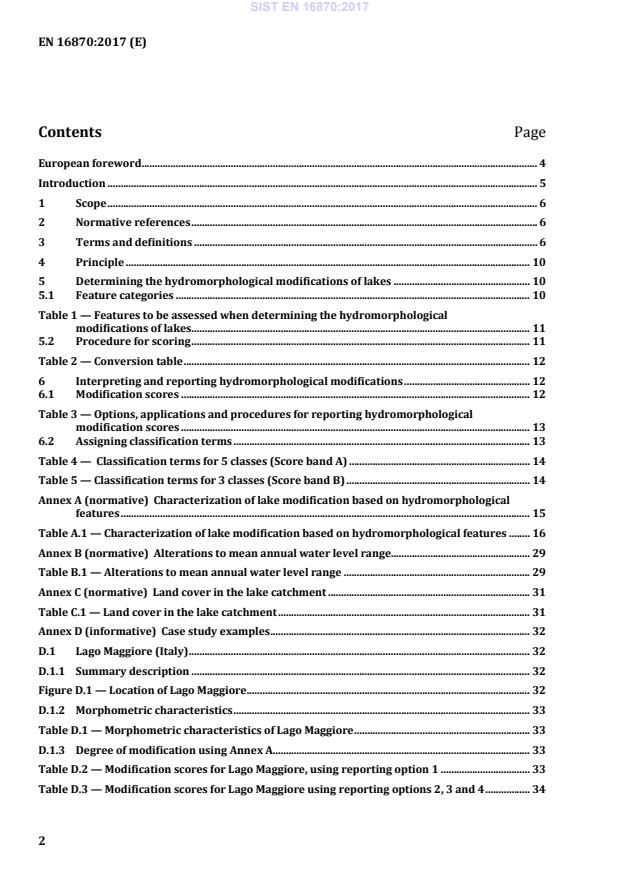
Classification terms for 5 classes (Score band A) . 14 Table 5 — Classification terms for 3 classes (Score band B) . 14 Annex A (normative)
Characterization of lake modification based on hydromorphological features . 15 Table A.1 — Characterization of lake modification based on hydromorphological features . 16 Annex B (normative)
Alterations to mean annual water level range. 29 Table B.1 — Alterations to mean annual water level range . 29 Annex C (normative)
Land cover in the lake catchment . 31 Table C.1 — Land cover in the lake catchment . 31 Annex D (informative)
Case study examples . 32 D.1 Lago Maggiore (Italy) . 32 D.1.1 Summary description . 32 Figure D.1 — Location of Lago Maggiore . 32 D.1.2 Morphometric characteristics . 33 Table D.1 — Morphometric characteristics of Lago Maggiore . 33 D.1.3 Degree of modification using Annex A. 33 Table D.2 — Modification scores for Lago Maggiore, using reporting option 1 . 33 Table D.3 — Modification scores for Lago Maggiore using reporting options 2, 3 and 4 . 34 SIST EN 16870:2017
4: Produce a single score for the lake assessed Reporting overall hydromorphological modification of a lake without the detail. Take the mean of the 16 scores (see no. 1 in table). Round up or down to the nearest integer. Scores ending in ‘0,5’ should be rounded up. 6.2 Assigning classification terms 6.2.1 Where five classes are used, the terms in Table 4 should be assigned to descriptions of hydromorphological modification, and represented (if required) on a map using the colour codings recommended in EN 16039. SIST EN 16870:2017
Classification terms for 5 classes (Score band A) Score Class Description Map colour 1 to < 1,5 1 Near-natural Blue 1,5 to < 2,5 2 Slightly modified Green 2,5 to < 3,5 3 Moderately modified Yellow 3,5 to < 4,5 4 Extensively modified Orange 4,5 to 5,0 5 Severely modified Red 6.2.2 Where three classes are used, the terms in Table 5 should be assigned to descriptions of hydromorphological modification, and represented (if required) on a map using the following colour codings: Table 5 — Classification terms for 3 classes (Score band B) Score Class Description Map colour 1 to < 2,5 1 Near-natural to slightly modified Blue 2,5 to < 3,5 3 Slightly to moderately modified Yellow 3,5 to 5,0 5 Extensively to severely modified Red 6.2.3 The names used to describe each class (e.g. ‘near-natural’) have been deliberately chosen to be different from terms used in the WFD (e.g. ‘high’, ‘good’) to emphasize that classifications using this standard are unrelated to classifications of ecological status for the WFD. Although the five colours listed in 6.2.1 for reporting hydromorphological modification are the same as those in the WFD, they are also used routinely for reporting other (non-WFD) aspects of environmental quality. SIST EN 16870:2017
Characterization of lake modification based on hydromorphological features When assessing artificial water bodies it may be possible to make a comparison with natural water bodies of a similar size and in a similar landscape setting, either in the same area or in areas remote from the artificial water body, but where a similar set of natural lake processes are operating. Alternatively, it may be possible to assess whether lake processes in the artificial water body have become naturalized by looking for evidence of historical water levels and depositional or erosional imbalances. Such evidence might also be obtained from modelling lake volumes, inflows and outflows, or by modelling lake landform evolution in response to the prevailing energy regime. Land cover in the wider catchment should also be assessed, using the guidance in Annex C, in order to provide context for the scored assessment of a lake. This should be undertaken as a separate assessment and should not be part of the hydromorphological assessment of the water body itself.
Features Score band A – Quantitative Score band B –
Qualitative Guidance Examples of methods/ data use
Riparian zone N/A N/A N/A N/A N/A
Shore zone (see Annex B) (see Annex B) (see Annex B) (see Annex B) (see Annex B) 1. HYDRAULICS Open water zone Lake volume (includes residence time, stratification and mixing)
Feature not scored
1 = Near-natural. Very little or no change to lake volume 3 = Lake volume moderately altered 5 = Lake volume severely altered This attribute captures changes in three related phenomena: i) water volumes and throughflow, e.g. change to residence times; ii) water volume and depth relations that influence stratification behaviour and stability of thermal or density layering; iii) mixing behaviour within the water column. If stratification or mixing is substantially different from a suitable natural analogue, a score of 5 should be allocated. If there is any abstraction or augmentation from the lake or the catchment (e.g. for hydropower production) a score of 1 cannot be assigned. Water level time series; use of historical maps to show changes in planform, e.g. smaller equates to drawdown and reduced volume; modelling linked to catchment-scale water balance; Lake Habitat Survey (LHS) database; regular physico-chemical measurements at the deepest part of the lake; temperature and oxygen profiles; remote sensing data to indicate shoreline exposure; discussion with lake managers on whether there are water-mixing measures (e.g. aeration systems) 2. MORPHOMETRY Riparian zone N/A N/A N/A N/A N/A SIST EN 16870:2017
Table A.1 (Continued)
Features Score band A – Quantitative Score band B –
Qualitative Guidance Examples of methods/ data use
Slope profile of shore zone 1 = 0 % to 5 % of lake with non-natural slope profile. 2 =
> 5 % to 15 % of lake with non-natural slope profile 3 =
> 15 % to 35 % of lake with non-natural slope profile 1 = Near-natural slope profile. 3 = Slope profile near-natural throughout part of the lake. 5 = Slope profile non-natural in majority of lake; or lake completely or almost completely
Assessment of the change in slope profile is very difficult to do accurately without repeat survey. There is some scope to estimate change by using a section of the shoreline that is unmodified. Alternatively, a change in slope profile might be indirectly inferred from: If using LHS, the following sections of the survey form will help to infer changes: (i) ‘Bank face erosion’ and ‘Signs of erosional or depositional imbalance’ from section 2.2 – Hab-Plot Attributes, Exposed Shore. (Use the median value of the range, e.g. for a score of 2
Shore zone
4 =
> 35 % to 75 % of lake with non-natural slope profile 5 =
> 75 % of lake with non-natural slope profile modified. (i) imbalances in shore erosion or deposition; (ii) historical changes to water level elevation and planform (because the shore zone is located in a different section of the landscape); (iii) presence of hard bank engineering (because of increased reflection of waves and associated scour and deposition). In the case of artificially dug lakes the natural slope is taken to be that of similar-sized lakes, once geomorphological processes
(>10 %–40 %), assume 25 % of the bank length is eroding); (ii) ‘Bank erosion’ from section 3.1 – Whole Lake Assessment, Lake Perimeter Characteristics. (Use the median value of the range); (iii) ‘Height water level raised or lowered’ from section 4 – Hydrology; (iv) ‘Predominant bank material’, ‘Bank face modification(s)’and ‘Predominant shore forming material’ from section 2.2 – Hab-Plot Attributes, Exposed Shore.
Features Score band A – Quantitative Score band B –
Qualitative Guidance Examples of methods/ data use
have been formative. Historical changes to water level elevation and planform may also be inferred from field evidence of historically higher lake levels or comparison of historical and contemporary maps or aerial photographs.
Planform
1 = 0 % to 5 % of lake with non-natural planform. 2 =
> 5 % to 15 % of lake with non-natural planform 3 =
> 15 % to 35 % of lake with non-natural planform 4 =
> 35 % to 75 % of lake with non-natural planform 5 =
> 75 % of lake with non-natural planform 1 = Near-natural planform. 3 = Planform near-natural throughout part of the lake. 5 = Planform non-natural in majority of lake; or lake completely or almost completely modified. The comparison of lake areas shall be based on a consistent datum, such as mean maximum water level within the historical observation period, or the mean minimum water level, combined with information on bathymetry. Potential data sources are listed in EN 16039:2011, 6.3.
Features Score band A – Quantitative Score band B –
Qualitative Guidance Examples of methods/ data use Open water zone Depth distribution
Feature not scored 1 = Depth distribution reflects near-natural condition. 3 = Depth distribution reflects moderate departure from near-natural condition. 5 = Depth distribution is artificial
Need information on the mean surface area of the lake and the depth per % of the area. Need information on mode of formation. Accurate assessment of the degree of modification of depth distribution is very difficult without repeat surveys of bathymetry. It is anticipated that assessments will become easier in future when new methods of measurement are developed. Alternatively, modifications might be indirectly inferred from historical changes to water level elevations and planform. Direct assessments of change might be made using hydro-acoustic data, remote sensing, profile data, interpolation program, bathymetric data or GIS applications. Indirect assessments may be made using LHS data from section 4 – Hydrology, ‘Height water level raised or lowered’, or by comparison of historical and contemporary maps or aerial photographs.
Riparian zone N/A N/A N/A N/A N/A SIST EN 16870:2017
Features Score band A – Quantitative Score band B –
Qualitative Guidance Examples of methods/ data use 3. BEDFORMS/ LANDFORMS AND SUBSTRATE Shore zone Landform and substrate characteristics (erosion/deposition character) 1 = 0 % to 5 % of lake with evidence of non-natural erosion or deposition 2 =
> 5 % to 15 % of lake with evidence of non-natural erosion or deposition 3 =
> 15 % to 35 % of lake with evidence of non-natural erosion or deposition 4 =
> 35 % to 75 % of lake with evidence of non-natural erosion or deposition 5 =
> 75 % of lake with evidence of non-natural erosion or deposition
1 = Erosion/deposition features reflect near-natural conditions 3 = Erosion/deposition features reflect moderate departure from near-natural conditions 5 = Erosion/deposition features conspicuously different from those expected under near-natural conditions
In-lake features comprise depositional features (e.g. steps, bars, islands), and erosional features (e.g. cliffs) and also features such as cushions of aquatic plants, large wood, etc. The significance of these features depends on the characteristics of the shoreline (e.g. slope, substrate, inflows). Where significant amounts of erosion and/or deposition are recorded it is important to distinguish one from the other, so that appropriate management can be put in place. Sediment core samples could be taken if further investigation is required to better understand the sedimentation regime. In some cases extensive non-natural deposition can cause embeddedness of substrate material. Hydromorphological surveys; databases; aerial photos. When using LHS survey data recorded erosion on the whole lake survey section will give % of shoreline affected. This information can be checked using records in Hab-Plots section 2.2 – Shorezone; Bankface which has a line where any erosion is recorded. This is indicated on the form as ‘ER’ and can be used as an indicator of erosion.
Features Score band A – Quantitative Score band B –
Qualitative Guidance Examples of methods/ data use
Bank structure and modifications – extent of artificial bank material (% of shore perimeter) 1 = Banks affected by 0 % to 5 % hard or 0 % to 10 % soft engineering. 2 = Banks affected by > 5 % to 15 % hard, or > 10 % to 30 % soft engineering. 3 = Banks affected by > 15 % to 25 % hard or > 30 % soft engineering. 4 = Banks affected by > 25 % to 50 % hard engineering. 5 = Banks affected by > 50 % hard engineering. 1 = Near-natural. No, or minimal, presence of artificial material 3 = Small to moderate presence of artificial material 5 = Extensive presence of artificial material
If modified bank materials are ‘natural’ (e.g. willow spiling) maximum score is 3. Assessment of extent of bank affected is based on predominant material present (may be a mix of two types) Hydromorphological surveys (e.g. LHS); databases; aerial photos If using LHS, key Hab-Plot data include Section 2.2 – Bank Face: ‘predominant bank material’ and ‘bank face modifications’; Beach: ‘predominant shore forming material’ SIST EN 16870:2017
Features Score band A – Quantitative Score band B –
Qualitative Guidance Examples of methods/ data use
Littoral substrate – extent of artificial material/ imported natural substrate 1 = 0 % to 1 % artificial material/imported natural substrate 2 =
> 1 % to 5 % artificial material/imported natural substrate 3 =
> 5 % to 15 % artificial material/imported natural substrate 4 =
> 15 % to 30 % artificial material/imported natural substrate 5 =
> 30 % artificial material/imported natural substrate 1 = Near-natural. No, or minimal, presence of artificial material 3 = Small to moderate presence of artificial material 5 = Extensive presence of artificial material
Artificial materials include brick-laid stone, concrete, geotextiles, etc. The percentage assessed is expressed as a proportion of the perimeter length and not as a proportion of the overall area of the littoral zone. Imported natural substrate refers to natural substrate types (e.g. gravel, sand, boulders) deliberately placed in areas of a lake where they would not naturally occur (e.g. large stone slabs positioned around the lake shore to prevent bank erosion). Record only natural substrates: mud, silt, sand, pebbles, gravel, stones, rocks, organic substrates. NOTE: The natural range of substrates is lake type- and site-specific. Hydromorphological surveys (e.g. LHS); records made during biological sampling; databases; aerial photos If using LHS, key Hab-Plot data include Section 2.3 Littoral zone: ‘predominant littoral substrate’ and ‘recent sedimentation over natural substrate’
Open water zone Lake bottom bedforms Feature not scored 1 = Near-natural bedforms 3 = Bedform changes throughout part of the lake/basin 5 = Bedforms changed in majority of the lake/basin This includes assemblage of natural bedform features (e.g. dunes, scour holes) and their associated properties (texture, structure). Activities such as dredging for navigation may be expected to influence bedforms. In lakes undergoing eutrophication increased Bathymetric survey; sidescan sonar; grab samples, coring to provide information on changes to sedimentation rates; sedimentation traps; data from SCUBA surveys SIST EN 16870:2017
Features Score band A – Quantitative Score band B –
Qualitative Guidance Examples of methods/ data use sedimentation may also influence bedform structure. Extent of artificial material/imported natural substrate 1 = 0 % to 1 % artificial material/imported natural substrate 2 =
> 1 % to 5 % artificial material/imported natural substrate 3 =
> 5 % to 15 % artificial material/imported natural substrate 4 =
> 15 % to 30 % artificial material/imported natural substrate 5 =
> 30 % artificial material/imported natural substrate 1 = Near-natural. No, or minimal, presence of artificial material 3 = Small to moderate pr
...
Questions, Comments and Discussion
Ask us and Technical Secretary will try to provide an answer. You can facilitate discussion about the standard in here.
Loading comments...