


SIST EN 18025:2025
(Main)Water quality - Guidance standard on a strategic approach to river restoration
Water quality - Guidance standard on a strategic approach to river restoration
This document gives guidelines for the restoration of rivers, including their channels, riparian zones and floodplains. The word ‘river’ is used as a generic term to describe permanently flowing and intermittent watercourses of all sizes, with the exception of artificial water bodies such as canals. Some aspects of landscape restoration beyond the boundaries of what are often considered typical river processes are also considered.
A clear framework of guiding principles to help inform the planning and implementation of river restoration work is provided. These principles are applicable to individuals and organizations wishing to restore rivers, and stress the importance of monitoring and appraisal. This document makes reference to existing techniques and guidance, where these are appropriate and within the scope of this document.
This document gives guidelines on:
- the core principles of restoration;
- aims and overall outcomes of river restoration;
- the spectrum of typical approaches to river restoration with a focus on those that are nature-based and restore both physical and ecological aspects;
- identifying opportunities for restoration and possible constraints, with a focus on physical and natural rather than socio-economic aspects;
- different scales of restoration and how restoration works across different catchments and landscapes;
- the importance of monitoring and appraising restoration work across the range of approaches and scales.
Wasserbeschaffenheit - Leitfaden für einen strategischen Ansatz zur Renaturierung von Fließgewässern
Dieses Dokument enthält Leitlinien für die Renaturierung von Flüssen, einschließlich ihrer Gerinne, Uferzonen und Überschwemmungsgebiete. Das Wort „Fluss“ wird als Oberbegriff für dauerhaft fließende und periodische Wasserläufe (Fließgewässer) aller Größen verwendet, mit Ausnahme künstlicher Gewässer wie Kanälen. Einige Aspekte der Landschaftsrenaturierung, die über die Grenzen dessen, was häufig als typische Fließgewässerprozesse angesehen wird, hinausgehen, werden ebenfalls berücksichtigt.
Es wird ein eindeutiges Rahmenwerk grundsätzlicher Leitlinien bereitgestellt, die als Informationsgrundlage bei der Planung und Umsetzung von Projekten zur Renaturierung von Fließgewässern dienen können. Diese Grundsätze sind sowohl durch Einzelpersonen als auch Organisationen anwendbar, die die Renaturierung von Fließgewässern anstreben, und unterstreichen die Bedeutung der Überwachung und Bewertung. Dieses Dokument verweist auf existierende Techniken und Leitfäden, wo diese zweckdienlich sind und zum Anwendungsbereich dieses Dokuments gehören.
Dieses Dokument bietet Leitlinien zu:
- den zentralen Grundsätzen der Renaturierung;
- den Zielen und Gesamtergebnissen der Fließgewässerrenaturierung;
- dem Spektrum der üblichen Ansätze bei der Fließgewässerrenaturierung mit Schwerpunkt auf denjenigen, die naturnah sind und sowohl physikalische als auch ökologische Aspekte wiederherstellen;
- der Feststellung von Möglichkeiten zur Renaturierung und der möglichen Beschränkungen, wobei der Schwerpunkt eher auf physikalischen und natürlichen als auf sozioökonomischen Aspekten liegt;
- den verschiedenen Maßstäben der Renaturierung und wie eine sich über verschiedene Einzugsgebiete und Landschaften erstreckende Renaturierung gelingt;
- der Bedeutung von Überwachung und Bewertung der Renaturierungsarbeit unter Einbeziehung aller Ansätze und Maßstäbe.
Qualité de l'eau - Guide pour une approche stratégique de la restauration des rivières
Le présent document fournit des lignes directrices pour la restauration des rivières, y compris leurs chenaux, bandes riveraines et plaines d'inondation. Le mot « rivière » est utilisé en tant que terme générique pour décrire les cours d'eau permanents et intermittents de toutes tailles, à l'exception des plans d'eau artificiels, tels que les canaux. Certains aspects de la restauration des sites se situant au-delà des limites de ce qui est souvent considéré comme des processus fluviaux types sont également pris en compte.
Un cadre de principes directeurs clair est fourni pour aider à la planification et à la mise en œuvre du travail de restauration des rivières. Ces principes s'appliquent aux personnes et aux organisations qui souhaitent restaurer des rivières et soulignent l'importance du suivi et de l'évaluation. Le présent document fait référence à des techniques et recommandations existantes, lorsque celles-ci sont appropriées et relèvent du domaine d'application du présent document.
Le présent document fournit des lignes directrices sur :
— les principes fondamentaux de la restauration ;
— les objectifs et les résultats globaux de la restauration des rivières ;
— la palette d'approches types en matière de restauration des rivières, en mettant l'accent sur celles qui sont fondées sur la nature et restaurent à la fois les composantes physiques et écologiques ;
— l'identification des opportunités de restauration et des éventuelles contraintes, en mettant l'accent sur les aspects physiques et naturels plutôt que sur les aspects socio-économiques ;
— les différentes échelles de restauration et la manière dont la restauration fonctionne dans différents bassins versants et paysages ;
— l'importance du suivi et de l'évaluation des travaux de restauration sur toute la gamme d'approches et d'échelles.
Kakovost vode - Navodilo za strateški pristop k obnovi vodotokov
General Information
- Status
- Not Published
- Public Enquiry End Date
- 02-Dec-2023
- Technical Committee
- KAV - Water quality
- Current Stage
- 6060 - National Implementation/Publication (Adopted Project)
- Start Date
- 15-Sep-2025
- Due Date
- 20-Nov-2025
Overview
EN 18025:2025 - Water quality: Guidance standard on a strategic approach to river restoration (CEN) provides a practical, principles-based framework for planning, designing and appraising river restoration projects. It covers rivers (permanently flowing and intermittent watercourses of all sizes, excluding artificial canals) including channels, riparian zones and floodplains, and promotes nature-based solutions that restore both physical and ecological functioning. The standard emphasises monitoring, appraisal and adaptive delivery rather than prescriptive engineering solutions.
Key topics
- Core principles of restoration - re-establishing natural physical processes (connectivity, sediment and water movement) to support habitat recovery and ecosystem services.
- Aims and outcomes - defining clear, measurable restoration objectives to guide design and monitoring.
- Spectrum of intervention - from natural recovery, assisted natural recovery to designed restoration, highlighting when each approach is appropriate.
- Spatial context and scale - how restoration actions operate across channel, floodplain, catchment and landscape scales.
- Opportunities and constraints - physical and natural limiting factors (morphology, hydrology, legacy land use), and when rivers can self-restore.
- Implementation process - catchment understanding, prioritisation, design, delivery and quality assurance.
- Monitoring and appraisal - designing monitoring programmes (including indicators and survey timing), using BACI and other approaches to assess outcomes.
- Quality assurance - qualifications, experience and training considerations for practitioners.
- Supporting materials - case studies that illustrate a range of restoration and monitoring approaches.
Practical applications
EN 18025:2025 is a guidance tool for delivering effective, sustainable river restoration that enhances biodiversity, reduces flood risk via natural measures, improves water quality and restores ecosystem services. Typical uses include:
- Developing restoration strategies at site, catchment or landscape scale
- Selecting appropriate nature-based interventions (e.g., re-meandering, riparian re-vegetation, floodplain reconnection)
- Designing monitoring programmes to evaluate ecological and geomorphological outcomes
- Informing project briefs, tender documents and quality assurance specifications
Who should use it
- River and catchment managers, environmental agencies and regulatory bodies
- Engineering and ecological consultants designing restoration works
- Conservation NGOs and landowners planning habitat enhancement
- Researchers and practitioners involved in hydromorphology, water quality and ecosystem services
Related frameworks and standards
EN 18025:2025 complements European policy drivers (e.g., Water Framework Directive, Habitats Directive, Floods Directive) and references related CEN standards on hydromorphology and river assessment (as cited in the document). Use EN 18025 for strategy-building, then consult local regulatory requirements and technical standards for implementation details.

Frequently Asked Questions
SIST EN 18025:2025 is a draft published by the Slovenian Institute for Standardization (SIST). Its full title is "Water quality - Guidance standard on a strategic approach to river restoration". This standard covers: This document gives guidelines for the restoration of rivers, including their channels, riparian zones and floodplains. The word ‘river’ is used as a generic term to describe permanently flowing and intermittent watercourses of all sizes, with the exception of artificial water bodies such as canals. Some aspects of landscape restoration beyond the boundaries of what are often considered typical river processes are also considered. A clear framework of guiding principles to help inform the planning and implementation of river restoration work is provided. These principles are applicable to individuals and organizations wishing to restore rivers, and stress the importance of monitoring and appraisal. This document makes reference to existing techniques and guidance, where these are appropriate and within the scope of this document. This document gives guidelines on: - the core principles of restoration; - aims and overall outcomes of river restoration; - the spectrum of typical approaches to river restoration with a focus on those that are nature-based and restore both physical and ecological aspects; - identifying opportunities for restoration and possible constraints, with a focus on physical and natural rather than socio-economic aspects; - different scales of restoration and how restoration works across different catchments and landscapes; - the importance of monitoring and appraising restoration work across the range of approaches and scales.
This document gives guidelines for the restoration of rivers, including their channels, riparian zones and floodplains. The word ‘river’ is used as a generic term to describe permanently flowing and intermittent watercourses of all sizes, with the exception of artificial water bodies such as canals. Some aspects of landscape restoration beyond the boundaries of what are often considered typical river processes are also considered. A clear framework of guiding principles to help inform the planning and implementation of river restoration work is provided. These principles are applicable to individuals and organizations wishing to restore rivers, and stress the importance of monitoring and appraisal. This document makes reference to existing techniques and guidance, where these are appropriate and within the scope of this document. This document gives guidelines on: - the core principles of restoration; - aims and overall outcomes of river restoration; - the spectrum of typical approaches to river restoration with a focus on those that are nature-based and restore both physical and ecological aspects; - identifying opportunities for restoration and possible constraints, with a focus on physical and natural rather than socio-economic aspects; - different scales of restoration and how restoration works across different catchments and landscapes; - the importance of monitoring and appraising restoration work across the range of approaches and scales.
SIST EN 18025:2025 is classified under the following ICS (International Classification for Standards) categories: 07.060 - Geology. Meteorology. Hydrology; 13.020.70 - Environmental projects; 13.060.10 - Water of natural resources; 13.060.99 - Other standards related to water quality. The ICS classification helps identify the subject area and facilitates finding related standards.
SIST EN 18025:2025 is associated with the following European legislation: EU Directives/Regulations: 2000/60/EC. When a standard is cited in the Official Journal of the European Union, products manufactured in conformity with it benefit from a presumption of conformity with the essential requirements of the corresponding EU directive or regulation.
SIST EN 18025:2025 is available in PDF format for immediate download after purchase. The document can be added to your cart and obtained through the secure checkout process. Digital delivery ensures instant access to the complete standard document.
Standards Content (Sample)
SLOVENSKI STANDARD
oSIST prEN 18025:2023
01-november-2023
Kakovost vode - Navodilo za strateški pristop k obnovi rek
Water quality - Guidance standard on a strategic approach to river restoration
Wasserbeschaffenheit - Richtlinien für einen strategischen Ansatz für Renaturierung von
Fließgewässern
Ta slovenski standard je istoveten z: prEN 18025
ICS:
13.020.70 Okoljevarstveni projekti Environmental projects
13.060.10 Voda iz naravnih virov Water of natural resources
oSIST prEN 18025:2023 en,fr,de
2003-01.Slovenski inštitut za standardizacijo. Razmnoževanje celote ali delov tega standarda ni dovoljeno.
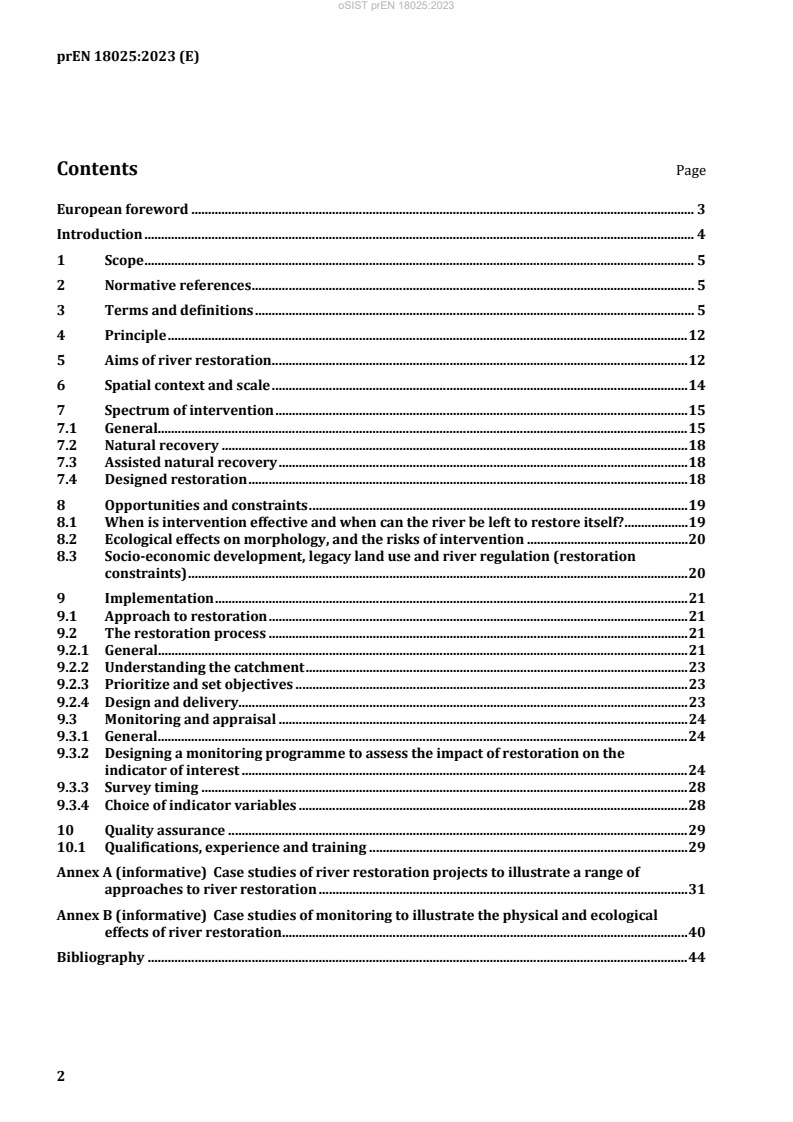
oSIST prEN 18025:2023
oSIST prEN 18025:2023
DRAFT
EUROPEAN STANDARD
prEN 18025
NORME EUROPÉENNE
EUROPÄISCHE NORM
October 2023
ICS 13.020.70; 13.060.10
English Version
Water quality - Guidance standard on a strategic approach
to river restoration
Wasserbeschaffenheit - Richtlinien für einen
strategischen Ansatz für Renaturierung von
Fließgewässern
This draft European Standard is submitted to CEN members for enquiry. It has been drawn up by the Technical Committee
CEN/TC 230.
If this draft becomes a European Standard, CEN members are bound to comply with the CEN/CENELEC Internal Regulations
which stipulate the conditions for giving this European Standard the status of a national standard without any alteration.
This draft European Standard was established by CEN in three official versions (English, French, German). A version in any other
language made by translation under the responsibility of a CEN member into its own language and notified to the CEN-CENELEC
Management Centre has the same status as the official versions.
CEN members are the national standards bodies of Austria, Belgium, Bulgaria, Croatia, Cyprus, Czech Republic, Denmark, Estonia,
Finland, France, Germany, Greece, Hungary, Iceland, Ireland, Italy, Latvia, Lithuania, Luxembourg, Malta, Netherlands, Norway,
Poland, Portugal, Republic of North Macedonia, Romania, Serbia, Slovakia, Slovenia, Spain, Sweden, Switzerland, Türkiye and
United Kingdom.
Recipients of this draft are invited to submit, with their comments, notification of any relevant patent rights of which they are
aware and to provide supporting documentation.
Warning : This document is not a European Standard. It is distributed for review and comments. It is subject to change without
notice and shall not be referred to as a European Standard.
EUROPEAN COMMITTEE FOR STANDARDIZATION
COMITÉ EUROPÉEN DE NORMALISATION
EUROPÄISCHES KOMITEE FÜR NORMUNG
CEN-CENELEC Management Centre: Rue de la Science 23, B-1040 Brussels
© 2023 CEN All rights of exploitation in any form and by any means reserved Ref. No. prEN 18025:2023 E
worldwide for CEN national Members.
oSIST prEN 18025:2023
prEN 18025:2023 (E)
Contents Page
European foreword . 3
Introduction . 4
1 Scope . 5
2 Normative references . 5
3 Terms and definitions . 5
4 Principle . 12
5 Aims of river restoration . 12
6 Spatial context and scale . 14
7 Spectrum of intervention . 15
7.1 General. 15
7.2 Natural recovery . 18
7.3 Assisted natural recovery . 18
7.4 Designed restoration . 18
8 Opportunities and constraints . 19
8.1 When is intervention effective and when can the river be left to restore itself? . 19
8.2 Ecological effects on morphology, and the risks of intervention . 20
8.3 Socio-economic development, legacy land use and river regulation (restoration
constraints) . 20
9 Implementation . 21
9.1 Approach to restoration . 21
9.2 The restoration process . 21
9.2.1 General. 21
9.2.2 Understanding the catchment . 23
9.2.3 Prioritize and set objectives . 23
9.2.4 Design and delivery . 23
9.3 Monitoring and appraisal . 24
9.3.1 General. 24
9.3.2 Designing a monitoring programme to assess the impact of restoration on the
indicator of interest . 24
9.3.3 Survey timing . 28
9.3.4 Choice of indicator variables . 28
10 Quality assurance . 29
10.1 Qualifications, experience and training . 29
Annex A (informative) Case studies of river restoration projects to illustrate a range of
approaches to river restoration . 31
Annex B (informative) Case studies of monitoring to illustrate the physical and ecological
effects of river restoration. 40
Bibliography . 44
oSIST prEN 18025:2023
prEN 18025:2023 (E)
European foreword
This document (prEN 18025:2023) has been prepared by Technical Committee CEN/TC 230 “Water
analysis”, the secretariat of which is held by DIN.
This document is currently submitted to the CEN Enquiry.
oSIST prEN 18025:2023
prEN 18025:2023 (E)
Introduction
Most European rivers and their catchments no longer function naturally. This loss of natural functioning
is the result of human modification undertaken over many centuries for (among other things) flood
defence, hydroelectric power generation, the provision of water for agricultural, industrial, and domestic
consumption, land use and land drainage. These activities have often resulted in disturbed river
functioning and led to degraded physical habitats and, as a consequence, to reductions in biodiversity,
reduced resilience to flooding and drought, and a decline in ecosystem services such as recreation.
Climate change is now compounding the issues created by human modification, and the need to restore
rivers will become increasingly pressing to ensure the conservation of their naturally occurring habitats
and species and the sustainable provision of their ecosystem services. Accordingly, river restoration
following a ‘nature-based’ approach is an imperative requirement to allow river ecosystems to recover,
a concept advocated by the International Union for Conservation of Nature (IUCN) [1].
River restoration is the act of returning natural functioning and form to a river that has been directly or
indirectly altered by human activity. Ideally it should result in uninterrupted lateral, longitudinal, and
vertical connectivity of hydraulic, sedimentary, chemical and biological processes, allowing unhindered
channel and floodplain evolution, and the associated mosaic of habitats that support a characteristic
array of flora and fauna. In many locations, physical and other constraints will affect what restoration is
practicable, but the ambition should be to achieve the greatest degree and spatial scale of re-
naturalization possible.
Rivers are restored for many reasons including to: re-establish natural patterns of water and sediment
movement and so remove the costs associated with managing modified channels; restore habitats and
biodiversity; manage flood risk through natural flood management; enhance the aesthetics of an area;
and create opportunities for recreation. Key policy and legal frameworks to drive river restoration within
the European context include the Water Framework Directive (WFD), Habitats Directive and the Floods
Directive. Furthermore, the EU Biodiversity Strategy 2030, and the UN Treaty on Climate Change, for
example, provide additional impetus for increased restoration efforts. Although the motivation for
restoring rivers and the extent to which rivers may be restored vary, a fundamental basis common to all
restoration projects should be the re-establishment of natural physical processes, leading to the
development of natural form and features, and the sustainable evolution of instream, riparian and
floodplain habitats. Activities such as adding gravel to construct specific spawning areas may be part of a
larger river restoration scheme, but are not by themselves considered to be river restoration unless they
are measures for restoring natural river processes.
Specifying the desired outcome of restoration is an essential element of any plan, and the meaningful
monitoring and appraisal of any project will depend upon the clarity in setting this goal.
oSIST prEN 18025:2023
prEN 18025:2023 (E)
1 Scope
This document concerns the restoration of rivers, including their channels, riparian zones, and
floodplains. The word ‘river’ is used as a generic term to describe permanently flowing and intermittent
watercourses of all sizes, with the exception of artificial water bodies such as canals. Some aspects of
landscape restoration beyond the boundaries of what are often considered typical river processes are
also considered. This document focuses on ‘nature-based solutions’, which are ‘actions to protect,
sustainably manage and restore natural or modified ecosystems that address societal challenges
effectively and adaptively, simultaneously providing human well-being and biodiversity benefits’
(https://portals.iucn.org/library/sites/library/files/documents/2016-036.pdf).
A clear framework of guiding principles to help inform the planning and implementation of river
restoration work is provided. These principles are aimed both at individuals and organizations wishing
to restore rivers, and stress the importance of monitoring and appraisal. This document makes reference
to existing techniques and guidance, where these are appropriate and within the scope of this document.
This document provides guidance on:
— the core principles of restoration
— the aims and overall outcomes of river restoration
— the spectrum of typical approaches to river restoration (the ‘restoration mode’) with a focus on those
that are nature-based and restore both physical and ecological aspects
— identifying opportunities for restoration and possible constraints, with a focus on physical and
natural rather than socio-economic aspects
— the different scales of restoration and how restoration works across different catchments and
landscapes
— the importance of monitoring and appraising restoration work across the range of approaches and
scales.
2 Normative references
There are no normative references in this document.
3 Terms and definitions
For the purposes of this document, the following terms and definitions apply.
ISO and IEC maintain terminology databases for use in standardization at the following addresses:
— ISO Online browsing platform: available at https://www.iso.org/obp/
— IEC Electropedia: available at https://www.electropedia.org/
oSIST prEN 18025:2023
prEN 18025:2023 (E)
3.1
bank
side of a river channel or island which extends above the normal (e.g. mean) water level and is only
completely submerged during periods of high river flow
Note 1 to entry: In the context of this document, the bank top is marked by the first major break in slope, above
which cultivation or development is possible.
[SOURCE: EN 14614:2020, 3.7]
3.2
bar
in-channel, elevated sediment deposit exposed during periods of low flow, which could be a side bar,
(including a point or counterpoint bar, located respectively along the convex or concave bank of a
meander bends) or a mid-channel bar
[SOURCE: EN 14614:2020, 3.9]
3.3
baseflow
sustained component of streamflow, usually resulting from drainage of groundwater, but also from
drainage of large lakes, swamps, soils, snow and ice packs
[SOURCE: EN 14614:2020, 3.10]
3.4
Before-After-Control-Impact
BACI
investigation of the effect of an Impact at a site by comparing the conditions Before the Impact with those
After the Impact while accounting for natural/background change through the use of Control site
3.5
berm
natural or artificial, flat-topped shelf along the margin of a river channel that is exposed above water level
during low flows, but is submerged during high flows
Note 1 to entry: Natural berms are vegetated features composed of sediments deposited by the river to the
baseflow level.
[SOURCE: EN 14614:2020, 3.13]
3.6
channel
main landform within river systems, conveying water
3.7
characterization
selection of properties or special features of a spatial unit that are uniquely relevant to identifying its
hydromorphological processes, forms and pressures
[SOURCE: EN 14614:2020, 3.19]
oSIST prEN 18025:2023
prEN 18025:2023 (E)
3.8
coarse sediment
sediment of grain size at or larger than ‘very fine gravel’ (diameter ≥ 2 mm, ≤ −1 phi)
EXAMPLE gravels, cobbles, boulders
Note 1 to entry: The phi scale defines sediment grain size as the negative logarithm to the base 2 of the grain
diameter in millimetres.
[SOURCE: EN 14614:2020, 3.20]
3.9
confirmatory appraisal
process of confirming the expectations following a restoration intervention through simple observation
(cf. investigative appraisal)
3.10
connectivity
See ‘lateral continuity’ and ‘longitudinal continuity’
3.11
control site
site representing (ideally identical) conditions to that of the Impact site except for the restoration
intervention
3.12
culvert
arched, enclosed or piped structure constructed to carry water under roads, railways and buildings
[SOURCE: EN 14614:2020, 3.25]
3.13
ecosystem services
the benefits people derive from ecosystems
3.14
embankment
artificial levée
artificial bank built to raise the natural bank level thereby reducing the frequency of flooding of adjacent
land
[SOURCE: EN 14614:2020, 3.27]
3.15
equilibrium form
morphological condition of a river that represents physical balance (stable but not necessarily static)
oSIST prEN 18025:2023
prEN 18025:2023 (E)
3.16
fine sediment
sediment of grain sizes equal to or smaller than ‘very coarse sand’ (≤ 2 mm diameter, ≥ 2 mm −1 phi), i.e.
sands, silt, clay
Note 1 to entry: The phi scale defines sediment grain size scale as the negative logarithm to the base 2 of the grain
diameter in millimetres.
[SOURCE: EN 14614:2020, 3.28]
3.17
floodplain
valley floor adjacent to a river that is (or was historically) inundated periodically by flood waters and is
formed of sediments deposited by the river
[SOURCE: EN 14614:2020, 3.29]
3.18
fluvial audit
method for assessing the condition of a river and its associated human pressures, using information from
field survey, remote sensing, historical and recent maps, scientific literature and other sources
[SOURCE: EN 16859:2017, 3.18]
3.19
fluvial geomorphology
scientific study of the physical processes, form and functioning of rivers and streams and their physical
interactions with the surrounding landscape
[SOURCE: EN 14614:2020, 3.31]
3.20
hydrodynamic modelling
numerical tool or methodology used to predict hydraulic patterns in rivers
3.21
hydrology
study of the distribution and movement of water both on and below the Earth’s surface
3.22
hydromorphology
morphological and hydrological characteristics of rivers including the underlying processes from which
they result
[SOURCE: EN 14614:2020, 3.36]
3.23
hyporheic zone
spatio-temporally dynamic ecotone between the surficial benthic substrate and the underlying aquifer
[EN 16772:2016, 2.13]
oSIST prEN 18025:2023
prEN 18025:2023 (E)
3.24
impact site
site at which restoration intervention effects are measured
3.25
investigative appraisal
process of investigating the outcomes of a restoration intervention through an experimental approach
(cf. confirmatory appraisal)
3.26
large wood
piece of wood that is more than 1 m long and 10 cm in diameter
[SOURCE: EN 14614:2020, 3.37]
Note 1 to entry: ‘wood’ refers to natural wood (e.g. tree branches)
3.27
lateral connectivity
lateral continuity
freedom for water, sediments and biota to move between the channel and the floodplain/hillslopes
[SOURCE: EN 14614:2020, 3.39]
3.28
longitudinal connectivity
longitudinal continuity
freedom for water, sediments and biota to move along the river channel
[SOURCE: EN 14614:2020, 3.41]
3.29
meander
one of a series of regular, sinuous curves along the course of a stream
[SOURCE: EN 14614:2020, 3.42]
3.30
morphology
physical form and structure of a river
3.31
natural flood management
working with nature to reduce and control the impacts of flooding
3.32
oxbow lake
small lake located in an abandoned meander loop of a river channel
3.33
palaeochannel
remnant floodplain feature indicating location of a previously active channel
oSIST prEN 18025:2023
prEN 18025:2023 (E)
3.34
planform
geometric form of a river channel viewed from above
EXAMPLE sinuous, straight
[SOURCE: EN 14614:2020, 3.43]
3.35
pool
distinctly deeper part of a river bed that is usually no longer than one to three times the channel’s bankfull
width, and where the hollowed river bed profile is sustained by scouring
[SOURCE: EN 14614:2020, 3.44]
3.36
quantitative sampling
-1
process of collecting measured information (e.g. flow measured in m s )
3.37
qualitative sampling
process of collecting information that is subjectively assessed (e.g. flow measured according to a category,
such as ‘riffle’, ‘run’, ‘glide’, etc.)
3.38
reach
section of river along which boundary conditions are sufficiently uniform that the river maintains a near
consistent internal set of process–form interactions
Note 1 to entry: In some situations, chemical changes along the length of a river, as well as physical and
hydrological ones, could also be important in defining river reaches
[SOURCE: EN 14614:2020, 3.47]
3.39
riffle
fast-flowing shallow water area of a river bed with a distinctly broken or disturbed water surface over a
gravel/pebble or cobble substrate
[SOURCE: EN 14614:2020, 3.50]
3.40
riparian zone
transitional, semi-terrestrial area of land adjoining a river channel (including the river bank) that is
regularly inundated and influenced by fresh water and can influence the condition of the aquatic
ecosystem (e.g. by shading and leaf litter input and through biogeochemical exchanges)
Note 1 to entry: ‘Riparian corridor’ is the linear extension of this concept along a channel or reach length. In this
document, the term ‘riparian zone’ does not include the wider floodplain.
[SOURCE: EN 14614:2020, 3.51]
oSIST prEN 18025:2023
prEN 18025:2023 (E)
3.41
river bed incision
process where a river has cut vertically to lower its bed
[SOURCE: EN 14614:2020, 3.53]
3.42
runoff
net discharge of water into the stream from surface-water and groundwater sources with losses
occurring from evapotranspiration and other consumptive uses
[SOURCE: EN 14614:2020, 3.58]
3.43
sediment transport
movement of sediment particles of a range of sizes by flowing water, which could include mobilization
and deposition
[SOURCE: EN 14614:2020, 3.61]
3.44
sinuosity
distance from upstream to downstream along the channel centre line between two points, divided by the
distance along the valley course between the same points
[SOURCE: EN 14614:2020, 3.63]
3.45
spatial unit
subdivision of a catchment at various geographical scales
EXAMPLE catchment, landscape unit, valley segment, reach
[SOURCE: EN 14614:2020, 3.64]
3.46
stream power
rate of energy dissipation against the bed and banks of a river per unit downstream length, which when
divided by channel width gives the specific stream power
[SOURCE: EN 14614:2020, 3.65]
3.47
substrate
material making up the bed of a river
[SOURCE: EN 14614:2020, 3.66]
3.48
two-stage channel
channel that accommodates high and low flow stages
oSIST prEN 18025:2023
prEN 18025:2023 (E)
3.49
vertical connectivity
freedom for water, biota and nutrients to move between the benthic substrate and the underlying aquifer
3.50
weir
artificial structure across a river for controlling flow and upstream surface level, or for measuring
discharge
[SOURCE: EN 14614:2020, 3.70]
3.51
wetland
habitats occupying the transitional zone between permanently inundated, and generally dry,
environments
EXAMPLE marsh, fen, shallow temporary water
[SOURCE: EN 14614:2020, 3.71]
3.52
WFD water body
length of river defined and delineated according to criteria outlined in the European Water Framework
Directive
3.53
xylophagous insect
adult or larva of insects that feed on or bore into wood
4 Principle
A standard protocol is described for planning, implementing, and monitoring river restoration, and draws
on experience from around Europe and elsewhere to provide a common framework that can be applied
across a wide geographical range. The Standard gives guidance on how to apply a strategic approach to
practical restoration, but does not attempt to describe the detailed methods used to restore rivers. It
emphasizes that restoration should explicitly take account of the dynamic nature of rivers and needs to
be set within a catchment context, even when the scale of restoration is relatively limited. The Standard
recognizes that river restoration is carried out for many reasons, but focuses especially on the importance
of restoring hydromorphology for the benefit of biodiversity. ‘Biological diversity’ (biodiversity) means
‘the variability among living organisms from all sources including, inter alia, terrestrial, marine and other
aquatic ecosystems and the ecological complexes of which they are part; this includes diversity within
species, between species and of ecosystems’ (Convention on Biological Diversity:
http://www.cbd.int/convention/articles/default.shtml?a=cbd-02 A).
5 Aims of river restoration
River restoration is not simply engineering the physical form. It aims to understand and address the
modification and damage to river functioning, features and habitats, in the context of the river floodplain
corridor and its catchment, and to return the conditions that allow natural processes to operate
unhindered – referred to as ‘reference conditions’ (EN 14614:2020). At their simplest, ‘reference
conditions’ refer to a complete lack of human interventions and pressures, but these are not necessarily
the desired conditions for the system or the river reach after restoration. Reference conditions represent
a benchmark against which to assess the degree of impact on the present state of the river from human
oSIST prEN 18025:2023
prEN 18025:2023 (E)
influence, and upon which restoration targets can be assessed objectively. By restoring river processes,
the movement of water and material (sediment and wood) from the land (catchment area) to the mouth
(estuary or inland lake) can shape and sustain a dynamic, complex, physical environment and the
characteristic flora, fauna and their habitats.
The advantages of restoring physical processes, rather than simply recreating physical form, are:
— More sustainable and help to re-establish characteristic natural habitat;
— Provides a focus on tackling the causes of degradation rather than its symptoms;
— Creates conditions naturally more appropriate for specific sections of rivers that support
characteristic biodiversity;
— Implicitly incorporates the dynamic physical processes that are a fundamental characteristic of a
naturally functioning river and essential to the evolution of diverse habitats;
— Results in dynamic river environments that are more resilient and sustainable than an engineered
channel, particularly in the face of climate change;
— Reduced construction and maintenance costs, by initiating or working with dynamic physical
processes that result in channel and floodplain evolution and associated habitat diversity;
— A greater likelihood of achieving wider ecosystem and societal benefits (i.e. ecosystem services)
(Figure 1).
Figure 1 — Benefits to society provided by naturally functioning rivers and floodplains
The water quality and quantity necessary to sustain the expected biodiversity of a naturally functioning
river system also enable more cost-effective provision of drinking water (i.e. less treatment required)
and a sustainable supply of food and materials. A well-functioning system is able to cope better with the
demands of social and economic needs, where those demands recognize the requirement for balance (e.g.
water companies investing in upstream catchment management to improve water quality and reduce
water supply costs).
Rivers that are fully (re)connected to their floodplains (as opposed to those that have historically been
deepened and embanked) help to regulate flood flows by slowing and spreading flood waters, and by
reducing the height and delaying the peak of the flood. Restoring the floodplain’s hydrology in this way
oSIST prEN 18025:2023
prEN 18025:2023 (E)
can work with, or perhaps replace, more traditional flood protection measures and help to adapt to
climate change. Floodplains are important for fine sediment storage and for nutrient deposition and
cycling, through uptake by wetland/ floodplain meadow/ wet woodland communities. Reinstating these
−1
processes has great potential benefit for carbon storage within the floodplain (e.g. 110 t ha of stored
carbon in the top 10 cm of floodplain meadows – nearly twice that of dry grasslands) [2].
Many towns and cities were founded on the banks of rivers, thus benefiting from water supply, transport,
food resources and security. A restored clean, healthy, river rich in wildlife offers a focal open space in
often densely urbanized areas. River corridors provide routes for paths and cycleways, encouraging
exercise and access to nature, which promotes physical and mental health. Direct uses include fishing,
watersports, and wild swimming. Use and visual amenity promotes better awareness and social
understanding of the pressures and impacts on water and habitat quality, with pollution and other
deterioration being noticed rapidly and becoming more integrated in local policy and planning.
6 Spatial context and scale
River restoration work is often undertaken opportunistically – for example, when funding becomes
available or landowner agreement is secured. As a result, relatively small, reach scale interventions have
been most common to date. However, to address the fundamental impacts on natural processes (i.e. the
supply, transport and deposition of water, sediment and wood) that influence the physical and ecological
condition of the river environment, more ambitious and spatially extensive initiatives need to be
promoted. To obtain the greatest sustainable improvements in river condition, restoration should be
applied at the largest spatial scale practicable. This should consider a catchment-scale strategy for
implementing specific restoration measures that may themselves be applied at the reach scale.
Catchment restoration measures applied beyond the river (e.g. planting native trees, increasing the
amount of wetland) may have indirect benefits for river corridors. The measures chosen should be
assigned priorities to optimize the cumulative benefit to the entire river system. Note that reach-scale
interventions can often have significant downstream benefits to physical processes and, therefore, to
ecological condition.
The importance of ensuring that the spatial context of any restoration is included at the planning stage is
now widely acknowledged. Whatever the scale of restoration, the work should take into account its
relative position within the catchment to ensure that any measures proposed are appropriate for the
physical conditions of that area that will subsequently affect the evolution of the restored section.
A detailed description of how to delineate and characterize spatial units (catchment, landscape, valley
segment, and river reach) is given in EN 14614:2020. This delineation and characterization identifies the
influences and controls on spatial units and will help to establish the most appropriate approach to
restoration.
Historical human influences on the natural evolution of rivers and the continuing need for the ecosystem
services that they provide means that restoration ambitions often need to be tempered to accommodate
current land and river management activities. Restoration planning should take such constraints into
account to identify and prioritize locations based on some assessment of the cost–benefit associated with
undertaking a range of appropriate measures. For example, if the impetus for restoration is to improve
aquatic biodiversity, focusing on headwaters or other smaller streams may in some instances lead to the
greatest return [3]. Any appraisal of restoration opportunities should include the scale of improvement
that restoration is likely to bring to physical and ecological conditions, and its effect on other uses of the
river environment; tools to assess ecosystem service provision are available. Not all locations warrant
the investment necessary to implement the appropriate restoration measures.
oSIST prEN 18025:2023
prEN 18025:2023 (E)
7 Spectrum of intervention
7.1 General
The river restoration spectrum covers a broad range of intervention approaches and styles that aim to
produce a more natural physical condition through degrees of reinstatement of active processes (i.e.
‘process-based’ restoration). At one end of the spectrum, measures to protect environments already in
optimal condition are important. Such locations can support restoration efforts elsewhere (i.e. support
physical and ecological connectivity between degraded sections of catchments) and they can act as
analogues for restoration ‘reference conditions’ in nearby locations, and locations of the same
hydromorphological type under similar pressures. Mechanisms to protect these environments can
include legal designations, incentives and regulatory controls. However, ‘natural recovery’ relies on the
reinstatement of natural physical processes to undertake most or all of the ‘design’ work. At the other
end of this continuum, ‘functional design’ does not require natural adjustment of physical form but
ensures that appropriate consideration of processes (i.e. that influence morphology) is incorporated into
the design of the restoration measure. In the middle, ‘initial conditions design’ provides a ‘proto-
condition’ for the river in which natural physical processes then adjust to an equilibrium form.
This continuum provides a useful framework to categorize restoration techniques based on several
criteria, including potential costs, technical requirements and levels of expertise needed. It also
recognizes the different potential restoration outcomes likely to be achieved: for example, the
naturalness, sustainability, and the likely time scales to realize the benefits and the overall long-term
effectiveness of an approach.
At the catchment scale, effective restoration will inevitably incorporate approaches across the entire
spectrum of process reinstatement, working as a blended suite of interventions, and with site-specific
implementation measures reflecting differences in environments, constraints (physical and socio-
economic) and restoration aims.
The broad spectrum of intervention types or ‘modes’ of restoration included within this document
(Figure 2; Table 1) are:
— Natural recovery
— Assisted natural recovery
— Designed restoration
— Initial conditions design
— Functional design
oSIST prEN 18025:2023
prEN 18025:2023 (E)
Figure 2 — Spectrum of intervention
oSIST prEN 18025:2023
prEN 18025:2023 (E)
Table 1 — Key elements of the different restoration intervention approaches
Spectrum of Intervention
Natural recovery Assisted natural recovery Designed restoration
Significant design and
No or minimal intervention Some intervention (removal
Intervention engineering intervention (e.g.
(e.g. fencing to prevent of constraints, e.g. redundant
type excavation of a new channel
livestock access) structures)
course)
Typically multi-reach or Typically reach or multi-
Typically sub-reach to reach
catchment/sub-catchment. reach scale; can include
Spatial scales scale; often in the channel and
Channel, floodplain and channel, floodplain and
adjacent floodplain
adjacent landscape adjacent landscape
Sub-annual/ annual to decadal
Multi-year to decadal with
Annual to decadal scale with
with benefits accumulating over
Time scales benefits accumulating over benefits accumulating over
time, especially for initial
time time
condition designs
Naturally designed; focus on Initiated with lower levels of
Tailored outcome with designed
processes and forms, intervention; natural
criteria; benefits can be
Main benefits offering long-term resilience; processes and forms
established quickly; often more
can adapt to future restored; can adapt to future
predictable outcomes
environmental change change
Outcomes can be
unpredictable; initial efforts
Outcomes may be Designs may be inflexible to
may initiate unforeseen
Main risks unpredictable; needs space further changes; possible
changes (e.g. channel
and time to be effective maintenance requirements
adjustment following weir
removal)
Design and engineering costs
Typically low capital and
Moderate initial capital costs; incurred; moderate to high
continuing costs; low
Costs low relative cost per unit relative cost per unit length/
relative cost per unit length/
length/area area; possible maintenance
area
costs
Can require some initial
Often low maintenance Some continuing maintenance
intervention, although
Continuing needs as natural recovery may be necessary, although
longer-term maintenance
Maintenance encourages self-maintaining good design options can
needs may diminish or
systems minimize intervention
disappear
In areas where existing
Where capacity for
Where adequate energy, modifications can be
geomorphological work is low
space and time are available removed, potential for
Suitability and/or constrained in areas
for recovery; less geomorphological work to
where possible risk to people or
constrained environments initiate restoration; low to
infrastructure
moderate constraints
oSIST prEN 18025:2023
prEN 18025:2023 (E)
7.2 Natural recovery
The focus of this restoration approach is to enable the river environment to adjust its physical condition
naturally and ‘self-recover’. In practical terms, the specific actions typically involve reducing or stopping
channel or floodplain maintenance, fencing off channel margins or palaeochannels and allowing the
colonization of native vegetation, all encouraging natural recovery. This approach may often require little
or no intrusive intervention or cessation of continuing maintenance. Over time, and undertaken in the
appropriate locations, channel naturalization will occur (e.g. the development of features such as bars,
berms, and side channels) that will tend to improve channel–floodplain connectivity and increase
physical complexity. The degree and rate of natural recovery depend on the level of disturbance (i.e.
typically, the level of artificial constraints to physical process) and the intensity of geomorphological
processes operating within that section of the catchment related to valley slope, hydrology, sediment
supply and large wood input. The full potential of such interventions will often not be realized for several
decades, depending on the controlling conditions of the site. This approach can work over large spatial
scales and provide a range of ecosystem service benefits. The specification of outcomes may be less
certain and the time taken to see improvements may be much longer than for more prescribed
interventions. This approach is more feasible in less constrained environments (e.g. without significant
flood risk or without transport networks).
7.3 Assisted natural recovery
This form of river restoration focuses on the removal of constraints that are acting to inhibit natural
physical processes, in conjunction with improvements to the riparian zone. (e.g. fencing to limit
overgrazing pressure). The constraints generally include engineering such as bank protection, flood
embankments and other instream structures (e.g. barriers, dams and culverts) and invasive non-native
species, which can affect bank stability. These actions provide the potential and space for natural
geomorphological processes to create greater physical heterogeneity and biodiversity. As with all
restoration initiatives, such activities require a clear understanding of how natural geomorphological
processes have been changed, both in the section of river of interest and in the upstream catchment.
Assisted natural recovery can be applied at the scale of multiple channel reaches, given the relatively low
levels of intervention required. This type of approach is perhaps particularly suited to locations where
moderate constraints to physical processes are associated with the potential for dynamic
geomorphological activity and with relatively low use of the river corridor by human activity (e.g.
farming, other infrastructure/ services).
7.4 Designed restoration
This approach to restoration includes activities such as full channel realignment (e.g. ‘re-meandering’),
the construction of ‘two-stage’ channels, or channel/ floodplain regrading following the removal of large
structures such as dams and embankments. It usually means that significant capital funding is required
with specialist contractors employed to design and implement the works, often in collaboration with
stakeholder organizations. Lengths or areas of restoration are typically classed as individual projects in
their own right. These approaches commonly focus on providing the river with a defined restoration
form, determined through a detailed design process, usually incorporating information from historical
reconstruction, analogue sites, geomorphological channel design theory, and hydrodynamic/ sediment
transport modelling. Depending on the degree of practical constraints and the potential for
geomorphological change within the area for restoration, the design immediately after implementation
will self-adjust to a dynamically stable equilibrium form (i.e. ‘initial conditions design’). If not, the design
should at least incorporate an explicit consideration of processes that prescribes a form that is
appropriate for the site (i.e. ‘functional design’).
oSIST prEN 18025:2023
prEN 18025:2023 (E)
These approaches are generally more suitable in less dynamic settings or where further physical changes
may need to be controlled – for example, close to important infrastructure and common in urban settings.
In such heavily constrained urban environments, the restoration of physical processes and features might
not be possible or desirable. However, the restoration principles described above can offer opportunities
for some appreciable enhancements within these constrained settings. Urban development or
regeneration can provide opportunities to incorporate elements of initial condition and functional design.
8 Opportunities and constraints
8.1 When is intervention effective and when can the river be left to restore itself?
Opportunities for active restoration of natural hydrological and morphological forms and processes
should be guided by a sound understanding of the capacity of the river environment to recover without
intervention, or very limited intervention. This can direct where intervention may be most effective, and
whether a river can be left to restore itself by natural recovery. An assessment of the present and
potential future hydrological regime, morphological condition and dynamics should be carried out. This
should identify the degree and extent of physical modifications (i.e. human impacts), associated
morphological pressures and any persisting socio-economic limitations on natural processes, wit
...
Questions, Comments and Discussion
Ask us and Technical Secretary will try to provide an answer. You can facilitate discussion about the standard in here.
Loading comments...