


SIST EN 805:2025
(Main)Water supply - Requirements for systems and components outside buildings
Water supply - Requirements for systems and components outside buildings
This document specifies:
- general requirements for water supply systems outside buildings including potable water mains and service pipes, service reservoirs, other facilities and raw water mains but excluding treatment works and water resources development;
- general requirements for components;
- general requirements for inclusion in product standards which can include specifications which are more stringent;
- general requirements for installation, site testing and commissioning.
The requirements of this document apply to:
- the design and construction of new water supply systems;
- the extension of significant areas forming a coherent part of an existing water supply system;
- interconnections between water supply systems;
- significant modification and/or rehabilitation of existing water supply systems.
NOTE It is not intended that existing water supply systems are altered to comply with this document, provided that there are no significant detrimental effects on water quantity, security, reliability and adequacy of the supply. However, this document is intended to cover all water infrastructure systems mentioned above since they are key to meet the sustainable goals of the cities and to show the urgent need to invest in them in order to consider fundamental aspects, such as resilience or mitigation/adaptation to climate change.
Wasserversorgung - Anforderungen an Wasserversorgungssysteme und deren Bauteile außerhalb von Gebäuden
Dieses Dokument legt Folgendes fest:
allgemeine Anforderungen an Wasserversorgungssysteme außerhalb von Gebäuden; hierzu gehören Trinkwasserleitungen und Anschlussleitungen, Trinkwasserbehälter, sonstige Anlagen und Rohwasserleitungen, jedoch keine Wasseraufbereitungs- und Wassergewinnungsanlagen;
allgemeine Anforderungen an Rohrleitungsteile;
allgemeine Anforderungen zur Aufnahme in die Produktnormen, welche strengere Bestimmungen enthalten können;
allgemeine Anforderungen für Bau, Prüfung und Inbetriebnahme.
Die Anforderungen dieses Dokuments gelten für:
die Planung und die Bauausführung neuer Wasserversorgungssysteme;
bedeutsame Erweiterungen bestehender Wasserversorgungssysteme;
Verbindungen zwischen Wasserversorgungssystemen;
bedeutsame Änderungen und/oder Sanierungen in bestehenden Wasserversorgungssystemen.
ANMERKUNG Es ist nicht beabsichtigt, bestehende Wasserversorgungssysteme zu verändern, um diesem Dokument zu entsprechen, sofern von diesen keine bedeutsamen nachteiligen Einflüsse auf das Wasservolumen, Sicherheit, Zuverlässigkeit und Angemessenheit der Versorgung ausgehen. Dieses Dokument soll jedoch alle oben genannten Wasserinfrastruktursysteme abdecken, da sie der Schlüssel zur Erreichung der nachhaltigen Ziele der Städte sind und die dringende Notwendigkeit aufzeigen, in sie zu investieren, um grundlegende Aspekte wie die Belastbarkeit oder den Klimaschutz/ die Adaption an Klimaänderungen zu berücksichtigen.
Alimentation en eau - Exigences pour les réseaux extérieurs aux bâtiments et leurs composants
Le présent document spécifie :
— des exigences générales pour les réseaux d'alimentation extérieurs aux bâtiments, comprenant les conduites principales et de branchement d'eau potable, les réservoirs de réseau, les autres installations et les conduites d'eau brute, mais excluant les usines de traitement des eaux et le développement des ressources en eau ;
— des exigences générales pour les composants ;
— des exigences générales destinées à être incluses dans les normes de produits, lesquelles peuvent inclure des spécifications plus rigoureuses ;
— des exigences générales pour l'installation, les épreuves sur chantier et la mise en service.
Les exigences du présent document s'appliquent :
— la conception et la réalisation de réseaux neufs d'alimentation en eau ;
— l'extension de zones importantes constituant une partie cohérente d'un réseau d'alimentation en eau existant ;
— aux interconnexions entre différents réseaux d'alimentation en eau ;
— à une modification et/ou une réhabilitation importante de réseaux d'alimentation en eau existants.
NOTE Il n'est pas prévu que les réseaux d'alimentation en eau existants soient modifiés pour se conformer au présent document, pourvu qu'ils ne portent pas atteinte de façon significative à la qualité de l'eau, à la sécurité, à la fiabilité et à l'adéquation de l'alimentation. Toutefois, le présent document est destiné à couvrir toutes les infrastructures hydrauliques susmentionnées, dans la mesure où elles jouent un rôle déterminant pour atteindre les objectifs de durabilité des villes et montrer l'urgence des investissements nécessaires pour prendre en compte les aspects fondamentaux, tels que la résilience ou l'atténuation/l’adaptation au changement climatique.
Oskrba z vodo - Zahteve za zunanje vodovode in dele
Ta dokument določa:
– splošne zahteve za zunanje sisteme oskrbe z vodo, vključno z glavnimi in priključnimi cevovodi za pitno vodo, zalogovniki, drugimi napravami ter vodovodnimi sistemi za neobdelano vodo, razen čistilnih naprav in razvoja vodnih virov;
– splošne zahteve za dele;
– splošne zahteve za vključitev v standarde za izdelke, ki lahko vključujejo natančnejše specifikacije;
– splošne zahteve za montažo, preskušanje na mestu uporabe in začetek uporabe.
Zahteve tega dokumenta se uporabljajo za:
– projektiranje in gradnjo novih sistemov oskrbe z vodo;
– razširitev območij, ki tvorijo skladen del obstoječega sistema oskrbe z vodo;
– medsebojne povezave med sistemi oskrbe z vodo;
– večje spremembe in/ali obnovo obstoječih sistemov oskrbe z vodo.
OPOMBA: Spreminjanje obstoječih sistemov oskrbe z vodo v skladu s tem dokumentom ni predvideno, če ni pomembnih škodljivih vplivov na količino vode, varnost, zanesljivost in ustreznost oskrbe. Vendar pa je namen tega dokumenta zajeti vse zgoraj omenjene sisteme vodne infrastrukture, ki so ključni za doseganje trajnostnih ciljev mest, ter prikazati nujnost naložb vanje, da se upoštevajo temeljni vidiki, kot je odpornost proti podnebnim spremembam oziroma blažitev/prilagajanje nanje.
General Information
- Status
- Published
- Public Enquiry End Date
- 29-Jun-2022
- Publication Date
- 26-Feb-2025
- Technical Committee
- IOVO - Water supply and waste water engineering
- Current Stage
- 6060 - National Implementation/Publication (Adopted Project)
- Start Date
- 20-Feb-2025
- Due Date
- 27-Apr-2025
- Completion Date
- 27-Feb-2025
Relations
- Effective Date
- 19-Jan-2023
Overview
EN 805:2025 - Water supply: Requirements for systems and components outside buildings is the updated CEN European Standard that sets general requirements for external water supply infrastructure. It applies to potable water mains, service pipes, service reservoirs, raw water mains and related facilities (excluding treatment works and water resources development). EN 805:2025 supersedes EN 805:2000 and emphasizes planning, design, installation, testing and commissioning to support resilient, sustainable urban water supply systems.
Key topics and technical requirements
EN 805:2025 covers a comprehensive set of technical topics for water supply systems and components outside buildings, including:
- Scope and applicability: design and construction of new systems, extensions, interconnections, significant modifications and rehabilitation of existing systems.
- Water quality and materials: requirements to protect potable water quality, material selection and prevention of contamination.
- Backflow prevention & cross-connections: measures to avoid contamination from backflow and inadvertent connections with other systems.
- Hydraulic design: sizing, hydraulic calculations, roughness, flow velocities and network analysis for mains and service pipes.
- Structural design: internal/external forces, hydrostatic design, temperature effects and unbalanced thrust.
- System layout & components: mains configuration, valves, surge limiting equipment, reservoirs and pumping stations.
- Durability & product requirements: material dimensions, joints, watertightness, mechanical resistance, protective measures and test methods.
- Installation & commissioning: trench construction, depth of cover, bedding, distances from other utilities, site testing, commissioning and documentation.
- Operational aspects: demand estimation (including firefighting), planning horizons, service levels, rehabilitation strategies and security against hazards.
- Quality management & marking: product marking, traceability and quality control for components and installations.
Practical applications & who uses it
EN 805:2025 is used by:
- Municipal and regional water utilities for design, expansion and rehabilitation of distribution networks.
- Civil and hydraulic engineers and consultants preparing network designs and specifications.
- Contractors and installation teams implementing trenching, laying, jointing and commissioning.
- Manufacturers of pipes, fittings, valves and reservoirs aligning products to general requirements and product standards.
- Asset managers and planners focused on resilience, long-term planning and climate change adaptation.
- Regulators and standards bodies referencing harmonized requirements for safety and water quality.
Keywords: EN 805:2025, water supply, external water mains, service pipes, hydraulic design, installation, reservoirs, water infrastructure resilience.
Related standards
EN 805:2025 should be used alongside applicable EN product standards and national regulations governing potable water, materials and construction practices.

Frequently Asked Questions
SIST EN 805:2025 is a standard published by the Slovenian Institute for Standardization (SIST). Its full title is "Water supply - Requirements for systems and components outside buildings". This standard covers: This document specifies: - general requirements for water supply systems outside buildings including potable water mains and service pipes, service reservoirs, other facilities and raw water mains but excluding treatment works and water resources development; - general requirements for components; - general requirements for inclusion in product standards which can include specifications which are more stringent; - general requirements for installation, site testing and commissioning. The requirements of this document apply to: - the design and construction of new water supply systems; - the extension of significant areas forming a coherent part of an existing water supply system; - interconnections between water supply systems; - significant modification and/or rehabilitation of existing water supply systems. NOTE It is not intended that existing water supply systems are altered to comply with this document, provided that there are no significant detrimental effects on water quantity, security, reliability and adequacy of the supply. However, this document is intended to cover all water infrastructure systems mentioned above since they are key to meet the sustainable goals of the cities and to show the urgent need to invest in them in order to consider fundamental aspects, such as resilience or mitigation/adaptation to climate change.
This document specifies: - general requirements for water supply systems outside buildings including potable water mains and service pipes, service reservoirs, other facilities and raw water mains but excluding treatment works and water resources development; - general requirements for components; - general requirements for inclusion in product standards which can include specifications which are more stringent; - general requirements for installation, site testing and commissioning. The requirements of this document apply to: - the design and construction of new water supply systems; - the extension of significant areas forming a coherent part of an existing water supply system; - interconnections between water supply systems; - significant modification and/or rehabilitation of existing water supply systems. NOTE It is not intended that existing water supply systems are altered to comply with this document, provided that there are no significant detrimental effects on water quantity, security, reliability and adequacy of the supply. However, this document is intended to cover all water infrastructure systems mentioned above since they are key to meet the sustainable goals of the cities and to show the urgent need to invest in them in order to consider fundamental aspects, such as resilience or mitigation/adaptation to climate change.
SIST EN 805:2025 is classified under the following ICS (International Classification for Standards) categories: 93.025 - External water conveyance systems. The ICS classification helps identify the subject area and facilitates finding related standards.
SIST EN 805:2025 has the following relationships with other standards: It is inter standard links to SIST EN 805:2000. Understanding these relationships helps ensure you are using the most current and applicable version of the standard.
SIST EN 805:2025 is associated with the following European legislation: EU Directives/Regulations: 305/2011, 93/38/EEC. When a standard is cited in the Official Journal of the European Union, products manufactured in conformity with it benefit from a presumption of conformity with the essential requirements of the corresponding EU directive or regulation.
SIST EN 805:2025 is available in PDF format for immediate download after purchase. The document can be added to your cart and obtained through the secure checkout process. Digital delivery ensures instant access to the complete standard document.
Standards Content (Sample)
SLOVENSKI STANDARD
01-april-2025
Oskrba z vodo - Zahteve za zunanje vodovode in dele
Water supply - Requirements for systems and components outside buildings
Wasserversorgung - Anforderungen an Wasserversorgungssysteme und deren Bauteile
außerhalb von Gebäuden
Alimentation en eau - Exigences pour les réseaux extérieurs aux bâtiments et leurs
composants
Ta slovenski standard je istoveten z: EN 805:2025
ICS:
93.025 Zunanji sistemi za prevajanje External water conveyance
vode systems
2003-01.Slovenski inštitut za standardizacijo. Razmnoževanje celote ali delov tega standarda ni dovoljeno.
EN 805
EUROPEAN STANDARD
NORME EUROPÉENNE
February 2025
EUROPÄISCHE NORM
ICS 93.025 Supersedes EN 805:2000
English Version
Water supply - Requirements for systems and components
outside buildings
Alimentation en eau - Exigences pour les réseaux Wasserversorgung - Anforderungen an
extérieurs aux bâtiments et leurs composants Wasserversorgungssysteme und deren Bauteile
außerhalb von Gebäuden
This European Standard was approved by CEN on 29 December 2024.
CEN members are bound to comply with the CEN/CENELEC Internal Regulations which stipulate the conditions for giving this
European Standard the status of a national standard without any alteration. Up-to-date lists and bibliographical references
concerning such national standards may be obtained on application to the CEN-CENELEC Management Centre or to any CEN
member.
This European Standard exists in three official versions (English, French, German). A version in any other language made by
translation under the responsibility of a CEN member into its own language and notified to the CEN-CENELEC Management
Centre has the same status as the official versions.
CEN members are the national standards bodies of Austria, Belgium, Bulgaria, Croatia, Cyprus, Czech Republic, Denmark, Estonia,
Finland, France, Germany, Greece, Hungary, Iceland, Ireland, Italy, Latvia, Lithuania, Luxembourg, Malta, Netherlands, Norway,
Poland, Portugal, Republic of North Macedonia, Romania, Serbia, Slovakia, Slovenia, Spain, Sweden, Switzerland, Türkiye and
United Kingdom.
EUROPEAN COMMITTEE FOR STANDARDIZATION
COMITÉ EUROPÉEN DE NORMALISATION
EUROPÄISCHES KOMITEE FÜR NORMUNG
CEN-CENELEC Management Centre: Rue de la Science 23, B-1040 Brussels
© 2025 CEN All rights of exploitation in any form and by any means reserved Ref. No. EN 805:2025 E
worldwide for CEN national Members.
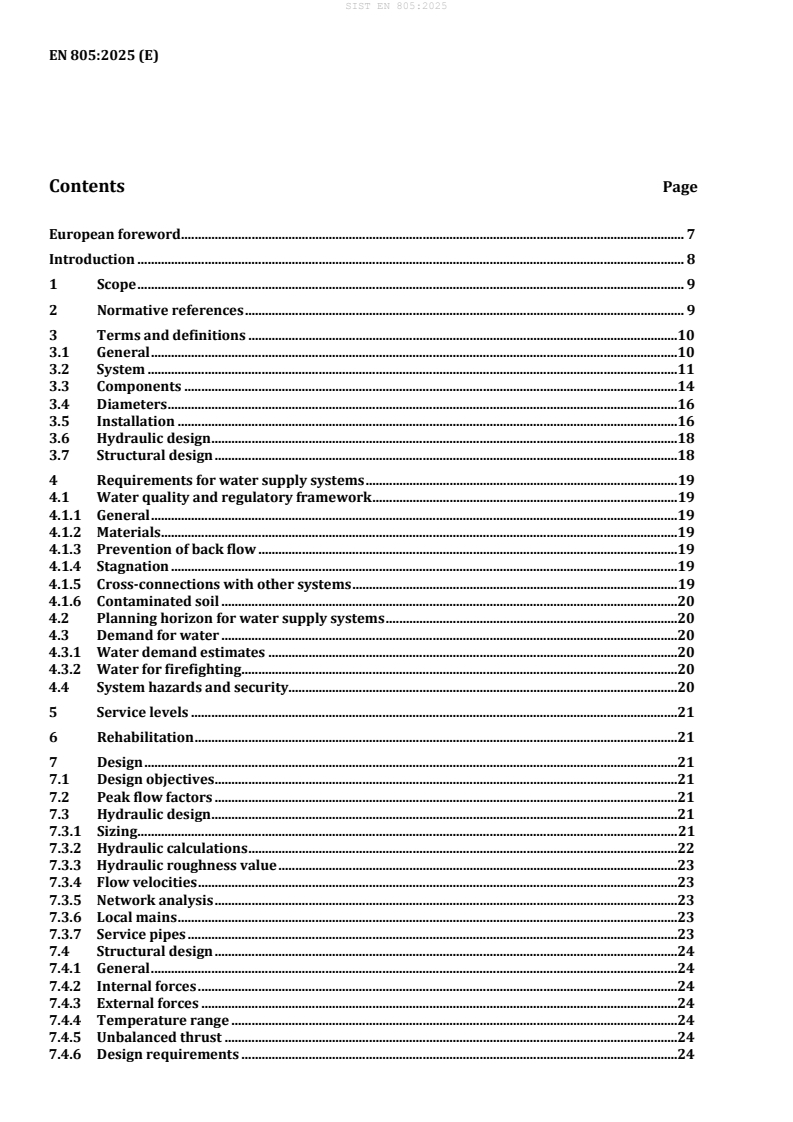
Contents Page
European foreword . 7
Introduction . 8
1 Scope . 9
2 Normative references . 9
3 Terms and definitions .10
3.1 General .10
3.2 System .11
3.3 Components .14
3.4 Diameters .16
3.5 Installation .16
3.6 Hydraulic design .18
3.7 Structural design .18
4 Requirements for water supply systems .19
4.1 Water quality and regulatory framework .19
4.1.1 General .19
4.1.2 Materials .19
4.1.3 Prevention of back flow .19
4.1.4 Stagnation .19
4.1.5 Cross-connections with other systems .19
4.1.6 Contaminated soil .20
4.2 Planning horizon for water supply systems .20
4.3 Demand for water .20
4.3.1 Water demand estimates .20
4.3.2 Water for firefighting .20
4.4 System hazards and security.20
5 Service levels .21
6 Rehabilitation .21
7 Design .21
7.1 Design objectives .21
7.2 Peak flow factors .21
7.3 Hydraulic design .21
7.3.1 Sizing .21
7.3.2 Hydraulic calculations .22
7.3.3 Hydraulic roughness value .23
7.3.4 Flow velocities .23
7.3.5 Network analysis .23
7.3.6 Local mains .23
7.3.7 Service pipes .23
7.4 Structural design .24
7.4.1 General .24
7.4.2 Internal forces .24
7.4.3 External forces .24
7.4.4 Temperature range .24
7.4.5 Unbalanced thrust .24
7.4.6 Design requirements .24
7.4.7 Hydrostatic design requirements . 25
7.4.8 Unforeseen ground conditions . 26
7.5 System layout . 26
7.5.1 Mains . 26
7.5.2 Types of system configurations . 27
7.5.3 Service pipes . 27
7.5.4 Valves . 27
7.5.5 Surge limiting equipment . 28
7.6 Protection against aggressive environment . 28
7.7 Reservoirs . 28
7.8 Pumping stations . 28
7.9 Design service life . 28
7.10 Documentation . 29
8 General requirements for products . 29
8.1 General . 29
8.2 Materials . 29
8.3 Dimensions . 29
8.3.1 Nominal sizes . 29
8.3.2 Internal diameters . 29
8.3.3 Length and wall thickness . 30
8.3.4 Geometry of pipes, fittings, and valves . 30
8.3.5 Internal surface . 30
8.3.6 Appearance and soundness . 30
8.4 Structural design. 30
8.5 Mechanical requirements . 31
8.5.1 Circumferential resistance . 31
8.5.2 Longitudinal resistance . 31
8.6 Water tightness . 31
8.7 Joints. 31
8.7.1 General . 31
8.7.2 Rigid joints . 32
8.7.3 Adjustable joints . 32
8.7.4 Flexible joints . 32
8.8 Protective measures . 32
8.9 Durability . 32
8.10 Test methods . 32
8.10.1 General . 32
8.10.2 Measurement of diameter and wall thickness . 32
8.10.3 Measurement of deviation from straightness of barrel . 33
8.10.4 Measurement of deviation from squareness of component ends . 33
8.10.5 Longitudinal resistance test for pipes . 33
8.10.6 Crushing test for pipes with rigid behaviour . 33
8.10.7 Ring stiffness test for pipes with flexible behaviour . 34
8.10.8 Pressure tests . 34
8.11 Interconnection of products . 34
8.12 Quality management . 34
8.13 Marking . 34
9 Installation . 35
9.1 General requirements . 35
9.1.1 Qualifications . 35
9.1.2 Rules for the execution of construction work . 35
9.1.3 Transport and storage of pipeline components . 35
9.1.4 Health and safety . 35
9.2 Pipe trenches . 36
9.2.1 Construction of pipe trenches; working space .36
9.2.2 Depth of cover .36
9.2.3 Bedding .36
9.3 Installation of pipeline components .37
9.3.1 Distances from underground installations .37
9.3.2 Protection of pipelines against contamination .37
9.3.3 Installation of valves, fittings and other components.37
9.3.4 Connection to structures .37
9.3.5 Precautions against flotation .38
9.4 Pipe joints .38
9.4.1 General requirements .38
9.4.2 Unrestrained joints .38
9.4.3 Restrained joints .38
9.4.4 Welded joints .38
9.4.5 Lubricants for joints .38
9.5 Protection against corrosion and contamination.38
9.5.1 External protection .38
9.5.2 Internal protection .39
9.6 Embedment and main backfill.39
9.6.1 General .39
9.6.2 Selected material for the embedment .39
9.6.3 Execution of the embedment .39
9.6.4 Execution of the main backfill .40
9.6.5 Control of the degree of compaction .40
9.6.6 Diametral deflection of flexible pipes after installation .40
9.7 Records of tests during installation .40
10 Testing of pipelines .40
10.1 General .40
10.2 Safety .41
10.2.1 Safety Equipment and clothing .41
10.2.2 Excavations .41
10.2.3 Filling and testing .41
10.3 Pressure test .41
10.3.1 Preparations .41
10.3.2 Test pressure .42
10.3.3 Installation point for testing equipment .43
10.3.4 Testing at operating pressure with visual inspection .43
10.4 Testing procedure .43
10.4.1 General requirements .43
10.4.2 Preliminary test .43
10.4.3 Pressure drop test.44
10.4.4 Main pressure test .44
10.4.5 Depressurization .45
10.4.6 Test evaluation .45
10.4.7 Final system test .45
10.4.8 Recording test results .45
11 Preparation for commissioning .45
11.1 General .45
11.2 Preparation for disinfection.45
11.2.1 General requirements .45
11.2.2 Disinfection equipment .46
11.3 Selection of disinfectant .46
11.4 Disinfection procedures .46
11.4.1 General requirements .46
11.4.2 Static procedure . 46
11.4.3 Dynamic procedure . 46
11.4.4 Disposal of disinfectant . 46
11.5 Microbiological clearance and reporting . 46
12 Additional requirements . 47
13 Operation . 47
13.1 Inspection and monitoring . 47
13.2 Maintenance . 48
14 Updating of the documentation . 48
Annex A (informative) Guidance to EN 805 . 49
A.1 General . 49
A.2 Pressures . 49
A.3 Prevention of back siphonage . 50
A.4 Water demand estimates . 50
A.5 Water for firefighting . 50
A.6 Service objectives . 51
A.7 Peak flow factors . 51
A.8 Sizing . 51
A.9 Hydraulic roughness value. 51
A.10 Flow velocities . 52
A.11 Network analysis . 52
A.12 Local mains . 53
A.13 Mains . 53
A.14 Types of system configuration . 54
A.15 Service pipes . 55
A.16 Entry and release of air . 55
A.17 Draining . 56
A.18 Isolation . 56
A.19 Hydrants . 56
A.20 Protection against aggressive environment . 56
A.21 Pumping stations . 57
A.22 Structural design. 57
A.23 Testing of non-viscoelastic pipelines (metals, concrete, GRP) . 59
A.23.1 General . 59
A.23.2 Safety . 60
A.23.3 Preparation of a test section . 60
A.23.4 Pressure testing procedure . 64
A.23.5 Finalization of testing . 69
A.24 Testing of viscoelastic pipelines (PE, PVC-U, PVC-O) . 70
A.24.1 General .70
A.24.2 Safety .70
A.24.3 Preparation of a test section .71
A.24.4 Pressure testing procedures .73
A.24.5 Testing procedure using the contraction method .76
A.24.6 Testing procedure using the normal method .81
A.24.7 Finalization of testing .85
A.25 Selection of disinfectants .85
Bibliography .86
European foreword
This document (EN 805:2025) has been prepared by Technical Committee CEN/TC 164 “Water supply”, the
secretariat of which is held by AFNOR.
This European Standard shall be given the status of a national standard, either by publication of an identical
text or by endorsement, at the latest by August 2025, and conflicting national standards shall be withdrawn
at the latest by August 2025.
Attention is drawn to the possibility that some of the elements of this document may be the subject of patent
rights. CEN shall not be held responsible for identifying any or all such patent rights.
This document supersedes EN 805:2000.
The main changes compared to the previous edition EN 805:2000 are listed below:
— addressing climate change and circular economy to enable improvements of water supply systems;
— addressing innovation in new products, processes and solutions for water supply systems;
— improvements related to the long-term safety, planning horizons and the resilience of the water supply
systems;
— new subclause A.23 “Testing of non-viscoelastic pipelines (metals, concrete, GRP)” added;
— subclause A.24 “Testing of viscoelastic pipelines (PE, PVC-U, PVC-O)”: improved procedures.
Any feedback and questions on this document should be directed to the users’ national standards body. A
complete listing of these bodies can be found on the CEN website.
According to the CEN-CENELEC Internal Regulations, the national standards organisations of the following
countries are bound to implement this European Standard: Austria, Belgium, Bulgaria, Croatia, Cyprus, Czech
Republic, Denmark, Estonia, Finland, France, Germany, Greece, Hungary, Iceland, Ireland, Italy, Latvia,
Lithuania, Luxembourg, Malta, Netherlands, Norway, Poland, Portugal, Republic of North Macedonia,
Romania, Serbia, Slovakia, Slovenia, Spain, Sweden, Switzerland, Türkiye and the United Kingdom.
Introduction
In specifying the requirements of this document, due regard has been taken of the importance of a reliable and
safe supply of water for human consumption without excluding other uses of the water from the supply
system.
The widely varying water supply legislative requirements, populations, social and climatic conditions across
Europe have also been taken into account.
This document does not make any implication with regard to ownership of or responsibility for pipes or other
apparatus in the supply system.
This document takes into account the EU Strategy on Standardization setting global standards in support of a
sustainable, resilient, green and digital EU single market.
Technical experts have reviewed and refreshed all the clauses of the EN 805:2000 revision to bring this
document up to date in particular the implications of climate change and adapting the water supply systems,
security, pressure testing, record keeping, resilience of water supply and updates as a result of many
constructive comments from active users of this document across Europe.
It is presupposed that the users of this document take into account any applicable laws, regulations, directives
and standards, including those on health and safety.
1 Scope
This document specifies:
— general requirements for water supply systems outside buildings including potable water mains and
service pipes, service reservoirs, other facilities and raw water mains but excluding treatment works and
water resources development;
— general requirements for components;
— general requirements for inclusion in product standards which can include specifications which are more
stringent;
— general requirements for installation, site testing and commissioning.
The requirements of this document apply to:
— the design and construction of new water supply systems;
— the extension of significant areas forming a coherent part of an existing water supply system;
— interconnections between water supply systems;
— significant modification and/or rehabilitation of existing water supply systems.
NOTE It is not intended that existing water supply systems are altered to comply with this document, provided that
there are no significant detrimental effects on water quantity, security, reliability and adequacy of the supply. However,
this document is intended to cover all water infrastructure systems mentioned above since they are key to meet the
sustainable goals of the cities and to show the urgent need to invest in them in order to consider fundamental aspects,
such as resilience or mitigation/adaptation to climate change.
2 Normative references
The following documents are referenced in the text in such a way that some parts of these or their entire
contents constitute requirements of this document. With dated references, only the referenced issue is
applicable. With undated references, the last issue of the referenced document is applicable (including all
changes).
EN 1295-1, Structural design of buried pipelines under various conditions of loading — Part 1: General
requirements
EN 1508, Water supply — Requirements for systems and components for the storage of water
ISO 48, Rubber, vulcanized or thermoplastic — Determination of hardness (hardness between 10 IRHD and 100
IRHD)
3 Terms and definitions
For the purposes of this document, the following definitions apply.
ISO and IEC maintain terminology databases for use in standardization at the following addresses:
— ISO Online browsing platform: available at https://www.iso.org/obp
— IEC Electropedia: available at https://www.electropedia.org/
3.1 General
3.1.1
allowable maximum operating pressure
PMA
maximum pressure occurring from time to time, including surge, that a component is capable of withstanding
in service
3.1.2
allowable operating pressure
PFA
maximum hydrostatic pressure that a component is capable of withstanding continuously in service
3.1.3
allowable site test pressure
PEA
maximum hydrostatic pressure that a newly installed component is capable of withstanding for a relatively
short duration, in order to ensure the integrity and tightness of the pipeline
3.1.4
design pressure
DP
maximum operating pressure of the system or of the pressure zone fixed by the designer considering future
developments but excluding surge
3.1.5
maximum design pressure
MDP
maximum operating pressure of the system or of the pressure zone fixed by the designer considering future
developments and including surge
3.1.5.1
MDPa
designation of MDP when there is a fixed allowance for surge
3.1.5.2
MDPc
designation of MDP when the surge is calculated
3.1.6
operating pressure
OP
internal pressure which occurs at a particular time and at a particular point in the water supply system
3.1.7
pressure zones
areas of pressure ranges within a water supply system
3.1.8
service pressure
SP
internal pressure delivered at the point of connection to the consumer’s installation at zero flow in the service
pipe
3.1.9
surge
rapid fluctuations of pressure caused by flow alterations over short periods of time
3.1.10
system test pressure
STP
hydrostatic pressure applied to a newly laid pipeline in order to ensure its integrity and tightness
3.2 System
3.2.1
gravity system
system where flow and/or pressure are caused by the force of gravity
Note 1 to entry: There are two kinds of such systems:
— pressurized gravity system, where the pipeline operates full;
— non-pressurized gravity system, where the pipeline operates partially full.
3.2.2
local main
water main which connects principal main(s) with service pipes
3.2.3
potable water
water intended for human consumption as defined by the relevant national authorities
3.2.4
principal main
water main serving as a principal distributor within the supply area, normally without direct consumer
connections
3.2.5
pumped and gravity system
system where the gravity system and the pumped system are used, either separately or in combination, to
provide the flow and/or pressure
3.2.6
pumping station
pumping installation designed to provide pressure and flow within the distribution system
Note 1 to entry: Three types can be distinguished (see Figure 1):
— main lift normally at the outlet of the treatment works, or source if there is no treatment, to provide flow to
the service reservoir;
— intermediate to deliver flow on the way to a service reservoir or supply area;
— booster to pump directly from and to the area without storage.
Key
1 main lift
2 intermediate
3 booster
Figure 1 — Example of different types of pumping stations
3.2.7
pumped system
system where flow and pressure are provided by means of one or more pumps and where the pipeline
operates full
3.2.8
reservoir
storage facility for water
3.2.9
service pipe
water pipe which supplies water from the local main to the consumer
3.2.10
service reservoir
covered r
...
Questions, Comments and Discussion
Ask us and Technical Secretary will try to provide an answer. You can facilitate discussion about the standard in here.
Loading comments...