


oSIST prEN 18247-1:2025
(Main)Performance testing of on-site non-potable water systems - Part 1: Greywater systems
Performance testing of on-site non-potable water systems - Part 1: Greywater systems
This document specifies the testing conditions to assess the treatment performances of greywater systems.
Excluded from the scope of this document are:
- the testing of rainwater harvesting systems;
- the testing of systems for direct use as mentioned in EN 16941–2 "On-site non-potable water systems - Part 2: Systems for the use of treated greywater";
- the testing of blackwater treatment systems;
- the testing of wastewater treatment plant.
Überprüfung der Leistungsfähigkeit von On-Site Nichttrinkwasseranlagen - Teil 1: Grauwassersysteme
Dieses Dokument legt die Prüfbedingungen zur Beurteilung der Behandlungsleistungen von Grauwasseranlagen fest.
Folgendes ist aus dem Anwendungsbereich dieses Dokuments ausgeschlossen:
die Überprüfung von Regenwassernutzungsanlagen;
die Überprüfung von Anlagen für die direkte Verwendung nach EN 16941 2, „Vor-Ort-Anlagen für Nicht-Trinkwasser — Teil 2: Anlagen für die Verwendung von behandeltem Grauwasser“;
die Überprüfung von Schwarzwasserbehandlungsanlagen;
die Überprüfung von Kläranlagen.
Essais de performance des systèmes d'eau non potable autonomes - Partie 1 : Systèmes d'eaux grises
Preskušanje zmogljivosti na kraju samem nameščenih sistemov za nepitno vodo - 1. del: Sistemi za sivo vodo
General Information
- Status
- Not Published
- Public Enquiry End Date
- 30-Dec-2025
- Technical Committee
- IOVO - Water supply and waste water engineering
- Current Stage
- 4020 - Public enquire (PE) (Adopted Project)
- Start Date
- 29-Oct-2025
- Due Date
- 18-Mar-2026
- Completion Date
- 05-Jan-2026
Overview
The draft European Standard oSIST prEN 18247-1:2025:2025, developed by CEN/TC 165, specifies the performance testing protocols for on-site greywater (non-potable) water treatment systems. This document focuses exclusively on greywater systems, defining testing conditions to assess treatment efficiency and water quality output. It excludes rainwater harvesting, direct-use greywater systems (covered in EN 16941-2), blackwater treatment, and wastewater treatment plants.
The standard aims to promote ecology and sustainability in water management by standardizing how greywater systems are tested for their ability to produce reusable, treated greywater suitable for a variety of non-potable applications. This enables manufacturers, operators, and regulators to reliably evaluate system efficacy within residential, commercial, and institutional settings.
Key Topics
- Scope and exclusions: Clearly distinguishes greywater systems from rainwater, blackwater, and direct-use greywater systems, ensuring focused and applicable test methods.
- Testing conditions: Details dosing volumes, hydraulic load schedules, stress tests, and preparation of test water representing typical greywater compositions (light greywater, laundry water, or combined).
- Performance evaluation: Procedures cover monitoring of physical, chemical, and biological parameters, including water quality indicators such as turbidity, biochemical oxygen demand (BOD), phosphorus, and microbial content.
- Sampling and analysis: Defines frequencies and methods for collecting representative water samples to assess treatment outcomes, addressing parameters like colour, odour, foaming, and energy consumption.
- Stress testing protocols: Includes overload, underload, vacation, wash day, and disinfection stress tests to simulate real-life operational variances and equipment failures.
- Reporting: Provides guidance for compiling comprehensive final reports on system performance based on test data, enabling transparent, standardized documentation.
- Reference to normative standards and analytical methods: Incorporates established EN and ISO standards for water quality testing to support harmonized assessment procedures.
Applications
The oSIST prEN 18247-1:2025 standard is essential for:
- Manufacturers of greywater treatment systems seeking standardized test methods to prove treatment performance in line with European requirements.
- Testing and certification bodies evaluating compliance of on-site greywater treatment products prior to market introduction or regulatory approval.
- Water management professionals and engineers designing sustainable water reuse systems with confidence in validated greywater treatment processes.
- Facility managers in residential complexes, hotels, commercial centers, and sports venues to verify system functionality and optimize non-potable water reuse.
- Environmental regulators and policy makers using consistent criteria to establish greywater reuse guidelines promoting water conservation and pollution control.
Practical reuse applications enabled by effective greywater treatment include:
- Toilet flushing
- Laundry processes
- Irrigation of landscapes and gardens
- Cleaning floors, vehicles, and outdoor surfaces
These uses reduce potable water demand and wastewater discharge, contributing to ecological sustainability.
Related Standards
- EN 16941-2: On-site non-potable water systems - Part 2: Systems for the use of treated greywater - complements oSIST prEN 18247-1:2025 by addressing direct reuse systems.
- EN 872: Water quality - Determination of suspended solids - supports testing of treated greywater clarity.
- EN 1899-2: Biochemical Oxygen Demand (BOD) measurement standard - necessary for evaluating organic load reduction.
- EN 16323: Glossary of wastewater engineering terms ensuring consistent terminology.
- ISO water quality standards covering turbidity, pathogen enumeration, chemical oxygen demand, and nutrient analysis pertinent to greywater testing.
The integration of these references guarantees a harmonized and scientifically robust framework for assessing greywater system performance according to oSIST prEN 18247-1:2025.
By adopting oSIST prEN 18247-1:2025, stakeholders ensure reliable, repeatable, and transparent evaluation of greywater treatment systems that align with environmental sustainability goals and promote safer, efficient non-potable water reuse throughout Europe and beyond.

Frequently Asked Questions
oSIST prEN 18247-1:2025 is a draft published by the Slovenian Institute for Standardization (SIST). Its full title is "Performance testing of on-site non-potable water systems - Part 1: Greywater systems". This standard covers: This document specifies the testing conditions to assess the treatment performances of greywater systems. Excluded from the scope of this document are: - the testing of rainwater harvesting systems; - the testing of systems for direct use as mentioned in EN 16941–2 "On-site non-potable water systems - Part 2: Systems for the use of treated greywater"; - the testing of blackwater treatment systems; - the testing of wastewater treatment plant.
This document specifies the testing conditions to assess the treatment performances of greywater systems. Excluded from the scope of this document are: - the testing of rainwater harvesting systems; - the testing of systems for direct use as mentioned in EN 16941–2 "On-site non-potable water systems - Part 2: Systems for the use of treated greywater"; - the testing of blackwater treatment systems; - the testing of wastewater treatment plant.
oSIST prEN 18247-1:2025 is classified under the following ICS (International Classification for Standards) categories: 93.025 - External water conveyance systems. The ICS classification helps identify the subject area and facilitates finding related standards.
oSIST prEN 18247-1:2025 is available in PDF format for immediate download after purchase. The document can be added to your cart and obtained through the secure checkout process. Digital delivery ensures instant access to the complete standard document.
Standards Content (Sample)
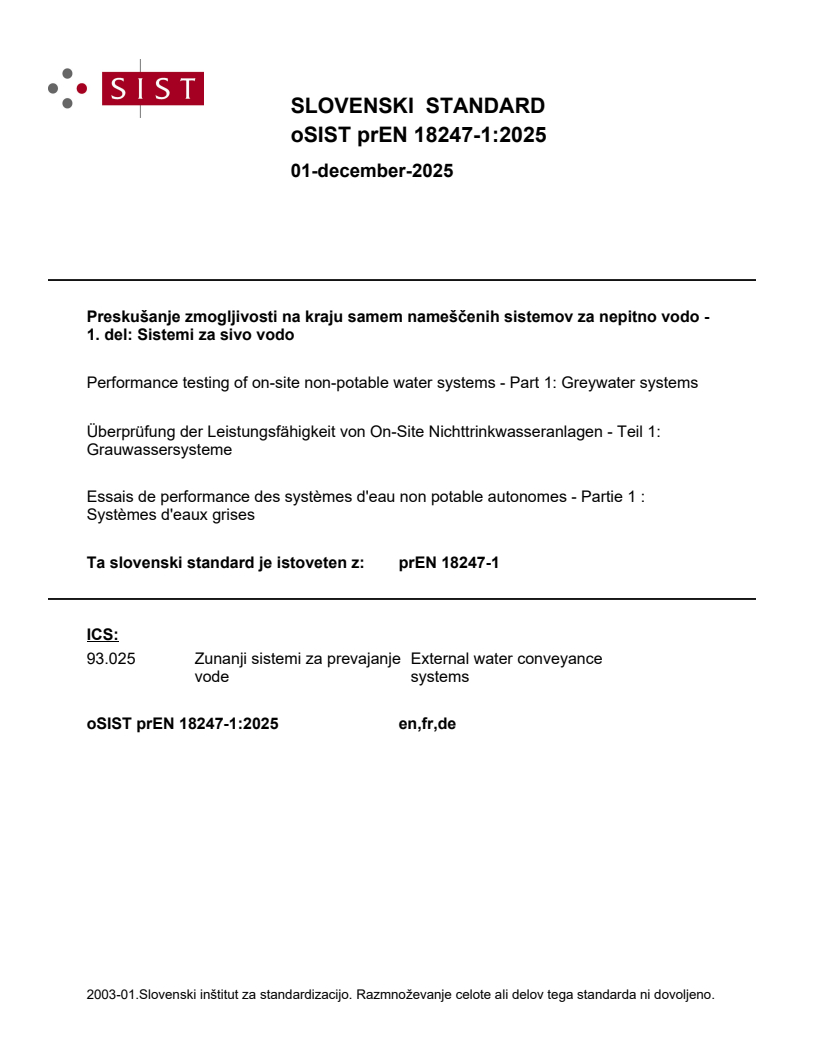
SLOVENSKI STANDARD
01-december-2025
Preskušanje zmogljivosti na kraju samem nameščenih sistemov za nepitno vodo -
1. del: Sistemi za sivo vodo
Performance testing of on-site non-potable water systems - Part 1: Greywater systems
Überprüfung der Leistungsfähigkeit von On-Site Nichttrinkwasseranlagen - Teil 1:
Grauwassersysteme
Essais de performance des systèmes d'eau non potable autonomes - Partie 1 :
Systèmes d'eaux grises
Ta slovenski standard je istoveten z: prEN 18247-1
ICS:
93.025 Zunanji sistemi za prevajanje External water conveyance
vode systems
2003-01.Slovenski inštitut za standardizacijo. Razmnoževanje celote ali delov tega standarda ni dovoljeno.
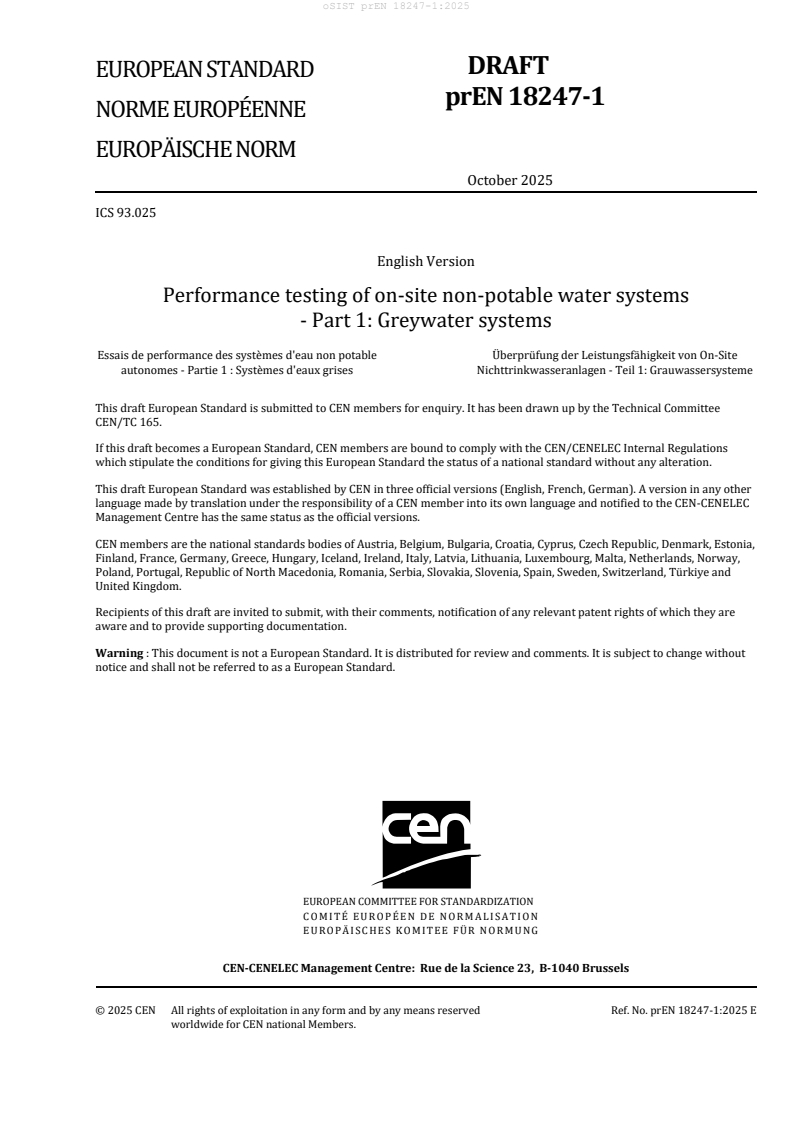
DRAFT
EUROPEAN STANDARD
NORME EUROPÉENNE
EUROPÄISCHE NORM
October 2025
ICS 93.025
English Version
Performance testing of on-site non-potable water systems
- Part 1: Greywater systems
Essais de performance des systèmes d'eau non potable Überprüfung der Leistungsfähigkeit von On-Site
autonomes - Partie 1 : Systèmes d'eaux grises Nichttrinkwasseranlagen - Teil 1: Grauwassersysteme
This draft European Standard is submitted to CEN members for enquiry. It has been drawn up by the Technical Committee
CEN/TC 165.
If this draft becomes a European Standard, CEN members are bound to comply with the CEN/CENELEC Internal Regulations
which stipulate the conditions for giving this European Standard the status of a national standard without any alteration.
This draft European Standard was established by CEN in three official versions (English, French, German). A version in any other
language made by translation under the responsibility of a CEN member into its own language and notified to the CEN-CENELEC
Management Centre has the same status as the official versions.
CEN members are the national standards bodies of Austria, Belgium, Bulgaria, Croatia, Cyprus, Czech Republic, Denmark, Estonia,
Finland, France, Germany, Greece, Hungary, Iceland, Ireland, Italy, Latvia, Lithuania, Luxembourg, Malta, Netherlands, Norway,
Poland, Portugal, Republic of North Macedonia, Romania, Serbia, Slovakia, Slovenia, Spain, Sweden, Switzerland, Türkiye and
United Kingdom.
Recipients of this draft are invited to submit, with their comments, notification of any relevant patent rights of which they are
aware and to provide supporting documentation.
Warning : This document is not a European Standard. It is distributed for review and comments. It is subject to change without
notice and shall not be referred to as a European Standard.
EUROPEAN COMMITTEE FOR STANDARDIZATION
COMITÉ EUROPÉEN DE NORMALISATION
EUROPÄISCHES KOMITEE FÜR NORMUNG
CEN-CENELEC Management Centre: Rue de la Science 23, B-1040 Brussels
© 2025 CEN All rights of exploitation in any form and by any means reserved Ref. No. prEN 18247-1:2025 E
worldwide for CEN national Members.
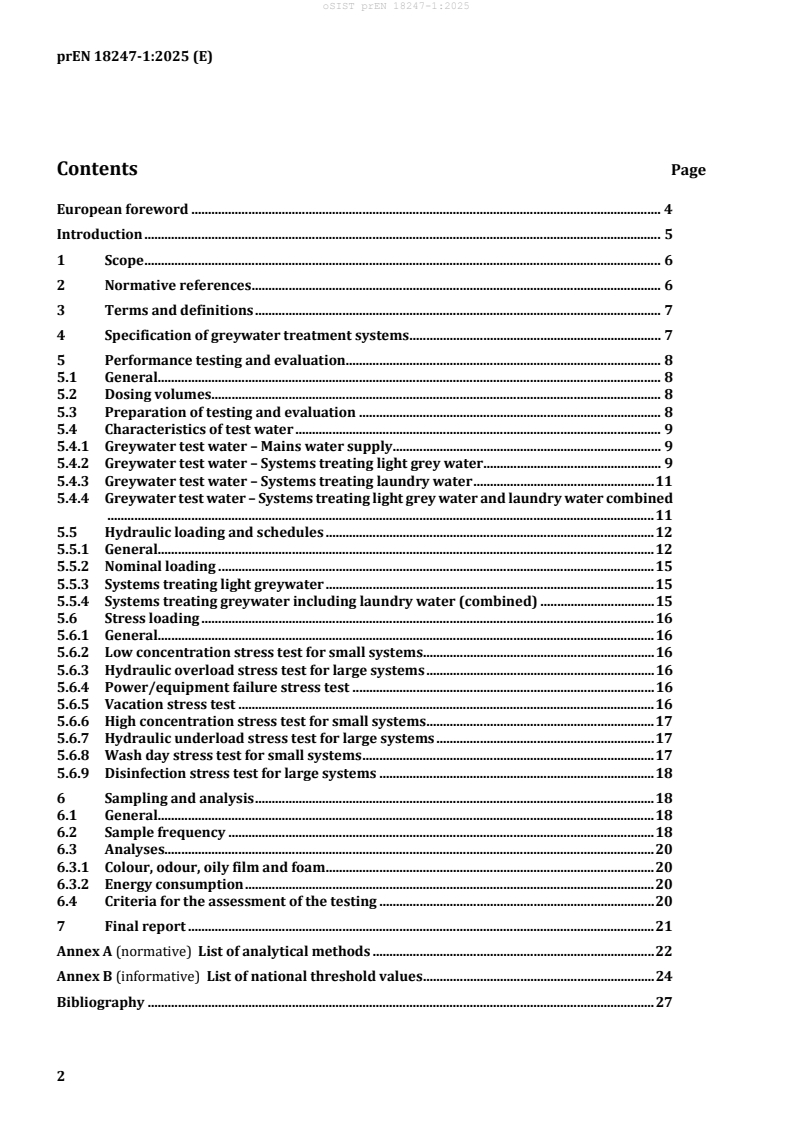
Contents Page
European foreword . 4
Introduction . 5
1 Scope . 6
2 Normative references . 6
3 Terms and definitions . 7
4 Specification of greywater treatment systems . 7
5 Performance testing and evaluation . 8
5.1 General. 8
5.2 Dosing volumes . 8
5.3 Preparation of testing and evaluation . 8
5.4 Characteristics of test water . 9
5.4.1 Greywater test water – Mains water supply . 9
5.4.2 Greywater test water – Systems treating light grey water . 9
5.4.3 Greywater test water – Systems treating laundry water . 11
5.4.4 Greywater test water – Systems treating light grey water and laundry water combined
................................................................................................................................................................... 11
5.5 Hydraulic loading and schedules . 12
5.5.1 General. 12
5.5.2 Nominal loading . 15
5.5.3 Systems treating light greywater . 15
5.5.4 Systems treating greywater including laundry water (combined) . 15
5.6 Stress loading . 16
5.6.1 General. 16
5.6.2 Low concentration stress test for small systems . 16
5.6.3 Hydraulic overload stress test for large systems . 16
5.6.4 Power/equipment failure stress test . 16
5.6.5 Vacation stress test . 16
5.6.6 High concentration stress test for small systems . 17
5.6.7 Hydraulic underload stress test for large systems . 17
5.6.8 Wash day stress test for small systems . 17
5.6.9 Disinfection stress test for large systems . 18
6 Sampling and analysis . 18
6.1 General. 18
6.2 Sample frequency . 18
6.3 Analyses. 20
6.3.1 Colour, odour, oily film and foam . 20
6.3.2 Energy consumption . 20
6.4 Criteria for the assessment of the testing . 20
7 Final report . 21
Annex A (normative) List of analytical methods . 22
Annex B (informative) List of national threshold values . 24
Bibliography . 27
Table contents
Table 1 — Hardness and alkalinity of mains water . 9
Table 2 — Preparation of test water for light greywater . 10
Table 3 — Concentration of test water for light greywater . 10
Table 4 — Preparation of test water for laundry water . 11
Table 5 — Concentration of test water for laundry water . 11
Table 6 — Concentration of test water for light greywater and laundry water combined . 12
Table 7 — Testing phases: Schedule and specific loading . 13
Table 8 — Time frame of daily loading for light greywater . 15
Table 9 — Time frame of daily loading for greywater including laundry water . 15
Table 10 — Dosing schedule during vacation stress test . 17
Table 11 — Schedule of wash day stress test . 17
Table 12 — Disinfection compound or alternatives . 18
Table 13 — Water quality monitoring plan . 19
Table A.1 — Analytical methods . 22
Table A.2 — Examples of analytic methods for 6.3.1 (informative) . 23
Table B.1 — List of national threshold values . 24
European foreword
This document (prEN 18247-1:2025) has been prepared by Technical Committee CEN/TC 165
“Wastewater engineering”, the secretariat of which is held by DIN.
This document is currently submitted to the CEN Enquiry.
Introduction
Ecology and sustainability are goals of any water management. In this connection greywater harvesting,
treatment and use reduces the potable water demand and the discharge of water.
On-site collection and use of treated greywater cover a variety of applications like toilet flushing, laundry,
landscape irrigation, floor and car cleaning, etc. in single and collective residential buildings, hotels,
offices, commercial centres and sportive premises for instance.
The diversity of reused water applications requires procedures for the evaluation of treatment systems
to assess the achieved water quality.
This document is intended to provide procedure for performance testing of greywater treatment systems.
1 Scope
This document specifies the testing conditions to assess the treatment performances of greywater
systems.
Excluded from the scope of this document are:
— the testing of rainwater harvesting systems;
— the testing of systems for direct use as mentioned in EN 16941-2 “On-site non-potable water systems
- Part 2: Systems for the use of treated greywater”;
— the testing of blackwater treatment systems;
— the testing of wastewater treatment plant.
2 Normative references
The following documents are referred to in the text in such a way that some or all of their content
constitutes requirements of this document. For dated references, only the edition cited applies. For
undated references, the latest edition of the referenced document (including any amendments) applies.
EN 872, Water quality — Determination of suspended solids — Method by filtration through glass fibre
filters
EN 1899-2, Water quality — Determination of biochemical oxygen demand after n days (BOD ) — Part 2:
n
Method for undiluted samples (ISO 5815)
EN 16941-2:2021, On-site non-potable water systems — Part 2: Systems for the use of treated greywater
EN 16323, Glossary of wastewater engineering terms
EN ISO 6878, Water quality — Determination of phosphorus — Ammonium molybdate spectrometric
method (ISO 6878)
EN ISO 7027-1, Water quality — Determination of turbidity — Part 1: Quantitative methods (ISO 7027-
1:2016))
EN ISO 7899-1, Water quality — Detection and enumeration of intestinal enterococci in surface and waste
water — Part 1: Miniaturized method (most probable number) by inoculation in liquid medium (ISO 7899-
1)
ISO 9308-2, Water quality — Enumeration of Escherichia coli and coliform bacteria — Part 2: Most
probable number method
EN ISO 9308-3, Water quality — Detection and enumeration of Escherichia coli and coliform bacteria in
surface and wastewater — Part 3: Miniaturized method (most probable number) by inoculation in liquid
medium (ISO 9308-3)
EN ISO 9963-1, Water quality — Determination of alkalinity — Part 1: Determination of total and
composite alkalinity (ISO 9963-1)
EN ISO 10304-1, Water quality — Determination of dissolved anions by liquid chromatography of ions —
Part 1: Determination of bromide, chloride, fluoride, nitrate, nitrite, phosphate and sulfate (ISO 10304-1)
ISO 11885, Water quality — Determination of selected elements by inductively coupled plasma optical
emission spectrometry (ICP-OES)
ISO 12103-1, Road vehicles — Test contaminants for filter evaluation — Part 1: Arizona test dust
ISO 10523, Water quality — Determination of pH
ISO 11731, Water quality — Enumeration of Legionella
ISO 15705, Water quality — Determination of the chemical oxygen demand index (ST-COD) — Small-scale
sealed-tube method
ISO 23695, Water quality — Determination of ammonium nitrogen in water — Small-scale sealed tube
method
ISO 23697-1, Water quality — Determination of total bound nitrogen (ST-TN ) in water using small-scale
b
sealed tubes — Part 1: Dimethylphenol colour reaction
3 Terms and definitions
For the purposes of this document, the terms and definitions given in EN 16323 and the following apply.
ISO and IEC maintain terminology databases for use in standardization at the following addresses:
— ISO Online browsing platform: available at https://www.iso.org/obp/
— IEC Electropedia: available at https://www.electropedia.org/
3.1
daily hydraulic capacity
dhc
amount of greywater a system treats within 24 hours
3.2
greywater treatment system
system designed to treat greywater by physical, chemical and/or biological process
3.3
light grey water
greywater excluding kitchen and clothes washer wastewater
[SOURCE: EN 16941-2:2021]
4 Specification of greywater treatment systems
Greywater treatment systems being tested according to this document shall be constructed in accordance
with EN 16941-2.
Systems that incorporate alternate materials, designs or constructions, may be acceptable when it is
confirmed that such systems meet the applicable requirements of this document.
5 Performance testing and evaluation
5.1 General
Testing shall be performed with an onsite greywater treatment system.
If the tests are performed by an independent testing institute, the manufacturer shall provide the testing
institute with plant and process design specifications including a complete set of drawing and supporting
calculations before testing starts. Full information concerning the installation and operation and
maintenance requirements of the plant shall also be provided. The manufacturer shall provide the
laboratory with information detailing the mechanical, electrical, and structural safety of the plant to be
tested. The manufacturer shall particularly make the nominal hydraulic capacity of his product available.
For the purposes of assessment, the manufacturer's products may be grouped into families, where it is
considered that the results for one or more characteristics from any one product within the product
family are representative for that same characteristics (i.e. technology or scaling) for all products within
that same family.
Systems to which a small number of residential units or one household are connected (small systems)
are exposed to different challenges than systems to which a large number of residential units are
connected (large systems), such as hotels. The test procedure in this standard is therefore set up
differently for these two scenarios. Small systems treat greywater of up to 1 000 L/d, large systems treat
greywater of more than 1 000 L/d.
The smallest model of the product family shall be tested. For large treatment plants, the testing size shall
/d. This is due to the testing possibility of on-site greywater systems.
not exceed 5 m
5.2 Dosing volumes
Greywater shall be applied to the system in doses. Each individual greywater dose shall be between
1 %and 2 % of the dhc. Regardless of the percentage rating, the smallest dosing size shall not be less than
15 litres.
The distribution of the individual greywater doses shall be evenly applied over the times specified in 5.4
and 5.5.
The 30-d average volume of the wastewater delivered to the system shall be within 100 % ± 10 % of the
system’s daily hydraulic capacity. All dosing days, except those with dosing requirements less than or
greater than the daily hydraulic capacity shall be included in the 30-d average calculation.
5.3 Preparation of testing and evaluation
The greywater treatment system shall be installed and commissioned in a way that is representative of
the usual conditions of use
Some greywater treatment systems are equipped with a feature that allows using potable water for the
topping off of the treated water storage tank, thus ensuring a continuous supply of water for its intended
use. This feature shall be disabled for performance testing purposes.
Some greywater treatment systems require a potable water connection to facilitate a backflush or
perform other functions. This feature shall remain active during performance testing, provided that the
volume of potable water used does not exceed 5 % of the system’s daily hydraulic capacity. On sampling
days, the volume of potable water used shall not exceed 5 % of the daily hydraulic capacity, and at least
90 % of the fresh water used in the process shall be directed to the sewer. For instance, fresh water may
be used to periodically flush the treated water storage tank, with the flush directed to the sewer. If more
than 10 % of the flush water remains in the treated water storage tank, this feature shall be disabled
during performance testing.
The system shall be inspected to ensure proper installation by the manufacturer according to his
specifications indicated in the installation manual. If no defects are found and the system is deemed
structurally sound, it shall be placed into operation following specific start-up procedures.
If the manufacturer’s instructions do not specify a filling procedure, the system shall be filled as follows:
Two-thirds (2/3) of the system's capacity shall be filled with water meeting the specifications outlined in
5.4.1, and the remaining one-third (1/3) shall be filled with greywater that complies with the
specifications in 5.4.2, 5.4.3, or 5.4.4, based on the provision to test with light greywater, laundry water,
or both. The system shall undergo nominal loading as specified in 5.5.1 until testing and evaluations are
initiated. Sample collection and analysis shall begin upon notification from the manufacturer and, unless
otherwise specified in 6.4, shall continue without interruption until the evaluation period concludes.
If the system is to be installed outdoors and site conditions prevent the system from being installed at the
prescribed depth, it is permitted to cover the system with soil to achieve the standard installation depth.
Performance testing and system evaluations shall not be limited to specific seasons.
Electrical or mechanical defects shall be repaired to prevent evaluation delays and shall be documented
in the final report.
The system shall be operated in accordance with the instructions manual during the performance testing
period. Routine maintenance and servicing of the system are not allowed during the testing and
evaluation period. Routine refilling or topping off of disinfection device reservoirs, such as those used for
tablet or liquid chlorinators, is permitted once every 30 days, with each instance documented in the final
report.
The manufacturer may recommend or offer more frequent maintenance or servicing of the system, but
for the purposes of performance testing and evaluation, maintenance shall not exceed the limits set forth
in this standard.
5.4 Characteristics of test water
5.4.1 Greywater test water – Mains water supply
A public water supply with drinking water shall be used as mains water to which individual ingredients
are added. The 30-d average concentration of the mains water supply shall meet or be adjusted to meet
the requirements shown in Table 1.
Table 1 — Hardness and alkalinity of mains water
Parameter Required range
Hardness as CaCO 110 mg/l – 220 mg/l
(1,1 mmol/l −2,2 mmol/l)
Alkalinity as CaCO > 40 mg/l
5.4.2 Greywater test water – Systems treating light grey water
Prepare the test water according to the formula using commercially available products shown in Table 2.
Table 2 — Preparation of test water for light greywater
Influent components Amount per 100 l mains water
Body wash 30 g
Toothpaste 3 g
Deodorant (liquid) 2 g
Shampoo 19 g
Conditioner 21 g
Lactic acid 3 g
Raw influent screened to ≤ 1mm 2 l (or adjusted to match the needed influent
requirements of bacteria)
Bath cleaner 10 g
Liquid hand soap 23 g
A2 – Fine Test dust, meeting ISO 12103-1 10 g
Urea As needed to bring influent TKN within the specific
range
NaOH As needed to adjust pH
HCl As needed to adjust pH
The amount of individual greywater components is a recommendation. If the required range for the 30-
d-average concentration of individual parameters is not met using the recommended volumes, then the
volume of components can be adjusted. All necessary adjustments to the ingredient volumes shall be
reported in the final report.
The light greywater delivered to the system shall have the concentrations shown in Table 3.
Table 3 — Concentration of test water for light greywater
Required Individual sample
Parameter Unit
range maximum
pH - 6,0 to 8,5
Temperature °C 25 to 35
Turbidity NTU 30 to 70
TSS mg/l 30 to 100
BOD5 mg/l 100 to 200
COD mg/l 200 to 400
Total phosphorus -P mg/l 1,0 to 4,0
Total Kjeldahl nitrogen-N mg/l 3,0 to 5,0
3 7 9
Total coliforms CFU/100 ml 10 to 10 10
2 6 7
E. coli (30d geometric mean) CFU/100 ml 10 to 10 10
5.4.3 Greywater test water – Systems treating laundry water
Prepare the test water according to the formula using commercially available products shown in Table 4.
Table 4 — Preparation of test water for laundry water
Wastewater components Amount per 100 l mains water
Liquid laundry detergent 40 ml
A2 – fine test dust, meeting ISO 12103-1 10 g
Raw influent screened to ≤ 1 mm 1 l
Liquid laundry fabric softener 21 ml
Na SO 4 g
2 4
NaHCO3 2 g
Na PO 4 g
3 4
Urea As needed to bring influent TKN within the specific
range
NaOH As needed to adjust pH
HCl As needed to adjust pH
The amount of individual wastewater components are recommendations and can be adjusted to achieve
the required 30-d average concentrations. All adjustments shall be reported in the final report.
The laundry water delivered to the system shall have the concentration shown in Table 5.
Table 5 — Concentration of test water for laundry water
Individual sample
Parameter Unit Required range
maximum
pH - 6,0 to 8,5
Temperature °C 25 to 35
Turbidity NTU 50 t
...
Questions, Comments and Discussion
Ask us and Technical Secretary will try to provide an answer. You can facilitate discussion about the standard in here.
Loading comments...