


SIST EN 14801:2006
(Main)Conditions for pressure classification of products for water and wastewater pipelines
Conditions for pressure classification of products for water and wastewater pipelines
This document applies to components (pipes, joints, fittings, ferrules and valves), which have pressure related classification in European Standards covering products which are intended to be used for buried water supply and waste water pressure pipelines outside buildings. It specifies combinations of loading conditions and installation conditions to be used in the design method by reference to the relevant product standard for the determination of the allowable pressures (PFA, PMA and PEA) as defined in EN 805.
This document does not apply as an installation guide.
NOTE 1 This document does not give the full range of installation and loading parameters for all components and does not specify calculation and/or test methods for determination of the allowable pressures.
NOTE 2 This document does not relieve designers of their obligation under EN 805:2000, 8.4; e.g. to consider all conditions not addressed in clause 5 (e. g. seismic loads).
NOTE 3 This document does not deal with marking of components.
Bedingungen für die Klassifizierung von Produkten für Rohrleitungssysteme für die Wasserversorgung und Abwasserentsorgung nach auftretenden Drücken
Diese Norm gilt für Bauteile (Rohre, Rohrverbindungen, Formstücke, Anbohrarmaturen und Armaturen), die nach den auftretenden Drücken klassifiziert und in Europäischen Normen für Produkte erfasst werden, die für erdverlegte Druckrohrleitungen zur Wasserversorgung und Abwasserentsorgung außerhalb von Gebäuden vorgesehen sind. In dieser Norm werden die Einbau- und Lastparameter festgelegt, die zur Bestimmung der in EN 805 definierten zulässigen Drücke (PRA, PMA und PEA) anzuwenden sind.
Es ist vorgesehen, diese Norm zusammen mit relevanten Normen anzuwenden, die vom CEN/TC 164 und CEN/TC 165 erarbeitet wurden und eine Klassifizierung nach auftretenden Drücken festlegen, z. B. EN 805, EN 1610, EN 752, EN 1295-1.
ANMERKUNG 1 In dieser Norm werden weder sämtliche Einbau- und Lastparameter für alle Werkstoffe, aus denen die jeweiligen Produkte bestehen, noch spezielle Verifizierungskriterien angegeben (Berechnungs- und/oder Prüfverfahren).
ANMERKUNG 2 Diese Norm entbindet die Planer nicht von den in 8.4 von EN 805 festgelegten Verpflichtungen, z. B. alle Bedingungen zu berücksichtigen, die im Abschnitt 5 nicht erwähnt werden (z. B. seismische Lasten).
ANMERKUNG 3 Bei Beurteilung der zulässigen Drücke können für Formstücke, Anbohrarmaturen und Armaturen unterschiedliche Lastparameter für das jeweils zu berücksichtigende Rohr zutreffen.
Diese Norm darf nicht als Anleitung für die Rohrverlegung angesehen werden.
Conditions pour la détermination des classes de pression des produits destinés aux réseaux d'alimentation en eau ou d'assainissement
Le présent document s’applique aux composants (tuyaux, assemblages, raccords, viroles et robinets) classifiés par pression dans des Normes européennes couvrant des produits qui sont destinés à être utilisés dans les réseaux d’alimentation en eau enterrés et les réseaux d’assainissement sous pression à l’extérieur des bâtiments. Il spécifie des combinaisons de conditions de chargement et de conditions de mise en oruvre à utiliser dans la méthode de conception, en référence à la norme de produit applicable, pour la détermination des pressions admissibles (PFA, PMA et PEA) telles que définies dans l’EN 805.
Le présent document ne s’applique pas en tant que guide pour la mise en oeuvre.
NOTE 1 Le présent document n’inclut pas l’ensemble des paramètres de mise en oeuvre et de chargement pour tous les composants et il ne spécifie pas de méthodes de calcul et/ou d’essai pour la détermination des pressions admissibles.
NOTE 2 Le présent document ne décharge pas les concepteurs de leurs obligations aux termes de l’EN 805:2000, 8.4 ; notamment l’obligation de prendre en considération toutes les conditions non spécifiées dans l’Article 5 (par exemple les charges sismiques).
NOTE 3 Le présent document ne traite pas du marquage des composants.
Pogoji za klasifikacijo proizvodov za cevne sisteme za oskrbo z vodo in cevne sisteme pod tlakom za odstranjevanje odpadne vode
General Information
- Status
- Published
- Publication Date
- 30-Sep-2006
- Technical Committee
- IOVO - Water supply and waste water engineering
- Current Stage
- 6060 - National Implementation/Publication (Adopted Project)
- Start Date
- 01-Oct-2006
- Due Date
- 01-Oct-2006
- Completion Date
- 01-Oct-2006
Overview
EN 14801:2006 (CEN) defines the conditions for pressure classification of components used in buried water and wastewater pressure pipelines outside buildings. It applies to products such as pipes, joints, fittings, ferrules and valves that have pressure-related classification in European product standards. EN 14801:2006 specifies combinations of loading and installation conditions to be used with the relevant product standard and EN 805 to determine allowable pressures: PFA (allowable operating pressure), PMA (allowable maximum operating pressure) and PEA (allowable site test pressure).
Note: EN 14801:2006 is not an installation guide, does not give full calculation or test methods, and does not cover component marking.
Key topics and technical requirements
- Scope and applicability
- Buried pipelines outside buildings; components with pressure classification in European product standards.
- Allowable pressures
- Definitions and linkage to EN 805: PFA, PMA, PEA.
- Constant parameters used in pressure determinations:
- Design life: 50 years
- Continuous operating temperature: 20 °C
- Transient negative pressure: 80 kPa below atmospheric
- Unit weight of soil (native/embedment/backfill): 20 kN/m³
- Native soil classification and Relative Standard Proctor Density (DPr) are assumed for calculations.
- Variable parameters
- Defined loading conditions (A, B, C) - e.g., main road, urban road, rural/earth load - and installation conditions (1, 2, 3) with corresponding embedment compaction levels.
- Combined cases (A1, A2, B1, B2, C1, C2, C3) determine input conditions for product standard design methods.
- Design method linkage
- EN 14801 provides the conditions to be used by product standards and refers designers back to EN 805 for overall system considerations (e.g., seismic loads not fully covered by EN 14801).
- Annexes
- Informative and normative annexes cover longitudinal effects, uniform soil classification, application examples, compaction and bedding reaction angle guidance.
Practical applications and users
Who uses EN 14801:2006:
- Product standards committees and manufacturers classifying component pressure ratings
- Design engineers and consultants assessing component suitability for buried water/wastewater systems
- Utilities, infrastructure owners and road authorities specifying loading and installation conditions
- Certification bodies and testing laboratories referencing allowable pressures (PFA/PMA/PEA)
Typical uses:
- Establishing pressure classes for new pipe/fitting product standards
- Determining allowable site test pressures (PEA) for newly installed pipelines
- Evaluating influence of embedment quality, depth of cover and traffic loads on allowable pressures
Related standards
- EN 805:2000 - Water supply - Requirements for systems and components outside buildings
- ENV 1046:2001 - Installation practices for plastic piping outside buildings
- EN 1295-1:1997 - Methods for soil–pipe interaction and traffic loading references
Keywords: EN 14801, pressure classification, buried water pipelines, wastewater pressure pipelines, allowable pressures, PFA PMA PEA, EN 805, loading conditions, embedment compaction.


Frequently Asked Questions
SIST EN 14801:2006 is a standard published by the Slovenian Institute for Standardization (SIST). Its full title is "Conditions for pressure classification of products for water and wastewater pipelines". This standard covers: This document applies to components (pipes, joints, fittings, ferrules and valves), which have pressure related classification in European Standards covering products which are intended to be used for buried water supply and waste water pressure pipelines outside buildings. It specifies combinations of loading conditions and installation conditions to be used in the design method by reference to the relevant product standard for the determination of the allowable pressures (PFA, PMA and PEA) as defined in EN 805. This document does not apply as an installation guide. NOTE 1 This document does not give the full range of installation and loading parameters for all components and does not specify calculation and/or test methods for determination of the allowable pressures. NOTE 2 This document does not relieve designers of their obligation under EN 805:2000, 8.4; e.g. to consider all conditions not addressed in clause 5 (e. g. seismic loads). NOTE 3 This document does not deal with marking of components.
This document applies to components (pipes, joints, fittings, ferrules and valves), which have pressure related classification in European Standards covering products which are intended to be used for buried water supply and waste water pressure pipelines outside buildings. It specifies combinations of loading conditions and installation conditions to be used in the design method by reference to the relevant product standard for the determination of the allowable pressures (PFA, PMA and PEA) as defined in EN 805. This document does not apply as an installation guide. NOTE 1 This document does not give the full range of installation and loading parameters for all components and does not specify calculation and/or test methods for determination of the allowable pressures. NOTE 2 This document does not relieve designers of their obligation under EN 805:2000, 8.4; e.g. to consider all conditions not addressed in clause 5 (e. g. seismic loads). NOTE 3 This document does not deal with marking of components.
SIST EN 14801:2006 is classified under the following ICS (International Classification for Standards) categories: 93.025 - External water conveyance systems; 93.030 - External sewage systems. The ICS classification helps identify the subject area and facilitates finding related standards.
SIST EN 14801:2006 is available in PDF format for immediate download after purchase. The document can be added to your cart and obtained through the secure checkout process. Digital delivery ensures instant access to the complete standard document.
Standards Content (Sample)
2003-01.Slovenski inštitut za standardizacijo. Razmnoževanje celote ali delov tega standarda ni dovoljeno.Conditions for pressure classification of products for water and wastewater pipelinesPogoji za klasifikacijo proizvodov za cevne sisteme za oskrbo z vodo in cevne sisteme pod tlakom za odstranjevanje odpadne vodeConditions pour la détermination des classes de pression des produits destinés aux réseaux d'alimentation en eau ou d'assainissementBedingungen für die Klassifizierung von Produkten für Rohrleitungssysteme für die Wasserversorgung und Abwasserentsorgung nach auftretenden DrückenTa slovenski standard je istoveten z:EN 14801:2006SIST EN 14801:2006en93.030Zunanji sistemi za odpadno vodoExternal sewage systems93.025Zunanji sistemi za prevajanje vodeExternal water conveyance systemsICS:SLOVENSKI
STANDARDSIST EN 14801:200601-oktober-2006
EUROPEAN STANDARDNORME EUROPÉENNEEUROPÄISCHE NORMEN 14801July 2006ICS 93.025; 93.030 English VersionConditions for pressure classification of products for water andwastewater pipelinesConditions de détermination de la classe de pression desproduits pour réseaux d'alimentation en eau oud'assainissementBedingungen für die Klassifizierung von Produkten fürRohrleitungssysteme für die Wasserversorgung undAbwasserentsorgung nach auftretenden DrückenThis European Standard was approved by CEN on 5 June 2006.CEN members are bound to comply with the CEN/CENELEC Internal Regulations which stipulate the conditions for giving this EuropeanStandard the status of a national standard without any alteration. Up-to-date lists and bibliographical references concerning such nationalstandards may be obtained on application to the Central Secretariat or to any CEN member.This European Standard exists in three official versions (English, French, German). A version in any other language made by translationunder the responsibility of a CEN member into its own language and notified to the Central Secretariat has the same status as the officialversions.CEN members are the national standards bodies of Austria, Belgium, Cyprus, Czech Republic, Denmark, Estonia, Finland, France,Germany, Greece, Hungary, Iceland, Ireland, Italy, Latvia, Lithuania, Luxembourg, Malta, Netherlands, Norway, Poland, Portugal, Romania,Slovakia, Slovenia, Spain, Sweden, Switzerland and United Kingdom.EUROPEAN COMMITTEE FOR STANDARDIZATIONCOMITÉ EUROPÉEN DE NORMALISATIONEUROPÄISCHES KOMITEE FÜR NORMUNGManagement Centre: rue de Stassart, 36
B-1050 Brussels© 2006 CENAll rights of exploitation in any form and by any means reservedworldwide for CEN national Members.Ref. No. EN 14801:2006: E
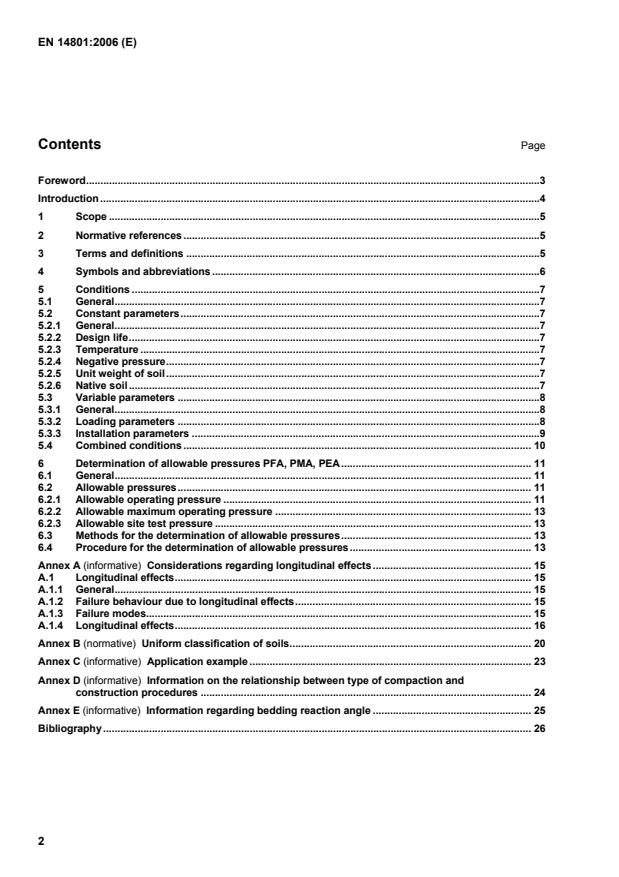
Considerations regarding longitudinal effects.15 A.1 Longitudinal effects.15 A.1.1 General.15 A.1.2 Failure behaviour due to longitudinal effects.15 A.1.3 Failure modes.15 A.1.4 Longitudinal effects.16 Annex B (normative)
Uniform classification of soils.20 Annex C (informative)
Application example.23 Annex D (informative)
Information on the relationship between type of compaction and construction procedures.24 Annex E (informative)
Information regarding bedding reaction angle.25 Bibliography.26
PEA maximum hydrostatic pressure that a newly installed component is capable of withstanding for a relatively short duration, in order to ensure the integrity and tightness of the pipeline [EN 805:2000]
English French German related to DP Design pressure Pression de calcul en régime permanent Systembetriebsdruck MDP Maximum design pressure Pression maximale de calcul Höchster Systembetriebsdruck STP System test pressure Pression d’épreuve du réseau Systemprüfdruck System related PFA Allowable operating pressure Pression de fonctionnement admissible Zulässiger Bauteilbetriebsdruck PMA Allowable maximum operating pressure Pression maximale admissible Höchster zulässiger Bauteilbetriebsdruck PEA Allowable site test pressure Pression d’épreuve admissible sur chantierZulässiger Bauteilprüfdruck auf der Baustelle Component related OP Operating pressure Pression de fonctionnement Betriebsdruck SP Service pressure Pression de service Versorgungsdruck System related a Valid for all language versions
This document uses installation terms based on EN 805, these are illustrated in Figure 1.
Trench Embankment
Key 1 Backfill 2 Bedding 3 Upper bedding 4 Lower bedding 5 Embedment Figure 1 — Installation terms used in pipe laying in trenches and under embankments
Components shall be designed to withstand, when installed, transient pressure of 80 kPa below atmospheric (see EN 805). 5.2.5 Unit weight of soil The unit weight for native soil, embedment and backfill shall be assumed constant at 20 kN/m3 for all determinations. 5.2.6 Native soil The type of native soil and its Relative Standard Proctor Density, DPr, shall be assumed constant for all determinations (see clause 6).
Design life 50 years Continuous operating temperature 20 °C Negative pressure (transient, below atmospheric) 80 kPa Unit weight of soil (native soil, embedment, backfill) 20 kN/m3 Native soil type “Gs” a
4 Relative Standard Proctor Density of native soil (DPr) b
100 % a Classification of soil types, see Annex B. b If appropriate, equivalent values of Modified Proctor Density may be used.
5.3 Variable parameters 5.3.1 General The variable parameters are the combination of several parameters, resulting from loading (see 5.3.2, e.g. soil loads, traffic loads, ground water loads) and installation (see 5.3.3, e.g. bedding, embedment, backfill). For loading conditions A, B and C1, C2 (see 5.3.2 and Table 4), due to requirement of road owners/authorities, the compaction is always carried out directly against the trench wall with the sheeting, if used, being progressively withdrawn. Therefore sheeting removal does not affect the variable parameters. For loading condition C3 (see Table 4), an embankment condition with no sheeting is specified. 5.3.2 Loading parameters The loading parameters of the loading conditions A, B and C given in Table 4 are: condition: trench/embankment compaction of backfill depth of cover (not less than 0,7m) traffic load width of trench ground water table. In Table 4, the figures given for the loading parameters, derived from traffic loads, are differentiated for the loading conditions A, B and C. Loading condition A is dominated by traffic load of a Main road under shallow depth of cover, i. e. covering the condition during road construction; the traffic load in Table 4 is expressed as the resulting additional soil pressure at pipe crown1); in order to allow the assessment of the influence from good and moderate embedment
1) The additional pressure, derived from traffic loads at the surface level, takes into account the method of Boussinesq and the influence of impact according to EN 1295-1:1997, 5.2. In accordance with the method adopted by the European Product Standard for the determination of the allowable pressures, the pipe/soil interaction should be considered as specified in EN 1295-1:1997, 5.2.
is dominated by traffic load of an Urban road under shallow depth of cover, i. e. covering the condition during road construction; the traffic load given in Table 4 is expressed as the resulting additional soil pressure at pipe crown1) ; in order to allow the assessment of the influence from good and moderate embedment quality, the loading condition B is combined with the installation conditions 1 and 2 respectively, resulting in the combined conditions B1 and B2. Loading condition C
is dominated by earth load; traffic load in a Rural area, due to high depth of cover, is of minor influence; the traffic load given in Table 4 is expressed as the resulting additional soil pressure at pipe crown; in order to allow the assessment of the influence from good, moderate and poor embedment quality, the loading condition C is combined with the installation conditions 1, 2 and 3 respectively, resulting in the combined conditions C1, C2 and C3. The figures given in Table 4 regarding the degree of the compaction of the main backfill are due to the average requirements of road owners/authorities in Europe (main roads, urban roads, rural areas). For guidance on longitudinal effects see Annex A (informative). NOTE 1 PFA etc. does not incorporate longitudinal effects. The results of longitudinal effects cannot always be corrected by altering the allowable pressure (PFA etc.). NOTE 2 Due to unfavourable site conditions (e.g. uneven trench bottom), differential settlements along the pipeline, either a step or a settlement in the trench bottom can occur; such conditions can cause damage to the components of the pipeline. 5.3.3 Installation parameters The installation parameters of the installation conditions 1, 2 and 3 according to Table 4 are given in Figures 2, 3 and 4. If appropriate, instead of Relative Standard Proctor Density (DPr), equivalent values of Modified Proctor Density may be used.
Key 1 Soil type 2 2 Native soil type 4 DPr = 100 % 3 Embedment, average DPr = 96 %
for calculation purpose
Figure 2 — Installation condition 1 for type of compaction “WELL” in the embedment (see Column 1 of Table 4)
Key 1 Soil type 3 2 Native soil type 4 DPr = 100 % 3 Embedment, average DPr = 92 % for
calculation purpose
Figure 3 — Installation condition 2 for type of compaction “MODERATE” in the embedment (see Column 2 of Table 4)
Key 1 Soil type 4 2 Native soil type 4 DPr = 100 % 3 Embedment, average DPr = 85 % for
calculation purpose
Figure 4 — Installation condition 3 for type of compaction “NONE” in the embedment (see Column 3 of Table 4) 5.4 Combined conditions The combined conditions (i. e. A1, A2; B1, B2; C1, C2, C3) shall consist of the following: all constant parameters according to Table 2 and
a combination of the variable loading conditions (A, B, C) and the variable installation conditions (1, 2, 3), as applicable. The constant parameters, given in Table 2 and the variable parameters, given in Table 4, cover most situations observed after installation of buried water supply and waste water pressure pipelines in Europe. In Annex B (normative), the unified classification for soil is given. In Annex C (informative), an example of one condition (B2) is given. In Annex D (informative), information is provided on the relationship between type of compaction and construction procedures. If certain calculation methods need more information regarding bedding reaction angle, see Annex E (informative).
For the determination of the allowable pressures (PFA, PMA, PEA), the conditions according to Table 4 (i. e. A1, A2; B1, B2; C1, C2, C3) consist of the following parameters: 1) all constant parameters (see Table 2) and
2) a combination of the variable loading conditions (A, B, C) and installation conditions (1, 2, 3) (see Table 4), as applicable. 6.2 Allowable pressures 6.2.1 Allowable operating pressure
Product Standards shall specify the allowable operating pressure (PFA) of the components (see EN 805).
1 Trench 2 Trench 3 Embankment condition unit trench Compaction of backfill % DPra
100 Depth of cover
m 0,7 Traffic b : Main road
Additional pressure at pipe crown, derived from traffic load at surface including impact kN/m² 80
c
Width of trench – EN 1610 Loading parameters Ground water table – none A1 A2 A3 not applicable due to inconsistency in the type of soil and compaction
Loading condition B
Installation conditions (see Figures 2, 3, 4)
condition unit trench Compaction of backfill % DPr a
a 97 Depth of cover m 0,7 Traffic b : Urban road
Additional pressure at pipe crown, derived from traffic load at surface including impact kN/m² 50
c
Width of trench – EN 1610 Loading parameters Ground water table – none B1 B2 B3 not applicable due to inconsistency in the type of soil and compaction
Loading condition C
Installation conditions (see Figures 2, 3, 4) condition unit Trench/em-bankment Compaction of backfill % DPr a
85 Depth of cover m 3,0 Traffic b : Rural area
Additional pressure at pipe crown, derived from traffic load at surface including impact kN/m² 5
c
Width of trench – EN 1610 Loading parameters Ground water table (in trench) – at pipe crown C1 C2 C3
b The assumed traffic pressures ignore the response of the installed pipe material . c Notional value in the absence of full harmonization of traffic loads (see EN 1991-2:2003, 4.3), unrelated to depth of cover.
6.2.2 Allowable maximum operating pressure Product Standards shall specify the allowable maximum operating pressure (PMA) of the components including surge (see EN 805). The surge allowance, when determining PMA, shall be at least 200 kPa (2 bar). For convenience, EN 805:2000, 11.3.2 (the first part) of is repeated here. Test pressure according to EN 805:2000, 11.3.2 "For all pipelines the System Test Pressure (STP) shall be calculated from the Maximum Design Pressure (MDP) as follows: surge calculated:
STP = MDPc + 100 kPa surge non calculated: STP = MDPa x 1,5
or
STP = MDPa + 500 kPa
whichever is the least The fixed allowance for surge pressure included in MDPa shall not be less than 200 kPa." NOTE
Product Standards should give information regarding admissible surge (e. g. number of surge cycles per day), if applicable. 6.2.3 Allowable site test pressure Product Standards shall specify the allowable site test pressure (PEA) of the components (see EN 805). 6.3 Methods for the determination of allowable pressures Each Product Standard shall state the adopted method for the determination of the allowable pressures (calculation method, e.g. a structural design method according to EN 1295-1 and/or test method; including safety factor).
6.4 Procedure for the determination of allowable pressures Figure 5 describes the procedure to determine the allowable pressures.
Figure 5 — Procedure for the determination of allowable pressures Product Standards shall specify for each pipe size and pipe type the applicable combinations of loading conditions (A, B, C) with installation conditions (1, 2, 3). This is in order to determine the relationship between their pressure classification and PFA, PMA and PEA.
Properties of the components Conditions
(A1, A2; B1, B2; C1, C2, C3) Method for the determination stated by Product Standards (structural calculations and/or test methods)
PFA __________ PMA __________ PEA __________
...
Questions, Comments and Discussion
Ask us and Technical Secretary will try to provide an answer. You can facilitate discussion about the standard in here.
Loading comments...