


oSIST prEN 15191:2005
(Main)Precast concrete products - Classification of glassfibre reinforced concrete performances
Precast concrete products - Classification of glassfibre reinforced concrete performances
This European standard deals with the classification of glassfibre reinforced concrete. This classification conforms to the needs of the design process of glassfibre reinforced concrete components. This European standard applies only if the standard EN 1169 is followed.
This standard does not include the design methods.
Betonfertigteile - Klassifizierung der Leistungseigenschaften von Glasfaserbeton
Diese Europäische Norm behandelt die Klassifizierung von Glasfaserbeton. Die Klassifizierung entspricht den Erfordernissen der Bemessung von Bauteilen aus Glasfaserbeton. Diese Europäische Norm gilt nur bei Einhaltung der Norm EN 1169.
Diese Norm enthält keine Bemessungsverfahren.
Produits préfabriqués en béton - Classification des performances des composites ciment-verre
La présente Norme européenne traite de la classification des composites ciment-verre. Cette classification répond aux besoins du processus de conception des éléments de composites ciment-verre. La présente Norme européenne s'applique uniquement si la norme EN 1169 est respectée.
La présente norme ne traite pas de méthodes de calcul.
Montažni betonski izdelki – Klasifikacija obnašanja betona, armiranega s steklenimi vlakni
General Information
- Status
- Not Published
- Technical Committee
- BBB - Concrete, reinforced concrete and prestressed concrete
- Current Stage
- 98 - Abandoned project (Adopted Project)
- Start Date
- 03-Apr-2014
- Due Date
- 08-Apr-2014
- Completion Date
- 03-Apr-2014
- Directive
- Harmonized Standard305/2011 - Regulation (eu) No 305/2011 of the European Parliament and of the Council of 9 march 2011 laying down harmonised conditions for the marketing of construction products and repealing council directive 89/106/eec
Not Harmonized89/106/EEC - Construction products

Overview
oSIST prEN 15191:2005 sets out the principles for the classification of glassfibre reinforced concrete (GRC) performances, providing a standardized framework essential for the design and specification of precast concrete products utilizing GRC. Developed by the Slovenian Institute for Standardization (SIST), this European standard aligns with the requirements of the design process for GRC components and is only applicable in conjunction with EN 1169, which covers general factory production control for glassfibre reinforced cement.
While oSIST prEN 15191:2005 details how to classify GRC based on material properties and production processes, it does not address design methods. Instead, it provides industry professionals, specifiers, and manufacturers with a comprehensive approach to ensuring GRC quality and uniformity across various applications.
Key Topics
- GRC Material Classification: The standard outlines the parameters for classifying GRC, particularly using mechanical properties such as limit of proportionality (LOP) and modulus of rupture (MOR) as primary indicators.
- Material Properties: Emphasis is placed on the properties of both the cementitious matrix and glassfibres, the bond strength between them, and the impact of manufacturing processes on the end performance.
- Manufacturing Approaches: GRC can be produced using spray or premix processes, each resulting in different fibre content, orientation, and mechanical characteristics.
- Quality Control and Testing: Testing methods, including acceptance and type tests, are referenced for verifying properties such as bending strength, fibre content, water absorption, and thermal behavior.
- Application-Relevant Performance: The standard introduces application factors (γa) to account for conditions such as weathering, ensuring classification reflects real-world exposure.
Applications
Proper classification of glassfibre reinforced concrete according to oSIST prEN 15191:2005 is crucial for:
- Architectural Precast Elements: Used for lightweight façade panels, cladding, decorative features, and complex shapes where high strength-to-weight ratio and durability are necessary.
- Infrastructure Components: GRC is selected for urban furniture, formwork, and landscape elements due to its flexibility in design and resistance to environmental factors.
- Industrial and Commercial Projects: Specifiers utilize the classification to ensure consistency, safety, and regulatory compliance for products exposed to various loadings and environmental conditions.
- Quality Assurance in Manufacturing: Factory production control systems utilize these classifications for ongoing verification and batch conformity, supporting optimized product performance and longevity.
By adhering to this standard, manufacturers and designers can reliably communicate performance expectations, facilitate acceptance across projects within the European market, and ensure durable, high-performance precast products.
Related Standards
To provide a robust framework for glassfibre reinforced concrete products, oSIST prEN 15191:2005 refers to several complementary European and international standards, including:
- EN 1169: Precast concrete products – General rules for factory production control of glassfibre reinforced cement.
- EN 1170-Series: A series of standards specifying test methods for various GRC properties, such as matrix consistency, fibre content, bending strength, water absorption, thermal expansion, and cyclic weathering.
- prEN 14649: Test method for strength retention of glassfibre in cement and concrete (SIC test).
- ISO 12491:1997: Statistical methods for quality control of building materials and components.
Industry professionals should ensure that all relevant standards are referenced and implemented to achieve optimal results when classifying and specifying GRC performances.
Keywords: glassfibre reinforced concrete, GRC, precast concrete, concrete classification, GRC standards, performance testing, factory production control, EN 1169, precast concrete applications
Get Certified
Connect with accredited certification bodies for this standard

DIBt (Deutsches Institut für Bautechnik)
German Institute for Building Technology.
DIN CERTCO
DIN Group product certification.

Aboma Certification B.V.
Specialized in construction, metal, and transport sectors.
Sponsored listings
Frequently Asked Questions
oSIST prEN 15191:2005 is a draft published by the Slovenian Institute for Standardization (SIST). Its full title is "Precast concrete products - Classification of glassfibre reinforced concrete performances". This standard covers: This European standard deals with the classification of glassfibre reinforced concrete. This classification conforms to the needs of the design process of glassfibre reinforced concrete components. This European standard applies only if the standard EN 1169 is followed. This standard does not include the design methods.
This European standard deals with the classification of glassfibre reinforced concrete. This classification conforms to the needs of the design process of glassfibre reinforced concrete components. This European standard applies only if the standard EN 1169 is followed. This standard does not include the design methods.
oSIST prEN 15191:2005 is classified under the following ICS (International Classification for Standards) categories: 91.100.30 - Concrete and concrete products. The ICS classification helps identify the subject area and facilitates finding related standards.
oSIST prEN 15191:2005 is associated with the following European legislation: EU Directives/Regulations: 305/2011, 89/106/EEC; Standardization Mandates: M/EXP. When a standard is cited in the Official Journal of the European Union, products manufactured in conformity with it benefit from a presumption of conformity with the essential requirements of the corresponding EU directive or regulation.
oSIST prEN 15191:2005 is available in PDF format for immediate download after purchase. The document can be added to your cart and obtained through the secure checkout process. Digital delivery ensures instant access to the complete standard document.
Standards Content (Sample)
SLOVENSKI oSIST prEN 15191:2005
PREDSTANDARD
maj 2005
Montažni betonski izdelki – Klasifikacija obnašanja betona, armiranega s
steklenimi vlakni
Precast concrete products - Classification of glassfibre reinforced concrete
performances
ICS 91.100.30 Referenčna številka
© Standard je založil in izdal Slovenski inštitut za standardizacijo. Razmnoževanje ali kopiranje celote ali delov tega dokumenta ni dovoljeno
EUROPEAN STANDARD
DRAFT
NORME EUROPÉENNE
EUROPÄISCHE NORM
March 2005
ICS
English version
Precast concrete products - Classification of glassfibre
reinforced concrete performances
This draft European Standard is submitted to CEN members for enquiry. It has been drawn up by the Technical Committee CEN/TC 229.
If this draft becomes a European Standard, CEN members are bound to comply with the CEN/CENELEC Internal Regulations which
stipulate the conditions for giving this European Standard the status of a national standard without any alteration.
This draft European Standard was established by CEN in three official versions (English, French, German). A version in any other language
made by translation under the responsibility of a CEN member into its own language and notified to the Management Centre has the same
status as the official versions.
CEN members are the national standards bodies of Austria, Belgium, Cyprus, Czech Republic, Denmark, Estonia, Finland, France,
Germany, Greece, Hungary, Iceland, Ireland, Italy, Latvia, Lithuania, Luxembourg, Malta, Netherlands, Norway, Poland, Portugal, Slovakia,
Slovenia, Spain, Sweden, Switzerland and United Kingdom.
: This document is not a European Standard. It is distributed for review and comments. It is subject to change without notice and
Warning
shall not be referred to as a European Standard.
EUROPEAN COMMITTEE FOR STANDARDIZATION
COMITÉ EUROPÉEN DE NORMALISATION
EUROPÄISCHES KOMITEE FÜR NORMUNG
Management Centre: rue de Stassart, 36 B-1050 Brussels
© 2005 CEN All rights of exploitation in any form and by any means reserved Ref. No. prEN 15191:2005: E
worldwide for CEN national Members.
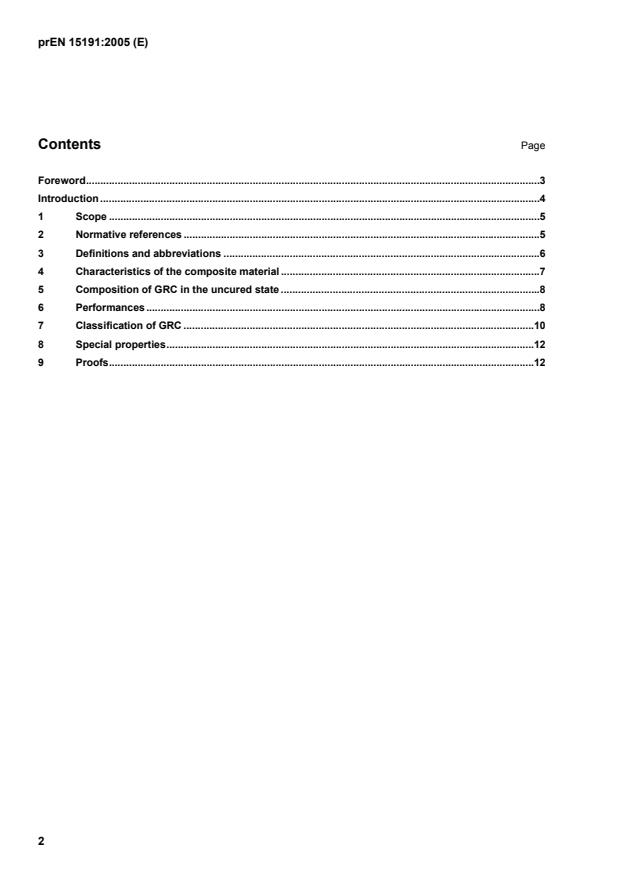
Contents Page
Foreword.3
Introduction .4
1 Scope .5
2 Normative references .5
3 Definitions and abbreviations .6
4 Characteristics of the composite material .7
5 Composition of GRC in the uncured state .8
6 Performances.8
7 Classification of GRC .10
8 Special properties.12
9 Proofs.12
Foreword
This document (prEN 15191:2005) has been prepared by Technical Committee CEN/TC 229 “Precast
concrete products”, the secretariat of which is held by AFNOR.
This document is currently submitted to the CEN Enquiry.
Introduction
This standard deals with the properties of GRC depending on the constituent materials, the composition of
glassfibre reinforced concrete and the production processes. The glassfibre reinforced concrete (GRC) can be
manufactured using different combination of materials to meet the required properties. Mix composition, type
of cement, and the proportion, length and orientation of glassfibres may all be varied to produce a specific
product. A polymer dispersion may be used for curing purposes.
The classification is based on the material properties to be achieved.
1 Scope
This European standard deals with the classification of glassfibre reinforced concrete. This classification
conforms to the needs of the design process of glassfibre reinforced concrete components. This European
standard applies only if the standard EN 1169 is followed.
This standard does not include the design methods.
2 Normative references
The following referenced documents are indispensable for the application of this document. For dated
references, only the edition cited applies. For undated references, the latest edition of the referenced
document (including any amendments) applies.
EN 1169, Precast concrete products — General rules for factory production control of glassfibre reinforced
cement.
EN 1170-1, Precast concrete products — Test method for glassfibre reinforced cement — Part 1: Measuring
the consistency of the matrix – “Slump test” method.
EN 1170-2, Precast concrete products – Test method for glassfibre reinforced cement — Part 2: Measuring
the fibre content in fresh GRC — “Wash out test”.
EN 1170-3, Precast concrete products — Test method for glassfibre reinforced cement — Part 3: Measuring
the fibre content of sprayed GRC.
EN 1170-4, Precast concrete products — Test method for glassfibre reinforced cement — Part 4: Measuring
bending strength — “Simplified bending test” method.
EN 1170-5, Precast concrete products — Test method for glassfibre reinforced cement — Part 5: Measuring
bending strength — “Complete bending test” method.
EN 1170-6, Precast concrete products — Test method for glassfibre reinforced cement — Part 6:
Determination of the absorption of water by immersion and determination of the dry density.
EN 1170-7, Precast concrete products — Test method for glassfibre reinforced cement — Part 7:
Measurement of extremes dimensional variations due to moisture content.
ENV 1170-8, Test method for glassfibre reinforced cement — Part 8: Cyclic weathering type test.
prEN 14649, Precast concrete products — Test method for strength retention of glassfibre in cement and
concrete (SIC TEST).
prEN XXXXX, Specification for the Alkali Resistance of glassfibres for the reinforcement of concrete (or
cement).
ISO 12491:1997, Statistical methods for quality control of building materials and components.
3 Definitions and abbreviations
3.1 Terms and definitions
For the purposes of this standard, the following definitions apply:
3.1.1
additive
product that may be added by volume to the matrix composition to improve some properties. It can be reactive
(e.g. silica fumes) or inert, mineral or organic (e.g. polymer dispersions)
3.1.2
admixture
product added in quantity less than 5% by volume (or the mass of cement), before or during mixing and giving
expected modifications to the initial properties (e.g. plasticiser, air entraining agents)
3.1.3
AR glassfibre
a glassfibre product with a proven resistance (prEN XXXX) to the alkaline environment of matrices made from
hydraulic cement
3.1.4
basic strand
glassfibre obtained by stranding a number of filaments (typically 100 to 200) having a defined individual
diameter (typically 10 µm to 30 µm)
3.1.5
roving
a number of parallel strands wound together on a mandrel to form uniform cylindrical package size
3.1.6
glassfibre reinforced concrete
GRC
composite material consisting of a matrix of hydraulic binder reinforced with glassfibres, these materials being
compatible
3.1.7
matrix
composition of the glassfibre reinforced concrete without the fibres. It is made of the mixture of sand, cement,
water an any additives and admixtures
3.1.8
spray processes
processes whereby continuous glassfibre are cut into set lengths and sprayed together with the matrix. The
processes are designed to give a glassfibre reinforced concrete in which the fibres are oriented parallel to the
mould surface
3.1.9
premix processes
processes whereby chopped strands of glassfibres are blended with the matrix to make a glassfibre reinforced
concrete ready for processing. The processes may be: “casting and vibration”, wet or dry spraying,
...