


SIST EN 15191:2025
(Main)Precast concrete products - Classification of glassfibre reinforced concrete performance
Precast concrete products - Classification of glassfibre reinforced concrete performance
This document deals with the classification of glassfibre reinforced concrete. This classification conforms to the needs of the design process of glassfibre reinforced concrete components. This document applies only if EN 1169 is followed.
This document does not deal with design methods.
Betonfertigteile - Klassifizierung der Leistungseigenschaften von Glasfaserbeton
Dieses Dokument behandelt die Klassifizierung von Glasfaserbeton. Diese Klassifizierung stimmt mit den Anforderungen an den Bemessungsprozess von Glasfaserbeton Bauteilen überein. Dieses Dokument ist nur bei Einhaltung von EN 1169 anwendbar.
Dieses Dokument behandelt keine Bemessungsverfahren.
Produits préfabriqués en béton - Classification des performances des composites ciment-verre
Le présent document traite de la classification des composites ciment-verre. Cette classification répond aux besoins du processus de conception des éléments de composites ciment-verre. Le présent document s’applique uniquement si l’EN 1169 est respectée.
Le présent document ne traite pas des méthodes de calcul.
Montažni betonski izdelki - Klasifikacija lastnosti betona, armiranega s steklenimi vlakni
Ta evropski standard obravnava klasifikacijo steklocementnega kompozita. Ta klasifikacija je v skladu s potrebami postopka projektiranja komponent steklocementnega kompozita. Ta evropski standard se uporablja le ob upoštevanju določil standarda EN 1169.
Ta standard ne zajema metod za projektiranje.
General Information
- Status
- Published
- Public Enquiry End Date
- 16-Jan-2024
- Publication Date
- 04-Feb-2025
- Technical Committee
- BBB - Concrete, reinforced concrete and prestressed concrete
- Current Stage
- 6060 - National Implementation/Publication (Adopted Project)
- Start Date
- 30-Jan-2025
- Due Date
- 06-Apr-2025
- Completion Date
- 05-Feb-2025

Relations
- Effective Date
- 01-Mar-2025
- Effective Date
- 28-Jan-2026
- Effective Date
- 28-Jan-2026
- Referred By
SIST EN 1170:2025 - Precast concrete products - Test methods for glassfibre reinforced concrete - Effective Date
- 28-Jan-2026
- Effective Date
- 28-Jan-2026
Overview
SIST EN 15191:2025 specifies the classification of glassfibre reinforced concrete (GRC) performance for precast concrete products. This European standard is designed to support the design process by defining material classes and performance criteria for GRC components used in construction. The standard is harmonized with EN 1169 and provides a consistent framework for GRC classification, ensuring quality, safety, and compliance across the industry. While it covers classification and assessment methods, it does not address specific design methodologies.
Key Topics
- Scope: Applies to precast products made using glassfibre reinforced concrete, providing a classification system based on key mechanical properties.
- Classification Parameters: Focuses on bending stress at the limit of proportionality and at modulus of rupture, with classes defined for these values.
- Material Classes: GRC is divided into classes (e.g., 6/8, 7/10, 7/14), supporting tailored performance criteria for different applications.
- Application Specific Parameters: Considers factors such as long-term weathering and additional durability demands.
- Special Properties: Highlights situations where further performance attributes like fire resistance, frost resistance, or water impermeability are required.
- Test Methods: Refers to standardized test methods (EN 1170 and EN 14649) for evaluating GRC characteristics and glassfibre strength retention.
- Glassfibre Requirements: Ensures glassfibres used meet quality specifications as defined in EN 15422 and are tested for strength retention using the SIC test as described in EN 14649.
Applications
SIST EN 15191:2025 enables manufacturers, designers, and specifiers to confidently use GRC in a range of construction and architectural applications. Practical uses include:
- Facade panels: Durable, lightweight cladding with customizable finishes.
- Architectural elements: Complex shapes and decorative features produced efficiently with precast GRC.
- Infrastructure: Drainage channels, street furniture, and urban landscaping elements benefiting from the material's strength-to-weight ratio.
- Non-structural building components: Partition walls, tiles, and modular systems with reliable performance classifications.
By adopting GRC classification per this standard, organizations ensure consistent product performance, facilitate regulatory compliance, and enable efficient project specification and procurement processes.
Related Standards
For comprehensive management of glassfibre reinforced concrete production and quality, the following standards are closely connected with SIST EN 15191:2025:
- EN 1169: General rules for factory production control of glassfibre reinforced cement. Compliance with EN 1169 is a prerequisite for the application of SIST EN 15191:2025.
- EN 1170: Test methods for glassfibre reinforced concrete; ensures standardized evaluation of critical mechanical properties.
- EN 14649: Procedures for strength retention testing of glassfibres within cement matrices.
- EN 15422: Specification of glassfibres for reinforcement of mortars and concrete, detailing material requirements for consistent GRC performance.
- EN 206: Specification, performance, production, and conformity for concrete in general.
- ISO 12491: Statistical methods for quality control in building materials, supporting reliable classification practices.
Practical Value
SIST EN 15191:2025 delivers significant value to construction professionals by ensuring:
- Reliable material performance classification for GRC, reducing project risk.
- Clear guidance for product evaluation and acceptance testing.
- Compatibility with European and international concrete standards, streamlining cross-border projects and procurement.
- Enhanced sustainability and durability of precast concrete products through standardized assessment of glassfibre reinforcement.
By following SIST EN 15191:2025, stakeholders can achieve higher quality, efficiency, and safety in projects utilizing glassfibre reinforced concrete.
Get Certified
Connect with accredited certification bodies for this standard

DIBt (Deutsches Institut für Bautechnik)
German Institute for Building Technology.
DIN CERTCO
DIN Group product certification.

Aboma Certification B.V.
Specialized in construction, metal, and transport sectors.
Sponsored listings
Frequently Asked Questions
SIST EN 15191:2025 is a standard published by the Slovenian Institute for Standardization (SIST). Its full title is "Precast concrete products - Classification of glassfibre reinforced concrete performance". This standard covers: This document deals with the classification of glassfibre reinforced concrete. This classification conforms to the needs of the design process of glassfibre reinforced concrete components. This document applies only if EN 1169 is followed. This document does not deal with design methods.
This document deals with the classification of glassfibre reinforced concrete. This classification conforms to the needs of the design process of glassfibre reinforced concrete components. This document applies only if EN 1169 is followed. This document does not deal with design methods.
SIST EN 15191:2025 is classified under the following ICS (International Classification for Standards) categories: 91.100.30 - Concrete and concrete products. The ICS classification helps identify the subject area and facilitates finding related standards.
SIST EN 15191:2025 has the following relationships with other standards: It is inter standard links to SIST EN 15191:2010, SIST EN 15422:2008, SIST EN 14649:2005, SIST EN 1170:2025, SIST EN 1169:2025. Understanding these relationships helps ensure you are using the most current and applicable version of the standard.
SIST EN 15191:2025 is available in PDF format for immediate download after purchase. The document can be added to your cart and obtained through the secure checkout process. Digital delivery ensures instant access to the complete standard document.
Standards Content (Sample)
SLOVENSKI STANDARD
01-marec-2025
Nadomešča:
SIST EN 15191:2010
Montažni betonski izdelki - Klasifikacija lastnosti betona, armiranega s steklenimi
vlakni
Precast concrete products - Classification of glassfibre reinforced concrete performance
Betonfertigteile - Klassifizierung der Leistungseigenschaften von Glasfaserbeton
Produits préfabriqués en béton - Classification des performances des composites
ciment-verre
Ta slovenski standard je istoveten z: EN 15191:2024
ICS:
91.100.30 Beton in betonski izdelki Concrete and concrete
products
2003-01.Slovenski inštitut za standardizacijo. Razmnoževanje celote ali delov tega standarda ni dovoljeno.
EN 15191
EUROPEAN STANDARD
NORME EUROPÉENNE
December 2024
EUROPÄISCHE NORM
ICS 91.100.30 Supersedes EN 15191:2009
English Version
Precast concrete products - Classification of glassfibre
reinforced concrete performance
Produits préfabriqués en béton - Classification des Betonfertigteile - Klassifizierung der
performances des composites ciment-verre Leistungseigenschaften von Glasfaserbeton
This European Standard was approved by CEN on 1 December 2024.
CEN members are bound to comply with the CEN/CENELEC Internal Regulations which stipulate the conditions for giving this
European Standard the status of a national standard without any alteration. Up-to-date lists and bibliographical references
concerning such national standards may be obtained on application to the CEN-CENELEC Management Centre or to any CEN
member.
This European Standard exists in three official versions (English, French, German). A version in any other language made by
translation under the responsibility of a CEN member into its own language and notified to the CEN-CENELEC Management
Centre has the same status as the official versions.
CEN members are the national standards bodies of Austria, Belgium, Bulgaria, Croatia, Cyprus, Czech Republic, Denmark, Estonia,
Finland, France, Germany, Greece, Hungary, Iceland, Ireland, Italy, Latvia, Lithuania, Luxembourg, Malta, Netherlands, Norway,
Poland, Portugal, Republic of North Macedonia, Romania, Serbia, Slovakia, Slovenia, Spain, Sweden, Switzerland, Türkiye and
United Kingdom.
EUROPEAN COMMITTEE FOR STANDARDIZATION
COMITÉ EUROPÉEN DE NORMALISATION
EUROPÄISCHES KOMITEE FÜR NORMUNG
CEN-CENELEC Management Centre: Rue de la Science 23, B-1040 Brussels
© 2024 CEN All rights of exploitation in any form and by any means reserved Ref. No. EN 15191:2024 E
worldwide for CEN national Members.
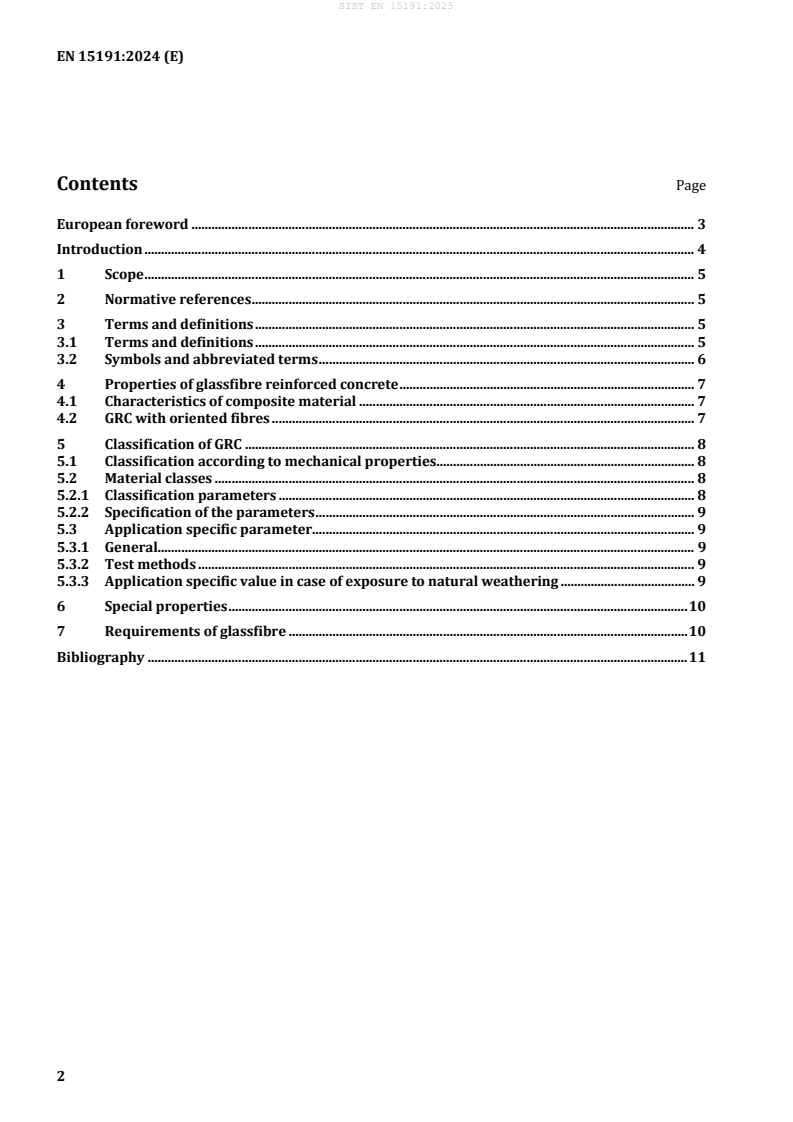
Contents Page
European foreword . 3
Introduction . 4
1 Scope . 5
2 Normative references . 5
3 Terms and definitions . 5
3.1 Terms and definitions . 5
3.2 Symbols and abbreviated terms . 6
4 Properties of glassfibre reinforced concrete . 7
4.1 Characteristics of composite material . 7
4.2 GRC with oriented fibres . 7
5 Classification of GRC . 8
5.1 Classification according to mechanical properties. 8
5.2 Material classes . 8
5.2.1 Classification parameters . 8
5.2.2 Specification of the parameters . 9
5.3 Application specific parameter. 9
5.3.1 General. 9
5.3.2 Test methods . 9
5.3.3 Application specific value in case of exposure to natural weathering . 9
6 Special properties . 10
7 Requirements of glassfibre . 10
Bibliography . 11
European foreword
This document (EN 15191:2024) has been prepared by Technical Committee CEN/TC 229 “Precast
Concrete Products”, the secretariat of which is held by AFNOR.
This European Standard shall be given the status of a national standard, either by publication of an
identical text or by endorsement, at the latest by June 2025, and conflicting national standards shall be
withdrawn at the latest by June 2025.
Attention is drawn to the possibility that some of the elements of this document may be the subject of
patent rights. CEN shall not be held responsible for identifying any or all such patent rights.
This document supersedes EN 15191:2009.
a) typical composition and performance moved to an informative annex;
b) introduction of a criterion on the ratio between the bending stress at limit of proportionality and the
bending stress at modulus of rupture;
c) update and simplification of the table of characteristic values for the classification of GRC;
d) modification of the provisions related to the application specific parameters, with the introduction
of default values.
Any feedback and questions on this document should be directed to the users’ national standards body.
A complete listing of these bodies can be found on the CEN website.
According to the CEN-CENELEC Internal Regulations, the national standards organisations of the
following countries are bound to implement this European Standard: Austria, Belgium, Bulgaria, Croatia,
Cyprus, Czech Republic, Denmark, Estonia, Finland, France, Germany, Greece, Hungary, Iceland, Ireland,
Italy, Latvia, Lithuania, Luxembourg, Malta, Netherlands, Norway, Poland, Portugal, Republic of North
Macedonia, Romania, Serbia, Slovakia, Slovenia, Spain, Sweden, Switzerland, Türkiye and the United
Kingdom.
Introduction
The classification covers all glassfibre reinforced concrete (GRC) formulation and production processes.
The properties of GRC depend on:
a) the constituent materials used;
b) the composition of glassfibre reinforced concrete;
c) the production processes.
The classification of GRC is based on the material properties that can be achieved.
1 Scope
This document deals with the classification of glassfibre reinforced concrete. This classification conforms
to the needs of the design process of glassfibre reinforced concrete components. This document applies
only if EN 1169 is followed.
This document does not deal with design methods.
2 Normative references
The following documents are referred to in the text in such a way that some or all of their content
constitutes requirements of this document. For dated references, only th
...