


SIST EN 1169:2025
(Main)Precast concrete products - General rules for factory production control of glassfibre reinforced concrete
Precast concrete products - General rules for factory production control of glassfibre reinforced concrete
This document defines the general processes, procedures and rules for production and production control system (PCS) of glassfibre reinforced concrete (GRC) used to manufacture products commonly used in construction, civil engineering, architecture and other applications.
GRC can be produced from a range of mix designs comprising various materials and manufactured by different processes. This document covers two primary production processes, namely sprayed GRC and premix GRC.
This document does not cover concrete, where the glassfibre does not act as primary reinforcement but is used as an additive. It does not cover but can be used as guidance for injection and extrusion manufacturing processes.
Vorgefertigte Betonerzeugnisse - Allgemeine Regeln für die werkseigene Produktionskontrolle von Glasfaserbeton
Dieses Dokument legt die allgemeinen Prozesse, Verfahren und Regeln für die Herstellung und das Produktionskontrollsystem (en: Production Control System (PCS)) von Glasfaserbeton (GFB) (en: Glassfibre Reinforced Concrete (GRC)) fest, der zur Herstellung von Erzeugnissen verwendet wird, die beim Bau, im Bauingenieurwesen, der Architektur und weiteren Anwendungen häufig eingesetzt werden.
Glasfaserbeton kann nach einer Reihe von Rezepturen hergestellt werden, die aus verschiedenen Werkstoffen bestehen und durch unterschiedliche Prozesse hergestellt werden. Dieses Dokument deckt zwei grundlegende Herstellungsprozesse ab, d. h.im Spritzverfahren hergestellten GFB und im Vormischverfahren hergestellten GFB.
Nicht abgedeckt von diesem Dokument ist Beton, bei dem die Glasfasern nicht als grundlegende Bewehrung wirken, sondern als Zusatzstoff verwendet werden. Dieses Dokument deckt zudem keine Injektions und Extrusions Herstellungsprozesse ab, kann aber als Leitlinie für diese verwendet werden.
Produits préfabriqués en béton - Règles générales pour le contrôle de la production en usine des composites ciment-verre
Le présent document définit les procédés généraux, les procédures et les règles pour la fabrication et le contrôle de la production de composite ciment-verre servant à fabriquer des produits couramment employés pour la construction, en génie civil, en architecture et pour d’autres applications.
Le composite ciment-verre peut être produit à partir d’une gamme de formulations comprenant divers matériaux et être fabriqué par différents procédés. Le présent document couvre deux procédés de fabrication primaires, à savoir le CCV projeté et le CCV prémix.
Le présent document ne traite pas du béton dans lequel les fibres de verre ne servent pas de renforcement primaire, mais sont utilisées comme addition. Il ne traite pas des procédés de fabrication par injection et extrusion, mais il peut être utilisé comme guide.
Montažni betonski izdelki - Splošna pravila za notranjo kontrolo proizvodnje betona, armiranega s steklenimi vlakni
Ta dokument opredeljuje splošne procese, postopke in pravila za proizvodnjo ter kontrolo proizvodnje steklobetonskega kompozita, ki se uporablja za proizvodnjo izdelkov, ki se običajno uporabljajo v gradbeništvu, pri nizkih gradnjah ter na področju arhitekture in drugih področjih. Steklobetonski kompozit je mogoče izdelati iz več vrst mešanic, ki vsebujejo različne materiale in so izdelane z različnimi postopki. Ta standard zajema dva glavna proizvodna procesa, tj. brizgan steklobetonski kompozit in vnaprej pripravljen steklobetonski kompozit. Ta dokument ne zajema betona, pri katerem se steklena vlakna ne uporabljajo za ojačitev, temveč kot dodatek. Ne zajema vbrizgavanja in ekstrudiranja, vendar ga je mogoče uporabiti kot vodilo za tovrstne proizvodne postopke.
General Information
- Status
- Published
- Public Enquiry End Date
- 16-Jan-2024
- Publication Date
- 03-Mar-2025
- Technical Committee
- BBB - Concrete, reinforced concrete and prestressed concrete
- Current Stage
- 6060 - National Implementation/Publication (Adopted Project)
- Start Date
- 30-Jan-2025
- Due Date
- 06-Apr-2025
- Completion Date
- 04-Mar-2025
Relations
- Effective Date
- 01-Mar-2025
Overview
EN 1169:2024 - Precast concrete products: General rules for factory production control of glassfibre reinforced concrete (GRC) - defines the principles, processes and requirements for a robust production control system (PCS) for GRC used in construction, civil engineering, architecture and related applications. Approved by CEN in December 2024 (supersedes EN 1169:1999), the standard covers the two primary manufacturing routes: sprayed GRC and premix GRC. It excludes conventional concrete where glassfibre is only an additive and does not formally cover injection or extrusion processes (though it can be used as guidance).
Key topics and requirements
The standard establishes mandatory and recommended elements of factory production control to ensure consistent quality and compliance:
- Scope and definitions for GRC, matrix, AR (alkali-resistant) glassfibre, strands/rovings, tex, etc.
- Organization and PCS structure: responsibilities, document control and record keeping.
- Process control: control of raw materials, batching, mixing, curing and specific controls for spray and premix processes.
- Material controls: reception, storage and verification of cementitious constituents, aggregates, AR glassfibres and admixtures.
- Batching & mixing: calibration and verification of weighing/batching equipment; mixing procedures for sprayed and premix GRC.
- Assessment and testing: type tests, fresh-state and hardened GRC tests, production of test specimens (test boards) and acceptance criteria for mechanical strength.
- Non-conformance management: procedures for handling and documenting non-conforming GRC composite material.
- PCS lifecycle: initial assessment, continuous surveillance, and procedures for modifications.
- Annexes provide practical guidance (Annex A) and control test summaries for fresh and hardened GRC (Annexes B–D).
Applications and users
EN 1169:2024 is intended for practical use by:
- Precast GRC manufacturers implementing or auditing factory production control and quality assurance.
- Quality/QA managers responsible for PCS, calibration, testing and non-conformance procedures.
- Product designers, specifiers, architects and engineers specifying GRC products or reviewing production quality requirements.
- Testing laboratories and certification bodies conducting type tests and surveillance.
- Regulators and procurement teams ensuring compliance with European product rules.
Typical applications include façade panels, decorative architectural elements, cladding, precast civil components and other structural/non‑structural GRC products.
Related standards
- EN 1170:2024 - Test methods for glassfibre reinforced concrete
- EN 15191:2024 - Classification of GRC performance
- EN 15422:2008 - Specification of glassfibres for reinforcement of mortars and concretes
Keywords: EN 1169:2024, glassfibre reinforced concrete, GRC, factory production control, PCS, sprayed GRC, premix GRC, precast concrete products, quality control.


Frequently Asked Questions
SIST EN 1169:2025 is a standard published by the Slovenian Institute for Standardization (SIST). Its full title is "Precast concrete products - General rules for factory production control of glassfibre reinforced concrete". This standard covers: This document defines the general processes, procedures and rules for production and production control system (PCS) of glassfibre reinforced concrete (GRC) used to manufacture products commonly used in construction, civil engineering, architecture and other applications. GRC can be produced from a range of mix designs comprising various materials and manufactured by different processes. This document covers two primary production processes, namely sprayed GRC and premix GRC. This document does not cover concrete, where the glassfibre does not act as primary reinforcement but is used as an additive. It does not cover but can be used as guidance for injection and extrusion manufacturing processes.
This document defines the general processes, procedures and rules for production and production control system (PCS) of glassfibre reinforced concrete (GRC) used to manufacture products commonly used in construction, civil engineering, architecture and other applications. GRC can be produced from a range of mix designs comprising various materials and manufactured by different processes. This document covers two primary production processes, namely sprayed GRC and premix GRC. This document does not cover concrete, where the glassfibre does not act as primary reinforcement but is used as an additive. It does not cover but can be used as guidance for injection and extrusion manufacturing processes.
SIST EN 1169:2025 is classified under the following ICS (International Classification for Standards) categories: 91.100.30 - Concrete and concrete products. The ICS classification helps identify the subject area and facilitates finding related standards.
SIST EN 1169:2025 has the following relationships with other standards: It is inter standard links to SIST EN 1169:2001. Understanding these relationships helps ensure you are using the most current and applicable version of the standard.
SIST EN 1169:2025 is available in PDF format for immediate download after purchase. The document can be added to your cart and obtained through the secure checkout process. Digital delivery ensures instant access to the complete standard document.
Standards Content (Sample)
SLOVENSKI STANDARD
01-april-2025
Nadomešča:
SIST EN 1169:2001
Montažni betonski izdelki - Splošna pravila za notranjo kontrolo proizvodnje
steklobetonskega kompozita
Precast concrete products - General rules for factory production control of glassfibre
reinforced concrete
Vorgefertigte Betonerzeugnisse - Allgemeine Regeln für die werkseigene
Produktionskontrolle von Glasfaserbeton
Produits préfabriqués en béton - Règles générales pour le contrôle de la production en
usine des composites ciment-verre
Ta slovenski standard je istoveten z: EN 1169:2024
ICS:
91.100.30 Beton in betonski izdelki Concrete and concrete
products
2003-01.Slovenski inštitut za standardizacijo. Razmnoževanje celote ali delov tega standarda ni dovoljeno.
EN 1169
EUROPEAN STANDARD
NORME EUROPÉENNE
December 2024
EUROPÄISCHE NORM
ICS 91.100.30 Supersedes EN 1169:1999
English Version
Precast concrete products - General rules for production
control of glassfibre reinforced concrete
Produits préfabriqués en béton - Règles générales de Vorgefertigte Betonerzeugnisse - Allgemeine Regeln
contrôle de production des composites ciment-verre für die werkseigene Produktionskontrolle von
Glasfaserbeton
This European Standard was approved by CEN on 1 December 2024.
CEN members are bound to comply with the CEN/CENELEC Internal Regulations which stipulate the conditions for giving this
European Standard the status of a national standard without any alteration. Up-to-date lists and bibliographical references
concerning such national standards may be obtained on application to the CEN-CENELEC Management Centre or to any CEN
member.
This European Standard exists in three official versions (English, French, German). A version in any other language made by
translation under the responsibility of a CEN member into its own language and notified to the CEN-CENELEC Management
Centre has the same status as the official versions.
CEN members are the national standards bodies of Austria, Belgium, Bulgaria, Croatia, Cyprus, Czech Republic, Denmark, Estonia,
Finland, France, Germany, Greece, Hungary, Iceland, Ireland, Italy, Latvia, Lithuania, Luxembourg, Malta, Netherlands, Norway,
Poland, Portugal, Republic of North Macedonia, Romania, Serbia, Slovakia, Slovenia, Spain, Sweden, Switzerland, Türkiye and
United Kingdom.
EUROPEAN COMMITTEE FOR STANDARDIZATION
COMITÉ EUROPÉEN DE NORMALISATION
EUROPÄISCHES KOMITEE FÜR NORMUNG
CEN-CENELEC Management Centre: Rue de la Science 23, B-1040 Brussels
© 2024 CEN All rights of exploitation in any form and by any means reserved Ref. No. EN 1169:2024 E
worldwide for CEN national Members.
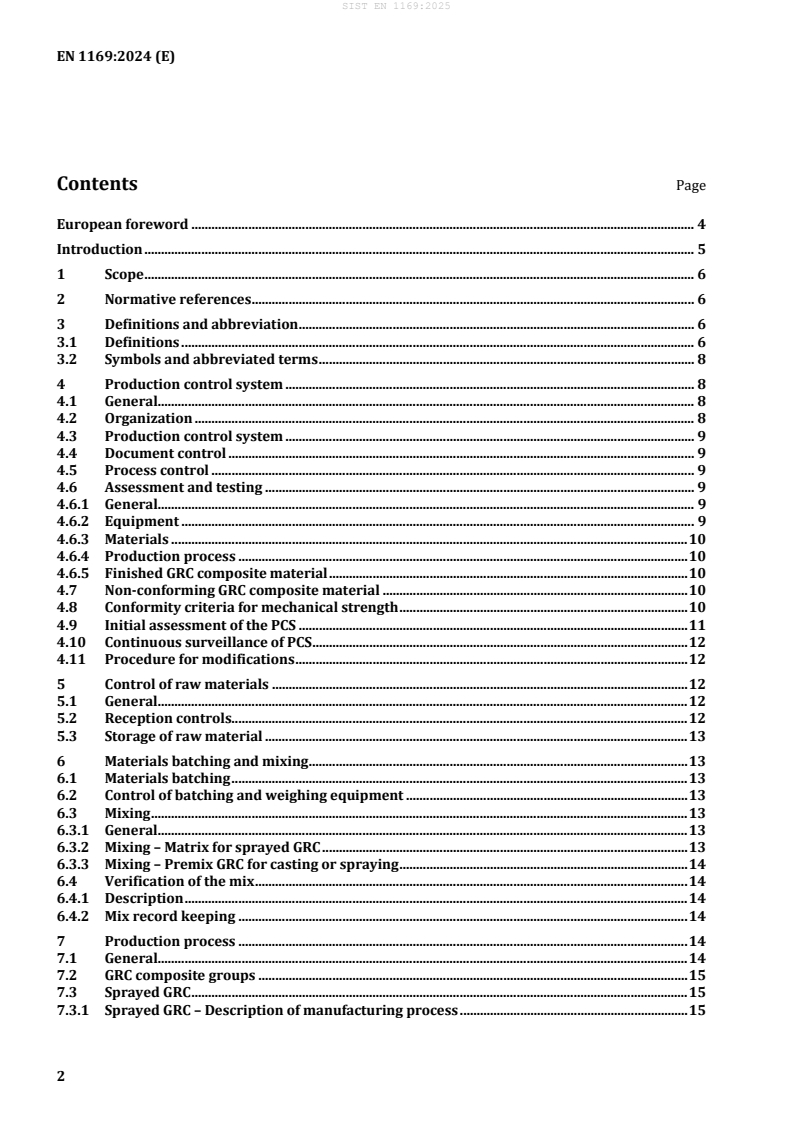
Contents Page
European foreword . 4
Introduction . 5
1 Scope . 6
2 Normative references . 6
3 Definitions and abbreviation . 6
3.1 Definitions . 6
3.2 Symbols and abbreviated terms . 8
4 Production control system . 8
4.1 General. 8
4.2 Organization . 8
4.3 Production control system . 9
4.4 Document control . 9
4.5 Process control . 9
4.6 Assessment and testing . 9
4.6.1 General. 9
4.6.2 Equipment . 9
4.6.3 Materials . 10
4.6.4 Production process . 10
4.6.5 Finished GRC composite material . 10
4.7 Non-conforming GRC composite material . 10
4.8 Conformity criteria for mechanical strength . 10
4.9 Initial assessment of the PCS . 11
4.10 Continuous surveillance of PCS . 12
4.11 Procedure for modifications . 12
5 Control of raw materials . 12
5.1 General. 12
5.2 Reception controls. 12
5.3 Storage of raw material . 13
6 Materials batching and mixing . 13
6.1 Materials batching . 13
6.2 Control of batching and weighing equipment . 13
6.3 Mixing . 13
6.3.1 General. 13
6.3.2 Mixing – Matrix for sprayed GRC . 13
6.3.3 Mixing – Premix GRC for casting or spraying . 14
6.4 Verification of the mix . 14
6.4.1 Description . 14
6.4.2 Mix record keeping . 14
7 Production process . 14
7.1 General. 14
7.2 GRC composite groups . 15
7.3 Sprayed GRC . 15
7.3.1 Sprayed GRC – Description of manufacturing process . 15
7.3.2 Calibration and regulation control of the spray equipment (to ensure the minimum
glassfibre content) . 15
7.4 Premix GRC - Description of manufacturing process . 15
7.4.1 General . 15
7.4.2 Premix GRC - Cast premix . 16
7.4.3 Premix GRC - Sprayed premix . 16
7.5 Directional AR glassfibre introduced in the production process . 16
7.6 Curing . 16
8 Controls of fresh and hardened GRC . 17
8.1 General . 17
8.2 Type tests . 17
8.3 Controls of the fresh GRC . 17
8.4 Processing time limits . 17
8.5 Controls of the hardened GRC . 18
8.5.1 General . 18
8.5.2 Production of the test boards . 18
8.5.3 Testing . 18
Annex A (normative) Guidelines for establishment of the production control system . 19
Annex B (informative) Control tests on fresh GRC: Premix GRC process . 21
Annex C (informative) Control tests on fresh GRC: Spray GRC process . 22
Annex D (informative) Summary of control tests on hardened GRC . 23
Bibliography . 25
European foreword
This document (EN 1169:2024) has been prepared by Technical Committee CEN/TC 229 “Precast
concrete products”, the secretariat of which is held by AFNOR.
This European Standard shall be given the status of a national standard, either by publication of an
identical text or by endorsement, at the latest by June 2025, and conflicting national standards shall be
withdrawn at the latest by June 2025.
Attention is drawn to the possibility that some of the elements of this document may be the subject of
patent rights. CEN shall not be held responsible for identifying any or all such patent rights.
This document supersedes EN 1169:1999.
— clarification of the scope, with precision about what is covered and what is excluded;
— modification of the symbols used in coherence with EN 1170 and EN 15191;
— updated reference to the new EN 1170:2024 as resulting of the revision and merging of parts of the
EN 1170 series;
— technical modifications in accordance with EN 1170:2024.
Any feedback and questions on this document should be directed to the users’ national standards body.
A complete listing of these bodies can be found on the CEN website.
According to the CEN-CENELEC Internal Regulations, the national standards organisations of the
following countries are bound to implement this European Standard: Austria, Belgium, Bulgaria, Croatia,
Cyprus, Czech Republic, Denmark, Estonia, Finland, France, Germany, Greece, Hungary, Iceland, Ireland,
Italy, Latvia, Lithuania, Luxembourg, Malta, Netherlands, Norway, Poland, Portugal, Republic of North
Macedonia, Romania, Serbia, Slovakia, Slovenia, Spain, Sweden, Switzerland, Türkiye and the United
Kingdom.
Introduction
When developing a GRC composite material, the manufacturer should not only consider the properties
required for the specific application but also the requirements of the production processes.
Where a customer is considering using products manufactured from GRC composites, early consultation
with GRC manufacturers is recommended.
1 Scope
This document defines the general processes, procedures and rules for production and production
control system (PCS) of glassfibre reinforced concrete (GRC) used to manufacture products commonly
used in construction, civil engineering, architecture and other applications.
GRC can be produced from a range of mix designs comprising various materials and manufactured by
different processes. This document covers two primary production processes, namely sprayed GRC and
premix GRC.
This document does not cover concrete, where the glassfibre does not act as primary reinforcement but
is used as an additive. It does not cover but can be used as guidance for injection and extrusion
manufacturing processes.
2 Normative references
The following documents are referred to in the text in such a way that some or all of their content
constitutes requirements of this document. For dated references, only the edition cited applies. For
undated references, the latest edition of the referenced document (including any amendments) applies.
EN 1170:2024, Precast concrete products — Test methods for glassfibre reinforced concrete
EN 15191:2024, Precast concrete products — Classification of glassfibre reinforced concrete performance
EN 15422:2008, Precast concrete products — Specification of glassfibres for reinforcement of mortars and
concretes
3 Definitions and abbreviation
For the purposes of this document, the terms, definitions, symbols and abbreviated terms given in
EN 15191:2024 and the following apply.
ISO and IEC maintain terminology databases for use in standardization at the following addresses:
— ISO Online browsing platform: available at https://www.iso.org/obp/
— IEC Electropedia: available at https://www.electropedia.org/
3.1 Definitions
3.1.1
additive
product that may be added to the matrix composition to improve some properties
Note 1 to entry: It can be reactive (e.g. silica fumes) or inert, mineral or organic (e.g. polymer dispersions).
Note 2 to entry: Inorganic additives are called additions in EN 206:2013.
[SOURCE: EN 15191:2024]
3.1.2
admixture
constituent added during the mixing process in small quantities related to the mass of cement to modify
the properties of fresh or hardened concrete
[SOURCE: EN 206:2013]
3.1.3
glassfibre content
fibre content of glassfibre reinforced concrete given in percentage by weight and related to the total
weight of the GRC
3.1.4
AR glassfibre
alkali-resistant glassfibre
glassfibre resistant to the alkaline environment of matrices made from cement, sand etc
Note 1 to entry: This resistance is due particularly to a specific composition of the glass.
3.1.5
strand
glassfibre reinforcement element formed by binding together individual filaments of a nominal diameter
between 10 µm to 30 µm
[SOURCE: EN 15191:2024]
3.1.6
glassfibre reinforced concrete
GRC
composite material consisting of a matrix of hydraulic binder reinforced with glassfibres usually
randomly distributed throughout the matrix, these materials being compatible
[SOURCE: EN 15191:2024]
3.1.7
matrix
part of GRC which does not contain AR glassfibres, normally composed of sand, cement, water, and
additives and admixtures when used
[SOURCE: EN 15191:2024]
3.1.8
spray process
process whereby a GRC product in which the fibres are oriented randomly in layers parallel to the mould
surface is manufactured by simultaneously spraying a cementitious matrix and alkali resistant glassfibres
through the same nozzle of a spray gun specifically designed for the purpose
3.1.9
premix process
process whereby glassfibres, which have been cut to predetermined lengths, are blended with the
cementitious matrix to produce a glassfibre reinforced concrete which can be formed into products by
casting, with or without vibration to aid compaction, spraying, injection, extrusion, etc
3.1.10
roving
number of parallel strands wound together on a mandrel to form uniform cylindrical package size
3.1.11
tex
weight of the roving or strand per kilometre, normally measured in grams
3.1.12
filament
individual element of the glassfibre from which strands are formed
3.1.13
textile GRC
process where a premix is cast or sprayed in layers and additional AR glassfibres (e.g., textiles, continuous
strands, mats, and other forms of continuous, directional reinforcement made from AR glass) are placed
in a defined direction
3.2 Symbols and abbreviated terms
PCS production control system
QMS quality management system
LOP limit of proportionality
MOR modulus of rupture
strain at limit of proportionality
εLOP
ε strain at failure
MOR
σ stress at limit of proportionality, in megapascals
LOP
σ stress at failure, in megapascals
MOR
4 Production control system
4.1 General
The manufacturer shall establish, document, maintain and implement a production control system (PCS)
to ensure that the GRC composite material meets the requirements of this standard and complies with
the specified or declared values and with the requirements on technical documentation.
NOTE A manufacturer that operates a quality management system (QMS) in accordance with EN ISO 9001 and
takes into account the requirements of this document is deemed to satisfy the production control system
requirements as described hereafter.
4.2 Organization
The tasks, competences, responsibilities and authority of the personnel involved in production control
system shall be defined, documented, maintained and implemented, including procedures for the
following activities:
a) demonstration of conformity of the GRC composite material at appropriate stages;
b) identification recording and dealing with any instance of non-conformity;
c) establishment of causes of non-conformity and possible corrective action.
An organisational scheme shall clarify the activities given in a) to c) of the personnel involved.
Special requirements regarding the competence level of various functions may be applicable.
4.3 Production control system
The production control system shall consist of procedures, instructions, regular assessments, tests and
the utilization of the results to control equipment, raw materials, other incoming materials, production
process and finished GRC composite material.
4.4 Document control
Documents shall be controlled in such a way that only valid copies are available in the workplace. These
documents are the procedures, instructions, standards, construction reports, drawings and the
production control procedures.
The production drawings and documents shall provide the specifications and all data necessary for the
manufacture (see 4.5) of the GRC composite material. They shall be dated and approved for production
by a person designated by the manufacturer.
In case the manufacturer uses shared product-type results, the PCS shall also include the appropriate
documentation as foreseen for the grouping of types in 7.2.
4.5 Process control
The manufacturer shall identify the relevant features of the plant and/or the production process which
affect the conformity of the GRC composite material with the technical specification. The manufacturer
shall plan and perform the production process in such a manner that conformity of the GRC composite
material with the requirements of the product standard is ensured.
4.6 Assessment and testing
4.6.1 General
Assessment and testing shall be performed on equipment, raw materials, other incoming materials,
production process and finished GRC composite material. The subjects, criteria, methods and frequencies
related to assessment and testing shall be laid down in the PCS. The frequency of checks and assessments
and the methods which are not specified in this standard shall be defined in such a way as to achieve
permanent conformity of the product.
The assessment schemes given in Annexes B to D are reference schemes.
The manufacturer shall apply the relevant parts of these schemes unless he can demonstrate that any
changes which he makes to them achieve equal confidence in the conformity of the GRC composite
material.
If relevant, additional assessments may be carried out.
The results of assessment which are expressed in numerical terms, all assessment results requiring
corrective action and test results, shall be recorded and be available.
The tests on GRC shall be carried out in accordance with EN 1170:2024.
Appropriate further testing of samples taken at the factory shall be carried out when considered
necessary.
The results of testing shall meet the specified conformity criteria and be available.
4.6.2 Equipment
The weighing, measuring and testing equipment used in the factory shall be calibrated and inspected
following the guidelines given in Annex A.
In the case of sprayed GRC where fibres are added at the gun, the spray gun shall have the capability to
cut the glassfibre to a range of pre-set lengths,
4.6.3 Materials
Raw materials and other incoming materials shall be inspected for conformity with the technical
documentation according to Clause 5.
The AR glassfibre shall comply with the requirements of EN 15422:2008, Table 1, Category B. Guidelines
for assessments, measurements and tests are given in Annex A.
4.6.4 Production process
The production process shall be inspected for conformity with the technical documentation according to
Clauses 6 and 7.
The reference schemes for assessments, measurements and tests are given in Annexes B and C.
4.6.5 Finished GRC composite material
A sampling and testing plan for the finished GRC composite material shall be prepared and implemented
for all properties (including marking) to be checked according to Clause 8.
The reference assessment scheme for the finished product is given in Annex D.
4.7 Non-conforming GRC composite material
If the results of production control or complaints after delivery reveal non-conformity of one or more
properties of the GRC composite material with this standard or with the manufacturer’s technical
specifications, the manufacturer shall take the necessary steps in order to rectify the shortcoming. If non-
conformity occurs, the possible relevant effects on resistance, serviceability, appearance durability and
on installation and assembly compatibility of the products in which the GRC composite is used shall be
documented. The documentation shall evaluate the possibility of acceptance with or without remedial
measures or after downgrading the GRC composite material for suitable uses within the scope of the
relevant product standard. If the faulty product is not acceptable and no satisfactory remedial measure
or downgrading is found, the faulty product shall be rejected.
If non-conformity is identified after delivery of the GRC, the manufacturer shall have the necessary
registrations and procedures that allow him to trace the non-conformity and to assess it.
GRC composite material which does not comply with the requirements shall be set aside and marked
accordingly.
Procedures dealing with non-conformity of the GRC composite material, with complaints concerning the
properties stated in the standard or in the specification and with corrective actions shall be documented.
4.8 Conformity criteria for mechanical strength
The parameters of mechanical strength and ductility for GRC are the characteristic values for σ , ε
LOP LOP
σ and ε (see Figure 1).
MOR MOR
Figure 1 — Stress-strain diagram
It shall be verified that the GRC meets the requirements of the requested classification in accordance with
EN 15191:2024.
This implies a systematic testing of the hardened GRC according to EN 1170:2024. A recommendation for
the frequency of testing is given in Annex D and summary of tests on hardened GRC is given in Table D.1.
For the verification of the classification, the test results shall be statistically evaluated according to
EN 1170:2024.
For production processes, tests of the fresh GRC using the same conformity assessment procedures and
criteria may be necessary. Further recommendations are given in Annexes B and C.
4.9 Initial assessment of the PCS
Initial assessment of factory and of PCS shall be carried out when the production process has been
finalised and in operation. The factory and PCS documentation shall be assessed to verify that the
requirements of 4.1 to 4.8 are fulfilled.
During the assessment it shall be verified:
a) that all resources necessary for the achievement of the GRC composite material characteristics
included in this document are in place and correctly implemented; and
b) that the PCS-procedures in accordance with the PCS documentation are followed in practice; and
c) when relevant, that the GRC composite material complies with the initial type testing, for which
compliance of the product performance to the declaration of conformity has been verified.
All locations where final assembly or at least final testing of the relevant product is performed, shall be
assessed to verify that the above conditions a) to c) are in place and implemented. If the PCS system
covers more than one type of GRC composite material, production line or production process, and it is
verified that the general requirements are fulfilled when assessing one type of GRC composite material,
production line or production process, then the assessment of the general requirements does not need to
be repeated when assessing the PCS for another type of GRC composite material, production line or
production process.
All assessments and their results shall be documented in the initial assessment report.
4.10 Continuous surveillance of PCS
Surveillance of the PCS shall be undertaken once per year. The surveillance of the PCS shall include a
review of the PCS test plan(s) and production processes(s) for each type of GRC composite material to
determine if any changes have been made since the last assessment or surveillance. The significance of
any changes shall be assessed.
Checks shall be made to ensure that the test plans are still correctly implemented and that the production
equipment is still correctly maintained and calibrated at appropriate time intervals.
The records of tests and measurement made during the production process and to finished GRC
composite material may be reviewed to ensure that the values obtained still correspond with those val
...
SLOVENSKI STANDARD
01-april-2025
Nadomešča:
SIST EN 1169:2001
Montažni betonski izdelki - Splošna pravila za notranjo kontrolo proizvodnje
betona, armiranega s steklenimi vlakni
Precast concrete products - General rules for factory production control of glassfibre
reinforced concrete
Vorgefertigte Betonerzeugnisse - Allgemeine Regeln für die werkseigene
Produktionskontrolle von Glasfaserbeton
Produits préfabriqués en béton - Règles générales pour le contrôle de la production en
usine des composites ciment-verre
Ta slovenski standard je istoveten z: EN 1169:2024
ICS:
91.100.30 Beton in betonski izdelki Concrete and concrete
products
2003-01.Slovenski inštitut za standardizacijo. Razmnoževanje celote ali delov tega standarda ni dovoljeno.
EN 1169
EUROPEAN STANDARD
NORME EUROPÉENNE
December 2024
EUROPÄISCHE NORM
ICS 91.100.30 Supersedes EN 1169:1999
English Version
Precast concrete products - General rules for production
control of glassfibre reinforced concrete
Produits préfabriqués en béton - Règles générales de Vorgefertigte Betonerzeugnisse - Allgemeine Regeln
contrôle de production des composites ciment-verre für die werkseigene Produktionskontrolle von
Glasfaserbeton
This European Standard was approved by CEN on 1 December 2024.
CEN members are bound to comply with the CEN/CENELEC Internal Regulations which stipulate the conditions for giving this
European Standard the status of a national standard without any alteration. Up-to-date lists and bibliographical references
concerning such national standards may be obtained on application to the CEN-CENELEC Management Centre or to any CEN
member.
This European Standard exists in three official versions (English, French, German). A version in any other language made by
translation under the responsibility of a CEN member into its own language and notified to the CEN-CENELEC Management
Centre has the same status as the official versions.
CEN members are the national standards bodies of Austria, Belgium, Bulgaria, Croatia, Cyprus, Czech Republic, Denmark, Estonia,
Finland, France, Germany, Greece, Hungary, Iceland, Ireland, Italy, Latvia, Lithuania, Luxembourg, Malta, Netherlands, Norway,
Poland, Portugal, Republic of North Macedonia, Romania, Serbia, Slovakia, Slovenia, Spain, Sweden, Switzerland, Türkiye and
United Kingdom.
EUROPEAN COMMITTEE FOR STANDARDIZATION
COMITÉ EUROPÉEN DE NORMALISATION
EUROPÄISCHES KOMITEE FÜR NORMUNG
CEN-CENELEC Management Centre: Rue de la Science 23, B-1040 Brussels
© 2024 CEN All rights of exploitation in any form and by any means reserved Ref. No. EN 1169:2024 E
worldwide for CEN national Members.
Contents Page
European foreword . 4
Introduction . 5
1 Scope . 6
2 Normative references . 6
3 Definitions and abbreviation . 6
3.1 Definitions . 6
3.2 Symbols and abbreviated terms . 8
4 Production control system . 8
4.1 General. 8
4.2 Organization . 8
4.3 Production control system . 9
4.4 Document control . 9
4.5 Process control . 9
4.6 Assessment and testing . 9
4.6.1 General. 9
4.6.2 Equipment . 9
4.6.3 Materials . 10
4.6.4 Production process . 10
4.6.5 Finished GRC composite material . 10
4.7 Non-conforming GRC composite material . 10
4.8 Conformity criteria for mechanical strength . 10
4.9 Initial assessment of the PCS . 11
4.10 Continuous surveillance of PCS . 12
4.11 Procedure for modifications . 12
5 Control of raw materials . 12
5.1 General. 12
5.2 Reception controls. 12
5.3 Storage of raw material . 13
6 Materials batching and mixing . 13
6.1 Materials batching . 13
6.2 Control of batching and weighing equipment . 13
6.3 Mixing . 13
6.3.1 General. 13
6.3.2 Mixing – Matrix for sprayed GRC . 13
6.3.3 Mixing – Premix GRC for casting or spraying . 14
6.4 Verification of the mix . 14
6.4.1 Description . 14
6.4.2 Mix record keeping . 14
7 Production process . 14
7.1 General. 14
7.2 GRC composite groups . 15
7.3 Sprayed GRC . 15
7.3.1 Sprayed GRC – Description of manufacturing process . 15
7.3.2 Calibration and regulation control of the spray equipment (to ensure the minimum
glassfibre content) . 15
7.4 Premix GRC - Description of manufacturing process . 15
7.4.1 General . 15
7.4.2 Premix GRC - Cast premix . 16
7.4.3 Premix GRC - Sprayed premix . 16
7.5 Directional AR glassfibre introduced in the production process . 16
7.6 Curing . 16
8 Controls of fresh and hardened GRC . 17
8.1 General . 17
8.2 Type tests . 17
8.3 Controls of the fresh GRC . 17
8.4 Processing time limits . 17
8.5 Controls of the hardened GRC . 18
8.5.1 General . 18
8.5.2 Production of the test boards . 18
8.5.3 Testing . 18
Annex A (normative) Guidelines for establishment of the production control system . 19
Annex B (informative) Control tests on fresh GRC: Premix GRC process . 21
Annex C (informative) Control tests on fresh GRC: Spray GRC process . 22
Annex D (informative) Summary of control tests on hardened GRC . 23
Bibliography . 25
European foreword
This document (EN 1169:2024) has been prepared by Technical Committee CEN/TC 229 “Precast
concrete products”, the secretariat of which is held by AFNOR.
This European Standard shall be given the status of a national standard, either by publication of an
identical text or by endorsement, at the latest by June 2025, and conflicting national standards shall be
withdrawn at the latest by June 2025.
Attention is drawn to the possibility that some of the elements of this document may be the subject of
patent rights. CEN shall not be held responsible for identifying any or all such patent rights.
This document supersedes EN 1169:1999.
— clarification of the scope, with precision about what is covered and what is excluded;
— modification of the symbols used in coherence with EN 1170 and EN 15191;
— updated reference to the new EN 1170:2024 as resulting of the revision and merging of parts of the
EN 1170 series;
— technical modifications in accordance with EN 1170:2024.
Any feedback and questions on this document should be directed to the users’ national standards body.
A complete listing of these bodies can be found on the CEN website.
According to the CEN-CENELEC Internal Regulations, the national standards organisations of the
following countries are bound to implement this European Standard: Austria, Belgium, Bulgaria, Croatia,
Cyprus, Czech Republic, Denmark, Estonia, Finland, France, Germany, Greece, Hungary, Iceland, Ireland,
Italy, Latvia, Lithuania, Luxembourg, Malta, Netherlands, Norway, Poland, Portugal, Republic of North
Macedonia, Romania, Serbia, Slovakia, Slovenia, Spain, Sweden, Switzerland, Türkiye and the United
Kingdom.
Introduction
When developing a GRC composite material, the manufacturer should not only consider the properties
required for the specific application but also the requirements of the production processes.
Where a customer is considering using products manufactured from GRC composites, early consultation
with GRC manufacturers is recommended.
1 Scope
This document defines the general processes, procedures and rules for production and production
control system (PCS) of glassfibre reinforced concrete (GRC) used to manufacture products commonly
used in construction, civil engineering, architecture and other applications.
GRC can be produced from a range of mix designs comprising various materials and manufactured by
different processes. This document covers two primary production processes, namely sprayed GRC and
premix GRC.
This document does not cover concrete, where the glassfibre does not act as primary reinforcement but
is used as an additive. It does not cover but can be used as guidance for injection and extrusion
manufacturing processes.
2 Normative references
The following documents are referred to in the text in such a way that some or all of their content
constitutes requirements of this document. For dated references, only the edition cited applies. For
undated references, the latest edition of the referenced document (including any amendments) applies.
EN 1170:2024, Precast concrete products — Test methods for glassfibre reinforced concrete
EN 15191:2024, Precast concrete products — Classification of glassfibre reinforced concrete performance
EN 15422:2008, Precast concrete products — Specification of glassfibres for reinforcement of mortars and
concretes
3 Definitions and abbreviation
For the purposes of this document, the terms, definitions, symbols and abbreviated terms given in
EN 15191:2024 and the following apply.
ISO and IEC maintain terminology databases for use in standardization at the following addresses:
— ISO Online browsing platform: available at https://www.iso.org/obp/
— IEC Electropedia: available at https://www.electropedia.org/
3.1 Definitions
3.1.1
additive
product that may be added to the matrix composition to improve some properties
Note 1 to entry: It can be reactive (e.g. silica fumes) or inert, mineral or organic (e.g. polymer dispersions).
Note 2 to entry: Inorganic additives are called additions in EN 206:2013.
[SOURCE: EN 15191:2024]
3.1.2
admixture
constituent added during the mixing process in small quantities related to the mass of cement to modify
the properties of fresh or hardened concrete
[SOURCE: EN 206:2013]
3.1.3
glassfibre content
fibre content of glassfibre reinforced concrete given in percentage by weight and related to the total
weight of the GRC
3.1.4
AR glassfibre
alkali-resistant glassfibre
glassfibre resistant to the alkaline environment of matrices made from cement, sand etc
Note 1 to entry: This resistance is due particularly to a specific composition of the glass.
3.1.5
strand
glassfibre reinforcement element formed by binding together individual filaments of a nominal diameter
between 10 µm to 30 µm
[SOURCE: EN 15191:2024]
3.1.6
glassfibre reinforced concrete
GRC
composite material consisting of a matrix of hydraulic binder reinforced with glassfibres usually
randomly distributed throughout the matrix, these materials being compatible
[SOURCE: EN 15191:2024]
3.1.7
matrix
part of GRC which does not contain AR glassfibres, normally composed of sand, cement, water, and
additives and admixtures when used
[SOURCE: EN 15191:2024]
3.1.8
spray process
process whereby a GRC product in which the fibres are oriented randomly in layers parallel to the mould
surface is manufactured by simultaneously spraying a cementitious matrix and alkali resistant glassfibres
through the same nozzle of a spray gun specifically designed for the purpose
3.1.9
premix process
process whereby glassfibres, which have been cut to predetermined lengths, are blended with the
cementitious matrix to produce a glassfibre reinforced concrete which can be formed into products by
casting, with or without vibration to aid compaction, spraying, injection, extrusion, etc
3.1.10
roving
number of parallel strands wound together on a mandrel to form uniform cylindrical package size
3.1.11
tex
weight of the roving or strand per kilometre, normally measured in grams
3.1.12
filament
individual element of the glassfibre from which strands are formed
3.1.13
textile GRC
process where a premix is cast or sprayed in layers and additional AR glassfibres (e.g., textiles, continuous
strands, mats, and other forms of continuous, directional reinforcement made from AR glass) are placed
in a defined direction
3.2 Symbols and abbreviated terms
PCS production control system
QMS quality management system
LOP limit of proportionality
MOR modulus of rupture
strain at limit of proportionality
εLOP
ε strain at failure
MOR
σ stress at limit of proportionality, in megapascals
LOP
σ stress at failure, in megapascals
MOR
4 Production control system
4.1 General
The manufacturer shall establish, document, maintain and implement a production control system (PCS)
to ensure that the GRC composite material meets the requirements of this standard and complies with
the specified or declared values and with the requirements on technical documentation.
NOTE A manufacturer that operates a quality management system (QMS) in accordance with EN ISO 9001 and
takes into account the requirements of this document is deemed to satisfy the production control system
requirements as described hereafter.
4.2 Organization
The tasks, competences, responsibilities and authority of the personnel involved in production control
system shall be defined, documented, maintained and implemented, including procedures for the
following activities:
a) demonstration of conformity of the GRC composite material at appropriate stages;
b) identification recording and dealing with any instance of non-conformity;
c) establishment of causes of non-conformity and possible corrective action.
An organisational scheme shall clarify the activities given in a) to c) of the personnel involved.
Special requirements regarding the competence level of various functions may be applicable.
4.3 Production control system
The production control system shall consist of procedures, instructions, regular assessments, tests and
the utilization of the results to control equipment, raw materials, other incoming materials, production
process and finished GRC composite material.
4.4 Document control
Documents shall be controlled in such a way that only valid copies are available in the workplace. These
documents are the procedures, instructions, standards, construction reports, drawings and the
production control procedures.
The production drawings and documents shall provide the specifications and all data necessary for the
manufacture (see 4.5) of the GRC composite material. They shall be dated and approved for production
by a person designated by the manufacturer.
In case the manufacturer uses shared product-type results, the PCS shall also include the appropriate
documentation as foreseen for the grouping of types in 7.2.
4.5 Process control
The manufacturer shall identify the relevant features of the plant and/or the production process which
affect the conformity of the GRC composite material with the technical specification. The manufacturer
shall plan and perform the production process in such a manner that conformity of the GRC composite
material with the requirements of the product standard is ensured.
4.6 Assessment and testing
4.6.1 General
Assessment and testing shall be performed on equipment, raw materials, other incoming materials,
production process and finished GRC composite material. The subjects, criteria, methods and frequencies
related to assessment and testing shall be laid down in the PCS. The frequency of checks and assessments
and the methods which are not specified in this standard shall be defined in such a way as to achieve
permanent conformity of the product.
The assessment schemes given in Annexes B to D are reference schemes.
The manufacturer shall apply the relevant parts of these schemes unless he can demonstrate that any
changes which he makes to them achieve equal confidence in the conformity of the GRC composite
material.
If relevant, additional assessments may be carried out.
The results of assessment which are expressed in numerical terms, all assessment results requiring
corrective action and test results, shall be recorded and be available.
The tests on GRC shall be carried out in accordance with EN 1170:2024.
Appropriate further testing of samples taken at the factory shall be carried out when considered
necessary.
The results of testing shall meet the specified conformity criteria and be available.
4.6.2 Equipment
The weighing, measuring and testing equipment used in the factory shall be calibrated and inspected
following the guidelines given in Annex A.
In the case of sprayed GRC where fibres are added at the gun, the spray gun shall have the capability to
cut the glassfibre to a range of pre-set lengths,
4.6.3 Materials
Raw materials and other incoming materials shall be inspected for conformity with the technical
documentation according to Clause 5.
The AR glassfibre shall comply with the requirements of EN 15422:2008, Table 1, Category B. Guidelines
for assessments, measurements and tests are given in Annex A.
4.6.4 Production process
The production process shall be inspected for conformity with the technical documentation according to
Clauses 6 and 7.
The reference schemes for assessments, measurements and tests are given in Annexes B and C.
4.6.5 Finished GRC composite material
A sampling and testing plan for the finished GRC composite material shall be prepared and implemented
for all properties (including marking) to be checked according to Clause 8.
The reference assessment scheme for the finished product is given in Annex D.
4.7 Non-conforming GRC composite material
If the results of production control or complaints after delivery reveal non-conformity of one or more
properties of the GRC composite material with this standard or with the manufacturer’s technical
specifications, the manufacturer shall take the necessary steps in order to rectify the shortcoming. If non-
conformity occurs, the possible relevant effects on resistance, serviceability, appearance durability and
on installation and assembly compatibility of the products in which the GRC composite is used shall be
documented. The documentation shall evaluate the possibility of acceptance with or without remedial
measures or after downgrading the GRC composite material for suitable uses within the scope of the
relevant product standard. If the faulty product is not acceptable and no satisfactory remedial measure
or downgrading is found, the faulty product shall be rejected.
If non-conformity is identified after delivery of the GRC, the manufacturer shall have the necessary
registrations and procedures that allow him to trace the non-conformity and to assess it.
GRC composite material which does not comply with the requirements shall be set aside and marked
accordingly.
Procedures dealing with non-conformity of the GRC composite material, with complaints concerning the
properties stated in the standard or in the specification and with corrective actions shall be documented.
4.8 Conformity criteria for mechanical strength
The parameters of mechanical strength and ductility for GRC are the characteristic values for σ , ε
LOP LOP
σ and ε (see Figure 1).
MOR MOR
Figure 1 — Stress-strain diagram
It shall be verified that the GRC meets the requirements of the requested classification in accordance with
EN 15191:2024.
This implies a systematic testing of the hardened GRC according to EN 1170:2024. A recommendation for
the frequency of testing is given in Annex D and summary of tests on hardened GRC is given in Table D.1.
For the verification of the classification, the test results shall be statistically evaluated according to
EN 1170:2024.
For production processes, tests of the fresh GRC using the same conformity assessment procedures and
criteria may be necessary. Further recommendations are given in Annexes B and C.
4.9 Initial assessment of the PCS
Initial assessment of factory and of PCS shall be carried out when the production process has been
finalised and in operation. The factory and PCS documentation shall be assessed to verify that the
requirements of 4.1 to 4.8 are fulfilled.
During the assessment it shall be verified:
a) that all resources necessary for the achievement of the GRC composite material characteristics
included in this document are in place and correctly implemented; and
b) that the PCS-procedures in accordance with the PCS documentation are followed in practice; and
c) when relevant, that the GRC composite material complies with the initial type testing, for which
compliance of the product performance to the declaration of conformity has been verified.
All locations where final assembly or at least final testing of the relevant product is performed, shall be
assessed to verify that the above conditions a) to c) are in place and implemented. If the PCS system
covers more than one type of GRC composite material, production line or production process, and it is
verified that the general requirements are fulfilled when assessing one type of GRC composite material,
production line or production process, then the assessment of the general requirements does not need to
be repeated when assessing the PCS for another type of GRC composite material, production line or
production process.
All assessments and their results shall be documented in the initial assessment report.
4.10 Continuous surveillance of PCS
Surveillance of the PCS shall be undertaken once per year. The surveillance of the PCS shall include a
review of the PCS test plan(s) and production processes(s) for each type of GRC composite material to
determine if any changes have been made since the last assessment or surveillance. The significance of
any changes shall be assessed.
Checks shall be made to ensure that the test plans are still correctly implemented and that the production
equipment is still correctly maintained and calibrated at appropriate time intervals.
The records of tests and measurement made during the production process and to finished GRC
composite material may be reviewed to ensure that the values obtained still correspond with tho
...
Questions, Comments and Discussion
Ask us and Technical Secretary will try to provide an answer. You can facilitate discussion about the standard in here.
Loading comments...