


SIST EN 1366-8:2024
(Main)Fire resistance tests for service installations - Part 8: Smoke extraction ducts
Fire resistance tests for service installations - Part 8: Smoke extraction ducts
This document specifies a test method for determining the fire resistance of smoke extraction ducts. It is applicable only to smoke extraction ducts that pass through another fire compartment apart from the compartment from where smoke needs to be extracted in case of fire. It represents fire exposure of a fully developed fire.
This method of test is only applicable to fire resistant ventilation ducts (same construction) with the following classification according to EN 13501-3:
- fire from inside and outside i ↔ o;
- applicable to a pressure difference up to 500 Pa in fire conditions;
NOTE 1 It is assumed that the duct A test(s) in accordance with EN 1366-1 has been performed with an under-pressure of minimum 500 Pa.
- with integrity (E) and insulation (I) criteria equal to or higher than the intended classification for the smoke extraction duct.
For the purposes of the test described in this document, the duct is referred to as duct C.
This test method has been designed to cover both vertical and horizontal smoke extraction ducts. A vertical system need not be evaluated to this method provided that:
- both horizontal (ho) and vertical (ve) classification according to EN 13501-3 has been obtained for the ventilation duct;
- it has been tested in a horizontal orientation to this method.
If the ventilation duct in practise is only used for vertical applications in smoke extraction systems, only vertical (ve) classification is obtained in accordance with EN 13501-3 and tested only in a vertical orientation to this test method.
This test method is suitable for ducts constructed from non-combustible materials (class A1 and A2-s1, d0 according to EN 13501-1).
NOTE 2 Reaction with components of the duct can affect the oxygen concentration inside the duct leading to inaccurate calculation of the leakage rate. If it is determined this has happened refer to Annex D.
This document applies to four sided rectangular and circular ducts only (with fire exposure on all sides). Ducts that utilize elements of construction for one, two or three sides are not covered. An alternative test method for one, two and three sided ducts will be developed separately.
Feuerwiderstandsprüfungen für Installationen - Teil 8: Entrauchungsleitungen
Dieses Dokument legt ein Prüfverfahren zur Bestimmung der Feuerwiderstandsfähigkeit von Entrauchungsleitungen fest. Dieses Prüfverfahren gilt nur für Entrauchungsleitungen, die von einem Brandraum, aus dem der Rauch im Brandfall abgesaugt werden soll, über einen weiteren Brandraum führen. Es stellt die Brandeinwirkung für einen Vollbrand dar.
Dieses Prüfverfahren ist nur für feuerwiderstandsfähige Lüftungsleitungen (gleiche Konstruktion) mit der folgenden Klassifizierung nach EN 13501 3 anwendbar:
Feuer von innen und außen i ↔ o;
anwendbar bis zu einer Druckdifferenz von bis zu 500 Pa bei Brandbedingungen;
ANMERKUNG 1 Es wird angenommen, dass der/die Prüfung(en) von Leitung A entsprechend EN 1366 1 mit einem Unterdruck von mindestens 500 Pa durchgeführt wurde.
mit Raumabschluss- (E) und Wärmedämmungskriterien (I) gleich oder höher als die vorgesehene Klassifizierung für die Entrauchungsleitung.
Für die in diesem Dokument beschriebene Prüfung wird die Leitung als Leitung C bezeichnet.
Dieses Prüfverfahren ist sowohl für vertikale als auch horizontale Entrauchungsleitungen vorgesehen. Ein vertikales System muss nicht nach diesem Verfahren geprüft werden, wenn:
sowohl die horizontale (ho) als auch die vertikale (ve) Klassifizierung nach EN 13501 3 für die Lüftungsleitung ermittelt wurde;
es nach diesem Verfahren in horizontaler Anordnung geprüft wurde.
Wenn die Lüftungsleitung in der Praxis nur für vertikale Anwendungen in Entrauchungsanlagen verwendet wird, wird nur die vertikale (ve) Klassifizierung nach EN 13501 3 erlangt und nur in einer vertikalen Ausrichtung nach diesem Prüfverfahren geprüft.
Dieses Prüfverfahren ist nur für Leitungen aus nichtbrennbaren Baustoffen geeignet (Klasse A1 und A2-s1, d0 nach EN 13501 1).
ANMERKUNG 2 Die Reaktion mit Komponenten der Leitung kann die Sauerstoffkonzentration in der Leitung beeinflussen und zu ungenauen Berechnungen Leckagerate führen. Wenn festgestellt wird, dass dies der Fall ist, siehe Anhang D.
Dieses Dokument ist nur für vierseitige rechteckige und kreisförmige Leitungen anwendbar (mit Brandbeanspruchung auf allen Seiten). Leitungen, die Konstruktionselemente für eine, zwei oder drei Seiten verwenden, sind nicht abgedeckt. Ein alternatives Prüfverfahren für ein-, zwei- und dreiseitige Leitungen wird separat entwickelt.
Essais de résistance au feu des installations techniques - Partie 8: Conduits d'extraction de fumées
Le présent document définit une méthode d’essai de détermination de la résistance au feu des conduits d’extraction de fumées et s’applique uniquement aux conduits d’extraction de fumée qui traversent un compartiment différent du compartiment feu dont les fumées sont à extraire en cas d’incendie. Il décrit les conditions d’exposition à un feu pleinement développé.
Cette méthode d’essai est uniquement applicable aux conduits de ventilation résistant au feu (construits de la même façon) ayant le classement suivant conformément à l’EN 13501-3 :
- feu provenant de l’intérieur ou de l’extérieur, i ↔ o ;
- applicable à un différentiel de pression allant jusqu’à 500 Pa dans des conditions d’incendie ;
NOTE 1 Par hypothèse, l’essai ou les essais sur les conduits A ont été réalisés avec une dépression d’au moins 500 Pa, conformément à l’EN 1366-1.
- ayant des critères d’étanchéité au feu (E) et d’isolation (I) supérieurs ou égaux au classement prévu pour le conduit d’extraction de fumées.
Pour les besoins des essais décrits dans le présent document, le conduit concerné est appelé conduit C.
Cette méthode d’essai a été conçue pour couvrir aussi bien les conduits d’extraction de fumées verticaux qu’horizontaux. Il n’est pas nécessaire d’évaluer un système vertical selon cette méthode si :
- les classements aussi bien horizontal (ho) que vertical (ve) conformément à l’EN 13501-3 ont été obtenus pour le conduit de ventilation ;
- les essais horizontaux ont été effectués suivant cette méthode.
Si, dans la pratique, le conduit de ventilation n’est utilisé que pour des applications verticales dans des systèmes d’extraction de fumées, seul le classement vertical (ve) est obtenu conformément à l’EN 13501-3 et le conduit n’est soumis à essai que dans une orientation verticale selon cette méthode d’essai.
Cette méthode d’essai est valable pour des conduits fabriqués à partir de matériaux non combustibles (classe A1 et A2 s1, d0 conformément à l’EN 13501-1).
NOTE 2 Des réactions avec les composants du conduit peuvent affecter la concentration d’oxygène à l’intérieur du conduit menant à un calcul imprécis du débit de fuite. S’il est déterminé que ceci s’est produit, consulter l’Annexe D.
Le présent document s’applique uniquement aux conduits rectangulaires et circulaires à quatre côtés (avec exposition au feu sur tous les côtés). Les conduits constitués d’éléments de construction pour un, deux ou trois côtés ne sont pas couverts. Une méthode d’essai différente pour les conduits à un, deux et trois côtés sera développée spécifiquement.
Preskusi požarne odpornosti servisnih inštalacij – 8. del: Kanali za odvod dima
Ta dokument določa preskusno metodo za določanje požarne odpornosti kanalov za odvod dima. Uporablja se samo za kanale za odvod dima, ki prehajajo skozi drug požarni sektor iz požarnega sektorja, iz katerega je treba odvajati dim v primeru požara. Ponazarja izpostavljenost ognju polno razvitega požara.
Ta preskusna metoda se uporablja samo za ognjevarne prezračevalne kanale (enaka konstrukcija) z naslednjo razvrstitvijo v skladu s standardom EN 13501-3:
– požar z notranje in zunanje strani (i ↔ o);
– uporablja se za razliko v tlaku največ 500 Pa;
OPOMBA 1: Predpostavlja se, da je preskus kanala A v skladu s standardom EN 1366-1 izveden s podtlakom najmanj 500 Pa.
– kriterija celovitosti (E) in izolacije (I) sta enaka ali višja od predvidene razvrstitve za kanal za odvod dima.
Za namene preskusa, opisanega v tem dokumentu, se kanal imenuje kanal C.
Ta preskusna metoda je bila zasnovana tako, da zajema tako navpične kot vodoravne kanale za odvod dima. Navpičnega sistema ni treba ovrednotiti po tej metodi, če:
– je bila za prezračevalni kanal pridobljena vodoravna (ho) in navpična (ve) razvrstitev v skladu s standardom EN 13501-3; ter
– je bil sistem preskušen v vodoravnem položaju po tej metodi.
Če se prezračevalni kanal v praksi uporablja samo za navpične aplikacije v sistemih za odvod dima, je treba uporabiti samo navpično (ve) razvrstitev in izvesti preskus v navpičnem položaju po tej metodi v skladu s standardom EN 13501-3.
Ta preskusna metoda je primerna za kanale, izdelane iz negorljivih materialov (evropski razred A1 in A2 v skladu s standardom EN 13501-1).
OPOMBA 2: Zaradi reakcije s sestavnimi deli kanala se lahko zmanjša koncentracija kisika, posledica česar je napačna interpretacija izračunane stopnje puščanja.
Ta standard se uporablja samo za štiristranske kanale (z izpostavljenostjo ognju na vseh štirih straneh). Kanali s konstrukcijskimi elementi za eno, dve ali tri strani niso zajeti. Alternativna preskusna metoda za eno-, dvo- in tristranske kanale bo razvita posebej.
General Information
- Status
- Published
- Public Enquiry End Date
- 18-Jul-2023
- Publication Date
- 24-Oct-2024
- Technical Committee
- POZ - Požarna varnost
- Current Stage
- 6060 - National Implementation/Publication (Adopted Project)
- Start Date
- 24-Oct-2024
- Due Date
- 29-Dec-2024
- Completion Date
- 25-Oct-2024
Relations
- Effective Date
- 01-Dec-2024
Overview
EN 1366-8:2024 - Fire resistance tests for service installations - Part 8: Smoke extraction ducts (CEN) specifies a laboratory test method to determine the fire resistance and smoke-leakage performance of smoke extraction ducts. The standard applies to ducts that pass through a different fire compartment than the one where smoke is extracted, simulating exposure to a fully developed fire. EN 1366-8:2024 supersedes EN 1366-8:2004 and was approved by CEN in September 2024.
Key topics and technical requirements
Scope and applicability
- Applies only to four-sided rectangular and circular smoke extraction ducts with fire exposure on all sides (referred to in the test as duct C).
- Suitable for ducts made from non-combustible materials (EN 13501-1 classes A1 and A2‑s1, d0).
- Designed for smoke extraction ducts classified per EN 13501-3 as fire from inside and outside (i ↔ o).
- Applicable to a pressure difference up to 500 Pa under fire conditions.
- Assumes prior duct A testing in accordance with EN 1366-1 at a minimum 500 Pa under-pressure (note in standard).
Test method and instrumentation
- Simulates fully developed fire exposure using furnace, perforated plate, measurement nozzles and an extraction fan.
- Measures integrity (E), insulation (I) and smoke‑leakage with thermocouples, pressure sensors, oxygen analysers and deflection/area reduction measurement.
- Includes pre-test ambient leakage, reduction in internal cross-sectional area, and post-fire leakage procedures (Annex D for oxygen-related measurement corrections).
- Annexes cover volume/mass flow measurement, oxygen measurement details, correction factors and post-fire leakage testing.
Orientation and construction notes
- Method covers both horizontal and vertical ducts; testing orientation depends on the intended practical use and EN 13501-3 classification (ho/ve).
- Does not cover ducts that form part of one-, two- or three-sided constructions (alternative methods to be developed separately).
Applications and who uses this standard
- Manufacturers of smoke extraction and fire‑resistant ventilation ducts seeking product fire-resistance classification and certification.
- Fire testing laboratories performing standardized fire-resistance and smoke‑leakage tests.
- Fire safety engineers, HVAC designers and building services consultants specifying smoke extraction systems and ductwork for compliance.
- Regulatory authorities and certification bodies evaluating conformity with European fire‑safety requirements.
EN 1366-8:2024 is essential when validating smoke extraction ducts for performance under fully developed fire conditions, ensuring compliance with EN 13501-3 classifications and reliable smoke control in multi-compartment buildings.
Related standards
- EN 13501-3 - Classification of fire resistance of building services (used for i ↔ o, ho/ve classifications)
- EN 1366-1 - Fire resistance tests for ducts (duct A tests referenced in EN 1366-8)
- EN 13501-1 - Reaction-to-fire classification (material classes A1, A2)

Frequently Asked Questions
SIST EN 1366-8:2024 is a standard published by the Slovenian Institute for Standardization (SIST). Its full title is "Fire resistance tests for service installations - Part 8: Smoke extraction ducts". This standard covers: This document specifies a test method for determining the fire resistance of smoke extraction ducts. It is applicable only to smoke extraction ducts that pass through another fire compartment apart from the compartment from where smoke needs to be extracted in case of fire. It represents fire exposure of a fully developed fire. This method of test is only applicable to fire resistant ventilation ducts (same construction) with the following classification according to EN 13501-3: - fire from inside and outside i ↔ o; - applicable to a pressure difference up to 500 Pa in fire conditions; NOTE 1 It is assumed that the duct A test(s) in accordance with EN 1366-1 has been performed with an under-pressure of minimum 500 Pa. - with integrity (E) and insulation (I) criteria equal to or higher than the intended classification for the smoke extraction duct. For the purposes of the test described in this document, the duct is referred to as duct C. This test method has been designed to cover both vertical and horizontal smoke extraction ducts. A vertical system need not be evaluated to this method provided that: - both horizontal (ho) and vertical (ve) classification according to EN 13501-3 has been obtained for the ventilation duct; - it has been tested in a horizontal orientation to this method. If the ventilation duct in practise is only used for vertical applications in smoke extraction systems, only vertical (ve) classification is obtained in accordance with EN 13501-3 and tested only in a vertical orientation to this test method. This test method is suitable for ducts constructed from non-combustible materials (class A1 and A2-s1, d0 according to EN 13501-1). NOTE 2 Reaction with components of the duct can affect the oxygen concentration inside the duct leading to inaccurate calculation of the leakage rate. If it is determined this has happened refer to Annex D. This document applies to four sided rectangular and circular ducts only (with fire exposure on all sides). Ducts that utilize elements of construction for one, two or three sides are not covered. An alternative test method for one, two and three sided ducts will be developed separately.
This document specifies a test method for determining the fire resistance of smoke extraction ducts. It is applicable only to smoke extraction ducts that pass through another fire compartment apart from the compartment from where smoke needs to be extracted in case of fire. It represents fire exposure of a fully developed fire. This method of test is only applicable to fire resistant ventilation ducts (same construction) with the following classification according to EN 13501-3: - fire from inside and outside i ↔ o; - applicable to a pressure difference up to 500 Pa in fire conditions; NOTE 1 It is assumed that the duct A test(s) in accordance with EN 1366-1 has been performed with an under-pressure of minimum 500 Pa. - with integrity (E) and insulation (I) criteria equal to or higher than the intended classification for the smoke extraction duct. For the purposes of the test described in this document, the duct is referred to as duct C. This test method has been designed to cover both vertical and horizontal smoke extraction ducts. A vertical system need not be evaluated to this method provided that: - both horizontal (ho) and vertical (ve) classification according to EN 13501-3 has been obtained for the ventilation duct; - it has been tested in a horizontal orientation to this method. If the ventilation duct in practise is only used for vertical applications in smoke extraction systems, only vertical (ve) classification is obtained in accordance with EN 13501-3 and tested only in a vertical orientation to this test method. This test method is suitable for ducts constructed from non-combustible materials (class A1 and A2-s1, d0 according to EN 13501-1). NOTE 2 Reaction with components of the duct can affect the oxygen concentration inside the duct leading to inaccurate calculation of the leakage rate. If it is determined this has happened refer to Annex D. This document applies to four sided rectangular and circular ducts only (with fire exposure on all sides). Ducts that utilize elements of construction for one, two or three sides are not covered. An alternative test method for one, two and three sided ducts will be developed separately.
SIST EN 1366-8:2024 is classified under the following ICS (International Classification for Standards) categories: 13.220.20 - Fire protection; 13.220.50 - Fire-resistance of building materials and elements; 91.060.40 - Chimneys, shafts, ducts. The ICS classification helps identify the subject area and facilitates finding related standards.
SIST EN 1366-8:2024 has the following relationships with other standards: It is inter standard links to SIST EN 1366-8:2004. Understanding these relationships helps ensure you are using the most current and applicable version of the standard.
SIST EN 1366-8:2024 is associated with the following European legislation: EU Directives/Regulations: 305/2011; Standardization Mandates: M/117. When a standard is cited in the Official Journal of the European Union, products manufactured in conformity with it benefit from a presumption of conformity with the essential requirements of the corresponding EU directive or regulation.
SIST EN 1366-8:2024 is available in PDF format for immediate download after purchase. The document can be added to your cart and obtained through the secure checkout process. Digital delivery ensures instant access to the complete standard document.
Standards Content (Sample)
SLOVENSKI STANDARD
01-december-2024
Nadomešča:
SIST EN 1366-8:2004
Preskusi požarne odpornosti servisnih inštalacij – 8. del: Kanali za odvod dima
Fire resistance tests for service installations - Part 8: Smoke extraction ducts
Feuerwiderstandsprüfungen für Installationen - Teil 8: Entrauchungsleitungen
Essais de résistance au feu des installations techniques - Partie 8: Conduits d'extraction
de fumées
Ta slovenski standard je istoveten z: EN 1366-8:2024
ICS:
13.220.50 Požarna odpornost Fire-resistance of building
gradbenih materialov in materials and elements
elementov
91.060.40 Dimniki, jaški, kanali Chimneys, shafts, ducts
2003-01.Slovenski inštitut za standardizacijo. Razmnoževanje celote ali delov tega standarda ni dovoljeno.
EN 1366-8
EUROPEAN STANDARD
NORME EUROPÉENNE
October 2024
EUROPÄISCHE NORM
ICS 13.220.20; 13.220.50 Supersedes EN 1366-8:2004
English Version
Fire resistance tests for service installations - Part 8:
Smoke extraction ducts
Essais de résistance au feu des installations techniques Feuerwiderstandsprüfungen für Installationen - Teil 8:
- Partie 8 : Conduits d'extraction de fumées Entrauchungsleitungen
This European Standard was approved by CEN on 2 September 2024.
CEN members are bound to comply with the CEN/CENELEC Internal Regulations which stipulate the conditions for giving this
European Standard the status of a national standard without any alteration. Up-to-date lists and bibliographical references
concerning such national standards may be obtained on application to the CEN-CENELEC Management Centre or to any CEN
member.
This European Standard exists in three official versions (English, French, German). A version in any other language made by
translation under the responsibility of a CEN member into its own language and notified to the CEN-CENELEC Management
Centre has the same status as the official versions.
CEN members are the national standards bodies of Austria, Belgium, Bulgaria, Croatia, Cyprus, Czech Republic, Denmark, Estonia,
Finland, France, Germany, Greece, Hungary, Iceland, Ireland, Italy, Latvia, Lithuania, Luxembourg, Malta, Netherlands, Norway,
Poland, Portugal, Republic of North Macedonia, Romania, Serbia, Slovakia, Slovenia, Spain, Sweden, Switzerland, Türkiye and
United Kingdom.
EUROPEAN COMMITTEE FOR STANDARDIZATION
COMITÉ EUROPÉEN DE NORMALISATION
EUROPÄISCHES KOMITEE FÜR NORMUNG
CEN-CENELEC Management Centre: Rue de la Science 23, B-1040 Brussels
© 2024 CEN All rights of exploitation in any form and by any means reserved Ref. No. EN 1366-8:2024 E
worldwide for CEN national Members.
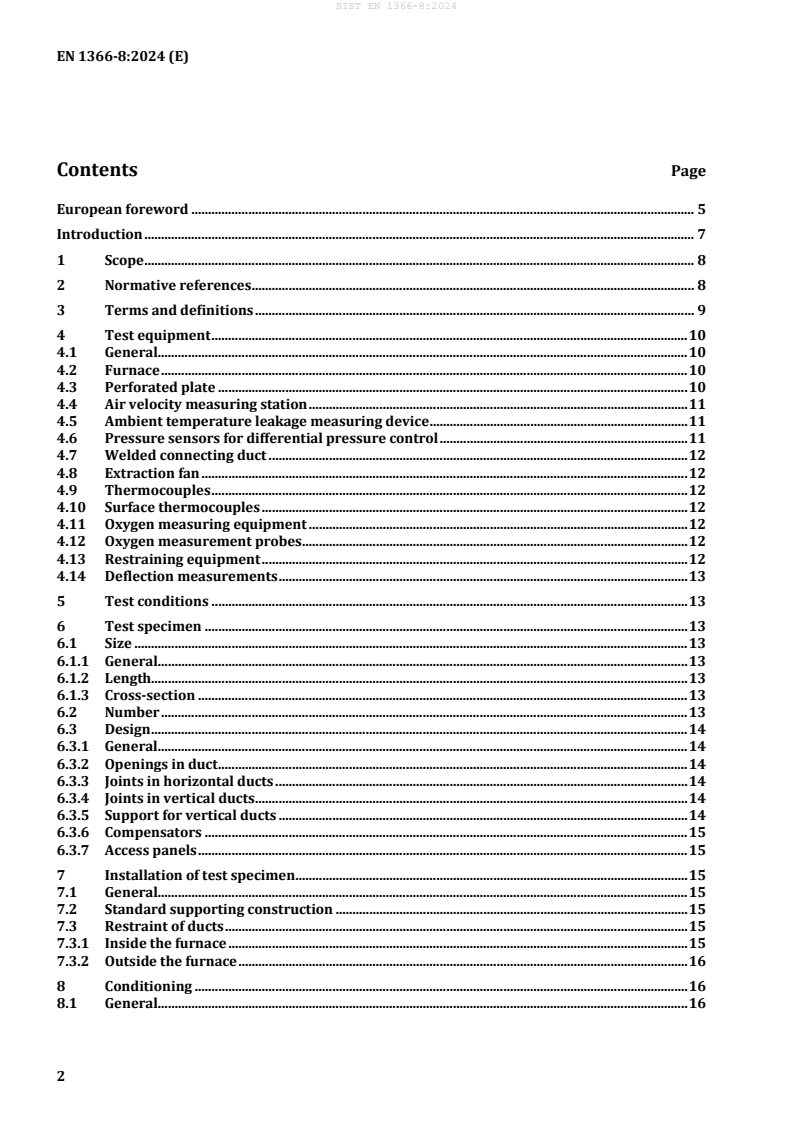
Contents Page
European foreword . 5
Introduction . 7
1 Scope . 8
2 Normative references . 8
3 Terms and definitions . 9
4 Test equipment . 10
4.1 General. 10
4.2 Furnace . 10
4.3 Perforated plate . 10
4.4 Air velocity measuring station . 11
4.5 Ambient temperature leakage measuring device . 11
4.6 Pressure sensors for differential pressure control . 11
4.7 Welded connecting duct . 12
4.8 Extraction fan . 12
4.9 Thermocouples . 12
4.10 Surface thermocouples . 12
4.11 Oxygen measuring equipment . 12
4.12 Oxygen measurement probes . 12
4.13 Restraining equipment . 12
4.14 Deflection measurements . 13
5 Test conditions . 13
6 Test specimen . 13
6.1 Size . 13
6.1.1 General. 13
6.1.2 Length. 13
6.1.3 Cross-section . 13
6.2 Number . 13
6.3 Design . 14
6.3.1 General. 14
6.3.2 Openings in duct . 14
6.3.3 Joints in horizontal ducts . 14
6.3.4 Joints in vertical ducts . 14
6.3.5 Support for vertical ducts . 14
6.3.6 Compensators . 15
6.3.7 Access panels . 15
7 Installation of test specimen . 15
7.1 General. 15
7.2 Standard supporting construction . 15
7.3 Restraint of ducts . 15
7.3.1 Inside the furnace . 15
7.3.2 Outside the furnace . 16
8 Conditioning . 16
8.1 General. 16
8.2 Water-based sealing materials . 16
9 Application of instrumentation . 16
9.1 Thermocouples . 16
9.1.1 Furnace thermocouples (plate thermometers) . 16
9.1.2 Unexposed surface thermocouples . 16
9.1.3 Measurement of gas temperature adjacent to nozzles . 16
9.2 Pressure . 16
9.2.1 Furnace pressure . 16
9.2.2 Under-pressure in duct . 17
9.3 Oxygen measurements . 17
9.4 Deflection measurement for determination of reduction in internal cross-sectional area
............................................................................................................................................................................. 17
10 Test procedure . 18
10.1 General . 18
10.2 Pre-test adjustment of the perforated plate . 19
10.3 Test at ambient temperature . 19
10.4 Pre-fire test procedures . 19
10.5 Fire test. 20
11 Performance criteria . 21
11.1 General requirements . 21
11.2 Criteria at ambient temperature . 22
11.2.1 Ambient leakage . 22
11.2.2 Reduction in internal cross-sectional area under ambient conditions outside the furnace
............................................................................................................................................................................. 22
11.3 Criteria under fire conditions . 22
11.3.1 General . 22
11.3.2 Integrity . 23
11.3.3 Insulation . 23
11.3.4 Smoke-Leakage . 23
12 Test report . 23
13 Field of direct application of test results . 24
13.1 General . 24
13.2 Vertical and horizontal ducts . 24
13.3 Sizes of ducts . 24
13.4 Supporting construction . 25
13.5 Steel ducts . 25
Annex A (normative) Measurement of volume/mass flow . 42
A.1 Hints on measuring volume flow or mass flow with differential pressure devices . 42
A.2 Density . 42
A.3 Absolute pressure (barometric pressure) . 43
A.4 Viscosity . 43
A.5 Characteristic data of the inlet nozzles according to Figure 7 of this standard . 44
Annex B (informative) Measurement of oxygen concentration Details on measuring oxygen
concentration with paramagnetic cell analysers . 47
B.1 General . 47
B.2 Choice of O measuring devices . 47
B.3 Effect of O measuring device errors . 48
B.4 Zero and end point drift . 48
Annex C (informative) The usage of correction factors for the consideration of different
parameters . 51
C.1 Details for the development of the correction factors and their error limits . 51
C.2 The complete formula for the leakage mass flow and the parameters . 51
C.3 Application of correction factors in the simple mass flow formulae and achievable accuracy
............................................................................................................................................................................. 54
Annex D (normative) Method for testing air leakage post fire test when the oxygen measuring
system indicates a failure (after corrections) . 56
D.1 General purpose of Annex D . 56
D.2 Presumptions for conducting post fire leakage test . 56
D.3 Undertaking the air leakage test . 57
Bibliography . 58
European foreword
This document (EN 1366-8:2024) has been prepared by Technical Committee CEN/TC 127 “Fire safety
in buildings”, the secretariat of which is held by BSI.
This European Standard shall be given the status of a national standard, either by publication of an
identical text or by endorsement, at the latest by April 2025, and conflicting national standards shall be
withdrawn at the latest by April 2025.
Attention is drawn to the possibility that some of the elements of this document may be the subject of
patent rights. CEN shall not be held responsible for identifying any or all such patent rights.
This document supersedes EN 1366-8:2004.
In comparison with the previous edition, the following technical modifications have been made:
— method for determination of reduction in internal cross-sectional area is added;
— positions for measurement of deflection of cross-section outside furnace are defined;
— introduction of an alternative oxygen sampling probe;
— use of two separate O analysers based on paramagnetic measurement method for the two sampling
points is mandatory;
— accuracy of ambient leakage measuring device revised from ±5 % to ±2,5 %;
— standard for gas temperature thermocouples added;
— failure criteria for mechanical stability of duct inside furnace defined.
This document has been prepared under a standardization request addressed to CEN by the European
Commission. The Standing Committee of the EFTA States subsequently approves these requests for its
Member States.
EN 1366, Fire resistance tests for service installations consists of the following parts:
— Part 1: Ventilation ducts;
— Part 2: Fire dampers;
— Part 3: Penetration seals;
— Part 4: Linear joint seals;
— Part 5: Service ducts and shafts;
— Part 6: Raised access and hollow core floors;
— Part 7: Conveyor systems and their closures;
— Part 8: Smoke extraction ducts;
— Part 9: Single compartment smoke extraction ducts;
— Part 10: Smoke control dampers;
— Part 11: Fire protective Systems for cable systems and associated components;
— Part 12: Non-mechanical fire barrier for ventilation ductwork;
— Part 13: Chimneys.
Any feedback and questions on this document should be directed to the users’ national standards body.
A complete listing of these bodies can be found on the CEN website.
According to the CEN-CENELEC Internal Regulations, the national standards organisations of the
following countries are bound to implement this European Standard: Austria, Belgium, Bulgaria, Croatia,
Cyprus, Czech Republic, Denmark, Estonia, Finland, France, Germany, Greece, Hungary, Iceland, Ireland,
Italy, Latvia, Lithuania, Luxembourg, Malta, Netherlands, Norway, Poland, Portugal, Republic of North
Macedonia, Romania, Serbia, Slovakia, Slovenia, Spain, Sweden, Switzerland, Türkiye and the United
Kingdom.
Introduction
This document has been prepared because a method of test for fire resisting smoke extraction ducts has
become necessary to evaluate the ability of fire resisting ducts already tested to EN 1366-1 to function
adequately as smoke extraction ducts.
Leakage is measured at both ambient and elevated temperatures. During the tests, air/gases are drawn
through the duct at a differential pressure between the inside and outside of the duct. Leakage is
determined at ambient temperature by sealing the openings in the duct located in the furnace and taking
flow measurements through a flow-measuring device located just before the extraction fan. With respect
to determining leakage at elevated temperatures, oxygen concentration measuring techniques are used.
The method described in this test is complex and requires sophisticated instrumentation. It is not
recommended therefore to try to test multiple assemblies in this test.
CAUTION — The attention of all persons concerned with managing and carrying out this fire resistance
test is drawn to the fact that fire testing can be hazardous and that there is a possibility that toxic and/or
harmful smoke and gases might be evolved during the test. Mechanical and operational hazards might
also arise during the construction of the test elements or structures, their testing and disposal of test
residues.
An assessment of all potential hazards and risks to health should be made and safety precautions should
be identified and provided. Written safety instructions should be issued. Appropriate training should be
given to relevant personnel. Laboratory personnel should ensure that they follow written safety
instructions at all times.
1 Scope
This document specifies a test method for determining the fire resistance of smoke extraction ducts. It is
applicable only to smoke extraction ducts that pass through another fire compartment apart from the
compartment from where smoke needs to be extracted in case of fire. It represents fire exposure of a fully
developed fire.
This method of test is only applicable to fire resistant ventilation ducts (same construction) with the
following classification according to EN 13501-3:
— fire from inside and outside i ↔ o;
— applicable to a pressure difference up to 500 Pa in fire conditions;
NOTE 1 It is assumed that the duct A test(s) in accordance with EN 1366-1 has been performed with an
under-pressure of minimum 500 Pa.
— with integrity (E) and insulation (I) criteria equal to or higher than the intended classification for the
smoke extraction duct.
For the purposes of the test described in this document, the duct is referred to as duct C.
This test method has been designed to cover both vertical and horizontal smoke extraction ducts. A
vertical system need not be evaluated to this method provided that:
— both horizontal (ho) and vertical (ve) classification according to EN 13501-3 has been obtained for
the ventilation duct;
— it has been tested in a horizontal orientation to this method.
If the ventilation duct in practise is only used for vertical applications in smoke extraction systems, only
vertical (ve) classification is obtained in accordance with EN 13501-3 and tested only in a vertical
orientation to this test method.
This test method is suitable for ducts constructed from non-combustible materials (class A1 and A2-s1,
d0 according to EN 13501-1).
NOTE 2 Reaction with components of the duct can affect the oxygen concentration inside the duct leading to
inaccurate calculation of the leakage rate. If it is determined this has happened refer to Annex D.
This document applies to four sided rectangular and circular ducts only (with fire exposure on all sides).
Ducts that utilize elements of construction for one, two or three sides are not covered. An alternative test
method for one, two and three sided ducts will be developed separately.
2 Normative references
The following documents are referred to in the text in such a way that some or all of their content
constitutes requirements of this document. For dated references, only the edition cited applies. For
undated references, the latest edition of the referenced document (including any amendments) applies.
EN 1363-1, Fire resistance tests — Part 1: General requirements
EN 1366-1, Fire resistance tests for service installations — Part 1: Ventilation ducts
EN 1507, Ventilation for buildings — Sheet metal air ducts with rectangular section — Requirements for
strength and leakage
EN 10095, Heat resisting steels and nickel alloys
EN 13501-3, Fire classification of construction products and building elements — Part 3: Classification
using data from fire resistance tests on products and elements used in building service installations: fire
resisting ducts and fire dampers
EN 60584-1, Thermocouples — Part 1: EMF specifications and tolerances (IEC 60584-1)
EN ISO 13943, Fire safety — Vocabulary (ISO 13943)
EN ISO 5167-1, Measurement of fluid flow by means of pressure differential devices inserted in circular
cross-section conduits running full — Part 1: General principles and requirements (ISO 5167-1)
EN ISO 5167-2, Measurement of fluid flow by means of pressure differential devices inserted in circular
cross-section conduits running full — Part 2: Orifice plates (ISO 5167-2)
EN ISO 5167-3, Measurement of fluid flow by means of pressure differential devices inserted in circular
cross-section conduits running full — Part 3: Nozzles and Venturi nozzles (ISO 5167-3)
3 Terms and definitions
For the purposes of this document, the terms and definitions given in EN 1363-1 and EN ISO 13943 and
the following apply.
ISO and IEC maintain terminology databases for use in standardization at the following addresses:
— ISO Online browsing platform: available at https://www.iso.org/obp
— IEC Electropedia: available at https://www.electropedia.org/
3.1
smoke extraction duct
fire resistant duct used for the extraction of smoke in case of fire
3.2
fire-resistant ventilation duct
duct used for the distribution or extraction of air and designed to provide a degree of fire resistance
[SOURCE: EN 1366-1:2014+A1:2020, definition 3.1]
3.3
self-supporting duct
duct constructed e.g. from fire-protective boards without encasing a steel duct
[SOURCE: EN 1366-1:2014+A1:2020, definition 3.3]
3.4
suspension devices
components used for securing a duct to a load bearing structure
3.5
supporting construction
wall, partition or floor through which the duct passes in the test
[SOURCE: EN 1366-1:2014+A1:2020, definition 3.5]
3.6
compensator
device used to prevent damage to the duct, the penetration seal and/or the structural elements
(horizontal or vertical) from the forces that are generated by the thermal expansion of the duct and/or
its suspension devices
3.7
access panel
cover for an inspection opening within the duct
[SOURCE: EN 1366-1:2014+A1:2020, definition 3.7]
3.8
fire protected steel duct
steel duct with an external insulation to provide fire resistance
[SOURCE: EN 1366-1:2014+A1:2020, definition 3.8]
3.9
internal surface area with under-pressure
surface area of the duct from the perforated plate to the end of the duct by the inlet nozzles including the
endplate where the nozzles are positioned and excluding the surface of the perforated plate
3.10
total internal surface area
full internal area of the duct including both end plates
4 Test equipment
4.1 General
In addition to the test equipment specified in EN 1363-1, the following is required:
4.2 Furnace
This shall be capable of subjecting smoke extraction ducts to the standard heating and pressure
conditions specified in EN 1363-1 and be suitable for testing ducts in the horizontal (see Figure 1) or
vertical (see Figure 2) orientation.
It is required that the construction of furnace shall allow observation of at least 75 % of the test specimen
4.3 Perforated plate
The perforated plate defines the under-pressure inside the duct by the air flow speed of 2 m/s in ambient
conditions. Choose the perforated plate from Figure 3 or Figure 4 to suit the required pressure level
according to Table 1. The plate shall be positioned (250 ± 50) mm from where the duct passes through
the furnace wall or roof, see Figures 1 and 2.
The plate shall be made from austenitic heat-resisting steel (grade number 1.4835 or 1.4828) in
accordance with EN 10095 Heat resisting steels and nickel alloys. The number of holes and dimensions
are given in Figures 3 and 4. The thickness of the plates shall be (2,5 ± 0,5) mm.
NOTE 1 The table in Figure 3 gives details of perforated plates for standard rectangular ducts of size
1 000 mm × 250 mm. For smaller sizes, the number of holes will be reduced proportional to the smaller cross
section.
NOTE 2 The table in Figure 4 gives details of perforated plates for standard circular ducts of diameter 560 mm.
For smaller sizes, the number of holes will be reduced proportional to the cross section (a change to larger sizes is
not permitted; see 6.1.3 and Table 3).
Further details of the plate are shown in Figures 3, 4 and 5.
Table 1 — Differential pressures between inside and outside the duct for smoke extraction
ductwork
Differential pressure for fire
Operating differential pressure
at ambient temperature
Pressure level test and pre-test calibration
Pa
Pa
1 −500 −150
2 −1 000 −300
3 −1 500 −500
4.4 Air velocity measuring station
The measuring station shall consist of one or two inlet nozzle(s), or other suitable device, installed in a
straight length of pipe sized to EN ISO 5167-1. The temperature of the extracted hot gas shall be
measured with a sheathed thermocouple type K according EN 60584-1, max. 3 mm in diameter. Its
measuring junction shall be located no more than 1/4 of the pipe diameter away from the centre line of
the pipe and at a maximum distance of 2 × d of the pipe diameter downstream from the nozzle / device.
The pipe between the nozzle(s)/device shall be insulated.
The measuring device shall be capable of measuring to an accuracy of 5 % when used in ambient
conditions.
The measuring device shall be capable of measuring to an accuracy of 5 % when used in ambient
conditions and shall be suitably connected to the end of the duct.
If the measuring device consist of a venturi, orifice plate and (where necessary) an airflow straightener,
this shall be installed in straight lengths of pipe, all sized to EN ISO 5167-1, EN ISO 5167-2 and
EN ISO 5167-3.
NOTE 1 For the standard sizes of ducts specified in 7.1, an internal dimension of diameter = 160 mm of each
nozzle is suitable (Figure 7). Descriptions of similar nozzles are given in EN ISO 5167-3, EN ISO 5167-4 and
ISO 5221.
NOTE 2 Suggestion to an inlet nozzles system for standard size ducts is shown in Figures 6 and 7. The calculation
procedure is given in Annex A.
4.5 Ambient temperature leakage measuring device
The measuring device shall be capable of measuring to an accuracy of ±2,5 % and suitably mounted at
the end of the duct, connected to appropriate differential pressure measuring equipment.
NOTE Descriptions of possible measuring devices are given in the EN ISO 5167 series and ISO 5221.
4.6 Pressure sensors for differential pressure control
A tube sensor as specified in EN 1363-1 shall be located at the end of the duct, inside the duct, at the level
of its centre line (D1, see Figures 6 and 7). As an alternative to this tube sensor, a piezometric ring can be
used. An example for the piezometric ring is shown in Figure 7, item 4.
A second sensor (e.g. an open end of a measuring tube) shall be located on the same level outside the
duct. This is shown in Figures 6 as pressure probe in laboratory D2.
4.7 Welded connecting duct
A fully welded duct designed to provide a gas tight connection between the inlet nozzles and the oxygen
measuring probes, shall be provided.
One end of the duct is designed to connect between the test specimen and the extraction fan. An inlet
opening may be provided if a flow control damper is used for fine control of the differential pressure. This
is shown in Figure 7, item 7.
4.8 Extraction fan
A fan for extracting gas under the fire test with a suggested capacity of at least 2 × Vn where Vn is the
required capacity calculated by multiplying the air speed (2 m/s) by the height and width of the duct, e.g.
for the rectangular duct described in 6.1.3 with cross section of 1 m × 0,25 m:
Vn = 2 m/s × 1,0 m × 0,25 m = 0,5 m /s
The characteristic curves of the fan shall be horizontal for the actual air flow. The conveyed air volume
flow of the fan shall not change by more than 10 % in the event of a drop in the pressure of up to 50 Pa.
4.9 Thermocouples
Sheathed thermocouples shall be provided for measuring the gas temperature adjacent to the nozzles of
nickel chromium/nickel aluminium type K wire as defined in EN 60584-1, with a nominal diameter of
1,5 mm to 3 mm. The thermocouples shall measure with an accuracy of ±15 K. The position is shown in
Figures 6 and 7, item 6.
4.10 Surface thermocouples
Surface thermocouples for measuring surface temperature of the type specified in EN 1363-1 and at the
locations specified in EN 1366-1 shall be used.
4.11 Oxygen measuring equipment
The oxygen concentration at points G1 and G2 shall be measured using two separate systems consisting
of O analysers based on the paramagnetic measurement method and suitable equipment for cooling,
filtering and drying the gases. Appropriate connecting tubes and probes shall be provided. The 90 %
response time of the complete system shall be 20 s maximum. The accuracy shall be equal to or better
than ±0,1 Vol-%.
4.12 Oxygen measurement probes
Gas probes made of stainless steel shall be provided for extracting the furnace gas from the inside of the
duct at the locations G1 and G2 in Figure 6. The end of the probe shall be located in the centre point of the
duct cross section.
An alternative gas probe according to Figure 14 can be used.
Both types of gas probes are described in 9.3.
4.13 Restraining equipment
Restraining equipment shall be applied as for duct B in EN 1366-1.
4.14 Deflection measurements
Deflection measurements shall be taken for determining the reduction of internal cross-sectional area at
ambient temperature and during the fire test. The measurement shall be done with an accuracy of ±1 mm.
The interval between a complete set of measurements shall not exceed 15 min, in any case near prior to
any classification time period.
5 Test conditions
The heating conditions and the furnace atmosphere shall conform to those given in EN 1363-1.
The furnace pressure shall be controlled to ΔP = 15 Pa throughout the test at the mid-height position of
the horizontal ducts. For vertical ducts the furnace pressure shall be controlled to ΔP = 20 Pa at a distance
of 100 mm below the ceiling. The tolerance of the pressure differential is given in EN 1363-1.
Details of test conditions within the ducts during the test are given in Clause 10.
6 Test specimen
6.1 Size
6.1.1 General
For duct specimens of sizes other than those given in Table 3, the field of direct application is restricted
(see Clause 13).
6.1.2 Length
The minimum lengths of the parts of the test specimen inside and outside the furnace shall be as given in
Table 2 (see also Figures 1 and 2).
Table 2 — Minimum length of test specimen
Orientation Minimum length (m)
Inside furnace Outside furnace
Horizontal 3,0 4,25
Vertical 2,0 4,25
6.1.3 Cross-section
The standard sizes of ducts given in Table 3 shall be tested unless only smaller cross-sections are used:
Table 3 — Internal cross-section of test specimen (dimension of the open cross-section)
Rectangular Circular
Width (mm) Height (mm) Diameter (mm)
1 000 ± 10 250 ± 10 560 ± 10
6.2 Number
A minimum of one test specimen shall be tested. For horizontal and vertical installation, see 13.2.
6.3 Design
6.3.1 General
The test shall be made on a test specimen representative of the complete duct assembly, including
integral or intended insulation on which information is required. Each type of duct requires a different
approach and the laboratory shall as far as practical reproduce the edge conditions and the method of
fixing or support inside and outside the furnace to that representative of that used in practise. The
distance between the suspension devices and the distance between suspension devices and the
separating element shall be representative of the intended application as they are an integral part of the
tested system. It should be as far as is reasonably practicable the same arrangement as (or within DIAP
and/or EXAP rules) complimentary to the system tested in EN 1366-1 for the same duct.
6.3.2 Openings in duct
Two openings equal in size shall be provided, one on each vertical side of the duct inside the furnace. For
horizontal ducts the openings shall be positioned (500 ± 25) mm from the end of the duct inside the
furnace (see Figure 1). For vertical ducts the openings shall be positioned (200 ± 50) mm as indicated in
Figure 2.
In both vertical and horizontal ducts, clear openings shall have the same width/height ratio as the cross-
section of the duct. For circular ducts, the openings shall be rectangular with a width/height ratio of 4:1.
The total area of the openings shall be 50 % ± 10 % of the internal cross-sectional area of the duct.
Framing of the openings shall be as in practise (to avoid weakening the duct walls in the area around the
openings).
6.3.3 Joints in horizontal ducts
The test configuration shall include at least one joint inside the furnace and at least one joint outside it.
There shall be at least one joint in every layer of fire protection material (if applicable), both inside and
outside the furnace and in any steel duct.
Outside the furnace, the joint in the outer layer of the fire protection material shall be no further than
700 mm from the supporting construction and no nearer than 100 mm to thermocouples T2. Inside the
furnace, the joint in the outer layer of fire protection material shall be located at approximately mid-span.
The distance between joints and suspension devices shall not be less than that used in practise. If the
minimum distance has not been specified, suspension devices shall be arranged so that the joint of the
outermost layer at the bottom of the insulation material (if no insulation material is present: joint of the
steel duct) lies midway between them. Centres of the suspension devices shall be specified by the
manufacturer and shall be representative of practise.
6.3.4 Joints in vertical ducts
The test configuration shall include at least one joint inside the furnace and one joint outside it.
There shall be at least one joint for every layer of fire protection material, both inside and outside the
furnace and in any steel duct.
Outside the furnace, the joint in the outer layer of the fire protection material shall be no further than
700 mm from the supporting construction and no nearer than 100 mm to thermocouples T2. Inside the
furnace, the joint in the outer layer of fire protection material shall be located at approximately mid-span.
6.3.5 Support for vertical ducts
Vertical ducts shall be supported on the furnace floor and penetrate through the supporting construction
(see Figure 2); the ducts shall be fixed at the level of the supporting construction as they would be fixed
in practise when penetrating a floor. This shall be as specified by the sponsor.
6.3.6 Compensators
Where compensators are used in practise then they shall be incorporated in the test specimen. In this
case the compensator shall be located outside the furnace approximately 500 mm from the perforated
plate.
6.3.7 Access panels
Where access panels are used in practise then they shall be incorporated in the test specimen. In this case
the access panels shall be located outside the furnace approximately 500 mm downstream from the
perforated plate. In cases where compensator and access panel are included in one test specimen, the
placement of the compensator takes precedence (access panel shall be located (300 ± 50) mm from the
end of the compensator or in the next section downstream).
In cases where access panel are included in the test specimen causing conflicts with the joints in the
different layers of the duct, the placement of the joints takes precedence. In that case move the access
panel further downstream.
7 Installation of test specimen
7.1 General
The test specimen shall be installed, as far as possible, in a manner representative of its use in practise.
The supporting construction selected shall be a wall, partition or floor either selected from the standard
supporting constructions in 7.2 or of the type to be used in practise.
Where the duct passes through an opening in the furnace wall or roof, then the opening shall be of
sufficient dimensions to allow for the supporting construction to surround all faces of the duct by at least
200 mm in case of rigid supporting constructions.
In case of flexible supporting walls, the flexible walls shall have minimum dimensions of 2 500 mm x
2 500 mm and have one fixed and one free vertical edge (for free edge cf. EN 1364-1:2015, 6.3.2). The
horizontal clear spacing between the outer edge of the penetration and the free edge of the flexible
supporting construction shall be (500 ± 50) mm. The clear vertical spacing between the top of the flexible
supporting construction and the top of the outer edge of the penetration shall be at least 500 mm.
Ducts shall be arranged as shown in Figures 1 and 2. The end of
...
Questions, Comments and Discussion
Ask us and Technical Secretary will try to provide an answer. You can facilitate discussion about the standard in here.
Loading comments...