


SIST EN 13616-2:2016+A1:2025
(Main + Amendment)Overfill prevention devices for static tanks for liquid fuels - Part 2: Overfill prevention devices without a closure device
Overfill prevention devices for static tanks for liquid fuels - Part 2: Overfill prevention devices without a closure device
Überfüllsicherungen für ortsfeste Tanks für flüssige Brenn- und Kraftstoffe - Teil 2: Überfüllsicherungen ohne Schließeinrichtung
Diese Europäische Norm enthält Anforderungen, Prüf und Bewertungsverfahren, Kennzeichnung, Etikettie¬rung und Verpackung, die für Überfüllsicherungen ohne Schließeinrichtung gelten.
Die Überfüllsicherung ohne Schließeinrichtung besteht gewöhnlich aus:
Überfüllsicherungssensor, bestehend aus
Sensor;
elektrischer Schnittstelle;
mechanischer Schnittstelle;
Steuereinrichtung der Überfüllsicherung nach EN 16657.
Diese Überfüllsicherungen sind für die Verwendung in/mit unter oder oberirdischen, drucklosen, ortsfesten Tanks für flüssige Brenn und Kraftstoffe vorgesehen.
ANMERKUNG 1 Flüssige Brenn und Kraftstoffe bedeutet Flüssigkeiten für interne Verbrennungsmotoren, Heiz /Kühlkessel und Generatoren.
ANMERKUNG 2 Im Folgenden wird für den Begriff „flüssige Brenn und Kraftstoffe“ der Begriff „Flüssigkeit“ verwendet.
Dispositifs limiteurs de remplissage pour réservoirs statiques pour carburants liquides - Partie 2: Dispositifs limiteurs de remplissage sans dispositif de fermeture
Naprave za preprečitev prepolnitve za nepremične rezervoarje za tekoča goriva - 2. del: Naprave za preprečitev prepolnitve brez zaporne naprave (vključno z dopolnilom A1)
General Information
- Status
- Published
- Publication Date
- 09-Nov-2025
- Technical Committee
- TLP - Pressure vessels
- Current Stage
- 6060 - National Implementation/Publication (Adopted Project)
- Start Date
- 16-Oct-2025
- Due Date
- 21-Dec-2025
- Completion Date
- 10-Nov-2025
Relations
- Effective Date
- 01-Dec-2025
Overview
EN 13616-2:2016+A1:2025 is the CEN European standard that specifies requirements, testing, assessment and marking for overfill prevention devices without a closure device used on static tanks for liquid fuels. It covers the overfill prevention sensor, its electrical and mechanical interfaces, and the interface to an overfill prevention controller (referenced to EN 16657). The devices are intended for use with underground or above‑ground, non‑pressurized static tanks storing liquid fuels (fuels for engines, boilers, generators).
Key Topics and Requirements
- Basic function: Sensor must provide a non‑permissive signal when tank level is equal to or above the maximum filling level L, and a permissive signal when the level is below L.
- Sensor composition: Acceptable sensor types include a PTC resistor or devices with equivalent behaviour.
- Electrical interface and explosion protection: Manufacturers must declare compatible fuels and flashpoint limits and define electrical supply parameters for explosion safety. For use in explosive atmospheres the device shall meet at least Ex ia IIB T3 per EN 60079‑0 / EN 60079‑11.
- Operating temperatures: Sensor operation is specified for liquid temperatures from −25 °C to +50 °C (unless otherwise declared).
- Supply characteristics: The supply circuit must be stabilised to (19 ± 0.3) V over the temperature range, supplyable up to 80 mA, with internal resistance (160 ± 3.2) Ω.
- Performance times: Reaction time from permissive to non‑permissive must be ≤ 1.5 s; other timing sequences for sensor warm up and wetting are defined.
- Durability, EMC and fail‑safe: Requirements and tests cover mechanical and chemical durability, operational cycles, electromagnetic compatibility (EMC), and fail‑safe behaviour.
- Assessment and factory control: The standard defines type testing, assessment and verification of constancy of performance (AVCP) and factory production control (FPC) requirements.
- Marking and documentation: Provisions for marking, labelling, packaging and product information (PID) are included.
Applications and Who Uses It
- Manufacturers of overfill prevention sensors and tank equipment use this standard to design compliant products.
- Fuel storage operators and petrol station owners apply the standard to ensure safe delivery and fill operations for static tanks.
- Tank installers, maintenance providers and safety inspectors use it for selection, installation checks, EMC and functional testing.
- Certification and testing laboratories, regulatory bodies and insurers refer to the standard during product approval, conformity assessment and risk evaluation.
Related Standards
- EN 13616‑1 (overfill devices with closure device)
- EN 16657 (tank vehicle equipment and controller interface)
- EN 60079‑0 / EN 60079‑11 (explosive atmospheres)
- EN 61000‑6‑2 / EN 61000‑6‑3 (EMC)
- EN ISO 13849‑1 (safety-related control systems)
- EN 14879‑4, EN 590
Keywords: EN 13616-2:2016+A1:2025, overfill prevention, static tanks, liquid fuels, overfill prevention sensor, explosion protection, EMC testing, durability, CEN standard.

Frequently Asked Questions
SIST EN 13616-2:2016+A1:2025 is a standard published by the Slovenian Institute for Standardization (SIST). Its full title is "Overfill prevention devices for static tanks for liquid fuels - Part 2: Overfill prevention devices without a closure device". This standard covers: Diese Europäische Norm enthält Anforderungen, Prüf und Bewertungsverfahren, Kennzeichnung, Etikettie¬rung und Verpackung, die für Überfüllsicherungen ohne Schließeinrichtung gelten. Die Überfüllsicherung ohne Schließeinrichtung besteht gewöhnlich aus: Überfüllsicherungssensor, bestehend aus Sensor; elektrischer Schnittstelle; mechanischer Schnittstelle; Steuereinrichtung der Überfüllsicherung nach EN 16657. Diese Überfüllsicherungen sind für die Verwendung in/mit unter oder oberirdischen, drucklosen, ortsfesten Tanks für flüssige Brenn und Kraftstoffe vorgesehen. ANMERKUNG 1 Flüssige Brenn und Kraftstoffe bedeutet Flüssigkeiten für interne Verbrennungsmotoren, Heiz /Kühlkessel und Generatoren. ANMERKUNG 2 Im Folgenden wird für den Begriff „flüssige Brenn und Kraftstoffe“ der Begriff „Flüssigkeit“ verwendet.
Diese Europäische Norm enthält Anforderungen, Prüf und Bewertungsverfahren, Kennzeichnung, Etikettie¬rung und Verpackung, die für Überfüllsicherungen ohne Schließeinrichtung gelten. Die Überfüllsicherung ohne Schließeinrichtung besteht gewöhnlich aus: Überfüllsicherungssensor, bestehend aus Sensor; elektrischer Schnittstelle; mechanischer Schnittstelle; Steuereinrichtung der Überfüllsicherung nach EN 16657. Diese Überfüllsicherungen sind für die Verwendung in/mit unter oder oberirdischen, drucklosen, ortsfesten Tanks für flüssige Brenn und Kraftstoffe vorgesehen. ANMERKUNG 1 Flüssige Brenn und Kraftstoffe bedeutet Flüssigkeiten für interne Verbrennungsmotoren, Heiz /Kühlkessel und Generatoren. ANMERKUNG 2 Im Folgenden wird für den Begriff „flüssige Brenn und Kraftstoffe“ der Begriff „Flüssigkeit“ verwendet.
SIST EN 13616-2:2016+A1:2025 is classified under the following ICS (International Classification for Standards) categories: 23.020.10 - Stationary containers and tanks; 75.200 - Petroleum products and natural gas handling equipment. The ICS classification helps identify the subject area and facilitates finding related standards.
SIST EN 13616-2:2016+A1:2025 has the following relationships with other standards: It is inter standard links to SIST EN 13616-2:2016. Understanding these relationships helps ensure you are using the most current and applicable version of the standard.
SIST EN 13616-2:2016+A1:2025 is available in PDF format for immediate download after purchase. The document can be added to your cart and obtained through the secure checkout process. Digital delivery ensures instant access to the complete standard document.
Standards Content (Sample)
SLOVENSKI STANDARD
01-december-2025
Nadomešča:
SIST EN 13616-2:2016
Naprave za preprečitev prepolnitve za nepremične rezervoarje za tekoča goriva - 2.
del: Naprave za preprečitev prepolnitve brez zaporne naprave (vključno z
dopolnilom A1)
Overfill prevention devices for static tanks for liquid fuels - Part 2: Overfill prevention
devices without a closure device
Überfüllsicherungen für ortsfeste Tanks für flüssige Brenn- und Kraftstoffe - Teil 2:
Überfüllsicherungen ohne Schließeinrichtung
Dispositifs limiteurs de remplissage pour réservoirs statiques pour carburants liquides -
Partie 2: Dispositifs limiteurs de remplissage sans dispositif de fermeture
Ta slovenski standard je istoveten z: EN 13616-2:2016+A1:2025
ICS:
23.020.10 Nepremične posode in Stationary containers and
rezervoarji tanks
75.200 Oprema za skladiščenje Petroleum products and
nafte, naftnih proizvodov in natural gas handling
zemeljskega plina equipment
2003-01.Slovenski inštitut za standardizacijo. Razmnoževanje celote ali delov tega standarda ni dovoljeno.
EN 13616-2:2016+A1
EUROPEAN STANDARD
NORME EUROPÉENNE
September 2025
EUROPÄISCHE NORM
ICS 23.020.10 Supersedes EN 13616-2:2016
English Version
Overfill prevention devices for static tanks for liquid fuels -
Part 2: Overfill prevention devices without a closure
device
Dispositifs limiteurs de remplissage pour réservoirs Überfüllsicherungen für ortsfeste Tanks für flüssige
statiques pour carburants liquides - Partie 2: Brenn- und Kraftstoffe - Teil 2: Überfüllsicherungen
Dispositifs limiteurs de remplissage sans dispositif de ohne Schließeinrichtung
fermeture
This European Standard was approved by CEN on 8 April 2016 and includes Amendment 1 approved by CEN on 12 February
2025.
CEN members are bound to comply with the CEN/CENELEC Internal Regulations which stipulate the conditions for giving this
European Standard the status of a national standard without any alteration. Up-to-date lists and bibliographical references
concerning such national standards may be obtained on application to the CEN-CENELEC Management Centre or to any CEN
member.
This European Standard exists in three official versions (English, French, German). A version in any other language made by
translation under the responsibility of a CEN member into its own language and notified to the CEN-CENELEC Management
Centre has the same status as the official versions.
CEN members are the national standards bodies of Austria, Belgium, Bulgaria, Croatia, Cyprus, Czech Republic, Denmark, Estonia,
Finland, France, Germany, Greece, Hungary, Iceland, Ireland, Italy, Latvia, Lithuania, Luxembourg, Malta, Netherlands, Norway,
Poland, Portugal, Republic of North Macedonia, Romania, Serbia, Slovakia, Slovenia, Spain, Sweden, Switzerland, Türkiye and
United Kingdom.
EUROPEAN COMMITTEE FOR STANDARDIZATION
COMITÉ EUROPÉEN DE NORMALISATION
EUROPÄISCHES KOMITEE FÜR NORMUNG
CEN-CENELEC Management Centre: Rue de la Science 23, B-1040 Brussels
© 2025 CEN All rights of exploitation in any form and by any means reserved Ref. No. EN 13616-2:2016+A1:2025 E
worldwide for CEN national Members.
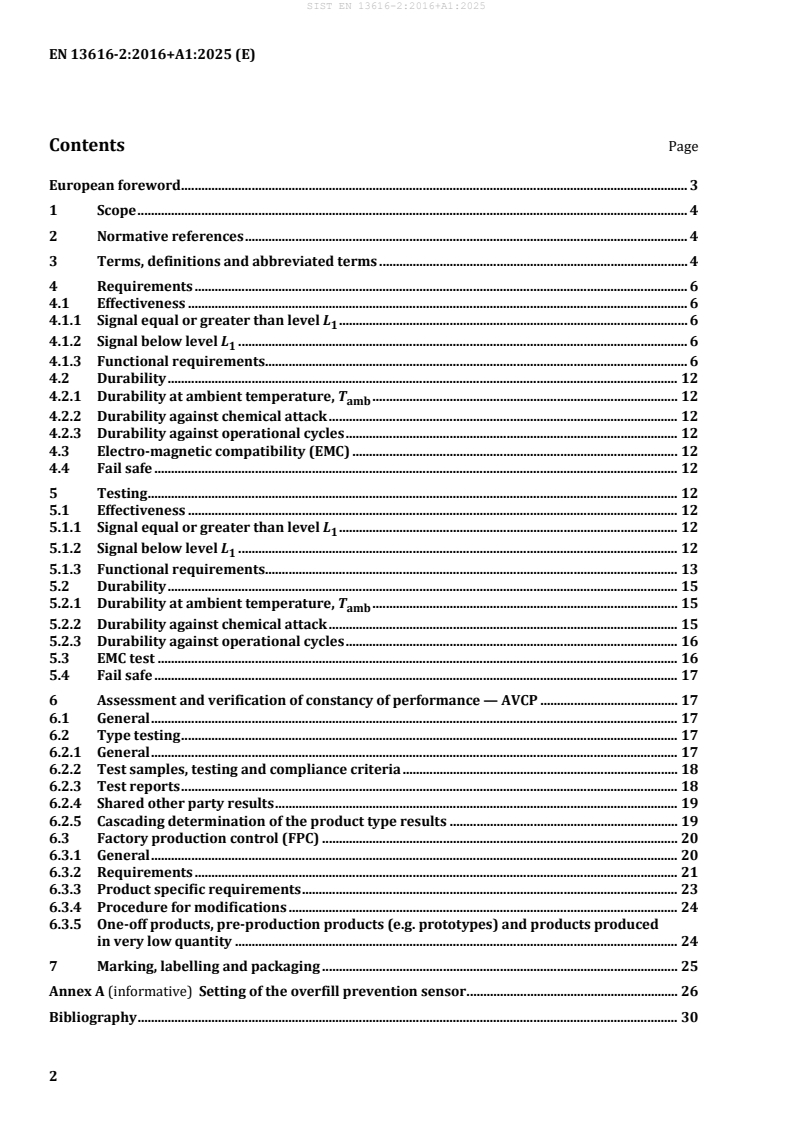
Contents Page
European foreword . 3
1 Scope . 4
2 Normative references . 4
3 Terms, definitions and abbreviated terms . 4
4 Requirements . 6
4.1 Effectiveness . 6
4.1.1 Signal equal or greater than level L . 6
4.1.2 Signal below level L . 6
4.1.3 Functional requirements. 6
4.2 Durability . 12
4.2.1 Durability at ambient temperature, T . 12
amb
4.2.2 Durability against chemical attack . 12
4.2.3 Durability against operational cycles . 12
4.3 Electro-magnetic compatibility (EMC) . 12
4.4 Fail safe . 12
5 Testing . 12
5.1 Effectiveness . 12
5.1.1 Signal equal or greater than level L . 12
5.1.2 Signal below level L . 12
5.1.3 Functional requirements. 13
5.2 Durability . 15
5.2.1 Durability at ambient temperature, T . 15
amb
5.2.2 Durability against chemical attack . 15
5.2.3 Durability against operational cycles . 16
5.3 EMC test . 16
5.4 Fail safe . 17
6 Assessment and verification of constancy of performance — AVCP . 17
6.1 General . 17
6.2 Type testing . 17
6.2.1 General . 17
6.2.2 Test samples, testing and compliance criteria . 18
6.2.3 Test reports . 18
6.2.4 Shared other party results . 19
6.2.5 Cascading determination of the product type results . 19
6.3 Factory production control (FPC) . 20
6.3.1 General . 20
6.3.2 Requirements . 21
6.3.3 Product specific requirements . 23
6.3.4 Procedure for modifications . 24
6.3.5 One-off products, pre-production products (e.g. prototypes) and products produced
in very low quantity . 24
7 Marking, labelling and packaging . 25
Annex A (informative) Setting of the overfill prevention sensor . 26
Bibliography . 30
European foreword
This document (EN 13616-2:2016+A1:2025) has been prepared by Technical Committee CEN/TC 393
“Equipment for storage tanks and for filling stations”, the secretariat of which is held by DIN.
This European Standard shall be given the status of a national standard, either by publication of an
identical text or by endorsement, at the latest by March 2026, and conflicting national standards shall
be withdrawn at the latest by March 2026.
Attention is drawn to the possibility that some of the elements of this document may be the subject of
patent rights. CEN shall not be held responsible for identifying any or all such patent rights.
This document includes Amendment 1 approved by CEN on 12 February 2025.
The start and finish of text introduced or altered by amendment is indicated in the text by tags !".
This document supersedes !EN 13616-2:2016".
!deleted text"
!The significant technical changes between EN 13616:2004 and EN 13616-2:2016 are the
following:"
— splitting of EN 13616:2004; the new EN 13616, under the general title Overfill prevention devices for
static tanks for liquid fuels, will consist of the following parts:
— Part 1: Overfill prevention devices with a closure device;
— Part 2: Overfill prevention devices without a closure device.
— reference to EN 14116;
— technical parameters regarding explosion updated;
— the requirements for the equipment of the overfill prevention devices with a closure device on the
static tank are fixed in EN 13616-1;
— the requirements for the equipment of the overfill prevention devices without a closure device on
the tank vehicle were shifted to EN 16657, Tanks for the transport of dangerous goods — Transport
tank equipment for overfill prevention devices for static tanks.
Any feedback and questions on this document should be directed to the users’ national standards body.
A complete listing of these bodies can be found on the CEN website.
According to the CEN-CENELEC Internal Regulations, the national standards organisations of the
following countries are bound to implement this European Standard: Austria, Belgium, Bulgaria,
Croatia, Cyprus, Czech Republic, Denmark, Estonia, Finland, France, Germany, Greece, Hungary, Iceland,
Ireland, Italy, Latvia, Lithuania, Luxembourg, Malta, Netherlands, Norway, Poland, Portugal, Republic of
North Macedonia, Romania, Serbia, Slovakia, Slovenia, Spain, Sweden, Switzerland, Türkiye and the
United Kingdom.
1 Scope
This European Standard contains requirements, test and assessment methods, marking, labelling and
packaging applicable to overfill prevention devices without a closure device.
The overfill prevention device without a closure device is usually composed of
— overfill prevention sensor consists of
— sensor,
— electrical interface,
— mechanical interface,
— overfill prevention controller according to EN 16657.
These overfill prevention devices are intended to be used in/with underground or above ground, non-
pressurized, static tanks designed for liquid fuels.
NOTE 1 Liquid fuel means liquids for internal combustion engines, heating/cooling boilers and generators.
NOTE 2 In further text, for liquid fuels the term liquid is used.
2 Normative references
The following documents are referred to in the text in such a way that some or all of their content
constitutes requirements of this document. For dated references, only the edition cited applies. For
undated references, the latest edition of the referenced document (including any amendments) applies.
EN 590, Automotive fuels — Diesel — Requirements and test methods
EN 14879-4:2007, Organic coating systems and linings for protection of industrial apparatus and plants
against corrosion caused by aggressive media — Part 4: Linings on metallic components
EN 60079-0, Explosive atmospheres — Part 0: Equipment — General requirements (IEC 60079-0)
EN 60079-11, Explosive atmospheres — Part 11: Equipment protection by intrinsic safety “i
(IEC 60079-11)
EN 61000-6-2:2005, Electromagnetic compatibility (EMC) — Part 6-2: Generic standards — Immunity for
industrial environments (IEC 61000-6-2:2005)
EN 61000-6-3:2007, Electromagnetic compatibility (EMC) — Part 6-3: Generic standards — Emission
standard for residential, commercial and light-industrial environments (IEC 61000-6-3:2006)
EN ISO 13849-1, Safety of machinery — Safety-related parts of control systems — Part 1: General
principles for design (ISO 13849-1)
EN 16657:2016, Tanks for the transport of dangerous goods — Transport tank equipment for overfill
prevention devices for static tanks
3 Terms, definitions and abbreviated terms
For the purposes of this document, the following terms, definitions and abbreviated terms apply.
3.1
overfill prevention device
device installed in a supply system, which automatically stops the delivery, preventing the liquid level
in the tank exceeding a maximum filling level
3.2
maximum filling level
L
max
permitted filling level subject to relevant standards and/or any national/regional safety requirements
and/or recommendations
3.3
supply system
connection hoses, fittings, devices and any fixed pipework through which the liquid is delivered to the
static tank from any tank vehicle
Note 1 to entry: The supply system includes both tank vehicle and stationary tank equipment.
3.4
tank vehicle
vehicle built to carry liquids in integral tanks comprising one or more compartments intended for
discharge to static tanks
3.5
level
L
filling level at which the sensor of the overfill prevention device provides an activation signal
3.6
sensor
liquid level detection device mounted in a tank for detecting liquid at a predetermined level
3.7
permissive
signal causing the permission of a liquid delivery
3.8
non-permissive
signal causing the prevention of a liquid delivery
3.9
residual volume
amount of liquid which is in the supply system at the moment of shutdown/closure
3.10
interface
point of transfer of specified information
3.11
PID
Product Identification Device
3.12
T
amb
ambient temperature
3.13
T
liq
liquid temperature
4 Requirements
4.1 Effectiveness
4.1.1 Signal equal or greater than level L
To ensure the effectiveness of the overfill prevention device the overfill prevention sensor shall provide
a signal showing tank contents are equal or greater than level L to show a non-permissive state.
Functional requirements according to 4.1.3.
4.1.2 Signal below level L
To ensure the effectiveness of the overfill prevention device the overfill prevention sensor shall provide
a signal showing tank contents are below level L to show a permissive state.
Functional requirements according to 4.1.3.
4.1.3 Functional requirements
4.1.3.1 Electrical interface
4.1.3.1.1 Power supply
The manufacturer shall declare which liquid fuels their overfill prevention sensors are compatible with
and according to their flashpoint, define the technical parameters for the electrical supply of the overfill
prevention sensor with regard to explosion safety.
For overfill prevention sensors intended to be used in explosive atmospheres the technical parameters
shall be at least Ex ia IIB T3 according to EN 60079-0 and EN 60079-11 and shall be suitable for the
maximum output values according to 5.4.3.3 of EN 16657:2016.
4.1.3.1.2 Working characteristics of the overfill prevention sensor
The sensor may be a resistor with a positive temperature coefficient (PTC-resistor) or a device with the
same behaviour.
The sensor shall work in a fuel temperature T range of −25 °C to +50 °C. If the fuel temperature T
liq liq
range deviates from the standard, it shall be declared by the manufacturer.
The operational characteristics for the overfill prevention sensor shall be according to Figure 1 and
Table 1.
Any additional use of the electrical interface shall not influence the operating characteristics and the
functioning of the overfill prevention sensor.
To obtain the characteristics in Figure 1 the voltage of the supply circuit has to be stabilized over the
whole temperature range to a value of (19 ± 0,3) V. The voltage value of (19 ± 0,3) V shall also be up to a
current of 80 mA. The internal resistance of the supply circuit shall be (160 ± 3,2) Ω.
Key
range for signal “filling permitted”
range for signal “filling not permitted”
t time of recognition of start of sensor warm up (I > I )
1 1
t time of recognition of reaching sensor operating condition
0,5 s < (t – t ) < 180 s
2 1
NOTE If (t – t ) > 180 s no product flow is possible.
2 1
t time of wetting sensor
t time of recognition of a wet sensor i.e. stop of product flow shall be initiated
Δt Δt = t – t
R R 4 3
Reaction time of the overfill prevention sensor (Δt ) from status permissive to status non-permissive shall
R
be ≤ 1,5 s.
Figure 1 — Cycle of electrical interface
Table 1 — Current values at electrical interface
Current Max. value Min. value Remark
mA mA
I 49,5 41
I > I
1 2
I 44 38
I 10 2
—
4.1.3.2 Installation of the overfill prevention sensor in the tank
The principle installation of the sensor and its main parts shall be according to Figure 2. See also
Annex A.
Key
X adjusted dimension 1 plug according to Figure 3
Y control dimension 2 sensor pipe
Z probe length between markings 3 connection thread of the tank for the overfill
prevention sensor
L level at which the sensor for overfill prevention 4 protection against spraying liquid
sensor is wetted
L maximum filling level 5 installation body of the overfill prevention
max
sensor, optional with adjustability for the
overfill prevention sensor
6 place for value Z in mm
7 sensor
Figure 2 — Structure of the overfill prevention sensor with installation in the static tank
4.1.3.3 Mechanical interface
The plug part of the connection between the overfill prevention sensor and the mating part of the
transport tank equipment is shown in Figure 4 and Figure 5.
The mating part (socket) is described in EN 16657.
The wiring at the storage tank between the PID and the listener contact shall be according to Figure 3.
Key
1 overfill prevention system socket BK black colour of the wire
2 fill coupling BL blue colour of the wire
3 optional vapour recovery BN brown colour of the wire
4 listener line RD red colour of the wire
Figure 3 — Wiring between the PID and the listener contact
Dimensions in millimetres
a) Plug type 907 and b) Plug insert for type AS 907 c) Plug insert for type 907
AS 907
Key
1 contact pin, material: brass nickel plated
2 terminal
3 insulating sleeve
Figure 4 — Mechanical construction of the overfill prevention sensor plug for type 907 and
type AS 907
Dimensions in millimetres
a) Plug type 904 b) Plug for type 905
c) Plug insert for type 905 and 904
Key
1 contact pin, material: brass nickel plated
2 drill for terminal cross section 1,5 mm2 with wire
protect
3 fastening lug
Figure 5 — Mechanical construction of the overfill prevention sensor plug for type 904 and type
4.2 Durability
4.2.1 Durability at ambient temperature, T
amb
Overfill prevention sensors shall be designed for an ambient temperature T range of −25 °C to
amb
+60 °C. Deviations shall be declared by the manufacturer.
4.2.2 Durability against chemical attack
The overfill prevention sensor, or parts normally exposed to liquids or their vapours, shall be durable in
contact with the declared liquids.
4.2.3 Durability against operational cycles
The overfill prevention sensor shall withstand ≥ 3.000 operational cycles.
4.3 Electro-magnetic compatibility (EMC)
Overfill prevention devices contain active electronic components, so they shall fulfil the requirements
according to:
— EN 61000-6-3 for emission;
— EN 61000-6-2 for immunity.
The classification shall be provided by the manufacturer, only if active electronic components are
incorporated.
Concerning immunity the overfill prevention sensor shall work as intended under all conditions or shall
provide a signal as above level L for the non-permissive state.
4.4 Fail safe
Resistors with a positive temperature coefficient (PTC-resistor) shall fulfil fail safe requirements.
NOTE The fail safe property of a PTC-resistor is contained in the requirements according to 4.1.3.1.2 and
verified according to 5.1.3.1.2 and a test according to 5.4 is not required.
Failure of any active electronic component, one at a time, in short circuit or open circuit state or a
permanent automatic self-test shall result in a non-permissive output or correct operation. All
components shall not be loaded more than 2/3 of their nominal load with respect to the ambient
temperature.
If a binary digital system is used the electronic circuitry of the sensors and the electronics to the
interface shall be designed according to the performance level PL b of EN ISO 13849-1.
5 Testing
5.1 Effectiveness
5.1.1 Signal equal or greater than level L
The test according to 5.1.3 shall demonstrate the effectiveness of the overfill prevention device by
providing the signal above level L for the status non-permissive.
5.1.2 Signal below level L
The test according to 5.1.3 shall demonstrate the effectiveness of the overfill prevention device by
providing the signal below level L for the status permissive.
5.1.3 Functional requirements
5.1.3.1 Electrical interface
5.1.3.1.1 Power supply
The power supply of the electrical interface shall be tested according to EN 16657.
5.1.3.1.2 Working characteristics of the overfill prevention sensor
5.1.3.1.2.1 Type testing
a) Test equipment
— power supply according to 4.1.3.1.1;
— oscilloscope measurement across the overfill prevention sensor described in 4.1.3.1.2;
— environmental chamber, the temperature of which can be varied over the range from −25 °C to
+50 °C with an accuracy of 2 K;
— test liquid: diesel according to EN 590.
b) Test method
The overfill prevention sensor under test shall be connected with a power supply according to 4.1.3.1.1.
Prior to each test to be conducted, and with the overfill prevention sensor fully operational, the
environmental chamber shall be at the required test temperature. All equipment (including the test
liquid) shall have reached the test temperature ± 2 K, before the test is performed.
The test temperature of the environmental chamber and the test liquid shall be equal:
— −25 °C
— +20 °C
— +50 °C
respectively +20 °C and the limits of the temperatures defined by the manufacturer.
The following series of tests shall be performed three times for each liquid for each temperature.
Results shall be recorded:
1) Heating up range — sensor not activated
Measurements commence when the overfill prevention sensor is connected to the power supply.
Measure initial current I and the time according to Figure 1.
Measure current I according to Figure 1 after heating up.
2) Reaction time of the overfill prevention sensor – sensor activated
Electrical current I is measured during the time the sensor is taken in the test liquid.
The reaction time of the overfill prevention sensor Δt shall be determined according to 4.1.3.1.2.
R
c) Test result
The overfill prevention sensor shall be accepted, if the results comply with the criteria listed in 4.1.3.1.2,
Figure 1 and Table 1.
5.1.3.1.2.2 Factory production control
a) Test equipment
— power supply according to 4.1.3.1.1 or controller according to EN 16657;
— optional oscilloscope measuring across the resistor;
— the test liquid for this test shall be water containing a corrosion preventing agent or an
aliphatic petroleum distillate.
b) Test method
The temperature of the environment and the test liquid shall be equal to (20 ± 10) °C.
The following series of tests shall be performed once with an appropriate test liquid.
— the overfill prevention sensor shall be connected to the power supply;
— the initial current I shall be checked;
— the duration t – t shall be checked;
2 1
— current I shall be checked;
— the sensor shall be activated (wetted);
— the duration t – t shall be checked.
4 3
c) Test result / evaluation
The overfill prevention sensor shall be accepted, if the results comply with the criteria listed in
4.1.3.1.2, Figure 1.
5.1.3.2 Installation of the overfill prevention sensor in the tank
5.1.3.2.1 Test equipment
— The mechanical interface connection of the overfill prevention sensor shall fit into the suitable
mating part, e.g. thread of the test equipment, see Figure 2;
— Calibrated instrument for measuring the length with a accuracy ± 1 mm.
5.1.3.2.2 Test method
— In the case of a height adjustable overfill prevention sensor, the sensor pipe shall be fitted securely.
— The mechanical interface connection shall be mounted into the mating part.
— Measure the distance between the activated position of the sensor and the marking Z.
5.1.3.2.3 Test result
— The sensor pipe shall be fixed in the installation body. The value of Z shall be visible on the sensor
pipe.
— The result shall be identical to indication of Z mm.
−2
5.1.3.3 Mechanical interface
5.1.3.3.1 Test equipment
The socket coupler type 903 and type AS 903 as specified in EN 16657.
5.1.3.3.2 Test method
Connect and disconnect the corresponding plugs and sockets.
5.1.3.3.3 Test result
The mating part socket coupler type 903 and type AS 903 as specified in EN 16657 shall fit into the
plugs specified in 4.1.3.3.
5.2 Durability
5.2.1 Durability at ambient temperature, T
amb
5.2.1.1 Test equipment
Temperature controlled test chamber.
5.2.1.2 Test method
The overfill prevention sensor without electrical supply shall be exposed to 10 cycles, covering the
specified minimum and maximum ambient temperatures.
The duration of exposure at the minimum and maximum ambient temperatures shall be 2 hours, once
the temperature has been stabilized. Stabilized conditions are reached when the temperature change in
-1
the environmental chamber is < 1 K ∙ 15 min
-1
The change of temperature shall not exceed 5 K ∙ min during heating up and cooling down the
environmental chamber.
5.2.1.3 Test result
A visual inspection and functional test according to 5.1.3.1.2 shall be carried out at (20 ± 10) °C.
The results shall be recorded.
There shall be no evident visible damage to the overfill prevention sensor and the overfill prevention
sensor shall operate in compliance with the criteria listed in 4.1.3.1.2, Figure 1 and Table 1.
5.2.2 Durability against chemical attack
5.2.2.1 General
Third party test results, data sheet of suppliers, as well as empirical values shall be accepted. If such
documents are not available, the durability of all materials of the overfill prevention sensor or parts,
normally exposed to liquids or their vapours, against chemical attack for the declared liquid shall be
checked with the test liquid of each relevant group according to Annex C of EN 14879-4:2007.
5.2.2.2 Test equipment
Appropriate test liquid according to Annex C of EN 14879-4:2007.
5.2.2.3 Test method
The test sample shall be immersed into test liquid for 7 days at a temperature of (+20 ± 5) °C.
5.2.2.4 Test result
A visual inspection and functional test according to 5.1.3.1.2 shall be carried out at (20 ± 10) °C.
The results shall be recorded.
There shall be no evident visible damage to the overfill prevention sensor and the overfill prevention
sensor shall operate in compliance with the criteria listed in 4.1.3.1.2, Figure 1 and Table 1.
5.2.3 Durability against operational cycles
5.2.3.1 Test equipment
— Power supply: according to 4.1.3.1.1 or controller according to EN 16657.
— Test liquid: water or diesel according to EN 590.
5.2.3.2 Test method
3 000 cycles of heating up, activating the overfill prevention sensor and cooling down shall be
performed at an ambient and liquid temperature of (20 ± 10) °C;
Test sequence:
a) connect the overfill prevention sensor to the power supply;
b) wait for a permissive signal and record;
c) immerse the sensor into the test liquid, wait for a non-permissive signal and record;
d) remove sensor from test liquid, disconnect overfill prevention sensor from the power supply for a
time specified by the manufacturer to ensure it is sufficiently cooled ;
e) re-start the test sequence 3.000 times.
A functional test according to 5.1.3.1.2 shall be carried out, but only at a test temperature of
(+20 ± 5) °
...
Questions, Comments and Discussion
Ask us and Technical Secretary will try to provide an answer. You can facilitate discussion about the standard in here.
Loading comments...