


SIST EN 15085-3:2023+A1:2023
(Main + Amendment)Railway applications - Welding of railway vehicles and components - Part 3: Design requirements
Railway applications - Welding of railway vehicles and components - Part 3: Design requirements
This document applies to welding of metallic materials in the manufacture and maintenance of railway vehicles and their components.
This document specifies applicable design and classification rules.
This document does not define parameters for the dimensioning.
NOTE Requirements on structures can be found in other standards like EN 12663.
Bahnanwendungen - Schweißen von Schienenfahrzeugen und -fahrzeugteilen - Teil 3: Konstruktionsvorgaben
Dieses Dokument gilt für das Schweißen metallischer Werkstoffe bei der Herstellung und Instandsetzung von Schienenfahrzeugen und fahrzeugteilen.
Dieses Dokument legt anwendbare Konstruktions- und Klassifizierungsregeln fest.
Dieses Dokument legt keine Parameter für die Dimensionierung fest.
ANMERKUNG Anforderungen an Strukturen finden sich in anderen Normen (z. B. EN 12663).
Applications ferroviaires - Soudage des véhicules ferroviaires et des pièces - Partie 3 : Exigences de conception
Le présent document s'applique au soudage de matériaux métalliques réalisé dans le cadre de la fabrication et de la maintenance des véhicules et des composants ferroviaires.
Le présent document spécifie les règles de conception et de classification applicables.
Le présent document ne spécifie pas les paramètres de dimensionnement.
NOTE Les exigences relatives aux structures peuvent être trouvées dans d'autres normes (par exemple, l'EN 12663).
Železniške naprave - Varjenje železniških vozil in elementov - 3. del: Zahteve za projektiranje (vključuje dopolnilo A1)
Ta dokument se uporablja za varjenje kovinskih materialov pri izdelavi in vzdrževanju železniških vozil ter njihovih elementov.
Dokument določa zahteve za projektiranje in pravila za klasifikacijo.
Ta dokument ne določa parametrov za dimenzioniranje.
OPOMBA: Zahteve za konstrukcije je mogoče najti v drugih standardih, kot je EN 12663.
General Information
- Status
- Published
- Publication Date
- 12-Apr-2023
- Technical Committee
- IŽNP - Reilway applications
- Current Stage
- 6060 - National Implementation/Publication (Adopted Project)
- Start Date
- 13-Apr-2023
- Due Date
- 18-Jun-2023
- Completion Date
- 13-Apr-2023
Relations
- Effective Date
- 01-Jun-2023
Overview
EN 15085-3:2022+A1:2023 - part of the CEN series for railway welding - sets design requirements for welding metallic materials used in the manufacture and maintenance of railway vehicles and components. Approved by CEN (including Amendment A1 in 2023), this standard defines design and classification rules for welded joints, but does not prescribe dimensioning parameters (structural sizing is covered by standards such as EN 12663). EN 15085-3 links design decisions (weld performance class, safety category) to inspection regimes and required personnel qualifications for railway welding.
Key topics and technical requirements
- Scope and applicability: Welding of metallic materials for new build and maintenance of railway rolling stock and components.
- Design requirements (Part 3 core): general design principles, joint preparation, and documented design guidance for welded assemblies.
- Classification and safety: assignment of components to safety categories and stress categories to determine required weld performance and inspection levels.
- Weld performance & inspection classes: definition of performance classes (including subdivision of CP B into CP B1 and CP B2) and corresponding inspection regimes.
- Quality levels for imperfections: acceptance criteria for fusion, beam, friction-stir, stud, resistance spot/seam/projection and flash welding processes.
- Selection of materials and consumables: guidance on parent metal and filler choice consistent with rail application needs.
- Weld joint design guidance: considerations for fabricated box sections, butt welds on dissimilar thicknesses, plug/slot welds, proximity of joints, stiffener details, intermittent welds, corrosion prevention, and use of run-on/run-off plates.
- Fatigue and post‑weld improvement: methods to improve fatigue strength including weld toe shaping, post-weld heat treatment (PWHT) for stress relief and techniques to introduce compressive stresses.
- Design documentation & review: mandatory drawing information, design review procedures and use of legacy drawings not originally compliant with EN 15085.
Practical applications and users
This standard is intended for:
- Design engineers and structural engineers working on railway vehicle bodies, bogies and components
- Welding manufacturers and fabricators of rolling stock
- Maintenance organizations performing repair welding
- Quality, inspection and certification bodies assessing welding conformity
- Procurement teams specifying weld performance class and inspection requirements
EN 15085-3 is used to ensure welds meet safety-relevant classification, enable correct inspection planning, and align welding processes with personnel qualifications and production/maintenance workflows.
Related standards
- EN 15085 series (Parts 1, 2, 4, 5, 6)
- EN 12663 (structural requirements)
- EN ISO 3834 (welding quality requirements)
- EN 1011-2, EN ISO 2553, EN ISO 3452-1 (welding/relevant testing and drawing symbols)
Keywords: EN 15085-3:2022+A1:2023, welding railway vehicles, weld performance class, weld inspection, welding design requirements, railway welding standard.



Frequently Asked Questions
SIST EN 15085-3:2023+A1:2023 is a standard published by the Slovenian Institute for Standardization (SIST). Its full title is "Railway applications - Welding of railway vehicles and components - Part 3: Design requirements". This standard covers: This document applies to welding of metallic materials in the manufacture and maintenance of railway vehicles and their components. This document specifies applicable design and classification rules. This document does not define parameters for the dimensioning. NOTE Requirements on structures can be found in other standards like EN 12663.
This document applies to welding of metallic materials in the manufacture and maintenance of railway vehicles and their components. This document specifies applicable design and classification rules. This document does not define parameters for the dimensioning. NOTE Requirements on structures can be found in other standards like EN 12663.
SIST EN 15085-3:2023+A1:2023 is classified under the following ICS (International Classification for Standards) categories: 25.160.10 - Welding processes; 45.060.01 - Railway rolling stock in general. The ICS classification helps identify the subject area and facilitates finding related standards.
SIST EN 15085-3:2023+A1:2023 has the following relationships with other standards: It is inter standard links to SIST EN 15085-3:2023. Understanding these relationships helps ensure you are using the most current and applicable version of the standard.
SIST EN 15085-3:2023+A1:2023 is associated with the following European legislation: EU Directives/Regulations: 2016/797/EU; Standardization Mandates: M/483, M/591. When a standard is cited in the Official Journal of the European Union, products manufactured in conformity with it benefit from a presumption of conformity with the essential requirements of the corresponding EU directive or regulation.
SIST EN 15085-3:2023+A1:2023 is available in PDF format for immediate download after purchase. The document can be added to your cart and obtained through the secure checkout process. Digital delivery ensures instant access to the complete standard document.
Standards Content (Sample)
SLOVENSKI STANDARD
01-junij-2023
Železniške naprave - Varjenje železniških vozil in elementov - 3. del: Zahteve za
projektiranje (vključuje dopolnilo A1)
Railway applications - Welding of railway vehicles and components - Part 3: Design
requirements
Bahnanwendungen - Schweißen von Schienenfahrzeugen und -fahrzeugteilen - Teil 3:
Konstruktionsvorgaben
Applications ferroviaires - Soudage des véhicules ferroviaires et des pièces - Partie 3 :
Exigences de conception
Ta slovenski standard je istoveten z: EN 15085-3:2022+A1:2023
ICS:
25.160.10 Varilni postopki in varjenje Welding processes
45.060.01 Železniška vozila na splošno Railway rolling stock in
general
2003-01.Slovenski inštitut za standardizacijo. Razmnoževanje celote ali delov tega standarda ni dovoljeno.
EN 15085-3:2022+A1
EUROPEAN STANDARD
NORME EUROPÉENNE
April 2023
EUROPÄISCHE NORM
ICS 25.160.10; 45.060.01 Supersedes EN 15085-3:2022
English Version
Railway applications - Welding of railway vehicles and
components - Part 3: Design requirements
Applications ferroviaires - Soudage des véhicules Bahnanwendungen - Schweißen von
ferroviaires et des pièces - Partie 3 : Exigences de Schienenfahrzeugen und -fahrzeugteilen - Teil 3:
conception Konstruktionsvorgaben
This European Standard was approved by CEN on 5 September 2022 and includes Amendment 1 approved by CEN on 1 February
2023.
CEN members are bound to comply with the CEN/CENELEC Internal Regulations which stipulate the conditions for giving this
European Standard the status of a national standard without any alteration. Up-to-date lists and bibliographical references
concerning such national standards may be obtained on application to the CEN-CENELEC Management Centre or to any CEN
member.
This European Standard exists in three official versions (English, French, German). A version in any other language made by
translation under the responsibility of a CEN member into its own language and notified to the CEN-CENELEC Management
Centre has the same status as the official versions.
CEN members are the national standards bodies of Austria, Belgium, Bulgaria, Croatia, Cyprus, Czech Republic, Denmark, Estonia,
Finland, France, Germany, Greece, Hungary, Iceland, Ireland, Italy, Latvia, Lithuania, Luxembourg, Malta, Netherlands, Norway,
Poland, Portugal, Republic of North Macedonia, Romania, Serbia, Slovakia, Slovenia, Spain, Sweden, Switzerland, Türkiye and
United Kingdom.
EUROPEAN COMMITTEE FOR STANDARDIZATION
COMITÉ EUROPÉEN DE NORMALISATION
EUROPÄISCHES KOMITEE FÜR NORMUNG
CEN-CENELEC Management Centre: Rue de la Science 23, B-1040 Brussels
© 2023 CEN All rights of exploitation in any form and by any means reserved Ref. No. EN 15085-3:2022+A1:2023 E
worldwide for CEN national Members.
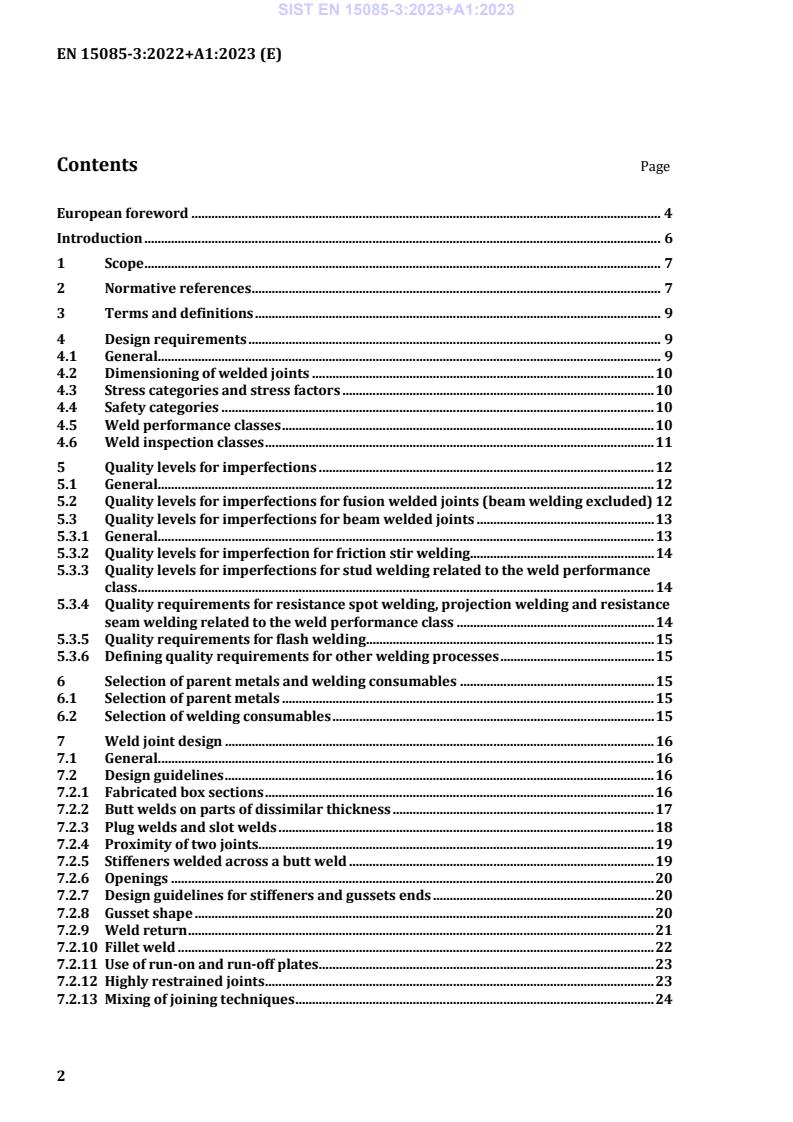
Contents Page
European foreword . 4
Introduction . 6
1 Scope . 7
2 Normative references . 7
3 Terms and definitions . 9
4 Design requirements . 9
4.1 General. 9
4.2 Dimensioning of welded joints . 10
4.3 Stress categories and stress factors . 10
4.4 Safety categories . 10
4.5 Weld performance classes . 10
4.6 Weld inspection classes . 11
5 Quality levels for imperfections . 12
5.1 General. 12
5.2 Quality levels for imperfections for fusion welded joints (beam welding excluded) 12
5.3 Quality levels for imperfections for beam welded joints . 13
5.3.1 General. 13
5.3.2 Quality levels for imperfection for friction stir welding. 14
5.3.3 Quality levels for imperfections for stud welding related to the weld performance
class . 14
5.3.4 Quality requirements for resistance spot welding, projection welding and resistance
seam welding related to the weld performance class . 14
5.3.5 Quality requirements for flash welding . 15
5.3.6 Defining quality requirements for other welding processes . 15
6 Selection of parent metals and welding consumables . 15
6.1 Selection of parent metals . 15
6.2 Selection of welding consumables . 15
7 Weld joint design . 16
7.1 General. 16
7.2 Design guidelines . 16
7.2.1 Fabricated box sections . 16
7.2.2 Butt welds on parts of dissimilar thickness . 17
7.2.3 Plug welds and slot welds . 18
7.2.4 Proximity of two joints . 19
7.2.5 Stiffeners welded across a butt weld . 19
7.2.6 Openings . 20
7.2.7 Design guidelines for stiffeners and gussets ends . 20
7.2.8 Gusset shape . 20
7.2.9 Weld return . 21
7.2.10 Fillet weld . 22
7.2.11 Use of run-on and run-off plates . 23
7.2.12 Highly restrained joints . 23
7.2.13 Mixing of joining techniques . 24
7.2.14 Prevention of corrosion problems . 25
7.2.15 Intermittent welds . 25
7.3 Joint preparation. 26
7.4 Methods to improve the fatigue strength (Post weld improvement) . 26
7.4.1 General . 26
7.4.2 Improvement of shape of weld toe . 27
7.4.3 Post Weld Heat Treatment (PWHT) — stress relief . 27
7.4.4 Introduction of compressive stress . 28
8 Design documentation related to welding . 28
8.1 Information on design drawings or documentation linked to the drawings . 28
8.2 Design review of welded components . 29
8.3 Use of existing drawings not according to EN 15085 . 30
Annex A (informative) List of welded joints (example) . 31
Annex B (informative) Joint preparation of welds . 32
Annex C (informative) Joint preparation for plug welds . 40
Annex D (informative) Types of joints in relation to stresses and inspection classes . 41
Annex E (informative) Flash welding . 42
Annex F (normative) Resistance spot, seam and projection welding . 45
F.1 General . 45
F.2 Minimum shear pull forces . 50
Annex G (informative) Determination of safety category for welded joints . 52
Annex ZA (informative) Relationship between this European Standard and the Essential
requirements of Directive (EU) 2016/797 aimed to be covered . 53
Bibliography. 55
European foreword
This document (EN 15085-3:2022+A1:2023) has been prepared by Technical Committee CEN/TC 256
“Railway applications”, the secretariat of which is held by DIN.
This European Standard shall be given the status of a national standard, either by publication of an
identical text or by endorsement, at the latest by October 2023, and conflicting national standards shall
be withdrawn at the latest by October 2023.
Attention is drawn to the possibility that some of the elements of this document may be the subject of
patent rights. CEN shall not be held responsible for identifying any or all such patent rights.
This document includes Amendment 1 approved by CEN on 1 February 2023.
This document supersedes !EN 15085-3:2022".
The start and finish of text introduced or altered by amendment is indicated in the text by tags !".
This series of European Standards EN 15085 “Railway applications — Welding of railway vehicles and
components” consists of the following parts:
— Part 1: General
— Part 2: Requirements of the organization of welding manufacturer
— Part 3: Design requirements
— Part 4: Production requirements
— Part 5: Inspection, testing and documentation
— Part 6: Maintenance
EN 15085-3:2022 includes the following changes with respect to EN 15085-3:2007.
— The weld performance class CP B has been divided into CP B1 and CP B2 (see Table 2);
— Terms and definitions have been updated;
— The following annexes have been reworked accordingly;
— Annex H has been deleted and part of its content has been integrated into the main text (see 6.2
and 7.1);
— Annex ZA has been added.
This document has been prepared under a Standardization Request given to CEN by the European
Commission and the European Free Trade Association, and supports essential requirements of EU
Directive(s) / Regulation(s).
For relationship with EU Directive(s) / Regulation(s), see informative Annex ZA, which is an integral part
of this document.
Any feedback and questions on this document should be directed to the users’ national standards body.
A complete listing of these bodies can be found on the CEN website.
According to the CEN-CENELEC Internal Regulations, the national standards organisations of the
following countries are bound to implement this European Standard: Austria, Belgium, Bulgaria, Croatia,
Cyprus, Czech Republic, Denmark, Estonia, Finland, France, Germany, Greece, Hungary, Iceland, Ireland,
Italy, Latvia, Lithuania, Luxembourg, Malta, Netherlands, Norway, Poland, Portugal, Republic of North
Macedonia, Romania, Serbia, Slovakia, Slovenia, Spain, Sweden, Switzerland, Türkiye and the United
Kingdom.
Introduction
Welding is a special process in the manufacture of railway vehicles and their parts. The required
provisions for this process are laid down in the standards series EN ISO 3834. The basis of these
provisions is the basic technical welding standards with respect to the special requirements for the
construction of railway vehicles.
This series of standards applies to welding of metallic materials in the manufacture and maintenance of
railway vehicles and their parts.
It describes the control for the welding process for railway vehicles and their components for new
manufacture and maintenance.
With respect to the railway environment, this series of standards defines the quality requirements for
the welding manufacturer to undertake new building and repair work.
Components, parts and subassemblies are assigned a classification level, based on their safety relevance.
According to these levels, qualifications for welding personnel of the manufacturer are specified.
This series provides an essential link between the weld performance class defined during design, the
quality of the weld, and the demonstration of the required quality by inspection.
This series of standards does not deal with product qualification.
NOTE This series of standard can also be used by internal and external parties, including certification bodies,
to assess the organization's ability to meet customer, regulatory and the organization's own requirements.
1 Scope
This document applies to welding of metallic materials in the manufacture and maintenance of railway
vehicles and their components.
This document specifies applicable design and classification rules.
This document does not specify parameters for the dimensioning.
NOTE Requirements for structures can be found in other standards (e.g. EN 12663).
2 Normative references
The following documents are referred to in the text in such a way that some or all of their content
constitutes requirements of this document. For dated references, only the edition cited applies. For
undated references, the latest edition of the referenced document (including any amendments) applies.
EN 1011-2:2001, Welding - Recommendations for welding of metallic materials - Part 2: Arc welding of
ferritic steels
EN 12663-1:2010+A1:2014, Railway applications - Structural requirements of railway vehicle bodies - Part
1: Locomotives and passenger rolling stock (and alternative method for freight wagons)
EN 12663-2:2010, Railway applications - Structural requirements of railway vehicle bodies - Part 2: Freight
wagons
EN 13749:2021, Railway applications - Wheelsets and bogies - Method of specifying the structural
requirements of bogie frames
EN 15085-1:—, Railway applications — Welding of railway vehicles and components — Part 1: General
EN 15085-2:2020, Railway applications - Welding of railway vehicles and components - Part 2:
Requirements for welding manufacturer
EN 15085-4:—, Railway applications — Welding of railway vehicles and components — Part 4:
Production requirements
EN 15085-5:—, Railway applications — Welding of railway vehicles and components — Part 5:
Inspection, testing and documentation
EN 15085-6:—, Railway applications — Welding of railway vehicles and components — Part 6:
Maintenance welding requirements
EN 15827:2011, Railway applications - Requirements for bogies and running gears
Under preparation. Stage at the time of publication: prEN 15085-1:2021
Under preparation. Stage at the time of publication: prEN 15085-4:2020
Under preparation. Stage at the time of publication: FprEN 15085-5:2021
Under preparation. Stage at the time of publication: FprEN 15085-6:2021
EN ISO 2553:2019, Welding and allied processes - Symbolic representation on drawings - Welded joints (ISO
2553:2019, Corrected version 2021-09)
EN ISO 3452-1:2021, Non-destructive testing - Penetrant testing - Part 1: General principles (ISO 3452-
1:2021)
EN ISO 4063:2010, Welding and allied processes - Nomenclature of processes and reference numbers (ISO
4063:2009, Corrected version 2010-03-01)
EN ISO 5817:2014, Welding - Fusion-welded joints in steel, nickel, titanium and their alloys (beam welding
excluded) - Quality levels for imperfections (ISO 5817:2014)
EN ISO 6520-1:2007, Welding and allied processes - Classification of geometric imperfections in metallic
materials - Part 1: Fusion welding (ISO 6520-1:2007)
EN ISO 6520-2:2013, Welding and allied processes - Classification of geometric imperfections in metallic
materials - Part 2: Welding with pressure (ISO 6520-2:2013)
EN ISO 10042:2018, Welding - Arc-welded joints in aluminium and its alloys - Quality levels for
imperfections (ISO 10042:2018)
EN ISO 10675-2:2021, Non-destructive testing of welds — Acceptance levels for radiographic testing —
Part 2: Aluminium and its alloys (ISO 10675-2:2021)
EN ISO 13919-1:2019, Electron and laser-beam welded joints - Requirements and recommendations on
quality levels for imperfections - Part 1: Steel, nickel, titanium and their alloys (ISO 13919-1:2019)
EN ISO 13919-2:2021, Electron and laser-beam welded joints - Requirements and recommendations on
quality levels for imperfections - Part 2: Aluminium, magnesium and their alloys and pure copper (ISO
13919-2:2021)
EN ISO 13920:1996, Welding - General tolerances for welded constructions - Dimensions for lengths and
angles - Shape and position (ISO 13920:1996)
EN ISO 14555:2017, Welding - Arc stud welding of metallic materials (ISO 14555:2017)
EN ISO 15614-1:2017, Specification and qualification of welding procedures for metallic materials —
Welding procedure test — Part 1: Arc and gas welding of steels and arc welding of nickel and nickel alloys
(ISO 15614-1:2017)
EN ISO 15614-12:2021, Specification and qualification of welding procedures for metallic materials -
Welding procedure test - Part 12: Spot, seam and projection welding (ISO 15614-12:2021)
EN ISO 17636-1:2022, Non-destructive testing of welds — Radiographic testing — Part 1: X- and gamma-
ray techniques with film (ISO 17636-1:2022)
EN ISO 17637:2016, Non-destructive testing of welds - Visual testing of fusion-welded joints (ISO
17637:2016)
Document impacted by A1:2019.
EN ISO 17653:2012, Resistance welding - Destructive tests on welds in metallic materials - Torsion test of
resistance spot welds (ISO 17653:2012)
EN ISO 17663:2009, Welding - Quality requirements for heat treatment in connection with welding and
allied processes (ISO 17663:2009)
EN ISO 23277:2015, Non-destructive testing of welds - Penetrant testing - Acceptance levels (ISO
23277:2015)
EN ISO 25239-5:2020, Friction stir welding - Aluminium - Part 5: Quality and inspection requirements (ISO
25239-5:2020)
EN ISO 10447:2015, Resistance welding - Testing of welds - Peel and chisel testing of resistance spot and
projection welds (ISO 10447:2015)
3 Terms and definitions
For the purposes of this document, the terms and definitions given in EN 15085-1:- apply.
ISO and IEC maintain terminology databases for use in standardization at the following addresses:
— ISO Online browsing platform: available at https://www.iso.org/obp
— IEC Electropedia: available at https://www.electropedia.org/
3.1
stress factor
ratio of the calculated / measured fatigue stress to the admissible fatigue stress of the joint type, adjusted
by the appropriate safety factor
3.2
admissible fatigue stress
maximum fatigue stress applicable to the welded joint according to the applicable standard /
specification
4 Design requirements
4.1 General
All welded joints produced under the scope of the EN 15085 series shall be designed according to the
requirements of this document unless more stringent product / project specific requirements are
defined.
A stress assessment shall be done for new designs. For existing designs not according to EN 15085, the
requirements of EN 15085-6:- shall apply.
Results of the stress assessment shall be used in combination with the safety category to define the weld
performance class (CP) according to Table 2. The weld performance class for each weld shall be identified
on the manufacturing drawing or associated technical documentation.
If the strength assessment procedure already considers the weld performance class (i.e. the quality levels
for imperfections and the weld inspection class), and the safety category according to the definition given
in this document, then Table 1 and 2 do not need to be applied.
NOTE EN 17149-3:- provides such a procedure.
Irrespective of the method of assessment, for welded joints with high safety category the weld
performance classes according to this document (CP A, CP B1, CP C1) shall be chosen.
CP D is only allowed for low safety category.
4.2 Dimensioning of welded joints
For dimensioning and preparation of different types of welded joints see Annexes B and C.
4.3 Stress categories and stress factors
The stress category is determined by the stress factor according to Table 1, (see 3.1).
The fatigue strength value can be obtained by calculation according to the appropriate standard /
guideline or fatigue tests on representative joint samples.
The statistical evaluation of the fatigue tests shall be done according to an appropriate standard. The
verification of strength should be carried out using only one coherent system for calculation.
European standards for structural requirements of railway vehicles, e.g. EN 12663-1:2010+A1:2014,
EN 12663-2:2010, EN 13749:2021, EN 15827:2011, shall be applied.
Table 1 — Stress categories
Stress category Stress factor (S)
High ≥ 0,9
Medium 0,75 ≤ S < 0,9
Low ≤ 0,75
4.4 Safety categories
The safety category defines the consequences of failure of a single welded joint with respect to its effect
on persons, facilities and the environment.
The safety categories are differentiated as follows:
Low: Failure of the welded joint does not lead to any direct impairment of the overall
function. Consequential events with personal injuries are unlikely.
Medium: Failure of the welded joint leads to an impairment of the overall function or can
lead to consequential events with personal injuries.
High: Failure of the welded joint leads to consequential events with personal injuries and
breakdown of the overall function.
For a more detailed explanation of the safety category, Annex G should also be considered.
4.5 Weld performance classes
Weld performance classes shall be defined in the design phase depending on the safety category and the
stress category. A welding coordinator should be consulted with respect to practicability and testing of
the welded joints.
Welded joints of railway vehicles are divided into seven weld performance classes (see Table 2).
Table 2 — Weld performance classes
Stress categories Safety categories
High Medium Low
a b
High CP C2
CP A CP B2
a
Medium CP C2 CP C3
CP B1
b
Low CP C3 CP D
CP C1
a Weld performance classes CP A and CP B1: CP A and CP B1 are only applicable for welds with full penetration
and full accessibility for inspection in production and maintenance.
b Weld performance classes CP B2 and CP C1: CP B2 and CP C1 are also applicable for welds where volumetric
NDT is not possible. Where this is the case, see EN 15085-5:- , Table 1, footnote b. This should be noted on the
related weld inspection documentation with a note “increase of surface test is required”.
For new manufacturing, the combination of high safety category and high stress category, which leads to
weld performance class CP A, shall be avoided. For application in maintenance see EN 15085-6:- .
The inspection of all welded joints shall be performed according to EN 15085-5:- , Table 1 as a minimum.
When the weld performance class assessment leads to CP B1, CP B2 or CP C1, and the weld is inaccessible
for inspection or repair during maintenance, one of the following actions shall be performed:
— Increase the weld inspection class to CT 1.
— change the design:
— to reduce the stress category;
— to allow access for inspection and repair in maintenance.
If it is not possible to fulfil the requirements of a weld performance class, the designer shall reduce the
stress category or change the design, see Annex D.
Different post weld treatment methods to increase the fatigue strength are possible. These methods can
lead to a downgrading of the stress category.
4.6 Weld inspection classes
The weld inspection class is determined based on the weld performance class.
The correlation between the weld performance class, weld inspection class and inspection requirements
is defined in Table 3. Details of weld inspection are further defined in EN 15085-5:- , Table 1.
Table 3 — Correlation between weld performance classes and weld inspection classes
Stress Safety Weld Quality levels for Weld Volumetric Surface Visual
category category performance imperfections inspection tests tests examination
class EN ISO 5817:2014 class
min. min. min.
EN ISO 10042:2018
Minimum
EN ISO 13919-1:2019
requirements
EN ISO 13919-2:2021
a
High High CP A B CT 1 100 % 100 % 100 %
a
High Medium CP B2 B CT 2 10 % 10 % 100 %
a
High Low CP C2 C CT 3 Not Not 100 %
required required
a
Medium High CP B1 B CT 2 10 % 10 % 100 %
a
Medium Medium CP C2 C CT 3 Not Not 100 %
required required
a
Medium Low CP C3 C CT 4 Not Not 100 %
required required
a
Low High CP C1 C CT 2 10 % 10 % 100 %
a
Low Medium CP C3 C CT 4 Not Not 100 %
required required
a
Low Low CP D D CT 4 Not Not 100 %
required required
a
For detail see Table 4 to 6
In case of higher weld inspection class than that defined in Table 3 it shall be shown on drawings or in
other documents, e.g. parts lists.
5 Quality levels for imperfections
5.1 General
The definition and classification of weld imperfections in accordance with EN ISO 6520-1:2007 and
EN ISO 6520-2:2013, are applicable.
5.2 Quality levels for imperfections for fusion welded joints (beam welding excluded)
The quality levels for imperfections related to the weld performance class are described below.
The quality levels for imperfection for fusion welding of steel and aluminium alloys are listed in Table 4
in accordance to EN ISO 5817:2014 and EN ISO 10042:2018.
EN ISO 5817:2014, Annex C, is not applicable in the production and maintenance of railway vehicles and
components.
Table 4 — Quality levels for imperfections for steel and aluminium alloys related to weld
performance classes
Imperfection No.
Weld performance classes
according to
CP A CP B1 / CP B2 CP C1 / CP C2 / CP D
EN ISO 6520-1:2007
CP C3
Level of Imperfections according to EN ISO 5817:2014 and
EN ISO 10042:2018
Group 100 B B C D
Group 200 B B C D
Group 300 B B C D
Group 400 B B C D
5011, 5012, 5013, Not permitted B C D
502, 504, 506, 509,
511, 510, 515, 516,
5071, 5072, 601 B B C D
a
503, 5213, 512 , 617 Not applicable B C D
505 and Multiple B These imperfections are not assessed
Imperfections
5214 [steel] Not applicable B C D
5214 [aluminium] Not applicable refer to geometrical dimension defined into design
documentation (e.g. avoid interference during assembly)
602, 610 [steel] B B C D
602 [aluminium] Acceptance depends on application, e.g. material, corrosion protection
610 [aluminium] Not applicable
a 512: Excessive asymmetry of fillet weld (unequal leg length) is not assessed if the fillet weld is an addition on a
HY-weld or HV-weld at T-joint (see Annex B, No. 10c and 11c). The throat thickness of these fillet welds depends on
the shorter leg length.
5.3 Quality levels for imperfections for beam welded joints
5.3.1 General
The quality levels for imperfections related to the weld performance class are described below.
Quality levels for imperfections shall be according to EN ISO 13919-1:2019 and EN ISO 13919-2:2021
and are given in Table 5 and Table 6.
Table 5 — Quality levels for imperfections for laser and electron beam welding for steel related
to the weld performance class
Imperfections Weld performance classes
according to
EN ISO 13919-1:2019 CP A CP B1 / CP B2 CP C1 / CP C2 / CP C3 CP D
1 to 4, 6, 7, 18 B B C D
5, 8, 10 to 16 Not permitted B C D
9, 17 Not applicable B C D
Table 6 — Quality levels for imperfections for laser and electron beam welding for aluminium
and its alloys related to the weld performance class
Imperfections Weld performance classes
according to
EN ISO 13919-2:2021 CP A CP B1 / CP B2 CP C1 / CP C2 / CP C3 CP D
1 to 5, 7, 8, 20 B B C D
6, 9, 11 to 18 Not permitted B C D
10, 19 Not applicable B C D
5.3.2 Quality levels for imperfection for friction stir welding
The visual inspection shall be carried out according to EN ISO 17637:2016.
The assessment criteria of all weld performance classes for destructive and non-destructive testing shall
be in accordance with EN ISO 25239-5:2020, Table A.1. Cracks, worm-holes and lack of fusion are not
permitted.
Penetrant Testing:
The assessment shall be in accordance with EN ISO 3452-1:2021 with the acceptance levels according to
EN ISO 23277:2015 group 2x.
Radiographic Testing:
Radiographic testing shall be carried out in accordance with EN ISO 17636-1:2022, class B. The
acceptance level 1 according to EN ISO 10675-2:2021 shall be fulfilled.
5.3.3 Quality levels for imperfections for stud welding related to the weld performance class
Stud welded joints are permitted for weld performance classes CP C3 and CP D only. The requirements
according to EN ISO 14555:2017 shall be fulfilled.
5.3.4 Quality requirements for resistance spot welding, projection welding and resistance seam
welding related to the weld performance class
The quality requirements for resistance spot welding, projection welding and resistance seam welding
are defined in Table F.2. For the surface quality, Table F.3 applies.
Resistance spot welding, projection welding and resistance seam welding is not permitted for weld
performance classes CP A, CP B1 and CP B2.
5.3.5 Quality requirements for flash welding
The quality requirements for flash welding of steels are defined in Annex E.
5.3.6 Defining quality requirements for other welding processes
The quality requirements for other welding processes shall be defined before starting the production.
6 Selection of parent metals and welding consumables
6.1 Selection of parent metals
Parent metals shall be selected according to the material grouping.
NOTE CEN ISO/TR 15608 (CEN ISO/TR 20172) provides a uniform system for grouping materials for welding
purposes.
For a parent metal without proven weldability it shall be demonstrated, by means of Welding Procedure
Qualification Record (according to the relevant standard), that the characteristics of the joints achieved
by using the parent metals comply with the requirements defined by the design office or engineering
department (see EN 15085-4:- ).
For components with welded joints of high or medium safety category, only parent metals with proven
fatigue strength shall be used.
The likely decrease of mechanical properties in the Heat Affected Zone (HAZ) shall be considered,
especially when welding aluminium alloys (material group 21 to 26 according to CEN ISO/TR 15608) and
high strength steels (e.g. with ReH > 690 MPa).
6.2 Selection of welding consumables
When specific properties of the welded joint are required (e.g. corrosion resistance), they shall be
indicated on the drawing or technical documentation.
When welding 6000 series aluminium alloys, for welds in the longitudinal direction of the car body, the
use of 5000 series alloy welding consumables is recommended as these have significantly better fracture
toughness than 4000 series consumables, particularly in partial penetration welds.
A welding coordinator shall be consulted with respect to the selection of the appropriate welding
consumables for the materials specified in the design. This shall be supported by Welding Procedure
Qualification Record (WPQR), for more details please see EN 15085-4:- .
Welding consumables shall be stored and handled in accordance with the manufacturer's
recommendations.
7 Weld joint design
7.1 General
Weld seams should be avoided in highly stressed areas.
For economy and ease of manufacture when designing welds, preference should be given to the use of
fillet welds. Where these do not satisfy structural requirements, partial penetration or partial penetration
with fillet weld reinforcement should be considered. Full penetration welds should only be specified
when no other weld types satisfy the structural or corrosion protection requirements.
Welded joints with sharp edges and steep changes of cross-section should be avoided. The stress path
should be distributed as evenly as possible.
Where possible, the neutral axes of the welded components should be aligned.
Where evidence of the design throat thickness is required, it shall be proven by a production weld test.
For steel components with stresses in the through thickness direction advice given in EN 1011-2:2001,
Annex F shall be followed.
Material with improved deformation properties perpendicular to the surface of the product should be
considered.
Welds made with permanent backing shall have the backing material included in the design calculation.
For full penetration butt welds in aluminium alloys made from one side it is recommended that backing
is used.
If hard stamping is to be used, the location shall be specified on the drawing.
In order to minimize distortion and shrinkage, welded joints should be positioned along or symmetrical
to the neutral axis of the component. Assemblies shall be designed to allow suitable access for welding
and inspection.
To avoid an excessive number of welded joints in close proximity, forged or cast components should be
considered.
The welding of non-structural / secondary attachments to the tension surface of components should be
used with caution. If necessary, the effect of the attachment shall be verified by an appropriate structural
assessment.
For longitudinal structural welds in heat treatable aluminium alloys, the geometry of extrusions should
ensure the weld and strength of the heat affected zone is matched to the parent material strength. Where
this is not possible, (e.g. Window pillars) the welded joint should be designed to be at least as strong as
the connected parent material.
Requirements for resistance spot welding are given in Annex F.
Only fasteners (e.g. bolts, screws, nuts) with proven weldability may be welded (e.g. to prevent turning).
7.2 Design guidelines
7.2.1 Fabricated box sections
In the case of fabricated box sections subjected to bending stresses, welds on both sides are
recommended for the joints subjected to tensile stresses (the flange in tension). Figure 1 shows an
example of a box section with the preferred welds.
Key
1 Fabricated box section
2 Compression flange
3 Tension flange
Figure 1 — Example of box section with high stress level in the tension flange
7.2.2 Butt welds on parts of dissimilar thickness
For butt welds in dissimilar thicknesses, the transition between the sections shall be gradual, with the
slope less than or equal to the values given in Figure 2, to reduce the notch effect. Exceptions may be used
only for weld performance class CP D.
The external shape of the weld shall provide a smooth transition.
Dimensions in millimeters
a) b)
1:1 for CP C3 and CP D
c) d)
Joint preparations are shown on the drawings. Slope < 1:1 is an angle of < 45°, slope < 1:4 is an angle
of < 15°. For CP B1, CP B2, CP C1 and CP C2 welding beads – use.
e)
Key
1 Slope
Figure 2 — Butt joint on parts of dissimilar thickness
7.2.3 Plug welds and slot welds
Plug and slot welds are only permitted for weld performance classes CP C2, CP C3 or CP D. Plug and slot
welds can only accommodate shear stress.
Plug welds with circular holes or slots shall allow access of the electrode or the welding torch at an angle
of 45° minimum (see Figure 3).
When filling the plug or slot welds completely, (e.g. welding wrongly drilled holes, etc.) the integrity of
the weld should be demonstrated with a production weld test as per EN 15085-4:- , 4.2.2.
Figure 3 — Weldability access for plug and slot welds
For fillet welds in holes or slots, see Annex C.
7.2.4 Proximity of two joints
Where possible, welds should be positioned to avoid overlapping of the heat affected zone (HAZ). When
the HAZ are overlapping, mechanical material properties shall be considered in that area (e.g. residual
stresses, drop in strength, hardness decrease). In order to reduce angular deformation and stress build-
up, the minimum distance between two joints is determined according to the thickness of the parts
jointed and the clamping arrangement of the assembly.
For aluminium alloys and high strength steels it is recommended that for material thicknesses < 20mm a
distance of at least 50 mm is left between welds, (see Figure 4).
Dimensions in millimetres
Key
A parent material
B HAZ
C weld metal
Figure 4 — Minimum distance between welds
7.2.5 Stiffeners welded across a butt weld
Openings on components when crossing a butt weld by a fillet weld should be avoided. The excess weld
material in this area should be ground to enable welding without interruption at crossing welds, see
Figure 5.
Figure 5 — Stiffeners welded across a butt weld
7.2.6 Openings
Openings (e.g. for drainage) should be avoided. If they are necessary, these openings shall be large enough
to be surrounded by a seal weld. Additionally, they should be made without inducing a stress build-up in
the heat affected zone of any existing weld, see Figure 6.
Key
r radius in mm; r ≥ 25 mm + t, but not less than t thickness of the stiffener in mm
30 mm
d ≥ 20 mm
Figure 6 — Typical opening
7.2.7 Design guidelines for stiffeners and gussets ends
Figures 7 and 8 show examples of stiffener and gusset design. To allow correct weld returns, gusset and
stiffener ends should be designed as per Figure 7.
Dimensions in millimeters
Key
a fillet weld throat thickness in mm t thickness of the gusset in mm
r radius in mm; r ≥ 25 mm + t, but not less than 30 mm
Figure 7 — Example gusset and stiffener end design
On highly stressed assemblies, gussets shall be continuously welded.
7.2.8 Gusset shape
Most failures affecting fatigue stressed parts (dynamic loaded parts) are due to shape-related problems
which poorly channel stresses and induce stress concentration, see Figure 8.
Figure 8 — Gusset shape
7.2.9 Weld return
The weld return is useful to reduce corrosion and fatigue problems at the end of the plate.
When a weld return is required, it shall be indicated on the drawing. If possible, the weld return should
be made as one continuous weld (e.g. without stop - start). The minimum length of the weld shall be as
indicated in Figure 9. If the weld return without interruption is necessary because of highly stressed
edges (e.g. high stress category per Table 1), it shall be indicated in the drawing or technical
documentation linked to the drawing. In this case, the weld return should be done without interruption
over a length l, equal to or greater than 2 t.
l≥ 2 t where
...
Questions, Comments and Discussion
Ask us and Technical Secretary will try to provide an answer. You can facilitate discussion about the standard in here.
Loading comments...