


ISO/FDIS 10993-7
(Main)Biological evaluation of medical devices — Part 7: Ethylene oxide sterilization residuals
Biological evaluation of medical devices — Part 7: Ethylene oxide sterilization residuals
ISO 10993-7:2008 specifies allowable limits for residual ethylene oxide (EO) and ethylene chlorohydrin (ECH) in individual EO-sterilized medical devices, procedures for the measurement of EO and ECH, and methods for determining compliance so that devices may be released. Additional background, including guidance and a flowchart showing how the standard is applied are also included in informative annexes. EO-sterilized devices that have no patient contact (e.g., in vitro diagnostic devices) are not covered by ISO 10993-7:2008.
Évaluation biologique des dispositifs médicaux — Partie 7: Résidus de stérilisation à l'oxyde d'éthylène
L'ISO 10993-7:2007 spécifie les limites admissibles des résidus d'oxyde d'éthylène (OE) et de chlorhydrate d'éthylène (ECH) pour des dispositifs médicaux individuels stérilisés à l'oxyde d'éthylène, les modes opératoires pour le mesurage de l'oxyde d'éthylène et du chlorhydrate d'éthylène et les méthodes de mesure en vue de déterminer leur conformité et de procéder à leur libération. Une documentation supplémentaire, y compris des directives et un diagramme de flux sont également inclus dans les annexes informatives.
General Information
Relations
Standards Content (Sample)
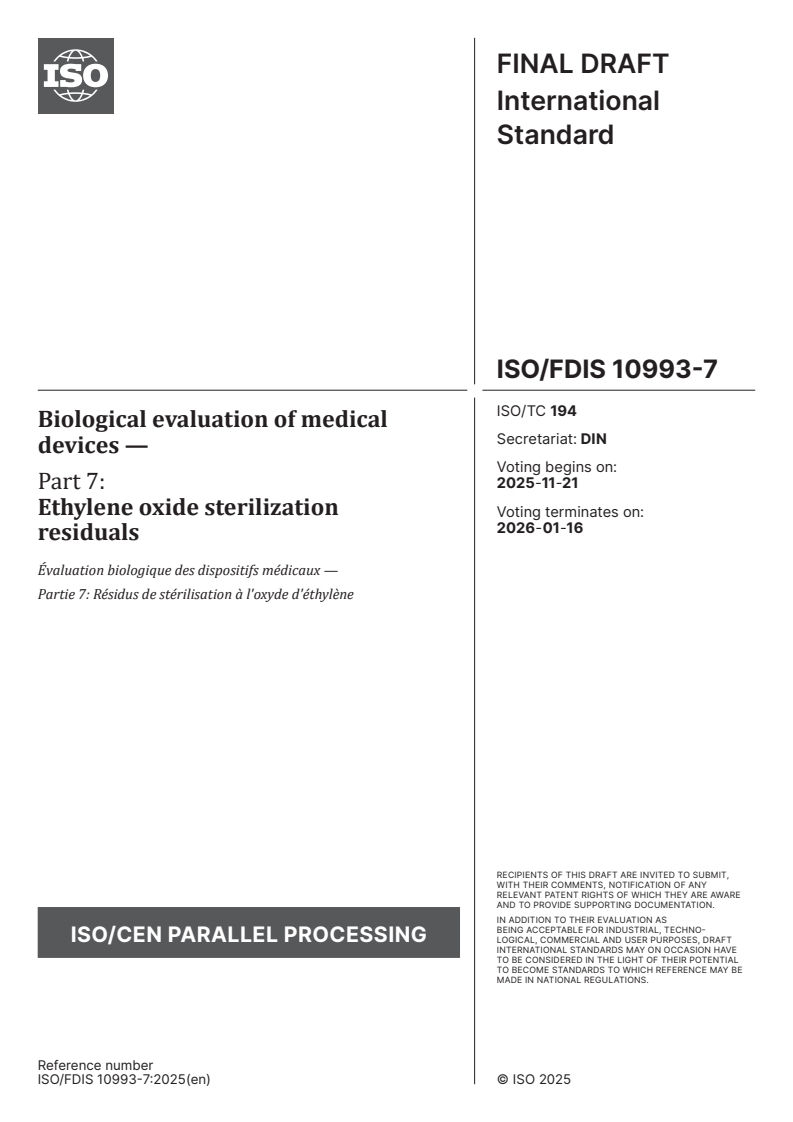
FINAL DRAFT
International
Standard
ISO/TC 194
Biological evaluation of medical
Secretariat: DIN
devices —
Voting begins on:
2025-11-21
Part 7:
Ethylene oxide sterilization
Voting terminates on:
2026-01-16
residuals
Évaluation biologique des dispositifs médicaux —
Partie 7: Résidus de stérilisation à l'oxyde d'éthylène
RECIPIENTS OF THIS DRAFT ARE INVITED TO SUBMIT,
WITH THEIR COMMENTS, NOTIFICATION OF ANY
RELEVANT PATENT RIGHTS OF WHICH THEY ARE AWARE
AND TO PROVIDE SUPPOR TING DOCUMENTATION.
IN ADDITION TO THEIR EVALUATION AS
BEING ACCEPTABLE FOR INDUSTRIAL, TECHNO-
ISO/CEN PARALLEL PROCESSING LOGICAL, COMMERCIAL AND USER PURPOSES, DRAFT
INTERNATIONAL STANDARDS MAY ON OCCASION HAVE
TO BE CONSIDERED IN THE LIGHT OF THEIR POTENTIAL
TO BECOME STAN DARDS TO WHICH REFERENCE MAY BE
MADE IN NATIONAL REGULATIONS.
Reference number
FINAL DRAFT
International
Standard
ISO/TC 194
Biological evaluation of medical
Secretariat: DIN
devices —
Voting begins on:
Part 7:
Ethylene oxide sterilization
Voting terminates on:
residuals
Évaluation biologique des dispositifs médicaux —
Partie 7: Résidus de stérilisation à l'oxyde d'éthylène
RECIPIENTS OF THIS DRAFT ARE INVITED TO SUBMIT,
WITH THEIR COMMENTS, NOTIFICATION OF ANY
RELEVANT PATENT RIGHTS OF WHICH THEY ARE AWARE
AND TO PROVIDE SUPPOR TING DOCUMENTATION.
© ISO 2025
IN ADDITION TO THEIR EVALUATION AS
All rights reserved. Unless otherwise specified, or required in the context of its implementation, no part of this publication may
BEING ACCEPTABLE FOR INDUSTRIAL, TECHNO-
ISO/CEN PARALLEL PROCESSING
LOGICAL, COMMERCIAL AND USER PURPOSES, DRAFT
be reproduced or utilized otherwise in any form or by any means, electronic or mechanical, including photocopying, or posting on
INTERNATIONAL STANDARDS MAY ON OCCASION HAVE
the internet or an intranet, without prior written permission. Permission can be requested from either ISO at the address below
TO BE CONSIDERED IN THE LIGHT OF THEIR POTENTIAL
or ISO’s member body in the country of the requester.
TO BECOME STAN DARDS TO WHICH REFERENCE MAY BE
MADE IN NATIONAL REGULATIONS.
ISO copyright office
CP 401 • Ch. de Blandonnet 8
CH-1214 Vernier, Geneva
Phone: +41 22 749 01 11
Email: copyright@iso.org
Website: www.iso.org
Published in Switzerland Reference number
ii
Contents Page
Foreword .iv
Introduction .v
1 Scope . 1
2 Normative references . 1
3 Terms and definitions . 1
4 Requirements . 5
4.1 General .5
4.2 Categorization of devices .6
4.3 Allowable limits .6
4.3.1 General .6
4.3.2 Limited exposure devices .8
4.3.3 Prolonged contact devices .9
4.3.4 Long-term exposure devices .9
4.3.5 Special situations .11
4.3.6 Tolerable contact level . 12
4.4 Determination of EO and ECH residuals . 12
4.4.1 Procedure . 12
4.4.2 Test method validation . 12
4.4.3 Product sampling . 12
4.4.4 Sample/fluid ratios . . 13
4.4.5 Product extraction . 13
4.4.6 Multi-device systems . 13
5 Product release .13
5.1 General . 13
5.2 Batch release of products . .14
5.3 Release of products at specified minimum aeration time .14
5.4 Procedure for product release using residual dissipation curves .14
6 Adoption of products into established aeration family .15
7 Change evaluation .15
Annex A (informative) Guidance for the application of this document for the determination of
EO and ECH residuals in medical devices .16
Annex B (informative) Factors influencing product residuals .26
Annex C (informative) Rationale for the provisions of this document .29
Annex D (informative) Establishment of allowable limits for EO .37
Annex E (informative) Establishment of allowable limits for ECH .55
Annex F (informative) Ethylene glycol .65
Annex G (normative) Evaluation of gas chromatograms .69
Annex H (informative) Gas chromatographic determination for EO and ECH .73
Annex I (informative) Preparation of EO and ECH standards .77
Annex J (informative) Ethylene oxide and ethylene chlorohydrin residual measuring methods .81
Annex K (informative) Examples of product release methods .89
Annex ZA (informative) Relationship between this European Standard the General Safety and
Performance Requirements of Regulation (EU) 2017/745 aimed to be covered .109
Bibliography .113
iii
Foreword
ISO (the International Organization for Standardization) is a worldwide federation of national standards
bodies (ISO member bodies). The work of preparing International Standards is normally carried out through
ISO technical committees. Each member body interested in a subject for which a technical committee
has been established has the right to be represented on that committee. International organizations,
governmental and non-governmental, in liaison with ISO, also take part in the work. ISO collaborates closely
with the International Electrotechnical Commission (IEC) on all matters of electrotechnical standardization.
The procedures used to develop this document and those intended for its further maintenance are described
in the ISO/IEC Directives, Part 1. In particular, the different approval criteria needed for the different types
of ISO document should be noted. This document was drafted in accordance with the editorial rules of the
ISO/IEC Directives, Part 2 (see www.iso.org/directives).
ISO draws attention to the possibility that the implementation of this document may involve the use of (a)
patent(s). ISO takes no position concerning the evidence, validity or applicability of any claimed patent
rights in respect thereof. As of the date of publication of this document, ISO had not received notice of (a)
patent(s) which may be required to implement this document. However, implementers are cautioned that
this may not represent the latest information, which may be obtained from the patent database available at
www.iso.org/patents. ISO shall not be held responsible for identifying any or all such patent rights.
Any trade name used in this document is information given for the convenience of users and does not
constitute an endorsement.
For an explanation of the voluntary nature of standards, the meaning of ISO specific terms and expressions
related to conformity assessment, as well as information about ISO's adherence to the World Trade
Organization (WTO) principles in the Technical Barriers to Trade (TBT), see www.iso.org/iso/foreword.html.
This document was prepared by Technical Committee ISO/TC 194, Biological and clinical evaluation of medical
devices, in collaboration with the European Committee for Standardization (CEN) Technical Committee CEN/
TC 206, Biological and clinical evaluation of medical devices, in accordance with the Agreement on technical
cooperation between ISO and CEN (Vienna Agreement).
This third edition cancels and replaces the second edition (ISO 10993-7:2008), which has been technically
revised. It also incorporates the Amendment ISO 10993-7:2008/Amd 1:2019 and the Technical Corrigendum
ISO 10993-7:2008/Cor 1:2009.
The main changes are as follows:
— allowable limits and extraction conditions have been derived based on the patient population and the
duration of use;
— the use of a risk assessment to establish allowable limits has been permitted;
— additional guidance on product release has been provided;
— additional guidance on determining residuals and the factors that affect residual has been provided.
A list of all parts in the ISO 10993 series can be found on the ISO website.
Any feedback or questions on this document should be directed to the user’s national standards body. A
complete listing of these bodies can be found at www.iso.org/members.html.
iv
Introduction
As noted in the introduction to ISO 11135:2014, when determining the suitability of ethylene oxide (EO)
for sterilization of medical devices, it is important to ensure that the levels of residual EO and ethylene
chlorohydrin (ECH) pose a minimal risk to the patient in intended product use. Therefore, it is important
that the use of alternative materials and sterilization processes are considered during product design
and development. EO is known to exhibit a number of biological effects. In the development of this
document, consideration was given to these effects, which include irritation, organ damage, mutagenicity,
carcinogenicity, and reproductive effects in humans and animals. Similar consideration was given to the
harmful effects of ECH and ethylene glycol (EG). ECH can be formed when EO comes into contact with free
chloride ions, whereas EG is a hydrolytic reaction product of EO and water. In practice, for most devices,
exposure to EO and ECH is considerably lower than the maximum allowable limits established according to
this document. No allowable limits are set for EG because risk assessment indicated that when EO residuals
are controlled, it is unlikely that biologically significant residuals of EG would be present.
Requirements herein are in addition to the biological evaluation requirements as indicated in ISO 10993-1.
The biological evaluation, combined with the EO-sterilization process residual limits, form the justification
that an EO-sterilized device is safe for its anticipated contact duration. Maximum allowable residuals for
ECH, when ECH has been found to be present in medical devices sterilized with EO, are also specified. Local
effects (e.g. irritation) have been considered and are incorporated in the TCL as given in 4.3.6.2 and Annex D
for EO, and in 4.3.6.3 and Annex E for ECH.
In this edition of this document (i.e. ISO 10993-7:2025), an uncertainty factor approach is used to derive EO
and ECH exposure duration-specific tolerable intake (TI) values (expressed in µg/kg/d). Furthermore, this
edition of this document (i.e. ISO 10993-7:2025) introduces the conversion of each EO and ECH TI value into
subpopulation-specific cumulative exposure-allowable limit values (expressed in milligrams per device),
which are used to determine the extent that EO and ECH, extracted under clinically relevant conditions and
time-periods, needs to be reduced post-sterilization.
This edition of this document (i.e. ISO 10993-7:2025) applies a different approach as compared to
ISO 10993-17:2023 to establishing allowable limits to make it useful for development, validation, and
routine control of ethylene oxide sterilization in the manufacture of finished medical devices with focus
on the risk assessments associated with three chemical constituents that are potentially left in medical
devices sterilized with ethylene oxide. This document extends this knowledge further by calculating the
largest amount of EO, ECH or EG that can be present in a medical device such that it would always meet
the requirements of ISO 10993-17 when that device has been exposed to the validated sterilization cycle
parameters. This maximum amount or allowable limit is expressed in milligrams per device deemed
acceptable when taken into the body through exposure to that medical device. These allowable limits will
help determine the appropriate sterilization parameters such as sterilant gas concentration and dwell, as
well as aeration temperature and hold time when validating the sterilization process to be used for a product
or group of products. Furthermore, the allowable limits can be used by regulatory bodies, manufacturers,
and processors to optimize processes and aid in the selection and qualification of alternative materials in
order to protect patient health.
v
FINAL DRAFT International Standard ISO/FDIS 10993-7:2025(en)
Biological evaluation of medical devices —
Part 7:
Ethylene oxide sterilization residuals
1 Scope
This document specifies allowable limits (AL) for residual ethylene oxide (EO) and ethylene chlorohydrin
(ECH) in EO-sterilized medical devices, procedures for the measurement of EO and ECH, and methods for
determining conformity so that devices can be released. Additional background, including guidance and a
flowchart showing how this document is applied, are also included in Annexes A, B, C, D, E, F, G, H, I, J and K.
EO-sterilized devices or components that have neither direct nor indirect body or user contact (e.g. in vitro
diagnostic devices) are out of scope of this document. This document does not apply to devices that have
been demonstrated to not absorb or retain EO or its degradation product ECH, such as medical devices made
[228]
exclusively of metal alloys and glass, see Clause C.5 .
NOTE This document does not specify limits for ethylene glycol (EG). No device limits are specified for EG because
the risk assessment in Annex F indicates that calculated allowable levels are higher than those likely to occur in a
medical device.
2 Normative references
The following documents are referred to in the text in such a way that some or all of their content constitutes
requirements of this document. For dated references, only the edition cited applies. For undated references,
the latest edition of the referenced document (including any amendments) applies.
ISO 10993-1:2018, Biological evaluation of medical devices — Part 1: Evaluation and testing within a risk
management process
ISO 10993-23:2021, Biological evaluation of medical devices — Part 23: Tests for irritation
3 Terms and definitions
For the purposes of this document, the terms and definitions given in ISO 10993-1 and the following apply.
ISO and IEC maintain terminology databases for use in standardization at the following addresses:
— ISO Online browsing platform: available at https:// www .iso .org/ obp
— IEC Electropedia: available at https:// www .electropedia .org/
3.1
aeration
part of the sterilization cycle (3.5) during which the sterilizing agent and/or its reaction products desorb
from the health care product until predetermined levels are reached
Note 1 to entry: Aeration can be performed within the sterilization chamber or in a separate chamber or room.
[SOURCE: ISO 11139:2018, 3.7, modified — Note 1 to entry has been added.]
3.2
allowable limit
AL
amount of residual (3.20) ethylene oxide or ethylene chlorohydrin on a single device that is permitted as a
condition of release for patient use
Note 1 to entry: Allowable limits are expressed in milligrams per device for each applicable exposure period. These
limits represent acceptable biological risks for medical devices under the circumstances of their anticipated contact
duration.
3.3
cumulative exposure
total quantity of ethylene oxide and ethylene chlorohydrin that contacts the body for a specified period of time
Note 1 to entry: Cumulative exposure can apply when consecutive uses of the same device or of new devices of the
same type for same patient or user applies (e.g. when one device is used repeatedly over a specified period of time).
3.4
concomitant exposure factor
CEF
numerical safety (3.21) factor that accounts for patient exposure to the simultaneous use of other ethylene
oxide sterilized medical devices different from the subject medical device
Note 1 to entry: CEF is calculated from the reciprocal of the number of devices (1/device) used during a procedure.
The default value (3.6) of 0,2 assumes five other devices are used during a procedure, see 4.4.5 and Clause D.6 for
further details.
3.5
cycle
set of sterilization process parameters
3.6
default value
value or factor used in the derivation of a tolerable contact level (3.22) or tolerable intake (3.24), in the
absence of specific data [e.g. an uncertainty factor (3.26)]
[SOURCE: ISO 10993-17:2023, 3.5, modified — the "worst-case exposure dose" has been removed from the
definition.]
3.7
dose-response
relationship of dosage to observable harm
Note 1 to entry: In general, there are two types of dose-response relationships. The first type is the change in response
of an individual to a range of doses. The second type is the distribution of the response among individuals to a range
of doses.
[SOURCE: ISO 10993-17:2023, 3.6]
3.8
exhaustive extraction
multi-step extraction conducted until the amount of material extracted in a subsequent extraction step is
less than 10 % of that determined in the initial extraction step
Note 1 to entry: Based upon the boiling point of ethylene oxide (EO) (10,7 °C) and the knowledge that substances,
other than EO and ethylene chlorohydrin, can be extracted from the device under evaluation, gravimetric analysis is
not appropriate for determining the exhaustivity level.
[SOURCE: ISO 10993-18:2020, 3.15, modified — "by gravimetric analysis (or achieved by other means)" has
been removed from the definition and Note 1 to entry has been added.]
3.9
harm to health
adverse reaction, such as altered morphology, physiology, growth, development, reproduction or lifespan that
a) impairs function of an organ or system, organism or (sub)population,
b) reduces capacity to tolerate an impaired function, or
c) increases susceptibility to other influences that impair function
Note 1 to entry: Examples of (sub)population include, but are not limited to: male, female, preterm neonates, adults.
[SOURCE: ISO 10993-17:2023, 3.8]
3.10
load
sterilization batch
sterilization load
product, equipment or materials to be processed together within an operating cycle (3.5)
[SOURCE: ISO 11139:2018, 3.155, modified — the admitted terms "sterilization batch" and "sterilization
load" have been added.]
3.11
implant
medical device which is intended to be totally introduced into the human body or to replace an epithelial
surface or the surface of the eye by means of clinical intervention and which is intended to remain in place
after the procedure
[SOURCE: ISO 10993-1:2018, 3.10]
3.12
irritation
localized non-specific inflammatory response to single, repeated or continuous application of a substance/
material
Note 1 to entry: Skin irritation is a reversible reaction and is mainly characterized by local erythema (redness) and
swelling (oedema) of the skin.
[SOURCE: ISO 10993-23:2021, 3.7]
3.13
lowest observed adverse effect level
LOAEL
lowest concentration or amount of an identified constituent found by experiment or observation which
causes detectable harm to health (3.9) to the target organism under defined conditions of exposure
[SOURCE: ISO 10993-17:2023, 3.13, modified — Note 1 to entry has been deleted.]
3.14
minimally irritating level
MIL
lowest amount per surface area of an identified constituent that is irritating to the tissue at the contact site
as determined by valid experimental or observational evidence
Note 1 to entry: The minimally irritating level is expressed in microgram per centimetre squared (μg/cm ).
[SOURCE: ISO 10993-17:2023, 3.15]
3.15
modifying factor
MF
mathematical product of uncertainty factors (3.26)
[SOURCE: ISO 10993-17:2023, 3.16]
3.16
non-irritating level
NIL
greatest amount per surface area of an identified constituent that does not elicit irritation (3.12) to the tissue
at the contact site as determined by valid experimental or observational evidence
Note 1 to entry: The non-irritating level is usually expressed as milligram or microgram per centimetre squared (mg/
2 2
cm or μg/cm ).
[SOURCE: ISO 10993-17:2023, 3.17, modified — Note 1 to add ‘usually’, ‘milligram or’ and ‘mg/cm ’. ]
3.17
no observed adverse effect level
NOAEL
greatest concentration or amount of an identified constituent found by experiment or observation which
causes no detectable harm to health (3.9) to the target organism under defined conditions of exposure
Note 1 to entry: No observed adverse effect level is expressed in microgram per kilogram of body mass per day (μg/kg/d).
[SOURCE: ISO 10993-17:2023, 3.18]
3.18
physiologically based pharmacokinetic modelling
PBPK modelling
system of modelling biological effects taking into account metabolic and pharmacokinetic differences among
species of animals
Note 1 to entry: Such data should be utilized whenever available and applicable to medical device anticipated contact
duration.
3.19
residual
quantity of ethylene oxide, ethylene chlorohydrin or ethylene glycol that remains in or on the product after
ethylene oxide sterilization
3.20
safety
freedom from unacceptable risk
[SOURCE: ISO 14971:2019, 3.26]
3.21
simulated-use extraction
extraction using a method that simulates clinical use
Note 1 to entry: A simulated-use extraction is performed to estimate the type and amount of substances that are
expected to be released from a medical device during its clinical use. A simulated-use extraction is designed to
produce an extractables profile that represents the worst-case leachables profile, meaning that all leachables are also
extractables and the levels of all individual extractables are at least equal to the level of all individual leachables.
[SOURCE: ISO 10993-18:2020, 3.35]
3.22
tolerable contact level
TCL
estimate of the surface-contact exposure to an identified constituent that is without appreciable irritation (3.12)
Note 1 to entry: Tolerable contact level is expressed in microgram per centimetre squared (μg/cm ) of tissue at the
contact site.
[SOURCE: ISO 10993-17:2023, 3.25]
3.23
tolerable exposure
TE
product of the tolerable intake (3.24), the body mass and the concomitant exposure factor (3.4)
Note 1 to entry: Tolerable exposure is normally expressed in milligrams per day to the patient.
3.24
tolerable intake
TI
estimate of the daily exposure of an identified constituent over a specified time period (e.g. acute, subacute,
sub-chronic or chronic), on the basis of body mass, that is considered to be without appreciable harm to
health (3.9)
Note 1 to entry: Tolerable intake is normally expressed in microgram per kilogram of body mass per day (μg/kg/d). It
is derived to establish an allowable limit (3.2) for a medical device constituent.
[SOURCE: ISO 10993-17:2023, 3.26, modified — ‘normally’ has been added and ‘toxicological exposure limit’
has been replaced with ‘an allowable limit (3.2)’ in Note 1 to entry.]
3.25
toxicological risk assessment
determination of whether an exposure dose to a constituent can or cannot elicit appreciable harm to health (3.10)
[SOURCE: ISO 10993-17:2023, 3.29]
3.26
uncertainty factor
UF
numerical value that accounts for uncertainties when extrapolating a point of departure to individuals who
can be exposed to a constituent of toxicological concern
EXAMPLE Extrapolation types include, but are not limited to: intraspecies, interspecies, dose route and study
duration.
[SOURCE: ISO 10993-17:2023, 3.31]
4 Requirements
4.1 General
This clause specifies maximum ALs for residuals of ethylene oxide (EO) and ethylene chlorohydrin (ECH) for
each individual medical device sterilized with EO. Local (acute) effects (e.g. irritation) have been considered
and are incorporated in the TCL.
The requirements in this document shall be applied in addition to the requirements set out in ISO 10993-1.
All applicable requirements of ISO 10993-1 shall take into account the EO residual level at the time of release
for each individually designed medical device. The results of the biological assessment of the device may
lead to other limits than those specified in 4.3, which are designed to protect against local irritation and
systemic effects.
Medical devices already on the market and tested to the previous edition of this document (i.e.
ISO 10993-7:2008) do not have to undergo the testing of this edition of this document (i.e. ISO 10993-7:2025).
A review and confirmation that none of the issues identified in ISO 10993-1:2018, 4.9 have occurred shall
be carried out. If there are any changes, then a new biological risk assessment shall be carried out to
demonstrate conformity to allowable limits. This may include re-testing to this edition of this document (i.e.
ISO 10993-7:2025). The previous editions of this document reported a limit of 4 mg for EO and 9 mg for ECH
for adults with limited exposure [with the concomitant exposure factor (CEF) equal to 0,2] for 70 kg adult
population and a uncertainty factor 1 (UF1) of 10 for intra-species variability. From a toxicological point of
view, these values are not significantly different from the values calculated in this edition of this document
(i.e. ISO 10993-7:2025) and thus, these changes in ALs do not warrant re-evaluating a product that met the
limits of the previous edition of this document (i.e. ISO 10993-7:2008).
A flowchart providing guidance for the application of this document to the determination of EO residuals in
medical devices is given in Annex A.
NOTE 1 Information on the derivation of the limits in this document as well as other background information and
guidance relevant to the use of this document is contained in Annexes C, D and E.
NOTE 2 Throughout this document, numbers calculated from formulae were rounded following the rules provided
[250]
in NIST Special Publication 811, Guide for the Use of the International System of Units (SI). Thereby, the number
of (typically two) significant digits from the source literature were retained, and only increased (to typically three
significant digits), where the calculated result was evaluated to provide the adequate amount of relevant information
[250]
only with an increased number of digits. This evaluation is in line with NIST Special Publication 811, section B.7.2.
4.2 Categorization of devices
In establishing the maximum daily doses of EO and ECH that a medical device is allowed to deliver to patients,
the medical device shall be categorized in accordance with the duration of body contact in accordance with
ISO 10993-1:2018:
a) limited exposure;
b) prolonged exposure;
c) long-term exposure.
If a device can be placed in more than one duration category, the more rigorous testing or evaluation
considerations shall apply. If a device is intended for repeated or multiple usages, the decision into which
exposure category a device is placed shall take into account the potential cumulative effect, bearing in mind
the period of time over which the cumulative exposure occurs. For example, a dialyzer cartridge is used for
less than 24 h per treatment, but repeated usages of the same or a replacement cartridge for more than 30 d
would categorize the cartridge as long-term contact.
For medical devices that have very brief contact with the body, typically for less than one minute (e.g. lancets,
hypodermic needles, capillary tubes), it can be possible to prepare a written justification that there is no
potential for biological harm. For products with repeated use, the total exposure period shall be considered.
However, for medical devices that can leave materials in contact with tissues after the medical device is
removed (e.g. coatings, lubricants), a more detailed biological evaluation is required (see ISO 10993-1 for
further guidance).
4.3 Allowable limits
4.3.1 General
For each medical device, the maximum exposure of EO and ECH to patients shall not exceed the AL using
Formulae (1) and (2) based on the defaults in Table 1 for any of the applicable exposure categories (see 4.2).
Alternative limits may be calculated based on risk assessment that accounts for device usage and patient
population. The procedure that was used to establish the tolerable intake (TI) is described in Annex D for EO
and in Annex E for ECH.
Prolonged contact devices carry additional limits for the first 24 h exposure period and, in the case of the
long-term exposure devices, for the first 24 h period and the first 30 d period. These constraints set limits
on the amount of EO and ECH that can be delivered to the patient during these early time periods.
The CEF uses a default value of 0,2 based on five devices used simultaneously. If data are available on
the number of devices used at one time, for example, in multi-device systems, convenience kits, long-
term exposure devices, then the default CEF of 0,2 may be modified (see 4.4.5, A.3.3 and D.6.1 for further
justification).
The tolerable exposure (TE) shall be calculated based on the TI multiplied by body mass (m ) and CEF.
b
TE=×TI mC× EF (1)
b
where
TE is the tolerable exposure;
TI is the tolerable intake;
m is the body mass;
b
CEF is the concomitant exposure factor.
The AL shall be determined based on tolerable exposure multiplied by the days in the category unless
an alternative limit can be justified. The lowest patient population mass, based on the anticipated
exposure duration for the device, shall be used, see Clause C.4. The application of higher body masses
associated for these sub population age groups, or lower body masses associated with younger sub
population age groups, shall be justified and documented. See example in K.8.1.
D
AL=×TE (2)
N
where
AL is the allowable limit;
D is the number of days of the medical device contact duration;
N is the number of devices used during this duration.
When the number of medical devices does not apply (e.g. the largest surface area of device which can be in
contact with the body is not the same as the surface area of the device which is tested, or powder or liquid
device), the “number of devices used during this duration” in Formula (2) shall be replaced by “the quantity
of devices used during this duration”. The quantity should be expressed in cm , g or ml as appropriate
considering the form of the device and the AL shall be expressed in mg/cm , mg/g or mg/ml respectively.
The definition of AL shall be modified accordingly.
NOTE The number of devices (N) considered in Formula (2) is not related to the CEF, but number subject devices
during the exposure duration used for a treatment or therapy, which can be 1 or more.
The intended population shall be documented.
Table 1 — TE and AL default values for Formulae (1) and (2)
TI for EO TI for ECH CEF Anticipated contact duration
Contact category
mg/kg/d mg/kg/d default d
Limited 0,3 0,64 ≤ 1
Prolonged 0,3 0,27 ≤ 30
≤ 25 000 d for adults (>16 y)
0,2
OR
Long-term 0,02 0,029 ≤ 5 840 d for paediatric (0 to 16 y)
AND
≤ 19 160 d for adult (> 16 y)
For medical devices used in a pediatric sub population age group, the factors to consider in the selection of fewer days (i.e. <
5 840 d) are described in Clause C.4 and D.6.8.
4.3.2 Limited exposure devices
The AL for limited exposure devices are based on the TI value of 0,3 mg/kg/d for EO, 0,64 mg/kg/d for
ECH, with CEF = 0,2 (default) as established in Clause D.4 and Clause E.5 respectively. The total EO and
ECH cumulative exposure estimate obtained by simulated-use or exhaustive extraction shall be compared
to the limited exposure AL, unless otherwise justified. Alternatively, an assessment targeted to evaluate
toxicological risk associated with exposure to EO or ECH from the actual anticipated exposure duration
of a specific device as well as more clinically relevant details for the device and indication can be used to
determine appropriate allowable limits using Formulae (3) to (5).
D
AL=×TI mC××EF (3)
b
N
EXAMPLE
D
AL =×03,,m ××02 (4)
EO b
N
where
0,3 is the limited contact tolerable intake value in mg/kg/d;
m is the body mass of anticipated patient population in kg;
b
0,2 is the default concomitant exposure factor;
D is the anticipated contact duration up to 1 d;
N is the number of devices used during this duration.
D
AL =×06,,40m ××2 (5)
ECHb
N
where
0,64 is the limited contact tolerable intake value in mg/kg/d;
m is the body mass of anticipated patient population in kg;
b
0,2 is the default concomitant exposure factor;
D is the anticipated contact duration up to 1 d;
N is the number of devices used during this duration.
Examples of AL calculations can be found in Annex K.
4.3.3 Prolonged contact devices
The AL for prolonged contact devices are based on TI value of 0,3 mg/kg/d for EO, 0,27 mg/kg/d for ECH,
body mass m , and with CEF equal to 0,2 (default) as established in Clause D.4 and Clause E.5. The cumulative
b
exposure estimate obtained by simulated use extraction or exhaustive extraction shall be compared to the
applicable prolonged duration limit for up to 30 d, unless otherwise justified. Alternatively, an assessment
targeted to evaluate toxicological risk associated with exposure to EO or ECH from the actual anticipated
exposure duration of a specific device as well as more clinically relevant details for the device and indication
can be used to determine appropriate allowable limits using Formulae (6) and (7).
D
AL =×03,,m ××02 (6)
EO b
N
where
0,3 is the limited contact tolerable intake value in mg/kg/d;
m is the body mass of anticipated patient population in kg;
b
0,2 is the default concomitant exposure factor;
D is the anticipated contact duration up to 30 d;
N is the number of devices used during this duration.
D
AL =×02,,70m ××2 (7)
ECHb
N
where
0,27 is the prolonged contact tolerable intake value in mg/kg/d;
m is the body mass of anticipated patient population in kg;
b
0,2 is the default concomitant exposure factor;
D is the anticipated contact duration up to 30 d;
N is the number of devices used during this duration.
Prolonged-contact devices shall meet limited exposure AL in 4.3.2 during the first 24 h period. Examples of
these calculations can be found in Annex K.
4.3.4 Long-term exposure devices
4.3.4.1 Ethylene oxide
For EO, the tolerable exposure for long-term use devices is based on TI value of 0,02 mg/kg/d. The
AL is determined by multiplying the TE with the number of days of anticipated contact from a single or
repeated use of a device for general populations (adults). Alternatively, an assessment targeted to evaluate
toxicological risk associated with exposure to EO or ECH from the actual anticipated exposure duration
of a specific device as well as more clinically relevant details for the device and indication can be used to
determine appropriate allowable limits using Formulae (8) and (9).
TE =×TI mC×=EF 00,,26××00 20= ,24mg/d (8)
AdultEOb
D
AL =×02, 4 (9)
AdultEO
N
where
0,02 is the long-term contact tolerable intake value in mg/kg/d;
m is the body mass of anticipated patient population in kg;
b
0,2 is the default concomitant exposure factor;
D is the anticipated contact duration up to 19 160 d;
N is the number of devices used during this duration.
For devices to be used for paediatric patients during a specific time frame (age), the TE value can be
calculated based upon the values given in Table D.9. For a device intended to be used throughout paediatric
time frame (age 0 to 16 y) and through adulthood, the TE value is 0,11 mg/d, see D.6.7. The cumulative
exposure estimate shall be compared to the applicable AL, unless otherwise justified.
TE =×TI mC× EF (10)
PaediatricEO b
D
AL =×TE (11)
Paediatric EO
N
Long-term exposure devices shall also meet limited and prolonged AL in 4.3.2 and 4.3.3 during the first 24 h
period and the first 30 d, respectively. Examples of AL calculations can be found in Annex K.
4.3.4.2 Ethylene chlorohydrin
For ECH, the tolerable exposure for long-term use devices is based on TI value of 0,029 mg/kg/d. The AL is
determined by multiplying the TE with the number of days of anticipated contact from a single or repeated
use of a device for general populations (adults) based on the anticipated contact duration. Alternatively, an
assessment targeted to evaluate toxicological risk associated with exposure to EO or ECH from the actual
anticipated exposure duration of a specific device as well as more clinically relevant details for the device
and indication can be used to determine appropriate allowable limits using Formulae (12) and (13).
TE = 0,029 × 60 × 0,2 = 0,35 mg/d (12)
Adult ECH
where
0,029 is the long-term contact tolerable intake value in mg/kg/d;
m is the body mass of anticipated patient population in kg;
b
0,2 is the default concomitant exposure factor;
D is the anticipated contact duration up to 19 160 d;
N is the number of devices used during this duration.
D
AL =×TE (13)
AdultE CH
N
For devices to be used for paediatric patients during a specific time frame, the TE value can be calculated
based upon the values given in Table E.5. For a device intended to be used for throughout the paediatric time
frame (age 0 to 16 y) and through adulthood the TE value is 0,16 mg/d, see E.5.2.3. The cumulative exposure
estimate shall be compared to the applicable AL, unless otherwise justified.
TE = TI × m × CEF (14)
Paediatric ECH b
D
AL =×TE (15)
Paediatric ECH
N
Long-term exposure devices shall also meet limited and prolonged AL in 4.3.2 and 4.3.3 during the first 24 h
period and the first 30 d, respectively.
4.3.5 Special situations
4.3.5.1 General
For certain medical devices, the default AL for EO and ECH are not
...
Style Definition
...
Formatted
...
ISO/TC 194/ WG 11
Formatted: zzCover large
Secretariat: DIN
Formatted
...
Formatted: English (United Kingdom)
Date: 2025-11-06
Biological evaluation of medical devices — —
Formatted: Regular, Font: 16 pt, Bold, French (France)
Part 7:
Formatted: Cover Title_A2
Ethylene oxide sterilization residuals
Formatted
...
Third edition
Date: 2024-11-17
ISO #####-#:####(X)
Évaluation biologique des dispositifs médicaux —
Partie 7: Résidus de stérilisation à l'oxyde d'éthylène
FDIS stage
2 © ISO #### – All rights reserved
Formatted: Left: 1.5 cm, Right: 1.5 cm, Bottom: 1 cm,
Header distance from edge: 1.27 cm, Footer distance
from edge: 0.5 cm
All rights reserved. Unless otherwise specified, or required in the context of its implementation, no part of this publication
may be reproduced or utilized otherwise in any form or by any means, electronic or mechanical, including photocopying,
Formatted: Indent: Left: 0 cm, Right: 0 cm, Space
or posting on the internet or an intranet, without prior written permission. Permission can be requested from either ISO
Before: 0 pt, No page break before, Adjust space
at the address below or ISO’s member body in the country of the requester.
between Latin and Asian text, Adjust space between
Asian text and numbers
ISO copyright office
Formatted: Default Paragraph Font
CP 401 • Ch. de Blandonnet 8
CH-1214 Vernier, Geneva
Phone: + 41 22 749 01 11
Formatted: French (France)
EmailE-mail: copyright@iso.org
Formatted: French (France)
Website: www.iso.org
Formatted: French (France)
Published in Switzerland
Formatted: English (United Kingdom)
Formatted: English (United Kingdom)
ii
Contents
Foreword . iv
Introduction . v
1 Scope . 1
2 Normative references . 1
3 Terms and definitions . 1
4 Requirements. 6
4.1 General . 6
4.2 Categorization of devices . 7
4.3 Allowable limits . 7
4.4 Determination of EO and ECH residuals . 13
5 Product release. 14
5.1 General . 14
5.2 Batch release of products . 15
5.3 Release of products at specified minimum aeration time . 15
5.4 Procedure for product release using residual dissipation curves . 15
6 Adoption of products into established aeration family . 16
7 Change evaluation . 16
Annex A (informative) Guidance for the application of this document for the determination of
EO and ECH residuals in medical devices . 17
Annex B (informative) Factors influencing product residuals . 30
Annex C (informative) Rationale for the provisions of this document . 33
Annex D (informative) Establishment of allowable limits for EO . 41
Annex E (informative) Establishment of allowable limits for ECH . 61
Annex F (informative) Ethylene glycol . 72
Annex G (normative) Evaluation of gas chromatograms . 77
Annex H (informative) Gas chromatographic determination for EO and ECH . 83
Annex I (informative) Preparation of EO and ECH standards . 87
Annex J (informative) Ethylene oxide and ethylene chlorohydrin residual measuring methods 92
Annex K (informative) Examples of product release methods . 102
Annex ZA (informative) Relationship between this European Standard the General Safety and
Performance Requirements of Regulation (EU) 2017/745 aimed to be covered . 126
Bibliography . 130
iii
Foreword
ISO (the International Organization for Standardization) is a worldwide federation of national standards
bodies (ISO member bodies). The work of preparing International Standards is normally carried out through
ISO technical committees. Each member body interested in a subject for which a technical committee has been
established has the right to be represented on that committee. International organizations, governmental and
non-governmental, in liaison with ISO, also take part in the work. ISO collaborates closely with the
International Electrotechnical Commission (IEC) on all matters of electrotechnical standardization.
The procedures used to develop this document and those intended for its further maintenance are described
in the ISO/IEC Directives, Part 1. In particular, the different approval criteria needed for the different types of
ISO document should be noted. This document was drafted in accordance with the editorial rules of the
ISO/IEC Directives, Part 2 (see www.iso.org/directives).
ISO draws attention to the possibility that the implementation of this document may involve the use of (a)
patent(s). ISO takes no position concerning the evidence, validity or applicability of any claimed patent rights
in respect thereof. As of the date of publication of this document, ISO had not received notice of (a) patent(s)
which may be required to implement this document. However, implementers are cautioned that this may not
represent the latest information, which may be obtained from the patent database available at
www.iso.org/patents. ISO shall not be held responsible for identifying any or all such patent rights.
Any trade name used in this document is information given for the convenience of users and does not
constitute an endorsement.
For an explanation of the voluntary nature of standards, the meaning of ISO specific terms and expressions
related to conformity assessment, as well as information about ISO's adherence to the World Trade
Organization (WTO) principles in the Technical Barriers to Trade (TBT), see www.iso.org/iso/foreword.html.
This document was prepared by Technical Committee ISO/TC 194, Biological and clinical evaluation of medical
devices, in collaboration with the European Committee for Standardization (CEN) Technical Committee
CEN/TC 206, Biological and clinical evaluation of medical devices, in accordance with the Agreement on
technical cooperation between ISO and CEN (Vienna Agreement).
This third edition cancels and replaces the second edition (ISO 10993-7:2008, ISO 10993-7:2008/Cor 1:2009
and ISO 10993-7:2008/Amd 1:2019), which has been technically revised. It also incorporates the Amendment
ISO 10993-7:2008/Amd 1:2019 and the Technical Corrigendum ISO 10993-7:2008/Cor 1:2009.
The main changes are as follows:
— — manufacturer to specify allowable limits and extraction conditions, have been derived based on the
patient population and the duration of use;
— — allow for the use of a risk assessment to establish allowable limits has been permitted;
— — provide additional guidance on product release has been provided;
— — provide additional guidance on determining residuals and the factors that affect residual has been
provided.
A list of all parts in the ISO 10993 series can be found on the ISO website.
Any feedback or questions on this document should be directed to the user’s national standards body. A
complete listing of these bodies can be found at www.iso.org/members.html.
iv
Introduction
As noted in the introduction to ISO 11135:2014, when determining the suitability of ethylene oxide (EO) for
sterilization of medical devices, it is important to ensure that the levels of residual EO and ethylene
chlorohydrin (ECH) pose a minimal risk to the patient in intended product use. Therefore, it is important that
the use of alternative materials and sterilization processes are considered during product design and
development. EO is known to exhibit a number of biological effects. In the development of this document,
consideration was given to these effects, which include irritation, organ damage, mutagenicity,
carcinogenicity, and reproductive effects in humans and animals. Similar consideration was given to the
harmful effects of ECH and ethylene glycol (EG). ECH can be formed when EO comes into contact with free
chloride ions, whereas EG is a hydrolytic reaction product of EO and water. In practice, for most devices,
exposure to EO and ECH is considerably lower than the maximum allowable limits established according to
this document. No allowable limits are set for EG because risk assessment indicated that when EO residuals
are controlled, it is unlikely that biologically significant residuals of EG would be present.
Requirements herein are in addition to the biological evaluation requirements as indicated in ISO 10993-1.
The biological evaluation, combined with the EO-sterilization process residual limits, form the justification
that an EO-sterilized device is safe for its anticipated contact duration. Maximum allowable residuals for ECH,
when ECH has been found to be present in medical devices sterilized with EO, are also specified. Local effects
(e.g. irritation) have been considered and are incorporated in the TCL as given in 4.3.6.24.3.6.2 and
Annex DAnnex D for EO, and in 4.3.6.34.3.6.3 and Annex EAnnex E for ECH.
In this edition of this document (i.e. ISO 10993-7:2025), an uncertainty factor approach is used to derive EO
and ECH exposure duration-specific tolerable intake (TI) values (expressed in µg/kg/d). Unique
inFurthermore, this versionedition of this document (i.e. ISO 10993-7 is:2025) introduces the conversion of
each EO and ECH TI value into subpopulation-specific cumulative exposure-allowable limit values (expressed
in mg/milligrams per device), which are used to determine the extent that EO and ECH, extracted under
clinically relevant conditions and time-periods, needs to be reduced post-sterilization.
This edition of this document (i.e. ISO 10993-7:2025) applies a different approach as compared to ISO 10993-
17:2023 to establishing allowable limits to make it useful for development, validation, and routine control of
ethylene oxide sterilization in the manufacture of finished medical devices with focus on the risk assessments
associated with 3three chemical constituents that are potentially left in medical devices sterilized with
ethylene oxide. ISO 10993-7This document extends this knowledge further by calculating the largest amount
of EO, ECH or EG that can be present in a medical device such that it would always meet the requirements of
ISO 10993-17 when that device has been exposed to the validated sterilization cycle parameters. This
maximum amount or allowable limit is expressed in mg/milligrams per device deemed acceptable when taken
into the body through exposure to that medical device. These allowable limits will help determine the
appropriate sterilization parameters such as sterilant gas concentration and dwell, as well as aeration
temperature and hold time when validating the sterilization process to be used for a product or group of
products. FurtherFurthermore, the allowable limits can be used by regulatory bodies, manufacturers, and
processors to optimize processes and aid in the selection and qualification of alternative materials in order to
protect patient health.
v
Biological evaluation of medical devices — —
Formatted: Main Title 2, Space After: 0 pt, Adjust
Part 7:
space between Latin and Asian text, Adjust space
Ethylene oxide sterilization residuals
between Asian text and numbers
Formatted: Adjust space between Latin and Asian text,
1 Scope
Adjust space between Asian text and numbers
This document specifies allowable limits (AL) for residual ethylene oxide (EO) and ethylene chlorohydrin
Formatted: Adjust space between Latin and Asian text,
Adjust space between Asian text and numbers, Tab
(ECH) in EO-sterilized medical devices, procedures for the measurement of EO and ECH, and methods for
stops: Not at 0.7 cm + 1.4 cm + 1.59 cm + 2.1 cm +
determining complianceconformity so that devices can be released. Additional background, including
2.8 cm + 3.5 cm + 4.2 cm + 4.9 cm + 5.6 cm + 6.3
guidance and a flowchart showing how this document is applied, are also included in Annex A, 0, Annex C,
cm + 7 cm
Annex D, Annex E, Annex F, Annex G, Annex H, Annex I, Annex J and Annex Kthe informative annexes.
Formatted: Adjust space between Latin and Asian text,
EO-sterilized devices or components that have neither direct nor indirect body or user contact (e.g. in vitro
Adjust space between Asian text and numbers
diagnostic devices) are out of scope of this document. This document does not apply to devices that have been
Formatted: Default Paragraph Font
demonstrated to not absorb or retain EO or its degradation product ECH, such as medical devices made
[ [228] ] Formatted: Adjust space between Latin and Asian text,
exclusively of metal alloys and glass, see C.5 Error! Reference source not found.Clause C.5 . .
Adjust space between Asian text and numbers, Tab
stops: Not at 0.7 cm + 1.4 cm + 2.1 cm + 2.8 cm +
NOTE This document does not specify limits for ethylene glycol (EG). No device limits are specified for EG because
3.5 cm + 4.2 cm + 4.9 cm + 5.6 cm + 6.3 cm + 7 cm
the risk assessment in Annex FAnnex F indicates that calculated allowable levels are higher than those likely to occur in
a medical device.
Formatted: Default Paragraph Font
Formatted: Default Paragraph Font
2 Normative references
Formatted: Default Paragraph Font
The following documents are referred to in the text in such a way that some or all of their content constitutes
Formatted: Default Paragraph Font
requirements of this document. For dated references, only the edition cited applies. For undated references,
Formatted: Default Paragraph Font
the latest edition of the referenced document (including any amendments) applies.
Formatted: Default Paragraph Font
ISO 10993--1:2018, Biological evaluation of medical devices — Part 1: Evaluation and testing within a risk
Formatted: Default Paragraph Font
management process
Formatted: Default Paragraph Font
ISO 10993--23:2021, Biological evaluation of medical devices — Part 23: Tests for irritation
Formatted: Adjust space between Latin and Asian text,
Adjust space between Asian text and numbers
3 Terms and definitions
Formatted: Default Paragraph Font
Formatted: Default Paragraph Font
For the purposes of this document, the terms and definitions given in ISO 10993-1 and the following apply.
Formatted: Default Paragraph Font
ISO and IEC maintain terminology databases for use in standardization at the following addresses:
Formatted: Adjust space between Latin and Asian text,
Adjust space between Asian text and numbers, Tab
— — ISO Online browsing platform: available at https://www.iso.org/obp
stops: Not at 0.7 cm + 1.4 cm + 2.1 cm + 2.8 cm +
3.5 cm + 4.2 cm + 4.9 cm + 5.6 cm + 6.3 cm + 7 cm
— — IEC Electropedia: available at https://www.electropedia.org/
Formatted: TermNum2, Adjust space between Latin
and Asian text, Adjust space between Asian text and
3.1 3.1
numbers
aeration
part of the sterilization cycle (Error! Reference source not found.(3.5)) during which the sterilizing agent Formatted: Adjust space between Latin and Asian text,
and/or its reaction products desorb from the health care product until predetermined levels are reached Adjust space between Asian text and numbers
Formatted: Default Paragraph Font
Note 1 to entry: This Aeration can be performed within the sterilization chamber or in a separate chamber or room.
Formatted: Default Paragraph Font
[SOURCE: ISO 11139:2018, 3.7, modified by adding— Note 1 to entry] has been added.]
Formatted: Default Paragraph Font
Formatted: Default Paragraph Font
Formatted: Default Paragraph Font
3.2 3.2
allowable limit
AL
amount of residual (Error! Reference source not found.(3.20) EO) ethylene oxide or ECHethylene
chlorohydrin on a single device that is permitted as a condition of release for patient use
Note 1 to entry: Allowable limits are expressed in mg/milligrams per device for each applicable exposure period. These
limits represent acceptable biological risks for medical devices under the circumstances of their anticipated contact
duration.
3.3 3.3
cumulative exposure
total quantity of EOethylene oxide and ECHethylene chlorohydrin that contacts the body for a specified period
of time
Note 1 to entry: Cumulative exposure can apply when consecutive uses of the same device or of new devices of the same
type for same patient or user applies. For example, (e.g. when one device is used repeatedly over a specified period of
time.).
3.4 3.4
concomitant exposure factor
CEF
numerical safety (Error! Reference source not found.(3.21)) factor that accounts for patient exposure to the
simultaneous use of other EOethylene oxide sterilized medical devices different from the subject medical
device
Note 1 to entry: CEF is calculated from the reciprocal of the number of devices (1/device) used during a procedure. The
default value (Error! Reference source not found.(3.6)) of 0,2 assumes five other devices are used during a procedure,
see 4.4.54.4.5 and D.6D.6 for further details.
3.5 3.5
cycle
set of sterilization process parameters
3.6 3.6
default value
value or factor used in the derivation of a tolerable contact level (Error! Reference source not found.(3.24))
or tolerable intake (Error! Reference source not found.(3.26),), in the absence of specific data [e.g. an
uncertainty factor (Error! Reference source not found.(3.28)])]
[SOURCE: ISO 10993-17:2023, 3.5, modified to remove — the "worst-case exposure dose and replace with
tolerable contact level]" has been removed from the definition.]
3.7 3.7
dose-response
relationship of dosage to observable harm
Note 1 to entry: In general, there are two types of dose-response relationships. The first type is the change in response
forof an individual to a range of doses. The second type is the distribution of athe response among individuals to a range
of doses.
[SOURCE: ISO 10993-17:2023, 3.6]
3.8 3.8
exhaustive extraction
multi-step extraction conducted until the amount of material extracted in a subsequent extraction step is less
than 10 % of that determined in the initial extraction step
Note 1 to entry: Based upon the boiling point of ethylene oxide (EO) (10,7 °C) and the knowledge that substances, other
than EO and ECHethylene chlorohydrin, can be extracted from the device under evaluation, gravimetric analysis is not
appropriate for determining the exhaustivity level.
[SOURCE: ISO 10993-18:2020, 3.15, modified – removal of ‘— "by gravimetric analysis (or achieved by other
means))" has been removed from the definition and addition of Note 1 to entry has been added.]
3.9 3.9
harm to health
adverse reaction, such as altered morphology, physiology, growth, development, reproduction or lifespan that
a) a) impairs function of an organ or system, organism, or (sub)population,
b) b) reduces capacity to tolerate an impaired function, or
c) c) increases susceptibility to other influences that impair function
Note 1 to entry: Examples of (sub)population include, but are not limited to: male, female, preterm neonates, adults.
[SOURCE: ISO 10993-17:2023, 3.8]
3.10 3.10
load
sterilization batch
sterilization load
product, equipment, or materials to be processed together within an operating cycle (Error! Reference
source not found.(3.5))
Note 1 to entry: Frequently referred to as a sterilization batch or sterilization load.
[SOURCE: ISO 11139:2018, 3.155, modified – addition of Note 1 to entry]— the admitted terms "sterilization
batch" and "sterilization load" have been added.]
3.11 3.11
implant
medical device which is intended to be totally introduced into the human body or to replace an epithelial
surface or the surface of the eye by means of clinical intervention and which is intended to remain in place
after the procedure
Note 1 to entry: Skin irritation is a reversible reaction and is mainly characterized by local erythema (redness) and
swelling (oedema) of the skin.
[SOURCE: ISO 10993-23:20211:2018, 3.7] 10]
3.12 3.12
irritation
localized non-specific inflammatory response to single, repeated, or continuous application of a
substance/material
Note 1 to entry: Skin irritation is a reversible reaction and is mainly characterized by local erythema (redness) and
swelling (oedema) of the skin.
[SOURCE: ISO 10993-23:2021, 3.7]
3.13 3.13
lowest observed adverse effect level
LOAEL
lowest concentration or amount of an identified constituent found by experiment or observation which causes
detectable harm to health (Error! Reference source not found.(3.10)) to the target organism under defined
conditions of exposure
[SOURCE: ISO 10993-17:2023, 3.13, modified –— Note 1 to entry has been deleted.]
3.14 3.14
minimally irritating level
MIL
lowest amount per surface area of an identified constituent that is irritating to the tissue at the contact site as
determined by valid experimental or observational evidence
Note 1 to entry: Minimally The minimally irritating level is expressed asin microgram per centimetre squared (μg/cm ).
[SOURCE: ISO 10993-17:2023, 3.15]
3.15 3.15
modifying factor
MF
mathematical product of uncertainty factors (Error! Reference source not found.(3.26))
[SOURCE: ISO 10993-17:2023, 3.16]
3.16 3.16
non-irritating level
NIL
greatest amount per surface area of an identified constituent that does not elicit irritation (Error! Reference
source not found.(3.12)) to the tissue at the contact site as determined by valid experimental or
observational evidence
Note 1 to entry: Non The non-irritating level is usually expressed as milligram or microgram per centimetre squared
2 2
(mg/cm or μg/cm ).
[SOURCE: ISO 10993-17:2023, 3.17 – Modified, modified — Note 1 to add ‘usually’, ‘milligram or’ and
‘mg/cm2’. ]
3.17 3.17
no observed adverse effect level
NOAEL
greatest concentration or amount of an identified constituent found by experiment or observation which
causes no detectable harm to health (Error! Reference source not found.(3.9)) to the target organism under
defined conditions of exposure
Note 1 to entry: No observed adverse effect level is expressed asin microgram per kilogram of body weightmass per day
(μg/kg/d).
[SOURCE: ISO 10993-17:2023, 3.18]
3.18 3.18
physiologically based pharmacokinetic modelling
PBPK modelling
system of modelling biological effects taking into account metabolic and pharmacokinetic differences among
species of animals
Note 1 to entry: Such data should be utilized whenever available and applicable to medical device anticipated contact
duration.
3.19 3.19
residual
quantity of EO, ECH,ethylene oxide, ethylene chlorohydrin or EGethylene glycol that remains in or on the
product after EOethylene oxide sterilization
3.20 3.20
safety
freedom from unacceptable risk
[SOURCE: ISO 14971:2019, 3.26]
3.21 3.21
simulated-use extraction
extraction using a method that simulates clinical use
Note 1 to entry: A simulated-use extraction is performed to estimate the type and amount of substances that are expected
to be released from a medical device during its clinical use. A simulated-use extraction is designed to produce an
extractables profile that represents the worst-case leachables profile, meaning that all leachables are also extractables
and the levels of all individual extractables are at least equal to the level of all individual leachables.
[SOURCE: ISO 10993-18:2020, 3.35]
3.22 3.22
tolerable contact level
TCL
estimate of the surface-contact exposure to an identified constituent that is without appreciable irritation
(Error! Reference source not found.(3.12))
Note 1 to entry: Tolerable contact level is expressed asin microgram per centimetre squared (μg/cm ) of tissue at the
contact site.
[SOURCE: ISO 10993-17:2023, 3.25]
3.23 3.23
tolerable exposure
TE
product of the tolerable intake (Error! Reference source not found.(3.24),), the body weight,mass and the
concomitant exposure factor (Error! Reference source not found.(3.4))
Note 1 to entry: It Tolerable exposure is normally expressed in milligrams per day to the patient.
3.24 3.24
tolerable intake
TI
estimate of the daily exposure of an identified constituent over a specified time period (e.g. acute, subacute,
sub-chronic, or chronic), on the basis of body weightmass, that is considered to be without appreciable harm
to health (Error! Reference source not found.(3.9))
Note 1 to entry: Tolerable intake is normally expressed asin microgram per kilogram of body weightmass per day
(μg/kg/d). It is derived to establish an allowable limit (Error! Reference source not found.) for a medical device
constituent.
[SOURCE: ISO 10993-17:2023, 3.26, Modified Note 1 to addmodified — ‘normally’ has been added and change
‘toxicological exposure limit’ tohas been replaced with ‘an ALallowable limit (3.2)’ in Note 1 to entry.]
3.25 3.25
toxicological risk assessment
determination of whether an exposure dose to a constituent can or cannot elicit appreciable harm to health
(Error! Reference source not found.(3.10))
[SOURCE: ISO 10993-17:2023, 3.29]
3.26 3.26
uncertainty factor
UF
numerical value that accounts for uncertainties when extrapolating a point of departure to individuals who
can be exposed to a constituent of toxicological concern
EXAMPLE Extrapolation types include, but are not limited to: intraspecies, interspecies, dose route and study
duration.
[SOURCE: ISO 10993-17:2023, 3.31]
4 Requirements
4.1 General
This clause specifies maximum ALs for residuals of ethylene oxide (EO) and ethylene chlorohydrin (ECH) for
each individual medical device sterilized with EO. Local (acute) effects (e.g. irritation) have been considered
and are incorporated in the TCL.
The requirements in this document areshall be applied in addition to the requirements set out in ISO 10993-
1. All applicable requirements of ISO 10993-1 shall take into account the EO residual level at the time of release
for each individually designed medical device. ResultsThe results of the biological assessment of the device
may lead to other limits than those specified in 4.34.3,, which are designed to protect against local irritation
and systemic effects.
Medical devices already on the market and tested to the previous revisionedition of this standard
maydocument (i.e. ISO 10993-7:2008) do not require additionalhave to undergo the testing toof this new
revision.edition of this document (i.e. ISO 10993-7:2025). A review and confirmation that none of the issues
identified in ISO 10993-1:2018, 4.9 have occurred shall be carried out. If there are any changes, then a new
biological risk assessment shall be carried out to demonstrate complianceconformity to allowable limits. This
may include re-testing to this new version of the standard.edition of this document (i.e. ISO 10993-7:2025).
The previous versionseditions of this standarddocument reported a limit of 4 mg for EO and 9 mg for ECH for
adults with limited exposure ([with the concomitant exposure factor, (CEF) equal to 0,2)] for 70 kg adult
population and a uncertainty factor 1 (UF1) of 10 for intra-species variability. From a toxicological point of
view, these values are not significantly different from the values calculated in the currentthis edition of this
document (i.e. ISO 10993-7:2025) and thus, these changes in ALs do not warrant re-evaluating a product that
met the limits of the previous edition of this document. (i.e. ISO 10993-7:2008).
A flowchart providing guidance for the application of this document to the determination of EO residuals in
medical devices is presentedgiven in Annex AAnnex A.
NOTE 1 Information on the derivation of the limits in this document as well as other background information and
guidance relevant to the use of this document is contained in Annex C, Annex D and Annex Ethe informative annexes.
NOTE 2 Throughout this document, numbers calculated from equationsformulae were rounded following the rules
[
provided in NIST Special Publication 811, Guide for the Use of the International System of Units (SI). Error! Reference
]
source not found.) [250]. Thereby, the number of (typically two) significant digits from the source literature were
retained, and only increased (to typically three significant digits), where the calculated result was evaluated to provide
the adequate amount of relevant information only with an increased number of digits. This evaluation is in line with NIST
[ ]
Special Publication 811, section B.7.2. Error! Reference source not found.
4.2 Categorization of devices
In establishing the maximum daily doses of EO and ECH that a medical device is allowed to deliver to patients,
the medical device shall be categorized according to in accordance with the duration of body contact in
accordance with ISO 10993-1:2018:
a) a) Limitedlimited exposure;
b) b) Prolongedprolonged exposure;
c) c) Longlong-term exposure.
If a device can be placed in more than one duration category, the more rigorous testing or evaluation
considerations shall apply. If a device is intended for repeated or multiple usages, the decision into which
exposure category a device is placed shall take into account the potential cumulative effect, bearing in mind
the period of time over which the cumulative exposure occurs. For example, a dialyzer cartridge is used for
less than 24 h per treatment, but repeated usages of the same or a replacement cartridge for more than 30 d
would categorize the cartridge as long-term contact.
For medical devices that have very brief contact with the body, typically for less than one minute (e.g.,. lancets,
hypodermic needles, capillary tubes), it can be possible for the manufacturer to prepare a written justification
that there is no potential for biological harm. For products with repeatrepeated use, the total exposure period
shouldshall be considered. However, for medical devices that couldcan leave materials in contact with tissues
after the medical device is removed (e.g.,. coatings, lubricants)), a more detailed biological evaluation is
required (see ISO 10993-1 for further guidance).
4.3 Allowable limits
4.3.1 General
For each medical device, the maximum exposure of EO and ECH to patients shall not exceed the AL using 0the
formulae (1) and 0(2) based on the defaults in 0Table 1 for any of the applicable exposure categories (see
04.2).). Alternative limits may be calculated based on risk assessment that accounts for device usage and
patient population. The procedure that was used to establish the tolerable intake (TI) is described in 0Annex D
for EO, and in 0Annex E for ECH.
Prolonged contact devices carry additional limits for the first 24 h exposure period and, in the case of the long-
term exposure devices, for the first 24 h period and the first 30 d period. These constraints set limits on the
amount of EO and ECH that can be delivered to the patient during these early time periods.
The CEF uses a default value of 0,2 based on 5five devices used simultaneously. If data are available on the
number of devices used at one time, e.g.for example, in multi-device systems, convenience kits, long-term
exposure devices, then the default CEF of 0,2 may be modified (see 04.4.5, A.3.3, 0 and 0D.6.1 for further
justification).
Formatted
...
Formatted Table
The tolerable exposure (TE) shall be calculated based on the tolerable intake (TI) multiplied by body
...
weightmass (m ) and CEF.
b
Formatted
...
Formatted
...
TE = TI × 𝑚 × CEF (1)
b
Formatted
...
where
Formatted
...
Formatted
...
TE is the tolerable exposure;
Formatted
...
TI is the tolerable intake;
Formatted
...
m is the body weightmass;
b
Formatted
...
CEF is the concomitant exposure factor.
Formatted
...
Formatted
The AL shall be determined based on tolerable exposure multiplied by the days in the category unless an .
alternative limit can be justified. The lowest patient population weightmass, based on the anticipated exposure
Formatted
...
duration for the device, shouldshall be used, see 0Clause C.4. Application. The application of higher body
Formatted
...
weightsmasses associated for these sub population age groups, or lower body weightsmasses associated
Formatted
with younger sub population age groups, shall be justified and documented. See example in K.8.1. .
Formatted Table
...
𝐷 𝐷
AL = TE × ( ) 𝐴𝐿 = 𝑇𝐸 × ( )
N 𝑁 Formatted
...
(2)
Formatted
...
where Formatted
...
Formatted
...
AL is the Allowable Limitallowable limit;
Formatted
...
D is the number of days of the medical device contact duration;
Formatted
...
N is the number of devicedevices used during this duration.
Formatted
...
Formatted
...
When the number of medical devices does not apply (e.g. the largest surface area of device which can be in
Formatted
...
contact with the body is not the same as the surface area of the device which is tested, or powder or liquid
device), the “number of devices used during this duration” in 0Formula (2) shall be replaced by “the quantity
Formatted
...
of devices used during this duration”. The quantity should be expressed in cm²,cm , g, or ml as appropriate
Formatted
...
considering the form of the device and the AL shall be expressed in mg/cm²,cm , mg/g or mg/mLml
Formatted
respectively.” Definition. The definition of AL shall be modified accordingly. .
Formatted
...
NOTE The number of devices (N) considered in 0Formula (2) is not related to the CEF, but number subject devices
Formatted
during the exposure duration used for a treatment or therapy, which maycan be 1 or more. .
Formatted
...
The intended population shall be documented.
Formatted
...
Table 1 — TE and AL Defaultdefault values for 0Formulae (1) and 0(2) Formatted Table
...
Formatted
...
TI for EO TI for ECH CEF Anticipated contact duration
Contact category
Formatted
...
mg/kg/d mg/kg/d default d
Formatted
...
Limited 0,3 0,64 ≤ 1
Formatted
...
Prolonged 0,3 0,27 ≤ 30
Formatted Table
...
≤ 25 000 d for adults (>16 y)
0,2
Formatted
...
OR
Long-term 0,02 0,029
Formatted
...
≤ 5 840 d for paediatric (0 to 16 y)
Formatted
AND
...
Formatted
...
TI for EO TI for ECH CEF Anticipated contact duration
Formatted: Font: Not Bold, English (United Kingdom)
Contact category
mg/kg/d mg/kg/d default d
Formatted: Font: Not Bold
≤ 19 160 d for adult (> 16 y)
Formatted: Font: Not Bold
For medical devices used in a pediatric sub population age group, whatthe factors to consider in the selection of fewer days (i.e.,.
Formatted: Font: Not Bold
< 5 840 d) are described in C.4C.4 and D.6.8D.6.8.
Formatted: Adjust space between Latin and Asian text,
Adjust space between Asian text and numbers
4.3.2 Limited exposure devices
Formatted Table
The AL for limited exposure devices are based on the tolerable intake (TI) value of 0,3 mg/kg/d for EO,
Formatted: Font: Not Bold
0,64 mg/kg/d for ECH, with CEF = 0,2 (default) as established in 0clause D.4 and 0clause E.5 respectively. The
Formatted: Adjust space between Latin and Asian text,
total EO and ECH cumulative exposure estimate obtained by simulated-use or exhaustive extraction shall be
Adjust space between Asian text and numbers
compared to the limited exposure AL, unless otherwise justified. Alternatively, an assessment targeted to
Formatted: English (United Kingdom)
evaluate toxicological risk associated with exposure to EO or ECH from the actual anticipated exposure
duration of a specific device as well as a more clinically relevant details for the device and indication can be
Formatted: Font: 9 pt
used to determine appropriate allowable limits using 0 to 0the formulas below.
Formatted: Table footer, Adjust space between Latin
and Asian text, Adjust space between Asian text and
𝐷 𝐷
AL = TI × 𝑚 × CEF × ( ) 𝐴𝐿 = 𝑇𝐼 × 𝑚 × 𝐶𝐸𝐹 × ( ) (3)
numbers
𝑏 b
N 𝑁
Formatted: Font: 9 pt
AL =EXAMPLE
EO
Formatted: Font: 9 pt
mg
Formatted: Font: 9 pt
kg 1 𝐷
𝐴𝐿 = 0,3 × 𝑚 × 𝑚 × 0,2 × ( ) × ( ) (4)
EO 𝑏 b
𝑑 N 𝑁
Formatted: Font: 9 pt
whereAL = Formatted: Font: 9 pt
ECH
Formatted: Heading 3, Space Before: 12 pt
0,3 is the limited contact tolerable intake value in mg/kg/d;
Formatted: Adjust space between Latin and Asian text,
m is the body mass of anticipated patient population in kg; Adjust space between Asian text and numbers
b
Formatted
0,2 is the default concomitant exposure factor; .
Formatted: English (United Kingdom)
D is the anticipated contact duration up to 1 d;
Formatted: label, English (United Kingdom)
N is the number of devices used during this duration.
Formatted: English (United Kingdom)
mg
1 𝐷 Formatted
kg .
AL = 0,64 × 𝑚 × 0,2 × ( ) × 𝑚 × 0,2 × ( ) (5)
ECH 𝑏 b
𝑑 N 𝑁
Formatted
...
where Formatted
...
Formatted: English (United Kingdom)
0,64 is the limited contact tolerable intake value in mg/kg/d;
Formatted: label, English (United Kingdom)
m is the body mass of anticipated patient population in kg;
b
Formatted: English (United Kingdom)
0,2 is the default concomitant exposure factor;
Formatted
...
D is the anticipated contact duration up to 1 d;
Formatted
...
N is the number of devices used during this duration.
Formatted: English (United Kingdom)
Formatted: label, English (United Kingdom)
Examples of AL calculations can be found in Annex KAnnex K. .
Formatted: English (United Kingdom)
4.3.3 Prolonged contact devices
Formatted
...
Formatted
...
The AL for prolonged contact devices are based on TI value of 0,3 mg/kg/d for EO, 0,27 mg/kg/d for ECH,
Formatted: Heading 3
body weightmass m , and with CEF =equal to 0,2 (default) as established in 0clause D.4 and 0clause E.5. The
b
cumulative exposure estimate obtained by simulated use extraction or exhaustive extraction shall be
Formatted
...
compared to the applicable prolonged duration limit for up to 30 d, unless otherwise justified. Alternatively,
an assessment targeted to evaluate toxicological risk associated with exposure to EO or ECH from the actual
anticipated exposure duration of a specific device as well as a more clinically relevant details for the device
and indication can be used to determine appropriate allowable limits using 0 and 0the formulas below.
mg
𝐷 𝐷
kg
AL = 𝐴𝐿 = 0,3 × 𝑚 × 𝑚 × 0,2 × ( ) × ( ) (6)
EO
EO 𝑏 b
𝑑 N 𝑁
Formatted: Adjust space between Latin and Asian text,
where D can be up to 30 d.
Adjust space between Asian text and numbers, Tab
stops: Not at 0.7 cm + 1.4 cm + 2.1 cm + 2.8 cm +
AL =
ECH
3.5 cm + 4.2 cm + 4.9 cm + 5.6 cm + 6.3 cm + 7 cm
+ 16.95 cm
0,3 is the limited contact tolerable intake value in mg/kg/d;
Formatted: Font: (Intl) Cambria Math, English (United
m is the body mass of anticipated patient population in kg;
b
Kingdom)
0,2 is the default concomitant exposure factor;
Formatted: English (United Kingdom)
D is the anticipated contact duration up to 30 d;
Formatted: label, English (United Kingdom)
N is the number of devices used during this duration. Formatted: English (United Kingdom)
Formatted: Space Before: 12 pt, Adjust space between
Latin and Asian text, Adjust space between Asian text
and numbers
mg
kg 𝐷 𝐷
Formatted: Heading 3
𝐴𝐿 = 0,27 × 𝑚 × 0,2 × ( ) × 𝑚 × 0,2 × ( )
ECH 𝑏 b
𝑑 N 𝑁
Formatted: Adjust space between Latin and Asian text,
(7)
Adjust space between Asian text and numbers, Tab
where D can be up to 30 d. stops: Not at 0.71 cm + 0.99 cm + 1.27 cm + 1.55 cm
+ 1.9 cm
0,27 is the prolonged contact tolerable intake value in mg/kg/d; Formatted: Adjust space between Latin and Asian text,
Adjust space between Asian text and numbers
m is the body mass of anticipated patient population in kg;
b
Formatted: Adjust space between Latin and Asian text,
0,2 is the default concomitant exposure factor;
Adjust space between Asian text and numbers, Tab
stops: Not at 0.7 cm + 1.4 cm + 2.1 cm + 2.8 cm +
D is the anticipated contact duration up to 30 d;
3.5 cm + 4.2 cm + 4.9 cm + 5.6 cm + 6.3 cm + 7 cm
N is the number of devices used during this duration.
+ 16.95 cm
Formatted: Font: (Intl) Cambria Math, English (United
Prolonged-contact devices shall meet Limitedlimited exposure AL in 4.3.24.3.2 during the first 24 h period.
Kingdom)
Examples of these calculations can be found in Annex KAnnex K.
Formatted: Font: (Intl) Cambria Math, English (United
Kingdom)
4.3.4 Long-term exposure devices
Formatted: Font: (Intl) Cambria Math, English (United
4.3.4.1 Ethylene oxide
Kingdom)
Formatted: Font: (Intl) Cambria Math, English (United
For EO, the tolerable exposure for long-term use devices is based on TI value of 0,02 mg/kg/d. The AL is
Kingdom)
determined by multiplying the TE with the number of days of anticipated contact from a single or repeated
Formatted: Eng
...
Questions, Comments and Discussion
Ask us and Technical Secretary will try to provide an answer. You can facilitate discussion about the standard in here.
Loading comments...