

ISO 25500-3:2026
(Main)Supply chain interoperability and integration — Part 3: Verification of trading entity identity
- Abstract
This document specifies the requirements for formatting request types (verify, resolve, and search) and replies to those requests, in order to verify trading entity identity data with the authoritative source. The following are within the scope of this document: the syntax requirements and application protocol interface (API) for a request and response to a request for the verification of an international business identifiers (IBID) to verify trading entity identity data (verify); the syntax requirements and API for a request and reply to the request for resolution of an IBID or international business registration number (IBRN) to other data associated with the trading entity (resolve); the syntax requirements and API for a request and response to a request to search for an IBID, IBRN, or authoritative legal entity identifier (ALEI) given a legal name (search). The following are outside the scope of this document: the methods used for the resolution of IBIDs and IBRNs by the register that issued the ALEI.
- Status
- Published
- Publication Date
- 03-Nov-2026
- Current Stage
- 6060 - International Standard published
- Start Date
- 04-Nov-2026
- Completion Date
- 04-Nov-2026
ISO 25500-3:2026 is the first edition of an ISO standard in the supply chain interoperability and integration series. It specifies how systems format and exchange requests and replies to verify trading entity identity data with the authoritative source.
The document is aimed at automated trading-partner verification, including verify, resolve, and search exchanges for IBID, IBRN, and ALEI data. In practice, it gives systems a common request-response structure so buyers, suppliers, and public bodies can confirm who a legal entity is and what data the authoritative source will return.
What does ISO 25500-3:2026 specify?
ISO 25500-3:2026 specifies the syntax requirements and application protocol interface (API) for three request types and their replies: verify, resolve, and search. Its focus is on exchanging trading entity identity data with the authoritative source in a form that can be handled by automated systems.
The scope covers:
- verify requests and responses for an international business identifier (IBID)
- resolve requests and replies for an IBID or international business registration number (IBRN)
- search requests and responses for an IBID, IBRN, or authoritative legal entity identifier (ALEI) given a legal name
The document is organized into scope, normative references, terms and definitions, the three identity processes, conformance, an informative annex for document identification, and a bibliography. Clause 4 contains the main technical material, while Clause 5 states how conformance is achieved.
What are the key requirements of ISO 25500-3:2026?
ISO 25500-3:2026 sets out the data that each request must carry, the response options the register may return, and the formats used for the reply. The key practical point is that every exchange is structured around a registered requestor, a respondent register, and the target identifier or legal name.
Verify request and reply
Clause 4.2 requires a verify request to be sent to the register identified by its ISO 8000-116 prefix. The request contains the requestor’s ISO 25500-3 formatted IBID, the respondent’s ISO 8000-116 prefix, and the IBID to be verified. The reply can report syntax error, data error, request denied, timed out, or that the IBID is verified correct. This matters because it gives a simple yes-no-plus-error path for identity checks.
Resolve request and reply
Clause 4.3 defines resolution of an IBID or IBRN to other data associated with the trading entity. The reply must be sent in ISO 8000-114 interoperable data format (.idf), which is the structured output a receiving system can process automatically. The reply can return error states or the data itself.
Clause 4.3.2 also gives a recommended minimum dataset for the returned information, including legal name, ALEI or IBRN, date of origin, legal status, citizenship type, jurisdiction of domestic registration, legal form, and legal service address. In practice, this is the core data set a buyer, supplier, or register can use to cross-check a trading entity.
Search request and reply
Clause 4.4 covers search by legal name. The request carries the requestor’s IBID, the respondent prefix, and the legal name to be searched. The reply may indicate that the legal name was not found, or return an IBID, an IBRN with the legal name, or an ALEI with the legal name.
Clause 4.1 states the preferred search result order: ISO 25500-3 formatted IBID first, ISO 8000-116 formatted IBRN second, and ALEI third. That helps implementers rank responses consistently.
Conformance
Clause 5 states that trading entity data verification conforms to the document when the specified request and reply requirements in 4.2.1, 4.2.2, 4.3.1, 4.3.2, 4.4.1, and 4.4.2 are applied.
What terms does ISO 25500-3:2026 define?
ISO 25500-3:2026 uses the terms and definitions from ISO 25500-2, and its main abbreviations are central to reading the document.
- IBID - international business identifier, the ISO 25500-3 formatted string used for verification and search.
- IBRN - international business registration number, the identifier formed from a local ALEI with a register prefix.
- ALEI - authoritative legal entity identifier, the local record number issued by the authoritative register.
- API - application protocol interface, the defined request and reply interface used by systems.
- .idf - ISO 8000-114 interoperable data format used for resolve replies.
- PNS - prefix name server, mentioned in the introduction as part of the recommended industrial internet approach.
Who uses ISO 25500-3:2026?
ISO 25500-3:2026 is used by buyers, suppliers, government agencies, and business registers that need to verify trading entity identity data. The introduction links it to KYC and KYS activities, regular entity verification, foreign registration checks, and automated processing of large lists of entities.
It is also relevant to system designers and integration teams implementing data exchange between organizations, especially where identity verification must be repeatable and machine-readable across borders and jurisdictions.
Which standards are used with ISO 25500-3:2026?
- ISO 8000-114 - provides the interoperable data format used for resolve replies.
- ISO 8000-116 - provides the format for an IBRN and the prefix used to identify the register in requests.
- ISO 25500-2 - provides the terms and definitions used throughout the document.
- ISO 8000-115 - is referenced in the introduction for quality identifiers and prefix handling.
- ISO 25500-1 and ISO 25500-100 - are referenced in the introduction as the industrial internet and related verification context.
- ISO/IEC 8824-1 - defines the object identifier notation used in Annex A.
What does the ISO 25500-3:2026 document contain?
ISO 25500-3:2026 contains the technical rules for three transaction types: verify, resolve, and search. Clause 4 lays out the request contents, the allowed reply outcomes, and the preferred data returned for resolution and search.
The document also contains a conformance clause and an informative annex for document identification. Annex A assigns an object identifier for unambiguous identification in an open information system, and the bibliography points readers to related standards on identifiers, data quality, and the industrial internet.
Get Certified
Connect with accredited certification bodies for this standard

BSI Group
BSI (British Standards Institution) is the business standards company that helps organizations make excellence a habit.

NYCE
Mexican standards and certification body.
Sponsored listings
Frequently Asked Questions
ISO 25500-3:2026 is a standard published by the International Organization for Standardization (ISO). Its full title is "Supply chain interoperability and integration — Part 3: Verification of trading entity identity". This standard covers: This document specifies the requirements for formatting request types (verify, resolve, and search) and replies to those requests, in order to verify trading entity identity data with the authoritative source. The following are within the scope of this document: the syntax requirements and application protocol interface (API) for a request and response to a request for the verification of an international business identifiers (IBID) to verify trading entity identity data (verify); the syntax requirements and API for a request and reply to the request for resolution of an IBID or international business registration number (IBRN) to other data associated with the trading entity (resolve); the syntax requirements and API for a request and response to a request to search for an IBID, IBRN, or authoritative legal entity identifier (ALEI) given a legal name (search). The following are outside the scope of this document: the methods used for the resolution of IBIDs and IBRNs by the register that issued the ALEI.
This document specifies the requirements for formatting request types (verify, resolve, and search) and replies to those requests, in order to verify trading entity identity data with the authoritative source. The following are within the scope of this document: the syntax requirements and application protocol interface (API) for a request and response to a request for the verification of an international business identifiers (IBID) to verify trading entity identity data (verify); the syntax requirements and API for a request and reply to the request for resolution of an IBID or international business registration number (IBRN) to other data associated with the trading entity (resolve); the syntax requirements and API for a request and response to a request to search for an IBID, IBRN, or authoritative legal entity identifier (ALEI) given a legal name (search). The following are outside the scope of this document: the methods used for the resolution of IBIDs and IBRNs by the register that issued the ALEI.
ISO 25500-3:2026 is classified under the following ICS (International Classification for Standards) categories: 35.240.63 - IT applications in trade. The ICS classification helps identify the subject area and facilitates finding related standards.
ISO 25500-3:2026 is available in PDF format for immediate download after purchase. The document can be added to your cart and obtained through the secure checkout process. Digital delivery ensures instant access to the complete standard document.
Standards Content (Sample)
International
Standard
ISO 25500-3
First edition
Supply chain interoperability and
2026-11
integration —
Part 3:
Verification of trading entity
identity
Interopérabilité et intégration dans la chaîne
d'approvisionnement —
Partie 3: Vérification de l'identité de l'entité commerciale
Reference number
© ISO 2026
All rights reserved.
This ISO publication is protected by copyright and is owned by ISO and/or its licensors.
The content of this ISO publication is provided under licence, not sold. Use is subject to the applicable licence terms issued by ISO,
an ISO member body, or an authorized third-party distributor.
Except as required for implementation or expressly permitted by a separate licence, no part of this ISO publication may be
reproduced, distributed, modified, used, or made available in any form or by any means – electronic or mechanical, including
photocopying, scanning, recording, or posting on internal or external digital platforms.
Any use beyond the scope of the granted rights is prohibited and may result in legal action.
ISO copyright office
CP 401 • CH-1214 Vernier, Geneva
Phone: +41 22 749 01 11
Email: copyright@iso.org
Website: www.iso.org
Published in Switzerland
ii
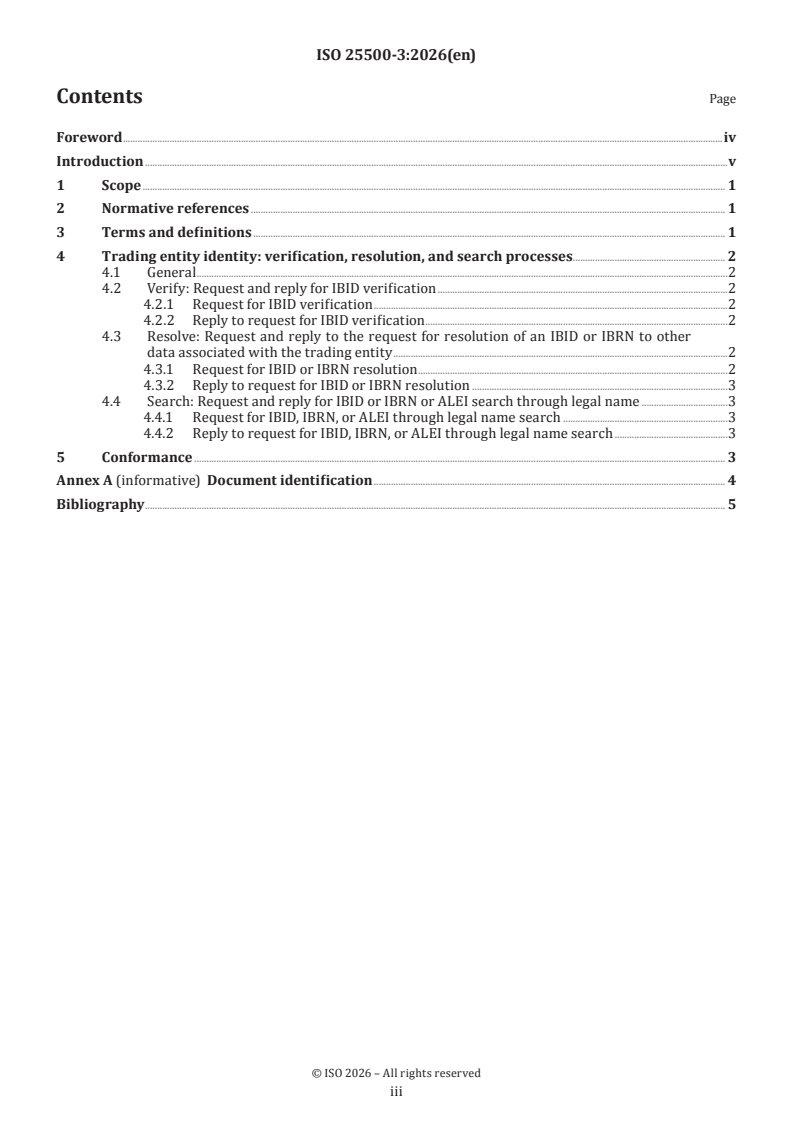
Contents Page
Foreword .iv
Introduction .v
1 Scope . 1
2 Normative references . 1
3 Terms and definitions . 1
4 Trading entity identity: verification, resolution, and search processes . 2
4.1 General .2
4.2 Verify: Request and reply for IBID verification .2
4.2.1 Request for IBID verification .2
4.2.2 Reply to request for IBID verification .2
4.3 Resolve: Request and reply to the request for resolution of an IBID or IBRN to other
data associated with the trading entity .2
4.3.1 Request for IBID or IBRN resolution .2
4.3.2 Reply to request for IBID or IBRN resolution .3
4.4 Search: Request and reply for IBID or IBRN or ALEI search through legal name .3
4.4.1 Request for IBID, IBRN, or ALEI through legal name search .3
4.4.2 Reply to request for IBID, IBRN, or ALEI through legal name search .3
5 Conformance . 3
Annex A (informative) Document identification . 4
Bibliography . 5
iii
Foreword
ISO (the International Organization for Standardization) is a worldwide federation of national standards
bodies (ISO member bodies). The work of preparing International Standards is normally carried out through
ISO technical committees. Each member body interested in a subject for which a technical committee
has been established has the right to be represented on that committee. International organizations,
governmental and non-governmental, in liaison with ISO, also take part in the work. ISO collaborates closely
with the International Electrotechnical Commission (IEC) on all matters of electrotechnical standardization.
The procedures used to develop this document and those intended for its further maintenance are described
in the ISO/IEC Directives, Part 1. In particular, the different approval criteria needed for the different types
of ISO documents should be noted. This document was drafted in accordance with the editorial rules of the
ISO/IEC Directives, Part 2 (see www.iso.org/directives).
ISO draws attention to the possibility that the implementation of this document may involve the use of (a)
patent(s). ISO takes no position concerning the evidence, validity or applicability of any claimed patent
rights in respect thereof. As of the date of publication of this document, ISO had not received notice of (a)
patent(s) which may be required to implement this document. However, implementers are cautioned that
this may not represent the latest information, which may be obtained from the patent database available at
www.iso.org/patents. ISO shall not be held responsible for identifying any or all such patent rights.
Any trade name used in this document is information given for the convenience of users and does not
constitute an endorsement.
For an explanation of the voluntary nature of standards, the meaning of ISO specific terms and expressions
related to conformity assessment, as well as information about ISO’s adherence to the World Trade
Organization (WTO) principles in the Technical Barriers to Trade (TBT), see www.iso.org/iso/foreword.html.
This document was prepared by Technical Committee ISO/TC 184, Automation systems and integration,
Subcommittee SC 5, Interoperability, integration, and architectures for enterprise systems and automation
applications.
A list of all parts in the ISO 25500 series can be found on the ISO website.
Any feedback or questions on this document should be directed to the user’s national standards body. A
complete listing of these bodies can be found at www.iso.org/members.html.
iv
Introduction
The effectiveness, efficiency, and security of a supply chain can be increased through standardization to
create greater interoperability and integration across applications, facilities, companies, and borders.
At each step of the supply chain from planning, sourcing, making, delivering, and returning, buyers and
suppliers need a standardized way to quickly identify and verify legal trading entities to limit corporate
identity theft and potentially fraudulent transactions.
A legal entity is created when it is formally recognized by the governing body of a nation, state or community
that has the authority to set and enforce laws relating to property and trade. The most common way for a
business to obtain legal status is through registration of its legal name in an authoritative business register.
The business register creates a record and assigns a local record number; this is the authoritative legal entity
identifier (ALEI). A business formed in one jurisdiction can also be required to register as a legal entity in
another jurisdiction where it regularly conducts business, which is called a foreign registration (as opposed
to domestic registration). Some legal entities, like government agencies, are typically formed through legal
actions such as proclamations, regulations, and acts and are not typically referred to by an identifier within
those acts. Thus, a government agency’s legal name is its ALEI.
Some legal entities attain proxy identifiers (identifiers issued by an organization that is not the originator
of the legal entity or object identified) through various sources and, unlike ALEI issuers that follow legal
requirements for assigning identifiers and granting access to the datasets they represent, there are no
requirements for proxy identifier issuers for the assignment of and access to the proxy legal entity identifiers
(or the datasets they represent) that they control. However, every legal entity has a government issued,
verifiable authoritative identifier, an ALEI, issued at its formation by the governing body under which it was
created and that maintains its legal existence; this governing body is the authoritative source of data on
that legal entity. As part of the supply chain meeting know your customer (KYC) and know your supplier
(KYS) demands, each legal entity can be verified with the authoritative source. This verification is typically
done by either searching authoritative source’s online database, with its own structure and terminology, or
asking (via phone call, email, fax, or postal mail) an employee of the governing body to search its paper or
electronic documents to verify the entity’s details. These methods are not suited for automated processing
and add time and cost to the verification process, especially for
...