

ISO 25500-240:2026
(Main)Supply chain interoperability and integration — Part 240: Strategic sourcing concepts, principles and data requirements
- Abstract
This document describes the fundamental concepts and principles of strategic sourcing which are universally applicable to the following: organizations seeking to improve their onboarding process through a common understanding of the fundamental concepts, principles and vocabulary used in strategic sourcing; organizations seeking to improve the quality of the data they receive from their trading partners in order to establish confidence in their supply chain. The following are within the scope of this document: stages of the strategic sourcing process; data required to support the strategic sourcing process; metadata and reference data required to support the strategic sourcing process. The following are outside the scope of this document: data exchange technology; supplier evaluation methods and techniques.
- Status
- Published
- Publication Date
- 03-Nov-2026
- Current Stage
- 6060 - International Standard published
- Start Date
- 04-Nov-2026
- Completion Date
- 04-Nov-2026
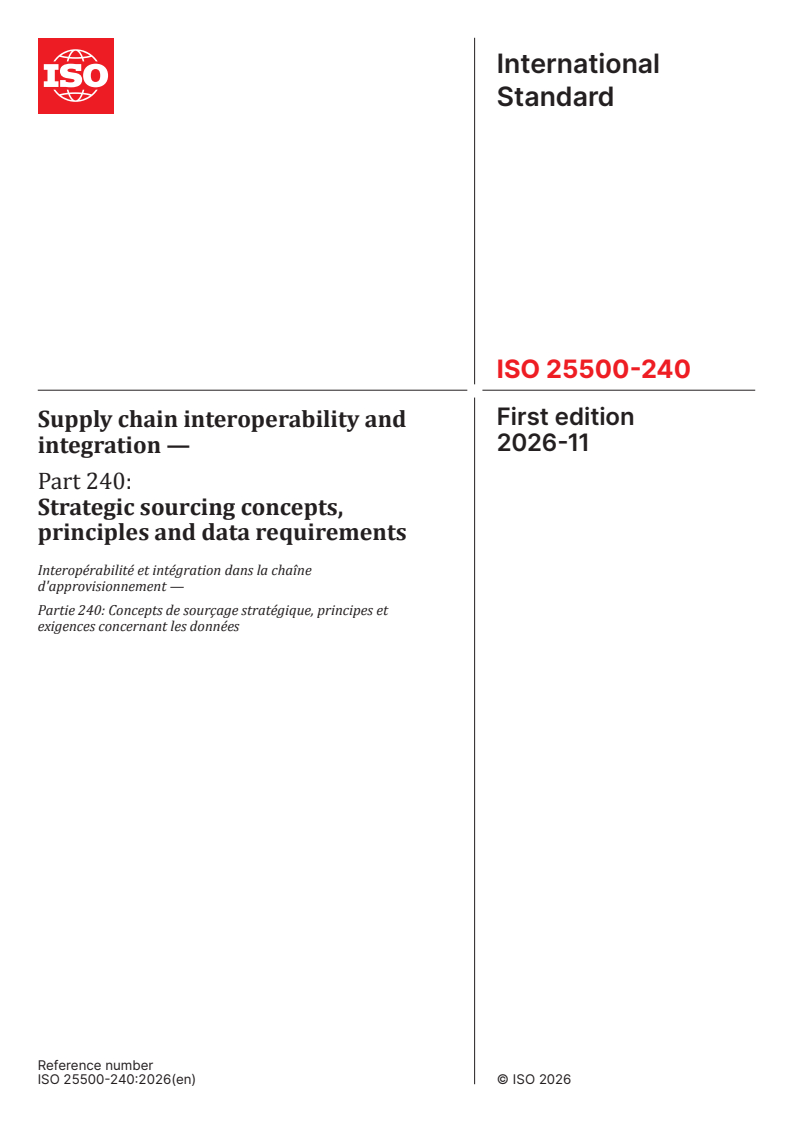

ISO 25500-240:2026, published by ISO, sets out the fundamental concepts, principles and data requirements for strategic sourcing within supply chain interoperability and integration (SCII). It is for organizations that want a common basis for onboarding products or services from new or existing suppliers and for improving the quality of data received from trading partners. The document focuses on the sourcing stages, the data needed to support them, and the metadata and reference data needed to build confidence in the supply chain.
What does ISO 25500-240:2026 specify?
ISO 25500-240:2026 specifies the strategic sourcing concepts and principles that support onboarding and supply chain data quality. It covers the stages of the strategic sourcing process, the data needed for those stages, and the metadata and reference data needed to support them.
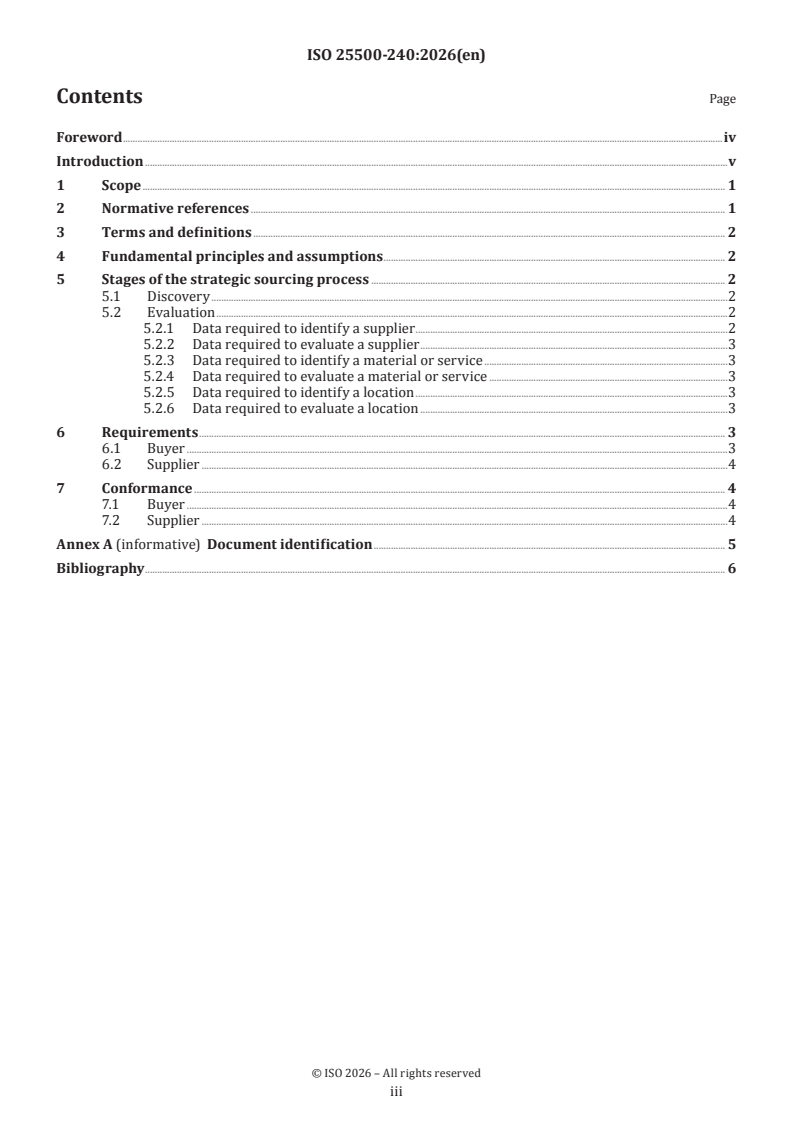
The document is organized into scope, normative references, terms and definitions, fundamental principles and assumptions, the stages of the strategic sourcing process, requirements, conformance, Annex A, and a bibliography.
It applies to organizations that want a shared vocabulary and a cleaner data handoff with trading partners. It excludes data exchange technology and supplier evaluation methods and techniques.
What are the key requirements of ISO 25500-240:2026?
ISO 25500-240:2026 treats strategic sourcing as a staged process in which data is collected, validated and approved before master data records are created. In practice, that means the buyer and supplier need to agree early on what data is needed, why it is needed, and how it will be protected.
The process is staged and data-driven
Clause 4 presents strategic sourcing as more than finding the lowest price. It emphasizes longer-term responsible and sustainable procurement, and it links sourcing to the creation of master data records for suppliers and for goods or services.
Clause 5 separates the process into discovery and evaluation, with specific data needs at each step. That matters because organizations can align requests, approvals and record creation instead of handling each supplier informally.
Discovery focuses on finding suitable suppliers
Clause 5.1 says the discovery phase is about identifying potential suppliers that can meet the organization’s needs for a specific good or service at a specific location. It also notes that publishing product or service specifications in the ISO 8000-114 interoperable data format (.idf) supports automation.
Supplier identity has a defined data set
Clause 5.2.1 requires three data elements to establish and verify a supplier’s identity: an ISO 8000-116 formatted authoritative legal entity identifier (ALEI), the legal name, and the date of formation. Together these form the international business identifier (IBID), which supports automated verification through ISO 25500-3.
Materials, services and locations have standard identifiers
Clause 5.2.3 identifies a material or service using an ISO 8000-115 formatted reference together with an item description. Clause 5.2.5 uses the natural location identifier (NLI) from ISO 8000-118 to identify a delivery or service location, including details such as elevation or floor within a building. In practice, these identifiers reduce ambiguity when buyers and suppliers refer to the same thing.
Evaluation requests must be clear and relevant
Clause 5.2.2 says a request for evaluation data must be unambiguous and relevant, and it places on the buying organization the duty to explain the data need and the associated confidentiality and data retention policy statements. Clause 5.2.4 gives the supplier the duty to provide a commercial specification in ISO 8000-114 format, after which the buyer can request additional data needed for evaluation.
Buyer and supplier obligations are symmetrical
Clause 6.1 requires the buyer to identify itself with its IBID, request data in the specified formats, identify locations with NLI, and include the ISO 25500-1 supply chain data formatting contract clause in contracts. Clause 6.2 requires the supplier to do the same kind of structured identification and data exchange, including product or service references in ISO 8000-115 format and commercial specifications in ISO 8000-114 format.
Conformance is simple
Clause 7 states that a buyer conforms when it meets 6.1, and a supplier conforms when it meets 6.2. This makes conformance straightforward to check against the stated buyer or supplier obligations.
What terms does ISO 25500-240:2026 define?
ISO 25500-240:2026 relies on terms and definitions from ISO 25500-2, and it uses several key abbreviations consistently.
- SCII - supply chain interoperability and integration, the wider framework to which this part applies.
- Strategic sourcing - a longer-term sourcing approach focused on responsible and sustainable procurement, not only immediate price.
- ALEI - authoritative legal entity identifier, a globally unique and verifiable identifier for a supplier’s legal entity.
- IBID - international business identifier, formed from the ALEI, legal name and date of formation.
- NLI - natural location identifier, a globally unique identifier for a physical location.
- Commercial specification - the supplier’s product or service description provided in ISO 8000-114 format for evaluation.
Who uses ISO 25500-240:2026?
ISO 25500-240:2026 is used by buyers and suppliers involved in onboarding new or existing trading relationships. It is also relevant to procurement teams, supply chain data managers, and organizations trying to improve the quality and consistency of master data.
Commercial buyers can use it to structure supplier discovery and evaluation. Government buyers can use it when publicly advertising needs for products or services. It is also useful where automated search, identity verification and structured data exchange are part of the sourcing process.
What changed in ISO 25500-240:2026 from the previous edition?
ISO 25500-240:2026 is the first edition.
Which standards are used with ISO 25500-240:2026?
ISO 25500-240:2026 uses the following normative references, each contributing part of the method or vocabulary:
- ISO 8000-114 - portable data and the interoperable format used for product or service specifications and some data requests.
- ISO 8000-115 - master data exchange of quality identifiers and the reference format used to identify materials or services.
- ISO 8000-118 - application for natural location identifiers used to identify locations.
- ISO 25500-1 - the supply chain data formatting contract clause used in contracts.
- ISO 25500-2 - the vocabulary source for terms and definitions.
- ISO 25500-3 - verification of trading entity identity.
- ISO 25500-100 - verification of supply chain data.
- ISO 25500-110 - verification of certificates in the supply chain.
- ISO 25500-120 - verification of data in support of local purchasing.
What does the ISO 25500-240:2026 document contain?
ISO 25500-240:2026 contains a short conceptual introduction, then clauses on principles, discovery, evaluation, requirements and conformance. Its main technical content is the staged sourcing model and the data elements used to identify suppliers, materials or services, and locations.
Annex A is informative and gives an object identifier for document identification in an open information system. The bibliography points to related ISO documents and background references used in the document’s development.
Get Certified
Connect with accredited certification bodies for this standard

BSI Group
BSI (British Standards Institution) is the business standards company that helps organizations make excellence a habit.

NYCE
Mexican standards and certification body.
Sponsored listings
Frequently Asked Questions
ISO 25500-240:2026 is a standard published by the International Organization for Standardization (ISO). Its full title is "Supply chain interoperability and integration — Part 240: Strategic sourcing concepts, principles and data requirements". This standard covers: This document describes the fundamental concepts and principles of strategic sourcing which are universally applicable to the following: organizations seeking to improve their onboarding process through a common understanding of the fundamental concepts, principles and vocabulary used in strategic sourcing; organizations seeking to improve the quality of the data they receive from their trading partners in order to establish confidence in their supply chain. The following are within the scope of this document: stages of the strategic sourcing process; data required to support the strategic sourcing process; metadata and reference data required to support the strategic sourcing process. The following are outside the scope of this document: data exchange technology; supplier evaluation methods and techniques.
This document describes the fundamental concepts and principles of strategic sourcing which are universally applicable to the following: organizations seeking to improve their onboarding process through a common understanding of the fundamental concepts, principles and vocabulary used in strategic sourcing; organizations seeking to improve the quality of the data they receive from their trading partners in order to establish confidence in their supply chain. The following are within the scope of this document: stages of the strategic sourcing process; data required to support the strategic sourcing process; metadata and reference data required to support the strategic sourcing process. The following are outside the scope of this document: data exchange technology; supplier evaluation methods and techniques.
ISO 25500-240:2026 is classified under the following ICS (International Classification for Standards) categories: 35.240.63 - IT applications in trade. The ICS classification helps identify the subject area and facilitates finding related standards.
ISO 25500-240:2026 is available in PDF format for immediate download after purchase. The document can be added to your cart and obtained through the secure checkout process. Digital delivery ensures instant access to the complete standard document.
Standards Content (Sample)
International
Standard
ISO 25500-240
First edition
Supply chain interoperability and
2026-11
integration —
Part 240:
Strategic sourcing concepts,
principles and data requirements
Interopérabilité et intégration dans la chaîne
d'approvisionnement —
Partie 240: Concepts de sourçage stratégique, principes et
exigences concernant les données
Reference number
© ISO 2026
All rights reserved.
This ISO publication is protected by copyright and is owned by ISO and/or its licensors.
The content of this ISO publication is provided under licence, not sold. Use is subject to the applicable licence terms issued by ISO,
an ISO member body, or an authorized third-party distributor.
Except as required for implementation or expressly permitted by a separate licence, no part of this ISO publication may be
reproduced, distributed, modified, used, or made available in any form or by any means – electronic or mechanical, including
photocopying, scanning, recording, or posting on internal or external digital platforms.
Any use beyond the scope of the granted rights is prohibited and may result in legal action.
ISO copyright office
CP 401 • CH-1214 Vernier, Geneva
Phone: +41 22 749 01 11
Email: copyright@iso.org
Website: www.iso.org
Published in Switzerland
ii
Contents Page
Foreword .iv
Introduction .v
1 Scope . 1
2 Normative references . 1
3 Terms and definitions . 2
4 Fundamental principles and assumptions . 2
5 Stages of the strategic sourcing process . 2
5.1 Discovery .2
5.2 Evaluation .2
5.2.1 Data required to identify a supplier .2
5.2.2 Data required to evaluate a supplier .3
5.2.3 Data required to identify a material or service .3
5.2.4 Data required to evaluate a material or service .3
5.2.5 Data required to identify a location .3
5.2.6 Data required to evaluate a location .3
6 Requirements . 3
6.1 Buyer .3
6.2 Supplier .4
7 Conformance . 4
7.1 Buyer .4
7.2 Supplier .4
Annex A (informative) Document identification . 5
Bibliography . 6
iii
Foreword
ISO (the International Organization for Standardization) is a worldwide federation of national standards
bodies (ISO member bodies). The work of preparing International Standards is normally carried out through
ISO technical committees. Each member body interested in a subject for which a technical committee
has been established has the right to be represented on that committee. International organizations,
governmental and non-governmental, in liaison with ISO, also take part in the work. ISO collaborates closely
with the International Electrotechnical Commission (IEC) on all matters of electrotechnical standardization.
The procedures used to develop this document and those intended for its further maintenance are described
in the ISO/IEC Directives, Part 1. In particular, the different approval criteria needed for the different types
of ISO documents should be noted. This document was drafted in accordance with the editorial rules of the
ISO/IEC Directives, Part 2 (see www.iso.org/directives).
ISO draws attention to the possibility that the implementation of this document may involve the use of (a)
patent(s). ISO takes no position concerning the evidence, validity or applicability of any claimed patent
rights in respect thereof. As of the date of publication of this document, ISO had not received notice of (a)
patent(s) which may be required to implement this document. However, implementers are cautioned that
this may not represent the latest information, which may be obtained from the patent database available at
www.iso.org/patents. ISO shall not be held responsible for identifying any or all such patent rights.
Any trade name used in this document is information given for the convenience of users and does not
constitute an endorsement.
For an explanation of the voluntary nature of standards, the meaning of ISO specific terms and expressions
related to conformity assessment, as well as information about ISO’s adherence to the World Trade
Organization (WTO) principles in the Technical Barriers to Trade (TBT), see www.iso.org/iso/foreword.html.
This document was prepared by Technical Committee ISO/TC 184, Automation systems and integration,
Subcommittee SC 5, Interoperability, integration, and architectures for enterprise systems and automation
applications.
A list of all parts in the ISO 25500 series can be found on the ISO website.
Any feedback or questions on this document should be directed to the user’s national standards body. A
complete listing of these bodies can be found at www.iso.org/members.html.
iv
Introduction
This document provides the fundamental concepts and principles for supply chain interoperability and
integration (SCII) as applied to the activity of strategic sourcing of products or services from new or existing
suppliers. This document is intended to help the user in understanding the fundamental concepts, principles,
and vocabulary of the strategic sourcing process in order to be able to effectively and efficiently onboard
products or services from new or existing suppliers.
Annex A contains an identifier that conforms to ISO/IEC 8824-1. The identifier unambiguously identifies this
document in an open information system.
v
International Standard ISO 25500-240:2026(en)
Supply chain interoperability and integration —
Part 240:
Strategic sourcing concepts, principles and data requirements
1 Scope
This document describes the fundamental concepts and principles of strategic sourcing which are
universally applicable to the following:
— organizations seeking to improve their onboarding process through a common understanding of the
fundamental concepts, principles and vocabulary used in strategic sourcing;
— organizations seeking to improve the quality of the data they receive from their trading partners in
order to establish confidence in their supply chain.
The following are within the scope of this document:
— stages of the strategic sourcing process;
— data required to support the strategic sourcing process;
— metadata and r
...