

ISO 25500-1:2026
(Main)Supply chain interoperability and integration — Part 1: Overview and principles of the industrial internet
- Abstract
This document provides an overview of the standards developed in the ISO 25500 series for supply chain interoperability and integration. This document: states the subject matter of the ISO 25500 series as a whole; establishes the principles of supply chain interoperability and integration; describes the path to supply chain interoperability and integration; describes the structure of the supply chain interoperability and integration series; establishes the relationship of the supply chain interoperability and integration series with other International Standards. The following is outside the scope of this document: the interoperability and integration of the physical objects or services exchanged.
- Status
- Published
- Publication Date
- 03-Nov-2026
- Current Stage
- 6060 - International Standard published
- Start Date
- 04-Nov-2026
- Completion Date
- 04-Nov-2026
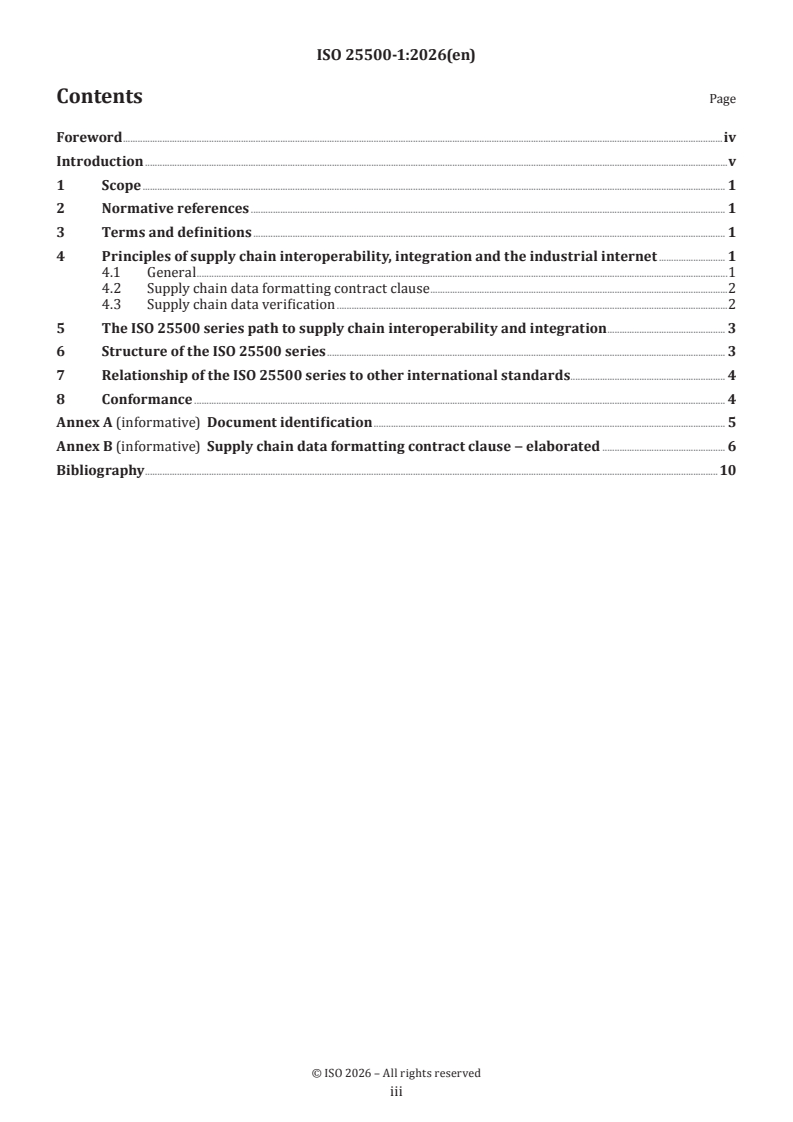
ISO 25500-1:2026 is an ISO standard in the Supply chain interoperability and integration series. ISO publishes it as the overview part for the industrial internet, giving the principles for sharing and verifying supply chain data between known trading entities and the structure of the wider series for organizations that design contracts, data exchanges, and verification processes.
What does ISO 25500-1:2026 specify?
ISO 25500-1:2026 specifies the subject matter, principles, development path, series structure, and relationship to other International Standards for supply chain interoperability and integration. It also sets out a contract-based approach for unambiguous supply chain data, while keeping the interoperability and integration of the physical objects or services exchanged outside its scope.
The document is organized into eight clauses, followed by two informative annexes and a bibliography.
| Annex | What it covers |
|---|---|
| Annex A | Document identification |
| Annex B | Supply chain data formatting contract clause - elaborated |
What are the key requirements of ISO 25500-1:2026?
ISO 25500-1:2026 centers on a trusted industrial internet for supply chains, where data can be exchanged and verified between identified legal entities. In practice, that means the standard is about how parties identify who they are, what is being exchanged, where events occur, and when they happen.
- Clause 4.1 presents the industrial internet as an intelligent service model for improving data quality across planning, sourcing, making, delivery, returns, and disposal. For users, this means the standard is aimed at the data behind supply chain decisions, not at the physical movement itself.
- Clause 4.2 requires a supply chain data formatting contract clause that standardizes the identification and description of who, what, where, and when. In practice, contracts using this standard need clear data-format rules so that partners can process the same information in the same way.
- Clause 4.3 defines supply chain data verification as a secure process based on registered prefixes and callback security through a prefix name server (PNS). This matters because it supports verification without exposing private contact details or relying on anonymity.
- Clause 5 frames the series around effective, efficient, and safe interoperability and integration, a shared terminology base, and formalized request and response formats that can be processed automatically. For implementers, this points to system-to-system exchange rather than manual interpretation.
- Clause 6 groups the series into three themes: general aspects, verification of supply chain data through automated processing, and operating procedures such as procurement, warehousing, make, order processing, and logistics. This helps readers place each future part of the series in context.
- Clause 6 also describes the main request types used in the series: verify, resolve, and search. These are the practical data-exchange patterns that systems use to confirm identifiers, retrieve datasets, or match characteristic data to identifiers.
- Clause 7 positions the series alongside other standards, especially by contrasting it with Electronic Data Interchange (EDI) approaches. The practical point is that ISO 25500-1:2026 is about requesting and verifying supply chain data between verified legal entities, not only sending pre-agreed transaction messages.
- Clause 8 states that supply chain contracts conform when they include the requirements of 4.2. For buyers and suppliers, conformance therefore depends on the contract wording used for data exchange.
What terms does ISO 25500-1:2026 define?
ISO 25500-1:2026 uses the terms from ISO 25500-2, and several key terms are central to reading the document.
- Supply chain data - data shared between trading entities to support acquisition, transfer, storage, maintenance, and disposal of goods or services.
- Industrial internet - a trusted business-to-business (B2B) platform for commercial users that supports interoperable supply chain data and integrated systems.
- Prefix name server (PNS) - an ISO 8000-115 compliant register of prefixes that identifies the legal owner of an identifier and provides resolution information.
- Callback security - a verification method that requires the user to end an incoming request and call back using a verified contact route.
- International Business Identifier (IBID) - the identifier used for a legal entity in the contract examples and annex notes.
- International Business Registration Number (IBRN) - the legal entity identifier format used in the document’s examples for authoritative registration data.
- Natural Location Identifier (NLI) - the location identifier used to identify places in a machine-readable form.
- International part number (IPN) - the item identifier used for products and parts in the contract clause.
Who uses ISO 25500-1:2026?
ISO 25500-1:2026 is used by industrial enterprises and their trading partners when they need agreed rules for supply chain data exchange. Typical users include suppliers, buyers, manufacturers, procurement teams, logistics teams, warehousing teams, and standards or IT teams implementing automated verification systems.
It is also relevant to quality managers and contract authors who need to specify data formatting for legal entities, locations, items, and technical characteristics. Organizations using AI, flexible manufacturing, or structured supply chain integration can use it as the overview part of the series.
Which standards are used with ISO 25500-1:2026?
ISO 25500-1:2026 normatively references ISO 25500-2 for the vocabulary used across the series. It also draws on related standards that support the identifiers, formatting rules, and document identification used in the standard.
- ISO 25500-2 - supplies the terms and definitions for the series.
- ISO 25500-3 - provides verification of trading entity identity.
- ISO 25500-100 - provides the generic verification API structure for supply chain data.
- ISO 25500-110 - covers verification of certificates in the supply chain.
- ISO 25500-120 - covers verification of data in support of local purchasing.
- ISO 25500-240 - covers strategic sourcing concepts, principles, and data requirements.
- ISO 8000-114, ISO 8000-115, ISO 8000-116, ISO 8000-118 - support portable data, quality identifiers, legal entity identifiers, and natural location identifiers.
- ISO 8601-1 - sets the date and time format used in the contract clause examples.
- ISO/IEC 8824-1 - provides the ASN.1 basis for the document identifier in Annex A.
What does the ISO 25500-1:2026 document contain?
ISO 25500-1:2026 contains an overview of the series, the industrial internet principles, and the relationship between supply chain interoperability and other standards. It also includes an example contract clause and expanded notes that show how to format dates, legal entities, locations, items, and item descriptions.
Table 1 illustrates a supply chain data formatting contract clause, while Table 2 summarizes the three themes of the ISO 25500 series. Annex A gives the document’s object identifier, and Annex B expands the clause with examples, notes, and a worked JSON representation of item characteristics.
Annex B is especially practical for implementation work because it shows how the standard’s data elements are expressed for contracts and machine processing. It also shows both a nonconforming attribute-value representation and an ISO 8000-114 conforming format for item data.
Get Certified
Connect with accredited certification bodies for this standard

BSI Group
BSI (British Standards Institution) is the business standards company that helps organizations make excellence a habit.

NYCE
Mexican standards and certification body.
Sponsored listings
Frequently Asked Questions
ISO 25500-1:2026 is a standard published by the International Organization for Standardization (ISO). Its full title is "Supply chain interoperability and integration — Part 1: Overview and principles of the industrial internet". This standard covers: This document provides an overview of the standards developed in the ISO 25500 series for supply chain interoperability and integration. This document: states the subject matter of the ISO 25500 series as a whole; establishes the principles of supply chain interoperability and integration; describes the path to supply chain interoperability and integration; describes the structure of the supply chain interoperability and integration series; establishes the relationship of the supply chain interoperability and integration series with other International Standards. The following is outside the scope of this document: the interoperability and integration of the physical objects or services exchanged.
This document provides an overview of the standards developed in the ISO 25500 series for supply chain interoperability and integration. This document: states the subject matter of the ISO 25500 series as a whole; establishes the principles of supply chain interoperability and integration; describes the path to supply chain interoperability and integration; describes the structure of the supply chain interoperability and integration series; establishes the relationship of the supply chain interoperability and integration series with other International Standards. The following is outside the scope of this document: the interoperability and integration of the physical objects or services exchanged.
ISO 25500-1:2026 is classified under the following ICS (International Classification for Standards) categories: 35.240.63 - IT applications in trade. The ICS classification helps identify the subject area and facilitates finding related standards.
ISO 25500-1:2026 is available in PDF format for immediate download after purchase. The document can be added to your cart and obtained through the secure checkout process. Digital delivery ensures instant access to the complete standard document.
Standards Content (Sample)
International
Standard
ISO 25500-1
First edition
Supply chain interoperability and
2026-11
integration —
Part 1:
Overview and principles of the
industrial internet
Interopérabilité et intégration dans la chaîne
d'approvisionnement —
Partie 1: Vue d'ensemble et principes de l'Internet industriel
Reference number
© ISO 2026
All rights reserved.
This ISO publication is protected by copyright and is owned by ISO and/or its licensors.
The content of this ISO publication is provided under licence, not sold. Use is subject to the applicable licence terms issued by ISO,
an ISO member body, or an authorized third-party distributor.
Except as required for implementation or expressly permitted by a separate licence, no part of this ISO publication may be
reproduced, distributed, modified, used, or made available in any form or by any means – electronic or mechanical, including
photocopying, scanning, recording, or posting on internal or external digital platforms.
Any use beyond the scope of the granted rights is prohibited and may result in legal action.
ISO copyright office
CP 401 • CH-1214 Vernier, Geneva
Phone: +41 22 749 01 11
Email: copyright@iso.org
Website: www.iso.org
Published in Switzerland
ii
Contents Page
Foreword .iv
Introduction .v
1 Scope . 1
2 Normative references . 1
3 Terms and definitions . 1
4 Principles of supply chain interoperability, integration and the industrial internet . 1
4.1 General .1
4.2 Supply chain data formatting contract clause .2
4.3 Supply chain data verification .2
5 The ISO 25500 series path to supply chain interoperability and integration . 3
6 Structure of the ISO 25500 series . 3
7 Relationship of the ISO 25500 series to other international standards . 4
8 Conformance . 4
Annex A (informative) Document identification . 5
Annex B (informative) Supply chain data formatting contract clause ‒ elaborated . 6
Bibliography .10
iii
Foreword
ISO (the International Organization for Standardization) is a worldwide federation of national standards
bodies (ISO member bodies). The work of preparing International Standards is normally carried out through
ISO technical committees. Each member body interested in a subject for which a technical committee
has been established has the right to be represented on that committee. International organizations,
governmental and non-governmental, in liaison with ISO, also take part in the work. ISO collaborates closely
with the International Electrotechnical Commission (IEC) on all matters of electrotechnical standardization.
The procedures used to develop this document and those intended for its further maintenance are described
in the ISO/IEC Directives, Part 1. In particular, the different approval criteria needed for the different types
of ISO documents should be noted. This document was drafted in accordance with the editorial rules of the
ISO/IEC Directives, Part 2 (see www.iso.org/directives).
ISO draws attention to the possibility that the implementation of this document may involve the use of (a)
patent(s). ISO takes no position concerning the evidence, validity or applicability of any claimed patent
rights in respect thereof. As of the date of publication of this document, ISO had not received notice of (a)
patent(s) which may be required to implement this document. However, implementers are cautioned that
this may not represent the latest information, which may be obtained from the patent database available at
www.iso.org/patents. ISO shall not be held responsible for identifying any or all such patent rights.
Any trade name used in this document is information given for the convenience of users and does not
constitute an endorsement.
For an explanation of the voluntary nature of standards, the meaning of ISO specific terms and expressions
related to conformity assessment, as well as information about ISO’s adherence to the World Trade
Organization (WTO) principles in the Technical Barriers to Trade (TBT), see www.iso.org/iso/foreword.html.
This document was prepared by Technical Committee ISO/TC 184, Automation systems and integration,
Subcommittee SC 5, Interoperability, integration, and architectures for enterprise systems and automation
applications.
A list of all parts in the ISO 25500 series can be found on the ISO website.
Any feedback or questions on this document should be directed to the user’s national standards body. A
complete listing of these bodies can be found at www.iso.org/members.html.
iv
Introduction
Supply chain data is the data that must be shared between potential or existing trading entities to support
the acquisition, transfer, storage, maintenance and eventual disposal of goods or services.
Fundamental to this document is the understanding that data is the tangible form of information. For data to
reliably transfer information between systems the data must be portable and unambiguous; this is the goal
of the ISO 8000 series, consisting of international standards for data quality.
The ISO 8000 series achieves data portability and unambiguity through including provenance as well as
concept encoding, a process where metadata and reference data are represented by a language independent
concept identifier from a concept dictionary that contains the terminology (terms, definitions, symbols or
images) used to provide the unambiguous meaning of the concept.
Also fundamental is the understanding that no two objects can occupy the same place at the same time and it
follows that all objects can be uniquely identified and differentiated from all other objects by their time and
place of origin. Finally, identifiers are a critical component of supply chain communication. An identifier is a
string of characters created by an organization to reference a dataset, the characteristic data that describes
the object identified.
Critical to supply chain interoperability and integration is trust. Trust requires the positive and verifiable
identification of the trading entities and an understanding of their authority. Anonymity is not acceptable in
supply chain data exchanges. In addition to the identification of the trading entities (who), the identification
and description of the products and services subject to contract (what), as well as the locations (where) and
the time (when) of associated events are necessary to create the industrial internet, a secure and efficient
environment for the verification of supply chain data.
The industrial internet is above all else a trusted business-to-business (B2B) platform for commercial users.
It is designed to allow interoperability of supply chain data and integration of supply chain systems between
known and trusted parties as legal entities. To do this, the industrial internet overcomes both anonymity
and impersonation. The industrial internet relies on verifiable legal identity to overcome anonymity and
protection from impersonation through callback security.
The industrial internet uses a prefix name server (PNS), which is an ISO 8000-115 compliant register of
prefixes with globally unique prefix records that contain the legal owner of any identifier with that prefix
and contains an electronic address to resolve the identifier to the dataset it represents as well as any use
restrictions. The PNS used in the industrial internet is an enhanced version of the domain name server (DNS),
that supports callback security, one of the earliest forms of secure communication and the backbone of two-
factor authentication. For example, if an account holder receives a call stating that a bank or credit account is
compromised, and the caller requests verification of account information, the appropriate response is to end
the call. The account holder should then promptly call the financial service provider using a verified number
(not one provided by the caller). This method is known as callback security. Callback security is simple, low
cost and very effective.
This document describes the principles of supply chain interoperability and integration and introduces
the supply chain data formatting contract clause which supports the creation and verification of quality
portable data that underpins the industrial internet. This document includes an overview of the structure
of the ISO 25500 series. Each document in this series defines the data required to perform specific supply
chain functions and how this data can be verified.
Annex A contains an identifier that conforms to ISO/IEC 8824-1. The identifier unambiguously identifies this
document in an open information system.
v
International Standard ISO 25500-1:2026(en)
Supply chain interoperability and integration —
Part 1:
Overview and principles of the industrial internet
1 Scope
This document provides an overview of the standards developed in the ISO 25500 series for supply chain
interoperability and integration.
This document:
— states the subject matter of the ISO 25500 series as a whole;
— establishes the principles of supply chain interoperability and integration;
— describes the path to supply chain interoperability and integration;
— describes the structure of the supply chain interoperability and integration series;
— establishes the relationship of the supply chain interoperability and integration series with other
International Standards.
The following is outside the scope of this document:
— the interoperability and integration of the physical objects or services exchanged.
2 Normative references
The following documents are referred to in the text in such a way that some or all of their content constitutes
requirements of this document. For dated references, only the edition cited applies. For undated references,
the latest edition of the referenced document (including any amendments) applies.
ISO 25500-2, Supply chain interoperability and integration — Part 2: Vocabulary
3 Terms and definitions
For the purposes of this document, the terms and definitions given in ISO 25500-2 apply.
ISO and IEC maintain terminology databases for use in standardization at the following addresses:
— ISO Online browsing platform: available at https:// www .iso .org/ obp
— IEC Electropedia: available at https:// www .electropedia .org/
4 Principles of supply chain interoperability, integration and the industrial internet
4.1 General
The industrial internet, along with supply chain interoperability and integration, is represented by
an intelligent service model which can be used to improve the quality of the data necessary for demand
forecasting and logistics management across independent systems encompassing the orchestrate, plan,
order, source, make, deliver, return and disposal functionality in a modern sustainable economic framework.
Data verification is achieved by implementing a standard process for requesting:
a) the verification of identifiers;
b) the characteristic data the identifier represents; or
c) using characteristic data to search for identifiers.
This data verification process is built on key data pieces which can be secured by trading partners by
including a supply chain data formatting clause in their contracts.
4.2 Supply chain data formatting contract clause
Modern supply chains are data-intensive; they involve multiple stakeholders who must ensure that the data
they exchange is unambiguous and can be trusted.
A supply chain data formatting contract clause shall require standardization (referencing relevant parts
of the ISO 8000 series and the ISO 25500 series) designed to ensure the unambiguous identification and
description of “who ”, “what”, “where”, and “when” to ensure clarity and consistency when sharing data
between supply chain stakeholders. Table 1 provides an example of a supply chain data formatting contract
clause.
Table 1 — Illustration of a supply chain data formatting contract clause
Data Requirement
General Supplier hereby accepts responsibility for providing the data necessary for the installation, oper-
ation, maintenance, or training purposes of the item covered by this contract including technical
data and specifications, studies, analyses, test data, or similar data, when the study, analysis,
test, or similar work was specified as an element of performance. The data shall be formatted as
follows:
Dates All dates and times shall be formatted in accordance with ISO 8601-1.
Legal entity All legal entities supplying goods or services under this contract shall be identified by their inter-
identification national business identifier (IBID) formatted in accordance with ISO 25500-3 or their legal name
and international business registration number (IBRN) formatted in accordance with ISO 8000-
116.
Locations All locations shall be identified using a natural location identifier (NLI) formatted in accordance
with ISO 8000-118.
Item All items shall be identified using an international part number (IPN) formatted in accordance
identification with ISO 8000-115.
Characteristic The technical data that describes the physical, functional, and performance characteristics of an
data item, component, or process shall be provided in interoperable data format (.idf) as described in
accordance with ISO 8000-114.
Annex B provides notes and examples for the supply chain data formatting contract clause’s standard
requirements.
4.3 Supply chain data verification
The ISO 25500 series presents the essential components of the industrial internet, with the supply chain
data formatting contract clause bringing in key data from trading partners, and by providing a standard
process for data verification to occur in a secure environment. This process uses registered ISO 8000-115
prefixes for both parties and callback security that routes the requests and the replies through a PNS. The
PNS maintains in each prefix record the IBID to definitively identify the prefix owner while protecting
privacy by keeping confidential the electronic address information used for the verified data exchange.
5 The ISO 25500 series path to supply chain interoperability and integration
The ISO 25500 series provides standards in the field of supply chain interoperability and integration for
industrial enterprises that leverages artificial intelligence (AI) as the new generation of information
technology, flexible manufacturing technology, and structurally flexible supply chains.
The ISO 25500 series is intended to research, develop, and maintain international standards for an eco-
system that promotes interoperable, integrated, and sustai
...