


ISO 17593:2022
(Main)Clinical laboratory testing and in vitro medical devices — Requirements for in vitro monitoring systems for self-testing of oral anticoagulant therapy
Clinical laboratory testing and in vitro medical devices — Requirements for in vitro monitoring systems for self-testing of oral anticoagulant therapy
This document specifies requirements for in vitro measuring systems for self-monitoring of vitamin-K antagonist oral anticoagulation therapy, including performance, quality assurance and user training and procedures for the validation of performance by the intended users under actual and simulated conditions of use. This document applies solely to prothrombin time measuring systems used by lay persons for monitoring their own vitamin-K antagonist oral anticoagulation therapy, and which report results as international normalized ratios (INR). This document is applicable to manufacturers of such systems and those other organizations (e.g. regulatory authorities and conformity assessment bodies) having the responsibility for assessing the performance of these systems. This document is not applicable to: — in vitro measuring systems for coagulation quantities assessing vitamin-K antagonist oral anticoagulation therapy used by physicians or healthcare providers; — non-vitamin-K antagonist oral anticoagulation therapy (e.g. dabigatran); — a comprehensive evaluation of all possible factors that can affect the performance of these systems; — the medical aspects of oral-anticoagulation therapy.
Laboratoires d'analyses de biologie médicale et dispositifs médicaux de diagnostic in vitro — Exigences relatives aux systèmes d'autosurveillance des traitements par anti-coagulant oraux
General Information
- Status
- Published
- Publication Date
- 10-Mar-2022
- Drafting Committee
- ISO/TC 212/WG 3 - In vitro diagnostic products
- Current Stage
- 6060 - International Standard published
- Start Date
- 11-Mar-2022
- Due Date
- 22-Aug-2022
- Completion Date
- 11-Mar-2022
Relations
- Effective Date
- 23-Apr-2020
Overview
ISO 17593:2022 specifies requirements for in vitro measuring systems used by lay persons to self-monitor vitamin‑K antagonist oral anticoagulant therapy. The standard covers prothrombin time (PT) measuring systems that report results as international normalized ratios (INR) and defines performance, quality assurance, user training, and procedures for validating performance under actual and simulated conditions of use. ISO 17593:2022 is intended for manufacturers and organizations (e.g., regulatory authorities, conformity assessment bodies) responsible for assessing these self‑testing systems. It does not apply to devices used by healthcare professionals, non‑vitamin‑K antagonist therapies (for example, dabigatran), or to clinical treatment decisions.
Key technical topics and requirements
- Design and development: General device design, measuring interval, safety, risk management, and human factors/ergonomics to support lay‑person use.
- Performance validation: Protocols for validating measurement precision (repeatability, intermediate precision) and system accuracy, including study design, comparator procedures, and data analysis.
- Quality assurance and metrological traceability: Requirements for measurement verification, control of system performance, and traceability to reference standards.
- Information and labeling: Requirements for instructions for use, reagent and control labeling, and user documentation tailored to lay persons.
- Safety and reliability testing: Electrical, mechanical, environmental (temperature, humidity), electromagnetic compatibility, and reagent storage/use testing. Annexes provide EMC requirements and traceability examples.
- User training and evaluation: Requirements for education programs for lay users and healthcare providers, and methods to evaluate lay‑person proficiency and adherence to instructions.
- Lay person performance evaluation: Protocols for real‑world and simulated studies to assess usability and clinical performance when used at home.
Practical applications
- Ensures self‑monitoring INR devices meet robust safety, accuracy, and usability criteria for home use.
- Guides manufacturers in product design, validation studies, labeling, and post‑market quality assurance.
- Supports regulatory and conformity assessment activities by providing objective criteria for approval and surveillance of self‑testing systems.
- Helps clinicians and patient programs evaluate device suitability for self‑management of vitamin‑K antagonist therapy.
Who should use this standard
- Medical device manufacturers of INR self‑testing systems
- Regulatory authorities and notified bodies assessing device conformity
- Clinical laboratories advising on device performance and traceability
- Healthcare providers and anticoagulation clinics implementing patient self‑monitoring programs
Related standards
ISO 17593 refers to ISO/IEC Directives and collaborates with IEC on electrotechnical matters; users should also consult applicable ISO and IEC standards on medical device safety, metrological traceability, and electromagnetic compatibility when implementing or assessing INR self‑testing systems.

Get Certified
Connect with accredited certification bodies for this standard

BSI Group
BSI (British Standards Institution) is the business standards company that helps organizations make excellence a habit.

TÜV Rheinland
TÜV Rheinland is a leading international provider of technical services.

TÜV SÜD
TÜV SÜD is a trusted partner of choice for safety, security and sustainability solutions.
Sponsored listings
Frequently Asked Questions
ISO 17593:2022 is a standard published by the International Organization for Standardization (ISO). Its full title is "Clinical laboratory testing and in vitro medical devices — Requirements for in vitro monitoring systems for self-testing of oral anticoagulant therapy". This standard covers: This document specifies requirements for in vitro measuring systems for self-monitoring of vitamin-K antagonist oral anticoagulation therapy, including performance, quality assurance and user training and procedures for the validation of performance by the intended users under actual and simulated conditions of use. This document applies solely to prothrombin time measuring systems used by lay persons for monitoring their own vitamin-K antagonist oral anticoagulation therapy, and which report results as international normalized ratios (INR). This document is applicable to manufacturers of such systems and those other organizations (e.g. regulatory authorities and conformity assessment bodies) having the responsibility for assessing the performance of these systems. This document is not applicable to: — in vitro measuring systems for coagulation quantities assessing vitamin-K antagonist oral anticoagulation therapy used by physicians or healthcare providers; — non-vitamin-K antagonist oral anticoagulation therapy (e.g. dabigatran); — a comprehensive evaluation of all possible factors that can affect the performance of these systems; — the medical aspects of oral-anticoagulation therapy.
This document specifies requirements for in vitro measuring systems for self-monitoring of vitamin-K antagonist oral anticoagulation therapy, including performance, quality assurance and user training and procedures for the validation of performance by the intended users under actual and simulated conditions of use. This document applies solely to prothrombin time measuring systems used by lay persons for monitoring their own vitamin-K antagonist oral anticoagulation therapy, and which report results as international normalized ratios (INR). This document is applicable to manufacturers of such systems and those other organizations (e.g. regulatory authorities and conformity assessment bodies) having the responsibility for assessing the performance of these systems. This document is not applicable to: — in vitro measuring systems for coagulation quantities assessing vitamin-K antagonist oral anticoagulation therapy used by physicians or healthcare providers; — non-vitamin-K antagonist oral anticoagulation therapy (e.g. dabigatran); — a comprehensive evaluation of all possible factors that can affect the performance of these systems; — the medical aspects of oral-anticoagulation therapy.
ISO 17593:2022 is classified under the following ICS (International Classification for Standards) categories: 11.100.20 - Biological evaluation of medical devices. The ICS classification helps identify the subject area and facilitates finding related standards.
ISO 17593:2022 has the following relationships with other standards: It is inter standard links to ISO 17593:2007. Understanding these relationships helps ensure you are using the most current and applicable version of the standard.
ISO 17593:2022 is available in PDF format for immediate download after purchase. The document can be added to your cart and obtained through the secure checkout process. Digital delivery ensures instant access to the complete standard document.
Standards Content (Sample)
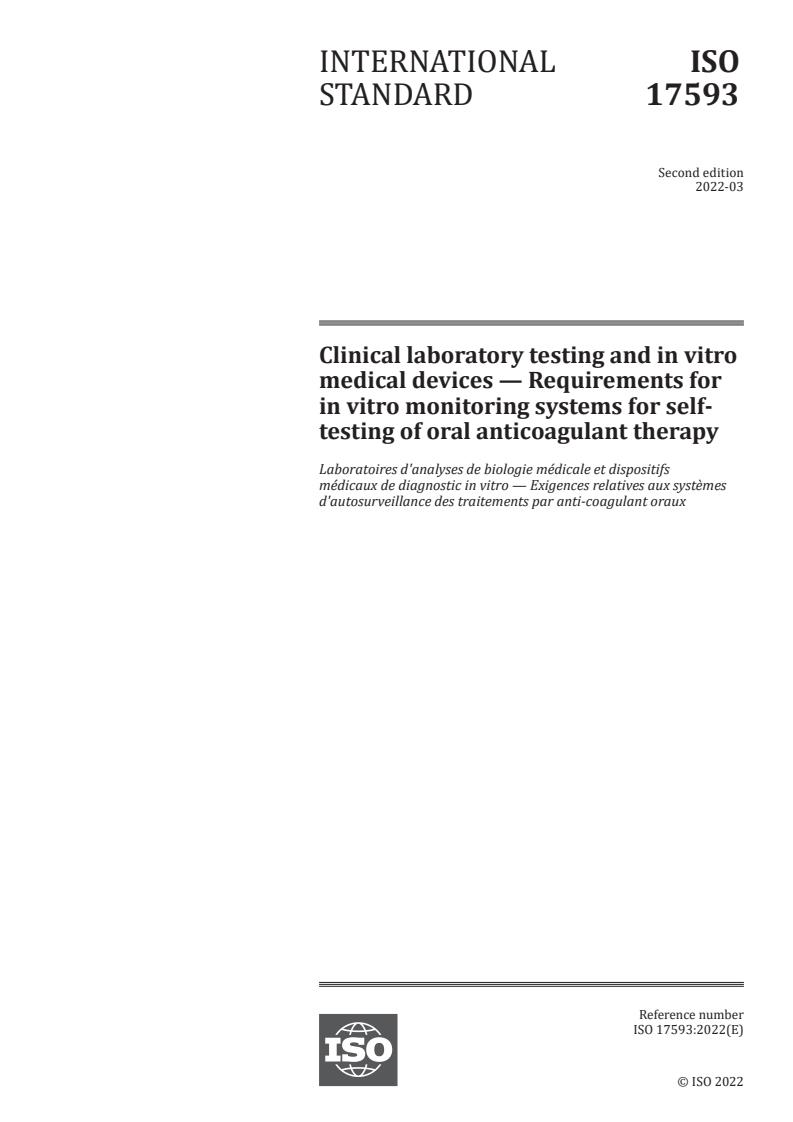
INTERNATIONAL ISO
STANDARD 17593
Second edition
2022-03
Clinical laboratory testing and in vitro
medical devices — Requirements for
in vitro monitoring systems for self-
testing of oral anticoagulant therapy
Laboratoires d'analyses de biologie médicale et dispositifs
médicaux de diagnostic in vitro — Exigences relatives aux systèmes
d'autosurveillance des traitements par anti-coagulant oraux
Reference number
© ISO 2022
All rights reserved. Unless otherwise specified, or required in the context of its implementation, no part of this publication may
be reproduced or utilized otherwise in any form or by any means, electronic or mechanical, including photocopying, or posting on
the internet or an intranet, without prior written permission. Permission can be requested from either ISO at the address below
or ISO’s member body in the country of the requester.
ISO copyright office
CP 401 • Ch. de Blandonnet 8
CH-1214 Vernier, Geneva
Phone: +41 22 749 01 11
Email: copyright@iso.org
Website: www.iso.org
Published in Switzerland
ii
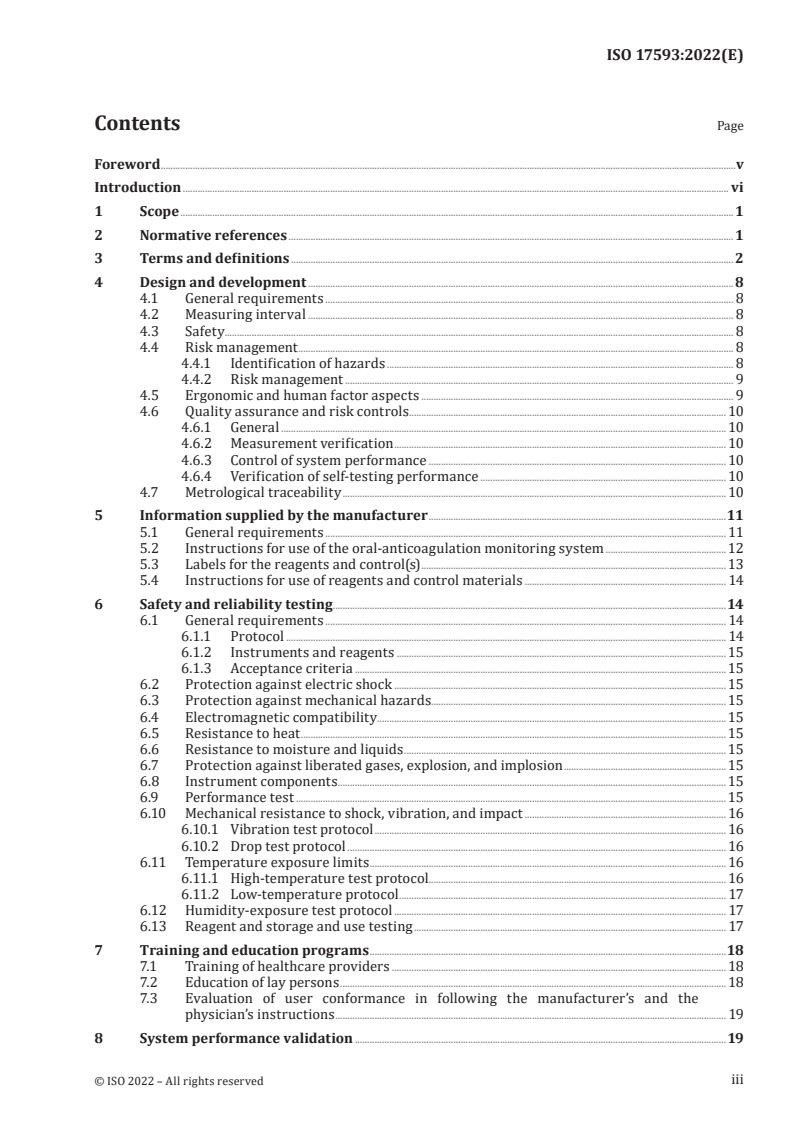
Contents Page
Foreword .v
Introduction . vi
1 Scope . 1
2 Normative references . 1
3 Terms and definitions . 2
4 Design and development .8
4.1 General requirements . 8
4.2 Measuring interval . 8
4.3 Safety. 8
4.4 Risk management . 8
4.4.1 Identification of hazards . 8
4.4.2 Risk management . 9
4.5 Ergonomic and human factor aspects . 9
4.6 Quality assurance and risk controls . 10
4.6.1 General . 10
4.6.2 Measurement verification . 10
4.6.3 Control of system performance . 10
4.6.4 Verification of self-testing performance . 10
4.7 Metrological traceability . 10
5 Information supplied by the manufacturer .11
5.1 General requirements . 11
5.2 Instructions for use of the oral-anticoagulation monitoring system .12
5.3 Labels for the reagents and control(s) . 13
5.4 Instructions for use of reagents and control materials . 14
6 Safety and reliability testing .14
6.1 General requirements . 14
6.1.1 Protocol . 14
6.1.2 Instruments and reagents . 15
6.1.3 Acceptance criteria .15
6.2 Protection against electric shock . 15
6.3 Protection against mechanical hazards. 15
6.4 Electromagnetic compatibility.15
6.5 Resistance to heat . 15
6.6 Resistance to moisture and liquids . 15
6.7 Protection against liberated gases, explosion, and implosion . 15
6.8 Instrument components . 15
6.9 Performance test . 15
6.10 Mechanical resistance to shock, vibration, and impact . 16
6.10.1 Vibration test protocol . 16
6.10.2 Drop test protocol . 16
6.11 Temperature exposure limits . . 16
6.11.1 High-temperature test protocol . 16
6.11.2 Low-temperature protocol . 17
6.12 Humidity-exposure test protocol . 17
6.13 Reagent and storage and use testing . 17
7 Training and education programs .18
7.1 Training of healthcare providers . 18
7.2 Education of lay persons . 18
7.3 Evaluation of user conformance in following the manufacturer’s and the
physician’s instructions . 19
8 System performance validation .19
iii
8.1 General . 19
8.2 Contributors to measurement uncertainty. 19
8.3 System performance validation study . 19
8.4 Validation of measurement precision . 20
8.4.1 General .20
8.4.2 Validation of measurement repeatability . 21
8.4.3 Validation of intermediate precision . 21
8.4.4 Data analysis .23
8.5 Validation of system accuracy .26
8.5.1 General requirements .26
8.5.2 Study population . 26
8.5.3 Samples/Specimen. 27
8.5.4 Instruments and reagents .28
8.5.5 Comparator measurement procedure .28
8.5.6 Study design .28
8.5.7 Procedure .29
8.5.8 Data analysis .30
8.6 Minimum acceptable system accuracy . 33
8.6.1 System accuracy requirement . 33
8.6.2 System accuracy assessment .34
8.6.3 Data presentation .34
9 Lay person performance evaluation .35
9.1 General . 35
9.2 Study overview . 35
9.3 Study sites . 37
9.4 Subjects . 37
9.5 Instruments and materials . 37
9.6 Evaluation of lay person proficiency . 37
9.6.1 Initial evaluation . 37
9.6.2 Home use .38
9.6.3 Mid and final evaluation .38
9.7 Evaluation of instructions for use .38
9.8 Acceptance criteria and data assessment . 39
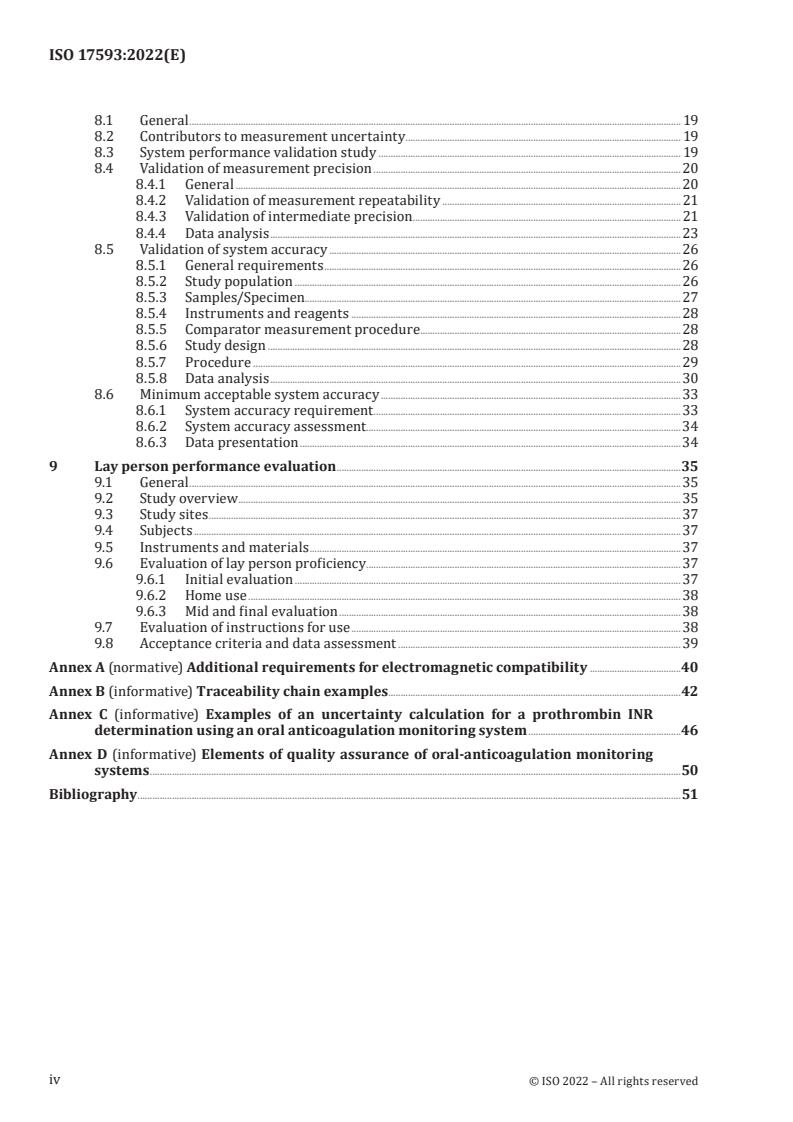
Annex A (normative) Additional requirements for electromagnetic compatibility .40
Annex B (informative) Traceability chain examples .42
Annex C (informative) Examples of an uncertainty calculation for a prothrombin INR
determination using an oral anticoagulation monitoring system .46
Annex D (informative) Elements of quality assurance of oral-anticoagulation monitoring
systems .50
Bibliography .51
iv
Foreword
ISO (the International Organization for Standardization) is a worldwide federation of national standards
bodies (ISO member bodies). The work of preparing International Standards is normally carried out
through ISO technical committees. Each member body interested in a subject for which a technical
committee has been established has the right to be represented on that committee. International
organizations, governmental and non-governmental, in liaison with ISO, also take part in the work.
ISO collaborates closely with the International Electrotechnical Commission (IEC) on all matters of
electrotechnical standardization.
The procedures used to develop this document and those intended for its further maintenance are
described in the ISO/IEC Directives, Part 1. In particular, the different approval criteria needed for the
different types of ISO documents should be noted. This document was drafted in accordance with the
editorial rules of the ISO/IEC Directives, Part 2 (see www.iso.org/directives).
Attention is drawn to the possibility that some of the elements of this document may be the subject of
patent rights. ISO shall not be held responsible for identifying any or all such patent rights. Details of
any patent rights identified during the development of the document will be in the Introduction and/or
on the ISO list of patent declarations received (see www.iso.org/patents).
Any trade name used in this document is information given for the convenience of users and does not
constitute an endorsement.
For an explanation of the voluntary nature of standards, the meaning of ISO specific terms and
expressions related to conformity assessment, as well as information about ISO's adherence to
the World Trade Organization (WTO) principles in the Technical Barriers to Trade (TBT), see
www.iso.org/iso/foreword.html.
This document was prepared by Technical Committee ISO/TC 212, Clinical laboratory testing and in
vitro diagnostic test systems.
This second edition cancels and replaces the first edition (ISO 17593:2007), which has been technically
revised.
The main changes are as follows:
— Updated with more current state of the art information that has evolved over several years.
— Subclause 8.4 Validation of measurement precision: added a more robust study design.
— Subclause 8.5.8.2 and 8.5.8.3: updated examples were added to reflect changes in criteria.
— Subclause 8.6 Minimum acceptable system accuracy : Updated requirements/performance criteria.
— Clause 9 Lay person performance evaluation: added clarity, revised performance criteria and
increased sample size.
— Removed Annex F listing of publications.
Any feedback or questions on this document should be directed to the user’s national standards body. A
complete listing of these bodies can be found at www.iso.org/members.html.
v
Introduction
Oral-anticoagulation monitoring systems are in vitro diagnostic (IVD) medical devices that measure
prothrombin time in fresh, untreated human blood specimens. Prothrombin time is an indicator of
the ability of blood to clot. IVD medical devices for self-testing of oral-anticoagulation therapy are
used predominantly by individuals who have heart valve replacements, or who are suffering from
atrial fibrillation or deep vein thrombosis and are receiving oral anticoagulant therapy with vitamin
K antagonist medicines (e.g. warfarin). Patients must maintain the level of anticoagulant in the blood
high enough to reduce thrombin formation, yet low enough to avoid excessive bleeding. An oral-
anticoagulation monitoring system allows the user to monitor anticoagulation therapy and take action
to control the level of anticoagulant present in the blood. This document applies to oral-anticoagulation
monitoring systems to be used by lay persons. The primary objectives are to establish requirements
for oral-anticoagulation monitoring systems that will enable lay persons to achieve acceptable
performance, and to specify procedures for manufacturers and other interested parties to demonstrate
conformance of such systems to the requirements stated in this document.
Performance criteria for oral-anticoagulation monitoring systems were established, based on the state-
[31]
of-the-art, which has been shown to offer significant benefit to patients . The criteria are given in
terms of “system accuracy”, because metrological terms commonly used in International Standards
(e.g. trueness and measurement uncertainty) would not be familiar to lay persons. System accuracy,
which is affected by systematic bias and random effects (and is inversely related to measurement
uncertainty), describes the degree to which the individual results produced by an oral-anticoagulation
monitoring system agree with correct international normalized ratio (INR) values when the system is
used as intended by lay persons. In setting the performance criteria, it is assumed that users will be
properly selected and will receive the necessary training and that operating and control procedures
will be followed in accordance with the manufacturer’s instructions for use. It is also assumed that
manufacturers will anticipate and mitigate the effects of reasonably foreseeable misuse, including
reasonably foreseeable deviations from recommended operating and control procedures by the
intended users.
Requirements that are unique to self-testing with oral anticoagulation monitoring systems, including
specific content of information supplied by the manufacturer, are addressed in this document.
General requirements that apply to all IVD medical devices and which are covered by other standards
(e.g. IEC 61010-1, IEC 61010-2-101, ISO 13485, ISO 14971, ISO 23640 and ISO 18113-1, ISO 18113-4,
ISO 18113-5) are incorporated by reference, when appropriate. While the goal is to standardize these
requirements, it is also recognized that current national and regional usage by patients and regulatory
authorities should be taken into consideration.
vi
INTERNATIONAL STANDARD ISO 17593:2022(E)
Clinical laboratory testing and in vitro medical devices —
Requirements for in vitro monitoring systems for self-
testing of oral anticoagulant therapy
1 Scope
This document specifies requirements for in vitro measuring systems for self-monitoring of vitamin-K
antagonist oral anticoagulation therapy, including performance, quality assurance and user training
and procedures for the validation of performance by the intended users under actual and simulated
conditions of use.
This document applies solely to prothrombin time measuring systems used by lay persons for
monitoring their own vitamin-K antagonist oral anticoagulation therapy, and which report results as
international normalized ratios (INR).
This document is applicable to manufacturers of such systems and those other organizations (e.g.
regulatory authorities and conformity assessment bodies) having the responsibility for assessing the
performance of these systems.
This document is not applicable to:
— in vitro measuring systems for coagulation quantities assessing vitamin-K antagonist oral
anticoagulation therapy used by physicians or healthcare providers;
— non-vitamin-K antagonist oral anticoagulation therapy (e.g. dabigatran);
— a comprehensive evaluation of all possible factors that can affect the performance of these systems;
— the medical aspects of oral-anticoagulation therapy.
2 Normative references
The following documents are referred to in the text in such a way that some or all of their content
constitutes requirements of this document. For dated references, only the edition cited applies. For
undated references, the latest edition of the referenced document (including any amendments) applies.
ISO 13485, Medical devices — Quality management systems — Requirements for regulatory purposes
ISO 14971, Medical devices — Application of risk management to medical devices
ISO 15198, Clinical laboratory medicine — In vitro diagnostic medical devices — Validation of user quality
control procedures by the manufacturer
ISO 17511, In vitro diagnostic medical devices — Requirements for establishing metrological traceability of
values assigned to calibrators, trueness control materials and human samples
ISO 18113-1, Clinical laboratory testing and in vitro diagnostic medical systems — Information supplied by
the manufacturer (labelling) — Part 1: Terms, definitions and general requirements
ISO 18113-4, Clinical laboratory testing and in vitro diagnostic medical systems — Information supplied by
the manufacturer (labelling) — Part 4: In vitro diagnostic reagents for self-testing
ISO 18113-5, Clinical laboratory testing and in vitro diagnostic medical systems — Information supplied by
the manufacturer (labelling) — Part 5: In vitro diagnostic instruments for self-testing
ISO 20916, In vitro diagnostic medical devices — Clinical performance studies using specimens from human
subjects — Good study practice
ISO 23640, In vitro diagnostic medical devices — Evaluation of stability of in vitro diagnostic reagents
IEC 60068-2-64:2008, Environmental testing — Part 2: Test methods — Test Fh: Vibration, broad-band
random (digital control) and guidance
IEC 60601-1-2, Medical electrical equipment - Part 1-2: General requirements for basic safety and essential
performance - Collateral Standard: Electromagnetic disturbances - Requirements and tests
IEC 61000-4-2, Electromagnetic compatibility (EMC) — Part 4-2: Testing and measurement techniques —
Electrostatic discharge immunity test
IEC 61000-4-3, Electromagnetic compatibility (EMC) — Part 4-3: Testing and measurement techniques —
Radiated, radiofrequency, electromagnetic field immunity test
IEC 61010-1:2010, Safety requirements for electrical equipment for measurement, control and laboratory
use — Part 1: General requirements
IEC 61010-2-101:2015, Safety requirements for electrical equipment for measurement, control and
laboratory use — Part 2-101: Particular requirements for in vitro diagnostic (IVD) medical equipment
IEC 61326-1, Electrical equipment for measurement, control and laboratory use — EMC requirements –
Part 1: General requirements
IEC 61326-2-6, Electrical equipment for measurement, control and laboratory use — EMC requirements –
Part 2-6: Particular requirements – In vitro diagnostic (IVD) medical equipment
EN 13532, General requirements for in vitro diagnostic medical devices for self-testing
WHO Technical Report Series, No. 889, 1999, Annex 3 — Guidelines for thromboplastins and plasma used
to control oral-anticoagulant therapy
3 Terms and definitions
For the purposes of this document, the terms and definitions given in ISO 18113-1 and the following
apply.
ISO and IEC maintain terminology databases for use in standardization at the following addresses:
— ISO Online browsing platform: available at https:// www .iso .org/ obp
— IEC Electropedia: available at https:// www .electropedia .org/
3.1
accuracy
closeness of agreement between a measured quantity value and a true quantity value of a measurand
Note 1 to entry: For oral-anticoagulation monitoring systems, accuracy is measured by the extent to which
measurements of blood (3.3) specimens from different patients agree with the INR (3.11) values traceable to a
thromboplastin international reference preparation (IRP) (3.12).
[SOURCE: ISO/IEC Guide 99:2007, 2.13, modified — Notes 1, 2 and 3 to entry have been deleted, and a
new Note 1 to entry has been added.]
3.2
bias
difference between the expectation of the test results and an accepted reference value
[SOURCE: ISO 5725-1:1994, 3.8, modified — Note 1 to entry has been deleted.]
3.3
blood
circulating intravascular tissue of the body, consisting of suspended formed elements and fluid plasma
Note 1 to entry: In this document, the term "blood" refers to fresh, untreated blood.
3.4
capillary blood specimen
blood (3.3) collected after puncturing minute vessels that connect the arterioles and venules
Note 1 to entry: Often obtained by pricking a fingertip, capillary blood is usually collected without additives.
3.5
control interval
statistically justified values specified as acceptable measured values obtained using a given quality
control
3.6
control material
substance, material, or article intended by its manufacturer to be used to verify the performance
characteristics of an in vitro diagnostic (IVD) medical device
Note 1 to entry: Control materials for anticoagulation monitoring can be reactive or nonreactive. A reactive
control material participates in a reaction with the reagent (3.28) components. A nonreactive control does not
react with the reagent (3.28) components, but may provide control functionality through other means, e.g. a
simulation of the reaction [see physical control (3.24)].
3.7
healthcare provider
individual authorized to deliver healthcare to a patient
Note 1 to entry: In this document, a healthcare provider is an individual, e.g. a doctor, nurse, technician, technical
specialist, or appropriate assistant, that provides instruction to a self-testing patient.
3.8
integrated control
quality control that is inherent in a reagent (3.28) component of a measuring system, intended by the
manufacturer to verify the performance of the measuring system
Note 1 to entry: The integrated functional control is run concurrently with a patient measurement, includes a
reactive component, and provides a functional check of the measurement procedure. The integrated control
results shall be within a predefined measurement interval for the measured value to be displayed.
3.9
intermediate precision condition
condition of measurement, out of a set of conditions that includes the same measurement procedure
(3.19), same location, and replicate measurements on the same or similar objects over an extended
period of time, but may include other conditions involving changes
[SOURCE: ISO/IEC Guide 99:2007, 2.22, modified — Notes 1, 2 and 3 to entryhave been deleted.]
3.10
intermediate precision
measurement precision under a set of intermediate precision conditions (3.9) of measurement
[6]
Note 1 to entry: The concept of intermediate levels of precision is described in ISO 5725-3:1994 .
Note 2 to entry: Quantitative measures of intermediate precision depend on the stipulated conditions.
Note 3 to entry: Intermediate precision provides an indication of the variability that will be experienced by a
user during typical use.
[SOURCE: ISO/IEC Guide 99:2007, 2.23, modified — Note 1 to entry has been deleted and new Note 1 to
entry, Note 2 to entry, and Note 3 to entry have been added.]
3.11
international normalized ratio
INR
patient’s prothrombin time (3.26) measurement result, which has been standardized for the potency
of the thromboplastin used in the measurement procedure (3.19) and expressed relative to a normal
population average
[35]
Note 1 to entry: For a discussion of the use of INR, see Poller, et al .
3.12
international reference preparation
IRP
reference calibrator maintained by the World Health Organization
Note 1 to entry: The IRP for thromboplastin is directly calibrated for potency against the original British
comparative thromboplastin preparations used in the establishment of the international normalized ratio (INR)
(3.11) system.
3.13
international sensitivity index
ISI
factor that allows the conversion of a patient’s prothrombin time (3.26) measurement result to
international normalized ratio (3.11) values
[35]
Note 1 to entry: For a discussion of the use of ISI and INR (3.11), see Poller, et al .
3.14
lay person
user of an oral-anticoagulation monitoring system who does not have specific formal medical, scientific,
or technical knowledge related to oral-anticoagulation monitoring
Note 1 to entry: “Lay person” also includes, for example, a person’s family member who performs the testing.
3.15
liquid quality control
liquid material that mimics patient specimens and monitors the testing process from specimen
application to result interpretation
3.16
manufacturer’s selected measurement procedure
measurement procedure (3.19) that is calibrated by one or more primary or secondary calibrators when
available.
[SOURCE: ISO 17511:2020, 3.43, modified — Notes 1, 2 and 3 to entry have been deleted.]
3.17
manufacturer’s standing measurement procedure
measurement procedure (3.19) used to assess (or assign values to) the end-user’s calibrator
Note 1 to entry: A standing measurement procedure may be calibrated with a reference method or with the
manufacturer’s “working” or “master” calibrator.
3.18
manufacturer’s working calibrator
working measurement standard
standard that is used routinely at the manufacturer's laboratory to calibrate or check material
measures, measuring instruments or reference materials
Note 1 to entry: This standard is used routinely at the manufacturer's laboratory to calibrate or check material
measures, measuring instruments or reference materials.
Note 2 to entry: This applies to a thromboplastin preparation used by the manufacturer during the preparation
of a prothrombin time (PT) (3.26) reagent mixture.
Note 3 to entry: The assigned value of the manufacturer’s working calibrator is metrologically traceable to that
of the international reference preparation (IRP) (3.12).
3.19
measurement procedure
detailed description of a measurement according to one or more measurement principles and to a
given measurement method, based on a measuring model and including any calculation to obtain a
measurement result
[SOURCE: ISO/IEC Guide 99:2007, 2.6, modified — Notes 1, 2 and 3 to entry have been deleted.]
3.20
measurement reproducibility
reproducibilitymeasurement precision (3.25) under reproducibility conditions (3.31) of measurement
[SOURCE: ISO/IEC Guide 99:2007, 2.25, modified — Note 1 to entry has been deleted.]
3.21
measuring interval
set of values of quantities of the same kind that can be measured by a given measuring instrument or
measuring system with specified instrumental measurement uncertainty, under defined conditions
Note 1 to entry: In some fields, the term is “measuring range” or “measurement range”.
Note 2 to entry: This represents the interval of examination results over which the performance characteristics
have been validated by the manufacturer.
[SOURCE: ISO/IEC Guide 99:2007, 4.7, modified — Note 2 to entry has been deleted and a new Note 2 to
entry has been added.]
3.22
metrological traceability
property of the result of a measurement or the value of a standard whereby it can be related to stated
references, usually national or international standards, through an unbroken chain of comparisons all
having stated uncertainties
3.23
oral anticoagulant
vitamin K antagonists (e.g. warfarin) and non-vitamin K antagonist (e.g. direct oral anticoagulant)
agents used for treating and preventing thromboembolic events
3.24
physical control
control device that does not include chemically reactive components and that is intended by the
manufacturer to verify the performance of the instrument
Note 1 to entry: The physical control system may be in the form of an electronic device that provides a simulated
reaction.
Note 2 to entry: The physical control result shall be within predefined limits, in order for the measuring system
to be considered properly functional.
3.25
precision
closeness of agreement between indications or measured quantity values obtained by replicate
measurements on the same or similar objects under specified conditions
Note 1 to entry: Measurement precision is usually expressed numerically by measures of imprecision, such as
standard deviation, variance, or coefficient of variation (CV) under the specified conditions of measurement.
Note 2 to entry: The ‘specified conditions’ can be, for example, repeatability conditions (3.29), intermediate
precision conditions (3.9), or reproducibility conditions (3.31). See ISO 5725-1:1994.
Note 3 to entry: Measurement precision is used to define repeatability (3.30) of measurement, intermediate
precision (3.10), and measurement reproducibility (3.20).
Note 4 to entry: Sometimes “measurement precision” is erroneously used to mean measurement accuracy.
[SOURCE: ISO/IEC Guide 99:2007, 2.15]
3.26
prothrombin time
PT
time required to clot a blood (3.3) specimen once exposed to a thromboplastin or tissue-factor derived
reagent (3.28) material
3.27
prothrombin time measuring system
measuring system that records the time required for a specimen to clot after being exposed to a
thromboplastin or tissue-factor derived reagent (3.28)
Note 1 to entry: The system includes the reagent (3.28) plus the instrument used to record the clotting time.
3.28
reagent
part of the in vitro diagnostic (IVD) medical device that produces a signal via a chemical or
electrochemical reaction, which allows the quantity to be detected and its value measured in a specimen
3.29
repeatability condition
condition of measurement, out of a set of conditions that includes the same measurement procedure,
same operators, same measuring system, same operating conditions and same location, and replicate
measurements on the same or similar objects over a short period of time
Note 1 to entry: Repeatability condition is essentially unchanging conditions, intended to represent conditions
resulting in minimum variability of measurement results.
Note 2 to entry: For the purposes of this document, “laboratories” should be interpreted as “locations”.
[SOURCE: ISO/IEC Guide 99:2007, 2.20, modified — Notes 1 and 2 to entry have been deleted, and new
Notes 1 and 2 to entry have been added.]
3.30
repeatability
measurement precision (3.25) under a set of repeatability conditions (3.29) of measurement
[SOURCE: ISO/IEC Guide 99:2007, 2.21]
3.31
reproducibility condition
condition of measurement, out of a set of conditions that includes different locations, operators,
measuring systems, and replicate measurements on the same or similar objects
[SOURCE: ISO/IEC Guide 99:2007, 2.24, modified — Notes 1 and 2 to entry have been deleted.]
3.32
secondary reference measurement procedure
measurement procedure (3.19) that is calibrated by one or more primary calibrators
Note 1 to entry: The measurement procedure (3.19) for prothrombin time (3.26) measurements is sometimes
referred to as a “secondary standard procedure”.
3.33
system accuracy
closeness of agreement of a set of representative measurement results from a measuring system and
their respective reference values
Note 1 to entry: The term accuracy (3.1) of measurement, when applied to a set of measurement results, involves
a combination of random error components and a common systematic error or bias (3.2) component.
Note 2 to entry: Reference values are assigned by a measurement procedure (3.19) traceable to a reference
measurement procedure of higher order.
Note 3 to entry: System accuracy may be expressed as the interval that encompasses 95 % of the differences
observed between the results of the system being evaluated and their reference values. This interval also
includes measurement uncertainty from the measurement procedure (3.19) used to assign the reference values.
3.34
trueness
agreement between the average value obtained from a large series of measurement results and an
accepted reference value
Note 1 to entry: A measure of trueness is usually expressed as bias (3.2).
3.35
type test
test of one or more samples of equipment (or parts of equipment) made to a particular design, to show
that the design and construction meet one or more requirements of the applicable standard
Note 1 to entry: Statistical sampling is not required for a type test.
[SOURCE: IEC 61326-1:2012, 3.1.13 , modified — Note 1 to entry added.]
3.36
user comformance
ability and willingness of the user of a measuring system to adhere to and operate within the defined
specifications of a measurement procedure (3.19)
3.37
validation
confirmation, through the provision of objective evidence, that the requirements for a specific intended
use or application have been fulfilled
Note 1 to entry: The word “validated” is used to designate the corresponding status.
Note 2 to entry: The use conditions for validation can be real or simulated.
Note 3 to entry: In design and development, validation concerns the process of examining an item to determine
conformity with user needs.
Note 4 to entry: Validation is normally performed during the final stage of development, under defined operating
conditions, although it may also be performed in earlier stages.
Note 5 to entry: Multiple validations may be carried out if there are different intended uses.
[SOURCE: ISO 9000:2015, 3.8.13, modified — Note 1 to entry was deleted and Notes 3, 4 and 5 to entry
have been added.]
3.38
venous blood specimen
blood (3.3) collected after directly puncturing a vein, usually with a needle and syringe, or another
collection device
Note 1 to entry: Venous blood may be collected without additives such as anticoagulants or preservatives,
and if so, will be inherently unstable. Venous blood may also be collected in containers containing additives or
preservatives with the intent to stabilize specific components.
3.39
verification
confirmation, through the provision of objective evidence, that specified requirements have been
fulfilled
Note 1 to entry: The word “verified” is used to designate the corresponding status.
Note 2 to entry: Design verification is the application of tests and appraisals to assess conformity of a design to
the specified requirement.
[SOURCE: ISO 9000:2015, 3.8.12, modified — Notes 1 and 2 to entry were deleted and new Note 2 to
entry has been added.]
3.40
volume fraction of erythrocytes in blood
proportion of packed cells in a blood (3.3) specimen
Note 1 to entry: It is expressed as a fraction, but often given as a percentage (conventional) of the SI unit.
Note 2 to entry: It is sometimes referred to as “haematocrit”, after the instrument originally used to estimate the
volume fraction of erythrocytes in blood (3.3).
4 Design and development
4.1 General requirements
The requirements specified in ISO 13485 apply.
The requirements specified in E
...
Questions, Comments and Discussion
Ask us and Technical Secretary will try to provide an answer. You can facilitate discussion about the standard in here.
Loading comments...