


EN 1337-5:2005
(Main)Structural bearings - Part 5: Pot bearings
Structural bearings - Part 5: Pot bearings
This part of EN 1337 specifies the requirements for the design and manufacture of pot bearings which will be used for operating temperatures between - 40 °C and 50 °C.
This part of EN 1337 does not apply to pot bearings made with other materials than those specified in clause 5.
Bearings which are subjected to rotation ad greater than 0,030 rad (see Figure 2) under the characteristic combination of actions or which incorporate elastomeric pads larger than 1500 mm in diameter are beyond the scope of this document.
Depending on the climatic region where the construction work is located the bearings can be designed to one of the following classes related to minimum operating temperatures (the minimum shade air temperatures): - 25 °C or - 40 °C.
When required to accommodate translational movements, pot bearings may be combined with sliding elements in accordance with EN 1337-2.
NOTE The minimum shade air temperature for a location should be obtained from meteorological data appropriate to a 120 year return period. Consideration should be given to adjustment of this temperature for height and local divergence such as frost pockets and sheltered low-lying areas if the data obtained applies to a general area rather than to a specific location.
Lager im Bauwesen - Teil 5: Topflager
Dieser Teil von EN 1337 legt die Anforderungen an die Bemessung und die Herstellung von Topflagern für Betriebstemperaturen zwischen -40 °C und 50 °C fest.
Dieser Teil von EN 1337 gilt nicht für Topflager, die aus anderen Materialien als die in Abschnitt 5 aufgeführten bestehen.
Lager, die unter der charakteristischen Kombination von Einwirkungen Verdrehungen ad von mehr als 0,030 Radian ausgesetzt sind (siehe Bild 2) oder die Elastomerkissen mit einem Durchmesser größer als 1500 mm enthalten, sind nicht Gegenstand dieser Europäischen Norm.
In Abhängigkeit von der Klimazone, in der sich das Bauwerk befindet, können die Lager für eine der folgenden Klassen der Mindestbetriebstemperatur (Mindestlufttemperatur im Schatten) bemessen werden: -25 °C oder -40 °C.
Zur Aufnahme von Tragwerksverschiebungen können Topflager mit Gleitteilen nach EN 1337-2 kombiniert werden.
ANMERKUNG Die Mindestlufttemperatur im Schatten für einen Ort sollte aus meteorologischen Daten für eine Wiederkehrperiode von 120 Jahren entnommen werden. Diese Temperatur kann abhängig von Höhe und örtlichen Abweichungen, wie z. B. Mulden mit erhöhter Frostbildung sowie geschützte tief liegende Gegenden, modifiziert werden, sofern sich die Daten auf eine Gegend im Allgemeinen eher als auf einen bestimmten Ort beziehen.
Appareils d'appui structuraux - Partie 5: Appareils d'appui à pot
La présente partie de l'EN 1337 spécifie les exigences pour la conception et la fabrication d'appareils d'appui à pot destinés à une utilisation à des températures de service comprises entre - 40 °C et 50 °C.
La présente partie de l'EN 1337 ne s'applique pas aux appareils d'appui à pot constitués d'un matériau différent de ceux spécifiés à l'Article 5.
Les appareils d'appui soumis à une rotation ad supérieure à 0,030 rad (voir Figure 2) sous la combinaison caractéristique d'actions ou ceux qui comportent des coussins en élastomère de diamètre supérieur à 1 500 mm n'entrent pas dans le domaine d'application du présent document.
Selon le climat de la région où l'ouvrage est situé, les appareils d'appui peuvent être conçus pour appartenir à une des classes suivantes, liées aux températures de service minimales (températures minimales à l'ombre) : - 25 °C ou - 40 °C.
Lorsque les appareils d'appui à pot doivent supporter des mouvements en translation, il est possible de les combiner avec des éléments de glissement conformes à l'EN 1337-2.
NOTE Il convient d'obtenir la température minimale à l'ombre d'un lieu à partir de données météorologiques appropriées pour une période de retour de 120 ans. Il convient de considérer l'ajustement de cette température à l'altitude et aux divergences locales telles que les poches de gelée et les zones basses abritées, dans le cas ou les données obtenues s'appliquent à une zone générale et non à un lieu particulier.
Konstrukcijska ležišča – 5. del: Lončna ležišča
General Information
Relations
Standards Content (Sample)
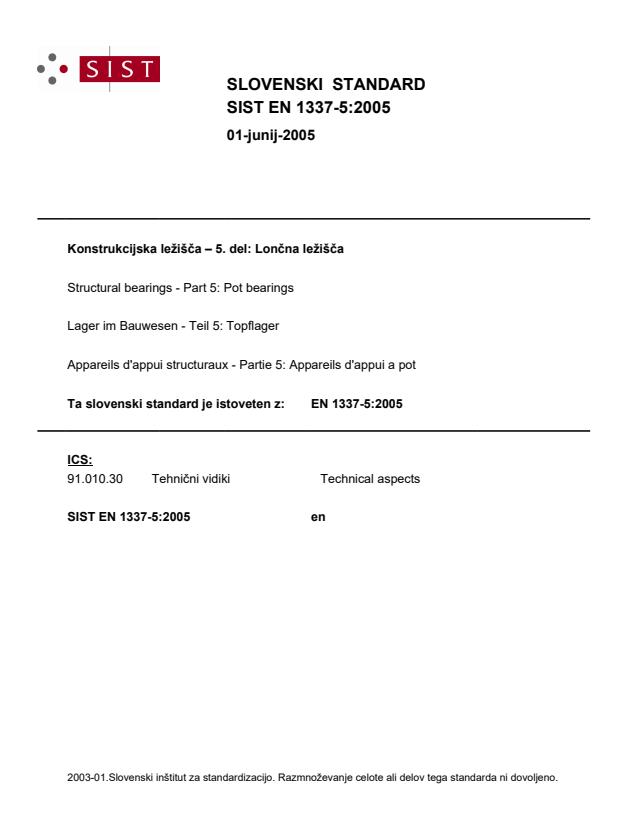
2003-01.Slovenski inštitut za standardizacijo. Razmnoževanje celote ali delov tega standarda ni dovoljeno.Structural bearings - Part 5: Pot bearingsAppareils d'appui structuraux - Partie 5: Appareils d'appui a potLager im Bauwesen - Teil 5: Topflager91.010.30Technical aspectsICS:SIST EN 1337-5:2005enTa slovenski standard je istoveten z:EN 1337-5:200501-junij-2005SIST EN 1337-5:2005SLOVENSKI
STANDARD
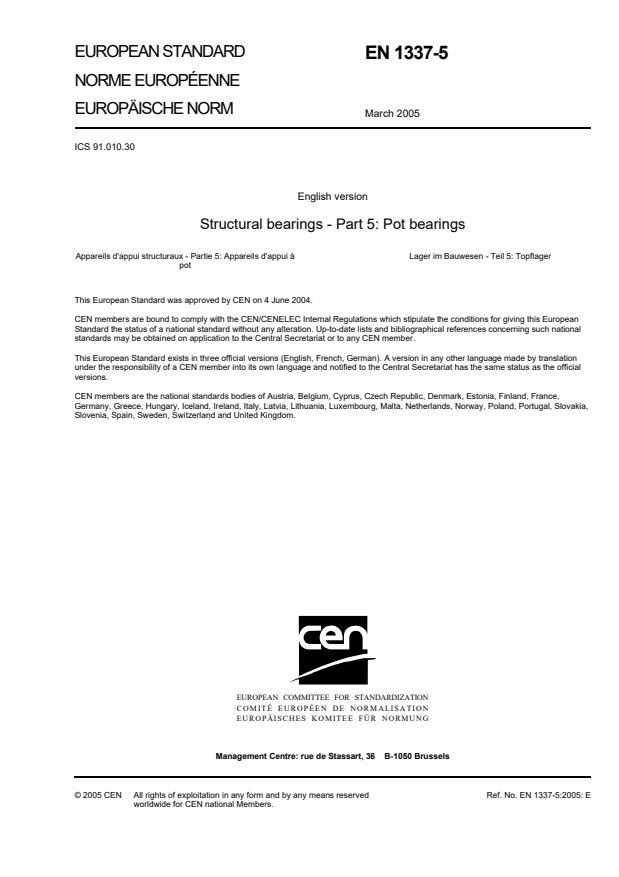
EUROPEAN STANDARDNORME EUROPÉENNEEUROPÄISCHE NORMEN 1337-5March 2005ICS 91.010.30English versionStructural bearings - Part 5: Pot bearingsAppareils d'appui structuraux - Partie 5: Appareils d'appui àpotLager im Bauwesen - Teil 5: TopflagerThis European Standard was approved by CEN on 4 June 2004.CEN members are bound to comply with the CEN/CENELEC Internal Regulations which stipulate the conditions for giving this EuropeanStandard the status of a national standard without any alteration. Up-to-date lists and bibliographical references concerning such nationalstandards may be obtained on application to the Central Secretariat or to any CEN member.This European Standard exists in three official versions (English, French, German). A version in any other language made by translationunder the responsibility of a CEN member into its own language and notified to the Central Secretariat has the same status as the officialversions.CEN members are the national standards bodies of Austria, Belgium, Cyprus, Czech Republic, Denmark, Estonia, Finland, France,Germany, Greece, Hungary, Iceland, Ireland, Italy, Latvia, Lithuania, Luxembourg, Malta, Netherlands, Norway, Poland, Portugal, Slovakia,Slovenia, Spain, Sweden, Switzerland and United Kingdom.EUROPEAN COMMITTEE FOR STANDARDIZATIONCOMITÉ EUROPÉEN DE NORMALISATIONEUROPÄISCHES KOMITEE FÜR NORMUNGManagement Centre: rue de Stassart, 36
B-1050 Brussels© 2005 CENAll rights of exploitation in any form and by any means reservedworldwide for CEN national Members.Ref. No. EN 1337-5:2005: E
Internal seals.24 Annex B (informative)
Determination of compression stiffness.29 Annex C (informative)
Factory Production Control (FPC).30 Annex D (normative)
Determination of restraint moment.33 Annex E (normative)
Long term rotation and load test.37 Annex F (normative)
Test equipment.41 Annex G (informative)
Application of internal seals.43 Annex ZA (informative)
Clauses of this European Standard addressing the provisions of the EU Construction Products Directive.44 Bibliography.56
Part 11 Transport, storage and installation According to the CEN/CENELEC Internal Regulations, the national standards organizations of the following countries are bound to implement this European Standard: Austria, Belgium, Czech Republic, Denmark, Finland, France, Germany, Greece, Iceland, Ireland, Italy, Luxembourg, Malta, Netherlands, Norway, Portugal, Spain, Sweden, Switzerland and the United Kingdom.
EN 1337-1:2000, Structural bearings — Part 1: General design rules. EN 1337-2:2004, Structural bearings — Part 2: Sliding elements. EN 1337-9:1997, Structural bearings — Part 9: Protection. EN 1337-10, Structural bearings — Part 10: Inspection and maintenance. EN 1990, Eurocode - Basis of structural design. EN 10025-1, Hot rolled products of structural steels - Part 1: General technical delivery conditions. EN 10025-2, Hot rolled products of structural steels - Part 2: Technical delivery conditions for non-alloy structural steels EN 10083-3, Quenched and tempered steels — Part 3: Technical delivery conditions for boron steels. EN 10088-2, Stainless steels — Part 2: Technical delivery conditions for sheet/plate and strip for general purposes. EN 10113-1, Hot-rolled products in weldable fine grain structural steels — Part 1: General delivery conditions. EN 10204, Metallic products — Types of inspection documents.
calibration of the force-measuring system (ISO 7500-1:2004) ISO 1083, Spheroidal graphite cast irons — Classification. ISO 1183, Plastics — Methods for determining the density of non-cellular plastics. ISO 3755, Cast carbon steels for general engineering purposes. ISO 6446, Rubber products — Bridge bearings — Specification for rubber materials. 3 Terms, definitions, symbols and abbreviations 3.1 Terms and definitions For the purposes of this document, the following terms and definitions apply (see Figure 1).
Key 1 Internal seal 2 Piston 3 Protection by external seal in this area 4 Elastomeric pad 5 Pot NOTE Pot bearings can be used with the pot inverted. Figure 1 — Details of a pot bearing
3.1.1 accumulated slide path the sum of the relative movements between the internal seal and the pot wall resulting from variable rotations 3.1.2 elastomeric pad component which provides the rotational capability 3.1.3 external seal component or material which is used to exclude moisture and debris from the gap between the piston and the pot 3.1.4 internal seal component which prevents escape of the elastomer material through the clearance between the recess walls and the piston when a compressive force is applied 3.1.5 lubricant special grease used to reduce the friction between the pad and the metallic components for the purpose of reducing wear as well as the rotation stiffness 3.1.6 piston component which closes the open end of the recess in the pot and bears on the elastomeric pad
internal diameter of pot, in millimetres DO outer diameter of pot ring, in millimetres F0 factor in restoring moment formula for zero rotation F1 factor in restoring moment formula for lubricated pad F2 factor in restoring moment formula for unlubricated pad Fw, resistance of weld in Newton per millimetre Fxy, applied horizontal load, in Newton H
depth of the cylindrical recess in millimetres M resistance moment from pad and internal seal in test in Newton millimetre Me resistance moment from pad and internal seal in Newton millimetre MR additional moment from friction between piston and pot in Newton millimetre MT total resistance moment from rotation in Newton millimetre N axial force in Newtons R
radius of contact surface in millimetres T thickness of the pot base in millimetres V total transverse or shear force in Newton V' total transverse or shear force per unit length in Newton per millimetre
effective contact diameter of upper surface, in millimetres dcb
effective contact diameter of lower surface, in millimetres fU ultimate strength of material, in Newton per square millimetre fy yield strength of material, in Newton per square millimetre fe,d design contact strength of the elastomer, in Newton per square millimetre t
nominal thickness of elastomeric pad in millimetres
w
width of piston face in millimetres 3.2.3 Greek letters γM partial safety factor α rotation angle due to permanent and variable actions, in radians α1 resultant rotation angle due to permanent actions, in radians α2 resultant rotation angle due to traffic loads, in radians θ rotation angle in restoring moment test, in radians 3.2.4 Subscripts Rd
design resistance d
design value Sd
design internal forces and moments from actions u
ultimate limit state
3.3 Abbreviations PTFE polytetrafluoroethylene POM polyoxymethylene (acetal)
When using an internal seal system indicated in annex A, pot bearings designed and used in accordance with this part of EN 1337 are considered to meet the aforementioned requirements. 4.2 Tests for durability When necessary (see 5.4) the long term functioning according to 4.1 shall be tested in accordance with annex E. Acceptance criteria for these tests are: there shall be no extrusion of cohesive elastomeric material. the compression deformation under the test load shall have not increased for at least 24 h. NOTE Wear of the seal and discoloration of the lubricant is acceptable in these tests. 5 Materials 5.1 General Materials used for the manufacture of pot bearings shall be in accordance with the requirements given in the following sub-clauses.
5.2 Ferrous materials for pot and piston The pot and piston shall be manufactured from ferrous materials in accordance with one of the following standards: EN 10025, EN 10083-3, EN 10113-1, EN 10088-2, ISO 3755, ISO 1083. Specification and certification of material shall correspond to the requirements for resistance and durability, weldability, if applicable, and the operating temperature specified (see clause 1). 5.3 Elastomeric materials The elastomer material used for the elastomeric pad shall be natural or polychloroprene rubber in accordance with ISO 6446.
5.4 Internal seal Suitable internal seals are given in annex A.
The internal seals given in annex A shall be classified with regard to the standard accumulated slide path, given in annex E as follows:
accumulated slide path “b”, 1000 m Seals according to A.1.2 and A.1.3
accumulated slide path “c”, 2000 m Seals according to A.1.4
accumulated slide path “a”, 500 m NOTE All seals given in annex A can be considered as suitable, according to the state of the art. Internal seals made from materials not specified in annex A are beyond the scope of this standard and the test procedures described herein are not necessarily applicable, particularly with regard to long term effects. For a seal system not specified in annex A, the ability of a pot bearing to satisfy these requirements shall be verified by testing in accordance with 4.2. 5.5 Lubricant The lubricant shall not be harmful to the elastomer or other components and shall not cause excessive swelling of the elastomer. Swelling of the elastomer is excessive when the relative change in weight is ≥ 8 % at 50 °C. 6 Design requirements 6.1 Design fundamentals 6.1.1 Principles of design calculation For the design of bearings, the principles given in clause 5 of EN 1337-1:2000 apply. The design values of the effects (forces, deformations, movements) from the actions at the supports of the structure shall be calculated from the relevant combination of actions according to EN 1990. NOTE
The decisive design values are assumed to be available from a bearing schedule as shown in prEN 1993-2. Until prEN 1993-2 is available the guidance given in annex B of EN 1337-1:2000 may be used. 6.1.2 Rotation limitation 6.1.2.1 General The relationship between the permanent and variable rotation angles is shown in Figure 2.
Key 1 Starting position (after installation) 2 Position due to rotation α1 caused by permanent actions α2min, α2 max negative and positive rotation angles due to variable loads. ∆α2 range of rotation angles due to extreme positions of variable loads αmax = α1 + α2max
(1) Figure 2 — Diagramatic representation of rotation angles 6.1.2.2 Rotation limitation Under the characteristic combination of actions the maximum rotation αdmax shall not exceed 0,03 rad. Under the frequent combination of actions the difference in rotation ∆αd2 shall not exceed 0,005 rad. 6.1.2.3 Variable rotation Variable rotations result in an accumulated slide path, which affects the durability of the internal seal.
When required the actual accumulated slide path SA,d shall be calculated with data provided by the bridge designer using the following formula: 22vdA,DnS×∆×=α (2) TdA,scS×≤ (3) in which: SA,d = actual accumulated slide path due to characteristic traffic loads nv = number of vehicles (lorries) for the intended life of the bearing c = factor to correct for the difference between the constant amplitude slide path used in the tests and the variable amplitude movements which actually occur due to traffic (equals :5)
is the resultant rotation angle due to permanent actions effects, in radians (rad), see Figure 2. α2max
is the resultant rotation angle due to variable actions, in radians (rad) see Figure 2. 6.1.3.2 Resistance to rotation due to pot/piston contact The additional moment Mµmax caused by friction at the pot/piston contact surface shall be considered. In determining this moment the maximum coefficient of friction between the pot wall and the piston shall be taken as 0,2. 6.1.3.3 Total restraint due to rotation The total restraint due to rotation to be considered in the design of the adjacent structure and bearing components shall be taken as the vectorial sum of the moments determined in accordance with 6.1.3.1 and 6.1.3.2. 6.1.4 Vertical deformation If the elastic compression stiffness of the bearing is of relevance to the design of the adjacent structure it shall be determined by means of testing (see annex B). 6.1.5 Load distribution through components The load dispersion angle through a component, as shown in Figure 3, shall be taken as 45° unless a greater angle is justified by calculations which take into account the characteristics of the adjacent components, materials and structural members. In no case shall the load dispersion angle exceed 60°.
Key 1 Load dispersion angle Figure 3 — Load distribution through components 6.1.6 Combination with sliding elements When a pot bearing is combined with a sliding element in accordance with EN 1337-2, the interaction of the respective components particularly with regard to their relative stress and strain shall be considered. Additional mechanical and geometrical effects e.g. due to lateral forces in guides (friction, couple from action and reaction) causing eccentricities additional to those resulting from resistance to rotation as given in 6.1.3 shall be taken into account. 6.2 Design verification 6.2.1 Elastomeric pad 6.2.1.1 Contact stress The design axial force NSd shall meet the following condition under the fundamental combination of actions: NSd ≤ NRd Where: MRkRdγNN= is the design value of resistance of the elastomeric pad (5) NRk is the characteristic value of resistance of the elastomeric pad The characteristic value of the resistance shall be determined from: ke,2Rkf4××=dNπwhere: (6) d is the diameter of elastomeric pad (mm) fe,k is the characteristic contact strength of the elastomer given by fe,k = 60 N/mm2
NOTE 1 The compressive resistance fe,k of the elastomer in pot bearings, that leads to NRk is limited by the effectiveness of the seal preventing the elastomer from extruding between the piston and the pot wall.
The recommended value of γM = 1,30. 6.2.1.2 Minimum thickness
Figure 4 — Permissible deflection in elastomeric pad The dimensions of the elastomeric pad shall be such that under the characteristic combination of actions the total rotation α dmax (see Figure 2) does not cause a deflection, ∆t, at the perimeter greater than 15 % of the pad thickness t (See Figure 4). To comply with this requirement the minimum elastomeric pad thickness shall be: dt××=maxdmin3,33α (7) In addition the elastomeric pad thickness, tmin, shall not be less than 15d 6.2.2 Pot For designing the pot to accommodate the lateral elastomeric pressure and the forces due to applied horizontal actions, the design stresses in the pot shall not exceed the design value of the yield strength at any section due to the fundamental combinations of actions.
Figure 5 — Types of pot construction
The analysis of the pot shall be based on the following assumptions: – The analytical model comprises the pot as well as the adjacent structural members and the boundary conditions due to fixing devices. The elastomeric pad is assumed to have hydrostatic characteristics under pressure. The pressure between piston and pot walls resulting from external horizontal actions is assumed to be parabolically distributed over half of the perimeter and the maximum value is taken as 1,5 times the mean value. Instead of a precise calculation under the above conditions (e.g. by means of finite element method) it is admissible to verify a pot designed according to Figures 5a) to c) by using the following simplified formulae considering the pot walls and the pot base as separate components. For this procedure the thickness of the pot base shall be at least 12 mm.
a) Pot walls subjected to tensile force: VSd ≤ VRd
where:SdFxy,Sde,SdVVV+= (8)
(11) where AR = (D0 - D) × H (12) b) Pot walls subjected to shear force: ''VVRdSd=< (13) Where DV,VV'SdFxy,Sde,Sd51+= (14) ()32M0yRd××−×=γDDf'V (15) c) Pot base subjected to tensile force: VSd ≤ VRd Where SdFxy,Sde,SdVVV+= (16) MpyRdγAfV×= (17) where Ap = D0 × T (18) d) Full penetration butt weld connecting the pot base to the pot wall within the pot wall (see Figure 5 (b)) : VSd ≤ VRd Where SdFxy,Sde,SdVVV+= (19) MpyRdγAfV×=< (20) where Ap = D0 × T (21) e) Partial penetration butt welds connecting the pot base to the pot wall within the pot wall: VSd ≤ VRd Where SdFxy,Sde,SdVVV+= (22) VRd=ΣFw,Rd ·D (23)
In all forms of construction, allowance shall be made for the adverse effects of any holes.
6.2.3 Piston/pot contact 6.2.3.1 General The contact face of the piston may be designed as flat in accordance with 6.2.3.2 provided that the width of the piston contact face, w, is less than 15 mm (see Figure 6). The mechanical resistance of contact faces shall be verified for the fundamental combination of actions in accordance with 6.2.3.2 or 6.2.3.3.
Key 1 Break edges Figure 6 — Details of flat piston contact face 6.2.3.2 Flat contact surface Flat contact faces shall be verified, so that: V,Sd ≤ V,Rd where
V,Sd is the design value of the transverse force (N) MyRd1,5γ×××=wDfV (25)
D is the internal diameter of pot (mm) fy is the yield strength of material (N/mm2) w
is the width of piston face (mm) NOTE γM values are defined in Eurocodes EN 1992 to EN 1999. Such values are defined in the national annex attached to the relevant Eurocodes. The recommended value is γM
= 1.
6.2.3.3 Curved contact surface Curved contact surfaces shall have a radius R (see Figure 7), of not less than 0,5 × D or 100 mm, whichever is the greater.
They shall be verified, so that VSd ≤ VRd
where 2Md2uRdEDRf15Vγ××××=
(26) where : R
is the radius of contact surface (mm) fU
is the ultimate strength of material (N/mm2) Ed
is the design modulus of elasticity (N/mm2) D see Figure 5 NOTE 1 The ability of curved surfaces and plates to withstand deformation under load is dependent upon the hardness of the material from which they are made. There is not a constant relationship between hardness and yield stress of steel but there is between hardness and ultimate strength. Consequently the above expressions are based on the ultimate strength of the material. NOTE 2 A force concentration factor 1,5 is included in the factor 15 (see 6.2.2).
Figure 7 — Details of curved contact face NOTE 3
γM values are defined in Eurocodes EN 1992 to EN 1999. Such values are defined in the national annex attached to the relevant Eurocodes. The recommended value is γM
= 1.
Figure 8 — Sketch illustrating geometrical conditions for rotation For the fundamental combination of action it shall be shown that: The edge of the piston/elastomer contact face remains within the cylindrical recess formed by the pot wall around the whole circumference (Point 1 in Figure 8). There is no contact between the top of the pot wall and any other metallic component (Point 2 in Figure 8). The above conditions are satisfied when: ()()dmax5,05,0aDbwtHd+××+×−+≥α (27) ()'5,0-DatHhdmaxdp××++=α (28) Where ad = 0,01 × D or 3 mm whichever is greater, but not exceeding 10 mm. For flat surfaces b = w. For curved surfaces DERV,b×××=dSdFxy,1,5043
and w = b + αD where: R
is the radius of contact surface (mm) Ed
is the design modulus of elasticity (N/mm2) αdmax is the design value of the maximum rotation angle (see Figure 2) 6.2.5 Fixing to the adjacent structure To ensure safety against sliding in joints, the connection between bearing and structure shall be in accordance with 5.2 of EN 1337-1:2000. 6.2.6 Stress at the adjacent structure Verification shall be in accordance with the relevant standard for the structure. The effective contact diameters dct and dcb (see Figure 3) shall be determined in accordance with 6.1.5. Eccentricity e shall be determined from moments as defined in 6.1.3 and from the moment caused by design applied
The tolerance on thickness shall be -0 +2,5 mm for d ≤ 750 mm and -0 + d/300 for 750 mm < d < 1500 mm. A vertical and/or horizontal subdivision of the elastomeric pad in several parts is admissible under the following conditions: - The total pad meets the required tolerances. 7.2 Parallelism of outer surfaces Where the upper and lower surfaces of a bearing are intended to be parallel the deviation from parallelism between any two pairs of points on the surfaces shall not be more than 0,1 % when the difference in the vertical distance between each pair is expressed as a percentage of the horizontal separating them. Where the upper and lower surfaces are intended to be inclined in relation to each other a similar tolerance shall apply between the actual and intended inclination. 7.3 Fit of components 7.3.1 Piston in pot The maximum diametrical clearance between the pot and the piston shall not exceed 1 mm for metallic and POM seals and 0,8 mm for carbon filled PTFE seals. When using internal seals not described in annex A the clearance shall not exceed that which existed in the specimens tested in accordance with annexes E and F. 7.3.2 Elastomeric pad in pot In the unloaded condition the diametrical clearance between the pot and the elastomeric pad shall not exceed 0,2 % of the diameter of the elastomeric pad or 1,0 mm whichever is greater.
7.3.3 Holes for fixing bolts Tolerance for holes for fixing bolts shall be related to the function of the bolts and the likely conditions prevailing at the time of installation of the bearings. As a guide, holes for fixing bolts or locating devices shall be drilled within 1 mm of the position shown on the drawings. 7.4 Surface roughness The surface roughness, RY5i, of the inner cylindrical surface of the pot in contact with the elastomer shall not exceed 6,3 µm. The plane surface of the pot in contact with the elastomer shall not exceed 25 µm when measured in accordance with EN ISO 4288. The surface roughness, RY5i, of the plane surface of the piston in contact with the elastomer shall not exceed 25 µm when measured in accordance with EN ISO 4288. 7.5 Corrosion protection Requirements for corrosion protection are given in EN 1337-9.
Table 2 — Specific testing of raw materials and constituents Type of inspection certificate in accordance with EN 10204 Subject of control Control in accordance with Frequency Ferrous materials for pot & piston Standards listed in 5.2 Elastomeric pad 5.3 a, 7.1 Brass A.1.1, A.2.1 POM seal A.1.2, A.2.2 Carbon filled PTFE seal A.1.3, A.2.3 Stainless steel seal A.1.4, A.2.4 Seal system not specified in annex A 8.2 Every batch 3.1.B Lubricant
5.5
Every 500 kg batch a Only tensile strength and hardness.
Internal seals A.1 General requirements A.1.1 Brass seal The internal brass seal shall be fitted into a formed recess in the upper edge of the elastomeric pad and shall consist of a number of split rings formed to the internal diameter of the pot. When fitted, the gap between the ends of the ring shall not exceed 0,5 mm and the gaps in adjacent rings shall be equally disposed around the perimeter of the pot. Where possible no gap should coincide with the point of maximum rotation movement on the pot wall. Rings with a minimum cross-section of 10 mm × 2 mm may have slits 7 mm deep × 0,5 mm wide spaced at 5 mm around the inner diameter to facilitate forming. Rings with a smaller cross-section shall not have slits. Table A.1 — Allowable solid brass sealing ring configurations Diameter d mm Minimum cross-section
mm Slits Number of rings ≤ 330 6 × 1,5 Not permitted 2 > 330 < 715 10 × 1,5 Not permitted 2 = 715 <1500 10 × 1,5 Not permitted 3 < 1500 10 × 2 7 mm × 0,5 mm 5 mm spacing 3
A.1.2 POM seal The POM sealing chain shall consist of individual interlocking elements, which can adapt easily to deformation. Width and height of the individual elements shall be: a) elastomer diameter d ≤ 550 mm: 10 mm ± 0,5 mm; b) elastomer diameter d> 550 mm: 15 mm ± 1,0 mm. The POM sealing ring shall be moulded as an integral part of the elastomeric pad during the vulcanisation process to ensure correct functioning. See Figure A.2. A.1.3 Carbon filled PTFE seal The carbon filled PTFE seal shall be completely recessed into the elastomeric pad.
Key 1 Brass angle 2 Sealing ring Figure A.1 — Typical seal joint A.2 Material requirements A.2.1 Brass seal The material used for the brass seal shall be grade CuZn37 or CuZn39Pb3, as specified in EN 12163 and EN 12164 respectively, in the metallurgical condition used in the type tests.
The dimensions shall be as shown in Figure A.2 a) and b).
a) Small POM element (For diameter of elastomeric pad up to 550 mm)
b) Large POM element (For diameter of elastomeric pad above 550 mm) Figure A.2 — Dimensions of POM seal
Table A.3 — Mechanical and physical properties of carbon filled PTFE seal Properties In accordance with Requirements Density ISO 1183 2100 kg/m3 to 2150 kg/m3 Ultimate tensile strength EN ISO 527-2 ≥ 17 N/mm
Ultimate strain EN ISO 527-1 ≥ 80 % Ball hardness EN ISO 2039-1 ≥ 40 N/mm
The material properties shall be verified on samples taken from finished tubes at 23 °C and 50 % humidity. The ultimate tensile strength and the ultimate strain shall be determined with a speed C = 50 mm/min on test samples with a PTFE thickness of 2 mm ± 0,2 mm in accordance with EN ISO 527-2. The ball hardness shall be determined on samples with a minimum thickness of 4,5 mm. A.2.4 Stainless steel The material used for the stainless steel seal shall be as specified in EN 10088-2, 1.4401 or 1.4311.
Determination of compression stiffness B.1 General If the compression stiffness of a bearing is critical to the design of the structure, the stiffness should be determined by test. As the load/deflection characteristics of pot bearings are markedly non-linear in the lower load range the stiffness should be determined between 30 % and 100 % of the test load range. The stiffness obtained by this method can be assumed to yield results with an accuracy of ± 20 % of the actual stiffness in service. See Figure B.1. NOTE Rate of loading = 0,05 N/mm2/s and maximum stress = 35 N/mm2.
Key x Deflection y Load Figure B.1 — Typical load/deflection curve B.2 Conditioning As there is a "bedding in" period with bearings a conditioning load equal to the maximum test load should be applied for 30 min before the load/deflection readings are started. B.3 Method of calculation Approximate values for compression stiffness can be obtained by calculation using the bulk modulus of the elastomer as the elastic modulus.
Factory Production Control (FPC) C.1 General C.1.1 Objectives The manufacturer should exercise a permanent FPC. NOTE A quality management system based on the relevant part of the EN ISO 9000 series or equivalent, including specific requirements from this standard, can be considered as suitable. The manufacturer is responsible for organising the effective implementation of the FPC system. Tasks and responsibilities in the production control organisation should be documented and this documentation should be kept up-to-date. In each factory the manufacturer can delegate the action to a person having the necessary authority to: a) identify procedures to demonstrate conformity of the construction product at appropriate stages; b) identify and record any instance of non-conformity; c) identify procedures to correct instances of non-conformity. C.1.2 Documentation The manufacturer should draw up and keep up-to-date documents defining the FPC which he applies. The manufacturer’s documentation and procedures should be appropriate to the construction product and manufacturing process. All FPC systems should achieve an appropriate level of confidence in the conformity of the construction product. This involves: a) the preparation of documented procedures and instructions relating to FPC operations, in accordance with the requirements of this part of EN 1337 (see C.1.3); b) the effective implementation of these procedures and instructions; c) the recording of these operations and their results; d) the use of these results to correct any deviations, repair the effects of such deviations, at any resulting instances of non-conformity and, if necessary, revise the FPC to rectify the cause of non-conformity. C.1.3 Operations FPC includes the following operations: a) the specification and verification of raw materials and constituents; b) the controls and tests to be carried out during manufacture of the construction product according to a frequency laid down in Table 1;
...
Questions, Comments and Discussion
Ask us and Technical Secretary will try to provide an answer. You can facilitate discussion about the standard in here.
Loading comments...