


EN 1337-4:2004
(Main)Structural bearings - Part 4: Roller bearings
General Information
- Abstract
This part of EN 1337 specifies the requirements for the design and manufacture of single and multiple roller bearings, in which the roller axis is horizontal. In order to accommodate displacements parallel to the roller axis roller bearings can be combined with sliding elements in accordance with EN 1337-2. To permit rotation about the axis perpendicular to the roller axis or about both axes, as for multiple roller bearings, the roller bearings can be combined with bearings from other parts of EN 1337.
This part of EN 1337 does not apply to roller bearings made with materials other than those specified in clause 5.
Bearings which are subjected to rotation greater than 0,05 rad resulting from the characteristic combination of actions are outside the scope of this part of EN 1337.
- Status
- Published
- Publication Date
- 06-Apr-2004
- Technical Committee
- CEN/TC 167 - Structural bearings
- Drafting Committee
- CEN/TC 167/WG 4 - Roller, rocker and pot bearings
- Current Stage
- 9092 - Decision on results of review/2YR ENQ - revise - Review Enquiry
- Start Date
- 14-Mar-2008
- Completion Date
- 14-Mar-2008
- Directive
- Harmonized Standard305/2011 - Regulation (eu) No 305/2011 of the European Parliament and of the Council of 9 march 2011 laying down harmonised conditions for the marketing of construction products and repealing council directive 89/106/eecOJ Ref: C, C 259 OJ Date: 08-Aug-2014
Not Harmonized89/106/EEC - Construction productsOJ Ref: C, C 139, C 263, C 319 OJ Date: 26-Oct-2004

Overview
EN 1337-4:2004 - Structural bearings: Part 4 - Roller bearings (CEN) defines requirements for the design and manufacture of single and multiple roller bearings with a horizontal roller axis. It is part of the EN 1337 series covering structural bearings and is intended for use with related parts (for example sliding elements in EN 1337-2) or other bearing types when combined to permit rotations about other axes. Note: roller bearings made from materials other than those specified in clause 5 and bearings subjected to rotation > 0.05 rad (from characteristic actions) are outside the scope.
Key topics and technical requirements
EN 1337-4 organizes technical requirements across design, materials, testing and conformity. Major topics include:
Functional requirements
- Load-bearing capacity and rotation capability for single and multiple rollers.
- Rules for combination with sliding elements and other EN 1337 bearings.
Materials
- Permitted ferrous materials (carbon steel, stainless steel, cast steel) are specified (see clause 5 and Annex A).
- Relevant material tests and certificates referenced (EN 10025, EN 10088-2, ISO 3755).
Design and geometry
- Roller dimensions, roller plate and supporting plate design.
- Guidance, security and length of rollers; curved contact surfaces.
- Design considerations for multiple rollers and rotation elements that share load.
Performance factors
- Design eccentricities (rolling friction, rotation, translation) and total eccentricity.
- Design coefficient of friction and load distribution to components.
Tolerances and surface quality
- Flatness, surface profile and roughness requirements (EN ISO 4287).
- Parallelism and diameter tolerances for multiple rollers.
Conformity, testing and CE marking
- Factory Production Control (FPC), initial type testing and routine testing.
- References to non-destructive testing (EN 10160), hardness testing (EN ISO 6506-1) and product documentation (EN 10204).
- Annex ZA covers links to EU Construction Products Directive and CE marking procedures.
Applications and users
EN 1337-4 is applicable to design, manufacture and procurement where roller bearings are used to transmit vertical loads and accommodate translational movement and limited rotation. Typical users:
- Structural and bridge engineers specifying bearings for bridges, viaducts and elevated structures
- Bearing manufacturers and fabricators ensuring compliance with CEN requirements
- QA/QC and testing laboratories carrying out FPC, inspection and non‑destructive testing
- Contractors, asset owners and maintenance teams using the standard for installation and in-service inspection
Related standards
- EN 1337 series (Parts 1, 2, 3, 7, 9, 10)
- EN 1990 / Eurocode basis and EN 1992 / EN 1993 design standards
- Material and testing standards: EN 10025, EN 10088-2, EN 10160, EN ISO 6506-1
Keywords: EN 1337-4:2004, structural bearings, roller bearings, CEN, roller axis horizontal, design requirements, factory production control, CE marking.
Relations
- Effective Date
- 25-Aug-2026
- Effective Date
- 28-Jan-2026
- Effective Date
- 28-Jan-2026
- Effective Date
- 28-Jan-2026
- Effective Date
- 28-Jan-2026
- Effective Date
- 28-Jan-2026
- Effective Date
- 28-Jan-2026
- Effective Date
- 28-Jan-2026
- Effective Date
- 28-Jan-2026
- Effective Date
- 28-Jan-2026
- Effective Date
- 28-Jan-2026
- Effective Date
- 28-Jan-2026
- Effective Date
- 28-Jan-2026
- Effective Date
- 28-Jan-2026
- Effective Date
- 28-Jan-2026
Get Certified
Connect with accredited certification bodies for this standard

DIBt (Deutsches Institut für Bautechnik)
German Institute for Building Technology.
DIN CERTCO
DIN Group product certification.

Aboma Certification B.V.
Specialized in construction, metal, and transport sectors.
Sponsored listings
Frequently Asked Questions
EN 1337-4:2004 is a standard published by the European Committee for Standardization (CEN). Its full title is "Structural bearings - Part 4: Roller bearings". This standard covers: This part of EN 1337 specifies the requirements for the design and manufacture of single and multiple roller bearings, in which the roller axis is horizontal. In order to accommodate displacements parallel to the roller axis roller bearings can be combined with sliding elements in accordance with EN 1337-2. To permit rotation about the axis perpendicular to the roller axis or about both axes, as for multiple roller bearings, the roller bearings can be combined with bearings from other parts of EN 1337. This part of EN 1337 does not apply to roller bearings made with materials other than those specified in clause 5. Bearings which are subjected to rotation greater than 0,05 rad resulting from the characteristic combination of actions are outside the scope of this part of EN 1337.
This part of EN 1337 specifies the requirements for the design and manufacture of single and multiple roller bearings, in which the roller axis is horizontal. In order to accommodate displacements parallel to the roller axis roller bearings can be combined with sliding elements in accordance with EN 1337-2. To permit rotation about the axis perpendicular to the roller axis or about both axes, as for multiple roller bearings, the roller bearings can be combined with bearings from other parts of EN 1337. This part of EN 1337 does not apply to roller bearings made with materials other than those specified in clause 5. Bearings which are subjected to rotation greater than 0,05 rad resulting from the characteristic combination of actions are outside the scope of this part of EN 1337.
EN 1337-4:2004 is classified under the following ICS (International Classification for Standards) categories: 91.010.30 - Technical aspects. The ICS classification helps identify the subject area and facilitates finding related standards.
EN 1337-4:2004 has the following relationships with other standards: It is inter standard links to ISO 3755:1991, EN 1993-1-8:2024, EN 10088-2:2024, EN 1337-7:2004, EN ISO 683-1:2018, EN 10160:1999, EN ISO 6506-1:2014, EN 1993-1-1:2022, EN 1993-1-10:2025, EN 1337-2:2004, EN 1337-10:2003, EN 1992-1-1:2023, EN 1248:2001, EN 1993-1-9:2025, EN 1337-9:1997. Understanding these relationships helps ensure you are using the most current and applicable version of the standard.
EN 1337-4:2004 is associated with the following European legislation: EU Directives/Regulations: 305/2011, 89/106/EEC; Standardization Mandates: M/104. When a standard is cited in the Official Journal of the European Union, products manufactured in conformity with it benefit from a presumption of conformity with the essential requirements of the corresponding EU directive or regulation.
EN 1337-4:2004 is available in PDF format for immediate download after purchase. The document can be added to your cart and obtained through the secure checkout process. Digital delivery ensures instant access to the complete standard document.
Standards Content (Sample)
2003-01.Slovenski inštitut za standardizacijo. Razmnoževanje celote ali delov tega standarda ni dovoljeno.Structural bearings - Part 4: Roller bearingsAppareils d'appui structuraux - Partie 4: Appuis a rouleauLager im Bauwesen - Teil 4: Rollenlager91.010.30Technical aspectsICS:SIST EN 1337-4:2004enTa slovenski standard je istoveten z:EN 1337-4:200401-junij-2004SIST EN 1337-4:2004SLOVENSKI
STANDARD
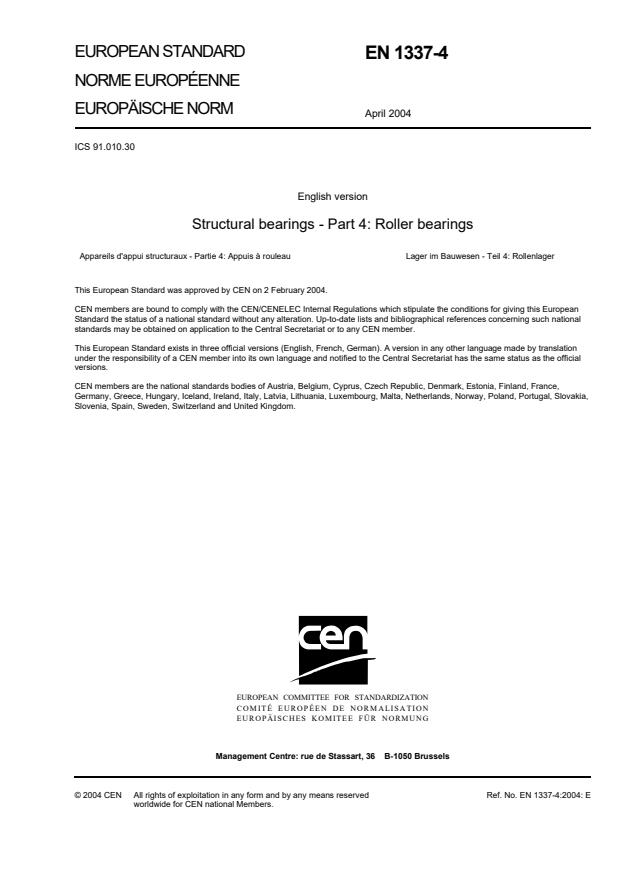
EUROPEAN STANDARDNORME EUROPÉENNEEUROPÄISCHE NORMEN 1337-4April 2004ICS 91.010.30English versionStructural bearings - Part 4: Roller bearingsAppareils d'appui structuraux - Partie 4: Appuis à rouleauLager im Bauwesen - Teil 4: RollenlagerThis European Standard was approved by CEN on 2 February 2004.CEN members are bound to comply with the CEN/CENELEC Internal Regulations which stipulate the conditions for giving this EuropeanStandard the status of a national standard without any alteration. Up-to-date lists and bibliographical references concerning such nationalstandards may be obtained on application to the Central Secretariat or to any CEN member.This European Standard exists in three official versions (English, French, German). A version in any other language made by translationunder the responsibility of a CEN member into its own language and notified to the Central Secretariat has the same status as the officialversions.CEN members are the national standards bodies of Austria, Belgium, Cyprus, Czech Republic, Denmark, Estonia, Finland, France,Germany, Greece, Hungary, Iceland, Ireland, Italy, Latvia, Lithuania, Luxembourg, Malta, Netherlands, Norway, Poland, Portugal, Slovakia,Slovenia, Spain, Sweden, Switzerland and United Kingdom.EUROPEAN COMMITTEE FOR STANDARDIZATIONCOMITÉ EUROPÉEN DE NORMALISATIONEUROPÄISCHES KOMITEE FÜR NORMUNGManagement Centre: rue de Stassart, 36
B-1050 Brussels© 2004 CENAll rights of exploitation in any form and by any means reservedworldwide for CEN national Members.Ref. No. EN 1337-4:2004: E
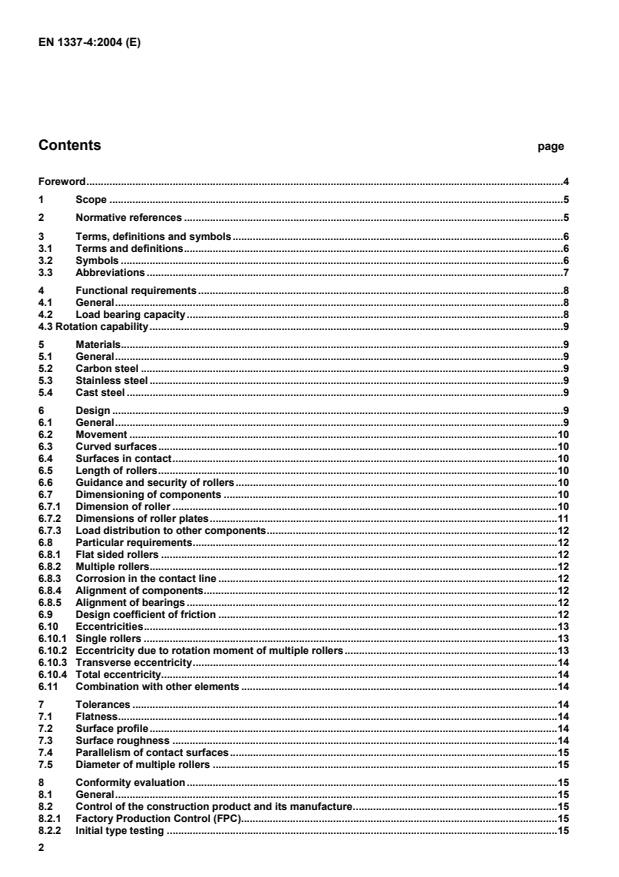
Ferrous materials.18Annex B (informative)
Factory Production Control.19B.1General.19B.1.1Objectives.19B.1.2Documentation.19B.1.3Operations.19B.2Verifications and tests.20B.2.1General comments.20B.2.2Monitoring of conformity.20B.2.3Tests.20B.2.4Treatment of construction products which do not conform.20B.2.5Recording of verification and tests (manufacturer's register).20B.2.6Traceability.21Annex ZA (informative)
Clauses of this European Standard addressing the provisions of the EUConstruction Products Directive.22ZA.1 Scope and relevant characteristics.22ZA.2 Procedure(s) for attestation of conformity of roller bearings.24ZA.2.1 System(s) of attestation of conformity.24ZA.2.2EC Certificate and declaration of conformity.28ZA.3 CE marking and labelling.29Bibliography.31
To permit rotation about theaxis perpendicular to the roller axis or about both axes, as for multiple roller bearings, the roller bearings can becombined with bearings from other parts of EN 1337.This part of EN 1337 does not apply to roller bearings made with materials other than those specified in clause 5.Bearings which are subjected to rotation greater than 0,05 rad resulting from the characteristic combination ofactions are outside the scope of this part of EN 1337.2 Normative referencesThis European Standard incorporates by dated or undated reference, provisions from other publications. Thesenormative references are cited at the appropriate places in the text, and the publications are listed hereafter. Fordated references, subsequent amendments to or revisions of any of these publications apply to this EuropeanStandard only when incorporated in it by amendment or revision. For undated references the latest edition of thepublication referred to applies (including amendments).EN 1337-1:2000, Structural bearings — Part 1: General design rules.EN 1337-2:2004, Structural bearings — Part 2: Sliding elements.EN 1337-7; Structural bearings - Part 7: Spherical and cylindrical PTFE bearings.EN 1337-9:1997, Structural bearings — Part 9: Protection.EN 1337-10, Structural bearings — Part 10: Inspection and maintenance.EN 1990; Eurocode - Basis of structural design.ENV 1992-1-1; Eurocode 2: Design of concrete structures - Part 1: General rules and rules for buildings.ENV 1993-1-1; Eurocode 3: Design of steel structures - Part 1-1: General rules and rules for buildings.EN 10025, Hot rolled products of non-alloy structural steels — Technical delivery conditions.EN 10083-1, Quenched and tempered steels — Part 1: Technical delivery conditions for special steels.EN 10083-2, Quenched and tempered steels — Part 2: Technical delivery condition for unalloyed quality steels.EN 10088-2, Stainless steels — Part 2: Technical delivery conditions for sheet/plate and strip for general purposes.EN 10160, Ultrasonic testing of steel flat product of thickness equal or greater than 6 mm (reflection method).EN 10204, Metallic products — Types of inspection documents.EN ISO 4287; Geometrical product specifications (GPS) - Surface texture: Profile method - Terms, definitions andsurface texture parameters (ISO 4287:1997).EN ISO 6506-1, Metallic materials - Brinell hardness test - Part 1: Test method (ISO 6506-1:1999).ISO 3755, Cast carbon steels for general engineering purposes.
(N)N'Sddesign axial force per unit length in Newton per millimetre (N/mm)gmpartial material safety factorLeffective length of roller, in millimetres (mm)MSdrotation moment, in Newton millimetres (Nmm)Rradius of contact surface, in millimetres (mm)tpthickness of roller plate, in millimetres (mm)mddesign coefficient of rolling frictionHdistance between horizontal section to be verified and roller contact area in millimetres (mm)VSdtotal transverse or shear force in Newtons (N)3.3 AbbreviationsULSUltimate Limit StateNDPNationally Determined ParametresFPC Factory Production Control
Load distribution to other componentsFor roller bearings the stiffness of the supporting plates is of paramount importance therefore the roller plates shall beso proportioned that loads are adequately distributed to adjacent components. The maximum load dispersion through acomponent shall be taken as 45° unless a greater angle is justified by calculations which take into account thecharacteristics of the adjacent components and materials. In no case shall load dispersion be assumed beyond a linedrawn at 60° to the vertical axis (see Figure 2).6.8 Particular requirements6.8.1 Flat sided rollersWhere movement requirements permit, flat sided rollers may be used. Such rollers shall be symmetrical about thevertical plane passing through the axis of the roller. The minimum width shall not be less than one-third of the diameternor such that the bearing contact area falls outside the middle third of the rolling surface when the roller is at theextremes of movement determined in accordance with EN 1337-1.NOTEFlat sided rollers can be mounted at closer centres than circular rollers of the same load capacity resulting in morecompact bearings.6.8.2 Multiple rollersWhere a bearing has more than one roller an additional bearing in accordance with other parts of EN 1337 shall beincluded to accommodate rotation (see Figure 1). The effects of any rotation moments from this element shall beincluded when calculating the roller forces by taking into account the corresponding eccentricities. The load per rollershall be calculated at the extreme of the expected movement. In addition where a bearing has more than two rollers thelimiting values for design load effects shall be taken as two-thirds of the value given by the expression in 6.7.1.6.8.3 Corrosion in the contact lineIf the materials used for the roller and roller plates are not intrinsically corrosion resistant then other provisions shall bemade in the design to prevent corrosion in the area. These measures may take the form of grease boxes, oil baths,flexible seals or other methods which can be shown to be effective or which have been found satisfactory during use.Where dissimilar materials are used in combination the effects of electrolytic corrosion shall be considered.6.8.4 Alignment of componentsProvision shall be made to ensure that bearing components remain correctly aligned with each other and clampedtogether between manufacture and installation. Temporary transit devices and devices intended to maintain alignmentduring installation shall not be used to locate the structure.6.8.5 Alignment of bearingsIt is particularly important that the axis of the rolling element is correctly aligned in the structure and accurate alignmentmarks defining the axes of the roller shall be indelibly scribed on outer surfaces of accessible plates.6.9 Design coefficient of frictionThe design friction coefficient md shall be taken as 0,02 for steel with a hardness ³ 300 HV and 0,05 for all other steels.NOTEThe coefficient of friction for rolling contact surfaces of rollers used for structural design purposes can be determinedby test.
Test results should be
...