


EN 1337-2:2004
(Main)Structural bearings - Part 2: Sliding elements
General Information
- Abstract
This European Standard specifies the characteristics for the design and manufacture of sliding elements and guides which are not structural bearings but only parts of them for combination with structural bearings as defined in other Parts of this European Standard.
Suitable combinations are shown in Table 1 of EN 1337-1:2000.
Sliding surfaces with a diameter of the circumscribing circle of single or multiple PTFE sheets less than 75 mm or greater than 1500 mm, or with effective bearing temperatures less than -35°C or greater than 48°C are outside the scope of this European Standard.
Sliding elements for use as temporary devices during construction, for example during launching of the superstructure, are also outside the scope of this European Standard.
In this standard the specification is also given for curved sliding surfaces which are not part of separate sliding elements but which are incorporated in cylindrical or spherical PTFE bearings as per EN 1337.
NOTE The general principles detailed in this European Standard may be applied for sliding elements outside this scope, but their suitability for the intended use should be proven.
- Status
- Published
- Publication Date
- 16-Mar-2004
- Technical Committee
- CEN/TC 167 - Structural bearings
- Drafting Committee
- CEN/TC 167/WG 3 - Sliding, spherical and cylindrical elements
- Current Stage
- 9092 - Decision on results of review/2YR ENQ - revise - Review Enquiry
- Start Date
- 14-Mar-2008
- Completion Date
- 14-Mar-2008
- Directive
- Harmonized Standard305/2011 - Regulation (eu) No 305/2011 of the European Parliament and of the Council of 9 march 2011 laying down harmonised conditions for the marketing of construction products and repealing council directive 89/106/eec
Not Harmonized89/106/EEC - Construction products

Overview
EN 1337-2:2004 is a key part of the European Standard series governing structural bearings, specifically addressing the requirements for sliding elements used in civil engineering structures. Developed by CEN (European Committee for Standardization), this document defines the characteristics, design, materials, and manufacturing criteria for sliding elements and guides. These components are incorporated into structural bearings to enable controlled movement and manage loads in bridges, buildings, and other large structures. However, they are not structural bearings themselves but are critical parts used in combination with bearings defined in other parts of EN 1337.
The standard excludes sliding surfaces with PTFE sheets smaller than 75 mm or larger than 1500 mm in diameter, applications outside the temperature range of -35°C to +48°C, and temporary construction devices.
Key Topics
EN 1337-2:2004 covers several essential aspects of sliding elements for structural bearings:
- Scope and Limits: Applicability to sliding surfaces within specified size and temperature ranges, and exclusion of temporary devices.
- Material Specifications: Detailed requirements for PTFE (polytetrafluoroethylene) sheets, composite materials, austenitic steel, and hard chromium surfaces.
- Design Criteria: Guidelines for combining materials, dimensioning, and ensuring durability under various loads and conditions.
- Manufacturing and Quality Control: Tolerances, surface roughness, and visual inspection protocols.
- Friction and Functional Performance: Criteria and coefficients of friction for different material combinations under short- and long-term loads.
- Testing Requirements: Methods for material testing, friction tests, hardness, and adhesive strength validation.
- Installation and Maintenance: Reference to installation standards and inspection requirements for in-service performance.
Applications
Sliding elements designed under EN 1337-2:2004 are vital for:
- Bridge Bearings: Allowing controlled sliding and rotation movements to accommodate thermal expansion, traffic loads, and seismic events.
- Building Supports: Enabling differential movement in large building structures due to shrinkage, creep, temperature changes, and external loads.
- Composite and PTFE Sliding Interfaces: Used with austenitic steel or hard chromium-plated components to ensure low friction and reduce wear.
- Specialized Guides: Providing directional movement and restraining forces in one or more axes within complex bearing assemblies.
The standard ensures that these components maintain structural integrity and operational safety over extended periods, meeting essential European project requirements for reliability and performance.
Related Standards
EN 1337-2:2004 is part of a comprehensive series. Key related standards include:
- EN 1337-1: General design rules for structural bearings (provides context on suitable combinations).
- EN 1337-3: Covers elastomeric bearings.
- EN 1337-7: Details on spherical and cylindrical PTFE bearings.
- EN 1337-10 and EN 1337-11: Inspection, maintenance, transport, storage, and installation procedures.
Additional materials and testing standards are referenced for material conformity, such as:
- EN 10025: Structural steel plates.
- EN 10088-2: Stainless steel requirements.
- EN ISO 527: Testing tensile properties for plastics.
- EN ISO 4287: Surface texture parameters.
Practical Value
Implementing EN 1337-2:2004 provides:
- Consistent Quality: Ensures sliding elements meet European expectations for reliability and durability.
- Optimized Structural Safety: Reduces risk of failure due to material incompatibility or excessive friction.
- Facilitates Compliance: Supports engineers, manufacturers, and inspectors in meeting regulatory and contractual obligations for infrastructure projects.
- Efficient Performance: Maintains low friction in load-bearing assemblies across varying environmental conditions.
By specifying standardized requirements, EN 1337-2:2004 assists in the creation of long-lasting, efficient, and safe structural bearings suitable for demanding civil engineering applications.
Relations
- Effective Date
- 22-Dec-2008
- Effective Date
- 25-Aug-2026
- Effective Date
- 25-Aug-2026
- Effective Date
- 25-Aug-2026
- Effective Date
- 25-Aug-2026
- Effective Date
- 25-Aug-2026
- Effective Date
- 25-Aug-2026
- Effective Date
- 08-Apr-2026
- Effective Date
- 28-Jan-2026
- Effective Date
- 28-Jan-2026
- Effective Date
- 28-Jan-2026
- Effective Date
- 28-Jan-2026
- Effective Date
- 28-Jan-2026
- Effective Date
- 28-Jan-2026
- Effective Date
- 28-Jan-2026
Get Certified
Connect with accredited certification bodies for this standard

DIBt (Deutsches Institut für Bautechnik)
German Institute for Building Technology.
DIN CERTCO
DIN Group product certification.

Aboma Certification B.V.
Specialized in construction, metal, and transport sectors.
Sponsored listings
Frequently Asked Questions
EN 1337-2:2004 is a standard published by the European Committee for Standardization (CEN). Its full title is "Structural bearings - Part 2: Sliding elements". This standard covers: This European Standard specifies the characteristics for the design and manufacture of sliding elements and guides which are not structural bearings but only parts of them for combination with structural bearings as defined in other Parts of this European Standard. Suitable combinations are shown in Table 1 of EN 1337-1:2000. Sliding surfaces with a diameter of the circumscribing circle of single or multiple PTFE sheets less than 75 mm or greater than 1500 mm, or with effective bearing temperatures less than -35°C or greater than 48°C are outside the scope of this European Standard. Sliding elements for use as temporary devices during construction, for example during launching of the superstructure, are also outside the scope of this European Standard. In this standard the specification is also given for curved sliding surfaces which are not part of separate sliding elements but which are incorporated in cylindrical or spherical PTFE bearings as per EN 1337. NOTE The general principles detailed in this European Standard may be applied for sliding elements outside this scope, but their suitability for the intended use should be proven.
This European Standard specifies the characteristics for the design and manufacture of sliding elements and guides which are not structural bearings but only parts of them for combination with structural bearings as defined in other Parts of this European Standard. Suitable combinations are shown in Table 1 of EN 1337-1:2000. Sliding surfaces with a diameter of the circumscribing circle of single or multiple PTFE sheets less than 75 mm or greater than 1500 mm, or with effective bearing temperatures less than -35°C or greater than 48°C are outside the scope of this European Standard. Sliding elements for use as temporary devices during construction, for example during launching of the superstructure, are also outside the scope of this European Standard. In this standard the specification is also given for curved sliding surfaces which are not part of separate sliding elements but which are incorporated in cylindrical or spherical PTFE bearings as per EN 1337. NOTE The general principles detailed in this European Standard may be applied for sliding elements outside this scope, but their suitability for the intended use should be proven.
EN 1337-2:2004 is classified under the following ICS (International Classification for Standards) categories: 91.010.30 - Technical aspects. The ICS classification helps identify the subject area and facilitates finding related standards.
EN 1337-2:2004 has the following relationships with other standards: It is inter standard links to EN 1337-2:2000, ISO 2137:1985, ISO 3016:1994, ISO 3522:1984, ISO 1083:1987, ISO 2176:1995, ISO 3755:1991, EN ISO 1183-2:2026, EN ISO 6506-1:2014, EN 1993-1-8:2024, EN ISO 6507-1:2023, EN ISO 6506-3:2014, EN 1337-7:2004, EN 1337-11:1997, EN ISO 6507-2:2018. Understanding these relationships helps ensure you are using the most current and applicable version of the standard.
EN 1337-2:2004 is associated with the following European legislation: EU Directives/Regulations: 305/2011, 89/106/EEC; Standardization Mandates: M/104. When a standard is cited in the Official Journal of the European Union, products manufactured in conformity with it benefit from a presumption of conformity with the essential requirements of the corresponding EU directive or regulation.
EN 1337-2:2004 is available in PDF format for immediate download after purchase. The document can be added to your cart and obtained through the secure checkout process. Digital delivery ensures instant access to the complete standard document.
Standards Content (Sample)
2003-01.Slovenski inštitut za standardizacijo. Razmnoževanje celote ali delov tega standarda ni dovoljeno.Lager im Bauwesen - Teil 2: GleitteileAppareils d'appui structuraux - Partie 2: Éléments de glissementStructural bearings - Part 2: Sliding elements91.010.30Technical aspectsICS:Ta slovenski standard je istoveten z:EN 1337-2:2004SIST EN 1337-2:2004en01-junij-2004SIST EN 1337-2:2004SLOVENSKI
STANDARDSIST EN 1337-2:20011DGRPHãþD
EUROPEAN STANDARDNORME EUROPÉENNEEUROPÄISCHE NORMEN 1337-2March 2004ICS 91.010.30Supersedes EN 1337-2:2000English versionStructural bearings - Part 2: Sliding elementsAppareils d'appui structuraux - Partie 2: Eléments deglissementLager im Bauwesen - Teil 2: GleitteileThis European Standard was approved by CEN on 2 January 2004.CEN members are bound to comply with the CEN/CENELEC Internal Regulations which stipulate the conditions for giving this EuropeanStandard the status of a national standard without any alteration. Up-to-date lists and bibliographical references concerning such nationalstandards may be obtained on application to the Central Secretariat or to any CEN member.This European Standard exists in three official versions (English, French, German). A version in any other language made by translationunder the responsibility of a CEN member into its own language and notified to the Central Secretariat has the same status as the officialversions.CEN members are the national standards bodies of Austria, Belgium, Cyprus, Czech Republic, Denmark, Estonia, Finland, France,Germany, Greece, Hungary, Iceland, Ireland, Italy, Latvia, Lithuania, Luxembourg, Malta, Netherlands, Norway, Poland, Portugal, Slovakia,Slovenia, Spain, Sweden, Switzerland and United Kingdom.EUROPEAN COMMITTEE FOR STANDARDIZATIONCOMITÉ EUROPÉEN DE NORMALISATIONEUROPÄISCHES KOMITEE FÜR NORMUNGManagement Centre: rue de Stassart, 36
B-1050 Brussels© 2004 CENAll rights of exploitation in any form and by any means reservedworldwide for CEN national Members.Ref. No. EN 1337-2:2004: ESIST EN 1337-2:2004
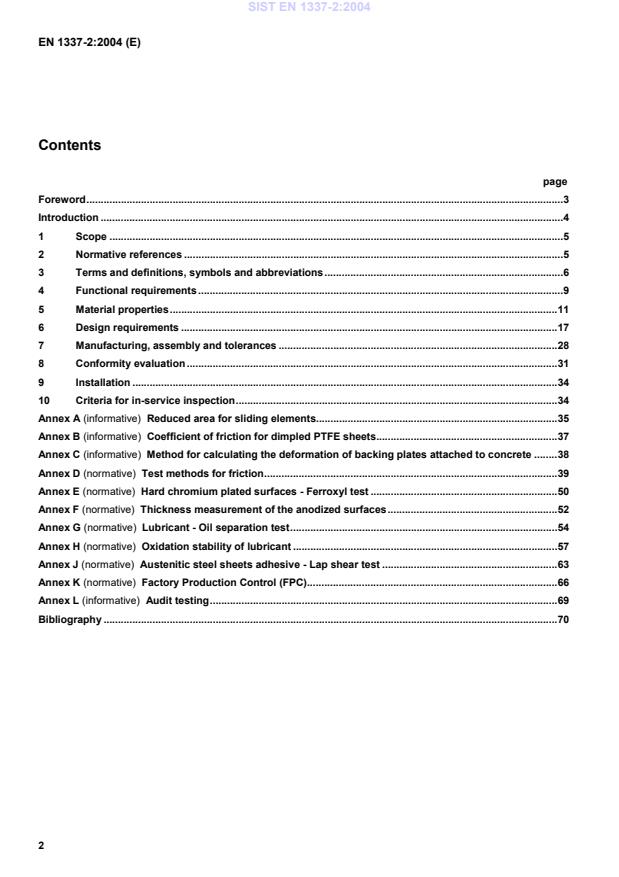
Reduced area for sliding elements.35Annex B (informative)
Coefficient of friction for dimpled PTFE sheets.37Annex C (informative)
Method for calculating the deformation of backing plates attached to concrete.38Annex D (normative)
Test methods for friction.39Annex E (normative)
Hard chromium plated surfaces - Ferroxyl test.50Annex F (normative)
Thickness measurement of the anodized surfaces.52Annex G (normative)
Lubricant - Oil separation test.54Annex H (normative)
Oxidation stability of lubricant.57Annex J (normative)
Austenitic steel sheets adhesive - Lap shear test.63Annex K (normative)
Factory Production Control (FPC).66Annex L (informative)
Audit testing.69Bibliography.70SIST EN 1337-2:2004
1.4401 + 2B or 1.4404 + 2B shall be used.The contact surface shall be ground and if necessary machine polished.5.4.2 Surface characteristicsAfter the surface treatment the roughness Ry5i shall not exceed 1 mm in accordance with EN ISO 4287 and thehardness shall be in the range 150 HV1 to 220 HV1, according to EN ISO 6507-2.5.5 Hard chromium plated surfaces5.5.1 GeneralThe entire curved surface of the backing plate shall be hard chromium plated.The hard chromium plating process shall comply with the requirements of prEN ISO 6158.SIST EN 1337-2:2004
% (mass)Oxidation resistance pressure dropafter 100 h at 160°Cannex H£ 0,1MPaPour-point of base oilISO 3016below –60°C5.8.3 Suitability for use in sliding elementsWhen tested in accordance with annex D, the lubricant shall meet the friction requirements given in 4.1.1 and 4.1.2.For the short term friction test the mating sliding surface shall be made of hard chromium in accordance with 5.5 oraustenitic steel in accordance with 5.4 and for the long term friction test of austenitic steel in accordance with 5.4.5.9 Adhesive for bonding austenitic steel sheetsNOTEThe main function of the adhesive is to join austenitic steel sheets to the backing plate in such a way that shear istransmitted without relative movement.SIST EN 1337-2:2004
mm,th,
mm 2,2 than less not but (mm)L,hp££+=SIST EN 1337-2:2004
mm1000mm 1,0Lc+£SIST EN 1337-2:2004
shall be taken as the gross area withoutdeduction for the area of the dimples. For sheets with “a” < 100 mm the area of the dimples shall be deducted fromthe gross area.For curved surfaces see EN 1337-7.6.9 Design verification of backing plates6.9.1 GeneralThe PTFE and the mating sliding materials shall be supported by metal plates (backing plates) with plane or curvedsurfaces.The design of the backing plates shall take into account the following:-verification at ultimate limit state when internal forces and moments from lateral actions are to beconsidered in addition to the effects from deformation as per 6.9.2;-any cross section reduction (for example due to keyway and the attachment bolts);-deformations as per 6.9.2;-the required stiffness for transport and installation as per 6.9.3;-distribution of forces to the adjacent structural members as per 6.9.4.6.9.2 Deformation verificationNOTEIf the deformations (see Figure 9) exceed the values given below, unacceptably small clearance between theadjacent backing plates and higher wear will occur. As this could endanger the long term fitness for use of the sliding element,this condition is considered serviceability limit state.SIST EN 1337-2:2004
...