


prEN ISO 9000
(Main)Quality management - Fundamentals and vocabulary (ISO/DIS 9000:2025)
Quality management - Fundamentals and vocabulary (ISO/DIS 9000:2025)
ISO 9000:2015 describes the fundamental concepts and principles of quality management which are universally applicable to the following:
organizations seeking sustained success through the implementation of a quality management system;
customers seeking confidence in an organization's ability to consistently provide products and services conforming to their requirements;
organizations seeking confidence in their supply chain that their product and service requirements will be met;
organizations and interested parties seeking to improve communication through a common understanding of the vocabulary used in quality management;
organizations performing conformity assessments against the requirements of ISO 9001;
providers of training, assessment or advice in quality management;
developers of related standards.
ISO 9000:2015 specifies the terms and definitions that apply to all quality management and quality management system standards developed by ISO/TC 176.
Qualitätsmanagement - Grundlagen und Begriffe (ISO/DIS 9000:2025)
Management de la qualité - Principes essentiels et vocabulaire (ISO/DIS 9000:2025)
L'ISO 9000:2015 décrit les concepts fondamentaux et les principes du management de la qualité qui sont applicables à toutes les entités suivantes:
organismes recherchant des performances durables par la mise en ?uvre d'un système de management de la qualité;
clients cherchant à s'assurer de l'aptitude d'un organisme à fournir régulièrement des produits et services conformes à leurs exigences;
organismes cherchant à s'assurer que leur chaîne d'approvisionnement satisfera leurs exigences relatives aux produits et services;
organismes et parties intéressées cherchant à améliorer la communication par une compréhension mutuelle du vocabulaire utilisé dans le domaine du management de la qualité;
organismes chargés de l'évaluation de la conformité aux exigences de l'ISO 9001;
prestataires assurant une formation, une évaluation ou fournissant des conseils dans le domaine du management de la qualité;
personnes élaborant des normes apparentées.
L'ISO 9000:2015 spécifie les termes et définitions s'appliquant à toutes les normes relatives au management de la qualité et aux systèmes de management de la qualité élaborées par l'ISO/TC 176.
Sistemi vodenja kakovosti - Osnove in slovar (ISO/DIS 9000:2025)
General Information
Relations
Standards Content (Sample)
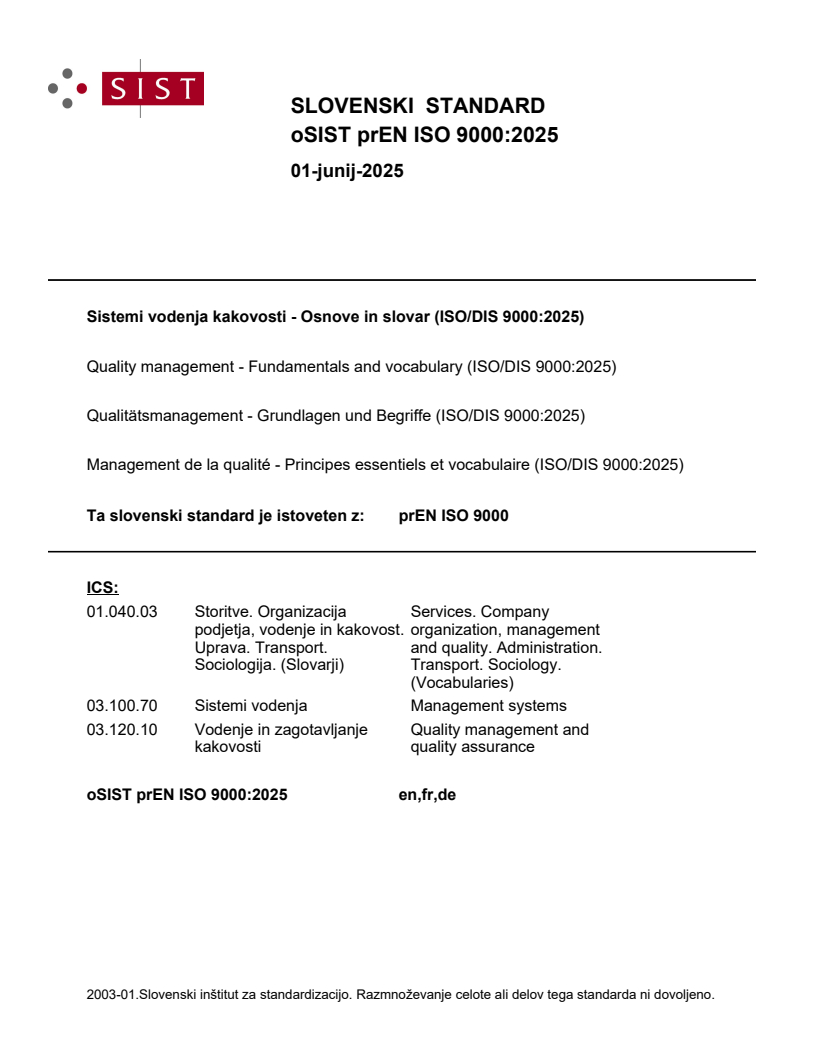
SLOVENSKI STANDARD
01-junij-2025
Sistemi vodenja kakovosti - Osnove in slovar (ISO/DIS 9000:2025)
Quality management - Fundamentals and vocabulary (ISO/DIS 9000:2025)
Qualitätsmanagement - Grundlagen und Begriffe (ISO/DIS 9000:2025)
Management de la qualité - Principes essentiels et vocabulaire (ISO/DIS 9000:2025)
Ta slovenski standard je istoveten z: prEN ISO 9000
ICS:
01.040.03 Storitve. Organizacija Services. Company
podjetja, vodenje in kakovost. organization, management
Uprava. Transport. and quality. Administration.
Sociologija. (Slovarji) Transport. Sociology.
(Vocabularies)
03.100.70 Sistemi vodenja Management systems
03.120.10 Vodenje in zagotavljanje Quality management and
kakovosti quality assurance
2003-01.Slovenski inštitut za standardizacijo. Razmnoževanje celote ali delov tega standarda ni dovoljeno.
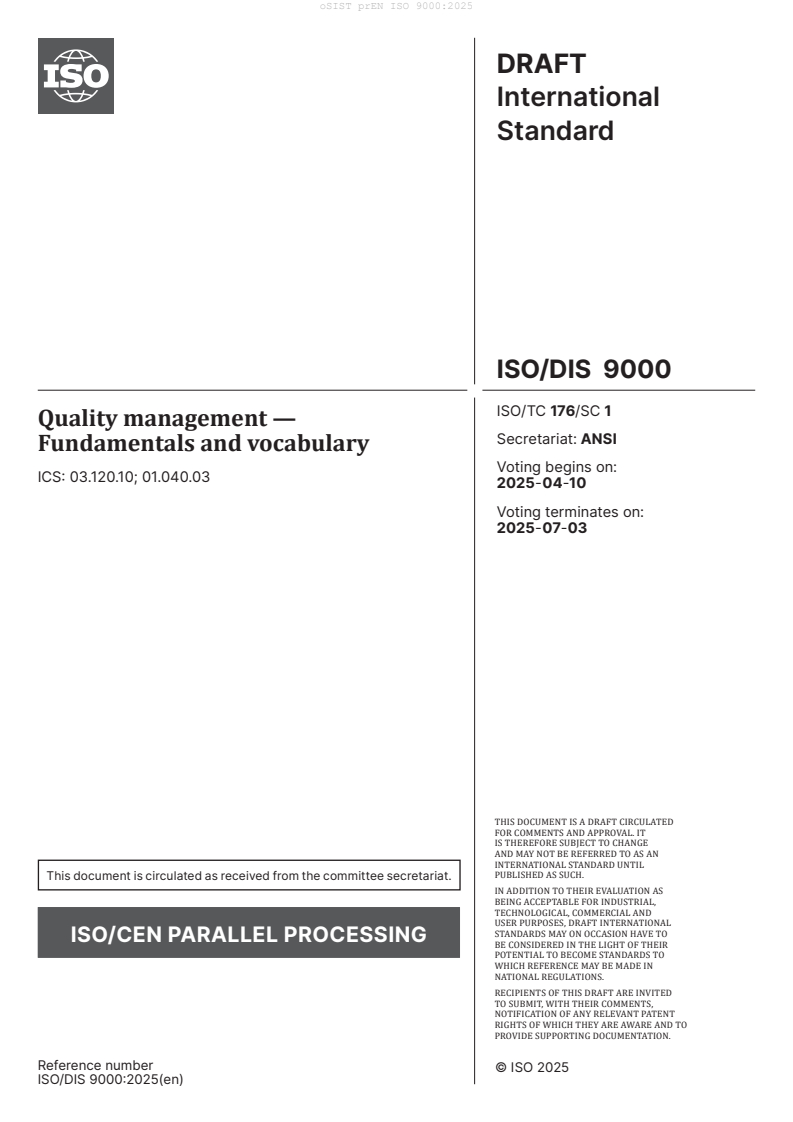
DRAFT
International
Standard
ISO/DIS 9000
ISO/TC 176/SC 1
Quality management —
Secretariat: ANSI
Fundamentals and vocabulary
Voting begins on:
ICS: 03.120.10; 01.040.03
2025-04-10
Voting terminates on:
2025-07-03
THIS DOCUMENT IS A DRAFT CIRCULATED
FOR COMMENTS AND APPROVAL. IT
IS THEREFORE SUBJECT TO CHANGE
AND MAY NOT BE REFERRED TO AS AN
INTERNATIONAL STANDARD UNTIL
PUBLISHED AS SUCH.
This document is circulated as received from the committee secretariat.
IN ADDITION TO THEIR EVALUATION AS
BEING ACCEPTABLE FOR INDUSTRIAL,
TECHNOLOGICAL, COMMERCIAL AND
USER PURPOSES, DRAFT INTERNATIONAL
STANDARDS MAY ON OCCASION HAVE TO
ISO/CEN PARALLEL PROCESSING
BE CONSIDERED IN THE LIGHT OF THEIR
POTENTIAL TO BECOME STANDARDS TO
WHICH REFERENCE MAY BE MADE IN
NATIONAL REGULATIONS.
RECIPIENTS OF THIS DRAFT ARE INVITED
TO SUBMIT, WITH THEIR COMMENTS,
NOTIFICATION OF ANY RELEVANT PATENT
RIGHTS OF WHICH THEY ARE AWARE AND TO
PROVIDE SUPPORTING DOCUMENTATION.
Reference number
ISO/DIS 9000:2025(en)
DRAFT
ISO/DIS 9000:2025(en)
International
Standard
ISO/DIS 9000
ISO/TC 176/SC 1
Quality management —
Secretariat: ANSI
Fundamentals and vocabulary
Voting begins on:
ICS: 03.120.10; 01.040.03
Voting terminates on:
THIS DOCUMENT IS A DRAFT CIRCULATED
FOR COMMENTS AND APPROVAL. IT
IS THEREFORE SUBJECT TO CHANGE
AND MAY NOT BE REFERRED TO AS AN
INTERNATIONAL STANDARD UNTIL
PUBLISHED AS SUCH.
This document is circulated as received from the committee secretariat.
IN ADDITION TO THEIR EVALUATION AS
BEING ACCEPTABLE FOR INDUSTRIAL,
© ISO 2025
TECHNOLOGICAL, COMMERCIAL AND
USER PURPOSES, DRAFT INTERNATIONAL
All rights reserved. Unless otherwise specified, or required in the context of its implementation, no part of this publication may
STANDARDS MAY ON OCCASION HAVE TO
ISO/CEN PARALLEL PROCESSING
be reproduced or utilized otherwise in any form or by any means, electronic or mechanical, including photocopying, or posting on
BE CONSIDERED IN THE LIGHT OF THEIR
the internet or an intranet, without prior written permission. Permission can be requested from either ISO at the address below
POTENTIAL TO BECOME STANDARDS TO
WHICH REFERENCE MAY BE MADE IN
or ISO’s member body in the country of the requester.
NATIONAL REGULATIONS.
ISO copyright office
RECIPIENTS OF THIS DRAFT ARE INVITED
CP 401 • Ch. de Blandonnet 8
TO SUBMIT, WITH THEIR COMMENTS,
CH-1214 Vernier, Geneva
NOTIFICATION OF ANY RELEVANT PATENT
Phone: +41 22 749 01 11
RIGHTS OF WHICH THEY ARE AWARE AND TO
PROVIDE SUPPORTING DOCUMENTATION.
Email: copyright@iso.org
Website: www.iso.org
Published in Switzerland Reference number
ISO/DIS 9000:2025(en)
ii
ISO/DIS 9000:2025(en)
Contents Page
Foreword .v
Introduction .vi
1 Scope . 1
2 Fundamentals of quality management . 1
2.1 General .1
2.2 Quality management principles .1
2.2.1 General .1
2.2.2 Customer focus .2
2.2.3 Leadership.2
2.2.4 Engagement of people .3
2.2.5 Process approach .4
2.2.6 Improvement.5
2.2.7 Evidence-based decision making .5
2.2.8 Relationship management .6
2.3 Fundamental quality management concepts .7
2.3.1 Quality .7
2.3.2 Quality management .7
2.3.3 Quality management system .7
2.3.4 Quality assurance .8
2.3.5 Quality control .8
2.3.6 Quality planning .8
2.3.7 Process management .9
2.3.8 Risk-based thinking .9
2.3.9 Organizational quality culture .9
2.3.10 Continual improvement.10
2.4 Additional concepts relevant to quality management .10
2.4.1 Context of an organization .10
2.4.2 Interested parties .10
2.4.3 Integrated management system .10
2.4.4 Circular economy .11
2.4.5 Emerging technologies.11
2.4.6 Innovation .11
2.4.7 Change management . 12
2.4.8 Customer experience . 12
2.4.9 Knowledge management . 12
2.4.10 Information management. 13
2.4.11 People aspects . 13
2.4.12 Business continuity . 13
2.5 Developing the QMS using fundamental concepts and principles .14
2.5.1 Attributes of a QMS .14
2.5.2 Development of a QMS . 15
2.5.3 QMS standards, other management systems and organizational excellence
models . 15
3 Terms and definitions . 16
3.1 Terms related to management system .16
3.2 Terms related to organization .19
3.3 Terms related to management .21
3.4 Terms related to process .24
3.5 Terms related to system . . 26
3.6 Terms related to requirement . .27
3.7 Terms related to nonconformity. 28
3.8 Terms related to result . 30
3.9 Terms related to data, information and document .32
3.10 Terms related to customer . 34
iii
ISO/DIS 9000:2025(en)
3.11 Terms related to characteristic . 36
3.12 Terms related to determination . 38
3.13 Terms related to audit . 40
3.14 Terms related to electoral bodies .42
3.15 Terms related to local government . 46
Annex A (informative) Concept relationships and their graphical representation .49
Bibliography .68
Alphabetical index of terms .70
iv
ISO/DIS 9000:2025(en)
Foreword
ISO (the International Organization for Standardization) is a worldwide federation of national standards
bodies (ISO member bodies). The work of preparing International Standards is normally carried out through
ISO technical committees. Each member body interested in a subject for which a technical committee
has been established has the right to be represented on that committee. International organizations,
governmental and non-governmental, in liaison with ISO, also take part in the work. ISO collaborates closely
with the International Electrotechnical Commission (IEC) on all matters of electrotechnical standardization.
The procedures used to develop this document and those intended for its further maintenance are described
in the ISO/IEC Directives, Part 1. In particular the different approval criteria needed for the different types
of ISO documents should be noted. This document was drafted in accordance with the editorial rules of the
ISO/IEC Directives, Part 2 (see www.iso.org/directives).
Attention is drawn to the possibility that some of the elements of this document may be the subject of patent
rights. ISO shall not be held responsible for identifying any or all such patent rights. Details of any patent
rights identified during the development of the document will be in the Introduction and/or on the ISO list of
patent declarations received (see www.iso.org/patents).
Any trade name used in this document is information given for the convenience of users and does not
constitute an endorsement.
For an explanation on the meaning of ISO specific terms and expressions related to conformity assessment,
as well as information about ISO's adherence to World Trade Organization (WTO) principles in the Technical
Barriers to Trade (TBT) see the following URL: www.iso.org/iso/foreword.html.
The committee responsible for this document is Technical Committee ISO/TC 176, Quality management and
quality assurance, Subcommittee SC 1, Concepts and terminology.
This fifth edition cancels and replaces the fourth edition (ISO 9000:2015), which has been technically
revised.
v
ISO/DIS 9000:2025(en)
Introduction
This document provides the fundamental concepts, principles and vocabulary for quality management and
provides the foundation for quality management and quality management systems (QMS) standards. This
document is intended to help the user to understand the fundamental concepts, principles and vocabulary
of quality management, in order to be able to effectively and efficiently implement a QMS and realize value
from quality management and QMS standards.
This document proposes a well-defined QMS, based on a framework that integrates established fundamental
concepts and principles related to quality management, in order to help organizations realize their
objectives. It is applicable to all organizations, regardless of size, complexity or business model. Its aim is to
increase an organization’s awareness of its duties and commitment in fulfilling the needs and expectations
of its customers and interested parties, and in achieving satisfaction with its products and services.
This document contains seven quality management principles supporting the fundamental concepts
described in 2.2. In 2.3, for each quality management principle, there is a “statement” describing each
principle, a “rationale” explaining why the organization would address the principle, “key benefits” that are
attributed to the principles, and “possible actions” that an organization can take in applying the principle.
This document contains the terms and definitions that apply to all quality management and QMS standards
developed by ISO/TC 176, at the time of publication. The terms and definitions are arranged in conceptual
order, with an alphabetical index of the terminological entries of this document provided in Annex B.
Annex A includes a set of concept diagrams on which the thematic grouping of the terms and definitions in
Clause 3 is based.
NOTE Guidance on some additional frequently-used words in the QMS standards developed by
ISO/TC 176, and which have an identified dictionary meaning, is provided in a glossary available at:
http://www.iso.org/iso/03_terminology_used_in_iso_9000_family.pdf
vi
DRAFT International Standard ISO/DIS 9000:2025(en)
Quality management — Fundamentals and vocabulary
1 Scope
This document describes the fundamental concepts and principles of quality management which are
universally applicable to the following:
— organizations seeking sustained success through the implementation of a quality management system;
— customers seeking confidence in an organization’s ability to consistently provide products and services
conforming to their requirements;
— organizations seeking confidence in their supply chain that product and service requirements will be met;
— organizations and interested parties seeking to improve communication through a common
understanding of the vocabulary used in quality management;
— organizations performing conformity assessments against the requirements of ISO 9001;
— providers of training, assessment or advice in quality management;
— developers of related standards.
This document specifies the terms and definitions that apply to all quality management and quality
management system standards developed by ISO/TC 176.
2 Fundamentals of quality management
2.1 General
The quality management principles and concepts described in clauses 2.2 and 2.3 of this document constitute
the fundamentals of quality management. They give the organization the ability to meet the challenges on
ongoing change in both internal and external issues. The context in which an organization works today
is characterized by accelerated change, global markets and supply chains, new technologies, information
technology, innovation, and knowledge as a principal resource. The impact of quality management extends
beyond customer satisfaction: it can also have a direct impact on the organization’s reputation and sustained
success.
All concepts, principles and their interrelationships should be seen as a whole and not in isolation of each
other. No individual concept or principle is more important than another. At any time, finding the right
balance in their application is critical.
2.2 Quality management principles
2.2.1 General
The quality management principles outlined in this document provide organizations with a solid foundation
for building or improving their quality management system.
While each principle can be understood individually, they should be viewed as interrelated and
interdependent when applied within the organization.
These principles serve as fundamental guidance and are universally applicable to any organization’s quality
management system.
ISO/DIS 9000:2025(en)
2.2.2 Customer focus
2.2.2.1 Statement
The primary focus of quality management is to meet customer requirements and to strive to exceed
customer expectations.
2.2.2.2 Rationale
Understanding current and future needs and expectations of customers and other interested parties
contributes to the sustained success of the organization. Every aspect of customer interaction provides an
opportunity to build and retain the confidence of customers and other relevant interested parties.
2.2.2.3 Key benefits
Key benefits attributed to each principle are:
— improved customer experience;
— increased customer satisfaction;
— improved customer loyalty;
— enhanced repeat business;
— enhanced reputation of the organization;
— expanded customer base.
2.2.2.4 Possible actions
Possible actions include:
— understand and take action on customers’ and relevant interested parties’ current and future needs and
expectations;
— link the organization’s policies and objectives to customer needs and expectations;
— communicate customer needs and expectations throughout the organization;
— plan, design, develop, produce, deliver, support and improve products and services to meet customer
needs and expectations;
— measure and monitor customer satisfaction and take appropriate actions;
— determine and address risks and opportunities that can affect customer satisfaction and experience;
— actively manage relationships with customers to achieve sustained success.
2.2.3 Leadership
2.2.3.1 Statement
Leaders at all levels establish unity of purpose and direction and create conditions in which people are
engaged in achieving the organization’s quality objectives.
2.2.3.2 Rationale
Creation of unity of purpose and the direction and engagement of people enable an organization to align its
strategies, policies, processes and resources to achieve its objectives.
ISO/DIS 9000:2025(en)
2.2.3.3 Key benefits
Some potential key benefits are:
— increased effectiveness and efficiency in meeting the organization’s quality objectives;
— better coordination of the organization’s processes;
— improved communication between levels and functions of the organization;
— development and improvement of the capability of the organization and its people to deliver desired
results.
2.2.3.4 Possible actions
Possible actions include:
— communicate the organization's mission, vision, strategy, policies and processes throughout the
organization;
— create and sustain shared values, fairness, trust and performance measures at all levels of the
organization;
— establish a quality culture and ethical behaviour;
— encourage an organization-wide commitment to quality;
— ensure that leaders at all levels are positive examples to people in the organization;
— encourage a risk approach to proactively address issues to enhance desirable effects;
— provide people with the required resources, training and authority to act with accountability;
— inspire, encourage and recognize the contribution of people.
2.2.4 Engagement of people
2.2.4.1 Statement
Competent, empowered and engaged people at all levels throughout the organization are essential to enhance
the organization’s capability to create and deliver value for customers and other relevant interested parties.
2.2.4.2 Rationale
In order to manage an organization effectively and efficiently, it is important to respect and involve all
people at all levels. Recognition, empowerment and enhancement of competence facilitate the engagement
of people in achieving the organization’s quality objectives.
2.2.4.3 Key benefits
Some potential key benefits are:
— improved understanding of the organization’s quality objectives by people in the organization and
increased motivation to achieve them;
— enhanced involvement of people in improvement activities;
— enhanced personal development, initiatives and creativity;
— enhanced people satisfaction;
— enhanced trust and collaboration throughout the organization;
ISO/DIS 9000:2025(en)
— increased attention to shared values and culture throughout the organization.
2.2.4.4 Possible actions
Possible actions include:
— communicate with people to promote understanding and awareness of the importance of their individual
contribution;
— promote collaboration throughout the organization;
— facilitate open discussion and sharing of knowledge and experience;
— empower people to determine constraints to performance and to take initiatives without fear;
— recognize and acknowledge people’s motivation, contribution, learning and improvement;
— enable self-evaluation of performance against personal objectives;
— conduct surveys to assess people’s satisfaction, communicate the results and take appropriate actions.
2.2.5 Process approach
2.2.5.1 Statement
Consistent and predictable results are achieved more effectively and efficiently when activities are
understood and managed as interrelated processes that function as a coherent system.
2.2.5.2 Rationale
The QMS consists of interrelated processes. Understanding how results are produced by this system enables
an organization to optimize the system and its performance.
2.2.5.3 Key benefits
Some potential key benefits are:
— enhanced ability to focus effort on key processes and opportunities for improvement;
— consistent and predictable outcomes through a system of aligned processes;
— optimized performance through effective process management, efficient use of resources and reduced
cross-functional barriers;
— enabling the organization to provide confidence to interested parties related to its consistency,
effectiveness and efficiency.
2.2.5.4 Possible actions
Possible actions include:
— define objectives of the system and processes necessary to achieve them;
— establish authority, responsibility and accountability for managing processes;
— understand the organization’s capabilities and determine resource constraints prior to action;
— determine process interdependencies and analyse the effect of modifications to individual processes on
the system as a whole;
— manage processes and their interrelations as a system to achieve the organization's quality objectives
effectively and efficiently;
ISO/DIS 9000:2025(en)
— ensure the necessary information is available to operate and improve the processes and to monitor,
analyse and evaluate the performance of the overall system;
— manage risks which can affect outputs of the processes and overall outcomes of the QMS.
2.2.6 Improvement
2.2.6.1 Statement
Successful organizations have an ongoing focus on improvement.
2.2.6.2 Rationale
Improvement is essential for an organization to maintain current levels of performance, to react to changes
in its internal and external conditions and to create new opportunities.
2.2.6.3 Key benefits
Some potential key benefits are:
— improved process performance, organizational capability and customer satisfaction;
— enhanced focus on root cause investigation and determination, followed by prevention and corrective
actions;
— enhanced ability to anticipate and react to internal and external risks and opportunities;
— enhanced consideration of both incremental and breakthrough improvement;
— improved use of learning for improvement;
— enhanced drive for innovation.
2.2.6.4 Possible actions
Possible actions include:
— promote establishment of improvement objectives at all levels of the organization;
— educate and train people at all levels on how to apply basic tools and methodologies to achieve
improvement objectives;
— ensure people are competent to successfully promote and complete improvement projects;
— develop and deploy processes to implement improvement projects throughout the organization;
— track, review and audit the planning, implementation, completion and results of improvement projects;
— integrate improvement consideration into development of new or modified products and services and
processes;
— recognize and acknowledge improvement.
2.2.7 Evidence-based decision making
2.2.7.1 Statement
Decisions based on the analysis and evaluation of data and information are more likely to produce desired
results and lead the organization to improve.
ISO/DIS 9000:2025(en)
2.2.7.2 Rationale
Decision-making can be a complex process and it always involves some uncertainty. It often involves multiple
types and sources of inputs, as well as their interpretation, which can be subjective. It is important to
understand cause and effect relationships and potential unintended consequences. Facts, evidence and data
analysis lead to greater objectivity and confidence in decision making for the benefit of all the organization’s
interested parties.
2.2.7.3 Key benefits
Some potential key benefits are:
— improved decision making processes;
— improved assessment of process performance and ability to achieve objectives;
— improved operational effectiveness and efficiency;
— increased ability to review, challenge and change opinions and decisions;
— increased ability to demonstrate the effectiveness of past decisions.
2.2.7.4 Possible actions
Possible actions include:
— determine, measure and monitor key indicators to demonstrate the organization’s performance;
— make all data needed available to the relevant people;
— ensure that data and information are sufficiently accurate, reliable and secure, and available when needed;
— analyse and evaluate data and information using suitable methods;
— ensure people are competent to analyse and evaluate data as needed;
— make decisions and take actions based on evidence, balanced with experience and intuition.
2.2.8 Relationship management
2.2.8.1 Statement
For sustained success, organizations manage their relationships with relevant interested parties.
2.2.8.2 Rationale
Relevant interested parties influence the performance of an organization. Sustained success is more likely
to be achieved when the organization manages relationships with all of its interested parties to optimize
their impact on its performance. Relationship management with its provider and partner networks is of
particular importance.
2.2.8.3 Key benefits
Some potential key benefits are:
— enhanced performance of the organization and its relevant interested parties through responding to the
opportunities and constraints related to each interested party;
— common understanding of objectives and values among interested parties;
— increased capability to create value for interested parties by sharing resources and competence and
managing relevant risks;
ISO/DIS 9000:2025(en)
— a well-managed supply chain that provides a stable flow of products and services.
2.2.8.4 Possible actions
Possible actions include:
— determine relevant interested parties (such as providers, partners, customers, regulatory agencies,
investors, employees, communities or society as a whole) and their relationship with the organization;
— determine and prioritize interested party relationships that need to be managed;
— establish relationships that balance short-term gains with long-term considerations;
— gather and share information, expertise and resources with relevant interested parties;
— measure performance and provide performance feedback to interested parties, as appropriate, to
enhance improvement initiatives;
— establish collaborative development and improvement activities with providers, partners and other
interested parties;
— encourage and recognize improvements and achievements by providers and partners.
2.3 Fundamental quality management concepts
2.3.1 Quality
The quality of an organization’s products and services is determined by the extent to which they satisfy
customers, and their intended and unintended impacts on relevant interested parties. Users of a product or
service may therefore experience good or poor quality, acceptable or unacceptable quality.
The quality of products and services influences not only their intended function and performance, but also
their perceived value and benefit to the customer.
An organization focused on quality promotes a culture that results in the behaviour, attitudes, activities and
processes that deliver value through fulfilling the needs and expectations of customers and other relevant
interested parties.
2.3.2 Quality management
Quality management is the part of overall management of an organization that applies the processes of
quality planning, quality control, quality assurance and quality improvement to achieving its intended
results. It is about managing the organization so that it meets the needs and expectations of its customers
and other relevant interested parties.
Quality management focuses on customers, while at the same time enhances engagement of people in
the organization and maintains effective relationships with other relevant interested parties. It supports
leadership in the development of policies and practices, as well as maintaining a commitment to evidence-
based decision-making. It provides a basis for ongoing development and improvement of processes within
a coherent quality management system, so that interrelationships and interactions among processes can
be managed effectively and efficiently. The quality management principles when applied together form the
foundation of quality management and a quality culture in the organization.
2.3.3 Quality management system
The quality management system (QMS) provides a framework of interacting and interrelated processes
and resources required to deliver value and realize results for relevant interested parties. A QMS is used
to manage activities by which the organization determines quality objectives, processes, and resources by
those whose work affects product and service quality to achieve intended results.
ISO/DIS 9000:2025(en)
Implementing a QMS enables top management to optimize the use of resources, considering the long- and
short-term consequences of their decision. It provides the means to determine risks and opportunities, and
actions to address intended and unintended consequences in providing products and services.
Maintaining and continually improving a quality management system enables organisations to improve
their performance, while providing confidence in their capabilities to relevant interested parties. This may
also provide a competitive advantage.
A QMS can ensure that all activities of an organisation are aligned and make people aware of what is required
of them to achieve intended results. This can increase engagement of people and assist in establishing a
strong quality culture.
2.3.4 Quality assurance
Quality assurance is the part of quality management that provides customers and other relevant interested
parties with a basis for confidence that their needs and expectations will be fulfilled. This can be achieved
by providing evidence of the effectiveness of the quality management system, and the processes involved in
the delivery of products and services. This can be done by providing results of relevant process monitoring
and measurement activities.
Confidence that needs and expectations will be fulfilled is an important aspect of the relationship of
organizations with its customers and other relevant interested parties. This applies to both current and
future relationships. Consistency between what is promised and what is delivered provides a basis for
future customer loyalty and support by relevant interested parties. Effective quality assurance also
provides people within the organization with confidence that they are acting with ethics and integrity in the
relationship between the organization and its customers and other relevant interested parties.
2.3.5 Quality control
Quality control is the part of quality management that deals with ensuring that the organization consistently
meets requirements for products and services. Effective quality control confirms that criteria for processes,
products and services are met and that intended outputs are delivered. Information from quality control
activities provides inputs to quality assurance and quality improvement.
Quality control activities can be planned to be appropriate to the nature and complexity of processes,
products and services. By controlling key aspects of processes, quality control can be consistent with
optimising the use of the skills of competent people.
Meeting the needs and expectations of customers and other relevant interested parties is the quality
objective that usually has the greatest effect on the success and reputation of an organization. Effective
quality control is essential to achieving this quality objective, while preventing or reducing undesired effects
for both the organization itself and its relevant interested parties.
Information from quality control activities is important in providing a basis for confidence in the
effectiveness of quality management and the ongoing improvement of processes, products, and services.
2.3.6 Quality planning
Quality planning is the building block of subsequent quality management activities aimed at controlling,
assuring or improving the quality of an organisation’s products or services. In general terms quality planning
relates to two different activities:
— Ensuring there are a clear set of requirements for the product or service to be supplied
— Ensuring there is a specified sequence and interaction of processes to realise the product and/or service.
Like in other fundamental concepts, quality planning is scalable, and quality plans can be nested. Quality
planning can occur at the system level, as if one were designing the QMS for a new business, or they can
occur at the level of an individual process or within a specific project. The detail required in quality plans
can vary from industry to industry, as well as the point in the development cycle of a new product or service.
ISO/DIS 9000:2025(en)
Quality planning is important because it connects quality control arrangements to the needs of the customer
or market. ISO quality management standards are primarily concerned with the notion of conformance
quality, but conformity to specification is insufficient if the specification is not what the customer wants.
Quality planning expresses the voice of the customer into the planned quality management arrangements of
a business and is a precursor to an effective QMS. As a result of quality planning an organisation can assure
itself that it has produced the right outputs in the right way.
2.3.7 Process management
Process management is a systematic approach and methodology that focusses on activities carried out
within processes, rather than within organisational structures. Process management recognises that
processes may cross functional boundaries and may have various interactions and interrelationships with
other processes.
Process management is the practice of planning, implementing, controlling and improving processes to
ensure they achieve the organization's goals and objectives. Process management enables process inputs,
activities and outputs to be managed coherently across functional boundaries. Interrelated processes can
be managed so that intended results are achieved efficiently and effectively.
Process management can add value by allowing for better resource allocation, monitoring of performance,
and continual improvement through analysis and optimization of processes.
2.3.8 Risk-based thinking
Risk-based thinking in quality management takes a preventive approach to potential problems and barriers
to achieving planned results. It involves the consideration of the potential benefits and harms of exercising
one choice of action over another when faced with a possibility of something not going as intended, including
a missed opportunity. Risk-based thinking promotes a commitment in the organization to prioritising and
managing the likely effects of uncertainty at all levels of the organization.
Risk-based thinking leads to better informed decision-making when planning and performing activities.
Promoting risk-based thinking throughout the organization assists people to focus on improving how
work is done. Using risk-based thinking also enables the organization to avoid unnecessary complexity by
minimizing the negative consequences of risk and taking advantage of opportunities.
2.3.9 Organizational quality culture
Organizational quality culture refers to the shared values, beliefs, history, attitudes and observed behaviours
of people within an organization. This is influenced and consistently reinforced through the behaviours and
attitudes of people at any level of the organization. Evidence of top management commitment to
...
Questions, Comments and Discussion
Ask us and Technical Secretary will try to provide an answer. You can facilitate discussion about the standard in here.