


FprEN 18167
(Main)Quality along the patient pathway for medical imaging in radiology services
Quality along the patient pathway for medical imaging in radiology services
This document specifies the requirements for implementation of a quality system along the patient pathway in radiology services. The objective is to ensure high quality delivery of all aspects of the examination safety and patient care.
This document deals with procedures using X-rays, ultrasonography and magnetic resonance imaging on humans, including diagnostic procedures and interventional radiology as well as remote practices. It also applies, in its principles, to any other technique and modality that would be used in radiology services.
The document covers:
- the different steps of patient care (from the imaging referral, before, during, and after the examination);
- the corresponding human resources and technical-medical requirements;
- quality and risk management.
This document does not apply to radiotherapy and nuclear medicine, nor to equipment and radiation controls which are covered in other standards. This document excludes requirements related to research and education themes.
This document establishes best practices description which constitutes a reference for audits, including clinical audits. Nevertheless, the clinical audits methodology, already defined at the European level, and implemented under the responsibility of each country is excluded from the document.
Qualität entlang des Patientenpfads in der medizinischen Bildgebung in der Radiologie
Dieses Dokument legt die Anforderungen für die Umsetzung eines Qualitätssystems entlang des Patientenpfads bei Radiologiedienstleistungen fest. Ziel ist es, eine qualitativ hochwertige Bereitstellung aller Aspekte der Untersuchungssicherheit und Patientenversorgung sicherzustellen.
Dieses Dokument befasst sich mit Verfahren, bei denen Röntgenstrahlen, Ultraschall und Magnetresonanztomographie am Menschen eingesetzt werden, einschließlich diagnostischer Verfahren und interventioneller Radiologie sowie Anwendungen aus der Ferne. Es gilt in seinen Grundsätzen auch für alle anderen Techniken und Modalitäten, die bei Radiologiedienstleistungen eingesetzt werden.
Das Dokument umfasst:
- die verschiedenen Schritte der Patientenversorgung (von der Überweisung zur bildgebenden Diagnostik, vor, während und nach der Untersuchung);
- die entsprechenden Anforderungen an das Personal und die medizinisch-technische Ausstattung;
- Qualitäts- und Risikomanagement.
Dieses Dokument ist weder auf Strahlentherapie und Nuklearmedizin noch auf Geräte und Strahlungskontrollen anwendbar, die in anderen Normen geregelt sind. Dieses Dokument schließt Anforderungen im Zusammenhang mit Forschungs- und Bildungsfragen aus.
Dieses Dokument enthält eine Beschreibung bewährter Verfahren, die als Referenz für Audits, einschließlich klinischer Audits, dient. Die bereits auf europäischer Ebene festgelegte und unter der Verantwortung jedes Landes umgesetzte Methodik für klinische Audits ist jedoch nicht Bestandteil dieses Dokuments.
Qualité du parcours patient en imagerie médicale dans les services de radiologie
Le présent document spécifie les exigences de mise en oeuvre d’un système de qualité tout au long du parcours patient dans les services de radiologie. L’objectif consiste à garantir la qualité de tous les aspects de la sécurité des examens et des soins prodigués aux patients.
Le présent document porte sur les procédures utilisant les rayons X, l’échographie et l’imagerie par résonance magnétique sur des personnes, couvrant les procédures de radiologie diagnostique et interventionnelle, ainsi que les pratiques à distance. Il s’applique également par principe à toute autre technique et modalité susceptibles d’être utilisées dans les services de radiologie.
Le document traite :
- des différentes étapes de la prise en charge des patients (de la demande d’examen, aux étapes avant, pendant et après l’examen) ;
- des ressources humaines correspondantes et des exigences médico-techniques ;
- du management de la qualité et de la gestion des risques.
Le présent document ne s’applique pas à la radiothérapie, à la médecine nucléaire, ni aux contrôles de l’équipement et des rayonnements utilisés, qui sont couverts par d’autres normes. Le présent document exclut les exigences relatives aux thématiques de la recherche et de la formation.
Il établit une description des bonnes pratiques qui constitue une référence pour les audits, notamment les audits cliniques. Néanmoins, la méthodologie des audits cliniques, d’ores et déjà définie au niveau européen et mise en oeuvre sous la responsabilité de chaque pays, est exclue du présent document.
Kakovost klinične poti pacienta pri medicinskem slikanju v storitvah radiologije
General Information
- Status
- Not Published
- Publication Date
- 26-May-2026
- Technical Committee
- CEN/TC 470 - Quality in medical imaging along the patient pathway
- Current Stage
- 5060 - Closure of Vote - Formal Approval
- Start Date
- 19-Mar-2026
- Due Date
- 16-Apr-2025
- Completion Date
- 19-Mar-2026
Overview
FprEN 18167 (prEN 18167:2025) is a CEN draft standard setting out requirements for implementing a quality system along the patient pathway in medical imaging (Radiology) services. It aims to ensure high-quality delivery of all aspects of examination safety and patient care across diagnostic and interventional Medical Imaging (MI) - notably X‑rays, ultrasonography and magnetic resonance imaging (MRI) - including remote and teleradiology practices. The document defines best‑practice processes from imaging referral through pre‑, intra‑ and post‑examination care, covering human resources, technical‑medical requirements, and quality and risk management. It explicitly excludes radiotherapy, nuclear medicine, equipment and radiation controls addressed in other standards, and research/education requirements.
Key topics and requirements
- Patient pathway management: standardized steps from imaging referral, justification and appointment scheduling, to conduct of the procedure, post‑procedure monitoring and reporting.
- Human resources and competencies: qualifications, entitlements, induction and training requirements for radiologists, radiographers and allied professionals.
- Premises, equipment and medical devices: requirements for imaging devices, supporting healthcare products (including contrast agents), and facility maintenance.
- Safety and protection:
- Protection against ionising radiation (roles, dose monitoring, controlled areas).
- MRI and non‑ionising radiation safety (access control, incident procedures).
- Hygiene, infection prevention and waste management.
- Information systems and data management: secure handling of images, reports, patient identity vigilance and access control.
- Teleradiology and remote practices: organizational measures for remote primary reading and remote scanning.
- Quality and risk management system: quality policy, measurable objectives, indicators, risk mapping, incident investigation, management review and continuous improvement.
- Clinical governance elements: patient information/informed consent, confidentiality, incident reporting, and medical accident management.
- Emerging topics: Artificial Intelligence (AI) considerations in MI workflows and reporting.
Practical applications - who should use it
- Radiology departments and imaging centres implementing or upgrading a quality management system.
- Hospital managers, clinical governance and quality officers responsible for patient safety and accreditation.
- Radiologists, radiographers, medical physicists and IT/data managers defining SOPs, staffing and training.
- Teleradiology providers and remote scanning services establishing secure workflows and responsibilities.
- External auditors, peer reviewers and accreditation bodies using the standard as an audit/reference framework (note: clinical audit methodology is handled separately at national/European level).
Related standards
- Equipment safety, radiation controls and technical performance are covered by other dedicated standards; organizations should apply those in conjunction with FprEN 18167.
- Clinical audit methodology is excluded and remains the responsibility of national/European frameworks.
FprEN 18167 provides a structured, process‑based reference to improve patient safety, standardize imaging workflows and support audits and continuous quality improvement across radiology services.

Get Certified
Connect with accredited certification bodies for this standard

BSI Group
BSI (British Standards Institution) is the business standards company that helps organizations make excellence a habit.

TÜV SÜD
TÜV SÜD is a trusted partner of choice for safety, security and sustainability solutions.

Bureau Veritas
Bureau Veritas is a world leader in laboratory testing, inspection and certification services.
Sponsored listings
Frequently Asked Questions
FprEN 18167 is a draft published by the European Committee for Standardization (CEN). Its full title is "Quality along the patient pathway for medical imaging in radiology services". This standard covers: This document specifies the requirements for implementation of a quality system along the patient pathway in radiology services. The objective is to ensure high quality delivery of all aspects of the examination safety and patient care. This document deals with procedures using X-rays, ultrasonography and magnetic resonance imaging on humans, including diagnostic procedures and interventional radiology as well as remote practices. It also applies, in its principles, to any other technique and modality that would be used in radiology services. The document covers: - the different steps of patient care (from the imaging referral, before, during, and after the examination); - the corresponding human resources and technical-medical requirements; - quality and risk management. This document does not apply to radiotherapy and nuclear medicine, nor to equipment and radiation controls which are covered in other standards. This document excludes requirements related to research and education themes. This document establishes best practices description which constitutes a reference for audits, including clinical audits. Nevertheless, the clinical audits methodology, already defined at the European level, and implemented under the responsibility of each country is excluded from the document.
This document specifies the requirements for implementation of a quality system along the patient pathway in radiology services. The objective is to ensure high quality delivery of all aspects of the examination safety and patient care. This document deals with procedures using X-rays, ultrasonography and magnetic resonance imaging on humans, including diagnostic procedures and interventional radiology as well as remote practices. It also applies, in its principles, to any other technique and modality that would be used in radiology services. The document covers: - the different steps of patient care (from the imaging referral, before, during, and after the examination); - the corresponding human resources and technical-medical requirements; - quality and risk management. This document does not apply to radiotherapy and nuclear medicine, nor to equipment and radiation controls which are covered in other standards. This document excludes requirements related to research and education themes. This document establishes best practices description which constitutes a reference for audits, including clinical audits. Nevertheless, the clinical audits methodology, already defined at the European level, and implemented under the responsibility of each country is excluded from the document.
FprEN 18167 is classified under the following ICS (International Classification for Standards) categories: 03.100.70 - Management systems; 11.040.50 - Radiographic equipment. The ICS classification helps identify the subject area and facilitates finding related standards.
FprEN 18167 is available in PDF format for immediate download after purchase. The document can be added to your cart and obtained through the secure checkout process. Digital delivery ensures instant access to the complete standard document.
Standards Content (Sample)
SLOVENSKI STANDARD
oSIST prEN 18167:2025
01-april-2025
Kakovost klinične poti pacienta pri medicinskem slikanju v storitvah radiologije
Quality along the patient pathway in medical imaging in Radiology services
Qualität entlang des Patientenpfads in der medizinischen Bildgebung in der Radiologie
Qualité du parcours patient en imagerie médicale dans les services de radiologie
Ta slovenski standard je istoveten z: prEN 18167
ICS:
03.100.70 Sistemi vodenja Management systems
11.040.50 Radiografska oprema Radiographic equipment
oSIST prEN 18167:2025 en,fr,de
2003-01.Slovenski inštitut za standardizacijo. Razmnoževanje celote ali delov tega standarda ni dovoljeno.
oSIST prEN 18167:2025
oSIST prEN 18167:2025
DRAFT
EUROPEAN STANDARD
prEN 18167
NORME EUROPÉENNE
EUROPÄISCHE NORM
February 2025
ICS 03.100.70; 11.040.50
English Version
Quality along the patient pathway in medical imaging in
Radiology services
Démarche qualité du parcours patient en imagerie Qualität entlang des Patientenpfads in der
médicale medizinischen Bildgebung
This draft European Standard is submitted to CEN members for enquiry. It has been drawn up by the Technical Committee
CEN/TC 470.
If this draft becomes a European Standard, CEN members are bound to comply with the CEN/CENELEC Internal Regulations
which stipulate the conditions for giving this European Standard the status of a national standard without any alteration.
This draft European Standard was established by CEN in three official versions (English, French, German). A version in any other
language made by translation under the responsibility of a CEN member into its own language and notified to the CEN-CENELEC
Management Centre has the same status as the official versions.
CEN members are the national standards bodies of Austria, Belgium, Bulgaria, Croatia, Cyprus, Czech Republic, Denmark, Estonia,
Finland, France, Germany, Greece, Hungary, Iceland, Ireland, Italy, Latvia, Lithuania, Luxembourg, Malta, Netherlands, Norway,
Poland, Portugal, Republic of North Macedonia, Romania, Serbia, Slovakia, Slovenia, Spain, Sweden, Switzerland, Türkiye and
United Kingdom.
Recipients of this draft are invited to submit, with their comments, notification of any relevant patent rights of which they are
aware and to provide supporting documentation.
Warning : This document is not a European Standard. It is distributed for review and comments. It is subject to change without
notice and shall not be referred to as a European Standard.
EUROPEAN COMMITTEE FOR STANDARDIZATION
COMITÉ EUROPÉEN DE NORMALISATION
EUROPÄISCHES KOMITEE FÜR NORMUNG
CEN-CENELEC Management Centre: Rue de la Science 23, B-1040 Brussels
© 2025 CEN All rights of exploitation in any form and by any means reserved Ref. No. prEN 18167:2025 E
worldwide for CEN national Members.
oSIST prEN 18167:2025
prEN 18167:2025(E)
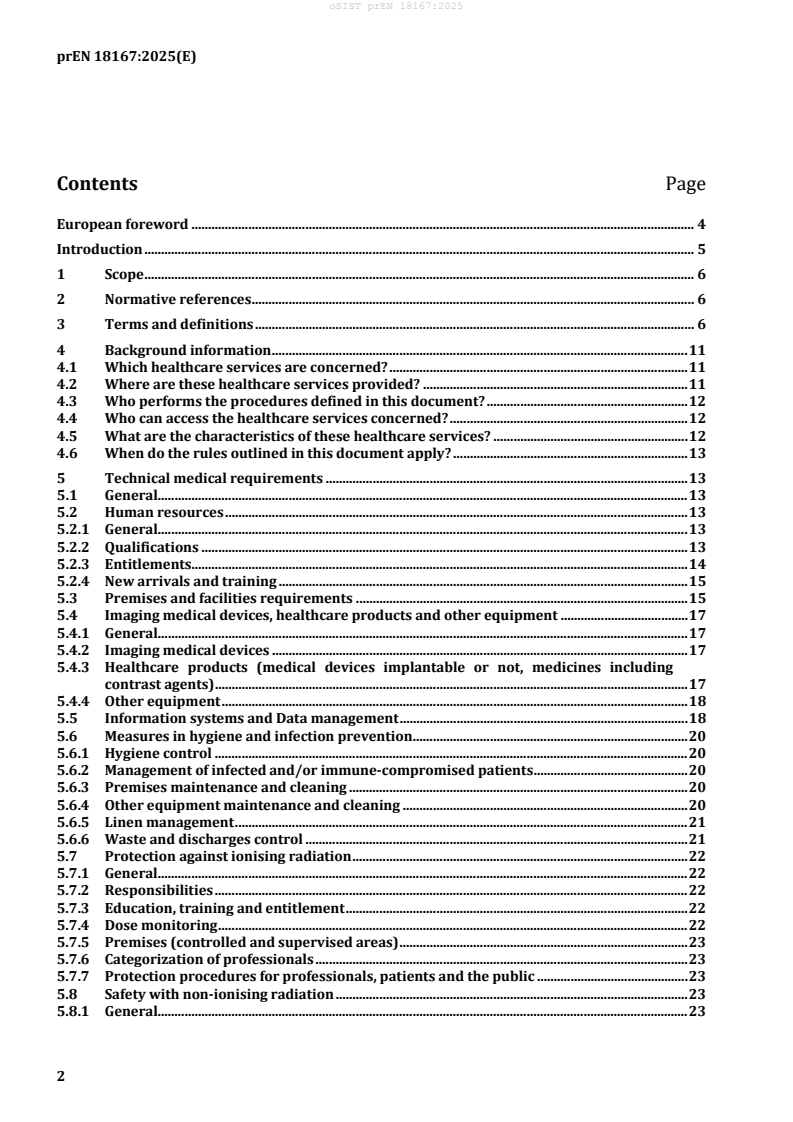
Contents Page
European foreword . 4
Introduction . 5
1 Scope . 6
2 Normative references . 6
3 Terms and definitions . 6
4 Background information . 11
4.1 Which healthcare services are concerned? . 11
4.2 Where are these healthcare services provided? . 11
4.3 Who performs the procedures defined in this document? . 12
4.4 Who can access the healthcare services concerned? . 12
4.5 What are the characteristics of these healthcare services? . 12
4.6 When do the rules outlined in this document apply? . 13
5 Technical medical requirements . 13
5.1 General. 13
5.2 Human resources . 13
5.2.1 General. 13
5.2.2 Qualifications . 13
5.2.3 Entitlements. 14
5.2.4 New arrivals and training . 15
5.3 Premises and facilities requirements . 15
5.4 Imaging medical devices, healthcare products and other equipment . 17
5.4.1 General. 17
5.4.2 Imaging medical devices . 17
5.4.3 Healthcare products (medical devices implantable or not, medicines including
contrast agents) . 17
5.4.4 Other equipment . 18
5.5 Information systems and Data management . 18
5.6 Measures in hygiene and infection prevention . 20
5.6.1 Hygiene control . 20
5.6.2 Management of infected and/or immune-compromised patients . 20
5.6.3 Premises maintenance and cleaning . 20
5.6.4 Other equipment maintenance and cleaning . 20
5.6.5 Linen management . 21
5.6.6 Waste and discharges control . 21
5.7 Protection against ionising radiation . 22
5.7.1 General. 22
5.7.2 Responsibilities . 22
5.7.3 Education, training and entitlement . 22
5.7.4 Dose monitoring . 22
5.7.5 Premises (controlled and supervised areas) . 23
5.7.6 Categorization of professionals . 23
5.7.7 Protection procedures for professionals, patients and the public . 23
5.8 Safety with non-ionising radiation . 23
5.8.1 General. 23
oSIST prEN 18167:2025
prEN 18167:2025(E)
5.8.2 Responsibilities . 24
5.8.3 MRI safety, education, training and entitlement . 24
5.8.4 Premises, equipment and access control . 24
5.8.5 Protection procedures for professionals and patients . 25
5.8.6 Specific actions in the event of an unexpected incident in MRI . 25
5.9 Identity vigilance . 25
5.10 Artificial Intelligence (AI) . 25
6 Patient pathway for a MI procedure . 26
6.1 Imaging referral for MI procedures . 26
6.2 Justification and approval of the imaging referral . 27
6.3 Patient information and making an appointment . 27
6.3.1 Patient information and informed consent . 27
6.3.2 Making an appointment . 28
6.4 Arrival of the patient in the MI organization . 29
6.5 Conducting the MI procedure . 30
6.6 Medical accidents and incidents . 30
6.7 Monitoring patients after an MI procedure . 31
6.8 MI procedure report . 31
6.8.1 General . 31
6.8.2 Content of the report . 32
6.8.3 Validation of the report . 32
6.8.4 Delivery of, and access to the report . 33
6.8.5 Revised reports . 33
6.9 Specific organizational measures . 33
6.9.1 Confidentiality . 33
6.9.2 Participation in out-of-hours service/emergencies . 34
6.9.3 Organization of relations with stakeholders throughout the MI procedure . 34
6.9.4 Interventional imaging . 34
6.9.5 Teleradiology, remote primary reading and remote scanning . 35
6.9.6 Implementation of new practices . 38
7 The quality management and risk management system of the MI organization . 38
7.1 General . 38
7.2 Definition of the quality policy . 40
7.3 Objectives of the quality policy . 40
7.4 Involvement of the senior management of the MI organization . 40
7.5 Roles and responsibilities in the MI organization . 41
7.6 Sustainability . 41
7.7 Quality of life at work . 42
7.8 Documentation and records . 42
7.9 Measurement of indicators, assessment, and analysis . 43
7.10 Risk management . 44
7.10.1 General . 44
7.10.2 Pre-emptive risk management: risk map and risk control . 44
7.10.3 Hindsight risk management . 44
7.11 Progress initiatives . 45
7.12 Assessment of the progress initiatives . 45
7.13 Management reviews . 46
8 Audits based on this document . 46
Annex A (normative) List of the required documented procedures for this document . 48
Bibliography . 51
oSIST prEN 18167:2025
prEN 18167:2025(E)
European foreword
This document (prEN 18167:2025) has been prepared by Technical Committee CEN/TC 470 “Quality
along the patient pathway in medical imaging”, the secretariat of which is held by AFNOR.
This document is currently submitted to the CEN Enquiry.
oSIST prEN 18167:2025
prEN 18167:2025(E)
Introduction
This document deals with quality in diagnostic and interventional Radiology practiced in Radiology
services.
The medical speciality Radiology is also known as Radiology and Medical Imaging and is referred to as
Medical Imaging (MI) throughout this document. It is exercised within a multi professional team
consisting of radiologists, radiographers and other professionals related to the context and the
complexity of the examinations.
This quality management standard refers to all diagnostic and interventional methods in MI especially
using X-rays, ultrasonography, and magnetic resonance imaging (MRI).
All healthcare professionals also using such imaging techniques are invited to adopt the standard.
MI activities are exercised for preventive, diagnostic, therapeutic, surveillance and follow-up purposes.
As is the case for all healthcare services, the objectives of MI activities are to provide patient care that is
appropriate, compliant with the current standards, with controlled risks that are announced,
understood as far as possible and accepted by the patient, for the correctly identified person, accessible
to all, taking the patient’s expectations into account and administered with care.
Obviously, MI extends beyond the mere production of images or the performance of a procedure, and
includes, in particular, all opinions or discussions on the justification and optimization of such
procedures, and their use in the subsequent management of patients.
This document enables peer assessment, through external peer audits, of the quality and competences
of an MI Organization to perform MI procedures. Conformity with this document aims to ensure the
appropriateness and quality of the procedures and patient care, and the safety of practices. It enables
professionals to improve their practices, while still having the time and energy for proper management
of patients.
Meeting the prevailing statutory and regulatory requirements of the prevailing jurisdiction is an
essential prerequisite.
This document was written according to the principle of a process-based approach, by presenting the
support processes first, then the patient management processes and finally the quality management
system, including assessments.
oSIST prEN 18167:2025
prEN 18167:2025(E)
1 Scope
This document specifies the requirements for implementation of a quality system along the patient
pathway in Radiology services. The objective is to ensure high quality delivery of all aspects of the
examination safety and patient care.
This document deals with procedures using X-rays, ultrasonography and magnetic resonance imaging
on humans, including diagnostic procedures and interventional Radiology as well as remote practices. It
also applies, in its principles, to any other technique and modality that would be used in Radiology
services.
The document covers:
— the different steps of patient care (from the imaging referral, before, during, and after the
examination);
— the corresponding human resources and technical-medical requirements;
— quality and risk management.
This document does not apply to radiotherapy and nuclear medicine, nor to equipment and radiation
controls which are covered in other standards. This document excludes requirements related to
research and education themes.
This document establishes best practices description which constitutes a reference for audits, including
clinical audits. Nevertheless, the clinical audits methodology, already defined at the European level, and
implemented under the responsibility of each country is excluded from the document.
2 Normative references
There are no normative references in this document.
3 Terms and definitions
For the purposes of this document, the following terms and definitions apply.
ISO and IEC maintain terminology databases for use in standardization at the following addresses:
— ISO Online browsing platform: available at https://www.iso.org/obp/
— IEC Electropedia: available at https://www.electropedia.org/
3.1
diagnostic reference levels
DRLs
dose levels in medical radio diagnostic or interventional Radiology practices, for typical examinations
for groups of standard-sized patients or standard phantoms for broadly defined types of equipment
[SOURCE: Council Directive 2013/59/Euratom, modified: reference to radiopharmaceutical aspects
[1]
removed ]
Note 1 to entry: DRLs are used as a tool to aid optimization of protection in the medical exposure of patients.
[2]
[SOURCE: ICRP, 2017 ]
oSIST prEN 18167:2025
prEN 18167:2025(E)
3.2
documented procedure
set of written rules that specify the manner in which an activity is exercised
Note 1 to entry: A procedure is a quality document included in the document system. The procedure, and the
medium on which it is contained, are controlled, and kept up to date.
Note 2 to entry: Documented procedures can be on any medium, in any format and from any source.
3.3
entitlement
formal validation by the manager of the MI Organization of the capability of a person working under its
responsibility to perform the assigned tasks
Note 1 to entry: The manager is the head of the MI Organization or is the person(s) delegated by this authority for
that purpose.
Note 2 to entry: Entitlement guarantees the capability of a professional to proficiently exercise an activity in a
given MI organization.
Note 3 to entry: Entitlement takes account of the regulatory requirements of the country concerned for the
exercise of an activity (initial qualification and continuous professional development) and the organization of
every MI organization, including, in particular, the experience of the professional concerned, in order to validate
the command of the activity exercised by every professional in every job (and before occupying this function
independently for the first time). Its renewal is conditional on an appropriate level of practice.
Note 4 to entry: Entitlement is personal.
3.4
governance
human-based system by which an organization is directed, overseen and held accountable for achieving
its defined purpose
[3]
[SOURCE: ISO 37000:2021, 3.1.1 ]
3.5
healthcare organization
entity, institution, or system that provides medical and healthcare services to individuals and patients
3.6
interventional imaging
all invasive medical procedures intended to diagnose and/or treat a pathology that are guided and
monitored by a means of medical imaging
3.7
just and learning culture
balance of fairness, justice and learning and taking responsibility for actions
Note 1 to entry: It is not about blame but it is also not about an absence of responsibility and accountability.
[4]
[SOURCE: ‘Being Fair’ – NHS Resolution, 2019 ]
oSIST prEN 18167:2025
prEN 18167:2025(E)
3.8
Medical Imaging
MI
medical specialty “Radiology” also known as “Radiology and Medical Imaging”
Note 1 to entry: MI is the term used in this document to clearly state that imaging techniques used by the medical
speciality named Radiology are not limited to the use of X-rays.
Note 2 to entry: It covers diagnostic and interventional imaging, performed by MI organizations, and includes the
procedures performed in operating suites by MI personnel.
Note 3 to entry This definition is specific for this document.
Note 4 to entry: Images that are conventional optical images (endoscopy, funduscopy…), photographs of patients
or lesions, anatomopathology are not in scope.
3.9
MI doctor
radiologist or non-radiologist medical doctor who works in the MI Organization and adopts this
document
Note 1 to entry: This also applies to non-physician healthcare professionals within the scope of medical activities
that are delegated to them in accordance with the different national regulations (for example, in certain countries,
the validation of the justification of certain imaging referrals, the issuing of certain reports…).
Note 2 to entry: The same applies to the trainees.
3.10
MI medical device
products or equipment intended for MI procedures
3.11
MI organization
designates the imaging departments, imaging centers, medical imaging facilities, performing MI
procedures
Note 1 to entry: An MI Organization can be independent or part of a healthcare organization.
Note 2 to entry: National regulation may have an equivalent term for MI organization.
3.12
MI procedure
all kind of diagnostic and interventional methods performed within the MI organization
Note 1 to entry: These methods are used for diagnostic purposes or in order to monitor, guide and perform an
interventional procedure. They especially use X-rays, MRI, and ultrasonography.
Note 2 to entry: MI procedure also refers to everything associated with the procedure from the imaging referral
to the report and clinical discussion.
Note 3 to entry: MI procedures performed within a MI Organization are defined by the MI Organization itself.
Note 4 to entry: Where appropriate, the MI procedure also includes the decision not to proceed with the
procedure after analysing the case.
oSIST prEN 18167:2025
prEN 18167:2025(E)
3.13
MI team
multi professional team of the MI Organization consisting of radiologists, radiographers and other
professionals related to the context and the complexity of the examinations
3.14
procedure
specified way to carry out an activity or a process
Note 1 to entry: A procedure can be documented or not.
[5]
[SOURCE: EN ISO 9000:2015, 3.45 ]
3.15
process
set of interrelated or interacting activities that use inputs to deliver an intended result
[5]
[SOURCE EN ISO 9000:2015, 3.4.1 ]
3.16
quality assurance
planned and systematic operations required to guarantee that a facility, a system, an item of equipment
or a procedure will function in a satisfactory manner in accordance with the established standards
3.17
quality management system
QMS
part of a management system with regard to quality
Note 1 to entry: The series of interdependent and interactive actions and processes work in harmony, enabling an
MI Organization to define and then implement its policy based on the objectives that it has predefined.
[5]
[SOURCE: EN ISO 9000:2015, 3.5.4 ]
3.18
quality policy
policy related to quality corresponding to the strategic priorities, intentions, and general objectives of
the MI Organization regarding quality
Note 1 to entry: The policy is expressed via a written document and formally adopted by the highest level of
management of the MI organization.
Note 2 to entry: In healthcare establishments where the MI Organization is not independent, the quality policy of
the MI Organization is included in accordance with the general policy of the healthcare establishment.
[5]
[SOURCE: EN ISO 9000:2015, 3.5.9 – modified and Notes to entry 1 and 2 added ]
oSIST prEN 18167:2025
prEN 18167:2025(E)
3.19
radiology
science of ionising radiation and its application to the diagnosis and treatment of disease
Note 1 to entry: Radiology in this document excludes Nuclear Medicine and Radiotherapy but includes non-
ionising imaging methods such as MRI and Ultrasound.
Note 2 to entry: The medical speciality “Radiology” is also called “Radiology and Medical Imaging” implying that
this speciality involves techniques other than just X-rays.
[SOURCE: EN 60601-1-3 :2008+AMD1 :2013+AMD2 :2021, 3.68, modified: Notes to entry 1 and 2
[6]
added ]
3.20
radiology services
services in healthcare of patients connected to diagnostic or interventional procedures carried out in a
MI Organization under the authority and responsibility of radiologists
Note 1 to entry: By extension, this term also applies in some countries to units which, under the coverage of their
national regulations, could be managed by radiographers.
3.21
relevance
requested examination of the correct patient at the right time in the proper place by the right
professional using suitable equipment
Note 1 to entry: The relevance of MI care corresponds to the match between the diagnostic and therapeutic
procedures and the patient’s needs. An analysis of relevance assesses the referral for an examination and/or the
appropriate use of MI procedures.
Note 2 to entry: The referred examination may be modified or rejected by the healthcare professional responsible
for the MI procedure.
3.22
risk management
coordinated activities to direct and control an Organization with regard to risk
Note 1 to entry: Documented process that aims to identify, assess and mitigate, wherever possible, the risks
incurred by patients, visitors and professionals in MI organizations, in order to reduce the number and/or
severity of undesirable event.
Note 2 to entry: This also includes environmental risk factors (pollution, radiation, noise and work environment).
3.23
standard operating procedures
SOPs
description of the regularly recurring activities and processes as well as their conditions and
requirements relevant to the quality of the procedure
Note 1 to entry: SOPs represent written rules that specify the manner in which an activity is exercised.
Note 2 to entry: SOPs shall be handled as documented procedures.
oSIST prEN 18167:2025
prEN 18167:2025(E)
3.24
systemic analysis
analysis to search for causes and treatment measures
Note 1 to entry: Also known as root cause analysis.
Note 2 to entry: For example, the causes of most adverse events are the result of multiple factors and involve the
risks that are inherent in the care procedures, and/or their organization, and/or their environment. Therefore,
following an adverse event, an analysis of the immediate causes, followed by a search for the root causes,
sometimes referred to as a systemic analysis, is essential.
Note 3 to entry: This approach ensures that the analysis extends beyond the identification of the responsibility of
one or more individuals and the immediately apparent cause of the detected issue.
4 Background information
4.1 Which healthcare services are concerned?
MI covers diagnostic imaging and interventional imaging.
MI diagnostic procedures deliver morphological and/or functional and/or metabolic information on the
human body. MI interventional procedures have investigational or therapeutic objectives and are
guided and monitored by imaging.
The corresponding procedures are performed on humans, from foetuses to the elderly, including
postmortem procedures.
MI activities are medical procedures. Their main steps are: the analysis and approval of the imaging
referral for the purposes of justification; scheduling; the prescription of the medicine required for the
MI procedure, where necessary; the preparation and performance of the MI procedure, including its
optimization; image processing if necessary and the production and delivery of the report. The MI
procedure is associated with pre- and post-procedure assessments and discussions, which, in
particular, may be multidisciplinary.
The healthcare services concerned call on all the skills and organizations required to perform these MI
procedures.
The MI Organization itself, or the healthcare organization which it belongs to, is responsible for meeting
the requirements of this document.
4.2 Where are these healthcare services provided?
MI procedures are performed in imaging departments and imaging centres, hereafter referred to as MI
organizations. Procedures performed by MI professionals, outside these locations, e.g. in operating
suites or by the use of mobile units, are also part of the scope.
These MI organizations are independent and autonomous, or part of a healthcare organization.
The MI Organization can have one or more sites belonging to the same public, private or mixed legal
entity. It can be associated with other healthcare organizations.
The MI Organization can be in healthcare units in specific environments (detention centres, or others).
However, facilities which do not administer any patient care, are outside the scope of this document.
oSIST prEN 18167:2025
prEN 18167:2025(E)
4.3 Who performs the procedures defined in this document?
The healthcare professionals who collaborate in the MI Organization do so within a team. The team
includes two key categories of licensed professionals: the radiologist, who is a physician specialized in
Radiology, and the radiographer. They work in a complementary manner according to their respective
qualification, training and entitlement, the techniques employed, the situations encountered, as well as
with national regulations and their developments.
Along the patient pathway some activities require specific competences (such as those related to safety
or mastery of certain examinations) which require specific qualifications. For this reason, and without
aiming to be exhaustive, in paragraph 5.7.2. reference is made to the roles of the Medical Physics Expert
(MPE) and of the Radiation Protection Officer (RPO), in paragraph 5.8.2 to the roles of the MR Medical
Director (MRMD), MR Safety Officer (MRSO), MR Safety Expert (MRSE) and in paragraph 7.4. to the role
of the quality manager.
NOTE 1 The MI team includes:
—non-radiologist doctors who work in the MI Organization and adopt this document.
—the professionals providing the support functions required to exercise the main activity.
—all those in training.
NOTE 2 The authorized health care professional also called the referrer who asks for the examination is not
part of the MI team.
4.4 Who can access the healthcare services concerned?
The healthcare services concerned can be accessed by the entire prenatal, child and adult population
likely to suffer from a health disorder (exploratory phase), with a health disorder (additional diagnosis,
treatment using MI, regular monitoring or in the case of possible complications), or subject to
screening.
The activities of MI organizations are scheduled or performed in emergencies, for both hospitalized
patients and outpatients.
Each MI Organization defines the types of MI procedures it performs and for which populations.
4.5 What are the characteristics of these healthcare services?
The objective is that the management of patients be administered with due quality and safety, in
accordance with the regulations and the recommendations on best-medical practices, including risk
management.
The internal rules of the organization comply with applicable regulations and recommendations.
Information, consent and the protection of professional confidentiality comply within the values,
obligations and rules of the healthcare professions and of other professionals who participate in the
activity of the MI organization, in accordance with the applicable regulations.
MI procedures involve the use of equipment and, in particular, of medical image acquisition devices
(CT scanners, magnetic resonance imaging (MRI), fixed or mobile radiography and radioscopy
equipment, ultrasonic scanners, hybrid devices, etc.), the use of other medical devices, which may be
implantable or not, and of medicines including contrast agents.
oSIST prEN 18167:2025
prEN 18167:2025(E)
The MI procedure implements the principles of justification and optimization, whether it uses ionising
radiation or not. The operational implementation of the principle of justification consists of choosing
the right procedure for the right patient, as described in “6.1 Imaging referrals for MI procedures” and
“6.2 Justification and approval of the imaging referral”. The adoption of the principle of optimization by
the professionals involved aims to limit the doses of exposure to ionising radiation and electromagnetic
waves for the exposed persons, and the doses of contrast agents administered, while guaranteeing the
adequate diagnostic quality of the examination.
Medical activity is usually conducted face to face, but it can also be exercised remotely (e.g. by
teleradiology) under conditions defined by regulations and procedures. In this case, the assessment of
the MI organization includes the procedures performed on-site and the procedures performed
externally/remotely under the organization’s control, and in particular their relevance and
optimization.
All the activities are exercised in accordance with the patient’s rights.
4.6 When do the rules outlined in this document apply?
This document applies to the medical activity of the MI Organization at all times.
5 Technical medical requirements
5.1 General
The MI Organization shall control the processes and risks related to the pathway and care of the patient
and the performance of the MI procedures. The performed MI procedures are defined by the MI
organization.
5.2 Human resources
5.2.1 General
The MI Organization shall determine and ensure that its workforce possesses the skills required for
safety, effectiveness, proper patient management of patients and a strong command of the MI
procedures that it performs. To this end, it shall determine and provide the necessary human resources
for the implementation of its quality management system (QMS).
The composition and structure of the MI Organization shall be defined in a document which describes
the roles and responsibilities of all the categories of professionals.
The MI Organization shall ensure that all relevant roles, responsibilities and training of the workforce
from external resources used are defined in the service contract and tracked.
The management conditions of human resources and the quality of life at work shall be concerns and
responsibility of the MI organization, which shall take and follow up actions. The organization shall
promote and create a positive safety culture.
5.2.2 Qualifications
The MI Organization shall ensure and document that all the professionals are qualified and authorized
to practice. It shall possess documents proving that every professional has the necessary skills and
command of the procedures they perform in order to meet the requirements within the professional
scope pertaining to the quality of care and the safety of the patients treated in the MI organization.
The MI Organization shall enable and record the continuing professional development of the
professionals in order to maintain and, if necessary, improve and develop their skills according to the
best practices, ensuring a periodic review.
oSIST prEN 18167:2025
prEN 18167:2025(E)
The training plan, including records and the monitoring of its quality and impact shall be described in a
documented procedure.
Initial and periodic training shall be defined for the acquisition of any medical devices, taking into
account their complexity, the practices and the number of users concerned. All equipment suppliers
should ensure a training programme of appropriate length for the professionals is available throughout
the life of the equipment. These mandatory training programmes shall be recorded and assessed using
the training materials made available to the workforce.
While considering the professional scope, professionals are expected to be able to communicate and
listen, show respect, kindness, and courtesy towards patients, and have ethical and professional
attitude towards the different professionals.
Any delegations of activity shall follow processes that meet the applicable regulations.
5.2.3 Entitlements
Each professional shall be authorized by the MI Organization to perform the different types of MI
procedures within their scope of competence and in accordance with the applicable regulations.
The same professional can be authorized for several operating positions and/or activities in the MI
organization.
The MI Organization shall define its quantitative and qualitative entitlement criteria to determine the
necessary level of activity per professional and for each of the types of procedures, in accordance with
any existing recommendations.
Entitlement shall be adapted to the profile of the job and the formalities shall be limited strictly to
meeting the needs. It shall be granted after practical exercise, according to internal procedures, for a
limited duration.
Entitlements shall be renewed in the event of a change of equipment, significant changes to the MI
Organization or a lengthy interruption of activity.
A documented procedure shall be put in place to describe the establishment and management of
professional entitlements.
A mapping of the entitlements and continuous professional development (CPD) shall be drawn up and
periodically reviewed.
In particular, the following documents are expected:
— a document describing the activities (types of MI procedures) carried out by the MI organization;
— job descriptions that describe the specific skills, competences, responsibilities, and tasks of the
professional categories required to conduct each of these activities, and the mentoring time
required for the entitlement of newly recruited professionals. All these job descriptions are used to
match the workforce to the activities conducted. These job descriptions act as the supporting
materials for individual entitlements;
— documents certifying the qualifications of the professional;
— initial training, including diplomas, and continuous professional development, in accordance with
the applicable regulations. The MI Organization makes sure that the titles and diplomas of the
professionals working in the MI Organization respect the applicable national regulations;
— validation of skills acquired through experience, in accordance with the applicable regulations;
— entitlement documents for each professional, listing the positions and the activities to which they
can be assigned. Specific entitlements may be necessary.
oSIST prEN 18167:2025
prEN 18167:2025(E)
Entitlements and their validation period shall be proportional to the risks related to the medical
imaging activity.
EXAMPLE Formal definition of a training and entitlement process.
Step 1
—Training of all relevant staff including radiographers by the medical device supplier application specialists,
on the basis of the technical clauses specifications of the medical device,
—Design of the procedures of the medical devices according to the internal policy.
Step 2
—Design of the tools used by the trained referent staff to train all the users of the medical devices: list of the
tasks to be understood and performed at the end of the training, etc,
—Organization of the training of all the users of the medical devices by the referent staff, with the support of
management: duration of supervision, working in pai
...
Questions, Comments and Discussion
Ask us and Technical Secretary will try to provide an answer. You can facilitate discussion about the standard in here.
Loading comments...