


EN 12596:2007
(Main)Bitumen and bituminous binders - Determination of dynamic viscosity by vacuum capillary
General Information
- Abstract
This European Standard specifies a method for the determination of the dynamic viscosity of bituminous binders by means of a vacuum capillary viscometer at 60 C in a range between 0,003 6 Pa s to over
580 000 Pa s. Bituminous Emulsions are not within the scope of this method.
NOTE 1 Emulsions containing bituminous binders are not considered to be covered by this method. This method can be used for anhydrous binders obtained from emulsions (stabilised and/or recovered binders).
NOTE 2 The viscosity behaviour of some polymer modified bitumens (PMB) is not demonstrated in a vacuum capillary viscometer. Other methods are more relevant.
WARNING Use of this European Standard can involve hazardous materials, operations and equipment. This European Standard does not purport to address all of the safety problems associated with its use. It is the responsibility of the user of this European Standard to establish appropriate safety and health practices and determine the applicability of regulatory limitations prior to use.
- Status
- Withdrawn
- Publication Date
- 13-Mar-2007
- Withdrawal Date
- 22-Sep-2026
- Technical Committee
- CEN/TC 336 - Bituminous binders
- Drafting Committee
- CEN/TC 336 - Bituminous binders
- Current Stage
- 9960 - Withdrawal effective - Withdrawal
- Start Date
- 05-Nov-2014
- Completion Date
- 23-Sep-2026
- Directive
- Harmonized Standard305/2011 - Regulation (eu) No 305/2011 of the European Parliament and of the Council of 9 march 2011 laying down harmonised conditions for the marketing of construction products and repealing council directive 89/106/eec
Not Harmonized89/106/EEC - Construction products

Relations
- Effective Date
- 22-Dec-2008
- Effective Date
- 08-Jun-2022
- Effective Date
- 28-Jan-2026
- Effective Date
- 28-Jan-2026
- Effective Date
- 28-Jan-2026
Get Certified
Connect with accredited certification bodies for this standard

DIBt (Deutsches Institut für Bautechnik)
German Institute for Building Technology.
DIN CERTCO
DIN Group product certification.

Element Materials Technology
Materials testing and product certification.
Sponsored listings
Frequently Asked Questions
EN 12596:2007 is a standard published by the European Committee for Standardization (CEN). Its full title is "Bitumen and bituminous binders - Determination of dynamic viscosity by vacuum capillary". This standard covers: This European Standard specifies a method for the determination of the dynamic viscosity of bituminous binders by means of a vacuum capillary viscometer at 60 C in a range between 0,003 6 Pa s to over 580 000 Pa s. Bituminous Emulsions are not within the scope of this method. NOTE 1 Emulsions containing bituminous binders are not considered to be covered by this method. This method can be used for anhydrous binders obtained from emulsions (stabilised and/or recovered binders). NOTE 2 The viscosity behaviour of some polymer modified bitumens (PMB) is not demonstrated in a vacuum capillary viscometer. Other methods are more relevant. WARNING Use of this European Standard can involve hazardous materials, operations and equipment. This European Standard does not purport to address all of the safety problems associated with its use. It is the responsibility of the user of this European Standard to establish appropriate safety and health practices and determine the applicability of regulatory limitations prior to use.
This European Standard specifies a method for the determination of the dynamic viscosity of bituminous binders by means of a vacuum capillary viscometer at 60 C in a range between 0,003 6 Pa s to over 580 000 Pa s. Bituminous Emulsions are not within the scope of this method. NOTE 1 Emulsions containing bituminous binders are not considered to be covered by this method. This method can be used for anhydrous binders obtained from emulsions (stabilised and/or recovered binders). NOTE 2 The viscosity behaviour of some polymer modified bitumens (PMB) is not demonstrated in a vacuum capillary viscometer. Other methods are more relevant. WARNING Use of this European Standard can involve hazardous materials, operations and equipment. This European Standard does not purport to address all of the safety problems associated with its use. It is the responsibility of the user of this European Standard to establish appropriate safety and health practices and determine the applicability of regulatory limitations prior to use.
EN 12596:2007 is classified under the following ICS (International Classification for Standards) categories: 75.140 - Waxes, bituminous materials and other petroleum products; 91.100.50 - Binders. Sealing materials. The ICS classification helps identify the subject area and facilitates finding related standards.
EN 12596:2007 has the following relationships with other standards: It is inter standard links to EN 12596:1999, EN 12596:2014, EN 58:2012, EN ISO 3696:1995, EN 12594:2024. Understanding these relationships helps ensure you are using the most current and applicable version of the standard.
EN 12596:2007 is associated with the following European legislation: EU Directives/Regulations: 305/2011, 89/106/EEC; Standardization Mandates: M/124. When a standard is cited in the Official Journal of the European Union, products manufactured in conformity with it benefit from a presumption of conformity with the essential requirements of the corresponding EU directive or regulation.
EN 12596:2007 is available in PDF format for immediate download after purchase. The document can be added to your cart and obtained through the secure checkout process. Digital delivery ensures instant access to the complete standard document.
Standards Content (Sample)
2003-01.Slovenski inštitut za standardizacijo. Razmnoževanje celote ali delov tega standarda ni dovoljeno.Bitumen and bituminous binders - Determination of dynamic viscosity by vacuum capillaryPHWRGRBitumes et liants bitumineux - Détermination de la viscosité dynamique par viscosimetre capillaire sous videBitumen und bitumenhaltige Bindemittel - Bestimmung der dynamischen Viskosität mit Vakuum-KapillarenTa slovenski standard je istoveten z:EN 12596:2007SIST EN 12596:2007en;fr;de91.100.50Veziva. Tesnilni materialiBinders. Sealing materials75.140Voski, bitumni in drugi naftni proizvodiWaxes, bituminous materials and other petroleum productsICS:SIST EN 12596:20001DGRPHãþDSLOVENSKI
STANDARDSIST EN 12596:200701-maj-2007
EUROPEAN STANDARDNORME EUROPÉENNEEUROPÄISCHE NORMEN 12596March 2007ICS 75.140; 91.100.50Supersedes EN 12596:1999
English VersionBitumen and bituminous binders - Determination of dynamicviscosity by vacuum capillaryBitumes et liants bitumineux - Détermination de la viscositédynamique par viscosimètre capillaire sous videBitumen und bitumenhaltige Bindemittel - Bestimmung derdynamischen Viskosität mit Vakuum-KapillarenThis European Standard was approved by CEN on 3 February 2007.CEN members are bound to comply with the CEN/CENELEC Internal Regulations which stipulate the conditions for giving this EuropeanStandard the status of a national standard without any alteration. Up-to-date lists and bibliographical references concerning such nationalstandards may be obtained on application to the CEN Management Centre or to any CEN member.This European Standard exists in three official versions (English, French, German). A version in any other language made by translationunder the responsibility of a CEN member into its own language and notified to the CEN Management Centre has the same status as theofficial versions.CEN members are the national standards bodies of Austria, Belgium, Bulgaria, Cyprus, Czech Republic, Denmark, Estonia, Finland,France, Germany, Greece, Hungary, Iceland, Ireland, Italy, Latvia, Lithuania, Luxembourg, Malta, Netherlands, Norway, Poland, Portugal,Romania, Slovakia, Slovenia, Spain, Sweden, Switzerland and United Kingdom.EUROPEAN COMMITTEE FOR STANDARDIZATIONCOMITÉ EUROPÉEN DE NORMALISATIONEUROPÄISCHES KOMITEE FÜR NORMUNGManagement Centre: rue de Stassart, 36
B-1050 Brussels© 2007 CENAll rights of exploitation in any form and by any means reservedworldwide for CEN national Members.Ref. No. EN 12596:2007: E
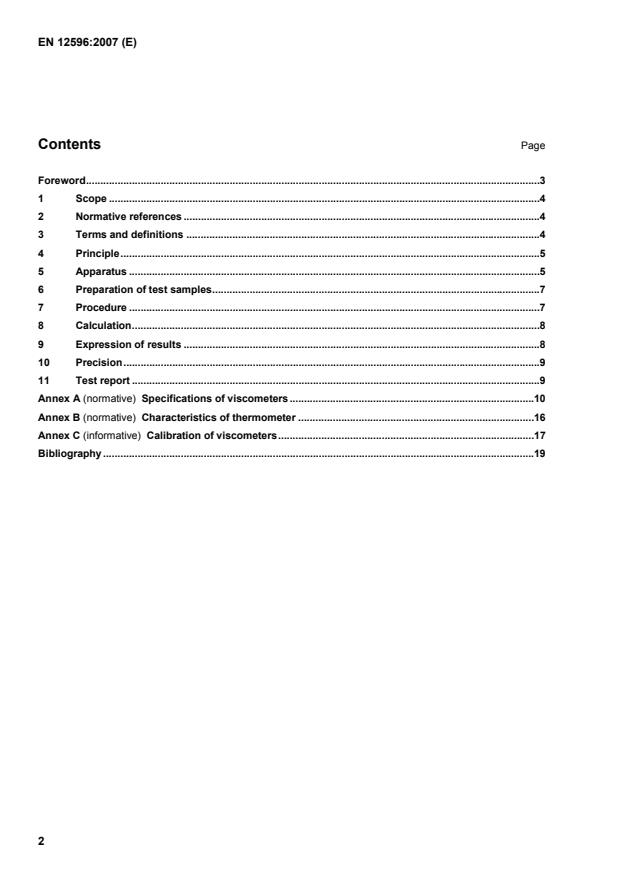
Specifications of viscometers.10 Annex B (normative)
Characteristics of thermometer.16 Annex C (informative)
Calibration of viscometers.17 Bibliography.19
580 000 Pa ⋅ s. Bituminous Emulsions are not within the scope of this method. NOTE 1 Emulsions containing bituminous binders are not considered to be covered by this method. This method can be used for anhydrous binders obtained from emulsions (stabilised and/or recovered binders). NOTE 2 The viscosity behaviour of some polymer modified bitumens (PMB) is not demonstrated in a vacuum capillary viscometer. Other methods are more relevant. WARNING — Use of this European Standard can involve hazardous materials, operations and equipment. This European Standard does not purport to address all of the safety problems associated with its use. It is the responsibility of the user of this European Standard to establish appropriate safety and health practices and determine the applicability of regulatory limitations prior to use. 2 Normative references The following referenced documents are indispensable for the application of this document. For dated references, only the edition cited applies. For undated references, the latest edition of the referenced document (including any amendments) applies. EN 58, Bitumen and bituminous binders - Sampling bituminous binders EN 12594, Bitumen and bituminous binders - Preparation of test samples EN ISO 3696:1995, Water for analytical laboratory use - Specification and test methods (ISO 3696:1987) 3 Terms and definitions For the purposes of this document, the following terms and definitions apply. 3.1 dynamic viscosity ratio between the applied shear stress and the velocity gradient NOTE 1 Dynamic viscosity is a measure of the resistance to the flow of a liquid and is commonly called the viscosity of the liquid. For the purposes of this standard, the word viscosity means the dynamic viscosity of a liquid. NOTE 2 The SI unit of dynamic viscosity is Pa · s. 3.2 Newtonian liquid liquid with a viscosity that is independent of the rate of shear NOTE The constant ratio of the shear stress to the velocity gradient is the dynamic viscosity of the liquid. If this ratio is not constant, the liquid is non-Newtonian. 3.3 density mass of a liquid divided by its volume NOTE 1 When reporting density, the unit of density used, together with the temperature, is stated explicitly, for example kilogram per cubic metre. NOTE 2 The SI unit of density is kg/m3.
When thermometers are completely submerged, corrections for each individual thermometer based on calibration under conditions of complete submergence are determined and applied.
If the thermometer is completely submerged in the bath during use, the pressure of the gas in the expansion chamber will be higher or lower than during standardization, and can cause a high or low reading on the thermometer. 5.2.2 It is essential that liquid-in-glass thermometers be recalibrated periodically and that official corrections be adjusted as necessary to conform to any changes in temperature readings. The thermometer shall be read as accurately as possible, any appropriate correction applied, and the corrected reading recorded to 0,1 °C. NOTE 1 Thermometers should be checked at regular intervals. NOTE 2 A commonly used procedure given in method ASTM E 77 applies a correction which is based on changes in the ice point calibration. Other temperature measuring devices may be used instead of mercury stem thermometers. However, the mercury stem thermometer is the reference device. Therefore any alternative device employed shall be calibrated so as to provide the same readings as would be provided by the mercury stem thermometer, recognising and allowing for the fact of changed thermal response times compared with the mercury thermometer. NOTE 3 When measuring and controlling nominally constant temperatures, as in this test method, alternative devices can indicate greater cyclic variations than mercury thermometers, to an extent depending on the cycle time
...