


CEN/TS 14383-6:2022
(Main)Prevention of crime - Urban planning and building design - Part 6: Schools and educational institutions
General Information
- Abstract
This document gives guidance and recommendations for reducing the crime risk and antisocial behaviour against people and property in schools through planning and design stage by preventative risk management.
This document is usable for public and private schools and educational institutions. This document can be used particularly but not exclusively for the security risks. Proposal and implementation of crime prevention measures work with risk management. It is essential to consider changing social and cultural unwished behaviours in school and educational premises with preventive risk management.
This document is not addressed to universities. However, it can be used as methodology for crime prevention and risk management as well as to ensure the level of physical protection in universities as well.
- Status
- Published
- Publication Date
- 12-Jul-2022
- Technical Committee
- CEN/TC 325 - Prevention of crime by urban planning and building design
- Drafting Committee
- CEN/TC 325/WG 3 - Building design
- Current Stage
- 9060 - Closure of 2 Year Review Enquiry - Review Enquiry
- Start Date
- 04-Mar-2026
- Completion Date
- 04-Mar-2026

Overview
CEN/TS 14383-6:2022 - Prevention of crime: Urban planning and building design - Part 6: Schools and educational institutions - is a CEN Technical Specification that provides guidance and recommendations to reduce crime and antisocial behaviour in schools through planning, design and preventative risk management. Intended for public and private schools and educational institutions, the document supports early-stage design decisions that improve physical security, site layout and operational regimes. While not specifically aimed at universities, its risk‑management methodology can be applied in higher‑education settings.
Key topics and requirements
This Technical Specification structures crime prevention around a risk-management process and covers practical topics without prescribing numeric specifications:
- Risk management framework: Establish context, define risk criteria, identify, analyse, evaluate and treat crime risks specific to schools.
- Risk identification & assets: Categorisation of threats, scenarios, assets (people, property, information) and local circumstances.
- Risk analysis & evaluation: Likelihood, vulnerability and consequence assessments to determine acceptable vs unacceptable risks.
- Risk treatment (design measures):
- Design and layout recommendations for site planning to reduce opportunities for crime (natural surveillance, clear public/private demarcation).
- Perimetric space guidance on access routes, boundaries and landscape design to control approach and visibility.
- Building envelope measures related to doors, windows and access points to reduce unauthorized entry.
- Internal school systems covering circulation, zoning, secure areas and avoidance of hiding places.
- Technical protection: CCTV, alarm systems, mechanical barriers and monitoring arrangements as part of an integrated security solution.
- Regime measures: Policies, procedures, training, incident recording and security staff roles.
- Implementation & assurance: Security audits, penetration testing, documentation, incident reporting, training, monitoring and periodic review of measures and technical systems.
Practical applications and users
Who uses CEN/TS 14383-6:2022:
- Architects, urban planners and building designers integrating crime prevention through environmental design (CPTED) into school projects.
- School estate managers, facility managers and local authorities planning refurbishments or new builds.
- Security consultants, risk assessors and system integrators specifying CCTV, alarms and access-control as part of a holistic solution.
- School leadership and operations teams developing regime measures, incident reporting and training.
Typical uses:
- Early-stage masterplanning to reduce vulnerability and improve natural surveillance.
- Preparing security requirements for procurement and tender documents.
- Conducting school-site risk assessments, audits and updating security documentation.
Related standards
- EN 14383-1 (Definitions) and other parts of EN/CEN 14383 family covering urban planning, dwellings, shops, petrol stations and public transport facilities - useful for cross‑reference when integrating school security into broader urban or building programmes.
Keywords: CEN/TS 14383-6:2022, crime prevention, schools, educational institutions, urban planning, building design, risk management, physical security, perimeter, building envelope.
Relations
- Effective Date
- 28-Jan-2026
Get Certified
Connect with accredited certification bodies for this standard

DIBt (Deutsches Institut für Bautechnik)
German Institute for Building Technology.
DIN CERTCO
DIN Group product certification.

Kiwa BDA Testing
Building and construction product certification.
Sponsored listings
Frequently Asked Questions
CEN/TS 14383-6:2022 is a technical specification published by the European Committee for Standardization (CEN). Its full title is "Prevention of crime - Urban planning and building design - Part 6: Schools and educational institutions". This standard covers: This document gives guidance and recommendations for reducing the crime risk and antisocial behaviour against people and property in schools through planning and design stage by preventative risk management. This document is usable for public and private schools and educational institutions. This document can be used particularly but not exclusively for the security risks. Proposal and implementation of crime prevention measures work with risk management. It is essential to consider changing social and cultural unwished behaviours in school and educational premises with preventive risk management. This document is not addressed to universities. However, it can be used as methodology for crime prevention and risk management as well as to ensure the level of physical protection in universities as well.
This document gives guidance and recommendations for reducing the crime risk and antisocial behaviour against people and property in schools through planning and design stage by preventative risk management. This document is usable for public and private schools and educational institutions. This document can be used particularly but not exclusively for the security risks. Proposal and implementation of crime prevention measures work with risk management. It is essential to consider changing social and cultural unwished behaviours in school and educational premises with preventive risk management. This document is not addressed to universities. However, it can be used as methodology for crime prevention and risk management as well as to ensure the level of physical protection in universities as well.
CEN/TS 14383-6:2022 is classified under the following ICS (International Classification for Standards) categories: 13.310 - Protection against crime; 91.020 - Physical planning. Town planning; 91.120.99 - Other standards related to protection of and in buildings. The ICS classification helps identify the subject area and facilitates finding related standards.
CEN/TS 14383-6:2022 has the following relationships with other standards: It is inter standard links to EN 14383-1:2006. Understanding these relationships helps ensure you are using the most current and applicable version of the standard.
CEN/TS 14383-6:2022 is available in PDF format for immediate download after purchase. The document can be added to your cart and obtained through the secure checkout process. Digital delivery ensures instant access to the complete standard document.
Standards Content (Sample)
SLOVENSKI STANDARD
01-september-2022
Preprečevanje kriminala - Urbanistično planiranje in projektiranje stavb - 6. del:
Šole in izobraževalne ustanove
Prevention of crime - Urban planning and building design - Part 6: Schools and
educational institutions
Vorbeugende Kriminalitätsbekämpfung - Stadt- und Gebäudeplanung - Teil 6: Schulen
Ta slovenski standard je istoveten z: CEN/TS 14383-6:2022
ICS:
03.180 Vzgoja in izobraževanje Education
13.310 Varstvo pred kriminalom Protection against crime
2003-01.Slovenski inštitut za standardizacijo. Razmnoževanje celote ali delov tega standarda ni dovoljeno.
CEN/TS 14383-6
TECHNICAL SPECIFICATION
SPÉCIFICATION TECHNIQUE
July 2022
TECHNISCHE SPEZIFIKATION
ICS 13.310; 91.020; 91.120.99
English Version
Prevention of crime - Urban planning and building design -
Part 6: Schools and educational institutions
Vorbeugende Kriminalitätsbekämpfung - Stadt- und
Gebäudeplanung - Teil 6: Schulen
This Technical Specification (CEN/TS) was approved by CEN on 6 June 2022 for provisional application.
The period of validity of this CEN/TS is limited initially to three years. After two years the members of CEN will be requested to
submit their comments, particularly on the question whether the CEN/TS can be converted into a European Standard.
CEN members are required to announce the existence of this CEN/TS in the same way as for an EN and to make the CEN/TS
available promptly at national level in an appropriate form. It is permissible to keep conflicting national standards in force (in
parallel to the CEN/TS) until the final decision about the possible conversion of the CEN/TS into an EN is reached.
CEN members are the national standards bodies of Austria, Belgium, Bulgaria, Croatia, Cyprus, Czech Republic, Denmark, Estonia,
Finland, France, Germany, Greece, Hungary, Iceland, Ireland, Italy, Latvia, Lithuania, Luxembourg, Malta, Netherlands, Norway,
Poland, Portugal, Republic of North Macedonia, Romania, Serbia, Slovakia, Slovenia, Spain, Sweden, Switzerland, Turkey and
United Kingdom.
EUROPEAN COMMITTEE FOR STANDARDIZATION
COMITÉ EUROPÉEN DE NORMALISATION
EUROPÄISCHES KOMITEE FÜR NORMUNG
CEN-CENELEC Management Centre: Rue de la Science 23, B-1040 Brussels
© 2022 CEN All rights of exploitation in any form and by any means reserved Ref. No. CEN/TS 14383-6:2022 E
worldwide for CEN national Members.
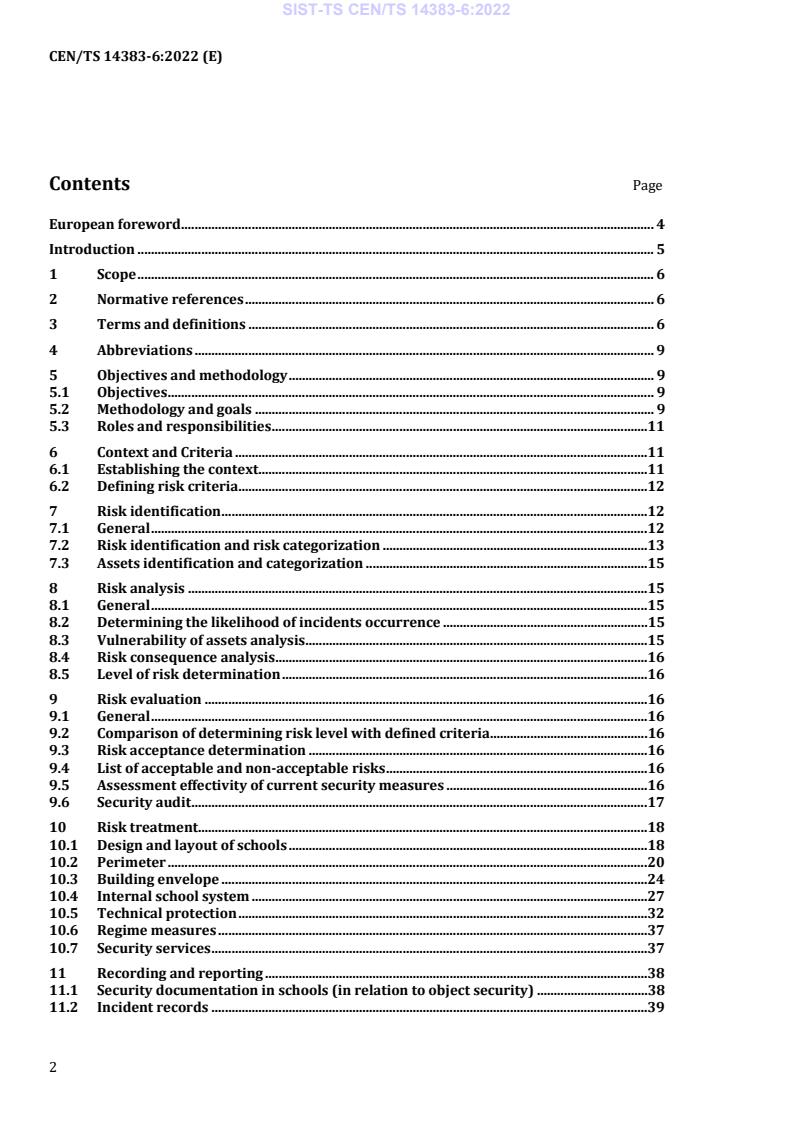
Contents Page
European foreword . 4
Introduction . 5
1 Scope . 6
2 Normative references . 6
3 Terms and definitions . 6
4 Abbreviations . 9
5 Objectives and methodology . 9
5.1 Objectives . 9
5.2 Methodology and goals . 9
5.3 Roles and responsibilities .11
6 Context and Criteria .11
6.1 Establishing the context .11
6.2 Defining risk criteria .12
7 Risk identification .12
7.1 General .12
7.2 Risk identification and risk categorization .13
7.3 Assets identification and categorization .15
8 Risk analysis .15
8.1 General .15
8.2 Determining the likelihood of incidents occurrence .15
8.3 Vulnerability of assets analysis .15
8.4 Risk consequence analysis.16
8.5 Level of risk determination .16
9 Risk evaluation .16
9.1 General .16
9.2 Comparison of determining risk level with defined criteria .16
9.3 Risk acceptance determination .16
9.4 List of acceptable and non-acceptable risks .16
9.5 Assessment effectivity of current security measures .16
9.6 Security audit .17
10 Risk treatment.18
10.1 Design and layout of schools .18
10.2 Perimeter .20
10.3 Building envelope .24
10.4 Internal school system .27
10.5 Technical protection .32
10.6 Regime measures .37
10.7 Security services .37
11 Recording and reporting .38
11.1 Security documentation in schools (in relation to object security) .38
11.2 Incident records .39
11.3 Security documentation updating . 39
12 Communication and consulting . 40
12.1 Periodical training for stakeholders and participating operators . 40
13 Monitoring and review . 40
13.1 Requirements on regime and organisational security audits . 40
13.2 Physical security control . 40
13.3 Requirements on functional tests and revision of technical protection (mechanical
and technical measures) . 41
13.4 Efficiency verification and implementation of security measures covering new
observed risks. 41
Bibliography . 42
European foreword
This document (CEN/TS 14383-6:2022) has been prepared by Technical Committee CEN/TC 325 “Crime
prevention though building, facility and area design”, the secretariat of which is held by UNMZ.
Attention is drawn to the possibility that some of the elements of this document may be the subject of
patent rights. CEN shall not be held responsible for identifying any or all such patent rights.
EN 14383 / CEN/TS 14383 consists of the following parts, under the general title Prevention of crime -
Urban planning and building design:
— Part 1: Definition of specific terms
— Part 2: Urban planning
— Part 3: Dwellings
— Part 4: Shops and offices
— Part 5: Petrol stations
— Part 6: Schools and educational institutions
— Part 7: Public transport facilities
— Part 8: Attacks with vehicles
Any feedback and questions on this document should be directed to the users’ national standards body.
A complete listing of these bodies can be found on the CEN website.
According to the CEN/CENELEC Internal Regulations, the national standards organisations of the
following countries are bound to announce this Technical Specification: Austria, Belgium, Bulgaria,
Croatia, Cyprus, Czech Republic, Denmark, Estonia, Finland, France, Germany, Greece, Hungary, Iceland,
Ireland, Italy, Latvia, Lithuania, Luxembourg, Malta, Netherlands, Norway, Poland, Portugal, Republic of
North Macedonia, Romania, Serbia, Slovakia, Slovenia, Spain, Sweden, Switzerland, Turkey and the United
Kingdom.
Introduction
While considering measures aimed at 'reduction of risk of crime and antisocial behaviour in schools and
educational institutions (schools), one of the most important tasks is risk management. High-quality risk
management when planning, implementing and using schools and educational institutions depends on
risk management system and its process risk assessment. A scope of security measures of physical
protection design and implementation should be taken in order to reduce the risk.
The causes of crime and antisocial behaviour have been researched for many years. There are many
factors that can influence the possibility of an offence being committed or not. Certain factors, for example
socio-economic conditions, are beyond the scope of this document. A common factor of all the measures
is the fact that it is difficult to limit unauthorized entry into a school building.
Most of crimes are committed because perpetrators use opportunities in schools such as easy access,
hiding places, absence of demarcation between public and private spaces, poor lighting and/or
favourable landscaping or architectural solution. By understanding the motivation of potential offenders
and counterbalancing it by risk assessment, specific physical security measures combined with real or
symbolic design elements with risk management, this document aims to assist designers, planners, estate
managers and stakeholders in crime prevention.
It helps to have a good understanding of technical recommendations, technical standards, laws and
regulations summarized in one document necessary for schools and educational institutions to
implement often neglected conceptual solutions of schools’ crime prevention in early stage planning.
1 Scope
This document gives guidance and recommendations for reducing the crime risk and antisocial behaviour
against people and property in schools through planning and design stage by preventative risk
management.
This document is usable for public and private schools and educational institutions. This document can
be used particularly but not exclusively for the security risks. Proposal and implementation of crime
prevention measures work with risk management. It is essential to consider changing social and cultural
unwished behaviours in school and educational premises with preventive risk management.
This document is not addressed to universities. However, it can be used as methodology for crime
prevention and risk management as well as to ensure the level of physical protection in universities as
well.
2 Normative references
The following documents are referred to in the text in such a way that some or all of their content
constitutes requirements of this document. For dated references, only the edition cited applies. For
undated references, the latest edition of the referenced document (including any amendments) applies.
EN 14383-1:2006, Prevention of crime - Urban planning and building design - Part 1: Definition of specific
terms
3 Terms and definitions
For the purposes of this document, the terms and definitions of EN 14383-1:2006 and the following
apply.
ISO and IEC maintain terminological databases for use in standardization at the following addresses:
— ISO Online browsing platform: available at https://www.iso.org/obp
— IEC Electropedia: available at http://www.electropedia.org/
3.1
asset
anything that has value to an organization
Note 1 to entry: Assets include but are not limited to human, physical, information, intangible and environmental
resources.
3.2
risk analysis
identification and evaluation of crime threats
[SOURCE: EN 14383-1:2006, 3.32]
3.3
secure area
mechanically and/or electronically enclosed area protected for safety and/or security purposes
[SOURCE: EN 14383-1:2006, 3.38]
3.4
security measures of physical protection
system of technical, technological and regime measures resulting in object/property protection, to
prevent crime and security threats and in case an event happens, to mitigate its consequences
3.5
physical protection
system of technical and regime measures for the protection of persons against security threats resulting
from unauthorized activities within or with regards the property
3.6
physical security
security services performed by school staff and/or security staff (guards)
3.7
threat
individual or a group with motivation and capability for intentional act that cause harm to people or loss
of asset
3.8
location
territory with a particular appearance, part of a geographical area
3.9
risk management
coordinated activities resulting from risk assessment processes to deal with crime risks
[SOURCE: ISO 31000:2018, 3.2, modified]
3.10
local circumstances
conditions characteristic of a particular location, such as: terrain, accessibility, urban concentration,
security situation, etc.
3.11
consequence
outcome of an event
[SOURCE: ISO 31000:2018, 3.6, modified]
3.12
penetration test
practical test of security measures functionality regarding access denial/control systems
3.13
perimetric space
space in close vicinity of the building (from the boundary to the building envelope – including the
accesses)
[SOURCE: EN 14383-1:2006, 3.27]
3.14
building envelope
outer walls with openings, i.e. doors and windows
3.15
risk assessment
categorization of risks and measures including evaluation of their likelihood
3.16
regime measures
set of binding and clearly defined internal rules, instructions, orders and procedures to asset regime and
security measures
Note 1 to entry: Regime measures provide links between security measures and objects users.
3.17
risk
probability of occurrence of an unwanted event and its consequences
Note 1 to entry: Risk is also considered in terms of effect of uncertainty on objectives.
3.18
scenario
assumed set of conditions and/or events of how a threat may achieve its objective
3.19
system of technical protection
technical system supplying prevention measures, installed as a part of physical protection of buildings
3.20
exterior space
land and neighbourhood around school property (streets, buildings, trees, vegetation, etc.)
3.21
internal space
zone located inside a building
[SOURCE: EN 14383-1:2006, 3.47]
EXAMPLES Corridors, classrooms, offices, gyms, etc.
3.22
vulnerability
weakness resulting in susceptibility to a threat
3.23
crime risk
likelihood of becoming a victim of something unlawful, thread, harmful or loss
3.24
antisocial behaviour
anti-social behaviours are actions that harm or lack consideration for the well-being of others
3.25
crime
unlawful act, punishable by a state or authority, which may be harmful not only to some individual but
also to community, society, or the state
Note 1 to entry: This definition is used for purpose of crime analysis and planning of preventive measures in the
context of European standardization. It does not contradict statutory provisions in national laws.
3.26
security audit
physical on-site control by audit of security measures, their functionality, efficiency and compatibility
4 Abbreviations
CCTV Closed Circuit Television
ARC and MARC Monitoring and Alarm Receiving Centre
MBE Mechanical Barrier Equipment
MBS Mechanical Barrier Systems
FPS Design of Fire Safety Protection
ASES Alarm Security and Emergency System
FDAS Fire Detection and Fire Alarm Systems
SGMK System of General and Main Key
EACS Electronic Access Control Systems
TPS Technical Protection System
5 Objectives and methodology
5.1 Objectives
The objective of this document is to embrace preventive risk management possibly occurring in schools
and educational institutions providing fundamentals and design proposals for reducing risk and
antisocial behaviour.
The main goal is to provide advice and ways of implementation of security measures based on risk
management in schools and educational institutions.
5.2 Methodology and goals
Risk management is the fundament for creating a strategy of crime prevention. Figure 1 shows the
process of risk management according to ISO 31000:2018. In each box of Figure 1 you can find a
reference, the clause number of this document, which provides guidance for the context of crime
prevention in schools and educational facilities.
The risk management process consists of the following steps:
Figure 1 — Process of risk management with references
to the related clauses of this document
NOTE Please find Risk Analysis for crime prevention in schools in Clause 8 of this document.
Risk assessment is the overall process of risk identification, risk analysis and risk evaluation. Risk
assessment is an important tool to comprehend risks, their sources, vulnerabilities, and their
consequences. It is necessary for the next process of security measures implementation.
Before the effective strategy is developed, all risk factors arising from the matters of security should be
taken into consideration.
A potential aggressor is motivated by an asset. The asset is characterized by certain vulnerability towards
the threat. Furthermore, the asset is protected by security measures against effects of active threats.
Selected security precautions discourage / prevent the threat from activation. In order to gain access to
the asset, the threat has a direct impact on the asset or the security precautions. For the threat impact,
activation is needed first. The activation requires resources – special conditions.
Not only local factors should be considered preferably in order to determine the level of risk. To identify
type of reported crimes it is recommended to make crime assessment, including information such as who
are the victims and where and when previous events occurred.
Moreover, it is important to identify factors influencing opportunities for a crime in school area.
5.3 Roles and responsibilities
Establishment of the roles and responsibilities of each participant on a building project proposal
in a stage of construction and security management.
Regardless of the project type (construction, reconstruction or adaptation and repair of buildings) it is
recommended to define organization responsible for security. Stakeholders and organisations who are
involved in crime prevention include:
— School participants (teaching staff, staff responsible for education and health, administrative and
technical staff, students and legal representatives of pupils and students);
— External partners from central and local government entities (representatives of state police, local
authorities, social workers etc.);
— External partners from private sector (e.g. service providers).
In accordance with this document, founders of schools should be responsible for school development
conception and strategy. Security conception and security policy are the most relevant documents.
Directors of schools and other educational staff of the institution must ensure processing of the security
documentation. In particular, risk assessment, together with other documents relating to the issue of
regime and organisational measures in schools. Staff in educational institutions is required to comply
with security measures, including requirement to report any non-conformity in realization of security
measures.
External partners from both, private sector and government authorities shall contribute to compliance
with security measures. External partners ensuring physical protection are required to be involved in
processing of internal documents.
6 Context and Criteria
6.1 Establishing the context
6.1.1 General
The most important processes of risk management are establishing the context and defining parameters
for risk management. Defining the external and internal context, risk criteria and perimeter is essential
for the risk management policy. Together with establishing the context, aim of risk assessment should be
formulated. Integral part of the establishing is defining risk management objectives.
6.1.2 Establishing the external context
Establishing the external context includes understanding the surrounding environment, in particular:
— Cultural, political, social and legal environment, whether national, regional or local.
— Key influences and trends of security impact on school.
— Perception and values of external stakeholders.
6.1.3 Establishing the internal context
Establishing the internal context includes, in particular:
— Information flows and decision-making processes.
— Internal stakeholders.
— Objectives and the strategies that are in the place to achieve.
— Policies and processes.
— Standards, guidelines and documents by schools.
— Structure (e.g. management, roles and responsibilities).
6.1.4 Establishing the context of the risk management process
Establishing the context of the risk management processes, particular decisions:
— Defining the goals and objectives of the risk management.
— Defining responsibility within the process and parts of risk management.
— Defining the scope of the risk management activities.
— Defining risk criteria.
— Defining the way performance and effectiveness is evaluated in the risk management.
6.2 Defining risk criteria
The above-mentioned section about establishing the context does not need to be final as other possible
parameters which could be present. Establishing the context should follow EN 31010 “Risk
management - Risk assessment techniques”.
— The nature and types of cause and consequences that should be included in risk management.
— How the likelihood of an event / incident will be defined.
— Defining consequences.
— Defining risk level.
— Criteria.
7 Risk identification
7.1 General
The initial activity to process risk evaluation is risk identification. Risk identification is the overall process
of finding, recognizing and describing risks. In this process, two tasks are conducted:
— Risk identification and categorization; and
— Asset identification and categorization.
7.2 Risk identification and risk categorization
Methods and techniques for risk identification can be used from EN 31010 “Risk management - Risk
assessment techniques” for performing risk analysis.
First of all, the following methods and techniques are recommended to be used in order to identify risk:
— Brainstorming.
— SWOT analyses.
— Structured interviews and questionnaires.
— Check-list.
— Historical data of incidents in schools within the local, regional, national and international context.
— Security audit and security assessment conducted by a professional.
— On a new place under construction: the professional security evaluator will assess the needed state
of security for the school and state the measures to be adopted.
NOTE On an existing school: the professional security evaluator assesses the needed state of security, the actual
security level (measures already in place), and states the measures to be adopted in order to cover the gap if it
exists.
A security audit is the verification of physical protection and conformity with accepted and adopted
security measures (technical protection, regime protection, physical guard) in accordance to the school
written documents.
A security assessment is objective evaluation of the current state and functionality of physical measures
applied and the primary instrument for the effective security system setting.
During the process of risk identification, risks (threats) and their sources which affect at least one asset
are selected. Risk identification is followed by risk categorization.
The objective of this document is to protect people and property and therefore all possible crimes and
antisocial behaviour at schools are to be considered. Individual events vary among day time. Vandalism,
aggression with or without weapon, abusive language, threats, physical violence occur mostly during
hours of occupancy. Some of them could happen outside the area on in close spaces, near entrances or on
access routes for both students and staff. Crimes connected with property are in particular: burglary and
arson. Extreme damages to property are mostly conducted out of hours when schools are closed.
Schools technical and personnel measures should be adjusted to protect against crime in accordance with
resulting risk assessment. Risks can be categorized for instance by their negative consequences.
Risks related to crimes against persons should be categorized as follows:
a) Insults, verbal offences, abusive language.
b) Bullying.
c) Racketeering or attempt to racketeering, money theft.
d) Sexual physical violence.
e) Armed physical violence.
f) Physical violence with common object used as weapon.
g) Physical violence without weapon.
h) Use explosives or threat with explosives.
i) Hostages' situations.
j) Threat with hazardous substances.
k) Kidnapping, attempt to kidnapping.
Risks related to crimes against property should be categorized as follows:
I. Theft (and attempted theft)
• Trading stolen goods.
• Break-in, pick a lock.
• Robbery.
• Armed robbery.
II. Destruction and damaging
• Graffiti.
• Throwing stones or other objects.
• Vandalism to buildings.
• Vandalism to security systems.
• Vandalism to devices other than security systems.
• Vandalism to personal property.
• Arson and attempted arson.
III. Other
• False alarm.
• Drug consumption.
• Drug dealing.
• Entry of unauthorized persons in schools.
• Carrying of weapons.
• Illegal occupation of spaces of the school and / or its surroundings.
List of the risks is not complete as there are also other important specific conditions at some schools. It
is also necessary to consider risk source dynamics and specifications capable to put protected interests
at risk. Crime mapping from the given location or a similar location can be used for the process of frisk
identification and categorization.
7.3 Assets identification and categorization
Asset identification means establishment of all assets located within the risk management. In terms of
security management, assets are considered as protected interests, i.e. life, health and property. There
are two types of property - tangible and intangible. Possible extent of harm caused by damage,
destruction or loss of the assets should be considered while determining value of an asset - property. Cost
characteristics of the asset can be used for this purpose. Name and in case of property also placement in
the borders of risk management shall be indicated in the process of decision making of involving into the
register and its risk categorization.
8 Risk analysis
8.1 General
Risk analysis is based on risk comprehension and provides assessment for deciding whether a risk should
be treated or not. Risk analysis considers causes and resources of threats, their consequences and
likelihood that those consequences could occur. Result of the risk analysis is the level determination of
specific risks.
All types of antisocial behaviour and crimes in schools should be analysed with regards to all the stages
of projects as construction, reconstruction or adaptation and repair of buildings. Risk assessment
provides knowledge for effective protection measures to build environment with decreased crime
occurrence.
Performance of risk assessment should be based on external risks from the surrounding environment as
well as on internal risks. When building in a new area sometimes there may not be relevant information
about crime activities in the area. For such situations it is recommended to consider threats of crimes
from similar locations that can provide with helpful data relevant crime events in case on-site available
information is not sufficient.
8.2 Determining the likelihood of incidents occurrence
The prior task of risk analysis is likelihood determination for risk occurrence or security events. Risk
assessment is here essential. The following approaches could be used for the determination:
a) Use of related historical data to identify events in a certain period of time in schools. This approach
gives a possibility to roughly extrapolate the further likelihood. If there are no accurate historic data,
crime mapping or data from similar locations can be used.
b) Predictive techniques can be used, for example tree analysis. For predictive methods, EN 31010 “Risk
management - Risk assessment techniques” for performing risk analysis can be used.
c) Expertise or expert’s estimation in risk management, due to high level of subjectivity Expertise or
expert’s estimation in risk management, due to high level of subjectivity, principles of likelihood
estimation should be considered.
8.3 Vulnerability of assets analysis
Most of the serious threats are connected with unauthorised entrances to the school area. It is therefore
important to categorize the assets aggregately. Object to protect as life and health can be analysed from
a vulnerability approach.
8.4 Risk consequence analysis
Next step includes risk consequences determination with regards to certain assets. The nature and type
for consequences are determined during the analysis.
The analysis can include:
— Consideration of existing tasks for risk management. For example, existing security measures for
consequences mitigation.
— Consideration of immediate consequences and so-called secondary ones occurring after some time.
— Consideration of other consequences influencing associating systems, activities, facilities or
organisations.
8.5 Level of risk determination
Vulnerability as characteristic of an asset, increases the consequences and therefore vulnerability is a
semiquantitative method for risk evaluation.
9 Risk evaluation
9.1 General
The final activity of risk analysis is risk evaluation to determine what risks should be dealt with first.
Comprehension gained during the risk analysis assists in the decision making about further security
measures on the mentioned consequences and vulnerability minimization is used in the evaluation. Risk
evaluation consists of the following tasks:
— Comparison among sets of risk limited by criteria;
— Level of risk acceptance determination;
— Acceptable and non-acceptable risks listing.
9.2 Comparison of determining risk level with defined criteria
For this process, criteria used in particular are: consequences, vulnerability and likelihood and should
characterize line the level of the risk.
9.3 Risk acceptance determination
If the risk the level does not fulfil the defined criteria, a broader context needs to be considered to
determine the risk treatment. Some rarely occurring risks do not necessarily need to be unacceptable.
However, it is recommended to analyse these risks to reduce vulnerability.
9.4 List of acceptable and non-acceptable risks
The list of acceptable (conditionally acceptable) and non-acceptable risks establishment is the final part
of risk evaluation. The list states the risks that have to be dealt with in the framework of physical
protection at schools.
9.5 Assessment effectivity of current security measures
The evaluation of the current security measures consists of two consecutive stages. The first stage, is the
evaluation of current security measures with regards to non-acceptable and conditionally acceptable. The
second stage it is the assessment of the effect of the current measures.
The level of technical protection corresponds to the level of major risks.
Then, it is required to evaluate the security measures efficiency and the functionality of overall security
system. An analysis of the current documentation (listed on provision 11.1 of this document) followed by
security control of school/object is essential for evaluating efficiency of the measures.
9.6 Security audit
Security audit includes parameters as described in Table 1.
Table 1 — Controlled parameters
Security
Parameter
measures
Physical state and resistance
— Perimeter (fencing security zone boundary)
MBE
— Building facades forming part of security zone boundary
— Mechanical protection of important parts of object or technology (magnetic gate)
— Level of protection
— Form and range of protection
ASES — Type of emergency system
— Form of control
— Form of signal output on ARC/MARC
— Types of identification (discretionary, mandatory, role-based).
— Type of access
EACS — Form of implementation
— Range of installation
— Form of signalization and alarm reporting
— Cameras installation range
— Form of monitoring
— It is recommended to have installed in the cameras recognition software that
CCTV would pull the alarm automatically and switch the camera that recognizes an
anomaly to the watch board in the security room
— Form and retention period of records
— Functionality links with other system of technical protection
— Range of service
— Communication method
Physical
security
— Effectivity
— Definition of (the legal limits of the) responsibility of the security staff
It is required to perform physical control of the spaces adjacent to perimeter, fencing check, identifying
potential obstacles for the right security measures functionality, evaluation of prohibition, order or
information signings and labels placement, availability of security instructions, visibility of security
paints. Physical control should be conducted by a person adequately trained and experienced in the field.
10 Risk treatment
10.1 Design and layout of schools
All types of antisocial behaviour and crimes in schools shall be analysed with regards to all the stages of
projects such as construction, reconstruction or adaptation and repair of buildings. The main
requirement is ensuring effective use of building environment, which results in reduction of crime
occurrence.
Planning should include social factors, crime types and location and time of construction development
from a local, regional and national diversity perspective.
In particular, the following factors should be considered:
— Choice of location can be subject to urbanism request or revitalisation of certain urban or other
places and other factors should be considered then (e.g. finance criteria).
— Security measures depend on chosen location and the national and local recommendations from
authorities and stakeholders.
— Short distance to predefined assembly places (e.g. public traffic, public transport interconnections,
sport facilities, shopping centres, restaurants and cafés, clubs, bars).
— Clearly defined lines between areas with different levels of accessibility and the use of the division of
space into public, semi-public and private.
— Natural factors such as rivers, rugged terrain, vegetation in surroundings, etc.
— Factors influencing safety and security, such as distance to rescue services or gardens with tall walls
and fences.
— Positive factors such as well-maintained school objects, interior or exterior lighting, surrounding
public connections, etc.
— Level of security provided by the neighbourhood.
— Possibility of monitoring, i.e. views on school buildings from surrounding buildings and public spaces
through maintained vegetation.
For planning process in new locations or when reusing of existing ones, it is important to follow principles
of sustainable construction, including relationship between school and other objects. The possibility of
building objects adjacent and their natural monitoring at night and day can increase the level of security.
Natural monitoring / social control is not enough to lower the number of crimes. Thus, natural monitoring
shall be combined with a system of physical protection or with remote.
10.1.1 Layout and location
10.1.1.1 Location
The assessment will the depend on whether the school is new or an already existing building as well as
the neighbourhood and the number of visitors.
10.1.1.2 Access routes
It is required to ensure the security of pedestrians and cyclists and transport means between school and
afterschool activities or facilities (gyms, pools, separated sport areas etc.). This can involve also transport
to separated school facilities for those cases when schools do not provide appropriate facilities in the
main school area.
10.1.1.3 Schools with more areas
Existing buildings located in separated areas can be parts of one school with more than one area. More
locations of school buildings can result in increased transport between the areas and related
unauthorised access as well as difficulty to defence a perimeter. New schools should be planned and
designed in one joint area.
10.1.1.4 Immediate surroundings
Security is influenced by its surrounding land or object usage type. Wooded lands or open sites with no
perimeter allow access of unauthorised persons, as opposed to urban areas with defined perimeters,
fenced, or surrounded by potential observing and notification of an event of crime or antisocial behaviour.
10.1.1.5 Layout of buildings
Following the trend of increased public use of some schools or their parts, these buildings can be built
very close to public spaces. School courtyard can be a part of area for public use. This kind of layout
certainly has some advantages such as high level of natural monitoring. Under these circumstances, it is
recommended to maintain clear differentiation between public and private areas and maintain proper
entrance to doors and school parking places or to private areas. It can be done by use of different surfaces
or marks. Protection measures can involve rising bollards/barriers with ability to rise after hours of
classes. This kind of protection can be used particularly for glass facades in high crime rate areas.
10.1.1.6 Spaces for sports equipment storage
It is recommended to provide spaces for safe storage of game and sports equipment including seasonal
storage of goods in the main building. The space should be accessible from the outside as well as from the
inside of the building. Detached buildings or spaces for sports equipment storage can be more vulnerable
to unwarranted entry and subsequent theft of placed equipment.
10.1.1.7 Site roads
Pavements among school buildings and those which lead from public entrance should be direct and lead
along known desired lines, or in case of new buildings, along expected desired lines. The pavements
should be well-illuminated, without visual obstacles and be as wide as needed to provide non-conflict
passing of people.
10.1.1.8 Public use of site
There should be signs discouraging entry to school site such as prevention from undesirable activities
(for instance dog walking). Some schools open their sites to the public out of classes and during holidays
under supervision of authorized employees. It is recommended to support authorized use of school sites
which can help preventing from particular forms of criminality.
At the same time, it is recommended to take into consideration that the use of school sites and buildings
by the public brings other risks related to security. Potential perpetrators who consider breaking into the
building can h
...