


EN 14620-4:2006
(Main)Design and manufacture of site built, vertical, cylindrical, flat-bottomed steel tanks for the storage of refrigerated, liquefied gases with operating temperatures between 0 °C and -165 °C - Part 4: Insulation components
General Information
- Abstract
This European Standard specifies the requirements for materials, design and installation of the insulation of refrigerated liquefied gas (RLG) storage tanks.
RLG storage tanks store liquefied gas with a low boiling point, i.e. below normal ambient temperature.
The concept of storing such products in liquid form and in non-pressurized tanks therefore depends on the combination of latent heat of vaporization and thermal insulation.
Consequently thermal insulation for RLG storage tanks is not an ancillary part of the containment system (as for most ambient atmospheric hydrocarbon tanks) but it is an essential component and the storage tank cannot operate without a properly designed, installed and maintained insulation system.
The main functions of the insulation in RLG storage tanks are:
¾ to maintain the boil off below the specific limits;
¾ to protect the non low temperature parts/materials of the tank (mainly the outer tank) by maintaining these parts at their required ambient temperature;
¾ to limit the cool-down of the foundations/soil underneath the tank to prevent damage by frost heave;
¾ to prevent/minimize condensation and icing on the outer surfaces of the tank.
A wide range of insulation materials is available. However the material properties differ greatly amongst the various generically different materials and also within the same generic group of materials.
Therefore within the scope of this European Standard, only general guidance on selection of materials is given.
NOTE For general guidance on selection of materials see Annex A.
This European Standard deals with the design and manufacture of site built, vertical, cylindrical, flat-bottomed steel tanks for the storage of refrigerated, liquefied gases with operating temperatures between 0 °C and –165 °C.
- Status
- Withdrawn
- Publication Date
- 12-Sep-2006
- Withdrawal Date
- 22-Sep-2026
- Technical Committee
- CEN/TC 265 - Site built metallic tanks for the storage of liquids
- Drafting Committee
- CEN/TC 265/WG 10 - Revision of EN 14620
- Current Stage
- 9960 - Withdrawal effective - Withdrawal
- Start Date
- 30-Apr-2025
- Completion Date
- 23-Sep-2026

Relations
- Effective Date
- 19-Jan-2023
- Effective Date
- 25-Aug-2026
- Effective Date
- 25-Aug-2026
- Effective Date
- 25-Aug-2026
- Effective Date
- 25-Aug-2026
- Effective Date
- 25-Aug-2026
- Effective Date
- 28-Jan-2026
- Effective Date
- 28-Jan-2026
- Effective Date
- 28-Jan-2026
- Effective Date
- 28-Jan-2026
- Effective Date
- 28-Jan-2026
- Effective Date
- 28-Jan-2026
- Effective Date
- 28-Jan-2026
- Effective Date
- 28-Jan-2026
- Effective Date
- 28-Jan-2026
Get Certified
Connect with accredited certification bodies for this standard

Institut za varilstvo d.o.o. (Welding Institute)
Slovenia's leading welding institute since 1952. ISO 3834, EN 1090, pressure equipment certification, NDT personnel, welder qualification. Only IIW Au
Sponsored listings
Frequently Asked Questions
EN 14620-4:2006 is a standard published by the European Committee for Standardization (CEN). Its full title is "Design and manufacture of site built, vertical, cylindrical, flat-bottomed steel tanks for the storage of refrigerated, liquefied gases with operating temperatures between 0 °C and -165 °C - Part 4: Insulation components". This standard covers: This European Standard specifies the requirements for materials, design and installation of the insulation of refrigerated liquefied gas (RLG) storage tanks. RLG storage tanks store liquefied gas with a low boiling point, i.e. below normal ambient temperature. The concept of storing such products in liquid form and in non-pressurized tanks therefore depends on the combination of latent heat of vaporization and thermal insulation. Consequently thermal insulation for RLG storage tanks is not an ancillary part of the containment system (as for most ambient atmospheric hydrocarbon tanks) but it is an essential component and the storage tank cannot operate without a properly designed, installed and maintained insulation system. The main functions of the insulation in RLG storage tanks are: ¾ to maintain the boil off below the specific limits; ¾ to protect the non low temperature parts/materials of the tank (mainly the outer tank) by maintaining these parts at their required ambient temperature; ¾ to limit the cool-down of the foundations/soil underneath the tank to prevent damage by frost heave; ¾ to prevent/minimize condensation and icing on the outer surfaces of the tank. A wide range of insulation materials is available. However the material properties differ greatly amongst the various generically different materials and also within the same generic group of materials. Therefore within the scope of this European Standard, only general guidance on selection of materials is given. NOTE For general guidance on selection of materials see Annex A. This European Standard deals with the design and manufacture of site built, vertical, cylindrical, flat-bottomed steel tanks for the storage of refrigerated, liquefied gases with operating temperatures between 0 °C and –165 °C.
This European Standard specifies the requirements for materials, design and installation of the insulation of refrigerated liquefied gas (RLG) storage tanks. RLG storage tanks store liquefied gas with a low boiling point, i.e. below normal ambient temperature. The concept of storing such products in liquid form and in non-pressurized tanks therefore depends on the combination of latent heat of vaporization and thermal insulation. Consequently thermal insulation for RLG storage tanks is not an ancillary part of the containment system (as for most ambient atmospheric hydrocarbon tanks) but it is an essential component and the storage tank cannot operate without a properly designed, installed and maintained insulation system. The main functions of the insulation in RLG storage tanks are: ¾ to maintain the boil off below the specific limits; ¾ to protect the non low temperature parts/materials of the tank (mainly the outer tank) by maintaining these parts at their required ambient temperature; ¾ to limit the cool-down of the foundations/soil underneath the tank to prevent damage by frost heave; ¾ to prevent/minimize condensation and icing on the outer surfaces of the tank. A wide range of insulation materials is available. However the material properties differ greatly amongst the various generically different materials and also within the same generic group of materials. Therefore within the scope of this European Standard, only general guidance on selection of materials is given. NOTE For general guidance on selection of materials see Annex A. This European Standard deals with the design and manufacture of site built, vertical, cylindrical, flat-bottomed steel tanks for the storage of refrigerated, liquefied gases with operating temperatures between 0 °C and –165 °C.
EN 14620-4:2006 is classified under the following ICS (International Classification for Standards) categories: 23.020.10 - Stationary containers and tanks. The ICS classification helps identify the subject area and facilitates finding related standards.
EN 14620-4:2006 has the following relationships with other standards: It is inter standard links to EN 14620-4:2025, ISO 8302:1991, ISO 4897:1985, ISO 8301:1991, ISO 844:2004, ISO 830:1999, EN 13763-19:2003, EN 12066:1997, EN ISO 16546:2020, EN ISO 4590:2016, EN ISO 13680:2010, EN ISO 16534:2020, EN ISO 16536:2019, EN ISO 4624:2023, EN 1607:2013. Understanding these relationships helps ensure you are using the most current and applicable version of the standard.
EN 14620-4:2006 is available in PDF format for immediate download after purchase. The document can be added to your cart and obtained through the secure checkout process. Digital delivery ensures instant access to the complete standard document.
Standards Content (Sample)
2003-01.Slovenski inštitut za standardizacijo. Razmnoževanje celote ali delov tega standarda ni dovoljeno.Design and manufacture of site built, vertical, cylindrical, flat-bottomed steel tanks for the storage of refrigerated, liquefied gases with operating temperatures between 0 °C and -165 °C - Part 4: Insulation componentsConception et fabrication de réservoirs en acier a fond plat, verticaux, cylindriques, construits sur site, destinés au stockage des gaz réfrigérés, liquéfiés, dont les températures de service sont comprises entre 0 °C et -165 °C - Partie 4: Constituants isolantsAuslegung und Herstellung standortgefertigter, stehender, zylindrischer Flachboden-Stahltanks für die Lagerung von tiefkalt verflüssigten Gasen bei einer Betriebstemperatur zwischen 0 °C und -165 °C - Teil 4: DämmungTa slovenski standard je istoveten z:EN 14620-4:2006SIST EN 14620-4:2007en23.020.10UH]HUYRDUMLStationary containers and tanksICS:SLOVENSKI
STANDARDSIST EN 14620-4:200701-januar-2007
EUROPEAN STANDARD NORME EUROPÉENNE EUROPÄISCHE NORM
EN 14620-4
September 2006 ICS 23.020.10 English Version
Design and manufacture of site built, vertical, cylindrical, flat-bottomed steel tanks for the storage of refrigerated, liquefied gases with operating temperatures between 0 °C and -165 °C - Part 4: Insulation components
Conception et fabrication de réservoirs en acier à fond plat, verticaux, cylindriques, construits sur site, destinés au stockage des gaz réfrigérés, liquéfiés, dont les températures de service sont comprises entre 0 °C et -165 °C - Partie 4: Constituants isolants
Auslegung und Herstellung standortgefertigter, stehender, zylindrischer Flachboden-Stahltanks für die Lagerung von tiefkalt verflüssigten Gasen bei einer Betriebstemperatur zwischen 0 °C und -165 °C - Teil 4: Dämmung This European Standard was approved by CEN on 20 February 2006.
CEN members are bound to comply with the CEN/CENELEC Internal Regulations which stipulate the conditions for giving this European Standard the status of a national standard without any alteration. Up-to-date lists and bibliographical references concerning such national standards may be obtained on application to the Central Secretariat or to any CEN member.
This European Standard exists in three official versions (English, French, German). A version in any other language made by translation under the responsibility of a CEN member into its own language and notified to the Central Secretariat has the same status as the official versions.
CEN members are the national standards bodies of Austria, Belgium, Cyprus, Czech Republic, Denmark, Estonia, Finland, France, Germany, Greece, Hungary, Iceland, Ireland, Italy, Latvia, Lithuania, Luxembourg, Malta, Netherlands, Norway, Poland, Portugal, Romania, Slovakia, Slovenia, Spain, Sweden, Switzerland and United Kingdom.
EUROPEAN COMMITTEE FOR STANDARDIZATION
COMITÉ EUROPÉEN DE NORMALISATION EUROPÄISCHES KOMITEE FÜR NORMUNG
Management Centre: rue de Stassart, 36
B-1050 Brussels © 2006 CEN All rights of exploitation in any form and by any means reserved worldwide for CEN national Members. Ref. No. EN 14620-4:2006: E
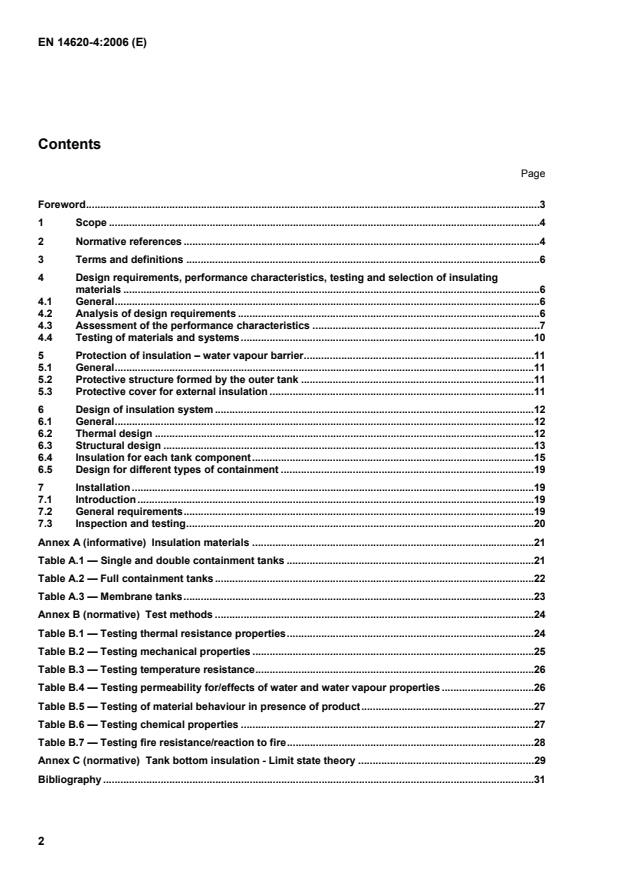
Insulation materials.21 Table A.1 — Single and double containment tanks.21 Table A.2 — Full containment tanks.22 Table A.3 — Membrane tanks.23 Annex B (normative)
Test methods.24 Table B.1 — Testing thermal resistance properties.24 Table B.2 — Testing mechanical properties.25 Table B.3 — Testing temperature resistance.26 Table B.4 — Testing permeability for/effects of water and water vapour properties.26 Table B.5 — Testing of material behaviour in presence of product.27 Table B.6 — Testing chemical properties.27 Table B.7 — Testing fire resistance/reaction to fire.28 Annex C (normative)
Tank bottom insulation - Limit state theory.29 Bibliography.31
The influence of the stored product on an internal insulation system is critical, as it is often continuously in contact with product vapours and it can come in direct contact with the liquid product in case of an accidental leakage. For testing of material behaviour in presence of product, see Table B.5. 4.3.7 Chemical properties An assessment shall be made of the compatibility between and/or possible chemical reactions of:
...