


EN 14620-1:2006
(Main)Design and manufacture of site built, vertical, cylindrical, flat-bottomed steel tanks for the storage of refrigerated, liquefied gases with operating temperatures between 0 °C and -165 °C - Part 1: General
General Information
- Abstract
This European Standard is a specification for vertical, cylindrical tanks, built on site, above ground and of which the primary liquid container is made of steel. The secondary container, if applicable, may be of steel or of concrete or a combination of both. An inner tank made only of pre-stressed concrete is excluded from the scope of this European Standard.
This European Standard specifies principles and application rules for the structural design of the “containment” during construction, testing, commissioning, operation (accidental included), and decommissioning. It does not address the requirements for ancillary equipment such as pumps, pumpwells, valves, piping, instrumentation, staircases etc. unless they can affect the structural design of the tank.
This European Standard applies to storage tanks designed to store products, having an atmospheric boiling point below ambient temperature, in a dual phase, i.e. liquid and vapour. The equilibrium between liquid and vapour phases being maintained by cooling down the product to a temperature equal to, or just below, its atmospheric boiling point in combination with a slight overpressure in the storage tank.
The maximum design pressure of the tanks covered by this European Standard is limited to 500 mbar. For higher pressures, reference can be made to EN 13445, Parts 1 to 5.
The operating range of the gasses to be stored is between 0 °C and –165 °C. The tanks for the storage of liquefied oxygen, nitrogen and argon are excluded.
The tanks are used to store large volumes of hydrocarbon products and ammonia with low temperature boiling points, generally called “Refrigerated Liquefied Gases” (RLG’s). Typical products stored in the tanks are: methane, ethane, propane, butane, ethylene, propylene, butadiene (this range includes the LNG’s and LPG’s).
NOTE Properties of the gases are given in Annex A.
The requirements of this European Standard cannot cover all details of design and construction because of the variet
- Status
- Withdrawn
- Publication Date
- 12-Sep-2006
- Withdrawal Date
- 22-Sep-2026
- Technical Committee
- CEN/TC 265 - Site built metallic tanks for the storage of liquids
- Drafting Committee
- CEN/TC 265/WG 10 - Revision of EN 14620
- Current Stage
- 9960 - Withdrawal effective - Withdrawal
- Start Date
- 15-May-2024
- Completion Date
- 23-Sep-2026

Relations
- Effective Date
- 19-Jan-2023
- Effective Date
- 25-Mar-2026
- Effective Date
- 25-Mar-2026
- Effective Date
- 28-Jan-2026
- Refers
EN 1991-1-4:2005 - Eurocode 1: Actions on structures - Part 1-4: General actions - Wind actions - Effective Date
- 28-Jan-2026
- Effective Date
- 28-Jan-2026
- Effective Date
- 28-Jan-2026
- Effective Date
- 28-Jan-2026
- Effective Date
- 28-Jan-2026
- Effective Date
- 28-Jan-2026
- Effective Date
- 28-Jan-2026
- Effective Date
- 28-Jan-2026
- Effective Date
- 28-Jan-2026
- Effective Date
- 28-Jan-2026
- Effective Date
- 28-Jan-2026
Get Certified
Connect with accredited certification bodies for this standard

Institut za varilstvo d.o.o. (Welding Institute)
Slovenia's leading welding institute since 1952. ISO 3834, EN 1090, pressure equipment certification, NDT personnel, welder qualification. Only IIW Au
Sponsored listings
Frequently Asked Questions
EN 14620-1:2006 is a standard published by the European Committee for Standardization (CEN). Its full title is "Design and manufacture of site built, vertical, cylindrical, flat-bottomed steel tanks for the storage of refrigerated, liquefied gases with operating temperatures between 0 °C and -165 °C - Part 1: General". This standard covers: This European Standard is a specification for vertical, cylindrical tanks, built on site, above ground and of which the primary liquid container is made of steel. The secondary container, if applicable, may be of steel or of concrete or a combination of both. An inner tank made only of pre-stressed concrete is excluded from the scope of this European Standard. This European Standard specifies principles and application rules for the structural design of the “containment” during construction, testing, commissioning, operation (accidental included), and decommissioning. It does not address the requirements for ancillary equipment such as pumps, pumpwells, valves, piping, instrumentation, staircases etc. unless they can affect the structural design of the tank. This European Standard applies to storage tanks designed to store products, having an atmospheric boiling point below ambient temperature, in a dual phase, i.e. liquid and vapour. The equilibrium between liquid and vapour phases being maintained by cooling down the product to a temperature equal to, or just below, its atmospheric boiling point in combination with a slight overpressure in the storage tank. The maximum design pressure of the tanks covered by this European Standard is limited to 500 mbar. For higher pressures, reference can be made to EN 13445, Parts 1 to 5. The operating range of the gasses to be stored is between 0 °C and –165 °C. The tanks for the storage of liquefied oxygen, nitrogen and argon are excluded. The tanks are used to store large volumes of hydrocarbon products and ammonia with low temperature boiling points, generally called “Refrigerated Liquefied Gases” (RLG’s). Typical products stored in the tanks are: methane, ethane, propane, butane, ethylene, propylene, butadiene (this range includes the LNG’s and LPG’s). NOTE Properties of the gases are given in Annex A. The requirements of this European Standard cannot cover all details of design and construction because of the variet
This European Standard is a specification for vertical, cylindrical tanks, built on site, above ground and of which the primary liquid container is made of steel. The secondary container, if applicable, may be of steel or of concrete or a combination of both. An inner tank made only of pre-stressed concrete is excluded from the scope of this European Standard. This European Standard specifies principles and application rules for the structural design of the “containment” during construction, testing, commissioning, operation (accidental included), and decommissioning. It does not address the requirements for ancillary equipment such as pumps, pumpwells, valves, piping, instrumentation, staircases etc. unless they can affect the structural design of the tank. This European Standard applies to storage tanks designed to store products, having an atmospheric boiling point below ambient temperature, in a dual phase, i.e. liquid and vapour. The equilibrium between liquid and vapour phases being maintained by cooling down the product to a temperature equal to, or just below, its atmospheric boiling point in combination with a slight overpressure in the storage tank. The maximum design pressure of the tanks covered by this European Standard is limited to 500 mbar. For higher pressures, reference can be made to EN 13445, Parts 1 to 5. The operating range of the gasses to be stored is between 0 °C and –165 °C. The tanks for the storage of liquefied oxygen, nitrogen and argon are excluded. The tanks are used to store large volumes of hydrocarbon products and ammonia with low temperature boiling points, generally called “Refrigerated Liquefied Gases” (RLG’s). Typical products stored in the tanks are: methane, ethane, propane, butane, ethylene, propylene, butadiene (this range includes the LNG’s and LPG’s). NOTE Properties of the gases are given in Annex A. The requirements of this European Standard cannot cover all details of design and construction because of the variet
EN 14620-1:2006 is classified under the following ICS (International Classification for Standards) categories: 23.020.10 - Stationary containers and tanks. The ICS classification helps identify the subject area and facilitates finding related standards.
EN 14620-1:2006 has the following relationships with other standards: It is inter standard links to EN 14620-1:2024, EN 1991-1-6:2026, EN 1991-1-4:2026, EN 1991-1-6:2005, EN 1991-1-4:2005, EN 14620-5:2025, EN 14620-2:2006, ENV 1998-4:1998, EN 1997-1:2004, EN 14620-3:2006, EN 14620-4:2025, EN 1992-1-1:2004, EN 1998-1:2004, EN 14620-5:2006, EN 1473:2016. Understanding these relationships helps ensure you are using the most current and applicable version of the standard.
EN 14620-1:2006 is available in PDF format for immediate download after purchase. The document can be added to your cart and obtained through the secure checkout process. Digital delivery ensures instant access to the complete standard document.
Standards Content (Sample)
2003-01.Slovenski inštitut za standardizacijo. Razmnoževanje celote ali delov tega standarda ni dovoljeno.Design and manufacture of site built, vertical, cylindrical, flat-bottomed steel tanks for the storage of refrigerated, liquefied gases with operating temperatures between 0 °C and -165 °C
- Part 1: GeneralConception et fabrication de réservoirs en acier a fond plat, verticaux, cylindriques, construits sur site, destinés au stockage de gaz réfrigérés, liquéfiés, dont les températures de service sont comprises entre 0° C et –165° C - Partie 1: GénéralitésAuslegung und Herstellung standortgefertigter, stehender, zylindrischer Flachboden-Stahltanks für die Lagerung von tiefkalt verflüssigten Gasen bei Betriebstemperaturen zwischen 0
C und -165
C - Teil 1: AllgemeinesTa slovenski standard je istoveten z:EN 14620-1:2006SIST EN 14620-1:2007en23.020.10UH]HUYRDUMLStationary containers and tanksICS:SLOVENSKI
STANDARDSIST EN 14620-1:200701-januar-2007
EUROPEAN STANDARD NORME EUROPÉENNE EUROPÄISCHE NORM
EN 14620-1
September 2006 ICS 23.020.10 English Version
Design and manufacture of site built, vertical, cylindrical, flat-bottomed steel tanks for the storage of refrigerated, liquefied gases with operating temperatures between 0 °C and -165 °C
-Part 1: General
Conception et fabrication de réservoirs en acier à fond plat, verticaux, cylindriques, construits sur site, destinés au stockage de gaz réfrigérés, liquéfiés, dont les températuresde service sont comprises entre 0 °C et -165 °C - Partie 1: Généralités
Auslegung und Herstellung standortgefertigter, stehender, zylindrischer Flachboden-Stahltanks für die Lagerung von tiefkalt verflüssigten Gasen bei Betriebstemperaturen zwischen 0 °C und -165 °C - Teil 1: Allgemeines This European Standard was approved by CEN on 20 February 2006.
CEN members are bound to comply with the CEN/CENELEC Internal Regulations which stipulate the conditions for giving this European Standard the status of a national standard without any alteration. Up-to-date lists and bibliographical references concerning such national standards may be obtained on application to the Central Secretariat or to any CEN member.
This European Standard exists in three official versions (English, French, German). A version in any other language made by translation under the responsibility of a CEN member into its own language and notified to the Central Secretariat has the same status as the official versions.
CEN members are the national standards bodies of Austria, Belgium, Cyprus, Czech Republic, Denmark, Estonia, Finland, France, Germany, Greece, Hungary, Iceland, Ireland, Italy, Latvia, Lithuania, Luxembourg, Malta, Netherlands, Norway, Poland, Portugal, Romania, Slovakia, Slovenia, Spain, Sweden, Switzerland and United Kingdom.
EUROPEAN COMMITTEE FOR STANDARDIZATION
COMITÉ EUROPÉEN DE NORMALISATION EUROPÄISCHES KOMITEE FÜR NORMUNG
Management Centre: rue de Stassart, 36
B-1050 Brussels © 2006 CEN All rights of exploitation in any form and by any means reserved worldwide for CEN national Members. Ref. No. EN 14620-1:2006: E
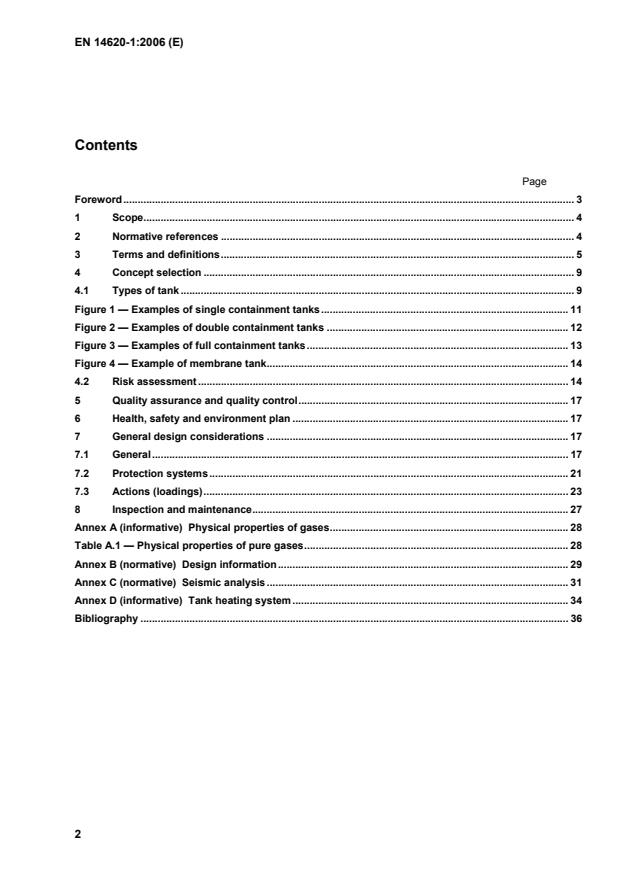
Physical properties of gases.28 Table A.1 — Physical properties of pure gases.28 Annex B (normative)
Design information.29 Annex C (normative)
Seismic analysis.31 Annex D (informative)
Tank heating system.34 Bibliography.36
3.9 design negative pressure maximum permissible negative pressure (vacuum) 3.10 design metal temperature minimum temperature for which the metal component is designed NOTE It may be the minimum design temperature (in the case of the primary container) or a higher calculated temperature. 3.11 double containment tank see 4.1.2 3.12 foundations elements of the construction that comprise the base slab, ring-wall or pile system required to support the tank and contents 3.13 full containment tank see 4.1.3. NOTE The secondary container contains the vapour in normal operation and ensures controlled venting in the case of a primary container leakage. 3.14 hazard event having the potential to cause harm, including ill health and injury, damage to property, products or the environment, production losses or increased liabilities 3.15 inner tank metallic self-supporting cylindrical primary container 3.16 insulation space volume containing insulation material in the tank annular space, and between the tank bottoms or roofs 3.17 liner metallic plate installed against the inside of the concrete outer tank, impervious to product vapour and water vapour 3.18 load bearing insulation thermal insulation with special properties capable of transferring loads to the appropriate load bearing structures
Note The average temperature is half the sum of the maximum and minimum temperature 3.20 maximum design liquid level maximum liquid level that will be maintained during operation of the tank used for the static shell thickness determination 3.21 maximum normal operating level Maximum liquid level that will be maintained during normal operation of the tank. Normally the level at which the first high level alarm is set 3.22 membrane thin metallic primary container of a membrane tank 3.23 membrane tank containment whereby a membrane (primary container) together with load bearing thermal insulation and a concrete tank are forming jointly an integrated, composite tank structure 3.24 minimum design temperature assumed temperature of the product, specified by the purchaser, for which the tank is designed NOTE This temperature may be lower than the actual product temperature. 3.25 Operating Basis Earthquake (OBE) maximum earthquake event for which no damage is sustained and restart and safe operation can continue NOTE This event would result in no loss to the operational integrity and public safety is assured. 3.26 outer tank self-supporting cylindrical secondary container made of steel or concrete 3.27 purchaser company who gives an order to the contractor for the design, construction and testing of a tank 3.28 primary liquid container part of a single, double, full containment or membrane tank that contains the liquid during normal operation 3.29 product vapour barrier polymeric vapour barrier or a liner to prevent escape of product vapours from the tank 3.30 ringbeam circular support under the shell of the tank
Figure 2 — Examples of double containment tanks
concrete outer tank
Figure 4 — Example of membrane tank 4.2 Risk assessment 4.2.1 General The type of tank shall be selected based on a risk assessment. The purchaser shall be responsible for the risk assessment (specifying/justifying the risk criteria). NOTE A consultant may carry out the assessment. Assistance may be needed from the contractor. 4.2.2 Site selection Before identification of hazards can be carried out, the site shall be selected. In general, the storage tank shall be placed such that the pipe connections to the receiving and supply sources are as short as possible. However, other requirements e.g. local regulations and safety distances (adjacent installations and plant boundaries) site and soil conditions, possible earthquake loading and pipe routings shall be considered. 4.2.3 Pre-selection of storage type A pre-selection of the storage type shall be carried out. This shall mainly be based on the environment of the tank. NOTE In “remote” located areas, where limited population or facilities are present, a single containment tank may be appropriate. For other areas, the double or full containment tank or a membrane tank may be required.
...