


EN 17229:2025
(Main)Fitness clubs - Requirements for amenities and operation - Operational and managerial requirements
Fitness clubs - Requirements for amenities and operation - Operational and managerial requirements
This document specifies the minimum requirements for the provision of physical exercise by fitness clubs.
This includes the operational, managerial, and supervision requirements in the delivery of both within and any externally related services offered by fitness clubs, together with the selection and positioning of exercise equipment, the essential skills required by fitness trainers, and any associated environmental and procedural requirements for safe physical exercising to take place.
This document is applicable to all publicly accessible fitness clubs where exercising in groups or individually takes place and is irrespective of the size of the club. It is intended to provide a healthy, safe and secure environment for its users, including through the use of digital technologies.
This document is applicable to fitness clubs publicly available and open to user subscription or pay-as-you-go services. This document does not cover clubs that are exclusively secondary businesses and offered in addition or as a complement to their primary service.
NOTE In the event that the fitness club is expected to be accessible to people with special needs (e.g. people with a disability and/or impairments, minors, etc.), attention is drawn to any relevant national guidelines.
Fitness-Studios - Anforderungen an Studioausstattung und -betrieb - Operative und betriebliche Anforderungen
Dieses Dokument legt die Mindestanforderungen für das Anbieten körperlicher Übungen durch Fitness-Studios fest.
Dazu gehören die Anforderungen an Betrieb, Verwaltung und Aufsicht bei der Erbringung interner und externer Dienstleistungen, die von Fitness-Studios angeboten werden, sowie die Auswahl und Positionierung von Trainingsausrüstung, die grundlegenden Fähigkeiten von Fitness-Trainern und alle damit verbundenen Umgebungs- und Verfahrensanforderungen, die für sichere körperliche Übungen erforderlich sind.
Dieses Dokument ist anwendbar für alle öffentlich zugänglichen Fitness-Studios, in denen Übungen in Gruppen oder einzeln durchgeführt werden, und zwar unabhängig von der Größe des Studios. Es soll seinen Benutzern ein gesundes und sicheres Umfeld bieten, auch durch den Einsatz digitaler Technologien.
Dieses Dokument ist anwendbar für Fitness-Studios, die öffentlich zugänglich sind und für Abonnement- oder Pay-as-you-go-Dienstleistungen offen sind. Dieses Dokument ist nicht anzuwenden für Studios, die ausschließlich ein sekundäres Geschäft darstellen und zusätzlich oder als Ergänzung zu der Hauptdienstleistung angeboten werden.
ANMERKUNG Falls das Fitness-Studio für Personen mit besonderen Erfordernissen (z. B. Personen mit Behinderung und/oder Beeinträchtigungen, Minderjährige usw.) zugänglich sein soll, wird auf relevante nationale Leitlinien verwiesen.
Club de fitness - Exigences en matière d'équipements et d'exploitation - Exigences opérationnelles et fonctionnelles
Le présent document spécifie les exigences minimales pour l’offre d’exercices physiques dans les clubs de fitness.
Cela comprend les exigences opérationnelles, fonctionnelles et de surveillance dans la prestation des services internes et externes proposés par les clubs de fitness, de même que la sélection et le positionnement des équipements d’entraînement, les aptitudes essentielles exigées par les entraîneurs fitness, et toutes les exigences associées en matière d’environnement et de procédures pour que l’exercice physique se déroule dans de bonnes conditions de sécurité.
Le présent document s’applique à tous les clubs de fitness accessibles au public où des exercices collectifs ou individuels sont pratiqués, quelle que soit la taille du club. Il vise à offrir un environnement sécurisé et maîtrisé aux usagers, y compris par l’utilisation de technologies numériques.
Le présent document s’applique aux clubs de fitness accessibles au public et ouverts aux services d’abonnement ou de paiement à l’utilisation. Le présent document ne couvre pas les clubs qui constituent exclusivement des activités secondaires qui sont proposées en plus ou en complément de leur service principal.
NOTE Lorsque le club de fitness est destiné à accueillir des personnes ayant des besoins particuliers (par exemple des personnes atteintes de handicap et/ou de déficiences, des mineurs, etc.), l’attention est attirée sur les éventuelles directives nationales à ce sujet.
Prostori za fitnes - Zahteve za opremo in delovanje - Zahteve za delovanje in vodenje
General Information
Relations

Standards Content (Sample)
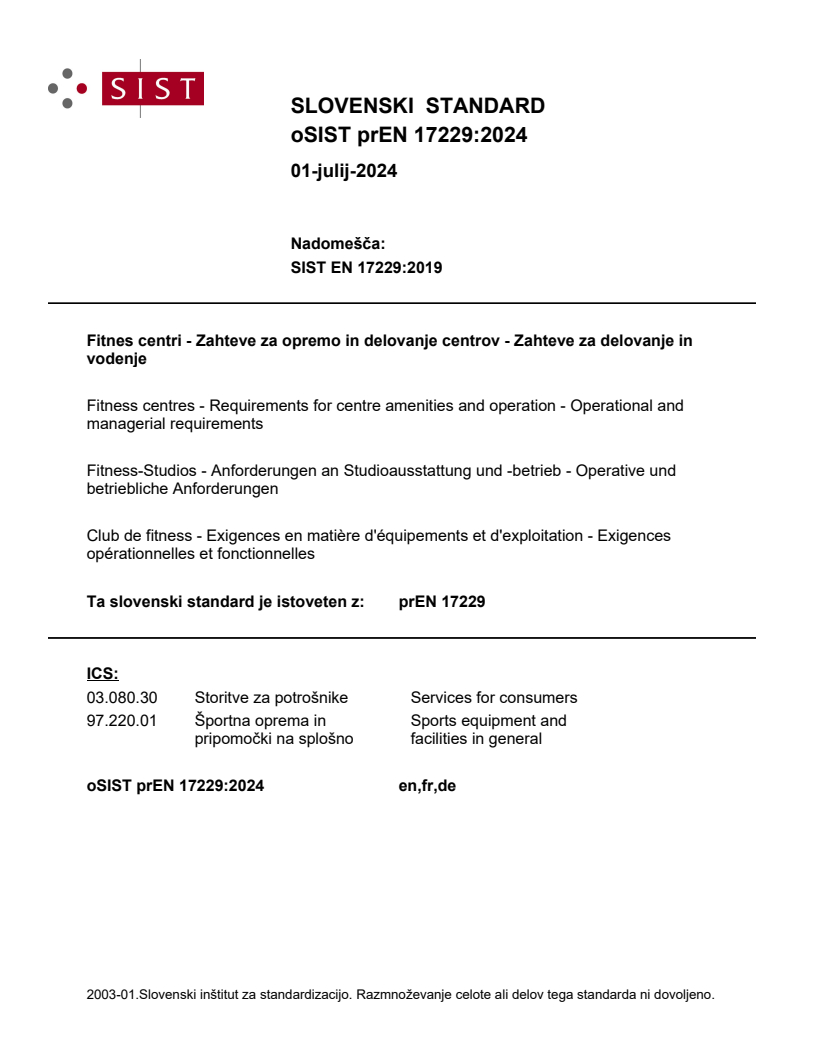
SLOVENSKI STANDARD
oSIST prEN 17229:2024
01-julij-2024
Nadomešča:
SIST EN 17229:2019
Fitnes centri - Zahteve za opremo in delovanje centrov - Zahteve za delovanje in
vodenje
Fitness centres - Requirements for centre amenities and operation - Operational and
managerial requirements
Fitness-Studios - Anforderungen an Studioausstattung und -betrieb - Operative und
betriebliche Anforderungen
Club de fitness - Exigences en matière d'équipements et d'exploitation - Exigences
opérationnelles et fonctionnelles
Ta slovenski standard je istoveten z: prEN 17229
ICS:
03.080.30 Storitve za potrošnike Services for consumers
97.220.01 Športna oprema in Sports equipment and
pripomočki na splošno facilities in general
oSIST prEN 17229:2024 en,fr,de
2003-01.Slovenski inštitut za standardizacijo. Razmnoževanje celote ali delov tega standarda ni dovoljeno.
oSIST prEN 17229:2024
oSIST prEN 17229:2024
DRAFT
EUROPEAN STANDARD
prEN 17229
NORME EUROPÉENNE
EUROPÄISCHE NORM
May 2024
ICS 03.080.30; 97.220 Will supersede EN 17229:2019, EN 17229-2:2023
English Version
Fitness centres - Requirements for centre amenities and
operation - Operational and managerial requirements
Club de fitness - Exigences en matière d'équipements Fitness-Studio - Anforderungen an Studioausstattung
et d'exploitation - Exigences opérationnelles et und -betrieb - Operative und betriebliche
fonctionnelles Anforderungen
This draft European Standard is submitted to CEN members for enquiry. It has been drawn up by the Technical Committee
CEN/TC 136.
If this draft becomes a European Standard, CEN members are bound to comply with the CEN/CENELEC Internal Regulations
which stipulate the conditions for giving this European Standard the status of a national standard without any alteration.
This draft European Standard was established by CEN in three official versions (English, French, German). A version in any other
language made by translation under the responsibility of a CEN member into its own language and notified to the CEN-CENELEC
Management Centre has the same status as the official versions.
CEN members are the national standards bodies of Austria, Belgium, Bulgaria, Croatia, Cyprus, Czech Republic, Denmark, Estonia,
Finland, France, Germany, Greece, Hungary, Iceland, Ireland, Italy, Latvia, Lithuania, Luxembourg, Malta, Netherlands, Norway,
Poland, Portugal, Republic of North Macedonia, Romania, Serbia, Slovakia, Slovenia, Spain, Sweden, Switzerland, Türkiye and
United Kingdom.
Recipients of this draft are invited to submit, with their comments, notification of any relevant patent rights of which they are
aware and to provide supporting documentation.
Warning : This document is not a European Standard. It is distributed for review and comments. It is subject to change without
notice and shall not be referred to as a European Standard.
EUROPEAN COMMITTEE FOR STANDARDIZATION
COMITÉ EUROPÉEN DE NORMALISATION
EUROPÄISCHES KOMITEE FÜR NORMUNG
CEN-CENELEC Management Centre: Rue de la Science 23, B-1040 Brussels
© 2024 CEN All rights of exploitation in any form and by any means reserved Ref. No. prEN 17229:2024 E
worldwide for CEN national Members.
oSIST prEN 17229:2024
prEN 17229:2024 (E)
Contents Page
European foreword . 4
Introduction . 5
1 Scope . 6
2 Normative references . 6
3 Terms and definitions . 7
4 Operational and managerial requirements . 13
4.1 General. 13
4.2 Contract/contractual obligations for users . 13
4.3 User code of conduct . 13
4.4 User care . 14
4.5 Basic service . 14
4.6 Promoting active and healthy lifestyles . 14
4.7 Accessibility and inclusion . 15
5 Health, safety, and security . 16
5.1 Safety management . 16
5.2 Stationary training equipment . 17
6 Operation of the facility . 18
6.1 General. 18
6.2 Operational matters related to safety . 18
6.3 Control of substances hazardous to health and environment . 19
6.4 Building installations or equipment . 20
7 In club supervision for operations and fitness trainers . 20
7.1 General. 20
7.2 In club supervision of operations by staff . 20
7.3 In club supervision of users by fitness trainers . 21
8 Remote supervision for operations and fitness trainers . 22
8.1 General. 22
8.2 Requirements for remote supervision . 23
9 Unstaffed fitness club for operations only . 26
9.1 General. 26
9.2 Requirements for unstaffed fitness club or fitness areas . 26
Annex A (normative) Procedure for a response chain . 27
A.1 General. 27
A.2 Detection . 27
A.3 Alerting . 27
A.4 Intervention . 27
Annex B (informative) Risk analysis . 28
B.1 General. 28
oSIST prEN 17229:2024
prEN17229:2024 (E)
Annex C (normative) Qualifications for fitness trainers . 30
C.1 Fitness instructor . 30
C.2 Group Fitness Instructor . 32
C.3 Personal trainer . 35
C.4 Exercise for health specialist . 38
Annex D (normative) Operational requirements for remote supervision . 43
D.1 General . 43
D.2 Planning . 43
D.3 Security . 43
D.4 Alarm systems of the remotely operated/supervised fitness facility . 44
D.5 Communication network . 46
D.6 MARC Operations . 47
Annex E (informative) Qualifications for operator staff of a MARC . 50
Bibliography . 51
oSIST prEN 17229:2024
prEN 17229:2024 (E)
European foreword
This document (prEN 17229:2024) has been prepared by Technical Committee CEN/TC 136 “Sports,
playground and other recreational facilities and equipment”, the secretariat of which is held by DIN.
This document is currently submitted to the CEN Enquiry.
This document will supersede EN 17229:2019 and EN 17229-2:2023.
prEN 17229:2024 includes the following significant technical changes with respect to EN 17229:2019
and EN 17229-2:2023:
— amendment of the scope to cover the supervision of users outside of the fitness club; the use of digital
technologies for supervision; the addition of inclusion and accessibility standards; the extension of
health and safety standards to include the security of users;
— alignment with CEN ISO/TR 20183;
— editorial amendments.
oSIST prEN 17229:2024
prEN17229:2024 (E)
Introduction
The risk assessment process (see Annex D) is the basis for the requirements in this document.
oSIST prEN 17229:2024
prEN 17229:2024 (E)
1 Scope
This document specifies the minimum requirements for the provision of physical exercise at fitness clubs.
This includes the operational, managerial, and supervision requirements in the delivery of both within
and any externally related services offered by fitness clubs, together with the selection and positioning
of exercise equipment, the essential skills required by fitness trainers, and any associated environmental
and procedural requirements for safe physical exercising to take place.
This document is applicable to all publicly accessible fitness clubs where exercising in groups or
individually takes place and is irrespective of the size of the club. It is intended to provide a safe and
controlled environment for its users, including through the use of digital technologies.
This document is applicable to fitness clubs publicly available and open to user subscription or pay-as-
you-go services. This document does not cover clubs that are exclusively secondary businesses and
offered in addition or as a complement to their primary service.
NOTE In the event that the fitness club is expected to be accessible to people with special needs (e.g. people
with a disability and/or impairments, minors, etc.), attention is drawn to any relevant national guidelines.
2 Normative references
The following documents are referred to in the text in such a way that some or all of their content
constitutes requirements of this document. For dated references, only the edition cited applies. For
undated references, the latest edition of the referenced document (including any amendments) applies.
EN 54 (series), Fire detection and fire alarm systems
EN 957-6:2010+A1:2014, Stationary training equipment — Part 6: Treadmills, additional specific safety
requirements and test methods
EN 1627, Pedestrian doorsets, windows, curtain walling, grilles and shutters — Burglar resistance —
Requirements and classification
EN 50131-1, Alarm systems — Intrusion and hold-up systems — Part 1: System requirements
EN 50136-1, Alarm systems — Alarm transmission systems and equipment — Part 1: General requirements
for alarm transmission systems
EN 50518, Monitoring and Alarm Receiving Centre
EN 60839-11-1, Alarm and electronic security systems — Part 11-1: Electronic access control systems —
System and components requirements
EN 62676-4, Video surveillance systems for use in security applications — Part 4: Application guidelines
(IEC 62676-4)
EN ISO 20957-1:2013, Stationary training equipment — Part 1: General safety requirements and test
methods (ISO 20957-1)
EN ISO 20957-2, Stationary training equipment — Part 2: Strength training equipment, additional specific
safety requirements and test methods (ISO 20957-2)
EN ISO 20957-4, Stationary training equipment — Part 4: Strength training benches, additional specific
safety requirements and test methods (ISO 20957-4)
oSIST prEN 17229:2024
prEN17229:2024 (E)
EN ISO 20957-5, Stationary training equipment — Part 5: Stationary exercise bicycles and upper body
crank training equipment, additional specific safety requirements and test methods (ISO 20957-5)
EN ISO 20957-7, Stationary training equipment — Part 7: Rowing equipment, additional specific safety
requirements and test methods (ISO 20957-7)
EN ISO 20957-8, Stationary training equipment — Part 8: Steppers, stairclimbers and climbers - Additional
specific safety requirements and test methods (ISO 20957-8)
EN ISO 20957-9, Stationary training equipment — Part 9: Elliptical trainers, additional specific safety
requirements and test methods (ISO 20957-9)
EN ISO 20957-10, Stationary training equipment — Part 10: Exercise bicycles with a fixed wheel or without
freewheel - Additional specific safety requirements and test methods (ISO 20957-10)
ISO 30061, Emergency lighting
3 Terms and definitions
For the purposes of this document, the following terms and definitions apply.
ISO and IEC maintain terminology databases for use in standardization at the following addresses:
— ISO Online browsing platform: available at https://www.iso.org/obp/
— IEC Electropedia: available at https://www.electropedia.org/
3.1
fitness club
publicly accessible place where exercise as well as diverse physical fitness activities are provided to
individuals and groups, which can involve equipment-based strength and cardiovascular training
Note 1 to entry: A fitness club can comprise of an exercising area with equipment-based strength training, free
weights, portable/fixed equipment, and/or most often also cardiovascular training equipment/machines and/or
frequently also group fitness training in specific rooms, or in a studio, or in a supervised space.
Note 2 to entry: Physical fitness activities delivered by the fitness club can take place outside of the facility.
Note 3 to entry: Physical fitness activities can be delivered by staff physically or by remote instruction.
3.2
safe
state of being protected from recognized hazards that are likely to cause harm
3.3
safety
freedom from unacceptable risk, but not safe
Note 1 to entry: Safety is achieved by reducing risk to a tolerable level.
Note 2 to entry: There is no complete absence of risk. In turn, there is no product or system that is without some
risk which shall be reduced to a tolerable risk.
oSIST prEN 17229:2024
prEN 17229:2024 (E)
3.4
risk
combination of the probability of occurrence of harm and the severity of that harm
Note 1 to entry: The probability of occurrence includes the exposure to a hazardous situation, the occurrence of a
hazardous event, and the possibility to limit the harm.
3.5
harm
injury or damage to the health of people or damage to property or the environment
3.6
hazard
potential source of harm
3.7
hazardous event
event to result in harm
3.8
hazardous situation
circumstances in which people, property or the environment are exposed to one or more hazards
3.9
tolerable risk
acceptable risk
risk which is acceptable in a given context based on the current values of society
Note 1 to entry: The terms “acceptable risk” and “tolerable risk” are synonymous.
3.10
risk reduction measure
protective measure
action or means of eliminating hazards or reducing risk
Note 1 to entry: Risk reduction measures or protective measure could include, but are not limited to, eliminating
hazards, guarding against hazards, use of protective devices, and reducing the likelihood of hazardous events.
3.11
residual risk
remaining risk after risk reduction measures or protective measures have been taken
Note 1 to entry: Following risk reduction measures, the residual risk should be less than tolerable risk, thus
providing safety.
3.12
risk analysis
systematic use of available information to identify hazards and to eliminate risk
3.13
risk evaluation
procedure based on the risk analysis to determine whether a tolerable risk has been achieved
oSIST prEN 17229:2024
prEN17229:2024 (E)
3.14
risk assessment
overall process comprising a risk analysis and risk evaluation
Note 1 to entry: Degree of exposure to danger or harm comprised of the potential severity of the harm and the
probability of that harm occurring. In determining the probability of occurrence of harm, the exposure of a user to
a hazardous situation, the possibility of a hazardous event, and the potential means of limiting the harm should all
be considered.
3.15
intended use
use of a product or system in accordance with the information provided by the supplier
3.16
reasonably foreseeable misuse
use of a product or system in a manner not intended by the supplier where that manner of use could be
anticipated based on predictable human behaviour
Note 1 to entry: Also referred to as “foreseeable misuse”.
Note 2 to entry: In evaluating readily predictable human behaviour, all relevant demographics should be
considered, including, but not limited to elderly, children, and persons with disabilities.
Note 3 to entry: In the context of consumer safety, ”reasonably foreseeable use” is often used to encompass both
“intended use” and “reasonably foreseeable misuse”.
3.17
user
user of a product or service in a fitness club
Note 1 to entry: A user of a fitness club can include a member, pay-as-you-go visitor, guest, or casual user.
Note 2 to entry: For a child under the age of consent, the user may be a parent, legal guardian, or qualified caregiver.
For minors and persons under guardianship permission to be a user may be granted by a parent or legal guardian.
3.18
inspection
act of identifying hazards or hazardous situations
Note 1 to entry: Inspection should include, but not be limited to consideration of hazards that can emerge during
or as a result of intended operation, reasonably foreseeable misuse, vandalism, aging of the product/environment,
and weather conditions.
3.19
warning
notice or communication to indicate a potentially hazardous situation that if not avoided, may result in
risk
3.20
as low as reasonably practical
ALARP
determination of the level of residual risk after steps of hazard reduction have taken place
Note 1 to entry: For the risk to be ALARP, it shall be possible to demonstrate that the cost involved in reducing the
risk further would be grossly disproportionate to the benefit gained.
oSIST prEN 17229:2024
prEN 17229:2024 (E)
3.21
personal security
planned protection of people in a fitness club
Note 1 to entry: Protection plan can consider threats such as theft, physical violence, verbal abuse, intimidating
activities, or digital interference.
3.22
staff
people working in the fitness club with an employment contract
3.23
staffed
opening time or opening hours during which staff are physically present and can see the exercising areas
in the club
3.24
unstaffed
opening time or opening hours during which no staff are physically present in the club
3.25
unstaffed area
area in the club which is not visible if not specially visited
3.26
publicly accessible
open to everyone or to a defined group of users, not designated solely for the
owner's/proprietor's/operator's family and guests, independently from paying an entrance fee
[SOURCE: EN 15288-1:2018, definition 3.5 – modified: term “public use” changed to “publicly accessible”
and deleting “use of an installation”]
3.27
competent person
individual who has acquired through instruction, qualifications or experience, or a combination of these,
the essential skills enabling that person to perform specified tasks
3.28
in club supervision by staff
supervision of a fitness club by a competent person(s) who has the main responsibility for the operations
and who is physically present during the use of the fitness club by users, staff and/or contractors
Note 1 to entry: fitness trainers may also be a competent person with responsibility for the operations
3.29
remote supervision
supervision of a fitness club by a surveillance system operated by a competent person(s) with the main
responsibility of continuous monitoring of the fitness club’s use by users, staff and/or contractors
Note 1 to entry: The qualification and competency of operators of Monitoring and Alarm Receiving (MARC) is
covered in Annex E.
oSIST prEN 17229:2024
prEN17229:2024 (E)
3.30
unstaffed
when a fitness club is without in club or remote supervision by staff and in use by users, staff and/or
contractors
3.31
skill
ability to apply knowledge and use know-how to complete tasks and solve problems
3.32
qualification
official record (certificate, diploma) of achievement which recognizes successful completion of education
or training, or satisfactory performance in a test or examination; and/or the requirements for an
individual to enter, or progress within an occupation
[SOURCE: Cedefop; European Parliament and Council of the European Union, 2014]
3.33
surveillance system
automated system including means for digitizing series of images of people in the
fitness club, and means for comparing and analyzing digitized images for the notification and sending an
alarm when an incident occurs
3.34
surveillance system
closed-circuit camera system to observe people in the fitness club
3.35
alarm
initiated response to the detection of an incident by a person or the surveillance system
3.36
incident
occurrence or an activity of interest which may need a response by a person or the surveillance system
3.37
surveillance
observation or inspection of persons or premises for security and safety purposes through alarm systems,
surveillance methods, or other monitoring methods
[SOURCE: EN 62676-1-1:2014, 3.1.138, modified – The term ‘VSS’ has been replaced by ‘surveillance
methods’.]
3.38
fitness trainers
competent person providing fitness instruction
3.39
supervision
responsibility for the fitness club execution and oversight of health, safety and welfare procedures
oSIST prEN 17229:2024
prEN 17229:2024 (E)
3.40
remote fitness service
service provided by a fitness centre/staff that contains digital content, including but not limited to group
exercise classes, exercise instruction, instruction programming, remote coaching, live-streaming classes
and online personal instruction; or any digital content provided by a fitness club/staff to its users to
provide fitness instruction
Note 1 to entry: Remote fitness services can take place in the form of independent use of digital classes or workouts
inside or outside of a fitness club.
3.41
group exercise class
service provided by a fitness club in any and all forms of exercise performed in a group setting, led by a
personal trainer or group instructor
Note 1 to entry: Visual instruction can be given in written form or shown via an image, video, other digital
technologies, or illustration.
3.42
instruction program
instruction and workout program with a goal to achieve in a specific amount of time, provided in a
written, visual, digital or auditory way
3.43
remote instruction
online communication to instruct, motivate and support members in a written, visual, digital, or auditory
way with their exercise and/or health-related questions
Note 1 to entry: Instruction can take place in the form of, but is not exclusively:
a) individual instruction where a trainer has contact with users on a regular basis via written, spoken-, and/or
digital or on-line communication;
b) instruction programs where users follow a pre-programmed, goal-based, fitness program. Users are instructed
via written-, spoken-, and/or digital or on-line content which is created in advance by fitness trainers;
c) all types of group classes which are streamed live online where members can follow classes real-time via a
fitness club;
d) instruction between a personal trainer and (a) user(s) where they work together, at the same time, with a live
connection.
3.44
low risk adult
person with minor, stable physical limitations or two or less coronary heart disease risk factors
[SOURCE: Irwin and Morgan Risk Stratification Tool, National Quality Assurance Framework and
American Council of Sport Medicine]
3.45
medium risk adult
person with significant physical limitation related to chronic disease or disability
[SOURCE: Irwin and Morgan Risk Stratification Tool, National Quality Assurance Framework and
American Council of Sport Medicine]
oSIST prEN 17229:2024
prEN17229:2024 (E)
3.46
contractor
people with a contract to provide materials or labour to perform a service or do a job in the fitness club
4 Operational and managerial requirements
4.1 General
In order to assist the fitness club and to ensure that all users enjoy their visits to the fitness club, there
shall be a contract and code of conduct for all users which will establish the terms and conditions for use.
This shall include, inter alia, 4.2 and 4.3.
4.2 Contract/contractual obligations for users
The fitness club shall provide a contract of the terms and conditions and the code of practice (see
Annex B) to the user of the fitness club facilities and services. This shall include at least:
a) contract term;
b) payment conditions;
c) extension of term;
d) termination;
e) withdrawal;
f) the process to use in the event of a contractual dispute or complaint arising;
g) that the fitness club shall provide a digital or analogue communication channel to receive feedback
from users.”.
4.3 User code of conduct
The fitness club shall provide a code of conduct for the user of the fitness club facilities and services. This
shall include at least the following:
a) Users shall treat the fitness club, its staff and other users with courtesy, respect and fairness at all
times.
b) Users shall use the equipment at the fitness club strictly in accordance with any rules or guidelines
issued by the club and to comply with any instructions regarding use given by any staff of the fitness
club.
c) Users agree to adhere to any Child Usage Policy.
d) When using the fitness club, users shall wear appropriate footwear and clothing. In addition, users
shall use the changing and sanitary facilities, if present, for the purpose that they are intended for
and that ensures hygiene and functionality.
e) Users shall use the equipment in the fitness club only for its designed purpose, taking good care of it
and, if relevant, storing it in the designated place after use.
h) Users agree to respect the privacy of staff and other users in the use of cameras and recording mobile
devices.
oSIST prEN 17229:2024
prEN 17229:2024 (E)
NOTE 1 This also applies if people appear in the background of the image or the film.
NOTE 2 Pictures and videos can be taken if users agree, for example, for commercial use or for the evaluation of
an instructor.
4.4 User care
4.4.1 General
The fitness club shall provide information to all users on how to safely use its facility and services.
4.4.2 User communications
The fitness club shall:
a) make no false claims with regard to any of the products and services offered by the fitness club;
b) provide a clearly worded and easy to access and understandable terms and conditions for the use of
the fitness club facilities and services;
c) actively seek user feedback to determine where improvements can be made;
4.5 Basic service
The fitness club shall provide the user at least the following information on demand:
a) normal opening hours;
b) fees for use of the fitness club facilities and services, if applicable;
d) appropriate liability insurance protection of users;
e) fitness trainers who prescribe exercise and/or programs, including exercise prescription via remote
and/or digital technologies, shall be compliant with requirements according to Annex D;
NOTE The information can, for example, be part of the contract, displayed on a wall, communicated on a
website, or presented on request.
4.6 Promoting active and healthy lifestyles
4.6.1 General
Fitness clubs make a positive contribution to promoting active and healthy lifestyles within the general
population through their products and services. Regular physical exercise also provides social benefits
and mental health improvements.
NOTE Fitness clubs are encouraged to promote body positivity and to be aware of their role in supporting all
users including those who might be challenged by, or be concerned by their own body perception.
4.6.2 Substance abuse
4.6.2.1 Anti-doping
The fitness club shall have a policy concerning the use of performance or image enhancing substances,
recreational drugs, and doping substances on their premises, and to work actively in the prevention of
doping use. The fitness club shall have a policy of what actions are taken when a user is suspected of
taking performance or image enhancing substances, recreational drugs, and doping substances.
oSIST prEN 17229:2024
prEN17229:2024 (E)
NOTE Attention is drawn to national anti-doping campaigns, education and awareness programs available (viz.
via National Anti-doping Organization.
4.6.2.2 Intoxication
The fitness club shall have a policy of what actions are taken when a user is suspected of being intoxicated,
NOTE The fitness club can provide information on the health hazards of alcohol abuse and risk of exercising
whilst intoxicated.
4.6.2.3 Smoking
The fitness club shall have a policy of what actions are taken when a user is found or suspected of smoking
including e-cigarettes.
NOTE 1 The fitness club can provide information on the health hazards associated with smoking.
NOTE 2 In particular it is recognized that doping practices in fitness clubs:
a) can threaten the health of individuals who use doping substances;
b) are threatening to other people in a doping users’ immediate environment;
c) can be harmful to the integrity and perception of the fitness sector;
d) is often linked to criminal activities such as drug trafficking;
e) can particularly affect young people and other vulnerable people.
4.6.3 User responsibility in physical exercise
The fitness club shall inform users that:
a) there are always risks and benefits when engaging in physical activity;
b) they should not exercise beyond what they consider to be their own abilities;
c) they can seek advice and/or guidance on appropriate means of exercising safely;
d) they should seek advice from a relevant professional if they have a medical condition which might
interfere with them exercising safely;
e) they should make themselves aware of any rules and instructions related to safe exercising, including
warning notices.
4.7 Accessibility and inclusion
4.7.1 User respect
The fitness club shall support and show respect for its users from different races, cultures, nationality,
religious and political belief, sexual orientation, age, gender, marital status, and physical and intellectual
ability.
4.7.2 Inclusiveness and accessibility
The fitness club shall provide information on its practice concerning products and services which are
adapted to provide an inclusive fitness environment.
oSIST prEN 17229:2024
prEN 17229:2024 (E)
Facilities, spaces, products, and services which are available for users with disabilities and/or
impairments or illnesses should be described in the fitness club user information. These can include, for
example, extra wide access, elevators, assisted changing spaces, adapted fitness exercise equipment,
additionally trained staff, outreach services, etc.
NOTE 2 Reference for further information and guidance: Inclusive Fitness Initiative
; American National Standard ANSI/RESNA IF-1:2021
https://www.activityalliance.org.uk/how-we-help/resources
for inclusive Fitness Environments.
5 Health, safety, and security
5.1 Safety management
5.1.1 General
The fitness club shall have a documented health, safety and security management procedure, which shall
include:
a) a health, safety and security management policy in accordance with 5.1.2;
b) a security management policy in accordance with 5.1.2;
c) a health and safety and security management process - requirements in accordance with 5.1.3 (see
also Annex A);
d) recording and rehearsing emergency and safety-related events in accordance with 5.1.4 (see also
Annex B).
5.1.2 Health, safety and security management policy
The fitness club shall define and document the health, safety and security management policy for the
general operation and safety of the fitness club which shall include:
a) management statement taking into account the safety and security approach at the highest level;
b) written procedures;
c) communicate, implement, and maintain the safety and security policy throughout the relevant parts
of the organization, including ensuring relevant staff are trained and informed of requirements and
processes.
A risk-benefit analysis (see ISO 4980:2023) is used.
The fitness centre shall have a documented policy to ensure that the users can exercise in a safe and
secure environment. The fitness club shall have:
1) a functioning alert system;
2) a system to know who is in the fitness club.
5.1.3 Health, safety, and security management process
The fitness club shall have a documented health, safety, and security management system to ensure that
the products and services being offered have been systematically reviewed to protect users from hazards
and harm within the context of acceptable risk. These shall include the points below so that the
management process is:
oSIST prEN 17229:2024
prEN17229:2024 (E)
a) based on a risk analysis the identification of potential dangers to the health, safety and security of
users;
b) planned to implement measures to reduce the identified risk to be as low as reasonably practical
(ALARP);
c) processing the monitoring and checking processes to ensure that the measures are working;
d) acting on identified problems with appropriate corrections;
e) undertaking a regular review of the health and safety management of the fitness club.
NOTE 1 See also ISO 45001 Occupational health and safety management systems - requirements with guidance
for use for further information.
NOTE 2 The risk evaluation procedure based on a risk analysis is to determine whether a tolerable or acceptable
risk has been achieved through the systematic use of available information to identify hazards and to eliminate risk.
NOTE 3 The probability of occurrence includes the exposure to a hazardous situation, the occurrence of a
hazardous event, and the possibility to limit the harm.
5.1.4 Safety operating procedures
The safety operating procedures shall include the individual allocation of the functions for those
responsible for the operation and supervision of exercise areas and spaces, and within their personal
training and competency.
5.1.5 Emergency and safety and security related events
The fitness club shall identify potential and foreseeable emergency and secure situations, to include:
a) life-threatening medical emergencies – see Annex A.
b) other foreseeable emergencies not necessarily associated with physical activity, such as weather,
fires, natural disasters, or personal security.
5.2 Stationary training equipment
5.2.1 Positioning of stationary training equipment
Stationary training equipment shall be sited and positioned in accordance with the manufacturer's
instructions and at least in accordance with EN ISO 20957-1:2013, 5.17.d. and EN 957-6:2010+A1:2014,
10 e).
Stationary training equipment shall be sited and positioned in accordance with the manufacturer's
instructions and at least in accordance with EN ISO 20957-1:2013, 5.17.d. and EN 957-6:2010+A1:2014,
10 e), and following a risk assessment covering safety of users in the siting of stationary training
equipment.
5.2.2 Selection of stationary training equipment
Stationary training equipment shall be selected in accordance with EN ISO 20957-1, EN ISO 20957-2,
EN ISO 20957-4, EN ISO 20957-5, EN ISO 20957-7, EN ISO 20957-8, EN ISO 20957-9, EN ISO 20957-10
and EN 957-6.
oSIST prEN 17229:2024
prEN 17229:2024 (E)
5.2.3 Care and maintenance of training equipment
The care and maintenance of training equipment shall be undertaken in accordance with EN ISO 20957-1,
EN ISO 20957-2, EN ISO 20957-4, EN ISO 20957-5, EN ISO 20957-7, EN ISO 20957-8, EN ISO 20957-9,
EN ISO 20957-10 and EN 957-6, including the manufacturer's instructions (see EN ISO 20957-1:2013,
5.17). Written procedures for the care and maintenance shall be provided (e.g. printed, digitally, with
pictures etc.).
NOTE Manufacturer's instructions can be considered as written procedures.
The training equipment shall be visually checked routinely for damage, excessive wear, missing parts and
cleanliness. The visual checking shall be done by a competent person who shall follow a checklist that
identifies all individual pieces of equipment. The person conducting the routine shall follow a checklist
and shall document it afterwards.
6 Operation of the facility
6.1 General
The fitness club shall have written policies and procedures on the operation of the facility. Activities and
resolutions on operational procedures shall be documented.
6.2 Operational matters related to safety
6.2.1 Electric supply to equipment
6.2.1.1 General
The fitness club shall have a routine visual inspection to check the electric supply to the equipment and
electric supply accessible to users. The visual checking shall be done by a competent person who shall
follow a checklist that identifies all individual pieces of equipment The person conducting the routine
shall follow a checklist and shall document it afterwards.
NOTE See manufacturer's guidelines for electrical supply for equipment for further guidance.
6.2.1.2 Lithium battery supply to equipment
The fitness club shall have a routine visual inspection to check the lithium batteries used in equipment
that are accessible to users. The visual checking shall be done by a competent person who shall follow a
checklist that identifies all individual pieces of equipment. The person conducting the routine shall follow
a checklist and shall document it afterwards.
The charging, storage, and use of lithium batteries shall be in accordance with manufacturer’s
instructions and guidance.
6.2.2 Flooring/surfaces in exercising areas and corridors
Floor surfaces shall be kept clean and shall be free of unmarked tripping/slipping hazards.
A routine for cleaning and maintenance shall be provided in accordance with the manufacturer's
instructions and in accordance with the use to which the floor is subjected and shall contain at least:
a) Object of hygiene activity;
b) Type of hygiene activity;
c) Time and frequency.
oSIST prEN 17229:2024
prEN17229:2024 (E)
During cleaning and maintenance of floor surfaces while in use by users, potential hazards should be
prevented, and signage shall be provided.
6.2.3 Hygiene
The fitness club shall have written hygiene policies and procedures.
EXAMPLE Hygiene includes cleaning, disinfection (where appropriate).
a) Activities on hygiene shall be documented in checklists;
b) Frequency is adjusted according to the different areas of the fitness club and usage levels;
c) The fitness club shall provide means to dispose of waste items in a hygienic and sustainable way.
6.2.4 Ventilation
The fitness club shall provide appropriate ventilation for the safety of users and if necessary include a
procedure for increasing fresh air supply to exercise areas during periods of higher usage.
NOTE 1 Measurements of carbon dioxide levels are a good indication of air quality.
NOTE 2 In the event of an infectious outbreak, see CEN/TS 17676.
6.2.5 Temperature
In all exercising areas, the fitness club shall display the temperature. The fitness club shall inform the
user that there is an increased risk for exercising if the temperature is > 26°C in order for the user to
make an informed decision about the type and intensity of their intended exercise.
6.2.6 Lighting
The lighting in the exercise areas shall provide enough light for safely conducting the planned exercise.
The lighting of the exercise area has an influence on the experi
...
Questions, Comments and Discussion
Ask us and Technical Secretary will try to provide an answer. You can facilitate discussion about the standard in here.
Loading comments...