


oSIST ISO/DIS 14824-1:2012
Grout for prestressing tendons - Part 1: Basic requirements
Grout for prestressing tendons - Part 1: Basic requirements
This part of ISO 14824 covers the materials that may be used in the manufacture of cement grouts and the required properties and composition of the grout. It is applicable to grouting of tendons in all types of structures, including bridges and buildings.
Coulis pour câbles de précontrainte - Partie 1: Exigences essentielles
Injekcijska masa za prednapete kable - 1. del: Osnovne zahteve
General Information
- Status
- Not Published
- Public Enquiry End Date
- 29-Jun-2012
- Publication Date
- 24-Sep-2012
- Technical Committee
- BBB - Concrete, reinforced concrete and prestressed concrete
- Current Stage
- 5020 - Formal vote (FV) (Adopted Project)
- Start Date
- 07-Sep-2012
- Due Date
- 26-Oct-2012
- Completion Date
- 25-Sep-2012

Overview
oSIST ISO/DIS 14824-1:2012, titled "Grout for prestressing tendons – Part 1: Basic requirements," is an international standard developed by SIST (Slovenian Institute for Standardization) and ISO. This standard establishes the baseline requirements for materials, composition, and essential properties of cement grout used in prestressing tendons, ensuring robust protection and performance in structural applications. Applicable to the grouting of tendons in diverse structures, such as bridges and buildings, ISO 14824-1 provides a consistent framework to support quality, safety, and durability in post-tensioned and prestressed concrete construction.
Key Topics
- Materials and Composition: Guidance on the types of cement, water, admixtures, and additions permissible in grout formulation, referencing compliance with relevant national and international specifications.
- Mixing and Batching: Requirements for batching by mass or volume, accuracy tolerances, and processes for ensuring homogeneous grout mixes in both on-site and pre-bagged factory conditions.
- Grout Properties: Performance criteria for essential properties, tested at various temperatures. These include:
- Sieve test for homogeneity
- Fluidity for effective injection and application
- Bleeding control to prevent segregation
- Volume change tolerances
- Compressive strength (minimum values specified)
- Setting time (minimum and maximum)
- Density declaration
- Evaluation of Conformity: Mandates procedures for initial type testing, audit testing, and ongoing production control to ensure compliance and maintain consistent quality over time.
- Documentation: Requirement for manufacturers to declare mix proportions, mixing equipment specifications, accepted water/cement ratios, and the thermal range of suitability.
Applications
ISO 14824-1 delivers practical value for a range of stakeholders in the construction industry, particularly where prestressed or post-tensioned concrete is deployed:
- Infrastructure Projects: Offers assurance for bridge builders and civil engineers that grouts applied comply with globally recognized material and performance requirements, helping mitigate structural risks such as tendon corrosion and void formation.
- Building Construction: Supports safe and durable grouting of tendons in commercial and residential buildings, enhancing the longevity and structural integrity of concrete elements.
- Grout Manufacturers: Provides clear direction on required material certifications, production controls, and documentation, promoting consistency and reliability in product delivery.
- Quality Assurance and Compliance: Enables regulatory bodies and independent certifiers to audit grout manufacturers systematically against standardized criteria, streamlining approvals and inspections.
By addressing the key factors that impact grout performance-such as compatibility, batch consistency, and strength-ISO 14824-1 helps ensure that prestressing tendons are protected from corrosion, achieve the necessary bond with concrete, and contribute effectively to the overall design objectives of the structure.
Related Standards
For full application, ISO 14824-1 should be used in conjunction with the following standards:
- ISO 14824-2: Grouting procedures for prestressing tendons-details on execution and quality control in the field
- ISO 14824-3: Test methods for grout properties-specifies referenced procedures for verifying conformance
- ISO 9597: Methods for testing cement-specifically setting times and soundness
- ISO 22965-2: Specifications and compliance of constituent materials in concrete production
- ISO 22966: Execution of concrete structures-provides additional execution guidance
- EN 445: Grout for prestressing tendons-alternative test methods relevant to European applications
Adhering to ISO 14824-1 enhances construction quality, reduces risks associated with tendon grouting, and facilitates international collaboration and trade in construction materials and practices.
Get Certified
Connect with accredited certification bodies for this standard

DIBt (Deutsches Institut für Bautechnik)
German Institute for Building Technology.
DIN CERTCO
DIN Group product certification.

Aboma Certification B.V.
Specialized in construction, metal, and transport sectors.
Sponsored listings
Frequently Asked Questions
oSIST ISO/DIS 14824-1:2012 is a standard published by the Slovenian Institute for Standardization (SIST). Its full title is "Grout for prestressing tendons - Part 1: Basic requirements". This standard covers: This part of ISO 14824 covers the materials that may be used in the manufacture of cement grouts and the required properties and composition of the grout. It is applicable to grouting of tendons in all types of structures, including bridges and buildings.
This part of ISO 14824 covers the materials that may be used in the manufacture of cement grouts and the required properties and composition of the grout. It is applicable to grouting of tendons in all types of structures, including bridges and buildings.
oSIST ISO/DIS 14824-1:2012 is classified under the following ICS (International Classification for Standards) categories: 91.100.30 - Concrete and concrete products. The ICS classification helps identify the subject area and facilitates finding related standards.
oSIST ISO/DIS 14824-1:2012 is available in PDF format for immediate download after purchase. The document can be added to your cart and obtained through the secure checkout process. Digital delivery ensures instant access to the complete standard document.
Standards Content (Sample)
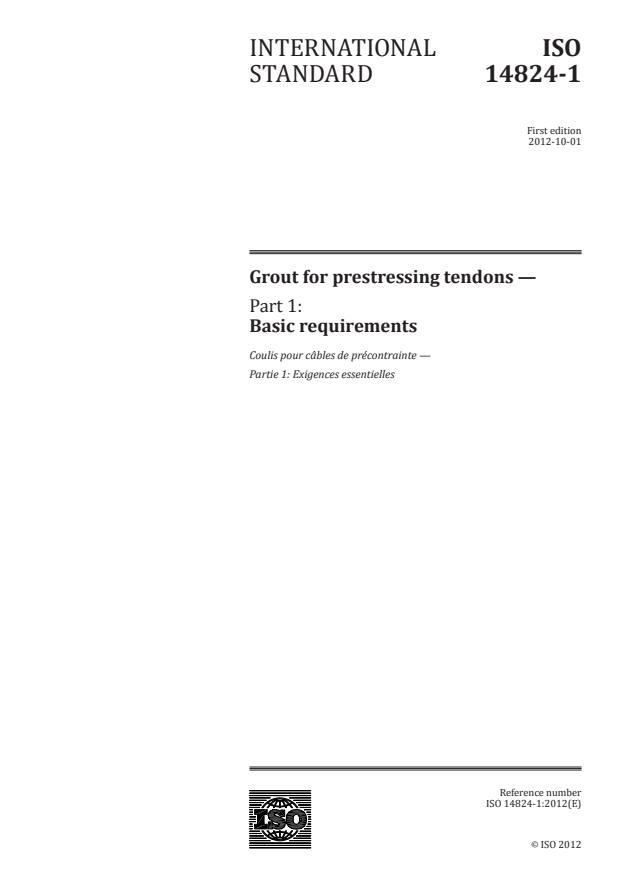
INTERNATIONAL ISO
STANDARD 14824-1
First edition
2012-10-01
Grout for prestressing tendons —
Part 1:
Basic requirements
Coulis pour câbles de précontrainte —
Partie 1: Exigences essentielles
Reference number
©
ISO 2012
© ISO 2012
All rights reserved. Unless otherwise specified, no part of this publication may be reproduced or utilized in any form or by any
means, electronic or mechanical, including photocopying and microfilm, without permission in writing from either ISO at the
address below or ISO’s member body in the country of the requester.
ISO copyright office
Case postale 56 • CH-1211 Geneva 20
Tel. + 41 22 749 01 11
Fax + 41 22 749 09 47
E-mail copyright@iso.org
Web www.iso.org
Published in Switzerland
ii © ISO 2012 – All rights reserved
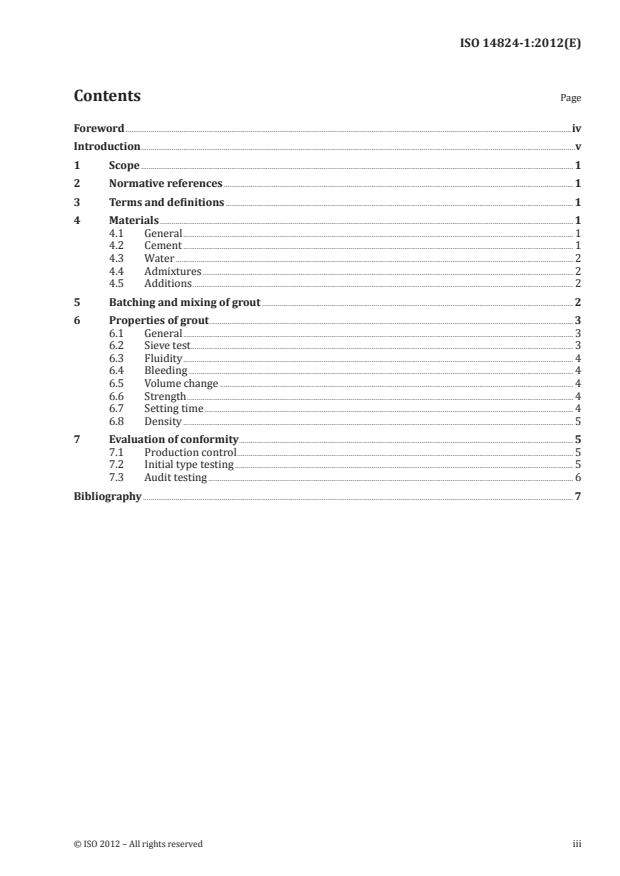
Contents Page
Foreword .iv
Introduction .v
1 Scope . 1
2 Normative references . 1
3 Terms and definitions . 1
4 Materials . 1
4.1 General . 1
4.2 Cement . 1
4.3 Water . 2
4.4 Admixtures . 2
4.5 Additions . 2
5 Batching and mixing of grout . 2
6 Properties of grout . 3
6.1 General . 3
6.2 Sieve test . 3
6.3 Fluidity . 4
6.4 Bleeding . 4
6.5 Volume change . 4
6.6 Strength . 4
6.7 Setting time . 4
6.8 Density . 5
7 Evaluation of conformity . 5
7.1 Production control . 5
7.2 Initial type testing . 5
7.3 Audit testing . 6
Bibliography . 7
Foreword
ISO (the International Organization for Standardization) is a worldwide federation of national standards
bodies (ISO member bodies). The work of preparing International Standards is normally carried out
through ISO technical committees. Each member body interested in a subject for which a technical
committee has been established has the right to be represented on that committee. International
organizations, governmental and non-governmental, in liaison with ISO, also take part in the work.
ISO collaborates closely with the International Electrotechnical Commission (IEC) on all matters of
electrotechnical standardization.
International Standards are drafted in accordance with the rules given in the ISO/IEC Directives, Part 2.
The main task of technical committees is to prepare International Standards. Draft International
Standards adopted by the technical committees are circulated to the member bodies for voting.
Publication as an International Standard requires approval by at least 75 % of the member bodies
casting a vote.
Attention is drawn to the possibility that some of the elements of this document may be the subject of
patent rights. ISO shall not be held responsible for identifying any or all such patent rights.
ISO 14824-1 was prepared by Technical Committee ISO/TC 71, Concrete, reinforced concrete and pre-
stressed concrete, Subcommittee SC 3, Concrete production and execution of concrete structures.
ISO 14824 consists of the following parts, under the general title Grout for prestressing tendons:
— Part 1: Basic requirements
— Part 2: Grouting procedures
— Part 3: Test methods
iv © ISO 2012 – All rights reserved
Introduction
In post-tensioned prestressed concrete construction, the grouting of tendons is an important operation.
The intention of this part of ISO 14824 is to provide basic requirements for the approval of cement
grouts, compliance with which will satisfy the requirements in ISO 22966.
The main function of grouting is to:
— protect the prestressing steel against corrosion;
— provide a bond between the prestressing steel and the ducts where required for the design of
the structure;
— allow transfer of compressive stresses in the structure in a direction transverse to internal tendons;
— fill all voids where water may accumulate and cause frost damage.
The testing regimes anticipated by this part of ISO 14824 include three levels:
(1) initial type and audit testing in accordance with this part of ISO 14824;
(2) suitability testing for confirmation of the selected grout for a specific project in accordance with
ISO 14824-2;
(3) inspection during grouting works on a specific project in accordance with ISO 14824-2.
The test methods for each of the regimes are given in ISO 14824-3.
In some countries requirements exist for independent third-party certification of grout and grouting
procedures which should be set out in national requirements to supplement ISO 22966.
Certain special structures or tendon configurations can require grouts with enhanced performance.
Any resulting necessary amendment of the requirements of this part of ISO 14824 needs to be included
in the execution specification.
INTERNATIONAL STANDARD ISO 14824-1:2012(E)
Grout for prestressing tendons —
Part 1:
Basic requirements
1 Scope
This part of ISO 14824 covers the materials that may be used in the manufacture of cement grouts and
the required properties and composition of the grout. It is applicable to grouting of tendons in all types
of structures, including bridges and buildings.
2 Normative references
The following referenced documents are indispensable for the application of this document. For dated
references, only the edition cited applies. For undated references, the latest edition of the referenced
document (including any amendments) applies.
ISO 9597, Methods of testing cement — Determination of setting times and soundness
ISO 22965-2, Concrete — Part 2: Specification of constituent materials, production of concrete and
compliance of concrete
ISO 14824-3, Grout for prestressing tendons — Part 3: Test methods
ISO 12439, Mixing water for concrete
3 Terms and definitions
For the purposes of this document, the following terms and definitions apply.
3.1
grout
homogeneous mixture of cement and water, which may contain admixtures and additions
3.2
tendon
assembly of prestressing steel and sheath with anchorages and all necessary auxiliary components to
permit grouting, either placed internally or externally to the concrete structure
4 Materials
4.1 General
Materials shall have a general suitability in accordance with ISO 22965-2.
4.2 Cement
Cement shall be Portland cement or any other type of cement permitted for grouting of tendons which
complies with national standards in the place of use of the grout. The cement type shall be declared.
4.3 Water
Water shall comply with ISO 12439.
...
SLOVENSKI STANDARD
01-junij-2012
Injekcijska masa za prednapete kable - 1. del: Osnovne zahteve
Grout for prestressing tendons - Part 1: Basic requirements
Coulis pour câbles de précontrainte - Partie 1: Exigences essentielles
Ta slovenski standard je istoveten z: ISO/DIS 14824-1
ICS:
91.100.30 Beton in betonski izdelki Concrete and concrete
products
2003-01.Slovenski inštitut za standardizacijo. Razmnoževanje celote ali delov tega standarda ni dovoljeno.
DRAFT INTERNATIONAL STANDARD ISO/DIS 14824-1
ISO/TC 71/SC 3 Secretariat: SN
Voting begins on Voting terminates on
2011-06-29 2011-11-29
INTERNATIONAL ORGANIZATION FOR STANDARDIZATION • МЕЖДУНАРОДНАЯ ОРГАНИЗАЦИЯ ПО СТАНДАРТИЗАЦИИ • ORGANISATION INTERNATIONALE DE NORMALISATION
Grout for prestressing tendons —
Part 1:
Basic requirements
Coulis pour câbles de précontrainte —
Partie 1: Exigences essentielles
ICS 91.100.30
In accordance with the provisions of Council Resolution 15/1993 this document is circulated in
the English language only.
Conformément aux dispositions de la Résolution du Conseil 15/1993, ce document est
distribué en version anglaise seulement.
To expedite distribution, this document is circulated as received from the committee
secretariat. ISO Central Secretariat work of editing and text composition will be undertaken at
publication stage.
Pour accélérer la distribution, le présent document est distribué tel qu'il est parvenu du
secrétariat du comité. Le travail de rédaction et de composition de texte sera effectué au
Secrétariat central de l'ISO au stade de publication.
THIS DOCUMENT IS A DRAFT CIRCULATED FOR COMMENT AND APPROVAL. IT IS THEREFORE SUBJECT TO CHANGE AND MAY NOT BE
REFERRED TO AS AN INTERNATIONAL STANDARD UNTIL PUBLISHED AS SUCH.
IN ADDITION TO THEIR EVALUATION AS BEING ACCEPTABLE FOR INDUSTRIAL, TECHNOLOGICAL, COMMERCIAL AND USER PURPOSES, DRAFT
INTERNATIONAL STANDARDS MAY ON OCCASION HAVE TO BE CONSIDERED IN THE LIGHT OF THEIR POTENTIAL TO BECOME STANDARDS TO
WHICH REFERENCE MAY BE MADE IN NATIONAL REGULATIONS.
RECIPIENTS OF THIS DRAFT ARE INVITED TO SUBMIT, WITH THEIR COMMENTS, NOTIFICATION OF ANY RELEVANT PATENT RIGHTS OF WHICH
THEY ARE AWARE AND TO PROVIDE SUPPORTING DOCUMENTATION.
© International Organization for Standardization, 2011
ISO/DIS 14824-1
Copyright notice
This ISO document is a Draft International Standard and is copyright-protected by ISO. Except as permitted
under the applicable laws of the user’s country, neither this ISO draft nor any extract from it may be
reproduced, stored in a retrieval system or transmitted in any form or by any means, electronic,
photocopying, recording or otherwise, without prior written permission being secured.
Requests for permission to reproduce should be addressed to either ISO at the address below or ISO’s
member body in the country of the requester.
ISO copyright office
Case postale 56 • CH-1211 Geneva 20
Tel. + 41 22 749 01 11
Fax + 41 22 749 09 47
E-mail copyright@iso.org
Web www.iso.org
Reproduction may be subject to royalty payments or a licensing agreement.
Violators may be prosecuted.
ii © ISO 2011 – All rights reserved
ISO/CD 14824-1 (E)
Contents ���
Foreword .3
Introduction .4
1 Scope .5
2 Normative references .5
3 Terms and definitions .5
4 Materials .5
4.1 General .5
4.2 Cement .5
4.3 Water .6
4.4 Admixtures .6
4.5 Additions .6
5 Batching and mixing of grout .6
6 Properties of grout.7
6.1 General .7
6.2 Sieve test .8
6.3 Fluidity .8
6.4 Bleeding .8
6.5 Volume change .8
6.6 Strength .8
6.7 Setting time .9
6.8 Density .9
7 Evaluation of conformity .9
7.1 Production control .9
7.2 Initial type testing .9
7.3 Audit testing . 10
Bibliography . 12
�
DRAFT 2011
ISO/CD 14824-1 (E)
Foreword
ISO (the International Organization for Standardization) is a worldwide federation of national standards bodies
(ISO member bodies). The work of preparing International Standards is normally carried out through ISO
technical committees. Each member body interested in a subject for which a technical committee has been
established has the right to be represented on that committee. International organizations, governmental and
non-governmental, in liaison with ISO, also take part in the work. ISO collaborates closely with the
International Electrotechnical Commission (IEC) on all matters of electrotechnical standardization.
International Standards are drafted in accordance with the rules given in the ISO/IEC Directives, Part 2.
The main task of technical committees is to prepare International Standards. Draft International Standards
adopted by the technical committees are circulated to the member bodies for voting. Publication as an
International Standard requires approval by at least 75 % of the member bodies casting a vote.
Attention is drawn to the possibility that some of the elements of this document may be the subject of patent
rights. ISO shall not be held responsible for identifying any or all such patent rights.
ISO 14824-1 was prepared by Technical Committee ISO/TC 71, Concrete, Reinforced and Prestressed
Concrete, Subcommittee SC 3, Production of Concrete and Execution of Concrete Structures.
DRAFT 2011
ISO/CD 14824-1 (E)
Introduction
In post-tensioned prestressed concrete construction, the grouting of tendons is an important operation. The
intention of this International Standard is to provide basic requirements for the approval of cement grouts,
compliance with which will satisfy the requirements in ISO 22966.
The main function of grouting is to:
Provide protection to the prestressing steel against corrosion;
Provide a bond between the prestressing steel and the ducts where required for the design of the
structure;
Allow transfer of compressive stresses in the structure in a direction transverse to internal tendons;
Fill all voids where water may accumulate and cause frost damage.
The testing regimes anticipated by this International Standard include three levels:
(1) Initial type and audit testing in accordance with this ISO 14824-1;
(2) Suitability testing for confirmation of the selected grout for a specific project in accordance with ISO
14824-2;
(3) Inspection during grouting works on a specific project in accordance with ISO 14824-2.
The test methods for each of the regimes are given in ISO 14824-3.
NOTE: In some countries requirements exist for Independent Third Party Certification of Grout and Grouting
procedures which should be set out in National Requirements to supplement ISO 22966 Execution of
Concrete Structures.
DRAFT 2011
ISO/CD 14824-1 (E)
Grout for prestressing tendons —
Part 1:
Basic requirements
1 Scope
This International Standard Part 1, covers the materials that may be used in the manufacture of cement grouts
and the required properties and composition of the grout. It is applicable to grouting of tendons in all types of
structures including bridges and buildings.
NOTE: Certain special structures or tendon configurations may require grouts with enhanced performance
which may require amendment of some of the requirements of this standard.
2 Normative references
The following referenced documents are indispensable for the application of this document. For dated
references, only the edition cited applies. For undated references, the latest edition of the referenced
document (including any amendments) applies.
ISO 9597, Methods of testing cement – Determination of setting times and soundness
ISO 22965-1, Concrete – Part 1: Methods for specifying and guidance for the specifier
ISO 22965-2, Concrete – Part 2: Specification of constituent materials, production of concrete and compliance
of concrete
ISO 14824-2, Grout for prestressing tendons – Part 2: Grouting procedures
ISO 14824-3, Grout for prestressing tendons – Part 3: Test methods
ISO 12439, Mixing water for concrete
3 Terms and definitions
For the purposes of this documen
...