


SIST EN 16194:2023
(Main)Mobile non-sewer-connected toilet cabins - Requirements of services and products relating to the deployment of cabins and sanitary products
Mobile non-sewer-connected toilet cabins - Requirements of services and products relating to the deployment of cabins and sanitary products
This document applies to mobile non-sewer-connected toilet cabins system.
It specifies the requirements for services related to the provision of toilet cabins and the relevant requirements for toilet cabins and sanitary products, taking into account comfort, hygiene, health and safety.
It specifies the minimum quality requirements for toilet cabins and sanitary products, as well as the extent of on-site service and the required disinfection and the number of toilet cabins to be provided. It also determines the frequency of use, the maximum number of uses per toilet cabins, the locations and the intervals for on-site service or disposal of faecal water.
This document is applicable to the framework of activities carried out in the following sectors:
— construction and extractive industries, opencast or underground;
— public events and recreational activities, festivals and concerts;
— agriculture, labour camps and temporary work camps;
— beaches;
— emergencies;
— military tactical and training exercises.
There are other types of mobile toilet cabins which are not connected to a sewage system (e.g. dry toilets, composting toilets, incinerations toilets, vacuum toilets, or other technologies and processes) and which are not covered by this document.
This document establishes a system to ensure that mobile sanitation facilities for waste disposal are available not only in the workplaces but wherever there are no waste disposal systems connected to a sewerage network.
This document is directed at manufacturers, services providers' companies and publics or private cabin hirers of toilet cabins not connected to a sewage network.
Mobile anschlussfreie Toilettenkabinen - Anforderungen an Dienstleistungen und Produkte für den Einsatz von Kabinen und Sanitärprodukten
Dieses Dokument ist anwendbar für mobile, anschlussfreie Toilettenkabinensysteme.
Es legt Anforderungen fest an Dienstleistungen bezüglich der Bereitstellung von Toilettenkabinen und die benötigten Anforderungen an Toilettenkabinen und Sanitärprodukte unter Berücksichtigung von Komfort, Hygiene, Gesundheit und Sicherheit.
Es legt die Mindestqualitätsanforderungen für Toilettenkabinen und Sanitärprodukte sowie den Umfang der Serviceleistung vor Ort und die erforderliche Desinfektion und die Anzahl der bereitzustellenden Toilettenkabinen fest. Es legt auch die Häufigkeit der Nutzung, die maximale Anzahl der Nutzungen je Toilettenkabine, die Standorte und die Intervalle für die Serviceleistung vor Ort oder die Entsorgung von Fäkalwasser fest.
Dieses Dokument ist anwendbar im Rahmen von Tätigkeiten in den folgenden Bereichen:
Bau- und Bergbauindustrie, im Tagebau oder unter Tage;
öffentliche Veranstaltungen und Freizeitaktivitäten, Festivals und Konzerte;
Landwirtschaft, Quartiere und temporäre Unterkünfte für Beschäftigte;
Strände;
Notfälle;
militärische taktische und Ausbildungsübungen.
Es gibt andere Arten von anschlussfreien mobilen Toilettenkabinen (z. B. Trockentoiletten, Komposttoiletten, Verbrennungstoiletten, Vakuumtoiletten oder andere Technologien und Verfahren), die in diesem Dokument nicht behandelt werden.
Dieses Dokument legt ein System fest, das sicherstellt, dass mobile Sanitäreinrichtungen für die Fäkalienentsorgung nicht nur an den Arbeitsplätzen, sondern überall dort zur Verfügung stehen, wo es keine an ein Kanalisationssystem angeschlossenen Fäkalienentsorgungssysteme gibt.
Dieses Dokument richtet sich an Hersteller, Dienstleistungsunternehmen und öffentliche oder private Vermieter von anschlussfreien Toilettenkabinen.
Cabines sanitaires mobiles autonomes - Exigences relatives aux services et produits, liées à la mise en place des cabines et des produits sanitaires
Le présent document s’applique aux systèmes de cabines sanitaires mobiles autonomes.
Il spécifie les exigences relatives aux services liés à la fourniture de cabines sanitaires mobiles autonomes et les exigences correspondantes relatives aux cabines et aux produits sanitaires, en tenant compte du confort, de l’hygiène, de la santé et de la sécurité.
Il spécifie les exigences de qualité minimales relatives aux cabines sanitaires mobiles autonomes et aux produits sanitaires ainsi que le degré de service sur site, la désinfection requise et le nombre de cabines sanitaires mobiles autonomes à fournir. Il détermine également la fréquence d’utilisation, le nombre maximum d’utilisations par cabine sanitaire, les emplacements et les intervalles de service sur site ou l’évacuation des eaux fécales.
Le présent document est applicable dans le cadre des activités menées dans les secteurs suivants :
— la construction et les industries extractives, à ciel ouvert ou souterraines ;
— les événements publics et les activités de loisirs, les festivals et les concerts ;
— l’agriculture, les camps de travailleurs et les camps de travail temporaires ;
— les plages ;
— les urgences ;
— les exercices militaires tactiques et d’entraînement.
Il existe d’autres types de cabines sanitaires mobiles autonomes (par exemple, les toilettes sèches, les toilettes à compost, les toilettes à incinération, les toilettes à aspiration, ou d’autres technologies et procédés) qui ne sont pas couverts par le présent document.
Le présent document définit un système permettant de garantir la disponibilité de cabines sanitaires mobiles autonomes pour l’évacuation des effluents, non seulement sur les lieux de travail, mais aussi partout où il n’existe pas de systèmes d’évacuation des eaux usées raccordés à un réseau d’assainissement.
Il s’adresse aux fabricants, aux sociétés prestataires de services et aux loueurs publics ou privés de cabines sanitaires mobiles autonomes.
Premične toaletne kabine, ki niso priključene na kanalizacijski sistem - Zahteve za storitve in proizvode v zvezi z uporabo kabin in sanitarnih proizvodov
Ta evropski standard se uporablja za premične toaletne kabine, ki niso priključene na kanalizacijski sistem.
Določa zahteve za storitve v zvezi z uporabo kabin in sanitarnih proizvodov ter ustrezne zahteve za kabine in sanitarne proizvode ob upoštevanju higiene, zdravja in varnosti.
Določa minimalne zahteve glede kakovosti kabin in sanitarnih proizvodov ter se navezuje tudi na obseg potrebnega čiščenja, števila kabin, ki jih je treba zagotoviti, lokacij in intervalov čiščenja/odstranjevanja.
General Information
- Status
- Published
- Public Enquiry End Date
- 12-Jul-2022
- Publication Date
- 27-Jun-2023
- Technical Committee
- I13 - Imaginarni 13
- Current Stage
- 6060 - National Implementation/Publication (Adopted Project)
- Start Date
- 27-Jun-2023
- Due Date
- 01-Sep-2023
- Completion Date
- 28-Jun-2023
Relations
- Effective Date
- 19-Jan-2023
Overview
EN 16194:2023 is the CEN European standard for mobile non-sewer-connected toilet cabins (portable toilets). It defines requirements for the supply, products and services associated with deploying toilet cabins and associated sanitary products where sewer connections are not available. The standard covers comfort, hygiene, health and safety, minimum quality, disinfection, on-site servicing and the planning needed to ensure adequate sanitation in temporary and mobile settings. It supersedes EN 16194:2012 and is intended for use across multiple sectors.
Key topics and requirements
- Scope and exclusions: Applies to non-sewer-connected toilet cabin systems; excludes other technologies such as dry/composting, incineration or vacuum toilets.
- Frequency of use & service intervals: Specifies how often cabins must be serviced/emptied and sets maximum uses per cabin, with sector-specific intervals for construction, events, agriculture, beaches, emergencies and military deployments.
- Supply types & minimum provision: Defines types of supply, minimum number of cabins and user-toilet ratios for different use-cases (construction sites, festivals, farms, beaches, emergency response, military).
- Product requirements: Requirements for mobile toilet cabins including wheelchair-accessible cabins, tank capacity (total and waste), materials, sanitary concentrates, scented oils and hygienic paper.
- Self-contained hand washing stations: Standards for provision of hand-wash facilities that complement portable toilets.
- Service requirements: Planning, delivery, on-site servicing (cleaning, disinfection), sewage treatment management and cabin pick-up procedures.
- Documentation & legal compliance: Records, service documentation and annexes with normative minimums and references to legal requirements.
Practical applications & who uses this standard
EN 16194:2023 is used by:
- Manufacturers of portable toilet cabins and sanitary consumables
- Service providers and cabin hire companies planning delivery, cleaning and waste disposal services
- Event organisers (festivals, concerts, public events) for sanitary planning and compliance
- Construction and infrastructure managers for site welfare provision
- Agricultural operators and seasonal labour camp managers
- Emergency planners and humanitarian agencies deploying temporary sanitation
- Military logistics and training coordinators specifying field sanitation Use of this standard helps ensure hygienic, safe and dignified sanitation where sewer networks are absent and supports SDGs such as Clean Water and Sanitation (SDG 6).
Related standards
- Supersedes EN 16194:2012 (updated provisions include adjusted daily use rates, reduced maximum uses, and defined tank capacity and minimum cleaning frequencies).
- Prepared by CEN/TC 183 (Waste management); national adoption required by CEN members.
Keywords: EN 16194:2023, mobile toilet cabins, portable toilets, non-sewer-connected, sanitary products, service intervals, event sanitation, construction site welfare, emergency sanitation.



Frequently Asked Questions
SIST EN 16194:2023 is a standard published by the Slovenian Institute for Standardization (SIST). Its full title is "Mobile non-sewer-connected toilet cabins - Requirements of services and products relating to the deployment of cabins and sanitary products". This standard covers: This document applies to mobile non-sewer-connected toilet cabins system. It specifies the requirements for services related to the provision of toilet cabins and the relevant requirements for toilet cabins and sanitary products, taking into account comfort, hygiene, health and safety. It specifies the minimum quality requirements for toilet cabins and sanitary products, as well as the extent of on-site service and the required disinfection and the number of toilet cabins to be provided. It also determines the frequency of use, the maximum number of uses per toilet cabins, the locations and the intervals for on-site service or disposal of faecal water. This document is applicable to the framework of activities carried out in the following sectors: — construction and extractive industries, opencast or underground; — public events and recreational activities, festivals and concerts; — agriculture, labour camps and temporary work camps; — beaches; — emergencies; — military tactical and training exercises. There are other types of mobile toilet cabins which are not connected to a sewage system (e.g. dry toilets, composting toilets, incinerations toilets, vacuum toilets, or other technologies and processes) and which are not covered by this document. This document establishes a system to ensure that mobile sanitation facilities for waste disposal are available not only in the workplaces but wherever there are no waste disposal systems connected to a sewerage network. This document is directed at manufacturers, services providers' companies and publics or private cabin hirers of toilet cabins not connected to a sewage network.
This document applies to mobile non-sewer-connected toilet cabins system. It specifies the requirements for services related to the provision of toilet cabins and the relevant requirements for toilet cabins and sanitary products, taking into account comfort, hygiene, health and safety. It specifies the minimum quality requirements for toilet cabins and sanitary products, as well as the extent of on-site service and the required disinfection and the number of toilet cabins to be provided. It also determines the frequency of use, the maximum number of uses per toilet cabins, the locations and the intervals for on-site service or disposal of faecal water. This document is applicable to the framework of activities carried out in the following sectors: — construction and extractive industries, opencast or underground; — public events and recreational activities, festivals and concerts; — agriculture, labour camps and temporary work camps; — beaches; — emergencies; — military tactical and training exercises. There are other types of mobile toilet cabins which are not connected to a sewage system (e.g. dry toilets, composting toilets, incinerations toilets, vacuum toilets, or other technologies and processes) and which are not covered by this document. This document establishes a system to ensure that mobile sanitation facilities for waste disposal are available not only in the workplaces but wherever there are no waste disposal systems connected to a sewerage network. This document is directed at manufacturers, services providers' companies and publics or private cabin hirers of toilet cabins not connected to a sewage network.
SIST EN 16194:2023 is classified under the following ICS (International Classification for Standards) categories: 03.080.30 - Services for consumers; 91.040.99 - Other buildings; 91.140.70 - Sanitary installations. The ICS classification helps identify the subject area and facilitates finding related standards.
SIST EN 16194:2023 has the following relationships with other standards: It is inter standard links to SIST EN 16194:2012. Understanding these relationships helps ensure you are using the most current and applicable version of the standard.
SIST EN 16194:2023 is available in PDF format for immediate download after purchase. The document can be added to your cart and obtained through the secure checkout process. Digital delivery ensures instant access to the complete standard document.
Standards Content (Sample)
SLOVENSKI STANDARD
01-september-2023
Premične toaletne kabine, ki niso priključene na kanalizacijski sistem - Zahteve za
storitve in proizvode v zvezi z uporabo kabin in sanitarnih proizvodov
Mobile non-sewer-connected toilet cabins - Requirements of services and products
relating to the deployment of cabins and sanitary products
Mobile anschlussfreie Toilettenkabinen - Anforderungen an Dienstleistungen und
Produkte für den Einsatz von Kabinen und Sanitärprodukten
Cabines sanitaires mobiles autonomes - Exigences relatives aux services et produits,
liées à la mise en place des cabines et des produits sanitaires
Ta slovenski standard je istoveten z: EN 16194:2023
ICS:
03.080.30 Storitve za potrošnike Services for consumers
91.140.70 Sanitarne naprave Sanitary installations
2003-01.Slovenski inštitut za standardizacijo. Razmnoževanje celote ali delov tega standarda ni dovoljeno.
EN 16194
EUROPEAN STANDARD
NORME EUROPÉENNE
June 2023
EUROPÄISCHE NORM
ICS 03.080.30; 91.040.99 Supersedes EN 16194:2012
English Version
Mobile non-sewer-connected toilet cabins - Requirements
of services and products relating to the deployment of
cabins and sanitary products
Cabines sanitaires mobiles autonomes - Exigences Mobile anschlussfreie Toilettenkabinen -
relatives aux services et produits, liées à la mise en Anforderungen an Dienstleistungen und Produkte für
place des cabines et des produits sanitaires den Einsatz von Kabinen und Sanitärprodukten
This European Standard was approved by CEN on 3 March 2023.
CEN members are bound to comply with the CEN/CENELEC Internal Regulations which stipulate the conditions for giving this
European Standard the status of a national standard without any alteration. Up-to-date lists and bibliographical references
concerning such national standards may be obtained on application to the CEN-CENELEC Management Centre or to any CEN
member.
This European Standard exists in three official versions (English, French, German). A version in any other language made by
translation under the responsibility of a CEN member into its own language and notified to the CEN-CENELEC Management
Centre has the same status as the official versions.
CEN members are the national standards bodies of Austria, Belgium, Bulgaria, Croatia, Cyprus, Czech Republic, Denmark, Estonia,
Finland, France, Germany, Greece, Hungary, Iceland, Ireland, Italy, Latvia, Lithuania, Luxembourg, Malta, Netherlands, Norway,
Poland, Portugal, Republic of North Macedonia, Romania, Serbia, Slovakia, Slovenia, Spain, Sweden, Switzerland, Türkiye and
United Kingdom.
EUROPEAN COMMITTEE FOR STANDARDIZATION
COMITÉ EUROPÉEN DE NORMALISATION
EUROPÄISCHES KOMITEE FÜR NORMUNG
CEN-CENELEC Management Centre: Rue de la Science 23, B-1040 Brussels
© 2023 CEN All rights of exploitation in any form and by any means reserved Ref. No. EN 16194:2023 E
worldwide for CEN national Members.
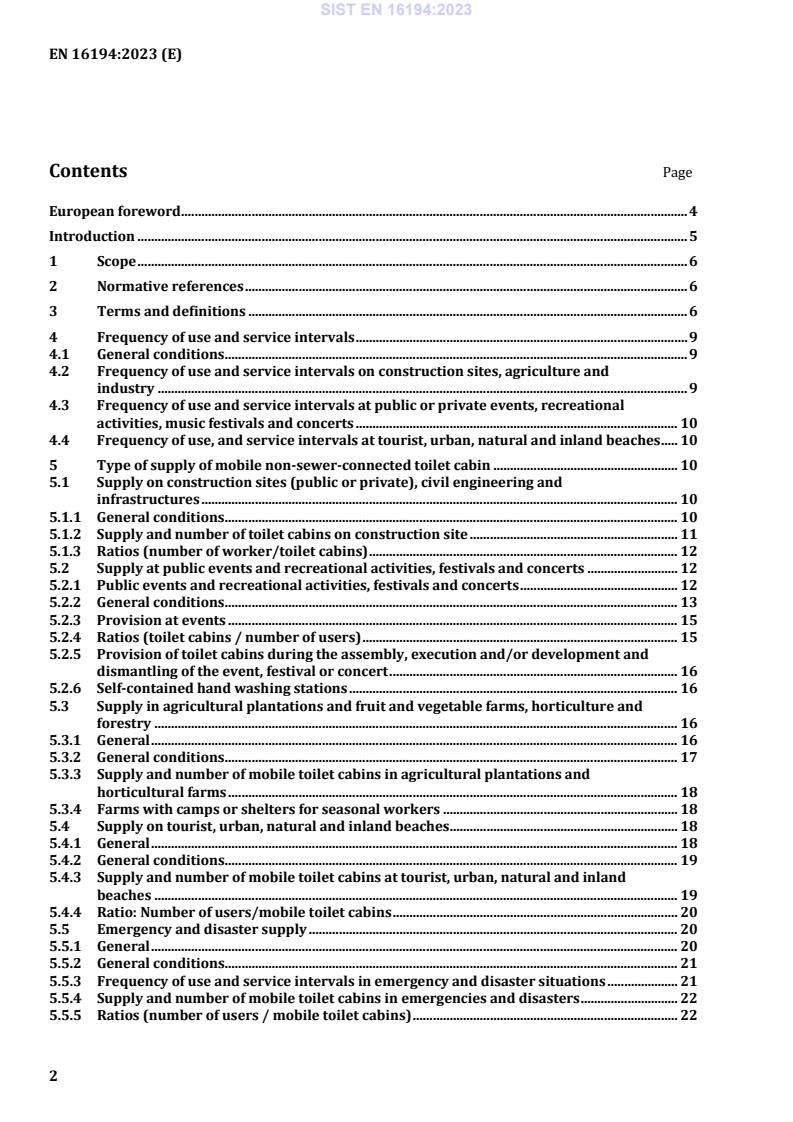
Contents Page
European foreword . 4
Introduction . 5
1 Scope . 6
2 Normative references . 6
3 Terms and definitions . 6
4 Frequency of use and service intervals . 9
4.1 General conditions . 9
4.2 Frequency of use and service intervals on construction sites, agriculture and
industry . 9
4.3 Frequency of use and service intervals at public or private events, recreational
activities, music festivals and concerts . 10
4.4 Frequency of use, and service intervals at tourist, urban, natural and inland beaches . 10
5 Type of supply of mobile non-sewer-connected toilet cabin . 10
5.1 Supply on construction sites (public or private), civil engineering and
infrastructures . 10
5.1.1 General conditions . 10
5.1.2 Supply and number of toilet cabins on construction site . 11
5.1.3 Ratios (number of worker/toilet cabins) . 12
5.2 Supply at public events and recreational activities, festivals and concerts . 12
5.2.1 Public events and recreational activities, festivals and concerts . 12
5.2.2 General conditions . 13
5.2.3 Provision at events . 15
5.2.4 Ratios (toilet cabins / number of users) . 15
5.2.5 Provision of toilet cabins during the assembly, execution and/or development and
dismantling of the event, festival or concert . 16
5.2.6 Self-contained hand washing stations . 16
5.3 Supply in agricultural plantations and fruit and vegetable farms, horticulture and
forestry . 16
5.3.1 General . 16
5.3.2 General conditions . 17
5.3.3 Supply and number of mobile toilet cabins in agricultural plantations and
horticultural farms . 18
5.3.4 Farms with camps or shelters for seasonal workers . 18
5.4 Supply on tourist, urban, natural and inland beaches . 18
5.4.1 General . 18
5.4.2 General conditions . 19
5.4.3 Supply and number of mobile toilet cabins at tourist, urban, natural and inland
beaches . 19
5.4.4 Ratio: Number of users/mobile toilet cabins . 20
5.5 Emergency and disaster supply . 20
5.5.1 General . 20
5.5.2 General conditions . 21
5.5.3 Frequency of use and service intervals in emergency and disaster situations . 21
5.5.4 Supply and number of mobile toilet cabins in emergencies and disasters . 22
5.5.5 Ratios (number of users / mobile toilet cabins) . 22
5.6 Supply on military manoeuvres, tactical training, fire drills and military camping or
hosting . 23
5.6.1 General conditions . 23
5.6.2 Frequency of use and service intervals in manoeuvres and military camps . 23
5.6.3 Supply and number of mobile toilet cabins in training camps and/or military camps
and shelters . 24
5.6.4 Ratios (Number of users/mobile toilet cabins) . 24
6 Self-contained hand washing stations . 24
7 Product requirements . 25
7.1 Mobile non-sewer connected toilet cabins . 25
7.1.1 General . 25
7.1.2 Mobile toilet cabin . 26
7.1.3 Wheelchair accessible toilet cabin . 27
7.2 Sanitary products . 27
7.2.1 Sanitary concentrates . 27
7.2.2 Scented oils . 28
7.2.3 Hygienic paper . 28
8 Service requirements . 28
8.1 Preconditions . 28
8.2 Planning and advice . 28
8.3 Delivery of the mobile toilet cabin . 28
8.4 On-site service . 29
8.5 Sewage treatment management . 30
8.6 Mobile toilet cabin pick-up . 30
9 Documentation and records . 30
10 Name of the service . 30
Annex A (informative) Legal requirements . 31
Annex B (normative) Construction and agricultural, labour camps and temporary work
camps – Minimum number of toilet cabins facilities . 32
Annex C (normative) Festivals and events . 34
C.1 Minimum number of mobile toilet cabins facilities . 34
C.2 Provision of mobile toilet cabins during the assembly/disassembly of the event . 38
Annex D (normative) Farms with camps or shelters for seasonal workers– Minimum
number of toilet cabins facilities . 39
Annex E (normative) Supply on tourist, urban, natural and inland beaches – Minimum
number of toilet cabins facilities . 40
Annex F (normative) Emergency and disaster supply – Minimum number of toilet cabins
facilities . 42
Annex G (normative) Supply on military manoeuvres, tactical training, fire drills and
military camping or hosting – Minimum number of toilet cabins facilities . 46
European foreword
This document (EN 16194:2023) has been prepared by Technical Committee CEN/TC 183 “Waste
management”, the secretariat of which is held by DIN.
This European Standard shall be given the status of a national standard, either by publication of an
identical text or by endorsement, at the latest by December 2023, and conflicting national standards shall
be withdrawn at the latest by December 2023.
Attention is drawn to the possibility that some of the elements of this document may be the subject of
patent rights. CEN shall not be held responsible for identifying any or all such patent rights.
This document supersedes EN 16194:2012.
The main changes compared to the previous edition are listed below:
— daily frequency of use by workers and users of mobile portable toilets increased;
— maximum number of uses per mobile portable toilet decreased in all sectors of application;
— introduced the total capacity and/or waste capacity in the waste tank;
— introduced the minimum frequency of cleaning and emptying of the tank for each application sector.
Any feedback and questions on this document should be directed to the users’ national standards body.
A complete listing of these bodies can be found on the CEN website.
According to the CEN-CENELEC Internal Regulations, the national standards organisations of the
following countries are bound to implement this European Standard: Austria, Belgium, Bulgaria, Croatia,
Cyprus, Czech Republic, Denmark, Estonia, Finland, France, Germany, Greece, Hungary, Iceland, Ireland,
Italy, Latvia, Lithuania, Luxembourg, Malta, Netherlands, Norway, Poland, Portugal, Republic of North
Macedonia, Romania, Serbia, Slovakia, Slovenia, Spain, Sweden, Switzerland, Türkiye and the United
Kingdom.
Introduction
For more than 60 years, mobile sanitation facilities have been used in many sectors of activity, public or
private. At the beginning, they were mainly used on various temporary or mobile construction sites; over
the years, they have become a practical facility in the following sectors: industry, agriculture, commerce,
training services, cultural events, leisure, concerts and outdoors festivals, beaches and parks, military
camps, refugee’s camps, public events, etc.
Whenever large numbers of people congregate for a long period of time in places where sanitation
facilities lack or are insufficient, the use of mobile toilet cabins not connected to the sewer has become a
common practice providing security, hygiene, healthiness, dignity and privacy.
Adequate provision of toilet cabins allows hygiene, healthiness, comfort, dignity and privacy.
This document complies with the three fundamental pillars of the Sustainable Development Goals,
promoting the best environmental management practices in a broad sense and constituting a large-scale
transversal commitment.
This document contributes to the following Sustainable Development Goals of the United Nations:
— SDG 3 Health and Well-being.
— SDG 5 Gender Equality.
— SDG 6 Clean Water and Sanitation.
— SDG 11 Sustainable Cities. (Waste management).
— SDG 12 Responsible Consumption and Production.
— SDG 13 Climate action.
1 Scope
This document applies to mobile non-sewer-connected toilet cabins system.
It specifies the requirements for services related to the provision of toilet cabins and the relevant
requirements for toilet cabins and sanitary products, taking into account comfort, hygiene, health and
safety.
It specifies the minimum quality requirements for toilet cabins and sanitary products, as well as the
extent of on-site service and the required disinfection and the number of toilet cabins to be provided. It
also determines the frequency of use, the maximum number of uses per toilet cabins, the locations and
the intervals for on-site service or disposal of faecal water.
This document is applicable to the framework of activities carried out in the following sectors:
— construction and extractive industries, opencast or underground;
— public events and recreational activities, festivals and concerts;
— agriculture, labour camps and temporary work camps;
— beaches;
— emergencies;
— military tactical and training exercises.
There are other types of mobile toilet cabins which are not connected to a sewage system (e.g. dry toilets,
composting toilets, incinerations toilets, vacuum toilets, or other technologies and processes) and which
are not covered by this document.
This document establishes a system to ensure that mobile sanitation facilities for waste disposal are
available not only in the workplaces but wherever there are no waste disposal systems connected to a
sewerage network.
This document is directed at manufacturers, services providers' companies and publics or private cabin
hirers of toilet cabins not connected to a sewage network.
2 Normative references
There are no normative references in this document.
3 Terms and definitions
For the purposes of this document, the following terms and definitions apply.
ISO and IEC maintain terminology databases for use in standardization at the following addresses:
— ISO Online browsing platform: available at https://www.iso.org/obp
— IEC Electropedia: available at https://www.electropedia.org/
3.1
mobile toilet cabins not connected to the sewer
self-contained mobile toilet cabin intended for use by a single person, to lockable from the inside, with a
sewage tank not connected to a waste water network
3.2
mobile male and/or female urinal unit not connected to the sewerage system
portable urinal unit, for use by either men or women, either freestanding or multiple, provided with a
wastewater tank not connected to a sewerage system
3.3
wheelchair accessible toilet cabins
units located on an accessible level that are part of the general core of mobile toilet cabins
Note 1 to entry: Toilet cabins’ arrangement of appliances (toilet roll holders, gel, soap and paper towel
dispensers), door opening and technical aids (folding bars or grab bars) are suitable for users with different
disabilities. In any case, toilet cabins’ arrangement has an interior free space that allows a wheelchair user to turn
around and transfer onto the toilet cabin tank from one side of the tank only.
3.4
sanitary products
concentrate with sanitary effect (liquid or solid), antifreeze for sewage tank, aromatic oils, toilet paper,
paper towel, soap and hydro alcoholic gel, bactericide, disinfectant and virucide
3.5
service
planning and advice, delivery of the toilet cabin, on-site service, transport of waste water to the discharge
point authorized in each case by the operator of the public sewerage system and collection of the toilet
cabin
3.6
on-site service
specified process for on-site service with a service truck (pumping of the toilet cabin tank, cleaning of the
inside of the tank with high pressure water, refilling with 20 l of water and deodorizers, washing with
high pressure water the inside and outside of the toilet cabin, drying of the inside of the toilet cabin),
disinfection with bactericide, refurnishing hygienic paper, soap or hydro alcoholic gel
3.7
standard cleaning
regular cleaning
routine maintenance carried out by the employer at the workplace according to the legal provisions in
force in the respective country
Note 1 to entry: Standard or regular cleaning is intended to be carried out by the customer at the workplace, as
described in the respective national workplace legislation.
3.8
mobile
readily relocatable
3.9
non-sewage waste disposal system
sanitary waste disposal system not connected to a toilet sewage, septic tank or on-site waste disposal
system
3.10
amount of workers
maximum number of workers present in a shift in the ordinary working week, in force in each EU member
3.11
frequency of use
number of uses of the cabin per hour by the user
3.12
frequency of on-site service
number of on-site service performed on each toilet cabin
3.13
maximum number of uses
maximum number of uses per toilet cabin between 2 on-site service operations
3.14
ratio
quantified relationship between two magnitudes reflecting their proportion
3.15
no food or beverage service
event or function where no food or beverages are served
3.16
with food or beverage service
event, festival or concert where food and beverages are served
3.17
capacity
maximum capacity that a given venue can hold
3.18
beach management body
organization or authorities having the power to manage and inspect aspects related to a beach, including
its public management, as well as its sphere of influence
3.19
carrying capacity
maximum number of users that can access and fit on a beach, in a given period
3.20
installation
supplies of toilet cabins or set of equipment, infrastructure and other physical elements, like hand wash
and urinals, necessary to carry out the portable sanitation activity
3.21
service providers
company providing planning, advice, supply and installation of toilet cabins, on-site service, waste water
extraction and delivery to the waste treatment plant, and toilets cabins collection
3.22
renter
owner
companies, organizations, public bodies, municipalities or individuals using the service for planning and
advice toilet cabin delivery, on-site service, sewage treatment management and toilet cabin collection
3.23
initial waste producer
public or private person whose activity produces waste
3.24
waste management
collection and transport to the public sewerage system or to sewerage network or to collectors or sewage
treatment plants in accordance with national and local legislation of each country, or waste treatment
plants
3.25
collection
collection of waste for the purpose of transport to a waste treatment facility
3.26
external hand washing station
hand washing station where, using any kind of non-electrical pump to dispense water from the fresh
water tank, the water is dispensed through a tap for hand washing and grey water drains into the waste
tank inside the sink body
Note 1 to entry: Most of the hand washing units offer space for one or two users at the same time.
3.27
internal hand washing station
hand washing station where any kind of non-electrical pump dispenses the fresh water from the hand
wash tank through a tap and the grey water drains into the toilets cabins waste tank
Note 1 to entry: This hand wash unit is always inside of the portable toilets cabins.
4 Frequency of use and service intervals
4.1 General conditions
The following guidelines should be taken into account when determining the number of mobile toilet
cabins required:
— the amount of waste within the toilet cabin tank should never exceed 87 l including the sanitary
product with the initial load of 20 l and the grey water from the self-contained hand washing stations
approximately 10 l;
— separate facilities for each sex need to be provided or separate use shall be provided in accordance
with the legal provisions in force in each country, with hand washing facilities or disinfection
facilities;
— if the toilet cabin contains a urinal in addition to the tank, then appropriate toilet cabins for men and
women shall be calculated.
4.2 Frequency of use and service intervals on construction sites, agriculture and
industry
The frequency of use per person shall be 3 times during a standard working day.
The maximum number of uses per toilet cabin between 2 on-site services should be no more than
105 uses. This is based on 7 workers using the toilet cabin 3 times per day for 5 days/week.
The minimum on-site service frequency shall be once a week, after 5 standard working days of 8 h each.
This on-site service is mandatory.
4.3 Frequency of use and service intervals at public or private events, recreational
activities, music festivals and concerts
The frequency of use per person for events without food and beverage service is as follows:
— 1,5 times during an event up to 6 h;
— 3 times during an event up to 12 h.
The frequency of use per person for events with food and beverage service is as follows:
— 2 times during an event up to 6 h;
— 4 times during an event up to 12 h.
The maximum number of uses per toilet cabin between 2on-site services shall in no case exceed 100 for
6 h and 125 for 12 h.
If the events last more than 6 h or 12 h, the mobile toilet cabins shall be on-site serviced at intervals of
6 h or 12 h or after each event on a mandatory basis. As a general rule, they shall always receive 1 on-site
service per 6 h interval or 12 h interval.
4.4 Frequency of use, and service intervals at tourist, urban, natural and inland beaches
The estimated frequency of use per person shall be 3 times during a 12-h day.
The maximum number of uses per toilet cabin between 2 on-site services shall not exceed 156 uses.
The minimum on-site service frequency shall be once a day, on working days, Saturdays, Sundays and
public holidays. If the beach has a high or very high turnover of people, these on-site services shall be
minimum 2 per day, spaced between the 12 opening h of the beach.
Separate facilities for each sex shall be provided with hand-washing facilities or disinfection facilities.
5 Type of supply of mobile non-sewer-connected toilet cabin
5.1 Supply on construction sites (public or private), civil engineering and
infrastructures
5.1.1 General conditions
Temporary or mobile construction sites, hereinafter referred to as “sites”, means any public or private
construction site on which construction or civil engineering works are carried out. A non-exhaustive list
of which is given in the European Directive 92/104/CEE, Directive 92/91/CEE and Directive 92/57/CEE.
Construction sites shall be equipped with fixed toilet services, or mobile or temporary toilet cabins,
depending on the number of workers who are going to use them.
These facilities shall be progressively adapted as workers, including those of subcontracting
undertakings and self-employed workers, join the site, always in relation to the number of workers
simultaneously carrying out tasks on the site.
Where the number of workers in a workplace fluctuates greatly, the number of portable toilet-cabins
required shall be determined by the maximum number of workers present during a regular ordinary
working week, in force in each EU member country.
Crews of workers, whether contracted or subcontracted, involved in the construction of dwellings should
be calculated on the basis of Ratio 1 (see Annex B), and are not considered “mobile”.
The contractor shall be responsible for providing sufficient toilet cabins facilities for the total number of
his own workers and for preventing the declared capacity of such facilities from being exceeded and thus
causing unsanitary conditions.
Standard/regular cleaning of workplaces, including mobile toilet cabins and their respective equipment
and facilities, shall be maintained in a proper hygienic condition; to this end, the client
contractor/developer shall be responsible for cleaning them periodically and whenever necessary to
maintain them at all times in a proper hygienic condition, and in a satisfactory state of sanitation.
In those works that have a basic health and safety study, these installations of mobile toilet cabins shall
be specify in the health and safety plan of each contractor in accordance with the provisions of the
corresponding study. Their quantity and location shall be set out in the technical document.
Mobile toilet cabins should be highly recommended in those temporary or mobile works which:
— arise conditioned by the need for rapid and urgent intervention, planned and unplanned;
— are of little technological and economic importance, require little time for their execution (such as,
among others: breakage of pipes, service connections, undermining or sinking of roads, potholes or
repairs to public roads, demolition, urgent shoring or reinforcement of structures, repairs to roofs,
etc.) and for which alternative solutions cannot be adopted.
NOTE The definitions of temporary and mobile works only lasting a short period can be found in the national
and regional standards.
In difficult conditions, or due to lack of space in the aforementioned works sites, these facilities shall not
be dispensed. Fewer mobile toilet cabins can be used by increasing the frequency of on-site services, as
described by the following ratios:
— Ratio 2 (see Annex B and in particular Table B.2);
— Ratio 3 (see Annex B and in particular Table B.3).
In case of underground extracting minerals industries, toilet cabins provided for in this document may
be installed above ground.
The use of trailers as toilet facilities, consisting of mobile toilet(s), washing facilities and sufficient tables
and seats, is permitted on sanitation network sites, on roads of considerable length and for short working
times in individual stalls away from each other, in addition to the ordinary toilet facilities located in the
site areas or base camps.
Works should not begin without having previously solved, by means of portable, fixed or provisional
sanitation installations, the aforementioned health and safety and hygiene conditions at work, in
accordance with their specific regulations.
In no case mobile toilet cabins shall be fewer than those specified in 5.1.3.
5.1.2 Supply and number of toilet cabins on construction site
The minimum installation of mobile toilet cabins, with a weekly on-site service frequency, shall be 1 toilet
cabin for every 7 workers, carrying out activities on the construction site.
On construction sites at ground level, the maximum distance between the workplace and the toilet cabin
shall not exceed 80 meters and shall be easily accessible to users.
On multi-level construction sites, toilet cabins shall be provided on every second floor. They shall have
lifting hooks for the crane, approved and homologate by the manufacturer of the hooks themselves.
This approval is understood for the lifting of the toilet cabin with the initial load and full hand wash and
at the moment of the lowering of the toilet cabin with the full load of waste water.
All toilet cabins should be equipped with a method of hand washing, as an extra product, either with a
disinfectant solution dispenser or with extras such as stand-alone hand washing facilities outside and/or
in combination with hand washing units inside, to facilitate a total hygiene, disinfection and comfort.
Mobile toilet cabins shall be placed throughout the construction site, depending on the characteristics
and peculiarities of each construction site, in such a way as to facilitate the pumping service of the
cleaning vehicles.
The constructions site managers shall provide a correct location and an access for the mobile toilet cabins
in order to be sure to grant access for its on-site service and the distance from the service vehicle to the
mobile toilet cabin shall not exceed 10 meters when possible.
5.1.3 Ratios (number of worker/toilet cabins)
The number of toilet cabins shall be calculated on the basis of the following ratios:
— Ratio 1, i.e. 1 toilet cabin / 7 workers with 1 on-site service per week (see Table 1 and Table B.1);
— Ratio 2, i.e. 1 toilet cabin / 14 workers with 2 on-site services per week (see Table 1 and Table B.2);
— Ratio 3, i.e. 1 toilet cabin / 22 workers with 3 on-site services per week (see Table 1 and Table B.3);
— Ratio 4, i.e. 1 toilet cabin / 7 workers with 3 on-site services per week with 3 shifts per day (see
Table 2 and Table B.4).
Table 1 — Number of toilet cabins for workers (Ratio 1, Ratio 2 and Ratio 3)
Toilet cabins Workers Weekly services
1 7 1
1 14 2
1 22 3
Table 2 — Number of toilet cabins for workers (Ratio 4)
8 h per shift
Workers 1 shift 2 shifts 3 shifts
Toilet cabins
1 to 7 1 2 3
5.2 Supply at public events and recreational activities, festivals and concerts
5.2.1 Public events and recreational activities, festivals and concerts
The concept of event and public spectacle in this document should refer to those events, of public or
private organization, with or without profit motive, that congregate people to witness them, that take
place in the open air (private or public) and that require the assembly and disassembly of temporary
installations for their development (see Table 3).
Table 3 — Events and festivals
(1) Public and private event (2) Music festivals and concerts
— Public and private events. a) Fast food such as food trucks, catering,
etc.
— Social events.
b) Camping area.
— Recreational events.
c) Fairs and attractions.
— Cultural events.
d) Backstage and stages.
— Commemorative events.
e) Rest areas.
— Sport events.
f) Parking.
— Patron saint festivals.
— Trade fairs and fairs.
— Festivals.
— Processions.
— Parades.
— Wedding and other private events
involving people.
5.2.2 General conditions
This document sets out key areas of consideration for organizers of public or private events, recreational
activities, music festivals and concerts. It aims to help them and the public and private sector stakeholders
to adopt an approach tailored to the true dimension of these events.
Poor management of mobile toilet cabins can be a source of complaint among attendees and can cause a
negative experience for the audience. This impression on the part of the audience is mainly due to long
queues or the dirt and odours that are generated.
Mobile toilet cabins are highly recommended whenever these events are held in an open-air space
(private or public) and require the assembly and dismantling of temporary facilities for the development
and holding of the event.
They are also recommended in enclosed areas where existing sanitary facilities are considered
inadequate, as an addition to fixed toilet cabin facilities.
Events shall not begin without having previously solved, by means of portable, fixed or temporary
sanitation facilities, the aforementioned conditions of sanitation, safety, health and hygiene and comfort
at the events, in accordance with their specific regulations. In any case, the installation of mobile
sanitation facilities shall be documented, their quantity and location shall be established in the technical
document of the event.
All the toilet cabins may include a urinal.
If the percentage of female audience exceeds 50 % of the total capacity, then the number of mobile toilet
cabins has to be increased by +15 %.
In no case shall there be fewer mobile toilet cabins than those specified in 5.2.4.
For events lasting up to 6 h or 12 h duration without food or beverage service, the number of toilet cabins
shall be calculated on the basis of the following ratios:
— Ratio 1, i.e. 1 toilet cabin/65 users every 6 h (see Table 4 and Table C.1);
— Ratio 1, i.e. 1 toilet cabin/35 users every 12 h (see Table 4 and Table C.1).
For events lasting up to 6 h or 12 h in duration with food or beverage service, the number of toilet cabins
shall be calculated on the basis of the following ratios:
— Ratio 1, i.e. 1 toilet cabin /52 users every 6 h (see Table 4 and see Table C.2);
— Ratio 1, i.e. 1 toilet cabin/30 users every 12 h (see Table 4 and see Table C.2).
Table 4 — Number of toilet cabins for users in function of the duration of the event and the food
and beverage service
Food and beverage Duration of the event Number of toilets Users
served
No 6 h 1 65
No 12 h 1 35
Yes 6 h 1 52
Yes 12 h 1 30
For public or private events, recreational activities, music festivals and / or concerts that have or offer
camping services, the ratios shall be:
— 1 toilet cabin for every 31 persons attending the same, with a mobile toilet cabin capacity of no more
than 100 uses between 2 on-site services spaced 12 h apart each.
— 1 shower for every 32 persons per point and these shall be divided at least 50/50 between hot/cold
showers.
— 1 water point for every 32 persons and shall be connected to the authorized water points on the site.
Standard/regular cleaning of the mobile toilet cabins and their respective equipment and facilities shall
be maintained in a proper hygienic condition; to this end, the client contractor/developer shall be
responsible for cleaning them periodically and whenever necessary to maintain them in a proper hygienic
condition at all times and in a satisfactory state of sanitation.
All public or private events, recreational activities, music festivals / concerts, which have or offer
camping, shall have mobile toilet cabins, as well as hot/cold showers and running water points for
persons with reduced mobility.
All toilet cabins should be equipped with internal self-contained hand washing facilities and/or have a
method of hand cleaning, either by means of a hand sanitizing solution and dispenser within the unit or
by providing hand washing stations external to facilitate total hygiene, disinfection and comfort.
The organizers of local and/or patron saint festivals, open-air festivals and fairgrounds (managed by
municipal, regional or state entities) festivals, concerts and events in general (whether they are natural
or legal persons, public or private) that carry out or promote public shows or recreational activities
(whether for profit or not) shall be considered initial waste producers of wastewater and, therefore,
responsible for the management of the waste produced at these celebrations and events when using the
portable sanitation cabins.
This responsibility shall include, among other things, the acceptance of the waste generated and the waste
remaining after the use of the mobile sanitation facilities, as well as the costs related to the management
of their waste accepted or refused, which shall be borne by the original producer of the waste.
Portable sanitation operators shall be responsible for the collection and transport of waste water from
the portable sanitation toilet cabins to the discharge point authorized in each case by the operator of the
public sewerage system, sewerage network, collectors or waste water treatment plants .
5.2.3 Provision at events
Mobile toilet cabins should be positioned so as to facilitate access to them, well signposted, close to hand-
washing points, well lit (including the surrounding area) if night-time use is envisaged. The more
accessible the facilities are, the more likely they can be used and the less queuing occurs.
Event attendees should always have the opportunity to use the toilet cabin when they need to, not just
when they are on break. This will help reduce the incidence of attendees or the general public relieving
themselves elsewhere (such as in the corners of the venue).
Toilet cabins can partially be replaced by urinals for male or female users. The quantities shall be specify
together by the customer and the mobile toilet cabins service provider.
NOTE To speed up the long queues inside festivals/concerts and to manage the mobile toilet cabins area more
efficiently, urinals (male/female type) can be prioritized in the male/female toilets, as they speed up the traffic and
help to keep the portable toilets cleaner.
The number of toilet cabins provided with tanks shall not be less than 50 % of the total number of toilet
cabins indicated in this document for each gender (male/female).
All these types of events shall have mobile wheelchair accessible toilet cabins for people with reduced
mobility, in the appropriate proportion according to the capacity of the event.
All events shall have at least 1 unit wheelchair accessible toilet cabin for persons with reduced mobility
up to a capacity of 500 persons.
From 500 peoples up to 5 000 peoples, the event shall have 1 extra wheelchair accessible toilet cabin for
persons with reduced mobility for each fraction of 500 spectators.
From 5 000 peoples the event shall have 1 extra wheelchair accessible toilet cabin for each fraction of
3 000 peoples.
Likewise, access to the wheelchair accessible toilet cabin for persons with reduced mobility shall be free
of kerbs, avoiding soft ground and other obstacles, which guarantee non-discriminatory use and the
autonomous and continuous circulation of all persons.
5.2.4 Ratios (toilet cabins / number of users)
The number of toilet cabins shall be calculated on the basis of the following ratios:
— Ratio 1, i.e. number of to
...
Questions, Comments and Discussion
Ask us and Technical Secretary will try to provide an answer. You can facilitate discussion about the standard in here.
Loading comments...