


SIST EN 18027:2025
(Main)Bio-based products - Life cycle assessment - Additional requirements and guidelines for comparing the life cycles of bio-based products with their fossil-based equivalents
Bio-based products - Life cycle assessment - Additional requirements and guidelines for comparing the life cycles of bio-based products with their fossil-based equivalents
This document provides requirements and guidelines for comparing the life cycles of bio-based products with their fossil-based equivalents.
NOTE The term "equivalents" generally refers to the "functional equivalence".
This document builds on existing LCA methodology and provides requirements and guidance on specific topics relevant for making well-balanced comparisons.
Biobasierte Produkte - Ökobilanzen - Zusätzliche Anforderungen und Leitlinien für den Vergleich der Lebenszyklen von biobasierten Produkten mit ihren fossilen Pendants
Dieses Dokument enthält Anforderungen und Richtlinien für den Vergleich der Lebenszyklen biobasierter Produkte mit ihren fossilbasierten Äquivalenten.
ANMERKUNG Der Begriff „Äquivalente“ bezieht sich grundsätzlich auf die „funktionale Äquivalenz“.
Dieses Dokument baut auf einer bestehenden Ökobilanz-Methodologie auf und enthält Anforderungen und Anleitungen zu spezifischen, für die Erstellung ausgewogener Vergleiche relevanten, Themen.
Produits biosourcés - Analyse du cycle de vie - Exigences et lignes directrices supplémentaires concernant la comparaison des cycles de vie de produits biosourcés avec leurs équivalents d’origine fossile
Le présent document fournit des exigences et des lignes directrices concernant la comparaison des cycles de vie de produits biosourcés avec leurs équivalents d’origine fossile.
NOTE Le terme « équivalents » fait généralement référence à « l’équivalence fonctionnelle ».
Le présent document s’appuie sur la méthodologie d’ACV existante et fournit des exigences et des recommandations sur des sujets particuliers pour la réalisation de comparaisons parfaitement équilibrées.
Bioizdelki - Ocenjevanje življenjskega cikla - Dodatne zahteve in smernice za primerjavo življenjskih ciklov bioizdelkov z njihovimi fosilnimi ekvivalenti
Ta dokument podaja zahteve in smernice za primerjavo življenjskih ciklov bioizdelkov z njihovimi fosilnimi ekvivalenti. OPOMBA: Izraz »ekvivalenti« se na splošno navezuje na »funkcionalno enakovrednost«. Ta dokument temelji na obstoječi metodologiji ocenjevanja življenjskega cikla ter podaja zahteve in smernice o posebnih vidikih, pomembnih za dobro uravnoteženo primerjavo.
General Information
- Status
- Published
- Public Enquiry End Date
- 20-Feb-2024
- Publication Date
- 08-May-2025
- Technical Committee
- I13 - Imaginarni 13
- Current Stage
- 6060 - National Implementation/Publication (Adopted Project)
- Start Date
- 22-Apr-2025
- Due Date
- 27-Jun-2025
- Completion Date
- 09-May-2025

Relations
- Effective Date
- 28-Jan-2026
- Effective Date
- 28-Jan-2026
- Effective Date
- 28-Jan-2026
- Effective Date
- 28-Jan-2026
- Effective Date
- 28-Jan-2026
- Effective Date
- 28-Jan-2026
- Effective Date
- 28-Jan-2026
- Effective Date
- 28-Jan-2026
- Effective Date
- 28-Jan-2026
Overview
SIST EN 18027:2025 provides comprehensive requirements and guidelines for the life cycle assessment (LCA) of bio-based products and specifically addresses the standardized comparison of their life cycles with those of fossil-based equivalents. The standard is designed to ensure scientifically robust, transparent, and well-balanced comparative LCA studies. This document builds upon established LCA methodologies, with additional guidance focusing on the unique challenges involved in comparing products derived from renewable biomass with those based on fossil raw materials.
Comparing the environmental impacts of bio-based and fossil-based products is essential for informed decision-making in sustainability, procurement, ecodesign, and policy development. The standard, developed under CEN/TC 411, supports the harmonization of LCA practices across industry sectors throughout Europe.
Key Topics
- Functional Equivalence: Emphasizes the use of functional equivalence to ensure that comparisons between bio-based and fossil-based products are meaningful and relevant.
- Life Cycle Perspective: Stresses the importance of considering the full product life cycle, from raw material extraction to end-of-life, due to inherent differences in supply chains and environmental impacts between bio-based and fossil-based systems.
- Carbon Flows: Provides guidance on modelling biogenic versus fossil carbon flows, including the quantification of greenhouse gas emissions, removals, and carbon storage within products.
- Comparability Requirements: Outlines explicit criteria for ensuring the comparability of datasets, methods, system boundaries, impact categories, and reporting procedures between the two product types.
- Transparency and Documentation: Requires comprehensive documentation and transparent communication of data sources, modelling choices, assumptions, and uncertainties.
- Critical Review: Mandates critical reviews of studies intended for public disclosure to assure conformity with international LCA standards and the specific provisions of the standard.
- Handling Data Asymmetry: Addresses challenges such as variability in data quality and availability, particularly in the context of differing raw material sources, processing technologies, and end-of-life scenarios.
Applications
SIST EN 18027:2025 is relevant for organizations undertaking life cycle assessments in support of:
- Environmental Product Declarations (EPD): Supporting accurate and comparable EPDs for bio-based and fossil-based alternatives.
- Sustainable Procurement: Enabling purchasers to make informed decisions based on robust comparative LCA data.
- Product Development and Ecodesign: Assisting designers and manufacturers in evaluating the potential environmental benefits of shifting from fossil-based to bio-based raw materials.
- Regulatory Compliance: Supporting policy-makers and regulators in establishing fair criteria and benchmarks for sustainable products.
- Corporate Sustainability Reporting: Facilitating the inclusion of meaningful, comparative LCA results in CSR and sustainability disclosures.
- Innovation Assessment: Providing a balanced framework for evaluating emerging bio-based technologies against conventional fossil-based options.
Related Standards
The requirements and guidelines of SIST EN 18027:2025 are complementary to, and should be applied in conjunction with, the following standards:
- EN ISO 14040 - Environmental management - Life cycle assessment - Principles and framework
- EN ISO 14044 - Environmental management - Life cycle assessment - Requirements and guidelines
- EN ISO 14067 - Greenhouse gases - Carbon footprint of products - Requirements and guidelines for quantification
- EN 16760 - Bio-based products - Life Cycle Assessment
- EN ISO 14025 - Environmental labels and declarations - Type III environmental declarations - Principles and procedures
- EN 16575 - Bio-based products - Vocabulary
Referencing these related standards ensures alignment with internationally recognized LCA principles while addressing the additional requirements needed for robust comparison of bio-based and fossil-based product systems.
By adopting SIST EN 18027:2025, practitioners ensure comparability, scientific integrity, and transparency in the assessment and communication of the environmental performance of bio-based versus fossil-based products, supporting the advancement of circular economy and sustainability objectives.
Get Certified
Connect with accredited certification bodies for this standard

BSI Group
BSI (British Standards Institution) is the business standards company that helps organizations make excellence a habit.

Bureau Veritas
Bureau Veritas is a world leader in laboratory testing, inspection and certification services.

DNV
DNV is an independent assurance and risk management provider.
Sponsored listings
Frequently Asked Questions
SIST EN 18027:2025 is a standard published by the Slovenian Institute for Standardization (SIST). Its full title is "Bio-based products - Life cycle assessment - Additional requirements and guidelines for comparing the life cycles of bio-based products with their fossil-based equivalents". This standard covers: This document provides requirements and guidelines for comparing the life cycles of bio-based products with their fossil-based equivalents. NOTE The term "equivalents" generally refers to the "functional equivalence". This document builds on existing LCA methodology and provides requirements and guidance on specific topics relevant for making well-balanced comparisons.
This document provides requirements and guidelines for comparing the life cycles of bio-based products with their fossil-based equivalents. NOTE The term "equivalents" generally refers to the "functional equivalence". This document builds on existing LCA methodology and provides requirements and guidance on specific topics relevant for making well-balanced comparisons.
SIST EN 18027:2025 is classified under the following ICS (International Classification for Standards) categories: 13.020.55 - Biobased products; 13.020.60 - Product life-cycles. The ICS classification helps identify the subject area and facilitates finding related standards.
SIST EN 18027:2025 has the following relationships with other standards: It is inter standard links to SIST EN 16760:2016, SIST EN ISO 14044:2006/A1:2018, SIST EN ISO 14067:2019, SIST EN ISO 14044:2006, SIST EN ISO 14025:2010, SIST EN ISO 14044:2006/A2:2020, SIST EN 16575:2014, SIST EN ISO 14040:2006/A1:2020, SIST EN ISO 14040:2006. Understanding these relationships helps ensure you are using the most current and applicable version of the standard.
SIST EN 18027:2025 is available in PDF format for immediate download after purchase. The document can be added to your cart and obtained through the secure checkout process. Digital delivery ensures instant access to the complete standard document.
Standards Content (Sample)
SLOVENSKI STANDARD
01-junij-2025
Bioizdelki - Ocenjevanje življenjskega cikla - Dodatne zahteve in smernice za
primerjavo življenjskih ciklov bioizdelkov z njihovimi fosilnimi ekvivalenti
Bio-based products - Life cycle assessment - Additional requirements and guidelines for
comparing the life cycles of bio-based products with their fossil-based equivalents
Biobasierte Produkte - Ökobilanzen - Zusätzliche Anforderungen und Leitlinien für den
Vergleich der Lebenszyklen von biobasierten Produkten mit ihren fossilen Pendants
Produits biosourcés - Analyse du cycle de vie - Exigences et lignes directrices
supplémentaires concernant la comparaison des cycles de vie de produits biosourcés
avec leurs équivalents d’origine fossile
Ta slovenski standard je istoveten z: EN 18027:2025
ICS:
13.020.55 Biološki izdelki Biobased products
13.020.60 Življenjski ciklusi izdelkov Product life-cycles
2003-01.Slovenski inštitut za standardizacijo. Razmnoževanje celote ali delov tega standarda ni dovoljeno.
EN 18027
EUROPEAN STANDARD
NORME EUROPÉENNE
April 2025
EUROPÄISCHE NORM
ICS 13.020.60; 13.020.55
English Version
Bio-based products - Life cycle assessment - Additional
requirements and guidelines for comparing the life cycles
of bio-based products with their fossil-based equivalents
Produits biosourcés - Analyse du cycle de vie - Biobasierte Produkte - Ökobilanzen - Zusätzliche
Exigences et lignes directrices supplémentaires Anforderungen und Leitlinien für den Vergleich der
concernant la comparaison des cycles de vie de Lebenszyklen von biobasierten Produkten mit ihren
produits biosourcés avec leurs équivalents d'origine fossilen Pendants
fossile
This European Standard was approved by CEN on 17 February 2025.
CEN members are bound to comply with the CEN/CENELEC Internal Regulations which stipulate the conditions for giving this
European Standard the status of a national standard without any alteration. Up-to-date lists and bibliographical references
concerning such national standards may be obtained on application to the CEN-CENELEC Management Centre or to any CEN
member.
This European Standard exists in three official versions (English, French, German). A version in any other language made by
translation under the responsibility of a CEN member into its own language and notified to the CEN-CENELEC Management
Centre has the same status as the official versions.
CEN members are the national standards bodies of Austria, Belgium, Bulgaria, Croatia, Cyprus, Czech Republic, Denmark, Estonia,
Finland, France, Germany, Greece, Hungary, Iceland, Ireland, Italy, Latvia, Lithuania, Luxembourg, Malta, Netherlands, Norway,
Poland, Portugal, Republic of North Macedonia, Romania, Serbia, Slovakia, Slovenia, Spain, Sweden, Switzerland, Türkiye and
United Kingdom.
EUROPEAN COMMITTEE FOR STANDARDIZATION
COMITÉ EUROPÉEN DE NORMALISATION
EUROPÄISCHES KOMITEE FÜR NORMUNG
CEN-CENELEC Management Centre: Rue de la Science 23, B-1040 Brussels
© 2025 CEN All rights of exploitation in any form and by any means reserved Ref. No. EN 18027:2025 E
worldwide for CEN national Members.
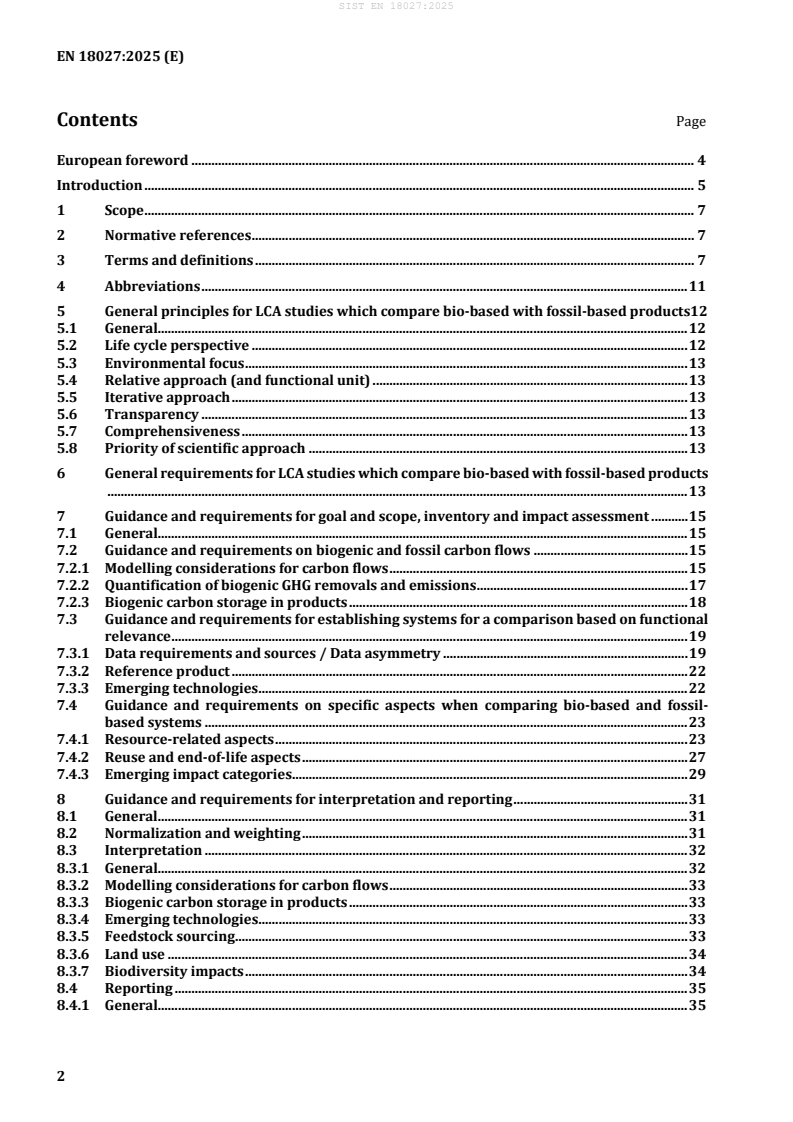
Contents Page
European foreword . 4
Introduction . 5
1 Scope . 7
2 Normative references . 7
3 Terms and definitions . 7
4 Abbreviations . 11
5 General principles for LCA studies which compare bio-based with fossil-based products12
5.1 General. 12
5.2 Life cycle perspective . 12
5.3 Environmental focus . 13
5.4 Relative approach (and functional unit) . 13
5.5 Iterative approach . 13
5.6 Transparency . 13
5.7 Comprehensiveness . 13
5.8 Priority of scientific approach . 13
6 General requirements for LCA studies which compare bio-based with fossil-based products
............................................................................................................................................................................. 13
7 Guidance and requirements for goal and scope, inventory and impact assessment . 15
7.1 General. 15
7.2 Guidance and requirements on biogenic and fossil carbon flows . 15
7.2.1 Modelling considerations for carbon flows . 15
7.2.2 Quantification of biogenic GHG removals and emissions . 17
7.2.3 Biogenic carbon storage in products . 18
7.3 Guidance and requirements for establishing systems for a comparison based on functional
relevance . 19
7.3.1 Data requirements and sources / Data asymmetry . 19
7.3.2 Reference product . 22
7.3.3 Emerging technologies . 22
7.4 Guidance and requirements on specific aspects when comparing bio-based and fossil-
based systems . 23
7.4.1 Resource-related aspects . 23
7.4.2 Reuse and end-of-life aspects . 27
7.4.3 Emerging impact categories. 29
8 Guidance and requirements for interpretation and reporting . 31
8.1 General. 31
8.2 Normalization and weighting . 31
8.3 Interpretation . 32
8.3.1 General. 32
8.3.2 Modelling considerations for carbon flows . 33
8.3.3 Biogenic carbon storage in products . 33
8.3.4 Emerging technologies . 33
8.3.5 Feedstock sourcing . 33
8.3.6 Land use . 34
8.3.7 Biodiversity impacts . 34
8.4 Reporting . 35
8.4.1 General. 35
8.4.2 Additional requirements and guidance for third-party reports . 35
8.4.3 Quantification of removals and emissions of biogenic and fossil carbon . 35
8.4.4 Biogenic carbon storage in products . 35
8.4.5 Data requirements and sources . 35
8.4.6 Biodiversity impacts . 35
8.5 Critical review . 36
Annex A (informative) Examples related to different aspects . 37
Annex B (informative) Overview of key aspects of approaches for biogenic carbon accounting
adopted in relevant standards and guidelines . 50
Annex C (informative) Models for land use . 60
Bibliography . 61
European foreword
This document (EN 18027:2025) has been prepared by Technical Committee CEN/TC 411 “Bio-based
products”, the secretariat of which is held by SIS.
This European Standard shall be given the status of a national standard, either by publication of an
identical text or by endorsement, at the latest by October 2025, and conflicting national standards shall
be withdrawn at the latest by October 2025.
Attention is drawn to the possibility that some of the elements of this document may be the subject of
patent rights. CEN shall not be held responsible for identifying any or all such patent rights.
This document is complementary to EN 16760:2015 Bio-based products – Life cycle assessment.
Any feedback and questions on this document should be directed to the users’ national standards body.
A complete listing of these bodies can be found on the CEN website.
According to the CEN-CENELEC Internal Regulations, the national standards organisations of the
following countries are bound to implement this European Standard: Austria, Belgium, Bulgaria, Croatia,
Cyprus, Czech Republic, Denmark, Estonia, Finland, France, Germany, Greece, Hungary, Iceland, Ireland,
Italy, Latvia, Lithuania, Luxembourg, Malta, Netherlands, Norway, Poland, Portugal, Republic of North
Macedonia, Romania, Serbia, Slovakia, Slovenia, Spain, Sweden, Switzerland, Türkiye and the United
Kingdom.
Introduction
Bio-based products from forestry and agriculture have a long history of application, such as paper, board
and various chemicals and materials. The last decades have seen the emergence of new bio-based
products in the market. Some of the reasons for the increased interest lie in the benefits of bio-based
products in relation to the depletion of fossil resources and climate change. Bio-based products can also
provide additional product functionalities. These developments have triggered a wave of innovation with
the development of knowledge and technologies allowing new transformation processes and product
development.
Acknowledging the need for common standards for bio-based products, the European Commission issued
mandate M/492 , resulting in a series of standards developed by CEN/TC 411 during 2012-2017, with a
focus on bio-based products other than food, feed and biomass for energy applications. This document
was developed after the expiration of the mandate, upon the initiative of CEN/TC 411/WG 4.
The standards of CEN/TC 411 “Bio-based products” provide a common basis on the following aspects:
— common terminology;
— bio-based content determination;
— life cycle assessment (LCA);
— sustainability aspects; and
— declaration tools.
It is important to understand what the term bio-based product covers and how it is being used. The term
‘bio-based’ means 'derived from biomass'. Bio-based products (bottles, insulation materials, wood and
wood products, paper, solvents, chemical intermediates, composite materials, etc.) are products which
are wholly or partly derived from biomass. It is essential to characterize the amount of biomass contained
in the product by, for instance, its bio-based content or bio-based carbon content.
The bio-based content of a product does not provide information on its environmental impact or
sustainability, which can be assessed through LCA and sustainability criteria. In addition, transparent and
unambiguous communication within bio-based value chains is facilitated by a harmonized framework for
certification and declaration.
This document has been developed with the aim to set a framework for fair comparisons between fossil-
based and bio-based product systems through LCA. Today, some comparisons have been made in a way
which (consciously or unconsciously) disadvantages the bio-based product systems related to a number
of aspects. Often, this is due to an incorrect application of LCA, and not being in full conformance with the
international LCA standard EN ISO 14044. In this document some of these issues are addressed when
setting the framework for how a correct study is to be performed.
The general methodology to perform LCAs of products is described in the standard mentioned above as
well as in EN ISO 14040, EN ISO 14067 and, more specific for bio-based products, in EN 16760 and
EN ISO 22526-1 to EN ISO 22526-3 and ISO 22526-4. However, significant problems often arise when it
comes to making well-balanced comparative LCAs between bio-based and fossil-based product systems.
This document provides additional requirements and guidelines to enable practitioners to perform
comparative LCA studies involving bio-based products with equivalent fossil-based products and to
disclose the results. Fossil resource use increases the total amount of carbon in the biosphere while bio-
A mandate is a standardization task embedded in European trade laws. Mandate M/492 was addressed to the
European Standardization bodies, CEN, CENELEC and ETSI, for the development of horizontal European Standards
for bio-based products.
based systems can operate in a renewable way within this system (where harvesting and growth rates
are in balance). When biomass grows, the plant captures carbon dioxide (CO ) from air or water. This CO
2 2
can either be stored as products or in soil, or released when the biomass decays or burns (at the end of
life).
This document sets requirements for comparisons between fossil-based and bio-based product systems.
There can in some cases be many other options (which can be better than both the fossil-based and bio-
based option), but this is outside of the scope of this document.
1 Scope
This document provides requirements and guidelines for comparing the life cycles of bio-based products
with their fossil-based equivalents.
NOTE The term “equivalents” generally refers to the “functional equivalence”.
This document builds on existing LCA methodology and provides requirements and guidance on specific
topics relevant for making well-balanced comparisons.
2 Normative references
The following documents are referred to in the text in such a way that some or all of their content
constitutes requirements of this document. For dated references, only the edition cited applies. For
undated references, the latest edition of the referenced document (including any amendments) applies.
EN ISO 14025:2010, Environmental labels and declarations — Type III environmental declarations —
Principles and procedures (ISO 14025:2006)
EN ISO 14040:2006, Environmental management — Life cycle assessment — Principles and framework
(ISO 14040:2006)
Environmental management — Life cycle assessment — Requirements and guidelines
EN ISO 14044:2006,
(ISO 14044:2006)
EN ISO 14067:2018, Greenhouse gases — Carbon footprint of products — Requirements and guidelines for
quantification (ISO 14067:2018)
EN 16575:2014, Bio-based products — Vocabulary
EN 16760:2015, Bio-based products — Life Cycle Assessment
3 Terms and definitions
For the purposes of this document, the terms and definitions given in EN ISO 14040:2006,
EN ISO 14044:2006, EN 16575:2014 and the following apply.
ISO and IEC maintain terminology databases for use in standardization at the following addresses:
— ISO Online browsing platform: available at https://www.iso.org/obp/
— IEC Electropedia: available at https://www.electropedia.org/
3.1
carbon footprint of a product
CFP
sum of GHG emissions (3.5) and GHG removals (3.6) in a product system, expressed as CO equivalents and
based on a life cycle assessment using the single impact category of climate change
Note 1 to entry: A CFP can be disaggregated into a set of figures identifying specific GHG emissions and removals.
A CFP can also be disaggregated into the stages of the life cycle.
[SOURCE: EN ISO 14067:2018, 3.1.1.1]
As impacted by EN ISO 14040:2006/A1:2020.
As impacted by EN ISO 14044:2006/A1:2018 and EN ISO 14044:2006/A2:2020.
3.2
carbon dioxide equivalent
CO equivalent
CO e
unit for comparing the radiative forcing of a GHG (3.3) to that of carbon dioxide
Note 1 to entry: Mass of a GHG is converted into CO2 equivalents by multiplying the mass of the GHG by the
corresponding GWP (34) or GTP of that gas.
Note 2 to entry: In the case of GTP, CO equivalent is the unit for comparing the change in global mean surface
temperature caused by a GHG to the temperature change caused by CO2.
[SOURCE: EN ISO 14067:2018, 3.1.2.2]
3.3
greenhouse gas
GHG
gaseous constituent of the atmosphere, both natural and anthropogenic, that absorbs and emits radiation
at specific wavelengths within the spectrum of infrared radiation emitted by the Earth’s surface, the
atmosphere and clouds
Note 1 to entry: For a list of GHGs, see the latest IPCC Assessment Report.
[SOURCE: EN ISO 14067:2018, 3.1.2.1]
3.4
global warming potential
GWP
index, based on radiative properties of GHGs (3.3), measuring the radiative forcing following a pulse
emission of a unit mass of a given GHG in the present-day atmosphere integrated over a chosen time
horizon, relative to that of carbon dioxide (CO )
Note 1 to entry: “Index” as used in this document is a “characterization factor” as defined in ISO 14040:2006, 3.37.
Note 2 to entry: A “pulse emission” is an emission at one point in time.
[SOURCE: EN ISO 14067:2018, 3.1.2.4]
3.5
greenhouse gas emission
GHG emission
release of a GHG (3.3) into the atmosphere
[SOURCE: EN ISO 14067:2018, 3.1.2.5]
3.6
greenhouse gas removal
GHG removal
withdrawal of a GHG (3.3) from the atmosphere
[SOURCE: EN ISO 14067:2018, 3.1.2.6]
3.7
greenhouse gas emission factor
GHG emission factor
coefficient relating activity data with the GHG emission (3.5)
[SOURCE: EN ISO 14067:2018, 3.1.2.7]
3.8
organization
person or group of people that has its own functions with responsibilities, authorities and relationships
to achieve its objectives
Note 1 to entry: The concept of organization includes, but is not limited to, sole-trader, company, corporation, firm,
enterprise, authority, partnership, charity or institution, or part or combination thereof, whether incorporated or
not, public or private.
[SOURCE: EN ISO 14067:2018, 3.1.5.1]
3.9
supply chain
those involved, through upstream and downstream linkages, in processes and activities relating to the
provision of products to the user
Note 1 to entry: In practice, the expression “interlinked chain” applies from suppliers to those involved in end-of-
life processing, which may include vendors, manufacturing facilities, logistics providers, internal distribution
centres, distributors, wholesalers and other entities that lead to the end user.
[SOURCE: EN ISO 14067:2018, 3.1.5.2]
3.10
primary data
quantified value of a process or an activity obtained from a direct measurement or a calculation based on
direct measurements
Note 1 to entry: Primary data need not necessarily originate from the product system under study because primary
data might relate to a different but comparable product system to that being studied.
Note 2 to entry: Primary data can include GHG emission factors (3.7) and/or GHG activity data (defined in
ISO 14064-1:2006, 2.11).
[SOURCE: EN ISO 14067:2018, 3.1.6.1]
3.11
site-specific data
primary data (3.10) obtained within the product system
Note 1 to entry: All site-specific data are primary data but not all primary data are site-specific data because they
may be obtained from a different product system.
Note 2 to entry: Site-specific data include GHG emissions (3.5) from GHG sources as well as GHG removals (3.6) by
GHG sinks for one specific unit process within a site.
[SOURCE: EN ISO 14067:2018, 3.1.6.2]
3.12
secondary data
data which do not fulfil the requirements for primary data (3.10)
Note 1 to entry: Secondary data can include data from databases and published literature, default emission factors
from national inventories, calculated data, estimates or other representative data, validated by competent
authorities.
Note 2 to entry: Secondary data can include data obtained from proxy processes or estimates.
[SOURCE: EN ISO 14067:2018, 3.1.6.3]
3.13
uncertainty
parameter associated with the result of quantification that characterizes the dispersion of the values that
could be reasonably attributed to the quantified amount
Note 1 to entry: Uncertainty can include, for example:
— parameter uncertainty, e.g. GHG emission factors (3.7), activity data;
— scenario uncertainty, e.g. use stage scenario, end-of-life stage scenario;
— model uncertainty.
Note 2 to entry: Uncertainty information typically specifies quantitative estimates of the likely dispersion of values
and a qualitative description of the likely causes of the dispersion.
[SOURCE: EN ISO 14067:2018, 3.1.6.4]
3.14
fossil carbon
carbon that is contained in fossilized material
Note 1 to entry: Examples of fossilized material are coal, oil and natural gas and peat.
[SOURCE: EN ISO 14067:2018, 3.1.7.3]
3.15
land use
LU
human use or management of land within the relevant boundary
Note 1 to entry: In this document, the relevant boundary is the boundary of the system under study.
Note 2 to entry: Land use is often referred to as “land occupation” in life cycle assessment (LCA).
[SOURCE: EN ISO 14067:2018, 3.1.7.4]
3.16
direct land use change
dLUC
change in the human use of land within the relevant boundary
Note 1 to entry: In this document, the relevant boundary is the boundary of the system under study.
Note 2 to entry: Land use change happens when there is a change in the land-use category as defined by the IPCC
(e.g. from forest land to cropland).
[SOURCE: EN ISO 14067:2018, 3.1.7.5]
3.17
indirect land use change
iLUC
change in the use of land which is a consequence of direct land use change (3.16), but which occurs outside
the relevant boundary
Note 1 to entry: In this document, the relevant boundary is the boundary of the system under study.
Note 2 to entry: Land use change happens when there is a change in the “land-use category” as defined by the IPCC
(e.g. from forest land to cropland).
EXAMPLE If land use on a particular parcel of land changes from food production to biofuel production, land
use change might occur elsewhere to meet the demand for food. This land use change elsewhere is indirect land use
change.
[SOURCE: EN ISO 14067:2018, 3.1.7.6]
4 Abbreviations
BPP Biotic production potential
C Carbon
CF Characterization factor
CFP Carbon footprint of products
CH Methane
CO Carbon monoxide
CO Carbon dioxide
CO e Carbon dioxide equivalents
dLUC Direct land use change
EOL End-of-life
EPD Environmental product declaration
EU European Union
GHG Greenhouse gas
GWP Global warming potential
HANPP Human appropriation of net primary production
iLUC Indirect land use change
IPCC The Intergovernmental Panel on Climate Change (IPCC) is the United Nations body
for assessing the science related to climate change
LCA Life cycle assessment
LCI Life cycle inventory
LCIA Life cycle impact assessment
LU Land use
LUC Land use change
LULUC Land use and land use change
m Square meter
m × a Square meter times year
m a Square meter per annum (i.e. year)
MP Microplastics
MPEP Microplastic emission potential
N O Nitrous oxide
NPP Net primary production
PCR Product category rules
PDF Potentially disappeared fraction (of species)
PE Polyethylene
PEF Product environmental footprint
PEFCR Product environmental footprint category rules
PET Polyethylene terephthalate
PLA Polylactide, polylactic acid
PP Polypropylene
PS Polystyrene
RMPEP Relative index MPEP
SOC Soil organic carbon
SOC Soil organic carbon at time zero
SOC Soil organic carbon at time zero minus T
(0-T)
SOM Soil organic matter
US United States
WWTP Wastewater treatment plant
5 General principles for LCA studies which compare bio-based with fossil-based
products
5.1 General
The principles from EN ISO 14040:2006, 4.1 apply for this document. They are followed in both planning,
conducting, and reviewing an LCA study. These principles are further elaborated in 5.2-5.8 below to cover
the comparison of bio-based products with their fossil-based equivalents.
5.2 Life cycle perspective
There are many possible differences between the product systems of bio-based products and their fossil-
based equivalents, the most prominent being in the supply chain and at end-of life. Therefore,
comparisons are only possible using a life-cycle perspective.
Due to different supply chains (e.g. agriculture and forestry vs. mining and extraction), data availability,
quality and appropriateness can deviate considerably between the systems under study.
Also, end-of-life for products can differ considerably due to the specific properties (such as recyclability)
and the availability of different treatment options.
Bio-based and fossil-based carbon flows are treated consistently in comparative studies that handle both
flows, or in comparisons of studies that handle one or the other of the two flows, taking into account the
different attributes between these flows.
5.3 Environmental focus
LCA focuses on addressing environmental aspects and impacts for distinctively different product systems
related to the safeguards natural resources, human health, and ecosystems. Due to the different nature of
the supply chains also different economic and social impacts can be observed, see 7.4.1.1. These impacts
are typically out of scope but can be addressed in broader assessments.
5.4 Relative approach (and functional unit)
Functional equivalence is crucial for meaningful comparisons and corresponding interpretations. An
absolute functional equivalence can be demonstrated for products during their use phase.
5.5 Iterative approach
Iterations between LCA phases help to support proper interpretation when making comparisons.
5.6 Transparency
Transparency is a key principle for LCA studies comparing bio-based and fossil-based product systems,
as for all LCA studies. In particular, this is relevant where conventions (e.g. carbon modelling) and value
choices are applied. Transparency along all four phases of an LCA study (goal and scope, inventory,
impact assessment and interpretation) helps to ensure proper interpretation (8.3) and appropriate
reporting (8.4), including the enabling of a critical review (8.5).
5.7 Comprehensiveness
The consideration of all aspects of the natural environment, human health, and resources in LCA avoids
burden shifting and identifies trade-offs.
For bio-based and fossil-based product systems this includes impacts of both systems, understanding the
different impact pathways in an overall perspective.
Impacts can be driven by emissions (e.g. contribution to global warming or eutrophication) which are
harmful for the natural environment or can be related to other inventory data like resource depletion,
land occupation or land transformation (7.4.1.2).
5.8 Priority of scientific approach
Decisions for comparing bio-based with fossil-based product systems are preferably based on natural
science, in particular for modelling decisions related to carbon flows, carbon content, carbon storage and
emissions and removals. If conventions or value choices are used to determine the difference between
two product systems, they are transparently documented and investigated during interpretation.
6 General requirements for LCA studies which compare bio-based with fossil-
based products
When performing LCA according to this document, the requirements in EN ISO 14040, EN ISO 14044,
EN ISO 14067 and EN 16760 shall be met.
The comparison of bio-based and fossil-based products relates to many challenges as there are inherent
differences between the systems and a balanced modelling is difficult to achieve. To support a meaningful
interpretation and appropriate reporting, data collection and documentation shall be guided by the
principles for LCA in general and the specific aspects of comparing bio-based with fossil-based in
particular, where e.g. the feedstock or raw material (such as oil, wood or crops) sourcing can be the
dominating or discriminating stage of the life cycle.
Due to different supply chains data availability, quality and appropriateness can deviate considerably
between bio-based and fossil-based raw material and the same can be valid for different end-of-life
options. In addition, temporal boundaries can deviate.
This asymmetry between the systems shall be considered through a careful set up of any LCA study that
intends to compare the product systems and shall be considered also when comparing the outcome of
different studies of bio-based and fossil-based systems. Differences can be compared given that the
modelling follows the same principles and assumptions, and the context of each study are equivalent.
LCA offers a variety of techniques to limit bias introduced by such asymmetries and ensure comparability.
Main techniques are:
— sensitivity analysis for any modelling assumption based on value choices or conventions; and
— statistical procedures to explore the relevance of data gaps.
Given that asymmetries cannot be avoided, the transparent documentation of limitations related to goal
and scope of the study and further reporting requirements of value choices, rationales, and expert
judgements, followed up with a comprehensive critical review, are pre-requisites for meaningful
conclusions to be drawn.
EN ISO 14044:2006 sets requirements for comparative studies, which shall be the basis when making
comparisons between bio-based and fossil-based product systems, see text box below.
EN ISO 14044:2006, 4.2.3.7 Comparisons between systems
In a comparative study, the equivalence of the systems being compared shall be evaluated before
interpreting the results. Consequently, the scope of the study shall be defined in such a way that the
systems can be compared. Systems shall be compared using the same functional unit and equivalent
methodological considerations, such as performance, system boundary, data quality, allocation
procedures, decision rules on evaluating inputs, and outputs and impact assessment. Any differences
between systems regarding these parameters shall be identified and reported. If the study is intended
to be used for a comparative assertion intended to be disclosed to the public, interested parties shall
conduct this evaluation as a critical review.
Furthermore, the requirements for comparability set in the bullet list of EN ISO 14025:2010, 6.7.2 shall
be met, see below for the list (adapted to the scope of this document):
a) The products compared have at least one identical function.
b) The goal and scope definition for the LCA of the product, according to ISO 14040, has the following
characteristics:
— the functional unit is identical and expressed in the same measurement system;
— the system boundary is equivalent;
— the description of data is equivalent;
— the criteria for the inclusion of inputs and outputs are identical; and
— the data quality requirements including coverage, precision, completeness, representativeness,
consistency, reproducibility, sources and uncertainty are equivalent.
c) For the inventory analysis:
— the methods of data collection are equivalent;
— the calculation procedures are identical; and
— the allocation of material and energy flows and releases is equivalent.
d) Impact category selection and impact assessment method, if applied, are identical. The relevant
impact categories should be assessed, with any exclusions justified.
NOTE: The selection of impact categories is part of the iterative nature of an LCA,
e) Predetermined parameters for reporting of LCA data (inventory data categories and impact category
indicators) are identical.
f) Requirements for provision of additional environmental information, including any methodological
requirements (e.g. specifications for hazard and risk assessment) are equivalent.
g) Materials and substances to be declared (e.g. information about product content, including
specification of materials and substances that can adversely affect human health and/or the
environment, in all stages of the life cycle) are equivalent.
In order to compare bio-based and fossil-based product systems based on information modules, either
the environmental impacts of omitted life cycle stages of the products shall not be significant, or the data
of omitted life cycle stages shall be identical within the accepted uncertainty of the data. In this context,
determination of significance shall take account EN ISO 14044:2006, 4.2.3.3.3.
7 Guidance and requirements for goal and scope, inventory and impact
assessment
7.1 General
For comparing bio-based with fossil-based product systems all aspects in Clause 7 for both systems shall
be comprehensively addressed. Annex A contains examples and further guidance related to these aspects.
7.2 Guidance and requirements on biogenic and fossil carbon flows
7.2.1 Modelling considerations for carbon flows
7.2.1.1 General
There are different ways to handle carbon containing elementary flows in a life cycle inventory, different
approaches to handle allocation of carbon flows for a process or processes shared by more than one
product system, including those at end-of-life; and different approaches to treatment of fossil and
biogenic carbon flows in life cycle impact assessment.
The main issues arising for fossil and biogenic carbon flows respectively are:
— Different methodological approaches can reveal or obscure that fossil carbon, once extracted from
the ground, can ultimately be released as a CO emission to the atmosphere. If a methodological
approach obscures the CO emission, it shall be described.
— Some methodological approaches do not take into account that biogenic CO has been removed from
the atmosphere nor take into account any benefit where such CO is not subsequently emitted.
— The impact assessment for carbon flows, removal, and emissions, can be seen with two different time
perspectives: long term or short term. With long-term perspective all removals and emissions are
accounted for as occurring now, with short term perspective removals and emissions accounted for
up to a specified time horizon. The choice of time perspective is inherently a value judgment which
will impact the end result.
— The use of only the short-term perspective can obscure the fact that fossil carbon once extracted from
the ground can ultimately be released as a CO emission to the atmosphere. On the other hand, the
use of only the long-term perspective does not allow sufficient differentiation between the CO
emissions from incineration and landfilling since the immediate emissions of incineration and the
future emissions from landfill are treated equally.
NOTE 1 Non-CO emissions are captured using the short-term perspective but the long term CO emissions from
2 2
landfill would not be sufficiently differentiated from the immediate CO emissions from incineration.
The complete picture is only obtained with the use of both perspectives but is not common practice.
Comparative studies should present both time perspectives but as a minimum, in a comparison between
bio-based and fossil materials, the selected approach shall be stated and justified in the goal and scope.
Any interpretation of the results shall be restricted to that specific scope. It shall also be consistently
applied to both product systems.
NOTE 2 Most often 100 years is used as the time horizon for short-term perspective.
NOTE 3 Guidance on how to handle algae grown with fossil CO can be found in A.1.1.
7.2.1.2 Life cycle inventory (LCI)
Greenhouse gas (GHG) emissions and removals arising from fossil carbon sources and biogenic carbon
sources and sinks shall be included and listed separately in the inventory.
The GHG inventory shall cover all carbon flows in such a way that the effect of choices related to stored
or released carbon (biogenic or fossil, respectively) and storage period(s) at the product end-of-life can
be assessed in sensitivity analyses during the interpretation phase (see 8.3). The biogenic and fossil
carbon can also flow into other products by mechanical, chemical, or organic recycling.
Multi-functionality shall be handled, if possible, by subdivision or by system expansion to avoid allocation
(following EN ISO 14044).
Where allocation cannot be avoided it is important to realize that allocation can introduce problems for
the accounting of biogenic carbon flows. Using different approaches for handling of biogenic carbon in
allocation situations can lead to different results and conclusions and the selected approach for that
allocation shall be stated and justified in the goal and scope.
Biogenic and fossil carbon content and flows shall be allocated reflecting the physical flows according to
stoichiometric rules irrespective of the allocation chosen for the process. Alternative allocation
approaches can lead to the modelled biogenic and fossil carbon flows not reflecting the actual physical
content and flows.
NOTE EN 16485:2014 contains examples on how to allocate biogenic carbon.
For cradle to gate studies, biogenic or fossil carbon content in the products shall be reported separately
to allow to calculate carbon emissions in end-of-life.
The ideal comparison should be made for cradle to grave. If relative comparisons (difference expressed
in %) are to be done cradle to gate, then the downstream stages of the product systems should be
modelled, and all assumptions related should be clearly documented and should be adapted for both
product systems.
7.2.1.3 Impact assessment
To carry out life cycle impact assessments, all biogenic and fossil carbon emissions and removals should
be considered. The impacts shall be reported separately, e.g. climate change – biogenic, climate change –
fossil. Two examples can be found in A.1.2.
The short-term perspective, which captures the rate of change, should use GWP100 as the metric and the
long-term perspective, which accounts for the final equilibrium temperature, should use GTP100 as the
metric.
7.2.2 Quantification of biogenic GHG removals and emissions
7.2.2.1 General
There are different ways to deal with biogenic carbon removals and emissions in LCA. Annex B provides
an overview of the different approaches used in LCA standards.
The main issues that can be observed are:
— There is a need for a harmonized and transparent approach on how the biogenic carbon removals
and emissions are to be handled including time perspectives in impact assessment. The inconsistency
in approaches of handling the removals and emissions of biogenic CO , in the life cycle inventory and
when performing impact assessments results in different outcomes and interpretations.
— There are different approaches regarding how to report biogenic carbon removals and emissions in
cradle to gate studies e.g. whether biogenic carbon removals are to be included as a negative emission
when the positive emissions from the end-of-life is not included in the scope.
7.2.2.2 Life cycle inventory
Biogenic carbon is captured as CO from the atmosphere and sequestered during biomas
...