


SIST EN IEC 62056-6-1:2024
(Main)Electricity metering data exchange - The DLMS/COSEM suite - Part 6-1: Object Identification System (OBIS) (IEC 62056-6-1:2023)
Electricity metering data exchange - The DLMS/COSEM suite - Part 6-1: Object Identification System (OBIS) (IEC 62056-6-1:2023)
This part of IEC 62056 specifies the overall structure of the OBject Identification System (OBIS) and the mapping of all commonly used data items in metering equipment to their identification codes.
OBIS provides a unique identifier for all data within the metering equipment, including not only measurement values, but also abstract values used for configuration or obtaining information about the behaviour of the metering equipment. The ID codes defined in this document are used for the identification of:
- logical names of the various instances of the ICs, or objects, as defined in IEC 62056-6-2:2021;
- data transmitted through communication lines;
- data displayed on the metering equipment, see Clause A.2.
This document applies to all types of metering equipment, such as fully integrated meters, modular meters, tariff attachments, data concentrators, etc.
To cover metering equipment measuring energy types other than electricity, combined metering equipment measuring more than one type of energy or metering equipment with several physical measurement channels, the concepts of medium and channels are introduced. This allows meter data originating from different sources to be identified. While this document fully defines the structure of the identification system for other media, the mapping of non-electrical energy related data items to ID codes is completed separately.
NOTE EN 13757-1:2014 defines identifiers for metering equipment other than electricity: heat cost allocators, thermal energy, gas, cold water and hot water.
Datenkommunikation der elektrischen Energiemessung - DLMS/COSEM - Teil 6-1: COSEM Object Identification System (OBIS) (IEC 62056-6-1:2023)
Echange des données de comptage de l'électricité - La suite DLMS/COSEM - Partie 6-1: Système d'identification des objets (OBIS) (IEC 62056-6-1:2023)
IEC 62056-6-1:2023 est disponible sous forme de IEC 62056-6-1:2023 RLV qui contient la Norme internationale et sa version Redline, illustrant les modifications du contenu technique depuis l'édition précédente.
L'IEC 62056-6-1:2023 spécifie la structure globale du système d’identification des objets (OBIS) et la correspondance entre tous les éléments de données couramment utilisés dans les équipements de comptage et leurs codes d’identification. Le système OBIS fournit un identifiant unique pour toutes les données des équipements de comptage, incluant non seulement les valeurs de mesure, mais aussi les valeurs abstraites utilisées pour la configuration ou pour obtenir des informations sur le comportement des équipements de comptage. Les codes d’identification définis dans le présent document sont utilisés pour identifier:
- les noms logiques des différentes instances des classes d’interfaces ou des objets, tels que définis dans l’IEC 62056‑6‑2:2023;
- les données transmises par des lignes de communication;
- les données affichées sur l’équipement de comptage (voir l'Article A.2 de l’Annexe A).
Le présent document s’applique à tous les types d’équipements de comptage, tels que les compteurs entièrement intégrés, les compteurs modulaires, les appareils tarifaires associés aux compteurs, les concentrateurs de données, etc.
Les concepts de support et de canaux sont introduits afin de couvrir les équipements de comptage mesurant d’autres types d’énergie que l’électricité, ainsi que les équipements de comptage combinés mesurant plusieurs types d’énergie ou les équipements de comptage avec plusieurs canaux de mesure physiques. Ceci permet d’identifier les données de comptage provenant de différentes sources. Bien que le présent document définisse entièrement la structure du système d’identification pour d’autres supports, la mise en correspondance d’éléments de données associés à une énergie non électrique avec des codes d’identification est effectuée séparément. Cette quatrième édition annule et remplace la troisième édition de l’IEC 62056-6-1 parue en 2017. Cette édition constitue une révision technique. Les modifications techniques majeures par rapport à l’édition précédente sont énumérées dans l’Annexe B (informative).
Izmenjevanje podatkov za odbiranje stanja števcev - Sestav DLMS/COSEM - 6-1. del: Sistem za prepoznavanje objektov (OBIS) (IEC 62056-6-1:2023)
Ta del standarda IEC 62056 določa splošno strukturo sistema za prepoznavanje objektov (OBIS) in preslikave vseh pogosto uporabljanih podatkovnih elementov v opremi za merjenje v njihove identifikacijske oznake.
Sistem za prepoznavanje objektov zagotavlja enolično oznako za vse podatke v opremi za merjenje, vključno z vrednostmi meritev in abstraktnimi vrednostmi, ki se uporabljajo za konfiguracijo ali pridobivanje informacij o delovanju opreme za merjenje. Oznake ID, opredeljene v tem dokumentu, se uporabljajo za prepoznavanje:
• logičnih imen različnih primerkov integriranih vezij ali objektov, kot je opredeljeno v standardu IEC 62056‑6‑2:2023;
• podatkov, prenesenih prek komunikacijskih vodov;
• podatkov, prikazanih prek opreme za merjenje (glej točko A.2 v dodatku A).
Ta dokument se uporablja za vse vrste opreme za merjenje, kot so vgrajeni števci,
modularni števci, tarifni priključki, podatkovni koncentratorji itd.
Za potrebe opreme za merjenje energije, ki ni električna energija, kombinirane opreme za merjenje več kot ene vrste energije ali opreme za merjenje z več fizičnimi merilnimi kanali sta uvedena koncepta medija in kanalov. To omogoča prepoznavanje merilnih podatkov z različnih virov. Čeprav ta dokument v celoti opredeljuje strukturo sistema prepoznavanja za druge medije, se preslikava podatkovnih elementov, povezanih z energijo druge vrste, v oznake ID izvede ločeno.
OPOMBA: Standard EN 13757-1:2014 opredeljuje oznake za opremo za merjenje energije, ki ni električna energija: delilniki stroškov, toplotna energija, plin, hladna in vroča voda.
General Information
- Status
- Published
- Publication Date
- 25-Jan-2024
- Technical Committee
- MEE - Equipment for electrical energy measurement and load control
- Current Stage
- 6060 - National Implementation/Publication (Adopted Project)
- Start Date
- 25-Jan-2024
- Due Date
- 31-Mar-2024
- Completion Date
- 26-Jan-2024
Relations
- Effective Date
- 26-Jul-2021
Overview
EN IEC 62056-6-1:2024 (IEC 62056-6-1:2023) defines the OBject Identification System (OBIS) used in the DLMS®/COSEM suite for electricity metering data exchange. The standard specifies the overall structure of OBIS codes and maps commonly used metering data items - including measurement values and abstract/configuration values - to unique identification codes. OBIS identifiers are used for: logical names of COSEM interface class instances, data transmitted over communications links, and values displayed on metering equipment. The standard applies to all metering equipment types (integrated meters, modular meters, tariff attachments, data concentrators, etc.) and introduces concepts of medium and channels to support multi-energy and multi-channel meters.
Key topics and technical requirements
- OBIS code structure: Defines the six value groups (A–F) that make up OBIS identifiers and rules for code presentation and reduced-ID formats (see Annex A).
- Value group semantics: Value group A identifies the medium (e.g., electricity A=1, other media A=15, abstract A=0). Other groups (B–F) specify data type, processing, measurement channels, billing periods, harmonics, tariffs, etc.
- Mapping of data items: Provides standardized mappings for commonly used electrical quantities (active/reactive energy, voltages, currents, harmonics, phase angles, losses) and abstract objects (registers, data profiles, lists).
- Manufacturer/utility/consortia/country ranges: Specifies reserved ranges and rules for vendor-specific and local extensions while maintaining interoperability.
- Handling of multi-energy / multi-channel meters: Introduces channels and media to uniquely identify data originating from different sources.
- Normative references and conformance: Works with other DLMS/COSEM parts (notably IEC 62056-6-2 for COSEM interface classes) and references IEC 62056-21 and IEC/TR 62051 for related definitions.
Applications and who uses it
- Meter manufacturers: Implement OBIS codes in firmware to ensure consistent identification of measured and configuration data.
- Utilities & energy suppliers: Use OBIS for meter reading, tariff management, and integration into AMI/MDM systems.
- System integrators & software vendors: Map meter datasets to backend systems, ensure correct interpretation of multi-channel and multi-energy meters.
- Test laboratories & certification bodies: Validate OBIS compliance and interoperability between devices and systems.
- Regulators & standards bodies: Reference OBIS mappings in procurement and compliance frameworks.
Practical benefits include improved interoperability across vendors, consistent data exchange in AMI deployments, and clearer support for combined and non-electrical metering.
Related standards
- IEC 62056-6-2 (COSEM interface classes)
- IEC 62056-21 (Direct local data exchange)
- IEC/TR 62051 (Metering glossary)
- EN IEC 62056-6-1:2024 supersedes EN 62056-6-1:2017 and is endorsed by CENELEC for national adoption.


Frequently Asked Questions
SIST EN IEC 62056-6-1:2024 is a standard published by the Slovenian Institute for Standardization (SIST). Its full title is "Electricity metering data exchange - The DLMS/COSEM suite - Part 6-1: Object Identification System (OBIS) (IEC 62056-6-1:2023)". This standard covers: This part of IEC 62056 specifies the overall structure of the OBject Identification System (OBIS) and the mapping of all commonly used data items in metering equipment to their identification codes. OBIS provides a unique identifier for all data within the metering equipment, including not only measurement values, but also abstract values used for configuration or obtaining information about the behaviour of the metering equipment. The ID codes defined in this document are used for the identification of: - logical names of the various instances of the ICs, or objects, as defined in IEC 62056-6-2:2021; - data transmitted through communication lines; - data displayed on the metering equipment, see Clause A.2. This document applies to all types of metering equipment, such as fully integrated meters, modular meters, tariff attachments, data concentrators, etc. To cover metering equipment measuring energy types other than electricity, combined metering equipment measuring more than one type of energy or metering equipment with several physical measurement channels, the concepts of medium and channels are introduced. This allows meter data originating from different sources to be identified. While this document fully defines the structure of the identification system for other media, the mapping of non-electrical energy related data items to ID codes is completed separately. NOTE EN 13757-1:2014 defines identifiers for metering equipment other than electricity: heat cost allocators, thermal energy, gas, cold water and hot water.
This part of IEC 62056 specifies the overall structure of the OBject Identification System (OBIS) and the mapping of all commonly used data items in metering equipment to their identification codes. OBIS provides a unique identifier for all data within the metering equipment, including not only measurement values, but also abstract values used for configuration or obtaining information about the behaviour of the metering equipment. The ID codes defined in this document are used for the identification of: - logical names of the various instances of the ICs, or objects, as defined in IEC 62056-6-2:2021; - data transmitted through communication lines; - data displayed on the metering equipment, see Clause A.2. This document applies to all types of metering equipment, such as fully integrated meters, modular meters, tariff attachments, data concentrators, etc. To cover metering equipment measuring energy types other than electricity, combined metering equipment measuring more than one type of energy or metering equipment with several physical measurement channels, the concepts of medium and channels are introduced. This allows meter data originating from different sources to be identified. While this document fully defines the structure of the identification system for other media, the mapping of non-electrical energy related data items to ID codes is completed separately. NOTE EN 13757-1:2014 defines identifiers for metering equipment other than electricity: heat cost allocators, thermal energy, gas, cold water and hot water.
SIST EN IEC 62056-6-1:2024 is classified under the following ICS (International Classification for Standards) categories: 17.220 - Electricity. Magnetism. Electrical and magnetic measurements; 17.220.20 - Measurement of electrical and magnetic quantities; 35.110 - Networking; 91.140.50 - Electricity supply systems. The ICS classification helps identify the subject area and facilitates finding related standards.
SIST EN IEC 62056-6-1:2024 has the following relationships with other standards: It is inter standard links to SIST EN 62056-6-1:2018. Understanding these relationships helps ensure you are using the most current and applicable version of the standard.
SIST EN IEC 62056-6-1:2024 is associated with the following European legislation: Standardization Mandates: M/441, M/490. When a standard is cited in the Official Journal of the European Union, products manufactured in conformity with it benefit from a presumption of conformity with the essential requirements of the corresponding EU directive or regulation.
SIST EN IEC 62056-6-1:2024 is available in PDF format for immediate download after purchase. The document can be added to your cart and obtained through the secure checkout process. Digital delivery ensures instant access to the complete standard document.
Standards Content (Sample)
SLOVENSKI STANDARD
01-marec-2024
Izmenjevanje podatkov za odbiranje stanja števcev - Sestav DLMS/COSEM - 6-1.
del: Sistem za prepoznavanje objektov (OBIS) (IEC 62056-6-1:2023)
Electricity metering data exchange - The DLMS/COSEM suite - Part 6-1: Object
Identification System (OBIS) (IEC 62056-6-1:2023)
Datenkommunikation der elektrischen Energiemessung - DLMS/COSEM - Teil 6-1:
COSEM Object Identification System (OBIS) (IEC 62056-6-1:2023)
Echange des données de comptage de l'électricité - La suite DLMS/COSEM - Partie 6-1:
Système d'identification des objets (OBIS) (IEC 62056-6-1:2023)
Ta slovenski standard je istoveten z: EN IEC 62056-6-1:2024
ICS:
17.220 Elektrika. Magnetizem. Electricity. Magnetism.
Električne in magnetne Electrical and magnetic
meritve measurements
35.110 Omreževanje Networking
91.140.50 Sistemi za oskrbo z elektriko Electricity supply systems
2003-01.Slovenski inštitut za standardizacijo. Razmnoževanje celote ali delov tega standarda ni dovoljeno.
EUROPEAN STANDARD EN IEC 62056-6-1
NORME EUROPÉENNE
EUROPÄISCHE NORM January 2024
ICS 17.220; 35.110; 91.140.50 Supersedes EN 62056-6-1:2017
English Version
Electricity metering data exchange -
The DLMS®/COSEM suite -
Part 6-1: Object Identification System (OBIS)
(IEC 62056-6-1:2023)
Echange des données de comptage de l'électricité - Datenkommunikation der elektrischen Energiemessung -
La suite DLMS®/COSEM - DLMS®/COSEM -
Partie 6-1: Système d'identification des objets (OBIS) Teil 6-1: COSEM Object Identification System (OBIS)
(IEC 62056-6-1:2023) (IEC 62056-6-1:2023)
This European Standard was approved by CENELEC on 2024-01-15. CENELEC members are bound to comply with the CEN/CENELEC
Internal Regulations which stipulate the conditions for giving this European Standard the status of a national standard without any alteration.
Up-to-date lists and bibliographical references concerning such national standards may be obtained on application to the CEN-CENELEC
Management Centre or to any CENELEC member.
This European Standard exists in three official versions (English, French, German). A version in any other language made by translation
under the responsibility of a CENELEC member into its own language and notified to the CEN-CENELEC Management Centre has the
same status as the official versions.
CENELEC members are the national electrotechnical committees of Austria, Belgium, Bulgaria, Croatia, Cyprus, the Czech Republic,
Denmark, Estonia, Finland, France, Germany, Greece, Hungary, Iceland, Ireland, Italy, Latvia, Lithuania, Luxembourg, Malta, the
Netherlands, Norway, Poland, Portugal, Republic of North Macedonia, Romania, Serbia, Slovakia, Slovenia, Spain, Sweden, Switzerland,
Türkiye and the United Kingdom.
European Committee for Electrotechnical Standardization
Comité Européen de Normalisation Electrotechnique
Europäisches Komitee für Elektrotechnische Normung
CEN-CENELEC Management Centre: Rue de la Science 23, B-1040 Brussels
© 2024 CENELEC All rights of exploitation in any form and by any means reserved worldwide for CENELEC Members.
Ref. No. EN IEC 62056-6-1:2024 E
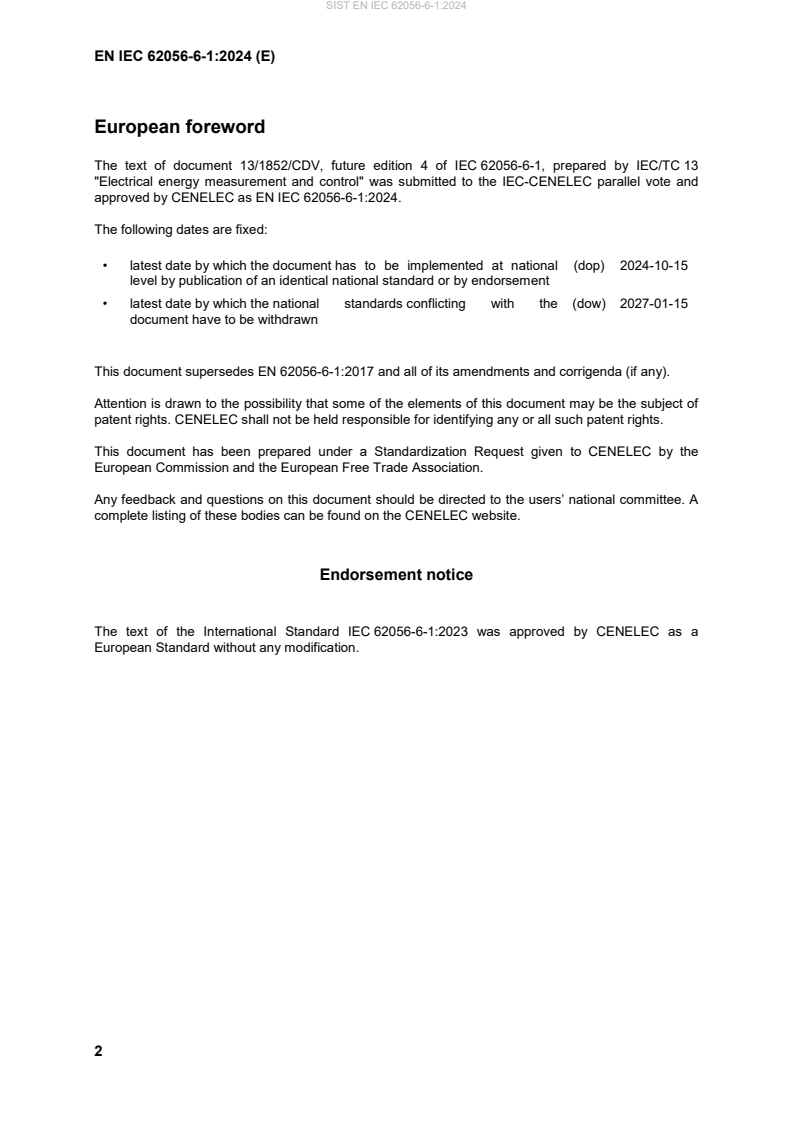
European foreword
The text of document 13/1852/CDV, future edition 4 of IEC 62056-6-1, prepared by IEC/TC 13
"Electrical energy measurement and control" was submitted to the IEC-CENELEC parallel vote and
approved by CENELEC as EN IEC 62056-6-1:2024.
The following dates are fixed:
• latest date by which the document has to be implemented at national (dop) 2024-10-15
level by publication of an identical national standard or by endorsement
• latest date by which the national standards conflicting with the (dow) 2027-01-15
document have to be withdrawn
This document supersedes EN 62056-6-1:2017 and all of its amendments and corrigenda (if any).
Attention is drawn to the possibility that some of the elements of this document may be the subject of
patent rights. CENELEC shall not be held responsible for identifying any or all such patent rights.
This document has been prepared under a Standardization Request given to CENELEC by the
European Commission and the European Free Trade Association.
Any feedback and questions on this document should be directed to the users’ national committee. A
complete listing of these bodies can be found on the CENELEC website.
Endorsement notice
The text of the International Standard IEC 62056-6-1:2023 was approved by CENELEC as a
European Standard without any modification.
Annex ZA
(normative)
Normative references to international publications
with their corresponding European publications
The following documents are referred to in the text in such a way that some or all of their content
constitutes requirements of this document. For dated references, only the edition cited applies. For
undated references, the latest edition of the referenced document (including any amendments)
applies.
NOTE 1 Where an International Publication has been modified by common modifications, indicated by (mod), the
relevant EN/HD applies.
NOTE 2 Up-to-date information on the latest versions of the European Standards listed in this annex is available
here: www.cencenelec.eu.
Publication Year Title EN/HD Year
IEC 62056-6-2 2023 Electricity metering data exchange - The EN IEC 62056-6-2 2023
DLMS®/COSEM suite - Part 6-2: COSEM
interface classes
IEC 62056-21 2002 Electricity metering - Data exchange for EN 62056-21 2002
meter reading, tariff and load control - Part
21: Direct local data exchange
IEC/TR 62051 1999 Electricity metering - Glossary of terms - -
IEC/TR 62051-1 2004 Electricity metering - Data exchange for - -
meter reading, tariff and load control -
Glossary of terms - Part 1: Terms related
to data exchange with metering equipment
using DLMS®/COSEM
IEC 62056-6-1 ®
Edition 4.0 2023-12
INTERNATIONAL
STANDARD
NORME
INTERNATIONALE
Electricity metering data exchange – The DLMS®/COSEM suite –
Part 6-1: Object Identification System (OBIS)
Echange des données de comptage de l'électricité – La suite DLMS®/COSEM –
Partie 6-1: Système d'identification des objets (OBIS)
INTERNATIONAL
ELECTROTECHNICAL
COMMISSION
COMMISSION
ELECTROTECHNIQUE
INTERNATIONALE
ICS 17.220, 35.110, 91.140.50 ISBN 978-2-8322-7872-7
– 2 – IEC 62056-6-1:2023 © IEC 2023
CONTENTS
FOREWORD . 5
INTRODUCTION . 7
1 Scope . 8
2 Normative references . 8
3 Terms, definitions and abbreviated terms . 9
3.1 Terms and definitions . 9
3.2 Abbreviated terms . 9
4 OBIS code structure . 9
4.1 Value groups and their use . 9
4.2 Manufacturer specific codes . 10
4.3 Reserved ranges . 10
4.4 Summary of rules for manufacturer, utility, consortia and country specific
codes . 10
4.5 Standard object codes . 11
5 Value group definitions – overview . 11
5.1 Value group A . 11
5.2 Value group B . 12
5.3 Value group C . 12
5.3.1 General . 12
5.3.2 Abstract objects . 13
5.4 Value group D . 13
5.4.1 General . 13
5.4.2 Consortia specific identifiers . 13
5.4.3 Country specific identifiers . 14
5.4.4 Identification of general and service entry objects . 15
5.5 Value group E . 15
5.6 Value group F . 15
5.6.1 General . 15
5.6.2 Identification of billing periods . 15
6 Abstract objects (Value group A = 0) . 16
6.1 General and service entry objects – Abstract . 16
6.2 Error registers, alarm registers / filters / descriptor objects – Abstract . 21
6.3 List objects – Abstract . 21
6.4 Register table objects – Abstract . 21
6.5 Data profile objects – Abstract . 21
7 Electricity (Value group A = 1) . 22
7.1 Value group C codes – Electricity . 22
7.2 Value group D codes – Electricity . 24
7.2.1 Processing of measurement values . 24
7.2.2 Use of value group D for identification of other objects . 27
7.3 Value group E codes – Electricity . 27
7.3.1 General . 27
7.3.2 Tariff rates . 27
7.3.3 Harmonics . 27
7.3.4 Phase angles . 28
7.3.5 Transformer and line loss quantities . 28
IEC 62056-6-1:2023 © IEC 2023 – 3 –
7.3.6 UNIPEDE voltage dips . 31
7.3.7 Use of value group E for the identification of other objects. 32
7.4 Value group F codes – Electricity . 32
7.4.1 Billing periods . 32
7.4.2 Multiple thresholds . 32
7.5 OBIS codes – Electricity . 33
7.5.1 General and service entry objects – Electricity . 33
7.5.2 Error register objects – Electricity . 37
7.5.3 List objects – Electricity . 37
7.5.4 Data profile objects – Electricity . 37
7.5.5 Register table objects – Electricity . 38
8 Other media (Value group A = 15) . 38
8.1 General . 38
8.2 Value group C codes – Other media . 38
8.3 Value group D codes – Other media . 39
8.4 Value group E codes – Other media . 39
8.5 Value group F codes – Other media . 39
Annex A (normative) Code presentation . 40
A.1 Reduced ID codes (e.g. for IEC 62056-21) . 40
A.2 Display . 40
A.3 Special handling of value group F . 41
A.4 COSEM. 41
Annex B (informative) Significant technical changes with respect to
IEC 62056‑6‑1:2017 . 42
Bibliography . 43
Figure 1 – Quadrant definitions for active and reactive power . 24
Figure 2 – Model of the line and the transformer for calculation of loss quantities . 29
Figure A.1 – Reduced ID code presentation . 40
Table 1 – OBIS code structure and use of value groups . 10
Table 2 – Rules for manufacturer, utility, consortia and country specific codes . 11
Table 3 – Value group A codes . 12
Table 4 – Value group B codes . 12
Table 5 – Value group C codes – Abstract objects . 13
Table 6 – Value group D codes – Consortia specific identifiers . 13
Table 7 – Value group D codes – Country specific identifiers . 14
Table 8 – OBIS codes for general and service entry objects . 16
Table 9 – OBIS codes for error registers, alarm registers and alarm filters – Abstract . 21
Table 10 – OBIS codes for list objects – Abstract . 21
Table 11 – OBIS codes for Register Table objects – Abstract . 21
Table 12 – OBIS codes for data profile objects – Abstract . 22
Table 13 – Value group C codes – Electricity . 22
Table 14 – Value group D codes – Electricity . 25
Table 15 – Value group E codes – Electricity – Tariff rates . 27
Table 16 – Value group E codes – Electricity – Harmonics . 28
– 4 – IEC 62056-6-1:2023 © IEC 2023
Table 17 – Value group E codes – Electricity – Extended phase angle measurement . 28
Table 18 – Value group E codes – Electricity – Transformer and line losses . 29
Table 19 – Value group E codes – Electricity – UNIPEDE voltage dips . 32
Table 20 – OBIS codes for general and service entry objects – Electricity . 33
Table 21 – OBIS codes for error register objects – Electricity. 37
Table 22 – OBIS codes for list objects – Electricity . 37
Table 23 – OBIS codes for data profile objects – Electricity . 38
Table 24 – OBIS codes for register Table objects – Electricity . 38
Table 25 – Value group C codes – Other media . 39
Table A.1 – Example of display code replacement . 40
Table A.2 – Value group F – Billing periods . 41
IEC 62056-6-1:2023 © IEC 2023 – 5 –
INTERNATIONAL ELECTROTECHNICAL COMMISSION
____________
ELECTRICITY METERING DATA EXCHANGE –
THE DLMS®/COSEM SUITE –
Part 6-1: Object Identification System (OBIS)
FOREWORD
1) The International Electrotechnical Commission (IEC) is a worldwide organization for standardization comprising
all national electrotechnical committees (IEC National Committees). The object of IEC is to promote international
co-operation on all questions concerning standardization in the electrical and electronic fields. To this end and
in addition to other activities, IEC publishes International Standards, Technical Specifications, Technical Reports,
Publicly Available Specifications (PAS) and Guides (hereafter referred to as “IEC Publication(s)”). Their
preparation is entrusted to technical committees; any IEC National Committee interested in the subject dealt with
may participate in this preparatory work. International, governmental and non-governmental organizations liaising
with the IEC also participate in this preparation. IEC collaborates closely with the International Organization for
Standardization (ISO) in accordance with conditions determined by agreement between the two organizations.
2) The formal decisions or agreements of IEC on technical matters express, as nearly as possible, an international
consensus of opinion on the relevant subjects since each technical committee has representation from all
interested IEC National Committees.
3) IEC Publications have the form of recommendations for international use and are accepted by IEC National
Committees in that sense. While all reasonable efforts are made to ensure that the technical content of IEC
Publications is accurate, IEC cannot be held responsible for the way in which they are used or for any
misinterpretation by any end user.
4) In order to promote international uniformity, IEC National Committees undertake to apply IEC Publications
transparently to the maximum extent possible in their national and regional publications. Any divergence between
any IEC Publication and the corresponding national or regional publication shall be clearly indicated in the latter.
5) IEC itself does not provide any attestation of conformity. Independent certification bodies provide conformity
assessment services and, in some areas, access to IEC marks of conformity. IEC is not responsible for any
services carried out by independent certification bodies.
6) All users should ensure that they have the latest edition of this publication.
7) No liability shall attach to IEC or its directors, employees, servants or agents including individual experts and
members of its technical committees and IEC National Committees for any personal injury, property damage or
other damage of any nature whatsoever, whether direct or indirect, or for costs (including legal fees) and
expenses arising out of the publication, use of, or reliance upon, this IEC Publication or any other IEC
Publications.
8) Attention is drawn to the Normative references cited in this publication. Use of the referenced publications is
indispensable for the correct application of this publication.
9) IEC draws attention to the possibility that the implementation of this document may involve the use of (a)
patent(s). IEC takes no position concerning the evidence, validity or applicability of any claimed patent rights in
respect thereof. As of the date of publication of this document, IEC had not received notice of (a) patent(s), which
may be required to implement this document. However, implementers are cautioned that this may not represent
the latest information, which may be obtained from the patent database available at https://patents.iec.ch. IEC
shall not be held responsible for identifying any or all such patent rights.
IEC 62056-6-1 has been prepared by IEC technical committee 13: Electrical energy
measurement and control. It is an International Standard.
This fourth edition cancels and replaces the third edition of IEC 62056-6-1, published in 2017.
This edition constitutes a technical revision.
The main technical changes with respect to the previous edition are listed in Annex B
(informative).
– 6 – IEC 62056-6-1:2023 © IEC 2023
The text of this International Standard is based on the following documents:
Draft Report on voting
13/1852/CDV 13/1883/RVC
Full information on the voting for its approval can be found in the report on voting indicated in
the above table.
The language used for the development of this International Standard is English.
This document was drafted in accordance with ISO/IEC Directives, Part 2, and developed in
accordance with ISO/IEC Directives, Part 1 and ISO/IEC Directives, IEC Supplement, available
at www.iec.ch/members_experts/refdocs. The main document types developed by IEC are
described in greater detail at www.iec.ch/publications.
A list of all the parts in the IEC 62056 series, published under the general title Electricity
metering data exchange – The DLMS®/COSEM suite, can be found on the IEC website.
The committee has decided that the contents of this document will remain unchanged until the
stability date indicated on the IEC website under webstore.iec.ch in the data related to the
specific document. At this date, the document will be
• reconfirmed,
• withdrawn, or
• revised.
IEC 62056-6-1:2023 © IEC 2023 – 7 –
INTRODUCTION
This fourth edition of IEC 62056-6-1 has been prepared by IEC TC13 with a significant
contribution of the DLMS® User Association, its A-type liaison partner.
This edition is in line with the DLMS® UA Blue Book Edition 14. This edition specifies new OBIS
codes related to new applications.
Data identification
The competitive electricity market requires an ever-increasing amount of timely information
concerning the usage of electrical energy. Recent technology developments enable to build
intelligent static metering equipment, which is capable of capturing, processing and
communicating this information to all parties involved.
To facilitate the analysis of metering information, for the purposes of billing, load, customer and
contract management, it is necessary to uniquely identify data items, whether collected
manually or automatically, via local or remote data exchange, in a manufacturer-independent
way. The definition of identification codes to achieve this – the OBIS codes – is based on
DIN 43863-3:1997, Electricity meters – Part 3: Tariff metering device as additional equipment
for electricity meters – EDIS – Energy Data Identification System.
The International Electrotechnical Commission (IEC) draws attention to the fact that it is claimed
that compliance with this International Standard may involve the use of a maintenance service
concerning the stack of protocols on which the present standard IEC 62056-6-1 is based.
The IEC takes no position concerning the evidence, validity and scope of this maintenance
service.
The provider of the maintenance service has assured the IEC that he is willing to provide
services under reasonable and non-discriminatory terms and conditions for applicants
throughout the world. In this respect, the statement of the provider of the maintenance service
is registered with the IEC. Information may be obtained from:
DLMS User Association
www.dlms.com
– 8 – IEC 62056-6-1:2023 © IEC 2023
ELECTRICITY METERING DATA EXCHANGE –
THE DLMS®/COSEM SUITE –
Part 6-1: Object Identification System (OBIS)
1 Scope
This part of IEC 62056 specifies the overall structure of the OBject Identification System (OBIS)
and the mapping of all commonly used data items in metering equipment to their identification
codes.
OBIS provides a unique identifier for all data within the metering equipment, including not only
measurement values, but also abstract values used for configuration or obtaining information
about the behaviour of the metering equipment. The ID codes defined in this document are used
for the identification of:
• logical names of the various instances of the ICs, or objects, as defined in
IEC 62056‑6‑2:2023;
• data transmitted through communication lines;
• data displayed on the metering equipment, see Clause A.2 in Annex A.
This document applies to all types of metering equipment, such as fully integrated meters,
modular meters, tariff attachments, data concentrators, etc.
To cover metering equipment measuring energy types other than electricity, combined metering
equipment measuring more than one type of energy or metering equipment with several physical
measurement channels, the concepts of medium and channels are introduced. This allows
meter data originating from different sources to be identified. While this document fully defines
the structure of the identification system for other media, the mapping of non-electrical energy
related data items to ID codes is completed separately.
NOTE EN 13757-1:2014 defines identifiers for metering equipment other than electricity: heat cost allocators,
thermal energy, gas, cold water and hot water.
2 Normative references
The following documents are referred to in the text in such a way that some or all of their content
constitutes requirements of this document. For dated references, only the edition cited applies.
For undated references, the latest edition of the referenced document (including any
amendments) applies.
IEC TR 62051:1999, Electricity metering – Glossary of terms
IEC TR 62051‑1:2004, Electricity metering – Data exchange for meter reading, tariff and load
control – Glossary of terms – Part 1: Terms related to data exchange with metering equipment
using DLMS®/COSEM
IEC 62056‑21:2002, Electricity metering – Data exchange for meter reading, tariff and load
control – Part 21: Direct local data exchange
IEC 62056‑6‑2:2023, Electricity metering data exchange – The DLMS®/COSEM suite –
Part 6‑2: COSEM interface classes
IEC 62056-6-1:2023 © IEC 2023 – 9 –
3 Terms, definitions and abbreviated terms
3.1 Terms and definitions
For the purposes of this document, the terms and definitions given in IEC TR 62051:1999 and
IEC TR 62051‑1:2004 apply.
ISO and IEC maintain terminology databases for use in standardization at the following
addresses:
• IEC Electropedia: available at https://www.electropedia.org/
• ISO Online browsing platform: available at https://www.iso.org/obp
3.2 Abbreviated terms
COSEM Companion Specification for Energy Metering
COSEM object An instance of a COSEM interface class
DLMS Device Language Message Specification
DLMS UA DLMS User Association
GSM Global System for Mobile Communications
IC Interface Class
IEC International Electrotechnical Commission
ISO International Organization for Standardization
OBIS OBject Identification System
VZ Billing period counter
4 OBIS code structure
4.1 Value groups and their use
OBIS codes identify data items used in energy metering equipment, in a hierarchical structure
using six value groups A to F, see Table 1.
– 10 – IEC 62056-6-1:2023 © IEC 2023
Table 1 – OBIS code structure and use of value groups
Value
Use of the value group
group
Identifies the media (energy type) to which the metering is related. Non-media related information is
A
handled as abstract data.
Generally, identifies the measurement channel number, i.e. the number of the input of a metering
equipment having several inputs for the measurement of energy of the same or different types (for
example in data concentrators, registration units). Data from different sources can thus be identified.
B
It may also identify the communication channel, and in some cases it may identify other elements.
The definitions for this value group are independent from the value group A.
Identifies abstract or physical data items related to the information source concerned, for example
current, voltage, power, volume, temperature. The definitions depend on the value in the value group A.
C Further processing, classification and storage methods are defined by value groups D, E and F.
For abstract data, value groups D to F provide further classification of data identified by value groups A
to C.
Identifies types, or the result of the processing of physical quantities identified by values in value
D groups A and C, according to various specific algorithms. The algorithms can deliver energy and
demand quantities as well as other physical quantities.
E Identifies further processing or classification of quantities identified by values in value groups A to D.
Identifies historical values of data, identified by values in value groups A to E, according to different
F
billing periods. Where this is not relevant, this value group can be used for further classification.
4.2 Manufacturer specific codes
In value groups B to F, the following ranges are available for manufacturer-specific purposes:
• group B: 128…199;
• group C: 128…199, 240;
• group D: 128…254;
• group E: 128…254;
• group F: 128…254.
If any of these value groups contain a value in the manufacturer specific range, then the whole
OBIS code shall be considered as manufacturer specific, and the value of the other groups
does not necessarily carry a meaning defined in this document or in IEC 62056‑6‑2:2023.
In addition, manufacturer specific ranges are defined in Table 8 with A = 0, C = 96 and in
Table 20 with A = 1, C = 96.
4.3 Reserved ranges
By default, all codes not allocated are reserved .
4.4 Summary of rules for manufacturer, utility, consortia and country specific codes
Table 2 summarizes the rules for manufacturer specific codes specified in 4.2, utility specific
codes specified in 5.2, consortia specific codes specified in 5.4.2 and country specific codes
specified in 5.4.3.
____________
Administered by the DLMS® User Association (see Introduction).
IEC 62056-6-1:2023 © IEC 2023 – 11 –
Table 2 – Rules for manufacturer, utility, consortia and country specific codes
Code type Value group
A B C D E F
128…199 c d e f
128…
b d e f
199, 240
Manufacturer
0, 1, 4.9, F
specific b c 128…254 e f
b c d 128…254 f
b c d e 128…254
Manufacturer
0 0…64 96 50…99 0…255 0…255
specific abstract
Manufacturer
specific, media
1, 4…9, F 0…64 96 50…99 0…255 0…255
related general
purpose
Utility specific 0, 1, 4.9, F 65…127 0…255 0…255 0…255 0…255
Consortia specific 0…64 93 See Table 6.
0, 1, 4.9, F
Country specific 0…64 94 See Table 7.
“b”, “c”, “d”, “e”, “f” means any value in the relevant value group.
The range D = 50…99 is available for identifying objects, which are not represented by another defined code,
but need representation on the display as well. If this is not required, the range D = 128…254 should be used.
If the value in value group B is 65…127, the whole OBIS code should be considered as utility specific and the
value of other groups does not necessarily carry a meaning defined neither in this document nor in
IEC 62056‑6‑2:2023.
The usage of value group E and F are defined in consortia specific documents.
The usage of value group E and F are defined in country specific documents.
Objects for which this document defines standard identifiers shall not be re-identified by
manufacturer, utility, consortia or country specific identifiers.
On the other hand, an object previously identified by a manufacturer-, utility-, consortia- or
country-specific identifier may receive a standard identifier in the future, if its use is of common
interest for the users of this document.
4.5 Standard object codes
Standard object codes are meaningful combinations of defined values of the six value groups.
Notation: In the following tables, in the various value groups, “b”, “c”, ”d”, “e”, “f” signify any
value in the respective value group. If only one object is instantiated, the value shall be 0. If a
value group is shaded, then this value group is not used.
NOTE The DLMS® UA maintains a list of standard COSEM object definitions at www.dlms.com. The validity of the
combination of OBIS codes and class_id-s as well as the data types of the attributes are tested during conformance
testing.
5 Value group definitions – overview
5.1 Value group A
The range for value group A is 0 to 15; see Table 3.
– 12 – IEC 62056-6-1:2023 © IEC 2023
Table 3 – Value group A codes
Value group A
0 Abstract objects
1 Electricity related objects
…
4 Heat cost allocator related objects
5, 6 Thermal energy related objects
7 Gas related objects
8 Cold water related objects
9 Hot water related objects
…
15 Other media
All other Reserved
The following subclauses contain value group definitions B to F common for all values of value
group A.
5.2 Value group B
The range for value group B is 0 to 255; see Table 4.
Table 4 – Value group B codes
Value group B
0 No channel specified
1…64 Channel 1.64
65…127 Utility specific codes
128…199 Manufacturer specific codes
200…255 Reserved
If channel information is not essential, the value 0 shall be assigned.
The range 65…127 is available for utility specific use. If the value of value group B is in this
range, the whole OBIS code shall be considered as utility specific and the value of other groups
does not necessarily carry a meaning defined neither in this document nor in
IEC 62056‑6‑2:2023.
5.3 Value group C
5.3.1 General
The range for value group C is 0 to 255. The definitions depend on the value in value group A.
The codes for abstract objects are specified in 5.3.2. See also:
• electricity related codes specified in 7.1;
• other media related codes specified in 8.2.
IEC 62056-6-1:2023 © IEC 2023 – 13 –
5.3.2 Abstract objects
Abstract objects are data items, which are not related to a certain type of physical quantity. See
Table 5.
Table 5 – Value group C codes – Abstract objects
Value group C
Abstract objects (A = 0)
a
0…89
Context specific identifiers
93 Consortia specific identifiers (See 5.4.2).
94 Country specific identifiers (See 5.4.3)
96 General and service entry objects – Abstract (See 6.1)
97 Error register objects – Abstract (See 6.2)
98 List objects – Abstract (See 6.3, 6.4)
99 Data profile objects – Abstract (See 6.5)
…
b
Inactive objects
128…199, 240 Manufacturer specific codes
All other Reserved
a
Context specific identifiers identify objects specific to a certain protocol and/or application. For the COSEM
context, the identifiers are defined in IEC 62056‑6‑2:2023, 6.2.
b
An inactive object is an object, which is defined and present in a meter, but which has no assigned functionality.
5.4 Value group D
5.4.1 General
The range for value group D is 0 to 255.
5.4.2 Consortia specific identifiers
Table 6 specifies the use of value group D for consortia specific applications. In this table, there
are no reserved ranges for manufacturer specific codes. The usage of value group E and F are
defined in consortia specific documents.
Objects that are already identified in this document shall not be re-identified by consortia
specific identifiers.
Table 6 – Value group D codes – Consortia specific identifiers
Value group D
Consortia specific identifiers (A = any, C = 93)
0 Reserved
1 STS Association
2…255 Reserved
NOTE At the time of the publication of this document, no consortia specific identifiers
are allocated.
– 14 – IEC 62056-6-1:2023 © IEC 2023
5.4.3 Country specific identifiers
Table 7 specifies the use of value group D for country specific applications. Wherever possible,
the country calling codes are used. In this table, there are no reserved ranges for manufacturer
specific codes. The usage of value group E and F are defined in country specific documents.
Objects that are already identified in this document shall not be re-identified by country specific
identifiers.
Table 7 – Value group D codes – Country specific identifiers
Value group D
Country specific identifiers (A = any, C = 94)
00 Finland (Country calling code = 358) 50
01 USA (= Country calling code) 51 Peru (= Country calling code)
02 Canada (Country calling code = 1) 52 South Korea (Country calling code = 82)
03 Serbia (Country calling code = 381) 53 Cuba (= Country calling code)
04 54 Argentina (= Country calling code)
05 55 Brazil (= Country calling code)
06 56 Chile (= Country calling code)
07 Russia (Country calling code = 7) 57 Colombia (= Country calling code)
08 58 Venezuela (= Country calling code)
09 59
10 Czech Republic (Country calling code = 420) 60 Malaysia (= Country calling code)
11 Bulgaria (Country calling code = 359) 61 Australia (= Country calling code)
12 Croatia (Country calling code = 385) 62 Indonesia (= Country calling code)
13 Ireland (Country calling code = 353) 63 Philippines (= Country calling code)
14 Israel (Country calling code = 972) 64 New Zealand (= Country calling code)
15 Ukraine (Country calling code = 380) 65 Singapore (= Country calling code)
a
16 66 Thailand (= Country calling code)
Yugoslavia
17 Qatar (Country calling code = 974) 67
18 68
19 69
20 Egypt (= Country calling code) 70
21 71 Latvia (Country calling code = 371)
22 Morocco (Country calling code = 212) 72
23 Algeria (Country calling code = 213) 73 Moldova (Country calling code = 373)
24 Nigeria (Country calling code = 234) 74
25 Ivory Coast (Country calling code = 225) 75 Belarus (Country calling code = 375)
26 Tunisia (Country calling code = 216) 76
27 South Africa (= Country calling code) 77
28 78
29 79
30 Greece (= Country calling code) 80
31 Netherlands (= Country calling code) 81 Japan (= Country calling code)
32 Belgium (= Country calling code) 82 Mexico
33 France (= Country calling code) 83
34 Spain (= Country calling code) 84
IEC 62056-6-1:2023 © IEC 2023 – 15 –
Value group D
Country specific identifiers (A = any, C = 94)
35 Portugal (Country calling code = 351) 85 Hong Kong (Country calling code = 852)
36 Hungary (= Country calling code) 86 China (= Country calling code)
37 Lithuania (Country calling code = 370) 87 Bosnia and Herzegovina (Country calling code
= 387)
38 Slovenia (Country calling code = 386) 88
39 Italy (= Country calling code) 89
40 Romania (= Country calling code) 90 Turkey (= Country calling code)
41 Switzerland (= Country calling code) 91 India (= Country calling code)
42 Slovakia (Country calling code = 421) 92 Pakistan (= Country calling code)
43 Austria (= Country calling code) 93
44 United Kingdom (= Country calling code) 94
45 Denmark (= Country calling code) 95
46 Sweden (= Country calling code) 96 Saudi Arabia (Country calling code = 966)
47 Norway (= Country calling code) 97 United Arab Emirates (Country calling code =
971)
48 Poland (= Country calling code) 98 Iran (= Country calling code)
49 Germany (= Country calling code) 99
All other codes are reserved
NOTE With the dissolution of the former Yugoslavia into separate nations, country code 38 was decommissioned.
5.4.4 Identification of general and service entry objects
For the use of value group D to identify:
• abstract general and service entry objects, see 6.1, Table 8;
• electricity related general and service entry objects, see 7.5, Table 20.
5.5 Value group E
The range for value group E is 0 to 255. It can be used for identifying further classification or
processing of values defined by values in value groups A to D, as specified in the relevant
energy type specific clauses. The various classifications and processing methods are exclusive.
For the use of value group E to identify:
• abstract general and service entry objects, see 6.1, Table 8;
• electricity related general and service entry objects, see Table 20.
5.6 Value group F
5.6.1 General
The range for value group F is 0 to 255. In all cases, if value group F is not used, it is set to
255.
5.6.2 Identification of billing periods
Value group F specifies the allocation to different billing periods (sets of historical values) for
the objects defined by value groups A to E, where storage of historical values is relevant. A
billing period scheme is identified with its billing period counter, number of available billing
– 16 –
...
SLOVENSKI STANDARD
01-marec-2024
Izmenjevanje podatkov za odbiranje stanja števcev - Sestav DLMS/COSEM - 6-1.
del: Sistem za prepoznavanje objektov (OBIS) (IEC 62056-6-1:2023)
Electricity metering data exchange - The DLMS/COSEM suite - Part 6-1: Object
Identification System (OBIS) (IEC 62056-6-1:2023)
Datenkommunikation der elektrischen Energiemessung - DLMS/COSEM - Teil 6-1:
COSEM Object Identification System (OBIS) (IEC 62056-6-1:2023)
Echange des données de comptage de l'électricité - La suite DLMS/COSEM - Partie 6-1:
Système d'identification des objets (OBIS) (IEC 62056-6-1:2023)
Ta slovenski standard je istoveten z: EN IEC 62056-6-1:2024
ICS:
17.220.20 Merjenje električnih in Measurement of electrical
magnetnih veličin and magnetic quantities
35.110 Omreževanje Networking
91.140.50 Sistemi za oskrbo z elektriko Electricity supply systems
2003-01.Slovenski inštitut za standardizacijo. Razmnoževanje celote ali delov tega standarda ni dovoljeno.
EUROPEAN STANDARD EN IEC 62056-6-1
NORME EUROPÉENNE
EUROPÄISCHE NORM January 2024
ICS 17.220; 35.110; 91.140.50 Supersedes EN 62056-6-1:2017
English Version
Electricity metering data exchange -
The DLMS®/COSEM suite -
Part 6-1: Object Identification System (OBIS)
(IEC 62056-6-1:2023)
Echange des données de comptage de l'électricité - Datenkommunikation der elektrischen Energiemessung -
La suite DLMS®/COSEM - DLMS®/COSEM -
Partie 6-1: Système d'identification des objets (OBIS) Teil 6-1: COSEM Object Identification System (OBIS)
(IEC 62056-6-1:2023) (IEC 62056-6-1:2023)
This European Standard was approved by CENELEC on 2024-01-15. CENELEC members are bound to comply with the CEN/CENELEC
Internal Regulations which stipulate the conditions for giving this European Standard the status of a national standard without any alteration.
Up-to-date lists and bibliographical references concerning such national standards may be obtained on application to the CEN-CENELEC
Management Centre or to any CENELEC member.
This European Standard exists in three official versions (English, French, German). A version in any other language made by translation
under the responsibility of a CENELEC member into its own language and notified to the CEN-CENELEC Management Centre has the
same status as the official versions.
CENELEC members are the national electrotechnical committees of Austria, Belgium, Bulgaria, Croatia, Cyprus, the Czech Republic,
Denmark, Estonia, Finland, France, Germany, Greece, Hungary, Iceland, Ireland, Italy, Latvia, Lithuania, Luxembourg, Malta, the
Netherlands, Norway, Poland, Portugal, Republic of North Macedonia, Romania, Serbia, Slovakia, Slovenia, Spain, Sweden, Switzerland,
Türkiye and the United Kingdom.
European Committee for Electrotechnical Standardization
Comité Européen de Normalisation Electrotechnique
Europäisches Komitee für Elektrotechnische Normung
CEN-CENELEC Management Centre: Rue de la Science 23, B-1040 Brussels
© 2024 CENELEC All rights of exploitation in any form and by any means reserved worldwide for CENELEC Members.
Ref. No. EN IEC 62056-6-1:2024 E
European foreword
The text of document 13/1852/CDV, future edition 4 of IEC 62056-6-1, prepared by IEC/TC 13
"Electrical energy measurement and control" was submitted to the IEC-CENELEC parallel vote and
approved by CENELEC as EN IEC 62056-6-1:2024.
The following dates are fixed:
• latest date by which the document has to be implemented at national (dop) 2024-10-15
level by publication of an identical national standard or by endorsement
• latest date by which the national standards conflicting with the (dow) 2027-01-15
document have to be withdrawn
This document supersedes EN 62056-6-1:2017 and all of its amendments and corrigenda (if any).
Attention is drawn to the possibility that some of the elements of this document may be the subject of
patent rights. CENELEC shall not be held responsible for identifying any or all such patent rights.
This document has been prepared under a Standardization Request given to CENELEC by the
European Commission and the European Free Trade Association.
Any feedback and questions on this document should be directed to the users’ national committee. A
complete listing of these bodies can be found on the CENELEC website.
Endorsement notice
The text of the International Standard IEC 62056-6-1:2023 was approved by CENELEC as a
European Standard without any modification.
Annex ZA
(normative)
Normative references to international publications
with their corresponding European publications
The following documents are referred to in the text in such a way that some or all of their content
constitutes requirements of this document. For dated references, only the edition cited applies. For
undated references, the latest edition of the referenced document (including any amendments)
applies.
NOTE 1 Where an International Publication has been modified by common modifications, indicated by (mod), the
relevant EN/HD applies.
NOTE 2 Up-to-date information on the latest versions of the European Standards listed in this annex is available
here: www.cencenelec.eu.
Publication Year Title EN/HD Year
IEC 62056-6-2 2023 Electricity metering data exchange - The EN IEC 62056-6-2 2023
DLMS®/COSEM suite - Part 6-2: COSEM
interface classes
IEC 62056-21 2002 Electricity metering - Data exchange for EN 62056-21 2002
meter reading, tariff and load control - Part
21: Direct local data exchange
IEC/TR 62051 1999 Electricity metering - Glossary of terms - -
IEC/TR 62051-1 2004 Electricity metering - Data exchange for - -
meter reading, tariff and load control -
Glossary of terms - Part 1: Terms related
to data exchange with metering equipment
using DLMS®/COSEM
IEC 62056-6-1 ®
Edition 4.0 2023-12
INTERNATIONAL
STANDARD
NORME
INTERNATIONALE
Electricity metering data exchange – The DLMS®/COSEM suite –
Part 6-1: Object Identification System (OBIS)
Echange des données de comptage de l'électricité – La suite DLMS®/COSEM –
Partie 6-1: Système d'identification des objets (OBIS)
INTERNATIONAL
ELECTROTECHNICAL
COMMISSION
COMMISSION
ELECTROTECHNIQUE
INTERNATIONALE
ICS 17.220, 35.110, 91.140.50 ISBN 978-2-8322-7872-7
– 2 – IEC 62056-6-1:2023 © IEC 2023
CONTENTS
FOREWORD . 5
INTRODUCTION . 7
1 Scope . 8
2 Normative references . 8
3 Terms, definitions and abbreviated terms . 9
3.1 Terms and definitions . 9
3.2 Abbreviated terms . 9
4 OBIS code structure . 9
4.1 Value groups and their use . 9
4.2 Manufacturer specific codes . 10
4.3 Reserved ranges . 10
4.4 Summary of rules for manufacturer, utility, consortia and country specific
codes . 10
4.5 Standard object codes . 11
5 Value group definitions – overview . 11
5.1 Value group A . 11
5.2 Value group B . 12
5.3 Value group C . 12
5.3.1 General . 12
5.3.2 Abstract objects . 13
5.4 Value group D . 13
5.4.1 General . 13
5.4.2 Consortia specific identifiers . 13
5.4.3 Country specific identifiers . 14
5.4.4 Identification of general and service entry objects . 15
5.5 Value group E . 15
5.6 Value group F . 15
5.6.1 General . 15
5.6.2 Identification of billing periods . 15
6 Abstract objects (Value group A = 0) . 16
6.1 General and service entry objects – Abstract . 16
6.2 Error registers, alarm registers / filters / descriptor objects – Abstract . 21
6.3 List objects – Abstract . 21
6.4 Register table objects – Abstract . 21
6.5 Data profile objects – Abstract . 21
7 Electricity (Value group A = 1) . 22
7.1 Value group C codes – Electricity . 22
7.2 Value group D codes – Electricity . 24
7.2.1 Processing of measurement values . 24
7.2.2 Use of value group D for identification of other objects . 27
7.3 Value group E codes – Electricity . 27
7.3.1 General . 27
7.3.2 Tariff rates . 27
7.3.3 Harmonics . 27
7.3.4 Phase angles . 28
7.3.5 Transformer and line loss quantities . 28
IEC 62056-6-1:2023 © IEC 2023 – 3 –
7.3.6 UNIPEDE voltage dips . 31
7.3.7 Use of value group E for the identification of other objects. 32
7.4 Value group F codes – Electricity . 32
7.4.1 Billing periods . 32
7.4.2 Multiple thresholds . 32
7.5 OBIS codes – Electricity . 33
7.5.1 General and service entry objects – Electricity . 33
7.5.2 Error register objects – Electricity . 37
7.5.3 List objects – Electricity . 37
7.5.4 Data profile objects – Electricity . 37
7.5.5 Register table objects – Electricity . 38
8 Other media (Value group A = 15) . 38
8.1 General . 38
8.2 Value group C codes – Other media . 38
8.3 Value group D codes – Other media . 39
8.4 Value group E codes – Other media . 39
8.5 Value group F codes – Other media . 39
Annex A (normative) Code presentation . 40
A.1 Reduced ID codes (e.g. for IEC 62056-21) . 40
A.2 Display . 40
A.3 Special handling of value group F . 41
A.4 COSEM. 41
Annex B (informative) Significant technical changes with respect to
IEC 62056‑6‑1:2017 . 42
Bibliography . 43
Figure 1 – Quadrant definitions for active and reactive power . 24
Figure 2 – Model of the line and the transformer for calculation of loss quantities . 29
Figure A.1 – Reduced ID code presentation . 40
Table 1 – OBIS code structure and use of value groups . 10
Table 2 – Rules for manufacturer, utility, consortia and country specific codes . 11
Table 3 – Value group A codes . 12
Table 4 – Value group B codes . 12
Table 5 – Value group C codes – Abstract objects . 13
Table 6 – Value group D codes – Consortia specific identifiers . 13
Table 7 – Value group D codes – Country specific identifiers . 14
Table 8 – OBIS codes for general and service entry objects . 16
Table 9 – OBIS codes for error registers, alarm registers and alarm filters – Abstract . 21
Table 10 – OBIS codes for list objects – Abstract . 21
Table 11 – OBIS codes for Register Table objects – Abstract . 21
Table 12 – OBIS codes for data profile objects – Abstract . 22
Table 13 – Value group C codes – Electricity . 22
Table 14 – Value group D codes – Electricity . 25
Table 15 – Value group E codes – Electricity – Tariff rates . 27
Table 16 – Value group E codes – Electricity – Harmonics . 28
– 4 – IEC 62056-6-1:2023 © IEC 2023
Table 17 – Value group E codes – Electricity – Extended phase angle measurement . 28
Table 18 – Value group E codes – Electricity – Transformer and line losses . 29
Table 19 – Value group E codes – Electricity – UNIPEDE voltage dips . 32
Table 20 – OBIS codes for general and service entry objects – Electricity . 33
Table 21 – OBIS codes for error register objects – Electricity. 37
Table 22 – OBIS codes for list objects – Electricity . 37
Table 23 – OBIS codes for data profile objects – Electricity . 38
Table 24 – OBIS codes for register Table objects – Electricity . 38
Table 25 – Value group C codes – Other media . 39
Table A.1 – Example of display code replacement . 40
Table A.2 – Value group F – Billing periods . 41
IEC 62056-6-1:2023 © IEC 2023 – 5 –
INTERNATIONAL ELECTROTECHNICAL COMMISSION
____________
ELECTRICITY METERING DATA EXCHANGE –
THE DLMS®/COSEM SUITE –
Part 6-1: Object Identification System (OBIS)
FOREWORD
1) The International Electrotechnical Commission (IEC) is a worldwide organization for standardization comprising
all national electrotechnical committees (IEC National Committees). The object of IEC is to promote international
co-operation on all questions concerning standardization in the electrical and electronic fields. To this end and
in addition to other activities, IEC publishes International Standards, Technical Specifications, Technical Reports,
Publicly Available Specifications (PAS) and Guides (hereafter referred to as “IEC Publication(s)”). Their
preparation is entrusted to technical committees; any IEC National Committee interested in the subject dealt with
may participate in this preparatory work. International, governmental and non-governmental organizations liaising
with the IEC also participate in this preparation. IEC collaborates closely with the International Organization for
Standardization (ISO) in accordance with conditions determined by agreement between the two organizations.
2) The formal decisions or agreements of IEC on technical matters express, as nearly as possible, an international
consensus of opinion on the relevant subjects since each technical committee has representation from all
interested IEC National Committees.
3) IEC Publications have the form of recommendations for international use and are accepted by IEC National
Committees in that sense. While all reasonable efforts are made to ensure that the technical content of IEC
Publications is accurate, IEC cannot be held responsible for the way in which they are used or for any
misinterpretation by any end user.
4) In order to promote international uniformity, IEC National Committees undertake to apply IEC Publications
transparently to the maximum extent possible in their national and regional publications. Any divergence between
any IEC Publication and the corresponding national or regional publication shall be clearly indicated in the latter.
5) IEC itself does not provide any attestation of conformity. Independent certification bodies provide conformity
assessment services and, in some areas, access to IEC marks of conformity. IEC is not responsible for any
services carried out by independent certification bodies.
6) All users should ensure that they have the latest edition of this publication.
7) No liability shall attach to IEC or its directors, employees, servants or agents including individual experts and
members of its technical committees and IEC National Committees for any personal injury, property damage or
other damage of any nature whatsoever, whether direct or indirect, or for costs (including legal fees) and
expenses arising out of the publication, use of, or reliance upon, this IEC Publication or any other IEC
Publications.
8) Attention is drawn to the Normative references cited in this publication. Use of the referenced publications is
indispensable for the correct application of this publication.
9) IEC draws attention to the possibility that the implementation of this document may involve the use of (a)
patent(s). IEC takes no position concerning the evidence, validity or applicability of any claimed patent rights in
respect thereof. As of the date of publication of this document, IEC had not received notice of (a) patent(s), which
may be required to implement this document. However, implementers are cautioned that this may not represent
the latest information, which may be obtained from the patent database available at https://patents.iec.ch. IEC
shall not be held responsible for identifying any or all such patent rights.
IEC 62056-6-1 has been prepared by IEC technical committee 13: Electrical energy
measurement and control. It is an International Standard.
This fourth edition cancels and replaces the third edition of IEC 62056-6-1, published in 2017.
This edition constitutes a technical revision.
The main technical changes with respect to the previous edition are listed in Annex B
(informative).
– 6 – IEC 62056-6-1:2023 © IEC 2023
The text of this International Standard is based on the following documents:
Draft Report on voting
13/1852/CDV 13/1883/RVC
Full information on the voting for its approval can be found in the report on voting indicated in
the above table.
The language used for the development of this International Standard is English.
This document was drafted in accordance with ISO/IEC Directives, Part 2, and developed in
accordance with ISO/IEC Directives, Part 1 and ISO/IEC Directives, IEC Supplement, available
at www.iec.ch/members_experts/refdocs. The main document types developed by IEC are
described in greater detail at www.iec.ch/publications.
A list of all the parts in the IEC 62056 series, published under the general title Electricity
metering data exchange – The DLMS®/COSEM suite, can be found on the IEC website.
The committee has decided that the contents of this document will remain unchanged until the
stability date indicated on the IEC website under webstore.iec.ch in the data related to the
specific document. At this date, the document will be
• reconfirmed,
• withdrawn, or
• revised.
IEC 62056-6-1:2023 © IEC 2023 – 7 –
INTRODUCTION
This fourth edition of IEC 62056-6-1 has been prepared by IEC TC13 with a significant
contribution of the DLMS® User Association, its A-type liaison partner.
This edition is in line with the DLMS® UA Blue Book Edition 14. This edition specifies new OBIS
codes related to new applications.
Data identification
The competitive electricity market requires an ever-increasing amount of timely information
concerning the usage of electrical energy. Recent technology developments enable to build
intelligent static metering equipment, which is capable of capturing, processing and
communicating this information to all parties involved.
To facilitate the analysis of metering information, for the purposes of billing, load, customer and
contract management, it is necessary to uniquely identify data items, whether collected
manually or automatically, via local or remote data exchange, in a manufacturer-independent
way. The definition of identification codes to achieve this – the OBIS codes – is based on
DIN 43863-3:1997, Electricity meters – Part 3: Tariff metering device as additional equipment
for electricity meters – EDIS – Energy Data Identification System.
The International Electrotechnical Commission (IEC) draws attention to the fact that it is claimed
that compliance with this International Standard may involve the use of a maintenance service
concerning the stack of protocols on which the present standard IEC 62056-6-1 is based.
The IEC takes no position concerning the evidence, validity and scope of this maintenance
service.
The provider of the maintenance service has assured the IEC that he is willing to provide
services under reasonable and non-discriminatory terms and conditions for applicants
throughout the world. In this respect, the statement of the provider of the maintenance service
is registered with the IEC. Information may be obtained from:
DLMS User Association
www.dlms.com
– 8 – IEC 62056-6-1:2023 © IEC 2023
ELECTRICITY METERING DATA EXCHANGE –
THE DLMS®/COSEM SUITE –
Part 6-1: Object Identification System (OBIS)
1 Scope
This part of IEC 62056 specifies the overall structure of the OBject Identification System (OBIS)
and the mapping of all commonly used data items in metering equipment to their identification
codes.
OBIS provides a unique identifier for all data within the metering equipment, including not only
measurement values, but also abstract values used for configuration or obtaining information
about the behaviour of the metering equipment. The ID codes defined in this document are used
for the identification of:
• logical names of the various instances of the ICs, or objects, as defined in
IEC 62056‑6‑2:2023;
• data transmitted through communication lines;
• data displayed on the metering equipment, see Clause A.2 in Annex A.
This document applies to all types of metering equipment, such as fully integrated meters,
modular meters, tariff attachments, data concentrators, etc.
To cover metering equipment measuring energy types other than electricity, combined metering
equipment measuring more than one type of energy or metering equipment with several physical
measurement channels, the concepts of medium and channels are introduced. This allows
meter data originating from different sources to be identified. While this document fully defines
the structure of the identification system for other media, the mapping of non-electrical energy
related data items to ID codes is completed separately.
NOTE EN 13757-1:2014 defines identifiers for metering equipment other than electricity: heat cost allocators,
thermal energy, gas, cold water and hot water.
2 Normative references
The following documents are referred to in the text in such a way that some or all of their content
constitutes requirements of this document. For dated references, only the edition cited applies.
For undated references, the latest edition of the referenced document (including any
amendments) applies.
IEC TR 62051:1999, Electricity metering – Glossary of terms
IEC TR 62051‑1:2004, Electricity metering – Data exchange for meter reading, tariff and load
control – Glossary of terms – Part 1: Terms related to data exchange with metering equipment
using DLMS®/COSEM
IEC 62056‑21:2002, Electricity metering – Data exchange for meter reading, tariff and load
control – Part 21: Direct local data exchange
IEC 62056‑6‑2:2023, Electricity metering data exchange – The DLMS®/COSEM suite –
Part 6‑2: COSEM interface classes
IEC 62056-6-1:2023 © IEC 2023 – 9 –
3 Terms, definitions and abbreviated terms
3.1 Terms and definitions
For the purposes of this document, the terms and definitions given in IEC TR 62051:1999 and
IEC TR 62051‑1:2004 apply.
ISO and IEC maintain terminology databases for use in standardization at the following
addresses:
• IEC Electropedia: available at https://www.electropedia.org/
• ISO Online browsing platform: available at https://www.iso.org/obp
3.2 Abbreviated terms
COSEM Companion Specification for Energy Metering
COSEM object An instance of a COSEM interface class
DLMS Device Language Message Specification
DLMS UA DLMS User Association
GSM Global System for Mobile Communications
IC Interface Class
IEC International Electrotechnical Commission
ISO International Organization for Standardization
OBIS OBject Identification System
VZ Billing period counter
4 OBIS code structure
4.1 Value groups and their use
OBIS codes identify data items used in energy metering equipment, in a hierarchical structure
using six value groups A to F, see Table 1.
– 10 – IEC 62056-6-1:2023 © IEC 2023
Table 1 – OBIS code structure and use of value groups
Value
Use of the value group
group
Identifies the media (energy type) to which the metering is related. Non-media related information is
A
handled as abstract data.
Generally, identifies the measurement channel number, i.e. the number of the input of a metering
equipment having several inputs for the measurement of energy of the same or different types (for
example in data concentrators, registration units). Data from different sources can thus be identified.
B
It may also identify the communication channel, and in some cases it may identify other elements.
The definitions for this value group are independent from the value group A.
Identifies abstract or physical data items related to the information source concerned, for example
current, voltage, power, volume, temperature. The definitions depend on the value in the value group A.
C Further processing, classification and storage methods are defined by value groups D, E and F.
For abstract data, value groups D to F provide further classification of data identified by value groups A
to C.
Identifies types, or the result of the processing of physical quantities identified by values in value
D groups A and C, according to various specific algorithms. The algorithms can deliver energy and
demand quantities as well as other physical quantities.
E Identifies further processing or classification of quantities identified by values in value groups A to D.
Identifies historical values of data, identified by values in value groups A to E, according to different
F
billing periods. Where this is not relevant, this value group can be used for further classification.
4.2 Manufacturer specific codes
In value groups B to F, the following ranges are available for manufacturer-specific purposes:
• group B: 128…199;
• group C: 128…199, 240;
• group D: 128…254;
• group E: 128…254;
• group F: 128…254.
If any of these value groups contain a value in the manufacturer specific range, then the whole
OBIS code shall be considered as manufacturer specific, and the value of the other groups
does not necessarily carry a meaning defined in this document or in IEC 62056‑6‑2:2023.
In addition, manufacturer specific ranges are defined in Table 8 with A = 0, C = 96 and in
Table 20 with A = 1, C = 96.
4.3 Reserved ranges
By default, all codes not allocated are reserved .
4.4 Summary of rules for manufacturer, utility, consortia and country specific codes
Table 2 summarizes the rules for manufacturer specific codes specified in 4.2, utility specific
codes specified in 5.2, consortia specific codes specified in 5.4.2 and country specific codes
specified in 5.4.3.
____________
Administered by the DLMS® User Association (see Introduction).
IEC 62056-6-1:2023 © IEC 2023 – 11 –
Table 2 – Rules for manufacturer, utility, consortia and country specific codes
Code type Value group
A B C D E F
128…199 c d e f
128…
b d e f
199, 240
Manufacturer
0, 1, 4.9, F
specific b c 128…254 e f
b c d 128…254 f
b c d e 128…254
Manufacturer
0 0…64 96 50…99 0…255 0…255
specific abstract
Manufacturer
specific, media
1, 4…9, F 0…64 96 50…99 0…255 0…255
related general
purpose
Utility specific 0, 1, 4.9, F 65…127 0…255 0…255 0…255 0…255
Consortia specific 0…64 93 See Table 6.
0, 1, 4.9, F
Country specific 0…64 94 See Table 7.
“b”, “c”, “d”, “e”, “f” means any value in the relevant value group.
The range D = 50…99 is available for identifying objects, which are not represented by another defined code,
but need representation on the display as well. If this is not required, the range D = 128…254 should be used.
If the value in value group B is 65…127, the whole OBIS code should be considered as utility specific and the
value of other groups does not necessarily carry a meaning defined neither in this document nor in
IEC 62056‑6‑2:2023.
The usage of value group E and F are defined in consortia specific documents.
The usage of value group E and F are defined in country specific documents.
Objects for which this document defines standard identifiers shall not be re-identified by
manufacturer, utility, consortia or country specific identifiers.
On the other hand, an object previously identified by a manufacturer-, utility-, consortia- or
country-specific identifier may receive a standard identifier in the future, if its use is of common
interest for the users of this document.
4.5 Standard object codes
Standard object codes are meaningful combinations of defined values of the six value groups.
Notation: In the following tables, in the various value groups, “b”, “c”, ”d”, “e”, “f” signify any
value in the respective value group. If only one object is instantiated, the value shall be 0. If a
value group is shaded, then this value group is not used.
NOTE The DLMS® UA maintains a list of standard COSEM object definitions at www.dlms.com. The validity of the
combination of OBIS codes and class_id-s as well as the data types of the attributes are tested during conformance
testing.
5 Value group definitions – overview
5.1 Value group A
The range for value group A is 0 to 15; see Table 3.
– 12 – IEC 62056-6-1:2023 © IEC 2023
Table 3 – Value group A codes
Value group A
0 Abstract objects
1 Electricity related objects
…
4 Heat cost allocator related objects
5, 6 Thermal energy related objects
7 Gas related objects
8 Cold water related objects
9 Hot water related objects
…
15 Other media
All other Reserved
The following subclauses contain value group definitions B to F common for all values of value
group A.
5.2 Value group B
The range for value group B is 0 to 255; see Table 4.
Table 4 – Value group B codes
Value group B
0 No channel specified
1…64 Channel 1.64
65…127 Utility specific codes
128…199 Manufacturer specific codes
200…255 Reserved
If channel information is not essential, the value 0 shall be assigned.
The range 65…127 is available for utility specific use. If the value of value group B is in this
range, the whole OBIS code shall be considered as utility specific and the value of other groups
does not necessarily carry a meaning defined neither in this document nor in
IEC 62056‑6‑2:2023.
5.3 Value group C
5.3.1 General
The range for value group C is 0 to 255. The definitions depend on the value in value group A.
The codes for abstract objects are specified in 5.3.2. See also:
• electricity related codes specified in 7.1;
• other media related codes specified in 8.2.
IEC 62056-6-1:2023 © IEC 2023 – 13 –
5.3.2 Abstract objects
Abstract objects are data items, which are not related to a certain type of physical quantity. See
Table 5.
Table 5 – Value group C codes – Abstract objects
Value group C
Abstract objects (A = 0)
a
0…89
Context specific identifiers
93 Consortia specific identifiers (See 5.4.2).
94 Country specific identifiers (See 5.4.3)
96 General and service entry objects – Abstract (See 6.1)
97 Error register objects – Abstract (See 6.2)
98 List objects – Abstract (See 6.3, 6.4)
99 Data profile objects – Abstract (See 6.5)
…
b
Inactive objects
128…199, 240 Manufacturer specific codes
All other Reserved
a
Context specific identifiers identify objects specific to a certain protocol and/or application. For the COSEM
context, the identifiers are defined in IEC 62056‑6‑2:2023, 6.2.
b
An inactive object is an object, which is defined and present in a meter, but which has no assigned functionality.
5.4 Value group D
5.4.1 General
The range for value group D is 0 to 255.
5.4.2 Consortia specific identifiers
Table 6 specifies the use of value group D for consortia specific applications. In this table, there
are no reserved ranges for manufacturer specific codes. The usage of value group E and F are
defined in consortia specific documents.
Objects that are already identified in this document shall not be re-identified by consortia
specific identifiers.
Table 6 – Value group D codes – Consortia specific identifiers
Value group D
Consortia specific identifiers (A = any, C = 93)
0 Reserved
1 STS Association
2…255 Reserved
NOTE At the time of the publication of this document, no consortia specific identifiers
are allocated.
– 14 – IEC 62056-6-1:2023 © IEC 2023
5.4.3 Country specific identifiers
Table 7 specifies the use of value group D for country specific applications. Wherever possible,
the country calling codes are used. In this table, there are no reserved ranges for manufacturer
specific codes. The usage of value group E and F are defined in country specific documents.
Objects that are already identified in this document shall not be re-identified by country specific
identifiers.
Table 7 – Value group D codes – Country specific identifiers
Value group D
Country specific identifiers (A = any, C = 94)
00 Finland (Country calling code = 358) 50
01 USA (= Country calling code) 51 Peru (= Country calling code)
02 Canada (Country calling code = 1) 52 South Korea (Country calling code = 82)
03 Serbia (Country calling code = 381) 53 Cuba (= Country calling code)
04 54 Argentina (= Country calling code)
05 55 Brazil (= Country calling code)
06 56 Chile (= Country calling code)
07 Russia (Country calling code = 7) 57 Colombia (= Country calling code)
08 58 Venezuela (= Country calling code)
09 59
10 Czech Republic (Country calling code = 420) 60 Malaysia (= Country calling code)
11 Bulgaria (Country calling code = 359) 61 Australia (= Country calling code)
12 Croatia (Country calling code = 385) 62 Indonesia (= Country calling code)
13 Ireland (Country calling code = 353) 63 Philippines (= Country calling code)
14 Israel (Country calling code = 972) 64 New Zealand (= Country calling code)
15 Ukraine (Country calling code = 380) 65 Singapore (= Country calling code)
a
16 66 Thailand (= Country calling code)
Yugoslavia
17 Qatar (Country calling code = 974) 67
18 68
19 69
20 Egypt (= Country calling code) 70
21 71 Latvia (Country calling code = 371)
22 Morocco (Country calling code = 212) 72
23 Algeria (Country calling code = 213) 73 Moldova (Country calling code = 373)
24 Nigeria (Country calling code = 234) 74
25 Ivory Coast (Country calling code = 225) 75 Belarus (Country calling code = 375)
26 Tunisia (Country calling code = 216) 76
27 South Africa (= Country calling code) 77
28 78
29 79
30 Greece (= Country calling code) 80
31 Netherlands (= Country calling code) 81 Japan (= Country calling code)
32 Belgium (= Country calling code) 82 Mexico
33 France (= Country calling code) 83
34 Spain (= Country calling code) 84
IEC 62056-6-1:2023 © IEC 2023 – 15 –
Value group D
Country specific identifiers (A = any, C = 94)
35 Portugal (Country calling code = 351) 85 Hong Kong (Country calling code = 852)
36 Hungary (= Country calling code) 86 China (= Country calling code)
37 Lithuania (Country calling code = 370) 87 Bosnia and Herzegovina (Country calling code
= 387)
38 Slovenia (Country calling code = 386) 88
39 Italy (= Country calling code) 89
40 Romania (= Country calling code) 90 Turkey (= Country calling code)
41 Switzerland (= Country calling code) 91 India (= Country calling code)
42 Slovakia (Country calling code = 421) 92 Pakistan (= Country calling code)
43 Austria (= Country calling code) 93
44 United Kingdom (= Country calling code) 94
45 Denmark (= Country calling code) 95
46 Sweden (= Country calling code) 96 Saudi Arabia (Country calling code = 966)
47 Norway (= Country calling code) 97 United Arab Emirates (Country calling code =
971)
48 Poland (= Country calling code) 98 Iran (= Country calling code)
49 Germany (= Country calling code) 99
All other codes are reserved
NOTE With the dissolution of the former Yugoslavia into separate nations, country code 38 was decommissioned.
5.4.4 Identification of general and service entry objects
For the use of value group D to identify:
• abstract general and service entry objects, see 6.1, Table 8;
• electricity related general and service entry objects, see 7.5, Table 20.
5.5 Value group E
The range for value group E is 0 to 255. It can be used for identifying further classification or
processing of values defined by values in value groups A to D, as specified in the relevant
energy type specific clauses. The various classifications and processing methods are exclusive.
For the use of value group E to identify:
• abstract general and service entry objects, see 6.1, Table 8;
• electricity related general and service entry objects, see Table 20.
5.6 Value group F
5.6.1 General
The range for value group F is 0 to 255. In all cases, if value group F is not used, it is set to
255.
5.6.2 Identification of billing periods
Value group F specifies the allocation to different billing periods (sets of historical values) for
the objects defined by value groups A to E, where storage of historical values is relevant. A
billing period scheme is identified with its billing period counter, number of available billing
– 16 – IEC 62056-6-1:2023 ©
...
Questions, Comments and Discussion
Ask us and Technical Secretary will try to provide an answer. You can facilitate discussion about the standard in here.
Loading comments...