


SIST EN 15430-1:2025
(Main)Winter and road service area maintenance equipment - Data acquisition and transmission - Part 1: In-vehicle data acquisition
Winter and road service area maintenance equipment - Data acquisition and transmission - Part 1: In-vehicle data acquisition
This document specifies a protocol for downloading data from the control box of the equipment to an in vehicle board computer to ensure interchangeability between a vehicle and different equipment that the same vehicle can carry.
It specifies the interface connection as well as variables, records and reports which permit the protocol to cover applications with the greatest possible variety of equipment for performing winter maintenance and road service area maintenance.
Winterdienst- und Straßenbetriebsdienstausstattung - Datenerfassung und -übertragung - Teil 1: Datenerfassung im Fahrzeug
Dieses Dokument legt ein Protokoll für das Übertragen von Betriebsdaten von der Anbau-Steuerung des Geräts (Steuergerät) zu einem im Fahrzeug befindlichen Bord-Computer fest, um die Kompatibilität zwischen dem Fahrzeug und den verschiedenen Anbau-Geräten, die an diesem Fahrzeug betrieben werden können, sicherzustellen.
Es legt sowohl Schnittstellen (Anschlüsse) als auch Variablen, Datensätze und Meldungen fest, die es im Protokoll ermöglichen, eine größtmögliche Vielfalt bei Anwendungen von Anbau-Geräten beim Straßenbetriebs- und Winterdienst abzudecken.
Matériels de viabilité hivernale et d'entretien des dépendances routières - Acquisition et transmission des données - Partie 1 : Acquisition des données véhiculaires
Le présent document spécifie un protocole pour le téléchargement des données entre le boîtier de com-mande du matériel et un ordinateur embarqué afin d’assurer l’interchangeabilité entre un véhicule et les différents matériels pouvant être embarqués à bord du véhicule.
Il spécifie l’interface de connexion, ainsi que les variables, les enregistrements et les rapports qui permet-tent au protocole normalisé de couvrir des applications avec des matériels les plus variés pour réaliser la viabilité hivernale et l’entretien des dépendances routières.
Oprema za vzdrževalna dela zimske službe in službe za vzdrževanje cest - Zajem in prenos podatkov - 1. del: Zajem podatkov v vozilu
Ta dokument določa protokol za prenos podatkov iz nadzorne omarice opreme v računalnik v vozilu, da se zagotovi zamenljivost med vozilom in drugo opremo, ki jo lahko to vozilo prevaža.
Določa vmesniško povezavo ter spremenljivke, zapise in poročila, ki protokolu omogočajo, da zajame uporabo najrazličnejše opreme za vzdrževalna dela zimske službe in službe za vzdrževanje cest.
General Information
- Status
- Published
- Public Enquiry End Date
- 11-Apr-2023
- Publication Date
- 17-Dec-2024
- Technical Committee
- I13 - Imaginarni 13
- Current Stage
- 6060 - National Implementation/Publication (Adopted Project)
- Start Date
- 17-Dec-2024
- Due Date
- 21-Feb-2025
- Completion Date
- 18-Dec-2024
Relations
- Effective Date
- 18-Jan-2023
Overview
EN 15430-1:2024 (CEN) defines a standardized protocol for in-vehicle data acquisition and download from winter and road service area maintenance equipment to an in-vehicle board computer. The aim is to ensure interchangeability between a vehicle and different equipment the vehicle may carry (e.g., spreaders, ploughs, sweepers). This 2024 edition supersedes EN 15430-1:2015 and standardizes interface, message format, variables, records and reports used for fleet management and operational reporting.
Key topics and technical requirements
- Scope: Data download from equipment control boxes to vehicle board-computer to cover a wide variety of winter maintenance and road service equipment.
- Communication interface: RS232 (TIA-232-F) via SUB-D 9 pin connectors; default baud 9 600 bit/s (programmable/autobaud supported). Configuration: 8 data bits, 1 stop bit, no parity.
- Message format: Extended ASCII (ISO/IEC 8859-1), semicolon-separated fields, CR+LF record termination; use of SOH/EOT control codes and software handshaking with ACK/NAK.
- Data integrity: CRC-16/CCITT checksum for record validation.
- Architecture: Roles defined as Data generator, buffer-memory, Data transmission handler and Board-computer; includes time synchronization record to align timestamps.
- Variables & records: Standardized variable types and recommended slots; predefined records cover geographic position, vehicle/route, road/weather conditions, plough/broom, spreader/sprayer, snow blower, sweeper, weight systems and more (record codes and trigger conditions specified).
- Extensibility: Free definable records (codes 10000+) for custom data; forward compatibility considered.
Practical applications
- Fleet management and telematics for winter maintenance operations
- Automated logging of spreading, ploughing and sweeping activities for compliance and billing
- Route documentation, performance analysis and KPI reporting for municipalities and contractors
- Interchangeable equipment operation: allows a single vehicle to work with multiple compatible implements while retaining consistent data capture
- Integration with office software for centralized reporting and asset management
Who should use this standard
- Manufacturers of winter and road service equipment (spreaders, ploughs, sweepers, cutters)
- Vehicle integrators and OEMs implementing board-computer and telematics systems
- Fleet managers in municipalities and private contractors operating winter road services
- Telematics and software vendors processing equipment data and reports
Related standards
- ISO/IEC 8859-1 (Extended ASCII)
- TIA-232-F (RS232 serial interface)
- NMEA 0183 (interface standard referenced)
- SAE J1939/71 (vehicle network application layer reference)
EN 15430-1:2024 provides a practical, interoperable foundation for reliable in-vehicle data acquisition and transmission in winter maintenance fleets, enabling consistent data exchange, validation and integration across manufacturers and systems.

Frequently Asked Questions
SIST EN 15430-1:2025 is a standard published by the Slovenian Institute for Standardization (SIST). Its full title is "Winter and road service area maintenance equipment - Data acquisition and transmission - Part 1: In-vehicle data acquisition". This standard covers: This document specifies a protocol for downloading data from the control box of the equipment to an in vehicle board computer to ensure interchangeability between a vehicle and different equipment that the same vehicle can carry. It specifies the interface connection as well as variables, records and reports which permit the protocol to cover applications with the greatest possible variety of equipment for performing winter maintenance and road service area maintenance.
This document specifies a protocol for downloading data from the control box of the equipment to an in vehicle board computer to ensure interchangeability between a vehicle and different equipment that the same vehicle can carry. It specifies the interface connection as well as variables, records and reports which permit the protocol to cover applications with the greatest possible variety of equipment for performing winter maintenance and road service area maintenance.
SIST EN 15430-1:2025 is classified under the following ICS (International Classification for Standards) categories: 35.240.60 - IT applications in transport; 43.160 - Special purpose vehicles. The ICS classification helps identify the subject area and facilitates finding related standards.
SIST EN 15430-1:2025 has the following relationships with other standards: It is inter standard links to SIST EN 15430-1:2015. Understanding these relationships helps ensure you are using the most current and applicable version of the standard.
SIST EN 15430-1:2025 is available in PDF format for immediate download after purchase. The document can be added to your cart and obtained through the secure checkout process. Digital delivery ensures instant access to the complete standard document.
Standards Content (Sample)
SLOVENSKI STANDARD
01-februar-2025
Nadomešča:
SIST EN 15430-1:2015
Oprema za vzdrževalna dela zimske službe in službe za vzdrževanje cest - Zajem
in prenos podatkov - 1. del: Zajem podatkov v vozilu
Winter and road service area maintenance equipment - Data acquisition and
transmission - Part 1: In-vehicle data acquisition
Winterdienst- und Straßenbetriebsdienstausstattung - Datenerfassung und -übertragung
- Teil 1: Datenerfassung im Fahrzeug
Matériels de viabilité hivernale et d'entretien des dépendances routières - Acquisition et
transmission des données - Partie 1 : Acquisition des données véhiculaires
Ta slovenski standard je istoveten z: EN 15430-1:2024
ICS:
35.240.60 Uporabniške rešitve IT v IT applications in transport
prometu
43.160 Vozila za posebne namene Special purpose vehicles
2003-01.Slovenski inštitut za standardizacijo. Razmnoževanje celote ali delov tega standarda ni dovoljeno.
EN 15430-1
EUROPEAN STANDARD
NORME EUROPÉENNE
December 2024
EUROPÄISCHE NORM
ICS 35.240.60; 43.160 Supersedes EN 15430-1:2015
English Version
Winter and road service area maintenance equipment -
Data acquisition and transmission - Part 1: In-vehicle data
acquisition
Matériels de viabilité hivernale et d'entretien des Winterdienst- und Straßenbetriebsdienstausstattung -
dépendances routières - Acquisition et transmission Datenerfassung und -übertragung - Teil 1:
des données - Partie 1 : Acquisition des données Datenerfassung im Fahrzeug
véhiculaires
This European Standard was approved by CEN on 23 September 2024.
CEN members are bound to comply with the CEN/CENELEC Internal Regulations which stipulate the conditions for giving this
European Standard the status of a national standard without any alteration. Up-to-date lists and bibliographical references
concerning such national standards may be obtained on application to the CEN-CENELEC Management Centre or to any CEN
member.
This European Standard exists in three official versions (English, French, German). A version in any other language made by
translation under the responsibility of a CEN member into its own language and notified to the CEN-CENELEC Management
Centre has the same status as the official versions.
CEN members are the national standards bodies of Austria, Belgium, Bulgaria, Croatia, Cyprus, Czech Republic, Denmark, Estonia,
Finland, France, Germany, Greece, Hungary, Iceland, Ireland, Italy, Latvia, Lithuania, Luxembourg, Malta, Netherlands, Norway,
Poland, Portugal, Republic of North Macedonia, Romania, Serbia, Slovakia, Slovenia, Spain, Sweden, Switzerland, Türkiye and
United Kingdom.
EUROPEAN COMMITTEE FOR STANDARDIZATION
COMITÉ EUROPÉEN DE NORMALISATION
EUROPÄISCHES KOMITEE FÜR NORMUNG
CEN-CENELEC Management Centre: Rue de la Science 23, B-1040 Brussels
© 2024 CEN All rights of exploitation in any form and by any means reserved Ref. No. EN 15430-1:2024 E
worldwide for CEN national Members.
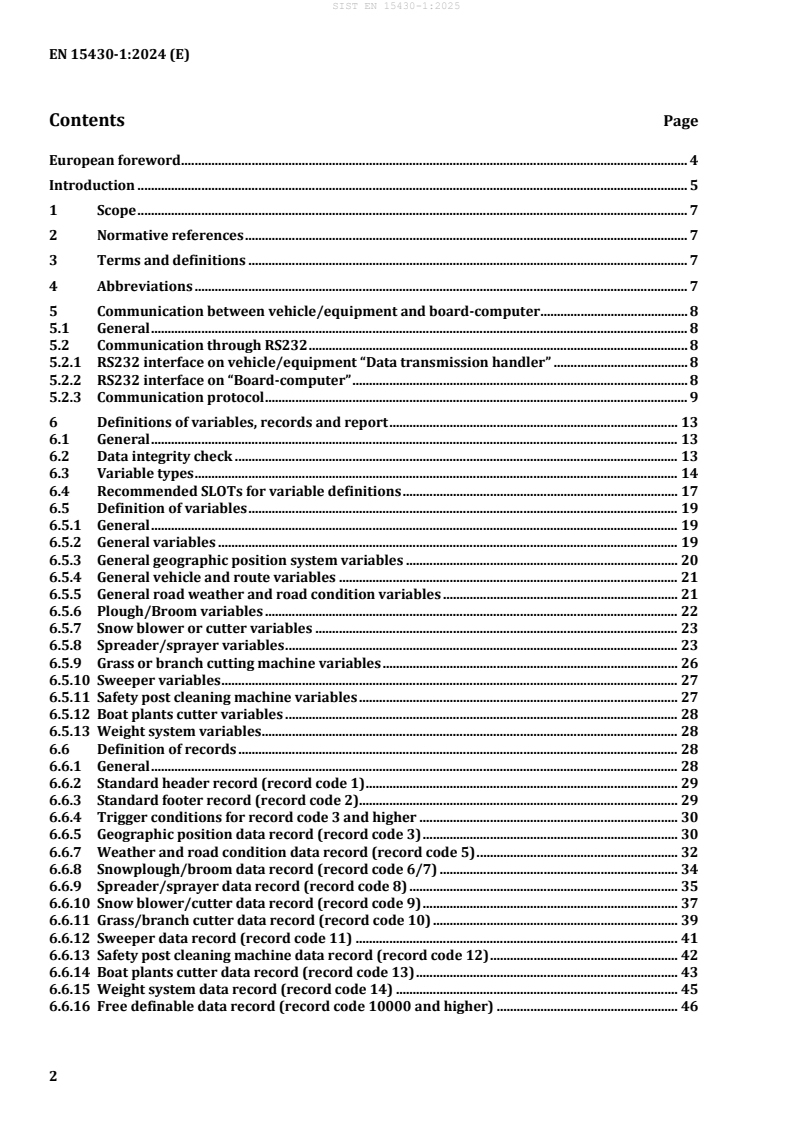
Contents Page
European foreword . 4
Introduction . 5
1 Scope . 7
2 Normative references . 7
3 Terms and definitions . 7
4 Abbreviations . 7
5 Communication between vehicle/equipment and board-computer . 8
5.1 General . 8
5.2 Communication through RS232 . 8
5.2.1 RS232 interface on vehicle/equipment “Data transmission handler” . 8
5.2.2 RS232 interface on “Board-computer” . 8
5.2.3 Communication protocol . 9
6 Definitions of variables, records and report . 13
6.1 General . 13
6.2 Data integrity check . 13
6.3 Variable types . 14
6.4 Recommended SLOTs for variable definitions . 17
6.5 Definition of variables . 19
6.5.1 General . 19
6.5.2 General variables . 19
6.5.3 General geographic position system variables . 20
6.5.4 General vehicle and route variables . 21
6.5.5 General road weather and road condition variables . 21
6.5.6 Plough/Broom variables . 22
6.5.7 Snow blower or cutter variables . 23
6.5.8 Spreader/sprayer variables . 23
6.5.9 Grass or branch cutting machine variables . 26
6.5.10 Sweeper variables . 27
6.5.11 Safety post cleaning machine variables . 27
6.5.12 Boat plants cutter variables . 28
6.5.13 Weight system variables . 28
6.6 Definition of records . 28
6.6.1 General . 28
6.6.2 Standard header record (record code 1) . 29
6.6.3 Standard footer record (record code 2) . 29
6.6.4 Trigger conditions for record code 3 and higher . 30
6.6.5 Geographic position data record (record code 3) . 30
6.6.7 Weather and road condition data record (record code 5) . 32
6.6.8 Snowplough/broom data record (record code 6/7) . 34
6.6.9 Spreader/sprayer data record (record code 8) . 35
6.6.10 Snow blower/cutter data record (record code 9) . 37
6.6.11 Grass/branch cutter data record (record code 10) . 39
6.6.12 Sweeper data record (record code 11) . 41
6.6.13 Safety post cleaning machine data record (record code 12) . 42
6.6.14 Boat plants cutter data record (record code 13) . 43
6.6.15 Weight system data record (record code 14) . 45
6.6.16 Free definable data record (record code 10000 and higher) . 46
6.7 Report definition . 47
Bibliography . 48
European foreword
This document (EN 15430-1:2024) has been prepared by Technical Committee CEN/TC 337 "Road
operation equipment and products", the secretariat of which is held by AFNOR.
This European Standard shall be given the status of a national standard, either by publication of an
identical text or by endorsement, at the latest by June 2025, and conflicting national standards shall be
withdrawn at the latest by June 2025.
Attention is drawn to the possibility that some of the elements of this document may be the subject of
patent rights. CEN shall not be held responsible for identifying any or all such patent rights.
This document supersedes EN 15430-1:2015.
The following changes have been implemented in this new edition:
— Multiple corrections and clarifications;
— Replaced ASCII with extended ASCII, Basic Date notes, correction of typing errors;
— Excluded semicolon from the STRING_X specification;
— Added ManufVersion to the general variables;
NOTE 1 This allows distinguishing between different interpretations of the manufacturer.
— Changed type of GeoAlt to allow negative altitudes;
— Added MaxVehSpd indicating the maximum speed over the last period;
NOTE 2 This allows a more precise interpretation of the spread amount.
— Both SprCntBrineL and SprCntBrineKg are mandatory;
NOTE 3 Both are needed for the data processing systems, but only mandatory one is removed.
— Added Weight system data record;
NOTE 4 Allowing transmission of weight data collected by weighing cells.
— Several corrections on the sweeper variables and the sweeper data record.
Any feedback and questions on this document should be directed to the users’ national standards body.
A complete listing of these bodies can be found on the CEN website.
According to the CEN-CENELEC Internal Regulations, the national standards organisations of the
following countries are bound to implement this European Standard: Austria, Belgium, Bulgaria, Croatia,
Cyprus, Czech Republic, Denmark, Estonia, Finland, France, Germany, Greece, Hungary, Iceland, Ireland,
Italy, Latvia, Lithuania, Luxembourg, Malta, Netherlands, Norway, Poland, Portugal, Republic of North
Macedonia, Romania, Serbia, Slovakia, Slovenia, Spain, Sweden, Switzerland, Türkiye and the United
Kingdom.
Introduction
The protocol described in this document is meant to be used for data acquisition in fleet management
applications in the field of municipal vehicles. The purpose of the protocol is to define how data of a
vehicle or equipment is generated, stored and transferred to a board-computer system in the vehicle and
from the board-computer to the software application in the office (refer to Figure 1). On the equipment
or vehicle the data is generated by a “Data generator”. This data is stored, if present, into a buffer-memory.
The “Data transmission handler” will send the data present in the buffer-memory to the “Board-
computer” or “Data Acquisition System”. The buffer-memory is there to ensure that data does not get lost
in case there is no transmission possible. The size or type of the buffer is not defined in this proposal. If
there is no buffer or the buffer is too small to store new data, data will get lost.
To synchronize time-stamps of the vehicle/equipment with the Board-computer, a special record for time
synchronization is defined.
In this part, the data acquisition and communication from vehicle/equipment to the Board-computer is
defined.
Figure 1 — Architecture
In general, the data is a semi-colon (“;”) separated extended ASCII text for separation of record codes and
values of variables. CR+LF is used for separation of records (one record is one line of text).
Examples of an on-board system configuration.
Figure 2 — Diagram of possible connections
1 Scope
This document specifies a protocol for downloading data from the control box of the equipment to an
in-vehicle board computer to ensure interchangeability between a vehicle and different equipment that
the same vehicle can carry.
It specifies the interface connection as well as variables, records and reports which permit the protocol
to cover applications with the greatest possible variety of equipment for performing winter maintenance
and road service area maintenance.
2 Normative references
The following documents are referred to in the text in such a way that some or all of their content
constitutes requirements of this document. For dated references, only the edition cited applies. For
undated references, the latest edition of the referenced document (including any amendments) applies.
ISO/IEC 8859-1, Information technology — 8-bit single-byte coded graphic character sets — Part 1: Latin
alphabet No. 1
NMEA 0183, Interface Standard
TIA-232-F, Interface between data terminal equipment and data circuit-terminating equipment employing
serial binary data interchange (RS232)
SAE J1939/71, Recommended practice for serial control and communications vehicle network — Vehicle
application layer
3 Terms and definitions
No terms and definitions are listed in this document.
ISO and IEC maintain terminology databases for use in standardization at the following addresses:
— ISO Online browsing platform: available at https://www.iso.org/obp
— IEC Electropedia: available at https://www.electropedia.org/
4 Abbreviations
For the purposes of this document the following abbreviations apply.
ACK Acknowledge (ASCII control code 06 )
h
ASCII American national Standard Code for Information Interchange
CRC-16 16-bit Cyclic Redundancy Check
CRC-32 32-bit Cyclic Redundancy Check
CR Carriage Return (ASCII control code 0D )
h
EOT End Of Transmission (ASCII control code 04 )
h
Number before h is in hexadecimal notation
h
IEEE Institute of Electrical and Electronics Engineers
LF Line Feed (ASCII control code 0A )
h
NAK Negative acknowledge (ASCII control code 15 )
h
SOH Start Of Header (ASCII control code 01 )
h
TBD To Be Defined
↲ CR + LF (carriage return + line feed)
5 Communication between vehicle/equipment and board-computer
5.1 General
The data exchange between vehicle/equipment “Data transmission handler” and the “Board-computer”
shall follow at least one of the communication standards described in the present document version or
future release. Until now, only the RS232 standard (TIA-232-F) is defined as a communication standard
so that means that at the present a compliant EN 15430 “Data transmission handler” shall supply a RS232
interface, if in the future other standard interfaces will be defined (e.g. CAN BUS, USB .) a compliant
EN 15430 future “Data transmission handler” shall supply at least one of the communication standard
until that time is defined.
5.2 Communication through RS232
5.2.1 RS232 interface on vehicle/equipment “Data transmission handler”
— Connector: SUB-D 9pF (socket)
— Pin 2 = Transmit Data
— Pin 3 = Receive Data
— Pin 5 = Signal Ground
— Baud rate: 1 200 Bit/s.115 200 Bit/s, default 9 600 Bit/s. Rate can be programmable (optional)
The baud rate shall be sufficient for a worst case amount of data to be send with retries.
— Data bits: 8
— Stop bits: 1
— Parity: No
— Data format: according to ISO/IEC 8859-1 (Extended ASCII)
— Handshaking: by software with ACK, NAK ASCII control codes, refer to 5.2.3
— Transmission control by SOH and EOT ASCII control codes, refer to 5.2.3
— Data validity check: CRC-16/CCITT, refer to 5.2.3
5.2.2 RS232 interface on “Board-computer”
— Connector: SUB-D 9pM (pin)
— Pin 2 = Receive Data
— Pin 3 = Transmit Data
— Pin 5 = Signal Ground
— Baud rate: 1 200 Bit/s.115 200 Bit/s, default 9 600 Bit/s. Rate shall be programmable or
automatically detected (autobaud)
— Data bits: 8
— Stop bits: 1
— Parity: No
— Data format: according to ISO/IEC 8859-1 (Extended ASCII)
— Handshaking: by software with ACK, NAK ASCII control codes, refer to 5.2.3
— Transmission control by SOH and EOT ASCII control codes, refer to 5.2.3
— Data validity check: CRC-16/CCITT, refer to 5.2.3
5.2.3 Communication protocol
5.2.3.1 Transmission of a record
In this definition a message to be communicated consists of one record. Records are terminated by CR+LF
(a record is one line of text). In general, a message is sent by the sender (e.g. the “Data transmission
handler” of a spreader) and received by the receiver (e.g. the Board-computer). After power up,
communication is always started by the vehicle/equipment “Data transmission handler” sending its first
message (this is the time synchronization record). Refer to Figures 3 and 4 for more detailed charts of
the sender and receiver algorithms.
The receiver will check the validity of a message by testing if the CRC-16 value corresponds to the data in
the message received. If the data is valid, the receiver sends an ACK. The sender can now send a new
message. If the data is invalid, the receiver sends a NAK. Then, the sender will try to send the same
message again for a maximum of 2 times. If the message still fails, the message is considered to be lost.
Preferably, a notification is given to the user (operator) that data has been lost by the sender and/or the
receiver.
The receiver sends an ACK or a NAK as a single character without other data. The ACK or NAK refers to
the latest message sent by the sender. To avoid record synchronization problems between sender and
receiver, the sender shall ignore any ACK or NAK received during the transmission of a message until the
last byte is sent (EOT character). Also, the receiver is not allowed to send an ACK or NAK during the
reception of a message until the last byte is received (EOT character).
Numerical values shall be transmitted with ASCII characters in decimal code.
5.2.3.2 Calculation of the CRC-16 value
The CRC value is calculated according to the CCITT definition. The CRC value is calculated over all record
bytes, starting with the record code, ending with CR+LF. The polynomial used is
16 12 5 0
x + x + x + x = 11021h (i.e. XOR mask 1021h) and initial value FFFFh.
NOTE The value is written in ASCII characters in hexadecimal code with capitals (0.9,A.F).
5.2.3.3 Calculation of the CRC-32 value
The CRC-32 value is calculated according to the CCITT definition. The CRC-32 value is calculated over all
record bytes, starting with the record code, ending with CR+LF. The polynomial used is
32 26 23 22 16 12 11 10 8 7 5 4 2
x + x + x + x + x + x + x + x + x + x + x + x + x + x + 1
NOTE The value is written in ASCII characters in hexadecimal code with capitals (0.9,A.F).
5.2.3.4 Sender without receiving options for handshaking
For old vehicle/equipment “Data transmission handlers”, it can be impossible to receive data. In this case
the sender cannot respond to an ACK or NAK, i.e. there is no handshaking feature. Hence, the sender will
send a new message. This can cause in the result that data gets lost, e.g. in case the Board-computer was
not started up yet or if transmission failed. It is up to the user to handle this problem (for example to
connect power supply such that power-up is always at the same time for sender and transmitter).
5.2.3.5 Synchronization of communication
To synchronize communication between sender and receiver, a message always starts with an SOH and
ends with an EOT. If the receiver is not synchronized yet but the sender is already transmitting a message
(e.g. when the Board-computer starts up while the spreader “Data transmission handler” is sending), all
data before the first SOH will be ignored. If the receiver is synchronized but detects an SOH before an
EOT, the previous, unfinished message is ignored.
5.2.3.6 Time synchronization between sender and receiver
In general, the sender system time and the receiver system time are not equal. To synchronize messages
to the system clock of the receiver, a time synchronization record is introduced. This Time Sync record
(refer to 6.5.2) contains the actual system time of the sender at the start of record transmission (with a
maximum error of ±0,5 s). The receiver shall record its system time at the moment of reception of a
message. In case of the reception of a Time Sync record, the receiver can calculate the difference between
its own system clock and the system clock of the sender. Now, the receiver can time-synchronize every
message received from the sender and thereby synchronize this data to other data generated by other
sources. The board computer shall contain a real time clock which runs even if the board computer has
no power. The electronic system on the vehicle/equipment shall have a real time clock which runs even
when this system has no power, or, a software clock shall be implemented which starts at date 1-1-2000
and time 00:00:00 and is updated every second.
A Time Sync record, is sent by the sender:
— as the first message starting the communication;
— after 10 s if the receiver does not respond to a message with an ACK or a NAK; after a successful
transmission of this record, the latest message before the time synchronization record is transmitted
again;
— if the system clock of the sender is adjusted, reset or set to any value which would cause a jump in
time.
5.2.3.7 Loss of data
Data will get lost in case of:
— a “Data transmission handler” without handshaking feature which is sending while reliable
communication is not possible;
— an overflow of the buffer-memory;
— 2 unsuccessful retransmissions after a NAK.
In case the “Data transmission handler” supports handshaking, the header record shall be the first record
of a report.
NOTE The Time Sync record is not part of the report.
Example of a message is shown in graphical form:
Start Data (codes + values, “;” separated) (x bytes) CR+LF CRC-16 End
(1 byte) (2 bytes) (2 bytes) (1 byte)
SOH 1;10;1602048;0461021;5;Abc;Equip1;;; CR LF 66D9 EOT
Extended ASCII characters in hexadecimal notation:
01 31 3B 31 30 3B 31 36 30 32 30 34 38 3B 30 34 36 31 0D 0A 36 36 44 39 04
30 32 31 3B 35 3B 41 62 63 3B 45 71 75 69 70 31 3B
3B 3B
Communication example:
Figure 3 — Flow diagram
Sender algorithm: Receiver algorithm:
Figure 4 — Flow chart
6 Definitions of variables, records and report
6.1 General
A report is a file of records which in general is used to describe one ride. A report starts with a header
record, one or more status records of the vehicle/equipment(s) and a footer record. A record is a
structure of coherent variables in a predefined order. A member of a record is called a “field”. For
description of equipment types, see Table 1.
Table 1 — Application or equipment types
Equipment Source ref. nr. Note
Board computer 1
Vehicle 2 On board vehicle electronic generating data
Snow plough or broom 3 It is assumed that if there is more than one snow-plough,
the data is generated by one source only
Snow blower or cutter 4
Spreader or sprayer 5 This equipment could also generate the data for example
for a snow plough, however, the source reference number
stays 5 (as the spreader is the data generator)
Road weather and road 6
condition information system
Grass or branch cutting 7
machine
Sweeper 8
Safety post cleaning machine 9
Boat plants cutter 10 Used for cutting plants in canals or rivers
Other 11 To be used for any equipment not defined
6.2 Data integrity check
There are at least two methods required to assure integrity:
a) Data should be checked for manipulation of the contents themselves.
b) Data should be checked for completeness: Data should be checked against any deletion of any parts
of them.
In this document these two requirements lead to the following methods of covering:
— Data manipulation (a) is checked by CRC.
— Data deletion (b) is checked by including the previously calculated CRC value into the new CRC
value.
In order to ensure data integrity two CRC variables (CRC_REC and CRC_STREAM) are defined for each
record and generated by the board computer. CRC_REC contains the CRC-32 value calculated over all the
data contents of the record itself and CRC_STREAM contains the CRC-32 value calculated over the
CRC_STREAM of the preceding record and the current CRC_REC value. CRC_REC and CRC_STREAM are
both optional and are not available in the Time synchronization record (record code 0), standard
header record (record code 1) and standard footer record (record code 2) (see 6.6).
6.3 Variable types
All variables defined, shall comply to the ranges and variable types defined in Tables 2 and Table 3. The
column “Format” shows how a variable is represented in one or more examples. A point (.) is defined as
a decimal separator.
Table 2 — Ranges
Range name 1 byte 2 bytes 4 bytes ASCII
0 to 250 0 to 64 255 0 to 4 211 081 215 1 to 254
Valid signal
00 to FA 0000 to FAFF 00000000 to FAFFFFFF 01 to FE
h h h h h h h h
251 64 256 to 64 511 4 211 081 216 to 4 227 858 431
Parameter specific
None
indicator
FBh FB00h to FBFFh FBxxxxxxh
Reserved range for 252 to 253 64 512 to 65 023 4 227 858 432 to 4 261 412 863
future indicator None
FCh to FDh FC00h to FDFFh FC000000h to FDFFFFFFh
bits
254 65 024 to 65 279 4 261 412 864 to 4 278 190 079 0
Error indicator
FEh FExxh FExxxxxxh 00h
255 65 280 to 65 535 4 278 190 080 to 4 294 967 294 255 255
Not available or
not requested
FF FFxx FFxxxxxx FF
h h h h
Table 3 — Basic variable types
Type Range Length Format Note
00 = Value is 0, no errors
01 = Value is 1, no errors Definition taken from
BOOLEAN 0, 1 2 Bits
10 = Error SAE J1939
11 = not available
0.250, Offset -125
Definition taken from
CHAR -125.+125 1 byte
254 = Error
SAE J1939
255 = not available
0.250, Offset 0
UNSIGNED Definition taken from
0.250 1 byte 254 = Error
CHAR SAE J1939
255 = not available
0.64 255, Offset 32 768
SIGNED 65 024.65 279 = Error Definition taken from
-32 127.+ 32 127 2 bytes
SHORT 65 280.65 535 = not SAE J1939
available
0.64 255, Offset 0
UNSIGNED 65 024.65 279 = Error Definition taken from
0.64 255 2 bytes
SHORT 65 280.65 535 = not SAE J1939
available
0 to 4 211 081 215,
Offset -2 105 540 608,
4 261 412 864 to
SIGNED -2 105 540 608. Definition taken from
4 bytes 4 278 190 079 = Error,
LONG +2 105 540 608 SAE J1939
4 278 190 080 to
4 294 967 295 = not
available
Type Range Length Format Note
0 to 4 211 081 215,
4 261 412 864 to
UNSIGNED 4 278 190 079 = Error, Definition taken from
0.4 211 081 215 4 bytes
LONG 4 278 190 080 to SAE J1939
4 294 967 295 = not
available
0,25 day/bit,
0 day offset
1.31,75 day
Definition taken from
1 month/bit,
BASIC_DATE 1.12 month 3 bytes
a
0 month offs.
SAE J1939
1985.2235 year
1 year/bit,
+1985 offset
0.23 h 1 h/bit, 0 h offset
Definition taken from
BASIC_TIME 0.59 min 3 bytes 1 min/bit, 0 min offset
SAE J1939
0.59,75 s 0,25 s/bit, 0 s offset
Allowed char
values: 01h.FEh
except for 3B
The
Extended ASCII-
string Definition taken from SAE J1939
characters
00h = Error
STRING_X
length SAEat1728
(character set is
3Bh = semicolon
shall be Any string with max. 255 characters.
ISO Latin I)
FF = not
h
≤ X
available
a
day = 0,1,2,3 are forbidden
day = 4,5,6,7 are first day of month
day = 8,9,10,11 are second day of month
....
month = 0 is forbidden
year = 0 is 1985,
year = 1 is 1986,
...
The STRING_X type shall follow these additional rules:
— Only characters that are part of the character set in Table 4 are allowed.
— If a transmission handler returns a valid string field the first character cannot be 00 or FF . The
h h
predefined string length shall be covered completely with valid characters.
— If the valid string content is shorter than the predefined length (X characters), the rest of the
predefined length should be left empty or filled with FF characters to indicate that these characters
h
are not valid. As the filling is optional, a semicolon, which is the field separator, cannot be part of the
string.
— If a transmission handler cannot supply the string field the first character shall be either 00 , when
h
the contents are incorrect, or FF , when the contents are not available. In these two special cases the
h
string length can be only one character in size, although it is also allowed to fill the rest of the
predefined string length with FF characters.
h
Table 4 — ISO LATIN I Character set definition
x0 x1 x2 x3 x4 x5 x6 x7 x8 x9 xA xB xC xD xE xF
0x ------------------------------------------- Should not be displayed -------------------------------------------
1x -----------------------------------------------------------------------------------------------------------------------
2x SP ! " # $ % & ' ( ) * + , - . /
3x 0 1 2 3 4 5 6 7 8 9 : ; < = > ?
4x @ A B C D E F G H I J K L M N O
5x P Q R S T U V W X Y Z [ \ ] ^ _
6x ` a b c d e f g h i j k l m n o
7x p q r s t u v w x y z { | } ~
8x ------------------------------------------- Should not be displayed -------------------------------------------
9x -----------------------------------------------------------------------------------------------------------------------
Ax NBSP ¡ ¢ £ ¤ ¥ ¦ § ¨ © ª « ¬ SHY ® ¯
2 3 1
Bx ° ± ´ µ ¶ · ¸ º » ¼ ½ ¾ ¿
Cx À Á Â Ã Ä Å Æ Ç È É Ê Ë Ì Í Î Ï
Dx Ð Ñ Ò Ó Ô Õ Ö × Ø Ù Ú Û Ü Ý Þ ß
Ex à á â ã ä å æ ç è é ê ë ì í î ï
Fx Ð ñ ò ó ô õ ö ÷ ø ù ú û ü ý -------
00 , 3B and FF are not allowed as part of a string.
h h h
Example of BASIC_TIME and BASIC_DATE format:
BASIC_TIME
EXAMPLE 16:02:12 (hh:mm:ss).
As the seconds are to be stated in quarters of a second these shall be written as 48. Combined
value 16 | 02 | 48. Because the maximum of the last value can be 239 (59,75 seconds × 4) 3 characters are
reserved for this value.
Combined value of BASIC_TIME = 16|02|048 = 1602048.
BASIC_DATE
th
EXAMPLE 11-10-2006 (October 11 2006).
The day value is stated in quarters. The time is 16:02, being in the third quarter of the day, so the total
value is 11,5 (= 46 quarters). Because the maximum of this value can be 127 (31,75 days × 4)
3 characters are reserved for this value.
The month value is 10.
The year value has is stated in years since 1985: 2006-1985 = 21.
Combined value of BASIC_DATE = 046|10|21 = 0461021.
6.4 Recommended SLOTs for variable definitions
This section is intended to define a set of recommended SLOTs (Scaling, Limit, Offset, and Transfer
Function, see Table 5), which can be used when parameters are added to this document. This permits
data consistency is to be maintained as much as possible between parameters of a given type
(temperature, pressure, speed, etc.). Each SLOT is intended to provide a range and resolution suitable for
most parameters within a given type. When necessary, a different scaling factor or offset can be used. All
SLOTs should be based on a power of 2 scaling from another SLOT. This will minimize the math required
for any internal scaling and reduce the opportunity for misinterpreted values. Offsets should be selected
preferably on the following basis:
a) Offset = 0
b) Offset = 50% (equal ± range)
If Parameter Size is 16 Bit or more, LSB is first, MSB is last.
Table 5 — SLOT definitions
Parameter SLOT-
Parameter Scaling (Resolution) Limits (Range) Offset
Size Name
-7
Angle/Direction 1 10 deg/bit -211 deg to 211,108 122 deg -211 32 Bit SAEad01
Angle/Direction 2 1/128 deg/bit -200 deg to 301 deg -200 16 Bit SAEad04
Angle/Direction 3 1/128 deg/bit 0 deg to 502 deg 0 16 Bit SAEad05
Distance 1 0,125 km/bit 0 km to 526 385 151,9 km 0 32 Bit SAEds10
Distance 2 0,125 m/bit - 2 500 m to 5 531,875 m -2 500 16 Bit SAEds06
Distance 3 0,001 m/bit 0 m to 4 211 081,215 m 0 32 Bit SAEds05
Distance 4 0,125 m/bit 0 m to 8 031,875 m 0 16 Bit CENds01
Distance 5 5 m/bit 0 km to 21 055 406 km 0 32 Bit SAEds09
Distance 6 0,1 mm/bit 0 mm to 6 425,5 mm 0 16 Bit SAEds04
Economy 1/512 (km/L)/bit 0 km/L to 125,5 km/L 0 16 Bit SAEel01
Electrical Current 1 1 A/bit -125 A to 125 A -125 8 Bit SAEec02
Electrical Current 2 1 A/bit 0 A to 250 A 0 8 Bit SAEec03
Electrical Potential 0,05 V/bit 0 V to 3 212,75 V 0 16 Bit SAEev01
Flow Rate 1 0,05 L/h per bit 0 L/h to 3 212,75 L/h 0 16 Bit SAEful01
Flow Rate 2 0,05 L/h per bit 0 L/h to 210 554 060,75 L/h 0 32 Bit CENful01
Force 5 N/bit 0 N to 321 275 N 0 16 Bit SAEfr01
Governor Gain 1/1 280 (%/rpm)/bit 0 %/rpm to 0,19 %/rpm 0 8 Bit SAEgg01
Mass (cargo) 1 0,5 kg/bit 0 kg to 32 127,5 kg 0 16 Bit SAEmc01
Mass (cargo) 2 2 kg/bit 0 kg to 128 510 kg 0 16 Bit SAEmc02
Mass (cargo) 3 0,5 kg/bit 0 kg to 2 105 540 608 kg 0 32 Bit CENmc01
Percent 1 (Position/L
0,4 %/bit 0 % to 100 % 0 8 Bit SAEpc03
evel)
Percent 2 (Position/L
1 %/bit -125 % to 125 % -125 8 Bit SAEpc05
evel)
Parameter SLOT-
Parameter Scaling (Resolution) Limits (Range) Offset
Size Name
Percent 3 (Position/L
0,5 %/bit 0 % to 100 % 0 8 Bit CENpc01
evel)
Power 0,5 kW/bit 0 kW to 32 127,5 kW 0 16 Bit SAEpw03
Pressure 1 4 kPa/bit 0 kPa to 1 000 kPa 0 8 Bit SAEpr10
Pressure 2 0,05 kPa/bit 0 kPa to 12,5 kPa 0 8 Bit SAEpr02
Pressure 3 16 kPa/bit 0 kPa to 4 000 kPa 0 8 Bit SAEpr14
Pressure 4 0,125 kPa/bit 0 kPa to 8 031,875 kPa 0 16 Bit SAEpr04
Pressure 5 1/256 MPa/bit 0 MPa to 251 MPa 0 16 Bit SAEpr09
Pressure 6 1/128 kPa/bit - 250 kPa to 251,99 kPa -250 16 Bit SAEpr01
Pressure 7 2 kPa/bit 0 kPa to 500 kPa 0 8 Bit SAEpr07
Pressure 8 0,5 kPa/bit 0 kPa to 125 kPa 0 8 Bit SAEpr05
Ratio 1 0,1/bit 0 to 25,0 0 8 Bit SAEr02
Ratio 2 0,001/bit 0 to 64,255 0 16 Bit SAEr01
Ratio 3 1/bit 0 to 250 0 8 Bit SAEr03
Revolutions 1 000 r/bit 0 r to 4 211 081 215 000 r 0 32 Bit SAErv01
Temperature 1 1 °C/bit - 40 °C to 210 °C -40 8 Bit SAEtp01
Temperature 2 0,031 25 °C/bit -273 °C to 1 735 °C -273 16 Bit SAEtp02
Time 1 0,25 s/bit 0 s to 62,5 s 0 8 Bit SAEtm04
Time 2 1 s/bit 0 s to 64 255 s 0 16 Bit SAEtm05
Time 3 1 min/bit 0 min to 250 min 0 8 Bit SAEtm08
Time 4 1 h/bit 0 h to 250 h 0 8 Bit SAEtm11
Time 5 0,05 h/bit 0 h to 210 554 060,75 h 0 32 Bit SAEtm09
Time 6 0,25 day/bit 0 days to 62,5 days 0 8 Bit SAEcd01
Time 7 1 month/bit 0 months to 250 months 0 8 Bit SAEcm01
Time 8 1 year/bit 1985 years to 2235 years +1,985 8 Bit SAEcy01
Torque 1 1 Nm/bit - 32 000 Nm to 32 255 Nm -32,000 16 Bit SAEtq01
Torque 2 1 Nm/bit 0 Nm to 64 255 Nm 0 16 Bit SAEtq02
1/256 (km/h)/bit
Velocity 1, linear (spe
(1 (km/h)/bit for upper 0 km/h to 250,996 km/h 0 16 Bit SAEvl02
ed)
byte)
Velocity 2, linear (spe
1/128 (km/h)/bit -250 16 Bit SAEvl03
- 250 km/h to 251,992 km/h
ed)
Velocity 3, linear (spe
1 (km/h)/bit 0 8 Bit SAEvl05
0 km/h to 250 km/h
ed)
0,125 rpm/bit (32 rpm
Velocity 1, Rotational 0 rpm to 8 031,875 rpm 0 16 Bit SAEvr01
/bit for upper byte)
Velocity 2, Rotational 4 rpm/bit 0 rpm to 257 020 rpm 0 16 Bit SAEvr03
Velocity 3, Rotational 0,5 rpm/bit 0 rpm to 32 127,5 rpm 0 16 Bit SAEvr02
Parameter SLOT-
Parameter Scaling (Resolution) Limits (Range) Offset
Size Name
Velocity 4, Rotational 10 rpm/bit 0 rpm to 2 500 rpm 0 8 Bit SAEvr04
Volume 0,5 L/bit 0 L to 2 105 540 608 L 0 32 Bit SAEvm1
2 2 2
Acceleration 0,031 25 m/s 0 m/s to 2 007,8 m/s 0 16 Bit CENac1
2 2 2
Dosage 1 0,031 25 g/m 0 g/m to 2 007,8 g/m 0 16 Bit CENdos01
2 2 2
Dosage 2 0,031 25 ml/m 0 ml/m to 2 007,8 ml/m 0 16 Bit CENdos02
6.5 Definition of variables
6.5.1 General
Variables are grouped by application. General variables apply to non application specific variables. Some
application specific variables can be generated by other applications (e.g. spreader generates plough data
and/or road weather information as well). If a variable is a field of a record being generated, then its value
at the moment of generation is written as defined by the basic type format in 6.3 or the SLOT definition
in 6.4.
The following variables are defined:
6.5.2 General variables
Table 6 — General variables
BASIC data format
No Name Description
or SLOT
1 Version Protocol version number. A positive value indicates a STRING_10
released version. A negative value means that the version
with its absolute value is not released yet.
2 ManufVersion Version of the manufacturer interpretation of the protocol STRING_10
3 SysTime Time (local time or system time of the equipment under BASIC_TIME
consideration)
4 SysDate Date (local date or system date of the equipment under BASIC_DATE
consideration)
5 Source Data generation source.
UNSIGNED CHAR
Refer to (Table 1 – Application or equipment types)
6 ManufID Manufacturer identification. STRING_20
7 EquipID Vehicle/equipment identification. In order to ensure the STRING_20
identification of every single equipment, it is a mandatory
that the EquipID shall include the manufactures serial
identification code.
8 DriverID Driver identification. STRING_40
9 Driver2ID 2nd driver identification. STRING_40
10 RunHrs Total of hours the system has run (time that control system SAEtm09
is switched on); (can start at any value at power-up, can
overrun, can be reset when counters are reset)
11 BeaconOn Beacon light is switched on (0 = off, 1 = on) BOOLEAN
BASIC data format
No Name Description
or SLOT
12 DeviceEntity If more than one implement is mounted on the vehicle, this UNSIGNED CHAR
indicator allows to differentiate between the individual
implements.
13 CRC_REC See Clause 6. STRING_8
14 CRC_STREAM See Clause 6. STRING_8
15 FreeDef1 This variable is free definable. It can be used for any variable STRING_20
which is not defined in this document. It is up to the user to
process this data in the office application software. The type
is STRING to provide easy conversion in any other type.
16 FreeDef2 Free definable variable (see FreeDef1) STRING_20
17 FreeDef3 Free definable variable (see FreeDef1) STRING_20
6.5.3 General geographic position system variables
Table 7 — General geographic position system variables
BASIC data format
No Name Description
or SLOT
30 GeoLat Geographic position latitude in NMEA-0183 format: STRING_10
DDMM.mmmmR
(two fixed digits of degrees, two fixed digits of minutes and
a variable number of digits for decimal-fraction of minutes,
R = reference - latitude direction: N = north, S = south.
Example: 3339.7334N = 33 º 39,7334’ north
31 GeoLon Geographic position longitude in NMEA-0183 format: STRING_11
DDDMM.mmmmR
(three fixed digits of degrees, two fixed digits of minutes and
a variable number of digits for decimal-fraction of minutes,
R = reference - longitude direction: E = east, W = west.
Example: 11751.7598W = 117 º 51,7598’ west
32 GeoAlt Geographic position altitude SAEds06
33 GeoSpd Speed over ground by geographic position system SAEvl02
34 GeoCours Course over ground by geographic position system SAEad05
(0 º.360 º, 0 º = northern direction)
35 GeoTime Time by geographic position system (UTC) BASIC_TIME
36 GeoDate Date by geographic position system (UTC) BASIC_DATE
37 GeoSQ Geographic position system signal quality UNSIGNED CHAR
(0 = no fix, 1 = 2D, 2 = 3D, 3 = differential correction active)
38 GeoSats Number of satellites tracked by geographic position system UNSIGNED CHAR
6.5.4 General vehicle and route variables
Table 8 — General vehicle and route variables
BASIC data format
No Name Description
or SLOT
50 RouteID Route identification STRING_20
Driven length as interpreted and generated by the source
51 DrivenLen (can start at any value at power-up, can overrun, can be SAEds09
reset when counters are reset)
52 VehSpd Vehicle speed (0 = not driving; any other value = driving) SAEvl02
52 MaxVehSpd Maximum vehicle speed over the last period SAEvl02
53 VehAcc Vehicle acceleration CENac1
Level of hydraulic tank of the vehicle (0% = empty,
54 VehHydrLev CENpc01
100% = full)
55 VehHydrTemp Hydraulic oil temperature SAEtp01
56 VehHydrBlock Blockage of hydraulic oil filter (0 = no, 1 = yes) BOOLEAN
6.5.5 General road weather and road condition variables
The variables refer to the weather and road conditions at the time and position (including altitude) of the
in-vehicle information system.
Table 9 — General road weather and road condition specific variables
BASIC data format
No Name Description
or SLOT
70 AirHum Relative air humidity CENpc01
71 AirTemp Air temperature SAEtp01
72 WindDir Wind direction (0 º . 360 º)
...
Questions, Comments and Discussion
Ask us and Technical Secretary will try to provide an answer. You can facilitate discussion about the standard in here.
Loading comments...