


SIST EN 1680:2025
(Main)Plastics piping systems - Valves for polyethylene (PE) piping systems - Test method for leaktightness under and after bending applied to the operating mechanisms
Plastics piping systems - Valves for polyethylene (PE) piping systems - Test method for leaktightness under and after bending applied to the operating mechanisms
This document specifies a test method for PE valves to maintain tightness during and after being subjected to a force, applied as a bending moment to the operating mechanism.
Valves according to these standards are intended for use in polyethylene (PE) piping systems for the transport of fluids.
When specified in the product standard, this document can be applied to valves of material other than PE.
Kunststoff-Rohrleitungssysteme - Armaturen für Systeme aus Polyethylen (PE) - Prüfverfahren für die Dichtheit während und nach der Aufbringung eines Biegemoments auf den Betätigungsmechanismus
Dieses Dokument legt ein Prüfverfahren für Armaturen aus PE zur Aufrechterhaltung der Dichtheit während und nach Einwirkung einer Kraft fest, die als Biegemoment auf das Betätigungsorgan aufgebracht wird.
Armaturen nach diesen Normen sind für den Einsatz in Rohrleitungssystemen aus Polyethylen (PE) für den Transport von Flüssigkeiten vorgesehen.
Wenn in der Produktnorm festgelegt, kann dieses Dokument auf Armaturen aus einem anderen Werkstoff als PE angewendet werden.
Systèmes de canalisations en plastique - Robinets pour les systèmes de canalisations en polyéthylène (PE) - Méthode d'essai d'étanchéité sous et après une flexion appliquée au mécanisme d'entraînement
Le présent document spécifie une méthode d’essai pour les robinets en PE devant maintenir l’étanchéité pendant et après avoir été soumis à une force, appliquée comme un moment de flexion au mécanisme d’entrainement.
Les robinets conformes à ces normes sont destinés à être utilisés dans des systèmes de canalisations en polyéthylène (PE) pour le transport de fluides.
Lorsque cela est spécifié dans la norme produit, le présent document peut être appliqué à des robinets en matériau autre que le PE.
Cevni sistemi iz polimernih materialov - Ventili za cevne sisteme iz polietilena (PE) - Metoda za preskus neprepustnosti med upogibanjem zaradi uporabe zapiralnih mehanizmov in po njem
Ta dokument določa preskusno metodo za ventile iz polietilena (PE), s katero se vzdržuje njihova neprepustnost med upogibanjem zaradi uporabe zapiralnega mehanizma in po njem. Ventili v skladu s temi standardi so namenjeni za uporabo v cevnih sistemih iz polietilena za transport tekočin. Če je tako določeno v standardu za izdelek, je mogoče ta dokument uporabiti tudi za ventile iz drugih materialov.
General Information
- Status
- Published
- Public Enquiry End Date
- 22-Jan-2024
- Publication Date
- 01-Apr-2025
- Technical Committee
- PCV - Plastic pipes, fittings and valves
- Current Stage
- 6060 - National Implementation/Publication (Adopted Project)
- Start Date
- 13-Mar-2025
- Due Date
- 18-May-2025
- Completion Date
- 02-Apr-2025

Relations
- Effective Date
- 28-Jan-2026
- Effective Date
- 28-Jan-2026
- Effective Date
- 28-Jan-2026
- Effective Date
- 28-Jan-2026
- Effective Date
- 28-Jan-2026
- Effective Date
- 28-Jan-2026
- Effective Date
- 28-Jan-2026
- Effective Date
- 28-Jan-2026
- Effective Date
- 28-Jan-2026
- Effective Date
- 28-Jan-2026
- Effective Date
- 22-Jan-2023
Overview
SIST EN 1680:2025 specifies the test method for evaluating the leaktightness of valves used in polyethylene (PE) piping systems subjected to mechanical stress, specifically a bending moment applied to the valve’s operating mechanism. This standard applies to valves designed for use with PE pipes for the transportation of fluids, such as water and gaseous fuels. When referenced in other product standards, it may also be applied to valves made from materials other than PE.
Ensuring the mechanical integrity and leaktightness of valves is critical for the safe and efficient operation of plastic piping systems across various industries. This standard addresses both internal and external leak risks that can arise during and after mechanical deformation from real-world use or installation.
Key Topics
Leaktightness Testing Under Mechanical Stress
The standard details a method for applying a controlled bending moment to the valve operating mechanism and evaluating tightness during and after the test. This simulates conditions where operating mechanisms are exposed to unexpected forces in the field.Test Arrangement and Equipment
The test involves:- Pressurizing the valve and pipe assembly (typically using air, per product requirements)
- Applying bending force to the operating device
- Immersing the assembly in a temperature-controlled water tank
- Monitoring for internal and external leakage
Sampling and Test Conditions
- Sampling, test piece preparation, and specific test parameters (temperature, pressure, duration) are aligned with referenced product standards (such as EN 1555-2 and EN 12201-2).
- The number of test samples and pressure levels are defined to match practical use cases and product requirements.
Reporting and Documentation
- Test reports must document all test parameters, product identification, test results, deviations, and any incidents during the process.
Applications
SIST EN 1680:2025 serves manufacturers, test laboratories, and quality assurance teams by providing:
PE Piping System Verification
Ensures that valves used for PE piping systems in fluid transport maintain tight seals even when exposed to operational stresses.Product Certification and Compliance
Supports third-party certification for valves in accordance with European market requirements, facilitating regulatory compliance and product reliability.Failure Prevention and Maintenance Planning
By rigorously testing valves under simulated real-world stresses, manufacturers can identify weak points and improve product designs, reducing the risk of leaks and the need for costly maintenance.Adaptability for Other Materials
While focused on polyethylene, the methodology can extend to valves of other thermoplastics when referenced by product standards, increasing its relevance across multiple piping system applications.
Related Standards
SIST EN 1680:2025 should be considered alongside the following European norms for a comprehensive approach to plastics piping systems and valve performance:
EN 1555-2 Plastics piping systems for the supply of gaseous fuels - Polyethylene (PE) - Part 2: Pipes
EN 12201-2 Plastics piping systems for water supply, and for drainage and sewerage under pressure - Polyethylene (PE) - Part 2: Pipes
EN 837-1 Pressure gauges - Part 1: Bourdon tube pressure gauges - Dimensions, metrology, requirements and testing
EN 1555-4 Plastics piping systems for the supply of gaseous fuels - Polyethylene (PE) - Part 4: Valves
EN 736-2 Valves - Terminology - Part 2: Definition of components of valves
Keyword summary:
plastics piping systems, polyethylene valves, PE pipe valves, leaktightness test, bending moment, valve testing, EN 1680, European standards, fluid transport, valve operating mechanisms, product compliance, piping system safety.
Get Certified
Connect with accredited certification bodies for this standard

DIN CERTCO
DIN Group product certification.
Institut za varilstvo d.o.o. (Welding Institute)
Slovenia's leading welding institute since 1952. ISO 3834, EN 1090, pressure equipment certification, NDT personnel, welder qualification. Only IIW Au

Smithers Quality Assessments
US management systems and product certification.
Sponsored listings
Frequently Asked Questions
SIST EN 1680:2025 is a standard published by the Slovenian Institute for Standardization (SIST). Its full title is "Plastics piping systems - Valves for polyethylene (PE) piping systems - Test method for leaktightness under and after bending applied to the operating mechanisms". This standard covers: This document specifies a test method for PE valves to maintain tightness during and after being subjected to a force, applied as a bending moment to the operating mechanism. Valves according to these standards are intended for use in polyethylene (PE) piping systems for the transport of fluids. When specified in the product standard, this document can be applied to valves of material other than PE.
This document specifies a test method for PE valves to maintain tightness during and after being subjected to a force, applied as a bending moment to the operating mechanism. Valves according to these standards are intended for use in polyethylene (PE) piping systems for the transport of fluids. When specified in the product standard, this document can be applied to valves of material other than PE.
SIST EN 1680:2025 is classified under the following ICS (International Classification for Standards) categories: 23.060.01 - Valves in general; 83.140.30 - Plastics pipes and fittings for non fluid use. The ICS classification helps identify the subject area and facilitates finding related standards.
SIST EN 1680:2025 has the following relationships with other standards: It is inter standard links to SIST EN 837-1:1997, SIST EN 1555-2:2025, SIST EN 12201-2:2024, SIST EN 1555-4:2011, SIST EN ISO 16486-4:2025, SIST EN 12201-4:2024, SIST EN 1555-4:2021, SIST EN 12201-4:2012, SIST EN ISO 16486-4:2022, SIST EN 1555-4:2025, SIST EN 1680:1999. Understanding these relationships helps ensure you are using the most current and applicable version of the standard.
SIST EN 1680:2025 is associated with the following European legislation: EU Directives/Regulations: 305/2011. When a standard is cited in the Official Journal of the European Union, products manufactured in conformity with it benefit from a presumption of conformity with the essential requirements of the corresponding EU directive or regulation.
SIST EN 1680:2025 is available in PDF format for immediate download after purchase. The document can be added to your cart and obtained through the secure checkout process. Digital delivery ensures instant access to the complete standard document.
Standards Content (Sample)
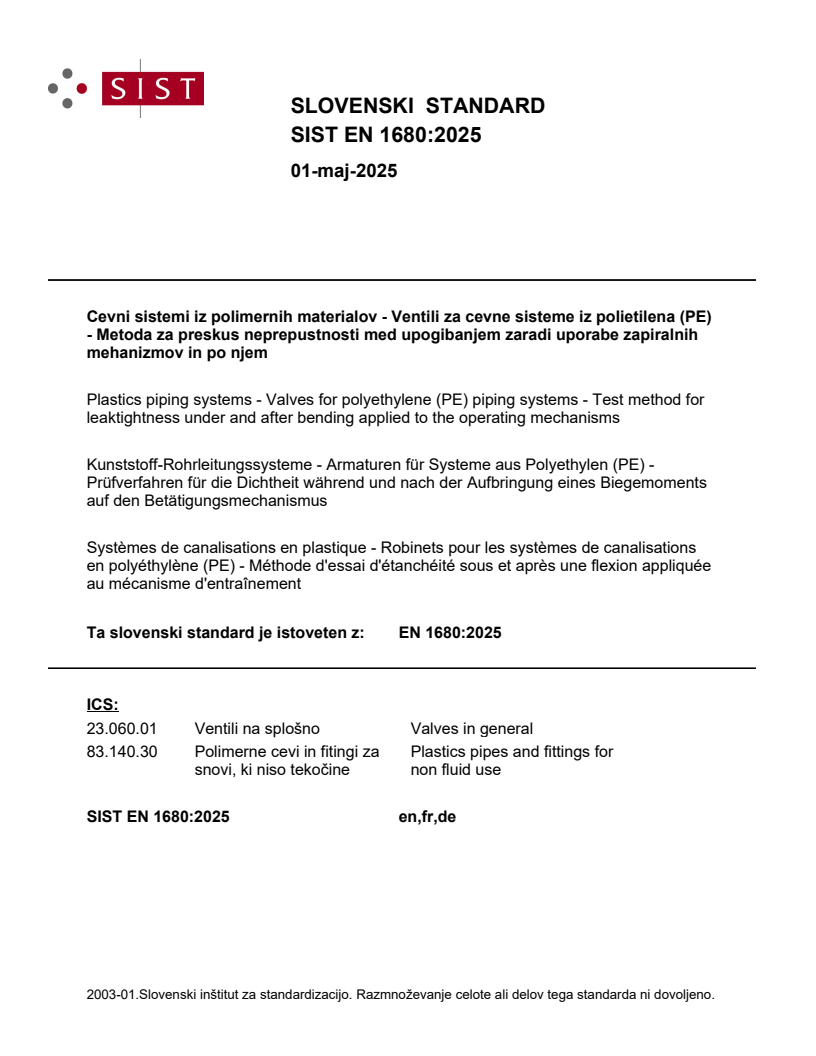
SLOVENSKI STANDARD
01-maj-2025
Cevni sistemi iz polimernih materialov - Ventili za cevne sisteme iz polietilena (PE)
- Metoda za preskus neprepustnosti med upogibanjem zaradi uporabe zapiralnih
mehanizmov in po njem
Plastics piping systems - Valves for polyethylene (PE) piping systems - Test method for
leaktightness under and after bending applied to the operating mechanisms
Kunststoff-Rohrleitungssysteme - Armaturen für Systeme aus Polyethylen (PE) -
Prüfverfahren für die Dichtheit während und nach der Aufbringung eines Biegemoments
auf den Betätigungsmechanismus
Systèmes de canalisations en plastique - Robinets pour les systèmes de canalisations
en polyéthylène (PE) - Méthode d'essai d'étanchéité sous et après une flexion appliquée
au mécanisme d'entraînement
Ta slovenski standard je istoveten z: EN 1680:2025
ICS:
23.060.01 Ventili na splošno Valves in general
83.140.30 Polimerne cevi in fitingi za Plastics pipes and fittings for
snovi, ki niso tekočine non fluid use
2003-01.Slovenski inštitut za standardizacijo. Razmnoževanje celote ali delov tega standarda ni dovoljeno.
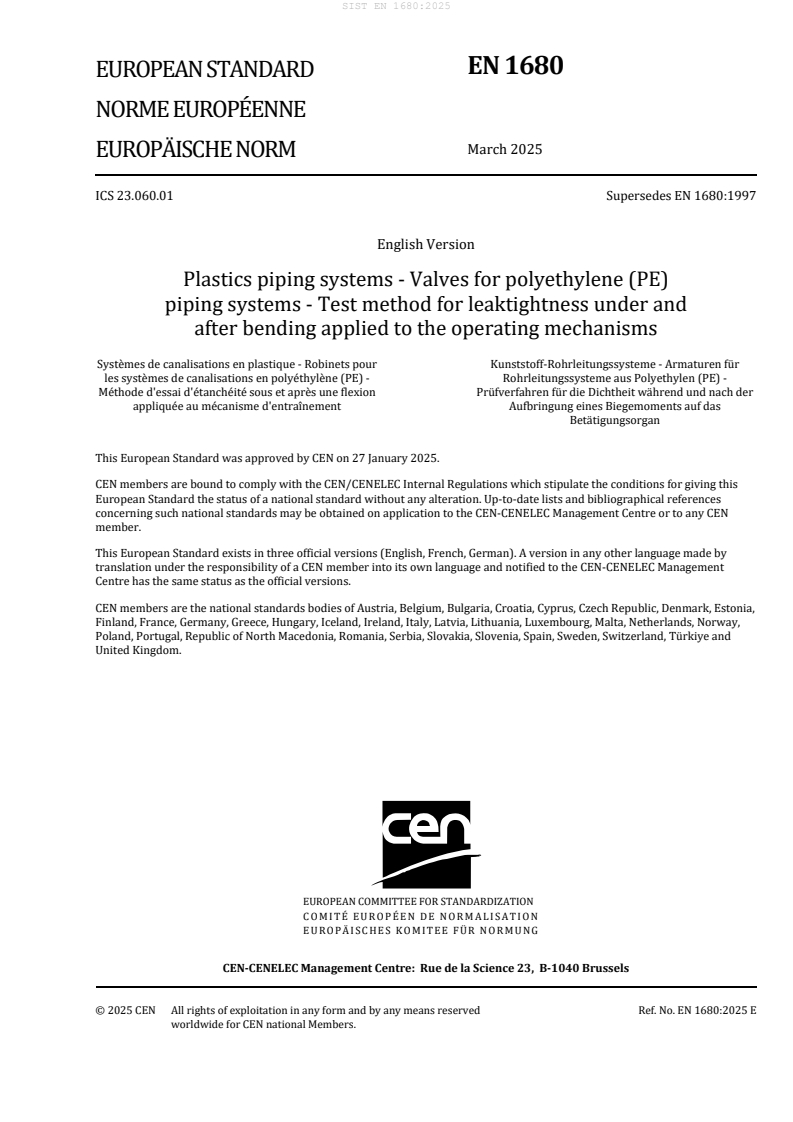
EN 1680
EUROPEAN STANDARD
NORME EUROPÉENNE
March 2025
EUROPÄISCHE NORM
ICS 23.060.01 Supersedes EN 1680:1997
English Version
Plastics piping systems - Valves for polyethylene (PE)
piping systems - Test method for leaktightness under and
after bending applied to the operating mechanisms
Systèmes de canalisations en plastique - Robinets pour Kunststoff-Rohrleitungssysteme - Armaturen für
les systèmes de canalisations en polyéthylène (PE) - Rohrleitungssysteme aus Polyethylen (PE) -
Méthode d'essai d'étanchéité sous et après une flexion Prüfverfahren für die Dichtheit während und nach der
appliquée au mécanisme d'entraînement Aufbringung eines Biegemoments auf das
Betätigungsorgan
This European Standard was approved by CEN on 27 January 2025.
CEN members are bound to comply with the CEN/CENELEC Internal Regulations which stipulate the conditions for giving this
European Standard the status of a national standard without any alteration. Up-to-date lists and bibliographical references
concerning such national standards may be obtained on application to the CEN-CENELEC Management Centre or to any CEN
member.
This European Standard exists in three official versions (English, French, German). A version in any other language made by
translation under the responsibility of a CEN member into its own language and notified to the CEN-CENELEC Management
Centre has the same status as the official versions.
CEN members are the national standards bodies of Austria, Belgium, Bulgaria, Croatia, Cyprus, Czech Republic, Denmark, Estonia,
Finland, France, Germany, Greece, Hungary, Iceland, Ireland, Italy, Latvia, Lithuania, Luxembourg, Malta, Netherlands, Norway,
Poland, Portugal, Republic of North Macedonia, Romania, Serbia, Slovakia, Slovenia, Spain, Sweden, Switzerland, Türkiye and
United Kingdom.
EUROPEAN COMMITTEE FOR STANDARDIZATION
COMITÉ EUROPÉEN DE NORMALISATION
EUROPÄISCHES KOMITEE FÜR NORMUNG
CEN-CENELEC Management Centre: Rue de la Science 23, B-1040 Brussels
© 2025 CEN All rights of exploitation in any form and by any means reserved Ref. No. EN 1680:2025 E
worldwide for CEN national Members.
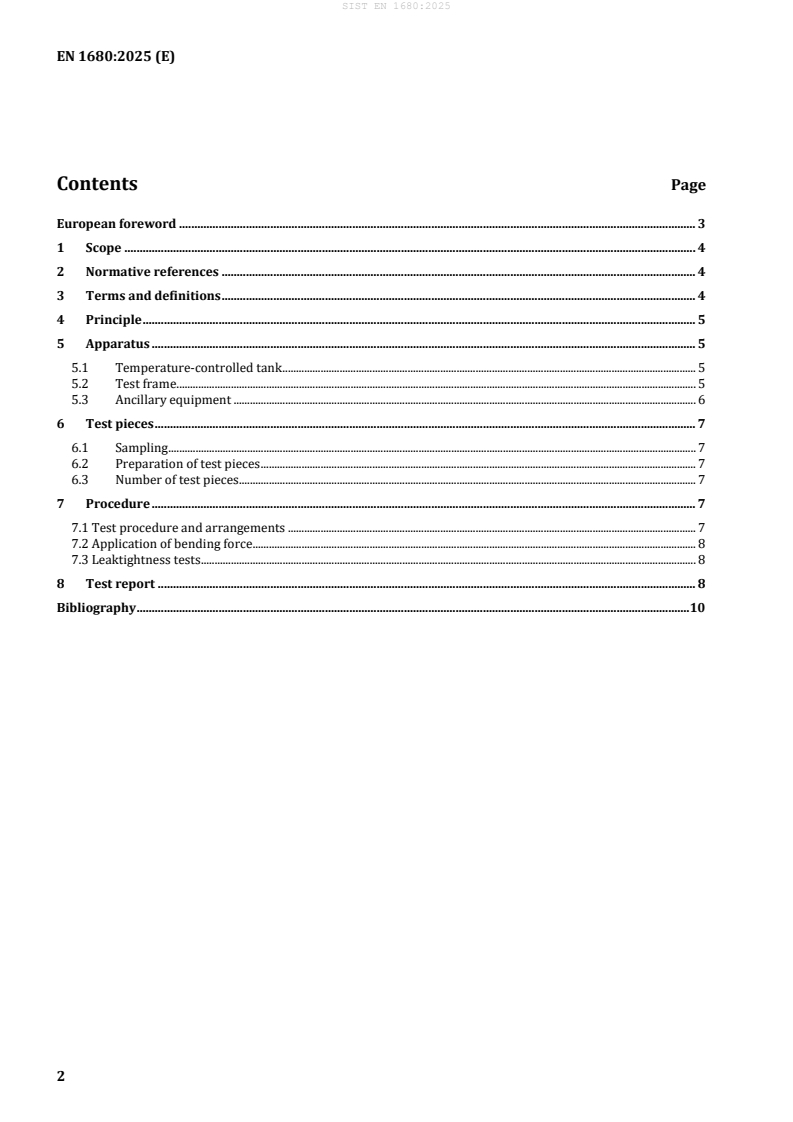
Contents Page
European foreword . 3
1 Scope . 4
2 Normative references . 4
3 Terms and definitions . 4
4 Principle . 5
5 Apparatus . 5
5.1 Temperature-controlled tank . 5
5.2 Test frame. 5
5.3 Ancillary equipment . 6
6 Test pieces . 7
6.1 Sampling . 7
6.2 Preparation of test pieces . 7
6.3 Number of test pieces. 7
7 Procedure . 7
7.1 Test procedure and arrangements . 7
7.2 Application of bending force. 8
7.3 Leaktightness tests . 8
8 Test report . 8
Bibliography . 10
European foreword
This document (EN 1680:2025) has been prepared by Technical Committee CEN/TC 155“Plastics piping
systems and ducting systems”, the secretariat of which is held by NEN.
This European Standard shall be given the status of a national standard, either by publication of an
identical text or by endorsement, at the latest by September 2025, and conflicting national standards shall
be withdrawn at the latest by September 2025.
Attention is drawn to the possibility that some of the elements of this document may be the subject of
patent rights. CEN shall not be held responsible for identifying any or all such patent rights.
This document supersedes EN 1680:1997.
— the title and scope of application have been extended to include use in pipework systems for the
transport of liquids;
— Clause 2 “Normative references” have been updated to the use in the clauses of the text;
— Clause 3 “Terms and definitions” added and numbering of the following sections adapted
accordingly;
— Clause 4 “Brief description” has been adapted in accordance with the amended scope;
— Clause 5 “Apparatus” has been adapted in accordance with the test frame used;
— updated the specification of the test group under consideration in 6.2 “Preparation of test
assemblies”;
— in Clause 7 “Procedure” has been added Table 1 — “Test procedure” with the list of the corresponding
steps to be done;
— 7.2 “Application of the bending force” has been added.
Any feedback and questions on this document should be directed to the users’ national standards body.
A complete listing of these bodies can be found on the CEN website.
According to the CEN-CENELEC Internal Regulations, the national standards organisations of the
following countries are bound to implement this European Standard: Austria, Belgium, Bulgaria, Croatia,
Cyprus, Czech Republic, Denmark, Estonia, Finland, France, Germany, Greece, Hungary, Iceland, Ireland,
Italy, Latvia, Lithuania, Luxembourg, Malta, Netherlands, Norway, Poland, Portugal, Republic of North
Macedonia, Romania, Serbia, Slov
...