


SIST EN 16141:2025
(Main)Conservation of cultural heritage - Guidelines for management of environmental conditions - Open storage facilities: definitions and characteristics of collection centres dedicated to the preservation and management of cultural heritage
Conservation of cultural heritage - Guidelines for management of environmental conditions - Open storage facilities: definitions and characteristics of collection centres dedicated to the preservation and management of cultural heritage
This document defines the functions and characteristics of collection storage facilities. These can be independent or integrated into cultural institutions. They are dedicated to the preservation, storage, management of, and access to, collections.
NOTE For the infrastructure and technical equipment of these collection storage facilities, see EN 16893:2018.
Erhaltung des kulturellen Erbes - Richtlinien für den Umgang mit Umwelt- und Umgebungsbedingungen - Schaudepots: Definitionen und Merkmale von Sammlungszentren bestimmt für die Bewahrung und Pflege des kulturellen Erbes
Dieses Dokument legt die Funktionen und Merkmale von Sammlungsdepots fest. Diese können in kulturelle Institutionen integriert oder von diesen unabhängig sein. Sie dienen der Bewahrung, Lagerung, Verwaltung von Sammlungen sowie dem Zugang zu diesen.
ANMERKUNG Für die Infrastruktur und technische Ausrüstung dieser Sammlungsdepots siehe EN 16893:2018.
Conservation du patrimoine culturel - Lignes directrices pour la gestion des conditions environnementales - Pôles de conservation: définitions et caractéristiques des centres des collections consacrés à la conservation et à l’exploitation du patrimoine culturel
Le présent document définit les fonctions et les caractéristiques des pôles de conservation. Ces derniers peuvent être indépendants ou intégrés à des institutions culturelles. Ils se consacrent à la conservation, au stockage, à l’exploitation et à l’accessibilité des collections.
NOTE Pour ce qui concerne les infrastructures et les équipements techniques de ces pôles de conservation, voir l’EN 16893:2018.
Ohranjanje kulturne dediščine - Smernice za upravljanje okoljskih razmer - Javne izkopanine: definicije in karakteristike zbirnih centrov, namenjenih hrambi in ohranjanju kulturne dediščine
Ta dokument opredeljuje funkcije in karakteristike zbirnih centrov. Ti so lahko samostojni ali vključeni v kulturne ustanove. Njihov namen je hramba, shranjevanje, ohranjanje in zagotavljanje dostopa do zbirk.
OPOMBA: Za infrastrukturo in tehnično opremo teh zbirnih centrov glej standard EN 16893:2018.
General Information
- Status
- Published
- Public Enquiry End Date
- 26-Sep-2023
- Publication Date
- 27-Nov-2024
- Technical Committee
- I13 - Imaginarni 13
- Current Stage
- 6060 - National Implementation/Publication (Adopted Project)
- Start Date
- 28-Nov-2024
- Due Date
- 02-Feb-2025
- Completion Date
- 28-Nov-2024

Relations
- Effective Date
- 28-Jan-2026
- Effective Date
- 19-Jan-2023
Overview
SIST EN 16141:2025 outlines comprehensive guidelines for the management of environmental conditions in open storage facilities, more specifically, the definitions and key characteristics of collection centres dedicated to the preservation and management of cultural heritage. Developed by the Slovenian Institute for Standardization (SIST), this European Standard is aligned with international best practices in safeguarding cultural property, including art, historic artifacts, archives, and other heritage items.
The standard is relevant for a diverse range of cultural institutions such as museums, libraries, archives, and archaeological depositories. It supports both the creation of new storage facilities and the optimization of existing ones to ensure efficient, secure, and sustainable preservation and management of valuable collections.
Key Topics
Functions of Collection Storage Facilities
- Permanent and temporary storage of objects
- Management activities: study, display, consultation, and research
- Collection services: transport, packing, workshops, treatment
- Safety, security, and facility management
Organization and Space Planning
- Clear zoning of storage, management, and service activities
- Adaptable spaces tailored to collection type, size, and growth
- Movement circuits for optimal preservation and handling
- Risk mitigation strategies for environmental, fire, and security threats
Collections Management
- Dedicated areas for documentation, digitization, and study
- Procedures for condition reporting, inventory, and database management
- Controlled and monitored access for staff, service providers, and occasional visitors
Environmental Control
- Maintenance of stable temperature, humidity, and air quality
- Monitoring systems for climate, pests, pollutants, and light exposure
Safety and Security Protocols
- Layers of access control and traceable authorization
- Emergency response areas for salvage and recovery
- Dedicated technical facilities for alarms, air treatment, and power supply
Supporting Amenities
- Staff and visitor amenities separated from storage operations
- Workshops and quarantine zones for preservation activities
Applications
SIST EN 16141:2025 is practical for a range of applications in the heritage sector:
- Designing New Collection Centres: Architects, planners, and cultural managers can use the guidelines to develop new facilities that meet internationally recognized standards for preservation, accessibility, and security.
- Upgrading Existing Storage Facilities: The standard assists institutions in assessing and improving current storage conditions to prolong the life of heritage assets.
- Collection Management Procedures: Establishes protocols for the safe movement, documentation, and handling of artifacts, ensuring compliance with sustainability and risk management policies.
- Facility Operations and Maintenance: Guides institutions in establishing routine cleaning, monitoring, and emergency preparedness plans to minimize deterioration and loss.
- Public Engagement: Supports the development of facilities that allow controlled public access for education and research, without compromising conservation priorities.
Related Standards
Effective use of SIST EN 16141:2025 is complemented by awareness of these related standards:
- EN 16893:2018 - Specifications for the location, construction, and modification of buildings or rooms intended for the storage of heritage collections (covering infrastructure and technical equipment).
- EN 15898 - Conservation of Cultural Heritage - Main general terms and definitions (foundational terminology for this standard).
- EN 16790 - Guidelines for integrated pest management in the protection of cultural heritage.
Conclusion
Adopting SIST EN 16141:2025 helps institutions preserve cultural heritage under optimal environmental conditions by providing a clear framework for the organization, management, and security of collection storage centres. Its robust approach to environmental management, risk mitigation, and operational best practices ensures the long-term safeguarding and accessibility of cultural treasures, supporting both institutional needs and public benefit.
Conservation of cultural heritage standards, such as SIST EN 16141:2025, are central to the responsible stewardship and sustainable use of the world’s collective heritage.
Get Certified
Connect with accredited certification bodies for this standard

BSI Group
BSI (British Standards Institution) is the business standards company that helps organizations make excellence a habit.

Bureau Veritas
Bureau Veritas is a world leader in laboratory testing, inspection and certification services.

DNV
DNV is an independent assurance and risk management provider.
Sponsored listings
Frequently Asked Questions
SIST EN 16141:2025 is a standard published by the Slovenian Institute for Standardization (SIST). Its full title is "Conservation of cultural heritage - Guidelines for management of environmental conditions - Open storage facilities: definitions and characteristics of collection centres dedicated to the preservation and management of cultural heritage". This standard covers: This document defines the functions and characteristics of collection storage facilities. These can be independent or integrated into cultural institutions. They are dedicated to the preservation, storage, management of, and access to, collections. NOTE For the infrastructure and technical equipment of these collection storage facilities, see EN 16893:2018.
This document defines the functions and characteristics of collection storage facilities. These can be independent or integrated into cultural institutions. They are dedicated to the preservation, storage, management of, and access to, collections. NOTE For the infrastructure and technical equipment of these collection storage facilities, see EN 16893:2018.
SIST EN 16141:2025 is classified under the following ICS (International Classification for Standards) categories: 13.020.99 - Other standards related to environmental protection; 97.195 - Items of art and handicrafts. Cultural property and heritage. The ICS classification helps identify the subject area and facilitates finding related standards.
SIST EN 16141:2025 has the following relationships with other standards: It is inter standard links to SIST EN 15898:2020, SIST EN 16141:2014. Understanding these relationships helps ensure you are using the most current and applicable version of the standard.
SIST EN 16141:2025 is available in PDF format for immediate download after purchase. The document can be added to your cart and obtained through the secure checkout process. Digital delivery ensures instant access to the complete standard document.
Standards Content (Sample)
SLOVENSKI STANDARD
01-januar-2025
Ohranjanje kulturne dediščine - Smernice za upravljanje okoljskih razmer - Javne
izkopanine: definicije in karakteristike zbirnih centrov, namenjenih hrambi in
ohranjanju kulturne dediščine
Conservation of cultural heritage - Guidelines for management of environmental
conditions - Open storage facilities: definitions and characteristics of collection centres
dedicated to the preservation and management of cultural heritage
Erhaltung des kulturellen Erbes - Richtlinien für den Umgang mit Umwelt- und
Umgebungsbedingungen - Schaudepots: Definitionen und Merkmale von
Sammlungszentren bestimmt für die Bewahrung und Pflege des kulturellen Erbes
Conservation du patrimoine culturel - Lignes directrices pour la gestion des conditions
environnementales - Pôles de conservation: définitions et caractéristiques des centres
des collections consacrés à la conservation et à l’exploitation du patrimoine culturel
Ta slovenski standard je istoveten z: EN 16141:2024
ICS:
13.020.99 Drugi standardi v zvezi z Other standards related to
varstvom okolja environmental protection
97.195 Umetniški in obrtniški izdelki. Items of art and handicrafts.
Kulturne dobrine in kulturna Cultural property and
dediščina heritage
2003-01.Slovenski inštitut za standardizacijo. Razmnoževanje celote ali delov tega standarda ni dovoljeno.
EN 16141
EUROPEAN STANDARD
NORME EUROPÉENNE
November 2024
EUROPÄISCHE NORM
ICS 97.195 Supersedes EN 16141:2012
English Version
Conservation of cultural heritage - Guidelines for
management of environmental conditions - Collection
storage facilities: definitions and characteristics of
buildings dedicated to the preservation and management
of cultural heritage
Conservation du patrimoine culturel - Lignes Erhaltung des kulturellen Erbes - Richtlinien für den
directrices pour la gestion des conditions Umgang mit Umwelt- und Umgebungsbedingungen -
environnementales - Pôles de conservation : Schaudepots: Definitionen und Merkmale von
définitions et caractéristiques des bâtiments consacrés Sammlungszentren bestimmt für die Bewahrung und
à la conservation et à l'exploitation du patrimoine Pflege des kulturellen Erbes
culturel
This European Standard was approved by CEN on 13 October 2024.
CEN members are bound to comply with the CEN/CENELEC Internal Regulations which stipulate the conditions for giving this
European Standard the status of a national standard without any alteration. Up-to-date lists and bibliographical references
concerning such national standards may be obtained on application to the CEN-CENELEC Management Centre or to any CEN
member.
This European Standard exists in three official versions (English, French, German). A version in any other language made by
translation under the responsibility of a CEN member into its own language and notified to the CEN-CENELEC Management
Centre has the same status as the official versions.
CEN members are the national standards bodies of Austria, Belgium, Bulgaria, Croatia, Cyprus, Czech Republic, Denmark, Estonia,
Finland, France, Germany, Greece, Hungary, Iceland, Ireland, Italy, Latvia, Lithuania, Luxembourg, Malta, Netherlands, Norway,
Poland, Portugal, Republic of North Macedonia, Romania, Serbia, Slovakia, Slovenia, Spain, Sweden, Switzerland, Türkiye and
United Kingdom.
EUROPEAN COMMITTEE FOR STANDARDIZATION
COMITÉ EUROPÉEN DE NORMALISATION
EUROPÄISCHES KOMITEE FÜR NORMUNG
CEN-CENELEC Management Centre: Rue de la Science 23, B-1040 Brussels
© 2024 CEN All rights of exploitation in any form and by any means reserved Ref. No. EN 16141:2024 E
worldwide for CEN national Members.
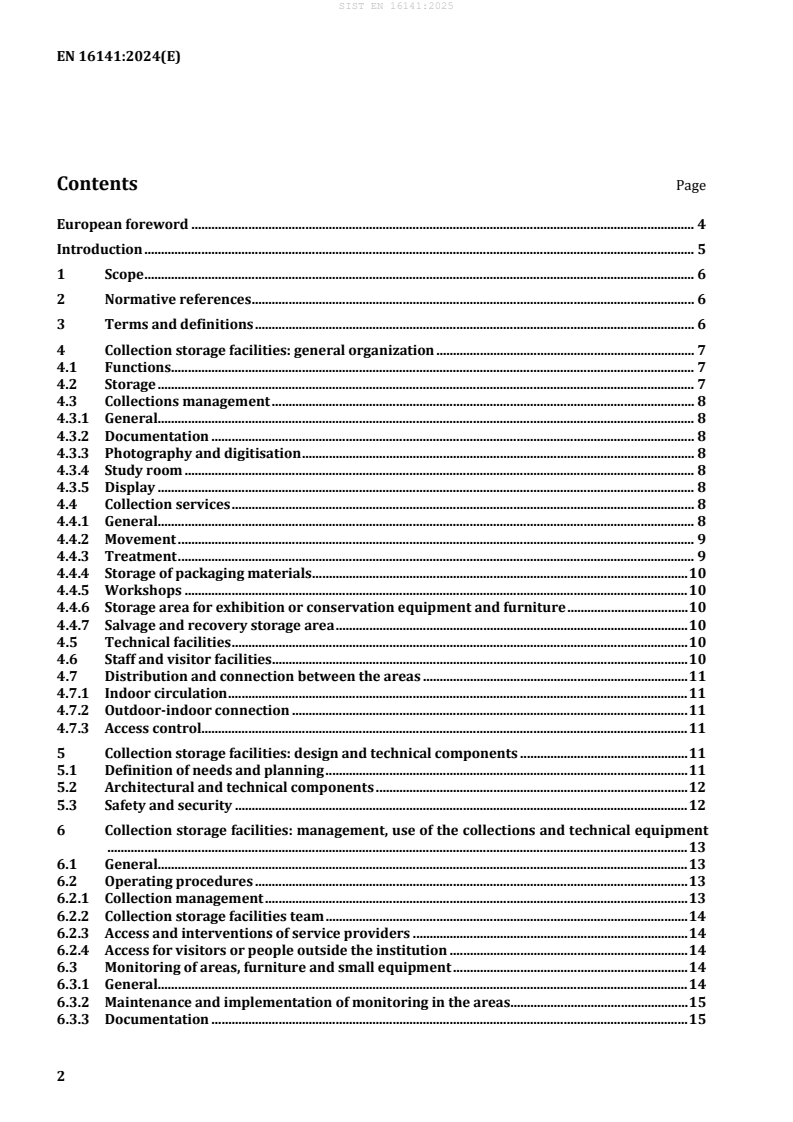
Contents Page
European foreword . 4
Introduction . 5
1 Scope . 6
2 Normative references . 6
3 Terms and definitions . 6
4 Collection storage facilities: general organization . 7
4.1 Functions . 7
4.2 Storage . 7
4.3 Collections management . 8
4.3.1 General. 8
4.3.2 Documentation . 8
4.3.3 Photography and digitisation . 8
4.3.4 Study room . 8
4.3.5 Display . 8
4.4 Collection services . 8
4.4.1 General. 8
4.4.2 Movement . 9
4.4.3 Treatment . 9
4.4.4 Storage of packaging materials . 10
4.4.5 Workshops . 10
4.4.6 Storage area for exhibition or conservation equipment and furniture . 10
4.4.7 Salvage and recovery storage area . 10
4.5 Technical facilities . 10
4.6 Staff and visitor facilities. 10
4.7 Distribution and connection between the areas . 11
4.7.1 Indoor circulation . 11
4.7.2 Outdoor-indoor connection . 11
4.7.3 Access control. 11
5 Collection storage facilities: design and technical components . 11
5.1 Definition of needs and planning . 11
5.2 Architectural and technical components . 12
5.3 Safety and security . 12
6 Collection storage facilities: management, use of the collections and technical equipment
............................................................................................................................................................................. 13
6.1 General. 13
6.2 Operating procedures . 13
6.2.1 Collection management . 13
6.2.2 Collection storage facilities team . 14
6.2.3 Access and interventions of service providers . 14
6.2.4 Access for visitors or people outside the institution . 14
6.3 Monitoring of areas, furniture and small equipment . 14
6.3.1 General. 14
6.3.2 Maintenance and implementation of monitoring in the areas. 15
6.3.3 Documentation . 15
6.4 Monitoring of technical installations related to the operation (functioning) of the building
............................................................................................................................................................................. 15
6.4.1 Establishment of monitoring . 15
6.4.2 Documentation . 16
Bibliography . 17
European foreword
This document (EN 16141:2024) has been prepared by Technical Committee CEN/TC 346 “Conservation
of cultural heritage”, the secretariat of which is held by UNI.
This European Standard shall be given the status of a national standard, either by publication of an
identical text or by endorsement, at the latest by May 2025, and conflicting national standards shall be
withdrawn at the latest by May 2025.
Attention is drawn to the possibility that some of the elements of this document may be the subject of
patent rights. CEN shall not be held responsible for identifying any or all such patent rights.
This document will supersede EN 16141:2012.
The main change compared to the previous edition is the introduction of the reference to EN 16893:2018
for infrastructure and technical equipment.
Any feedback and questions on this document should be directed to the users’ national standards body.
A complete listing of these bodies can be found on the CEN website.
According to the CEN-CENELEC Internal Regulations, the national standards organisations of the
following countries are bound to implement this European Standard: Austria, Belgium, Bulgaria, Croatia,
Cyprus, Czech Republic, Denmark, Estonia, Finland, France, Germany, Greece, Hungary, Iceland, Ireland,
Italy, Latvia, Lithuania, Luxembourg, Malta, Netherlands, Norway, Poland, Portugal, Republic of North
Macedonia, Romania, Serbia, Slovakia, Slovenia, Spain, Sweden, Switzerland, Türkiye and the United
Kingdom.
Introduction
The importance of preserving cultural heritage under the best conditions is imperative for all.
Cultural heritage institutions have the responsibility of preserving collections, either presented in spaces
dedicated to the public or stored in the dedicated areas (stored collections).
These dedicated stored collection areas should ensure the preservation, management, research and
conservation of the cultural heritage, and provide access to the public where appropriate. These areas
dedicated to the preservation of cultural heritage include various functions and can sometimes also be
made accessible to the public.
The purpose of the present document is to help the user in the design and function of these areas called
“Collection Storage Facilities”.
Collection Storage Facilities have four main purposes:
— to store collections while meeting conservation requirements;
— to facilitate access to the collections;
— to allow for the management of collections;
— to provide the safety and security of collections.
This document may be used for designing new collection storage facilities or for the improvement of
existing storage facilities.
The concept of collection storage facilities is general. It relates to places fulfilling the functions defined in
this document belonging to any type of institution (archives, libraries, archaeological stores, museums,…)
dedicated to the safekeeping of any type of collection (archives, books, archaeological items, etc.).
This document identifies the functions and space-related components of collection storage facilities. It is
complementary to EN 16893:2018 Conservation of Cultural Heritage — Specifications for location,
construction and modification of buildings or rooms intended for the storage or use of heritage collections.
1 Scope
This document defines the functions and characteristics of collection storage facilities. These can be
independent or integrated into cultural institutions. They are dedicated to the preservation, storage,
management of, and access to, collections.
NOTE For the infrastructure and technical equipment of these collection storage facilities, see EN 16893:2018.
2 Normative references
The following documents are referred to in the text in such a way that some or all of their content
constitutes requirements of this document. For dated references, only the edition cited applies. For
undated references, the latest edition of the referenced document (including any amendments) applies.
EN 15898, Conservation of cultural heritage - Main general terms and definitions
3 Terms and definitions
For the purposes of this document, the terms and definitions given in EN 15898 and the following apply.
ISO and IEC maintain terminology databases for use in standardization at the following addresses:
— ISO Online browsing platform: available at https://www.iso.org/obp/
— IEC Electropedia: available at https://www.electropedia.org/
3.1
collection storage facility
place dedicated to the storage of collections, and to activities relating to their study, conservation and
management providing the necessary conditions required for collection accessibility, preservation, safety
and security and, if necessary, public access
3.2
protocol
agreed procedure defining the progress of an operation
3.3
safety
measures and actions taken to prevent disasters (whether of natural or human origin: fire, flood,
earthquake, etc.) and their effects on people and property
3.4
security
measures and actions taken to prevent theft and malicious acts (including vandalism)
3.5
storage
designated area where objects are housed providing the necessary conditions required for preservation,
safety and security while not on display
Note 1 to entry: The term “repository” is used in archives and libraries.
4 Collection storage facilities: general organization
4.1 Functions
Collection storage facilities are part of the general organization of one or several cultural heritage
institutions. Such premises constitute a set of areas isolated from each other but interdependent and
organized around functional circuits of circulation of cultural objects and persons.
Collection storage facilities have four principal functions:
a) permanent and temporary storage of objects;
b) collection management: study, display, consultation, and scientific examination of the collections;
some of these functions require areas dedicated to receiving the public;
c) collection services: movement, packing/unpacking, workshops, and sometimes physical treatment of
the collection;
d) facilities management (e.g. security system, alarm control unit, and plant room).
The purpose is to offer the best conditions for collections conservation and management. However, not
all functions of a collection storage facility necessarily require their own area. In the case of multi-function
spaces, the specificities and use of each function shall be respected without interfering with the others.
4.2 Storage
A clear and rational organization of the collections is important as well as policies and procedures for
managing operations related to the activities.
Collections shall be arranged in spaces which are exclusively devoted to them. These areas constitute the
central and vital core of the collection storage facilities. Preventive measures shall be the subject of
special attention: they affect both environmental conditions (climate, pollutants, light, etc.) as well as
safety and security (fire, major risks, etc.). Collection areas shall be kept dark, except when lighting is
required for access. They shall be provided with equipment to detect risks (fire, inappropriate
temperature and relative humidity; pests; volatile organic compounds, intrusion, etc.).
The distribution of the collections in storage areas shall follow these principles:
— stable environmental conditions adapted to the requirements of the various collections;
— clearly identified distribution (for example, by institution, by collection, by storage method, etc.);
— storage furniture such as cabinets, shelves, racks, exhibition furniture, etc. shall be adapted to the
collections (number, shape, weight, condition and preservation state) and to the activities of the
heritage institution. Their arrangement ensures easy and efficient accessibility of objects as well as
their safe handling. Storage furniture and all fittings shall not in themselves or in their materials
present hazards or cause damage to the collections.
The arrangement of storage areas (choice of furniture, placement, etc.) shall facilitate, without risk to
cultural objects and persons, the following interventions:
— identification of locations of the objects;
— movement of objects and staff;
— access to collections by maintaining a balance between the safety of the collections and their
accessibility;
— maintenance of floors, walls and furniture.
Storage areas and furniture shall be able to be adapted to the growth of the collections allowing optimal
use of the collection storage facilities over time.
For further information and technical elements, see EN 16893:2018, 5.3.4.2.
4.3 Collections management
4.3.1 General
Collections management areas fulfil the functions of study, consultation and preparation for display.
These functions shall be carried out in protected spaces and with preservation conditions appropriate to
the collections and similar to those in the storage areas. If collections require particular preservation
conditions (e.g. cold storage), the relevant acclimatization measures shall be applied.
4.3.2 Documentation
The documentation process includes e.g. identification, description, location, measurement, and labelling
of objects. All of this information shall be registered into a computerized database. This work shall take
place in an area close to the storage area and allow the handling and temporary movement of the objects
to be inventoried. During the documentation process, no other activity shall be carried out in the vicinity
of the objects.
4.3.3 Photography and digitisation
Photography and digitisation, which may be for documentation, exhibition, scholarly, promotional or
conservation purposes, shall be carried out in a designated area facilitating and limiting, if possible, the
movement of people and objects. These spaces shall only house the objects during imaging.
4.3.4 Study room
In the study room, objects are made available for study and research. This area shall be close to the
storage areas and shall allow the safe examination and easy handling of the objects, as well as access to
digital documentation, such as files, database and internet connections. It shall contain only the objects
being examined.
In archive centres, documents being examined for several days shall be stored in a specific and secure
place.
4.3.5 Display
If the storage facilities are connected to public exhibition areas, handling, packing, moving and
conditioning of the objects shall meet the same protocols as all other objects in transit. This also applies
to loaned objects. Public entry to the exhibition areas shall be separate from any access to other activities
in the storage facility. It shall be reinforced with a control area for visitor access.
NOTE For additional information and technical elements, see EN 16893:2018, 5.3.4.3.
4.4 Collection services
4.4.1 General
Collection services include all operations relating to the movement and care of objects, especially those
related to exit from or entry to the collection storage facility. Service areas shall be located in separate
areas, connected on one hand to storage areas, and on the other hand with collections management areas.
The following principles shall be respected:
— collection service activities shall be carried out in areas separate from those for storing the objects;
— objects shall be present in these spaces only on a temporary basis;
— objects shall be subject to the same environmental conditions as in the storage areas, with the
possible exception of workshops (4.4.5), and storage areas for emergency response
equipment (4.4.7);
— objects shall be subject to the same security and safety conditions as in the storage areas;
NOTE National standards for health and safety and for operating equipment can apply.
4.4.2 Movement
4.4.2.1 Transit and transport
Movements within the facility (transit) and movements to and from the facility (transport) shall be
subject to a protocol, listing rules for protection and handling of
...