


SIST EN 1420:2026
(Main)Influence of organic materials on water intended for human consumption - Determination of odour, flavour, colour and turbidity of water in piping and storage systems
Influence of organic materials on water intended for human consumption - Determination of odour, flavour, colour and turbidity of water in piping and storage systems
This document specifies a procedure for obtaining a migration water to determine odour, flavour, colour and turbidity for products made from organic materials intended to come in contact with water for human consumption (drinking water) and used in piping and storage systems. Such products include pipes, tanks, reservoirs, fittings, ancillaries and their coatings both for site applied and factory-made products.
This document is applicable to products to be used under various conditions for the transport, storage and distribution of water intended for human consumption and raw water used for the manufacture of water intended for human consumption.
This document specifies a test method comprising a set of procedures. The use may be dependent on the relevant national regulations and/or the Commission Implementing Decision (EU) 2024/368.
Einfluss von organischen Werkstoffen auf Wasser für den menschlichen Gebrauch - Bestimmung des Geruchs und Geschmacks des Wassers in Rohrleitungssystemen
Dieses Dokument legt ein Verfahren zur Gewinnung eines Migrationswassers zur Bestimmung von Geruch, Geschmack, Färbung und Trübung von Produkten aus organischen Materialien fest, die für den Kontakt mit Wasser zum menschlichen Gebrauch (Trinkwasser) vorgesehen sind und in Rohrleitungs- und Speichersystemen verwendet werden. Zu solchen Produkten zählen Rohre, Tanks, Wasserbehälter, Formstücke und Ausrüstungsgegenstände sowie deren Beschichtungen für vor Ort aufgebrachte und fabrikmäßig hergestellte Produkte.
Dieses Dokument ist auf Produkte anwendbar, die unter verschiedenen Bedingungen für Transport, Lagerung und Verteilung von Wasser für den menschlichen Gebrauch und Rohwasser, das zu Wasser für den menschlichen Gebrauch aufbereitet werden soll, vorgesehen sind.
Dieses Dokument legt ein Prüfverfahren fest, das eine Anzahl von Verfahren umfasst. Die Anwendung könnte von den einschlägigen nationalen Vorschriften und/oder den System- oder Produktnormen abhängig sein.
Influence des matériaux organiques sur l'eau destinée à la consommation humaine - Détermination de l'odeur, de la flaveur, de la couleur et de la turbidité de l'eau dans les réseaux de conduites et les systèmes de stockage
Le présent document spécifie un mode opératoire permettant d’obtenir une eau de migration pour déterminer l’odeur, la flaveur, la couleur et la turbidité des produits à base de matériaux organiques conçus pour être en contact avec l’eau destinée à la consommation humaine (eau potable) et utilisés dans les réseaux de conduites et les systèmes de stockage. Ces produits sont notamment les tubes, les cuves, les réservoirs, les raccords, les accessoires et leurs revêtements, destinés aussi bien aux produits appliqués sur site qu’aux produits fabriqués en usine.
Le présent document est applicable aux produits conçus pour être utilisés dans différentes conditions de transport, stockage et distribution de l’eau destinée à la consommation humaine et de l’eau brute utilisée pour produire de l’eau destinée à la consommation humaine.
Il spécifie une méthode d’essai comprenant un ensemble de modes opératoires. L’utilisation peut dépendre des réglementations nationales de référence et/ou des normes de système ou de produit.
Vpliv organskih snovi na pitno vodo - Ugotavljanje vonja, okusa, barve in motnosti vode v vodovodnih in skladiščnih sistemih
Ta dokument določa postopek za pridobitev migracijske vode za določanje vonja, okusa, barve in motnosti za izdelke iz organskih materialov, namenjene stiku z vodo za človeško potrošnjo (pitna voda) in uporabljene v cevnih in skladiščnih sistemih. Takšni izdelki vključujejo cevi, rezervoarje, zbiralnike, armature, dodatke in njihove premaze, tako za izdelke, ki se nanašajo na mestu, kot za tovarniško izdelane izdelke.
Ta dokument je uporaben za izdelke, ki se uporabljajo v različnih pogojih za transport, skladiščenje in distribucijo vode, namenjene za človeško potrošnjo, in surove vode, uporabljene za proizvodnjo vode, namenjene za človeško potrošnjo.
Ta dokument določa preskusno metodo, ki vključuje niz postopkov. Uporaba je lahko odvisna od ustreznih nacionalnih predpisov in/ali Izvedbene odločbe Komisije (EU) 2024/368.
General Information
- Status
- Published
- Public Enquiry End Date
- 27-Feb-2025
- Publication Date
- 20-May-2026
- Technical Committee
- IOVO - Water supply and waste water engineering
- Current Stage
- 6060 - National Implementation/Publication (Adopted Project)
- Start Date
- 13-May-2026
- Due Date
- 18-Jul-2026
- Completion Date
- 21-May-2026
- Directive
- Not Harmonized98/83/EC - Quality of water intended for human consumption

Relations
- Effective Date
- 06-May-2026
- Effective Date
- 19-Nov-2025
- Effective Date
- 19-Nov-2025
- Effective Date
- 31-May-2023
Overview
SIST EN 1420:2026 specifies a standardized procedure to assess the influence of organic materials on water intended for human consumption. The standard is focused on determining odour, flavour, colour, and turbidity of water that has been in contact with products made from organic materials in piping and storage systems, including pipes, tanks, reservoirs, fittings, ancillaries, and their coatings. This ensures water quality and consumer safety throughout transport, storage, and distribution networks.
The document establishes test methods for evaluating potential changes in key water quality parameters when water interacts with these materials. Compliance supports regulatory alignment, facilitates international trade, and helps maintain high standards for potable water systems.
Key Topics
Migration Water Assessment
The standard details how to prepare and use migration water-water that has been exposed to a test sample-to simulate conditions in actual distribution systems.Parameters Evaluated
It sets methods for determining:- Odour
- Flavour (or taste)
- Colour
- Turbidity
Applicability
- For all factory-made and site-applied organic products (including coatings) in contact with drinking water.
- Relevant to both cold and hot water systems, including raw water used in the production of potable water.
Testing Procedures
- Sample preparation and pre-treatment, including flushing, stagnation, and prewashing.
- Guidelines for testing at different temperatures (e.g., cold: 23°C, warm: 60°C, hot: 85°C).
- Periodic migration and testing cycles.
- Panel-based organoleptic testing (threshold odour number - TON, threshold flavour number - TFN).
- Use of reference water, blank samples, and control over test conditions.
Panel Qualification
- Requirements for test panels, including member qualification and testing protocols, reflect industry best practices for sensory assessment.
Applications
SIST EN 1420:2026 is crucial for a variety of stakeholders in the water sector:
Manufacturers of Water Contact Materials
Ensures products such as plastic pipes, tank coatings, seals, and fittings meet drinking water quality standards by verifying they do not impart unacceptable levels of odour, flavour, colour, or turbidity.Water Utilities and Service Companies
Validates that installed products will not degrade supplied water quality, supporting compliance with public health requirements and improving consumer confidence.Testing Laboratories
Supplies accredited labs with harmonized, reproducible methodologies for evaluating products intended for use in water supply systems.Regulatory Authorities
Provides a technical reference for assessing compliance with national and European Union regulations governing drinking water safety.Designers and Engineers
Assists in specifying suitable products for water infrastructure projects by referencing tested and compliant materials.
Effective implementation of SIST EN 1420:2026 helps prevent consumer complaints, reduces remediation costs, and contributes to the sustainable operation of municipal and industrial water distribution systems.
Related Standards
- EN 1622: Water quality - Determination of threshold odour and flavour numbers (TON and TFN)
- EN 12873-1: Influence of materials on water for human consumption - Test method for factory-made products of organic or glassy materials
- EN 12873-2: Test method for non-metallic and noncementitious site-applied materials
- EN ISO 7027-1: Water quality - Determination of turbidity - Quantitative methods
- EN ISO 7887: Water quality - Examination and determination of colour
- EN ISO 7393-2: Water quality - Determination of chlorine
These related standards ensure coordinated approaches for material testing, panel qualification, and analytical procedures across the water industry, aligning with EU directives and supporting standardization objectives.
Get Certified
Connect with accredited certification bodies for this standard

BSI Group
BSI (British Standards Institution) is the business standards company that helps organizations make excellence a habit.

Bureau Veritas
Bureau Veritas is a world leader in laboratory testing, inspection and certification services.

DNV
DNV is an independent assurance and risk management provider.
Sponsored listings
Frequently Asked Questions
SIST EN 1420:2026 is a standard published by the Slovenian Institute for Standardization (SIST). Its full title is "Influence of organic materials on water intended for human consumption - Determination of odour, flavour, colour and turbidity of water in piping and storage systems". This standard covers: This document specifies a procedure for obtaining a migration water to determine odour, flavour, colour and turbidity for products made from organic materials intended to come in contact with water for human consumption (drinking water) and used in piping and storage systems. Such products include pipes, tanks, reservoirs, fittings, ancillaries and their coatings both for site applied and factory-made products. This document is applicable to products to be used under various conditions for the transport, storage and distribution of water intended for human consumption and raw water used for the manufacture of water intended for human consumption. This document specifies a test method comprising a set of procedures. The use may be dependent on the relevant national regulations and/or the Commission Implementing Decision (EU) 2024/368.
This document specifies a procedure for obtaining a migration water to determine odour, flavour, colour and turbidity for products made from organic materials intended to come in contact with water for human consumption (drinking water) and used in piping and storage systems. Such products include pipes, tanks, reservoirs, fittings, ancillaries and their coatings both for site applied and factory-made products. This document is applicable to products to be used under various conditions for the transport, storage and distribution of water intended for human consumption and raw water used for the manufacture of water intended for human consumption. This document specifies a test method comprising a set of procedures. The use may be dependent on the relevant national regulations and/or the Commission Implementing Decision (EU) 2024/368.
SIST EN 1420:2026 is classified under the following ICS (International Classification for Standards) categories: 13.060.20 - Drinking water; 67.250 - Materials and articles in contact with foodstuffs; 91.140.60 - Water supply systems. The ICS classification helps identify the subject area and facilitates finding related standards.
SIST EN 1420:2026 has the following relationships with other standards: It is inter standard links to SIST-TP CEN/TR 16950:2017, SIST EN 13052-1:2001, SIST EN 14395-1:2005, SIST EN 1420:2016. Understanding these relationships helps ensure you are using the most current and applicable version of the standard.
SIST EN 1420:2026 is associated with the following European legislation: EU Directives/Regulations: 98/83/EC; Standardization Mandates: M/136 REV2. When a standard is cited in the Official Journal of the European Union, products manufactured in conformity with it benefit from a presumption of conformity with the essential requirements of the corresponding EU directive or regulation.
SIST EN 1420:2026 is available in PDF format for immediate download after purchase. The document can be added to your cart and obtained through the secure checkout process. Digital delivery ensures instant access to the complete standard document.
Standards Content (Sample)
SLOVENSKI STANDARD
01-julij-2026
Vpliv organskih snovi na pitno vodo - Ugotavljanje vonja, okusa, barve in motnosti
vode v vodovodnih in skladiščnih sistemih
Influence of organic materials on water intended for human consumption - Determination
of odour, flavour, colour and turbidity of water in piping and storage systems
Einfluss von organischen Werkstoffen auf Wasser für den menschlichen Gebrauch -
Bestimmung des Geruchs und Geschmacks des Wassers in Rohrleitungssystemen
Influence des matériaux organiques sur l'eau destinée à la consommation humaine -
Détermination de l'odeur, de la flaveur, de la couleur et de la turbidité de l'eau dans les
réseaux de conduites et les systèmes de stockage
Ta slovenski standard je istoveten z: EN 1420:2026
ICS:
13.060.20 Pitna voda Drinking water
91.140.60 Sistemi za oskrbo z vodo Water supply systems
2003-01.Slovenski inštitut za standardizacijo. Razmnoževanje celote ali delov tega standarda ni dovoljeno.
EN 1420
EUROPEAN STANDARD
NORME EUROPÉENNE
April 2026
EUROPÄISCHE NORM
ICS 13.060.20 Supersedes EN 13052-1:2001, EN 14395-1:2004, EN
1420:2016
English Version
Influence of organic materials on water intended for
human consumption - Determination of odour, flavour,
colour and turbidity of water in piping and storage
systems
Influence des matériaux organiques sur l'eau destinée Einfluss von organischen Werkstoffen auf Wasser für
à la consommation humaine - Détermination de den menschlichen Gebrauch - Bestimmung des Geruchs
l'odeur, de la flaveur, de la couleur et de la turbidité de und Geschmacks des Wassers in Rohrleitungssystemen
l'eau dans les réseaux de conduites et les systèmes de
stockage
This European Standard was approved by CEN on 20 March 2026.
CEN members are bound to comply with the CEN/CENELEC Internal Regulations which stipulate the conditions for giving this
European Standard the status of a national standard without any alteration. Up-to-date lists and bibliographical references
concerning such national standards may be obtained on application to the CEN-CENELEC Management Centre or to any CEN
member.
This European Standard exists in three official versions (English, French, German). A version in any other language made by
translation under the responsibility of a CEN member into its own language and notified to the CEN-CENELEC Management
Centre has the same status as the official versions.
CEN members are the national standards bodies of Austria, Belgium, Bulgaria, Croatia, Cyprus, Czech Republic, Denmark, Estonia,
Finland, France, Germany, Greece, Hungary, Iceland, Ireland, Italy, Latvia, Lithuania, Luxembourg, Malta, Netherlands, Norway,
Poland, Portugal, Republic of North Macedonia, Romania, Serbia, Slovakia, Slovenia, Spain, Sweden, Switzerland, Türkiye and
United Kingdom.
EUROPEAN COMMITTEE FOR STANDARDIZATION
COMITÉ EUROPÉEN DE NORMALISATION
EUROPÄISCHES KOMITEE FÜR NORMUNG
CEN-CENELEC Management Centre: Rue de la Science 23, B-1040 Brussels
© 2026 CEN All rights of exploitation in any form and by any means reserved Ref. No. EN 1420:2026 E
worldwide for CEN national Members.
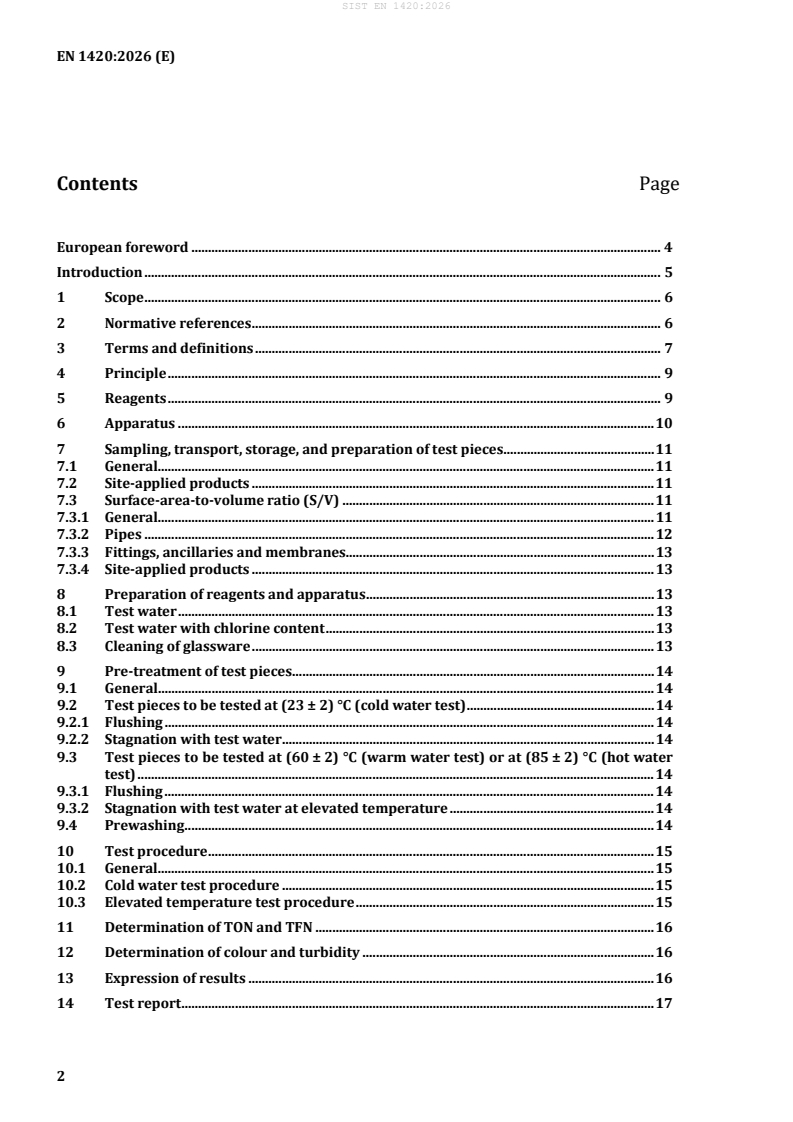
Contents Page
European foreword . 4
Introduction . 5
1 Scope . 6
2 Normative references . 6
3 Terms and definitions . 7
4 Principle . 9
5 Reagents . 9
6 Apparatus . 10
7 Sampling, transport, storage, and preparation of test pieces . 11
7.1 General. 11
7.2 Site-applied products . 11
7.3 Surface-area-to-volume ratio (S/V) . 11
7.3.1 General. 11
7.3.2 Pipes . 12
7.3.3 Fittings, ancillaries and membranes. 13
7.3.4 Site-applied products . 13
8 Preparation of reagents and apparatus . 13
8.1 Test water . 13
8.2 Test water with chlorine content . 13
8.3 Cleaning of glassware . 13
9 Pre-treatment of test pieces . 14
9.1 General. 14
9.2 Test pieces to be tested at (23 ± 2) °C (cold water test) . 14
9.2.1 Flushing . 14
9.2.2 Stagnation with test water . 14
9.3 Test pieces to be tested at (60 ± 2) °C (warm water test) or at (85 ± 2) °C (hot water
test) . 14
9.3.1 Flushing . 14
9.3.2 Stagnation with test water at elevated temperature . 14
9.4 Prewashing . 14
10 Test procedure . 15
10.1 General. 15
10.2 Cold water test procedure . 15
10.3 Elevated temperature test procedure . 15
11 Determination of TON and TFN . 16
12 Determination of colour and turbidity . 16
13 Expression of results . 16
14 Test report . 17
14.1 General information . 17
14.2 Information on the product/material . 17
14.3 Information for site-applied products . 18
14.4 Information on the test procedure . 18
14.5 Test results. 19
Annex A (informative) Schematic presentation of test method. 20
Annex B (normative) Sequence of additional migration periods . 21
Annex C (normative) Panel qualification for odour and flavour testing . 23
C.1 General . 23
C.2 Individual TON determination. 23
C.3 Ranking test . 24
C.4 Long term monitoring . 24
Annex D (informative) Preparation of dilution series for panel qualification . 25
D.1 Series of successive MtBE dilutions . 25
D.1.1 MtBE spike solution . 25
D.1.2 Series of successive dilutions . 25
D.2 Series of successive 1-butanol concentrations . 25
D.2.1 1-butanol spike solution . 25
D.2.2 Series of successive dilutions . 26
Bibliography . 27
European foreword
This document (EN 1420:2026) has been prepared by Technical Committee CEN/TC 164 “Water supply”,
the secretariat of which is held by AFNOR.
This European Standard shall be given the status of a national standard, either by publication of an
identical text or by endorsement, at the latest by October 2026, and conflicting national standards shall
be withdrawn at the latest by October 2026.
Attention is drawn to the possibility that some of the elements of this document may be the subject of
patent rights. CEN shall not be held responsible for identifying any or all such patent rights.
This document supersedes EN 1420:2016, EN 13052-1:2001 and EN 14395-1:2004.
With regard to the previous edition EN 1420:2016, the following changes were made:
— the test methods for turbidity and colour have been included,
— the scope of the document has been extended: all organic products (included storage systems) can
be tested according to this document.
This document has been prepared under a mandate given to CEN by the European Commission and the
European Free Trade Association.
Any feedback and questions on this document should be directed to the users’ national standards body.
A complete listing of these bodies can be found on the CEN website.
According to the CEN-CENELEC Internal Regulations, the national standards organisations of the
following countries are bound to implement this European Standard: Austria, Belgium, Bulgaria, Croatia,
Cyprus, Czech Republic, Denmark, Estonia, Finland, France, Germany, Greece, Hungary, Iceland, Ireland,
Italy, Latvia, Lithuania, Luxembourg, Malta, Netherlands, Norway, Poland, Portugal, Republic of North
Macedonia, Romania, Serbia, Slovakia, Slovenia, Spain, Sweden, Switzerland, Türkiye and the United
Kingdom.
Introduction
This document is intended to safeguard the quality of drinking water for human consumption by
providing a framework for monitoring and evaluating potential adverse effects arising from contact with
materials used in conveyance and distribution systems. The adverse effects considered are limited to
changes in odour, taste, colour, and turbidity.
1 Scope
This document specifies a procedure for obtaining a migration water to determine odour, flavour, colour
and turbidity for products made from organic materials intended to come in contact with water for
human consumption (drinking water) and used in piping and storage systems. Such products include
pipes, tanks, reservoirs, fittings, ancillaries and their coatings both for site applied and factory-made
products.
This document is applicable to products to be used under various conditions for the transport, storage
and distribution of water intended for human consumption and raw water used for the manufacture of
water intended for human consumption.
This document specifies a test method comprising a set of procedures. The use may be dependent on the
relevant national regulations and/or the Commission Implementing Decision (EU) 2024/368.
2 Normative references
The following documents are referred to in the text in such a way that some or all of their content
constitutes requirements of this document. For dated references, only the edition cited applies. For
undated references, the latest edition of the referenced document (including any amendments) applies.
EN 1622, Water quality - Determination of the threshold odour number (TON) and threshold flavour
number (TFN)
EN 12873-1:2014, Influence of materials on water intended for human consumption - Influence due to
migration - Part 1: Test method for factory-made products made from or incorporating organic or glassy
(porcelain/vitreous enamel) materials
EN 12873-2, Influence of materials on water intended for human consumption - Influence due to migration
- Part 2: Test method for non-metallic and noncementitious site-applied materials
EN ISO 7393-2, Water quality - Determination of free chlorine and total chlorine - Part 2: Colorimetric
method using N,N-dialkyl-1,4-phenylenediamine, for routine control purposes (ISO 7393-2 )
EN ISO 7027-1:2016, Water quality - Determination of turbidity - Part 1: Quantitative methods (ISO 7027-
1:2016)
EN ISO 7887:2011, Water quality - Examination and determination of colour (ISO 7887:2011)
3 Terms and definitions
For the purposes of this document, the following terms and definitions apply.
ISO and IEC maintain terminology databases for use in standardization at the following addresses:
— ISO Online browsing platform: available at https://www.iso.org/obp/
— IEC Electropedia: available at https://www.electropedia.org/
3.1
blank water
test water which has been kept at the same specified conditions as migration water but without contact
with the test piece
3.2
colour
optical property that causes the changing of the spectral composition of transmitted visible light
[SOURCE: EN ISO 7887:2011, 3.2]
3.3
fitting, ancillary
complete functional unit made up of one or more components and materials, parts of which are in contact
with drinking water
EXAMPLE Taps, valves.
3.4
flavour
complex combination of the olfactory, gustatory and trigeminal sensations perceived during tasting
which may be influenced by tactile, thermal, painful and/or kinaesthesic effects
[SOURCE: EN ISO 5492]
3.5
membranes
elastomer as used in pressure relief devices
3.6
migration water
test water which has been in contact with a test piece under specified conditions
3.7
odour
organoleptic attribute perceptible by the olfactory organ on sniffing certain volatile substances
[SOURCE: EN ISO 5492]
3.8
panel coordinator
person responsible for the qualification of the members of the odour/flavour panel (panellists) and the
check of the reliability of the determined TON-/TFN-results
3.9
prewashing water
tapwater without any odour and flavour and a chlorine content less than 0,05 mg/l as Cl
3.10
product
manufactured item, in its finished form
3.11
sample
one or more units, or a specified quantity, drawn from a batch or lot, selected at random for inspection
3.12
site-applied product
product where the final surface in contact with drinking water is prepared on site
3.13
storage systems
tanks, reservoirs, cisterns and their coatings
3.14
test piece
sample or portion of sample that is conditioned, treated or otherwise prepared to be tested to obtain a
single test result
3.15
test water
water used for testing purposes prepared as described in 5.1.1 and 5.1.2
3.16
testing panel
group of people meeting the relevant requirements of this document and according to EN 1622
3.17
threshold flavour number – TFN
dilution ratio beyond which the diluted sample does not have any perceptible flavour
[SOURCE: EN 1622:2006, 3.4]
3.18
threshold odour number – TON
dilution ratio beyond which the diluted sample does not have any perceptible odour
[SOURCE: EN 1622:2006, 3.3]
3.19
turbidity
reduction of transparency of a liquid caused by the presence of undissolved matter
[SOURCE: EN ISO 7027-1:2016, 3.1]
4 Principle
Following a defined pre-treatment procedure of flushing, stagnation with test water and subsequent
prewashing, the surface of the test pieces, exposed in practice to drinking water, is brought into contact
with test waters.
The migration procedure is carried out under specified conditions as follows: test pieces are put in
contact with unchlorinated and where required chlorinated test waters for 72 h at (23 ± 2) °C (cold water
test), or put in contact with unchlorinated test water for 24 h at temperature of (60 ± 2) °C (warm water
test) or (85 ± 2) °C (hot water test). If warm or hot water test is required, additionally a cold water test
shall be performed.
NOTE The choice of the type of test water (chlorinated and/or chlorine-free), the temperature of the test water,
the number of additional migration periods will be specified in product standards or national or European
regulations.
After this contact, the migration water is assessed for colour and turbidity (see Clause 12) and by a test
panel to determine the TON and the TFN (see Clause 11).
Additional information concerning the temperature to be used in the test and the sequence of extraction
periods is given in Clause 10.
5 Reagents
5.1 Waters to be used for testing
5.1.1 Test water shall be without any perceptible odour and flavour, and with a spectral absorption
−1
coefficient less than 0,1 m , with an Nephelometric Turbidity Units (NTU) < 0,1. The test water shall be
conformed to the reference water as described in EN 1622.
NOTE Reference water is the term used in EN 1622, which has the same characteristics as the water used for
the testing in the present standard, referred as test water.
5.1.2 Chlorinated test water shall consist of test water (5.1.1) with a free chlorine content of (1 ± 0,2)
mg/l as Cl after addition of sodium hypochlorite solution (5.2). When chlorinated test water is
dechlorinated after 72 h (see 11.1) with sodium thiosulfate (5.3) or ascorbic acid (5.4), it shall have no
perceptible odour and flavour.
5.2 Sodium hypochlorite solution
Sodium hypochlorite solution, prepared from a technical or general purpose reagent grade of sodium
hypochlorite (NaOCl), using test water (5.1.1) and having a known concentration of about 0,1 % by mass
of free chlorine determined in accordance with EN ISO 7393-2.
This sodium hypochlorite solution is unstable and should be prepared on the day of use.
5.3 Sodium thiosulfate solution
Sodium thiosulfate solution, comprising a solution of 3,5 g per litre of sodium thiosulfate pentahydrate
(Na S O∙5H O) analytical grade, stored in the absence of light at a temperature below 10 °C, for a
2 2 3 2
maximum of 1 week. Two ml of this solution will neutralize 1 mg/l of residual chlorine in 1 l of water.
Occasionally this solution causes odours/flavours that interfere with analyses. An alternative (5.4) is
available.
5.4 Ascorbic acid solution
Ascorbic acid solution, comprising a solution of 4,0 g per litre of L (+)-ascorbic acid analytical grade,
stored in the absence of light at a temperature below 10 °C, for a maximum of one month. Two ml of this
solution will neutralize 1 mg/l of residual chlorine in 1 l of water.
5.5 1-Butanol (analytic reagent grade)
5.6 2-Methoxy-2-methylpropane (Methyl-tert-butyl ether, MtBE) (analytic reagent grade)
5.7 Cleaning liquids for glassware
5.7.1 Hydrochloric acid, concentrated (30 % mass per volume) analytical reagent grade.
5.7.2 Hydrochloric acid solution, prepared by slowly adding (0,5 ± 0,01) l of concentrated hydrochloric
acid (5.7.1) to (0,5 ± 0,01) l of test water (5.1.1).
NOTE Care is needed because preparing the solution can generate heat.
5.7.3 Nitric acid, concentrated ((65 ± 3) % mass per volume) analytical reagent grade.
5.7.4 Nitric acid solution, (2 % mass per volume) is prepared by slowly adding (0,15 ± 0,01) l of
concentrated nitric acid (5.7.3) to (5,0 ± 0,1) l of test water (5.1.1).
NOTE Care is needed because preparing the solution can generate heat.
5.7.5 Hydrogen peroxide, 3 % vol/vol (analytical reagent grade).
6 Apparatus
6.1 Vessels, containers, stoppers and connectors, shall consist of a material, such as glass or stainless
steel, that is inert under the specified test conditions.
6.2 Plates made of stainless steel, mild steel, sand-blasted glass or concrete/cement-mortar plates, for
testing certain site-applied products. The plates shall be covered completely by the test material.
6.3 Equipment, capable of maintaining the appropriate migration temperature, e.g (23 ± 2) °C, (60 ± 2)
°C or (85 ± 2) °C.
6.4 500 ml Erlenmeyer flasks with ground stoppers shall be used for the presentation of the dilution
series to panellists. Alternative glassware, such as wide-necked reagent bottles with ground stoppers, can
be used provided that comparable results are demonstrated.
6.5 Apparatus for colour analysis complying with the requirements of EN ISO 7887:2011, 5.5.
6.6 Apparatus for turbidity analysis complying with the requirements of EN ISO 7027-1:2016, 5.3.1.
7 Sampling, transport, storage, and preparation of test pieces
7.1 General
Sampling of products (i.e. collection of (a) sample(s) from a batch or lot) shall be performed in accordance
with the relevant product standard or system standard.
NOTE 1 National regulations and/or the Commission Implementing Decision (EU) 2024/368 may apply.
During transport and storage samples shall be protected from contamination. If the manufacturer
provides written transport and storage instructions they shall be followed and documented. All samples
shall be transported and stored in their original form as delivered. Transport storage and test containers
shall be clean.
The room used for sample and test piece preparation shall be free from odour and flavour. The general
environment shall not adversely affect the preparation (see EN 1622:2006, Clause 6).
The test pieces shall be prepared such that only the surface intended to come into contact with drinking
water is exposed to the test waters (5.1.1 and 5.1.2). When the product has the same material composition
for the outside and inside surfaces, the test pieces may be immersed in test water.
NOTE 2 Composite products, for example kitchen taps, can consist of different substances and materials. If a
component made of organic material is assessed separately, it comes under the scope of application of this
document.
The surface of the test pieces intended to come into contact with test water shall be free from adhesive
tape, labels, ink or pencil marks.
The minimum age of the test pieces shall conform to the relevant product standard or system standard
or, if not given in such a standard, to that recommended by the manufacturer for the product to be ready
for use.
7.2 Site-applied products
Test samples for site-applied products shall be prepared, stored and transported in accordance to
EN 12873-2 and 7.1.
If the preparation procedure for a test piece for a particular type of product has not been covered in this
document, deviation from this procedure is allowable under the following conditions:
a) the finished product and the test piece shall be produced in the same manner;
b) the preparation of test pieces before testing shall include the procedures which are performed in
practice before the system is put into operation, e.g. curing and cleaning procedures.
7.3 Surface-area-to-volume ratio (S/V)
7.3.1 General
The surface area of the test pieces exposed to the test water shall be in accordance with Table 1. If S/V of
the test pieces is larger than specified in Table 1, the migration water may be diluted with test water up
to the given value prior determination of TON, TFN, colour and turbidity.
----------------------
...