


SIST EN 17230:2021
(Main)Information technology - RFID in rail
Information technology - RFID in rail
The RFID tag location, tag data content and functional requirements have been developed for application on the main line railway networks. Other networks (such as metro) could apply to this document but are outside of its scope.
This document contains:
- description of the RFID tag installation location;
- description of the RFID tag data content;
- description of the functional requirements in relation to the RFID tag track side reading performance.
Informationstechnik - RFID in Eisenbahnanwendungen
Die Platzierung, der Dateninhalt und die funktionalen Anforderungen der RFID-Tags wurden für die Anwendung auf Hauptstrecken von Eisenbahnnetzen erarbeitet. Dieses Dokument könnte auch auf andere Netze (wie U Bahn-Netze) angewendet werden; diese liegen aber außerhalb des Anwendungsbereiches dieses Dokuments.
Dieses Dokument enthält:
- Beschreibung der Platzierung von RFID Tags;
- Beschreibung des Dateninhalts eines RFID Tags;
- Beschreibung der funktionalen Anforderungen in Bezug auf die streckenseitige Ausleseleistung von RFID Tags.
Technologies de l'information - Identification par radiofréquence dans le secteur ferroviaire
L’emplacement des étiquettes RFID, le contenu des données d’étiquettes et les exigences fonctionnelles ont été définis dans le cadre d’une application sur les principaux réseaux ferroviaires. Les autres réseaux (métropolitains, par exemple) pourraient se référer au présent document, bien qu'ils se trouvent en dehors de son domaine d’application.
Le présent document contient :
- une description de l’emplacement d'installation de l’étiquette RFID ;
- une description du contenu des données de l’étiquette RFID ;
- une description des exigences fonctionnelles du point de vue des performances de lecture de l’étiquette RFID côté voie.
Informacijska tehnologija - Uporaba radiofrekvenčne prepoznave (RFID) v železniškem prometu
General Information
- Status
- Published
- Public Enquiry End Date
- 30-Apr-2018
- Publication Date
- 11-Jan-2021
- Technical Committee
- ITC - Information technology
- Current Stage
- 6060 - National Implementation/Publication (Adopted Project)
- Start Date
- 05-Jan-2021
- Due Date
- 12-Mar-2021
- Completion Date
- 12-Jan-2021
Overview
EN 17230:2020 - "Information technology - RFID in rail" (CEN) specifies how Ultra High Frequency (UHF) RFID is applied for automatic identification of railway rolling stock on main line networks. The standard defines RFID tag location, tag data content, and functional requirements for reliable track-side reading to enable interoperable, globally unique identification of vehicles (notably the European Vehicle Number - EVN). Metro and other non-main-line networks could adopt the guidance but are outside the standard’s scope.
Key topics and technical requirements
- RFID technology & protocol: Uses ISO/IEC 18000-63 UHF RFID air interface; reader-tag interactions and collision handling conform to that standard.
- Tag quantity & labeling: Each vehicle shall carry two UHF RFID tags with identical data except for an encoded end/side indicator (values “1” and “2”) to support vehicle orientation.
- Tag location - vertical limits: Tag centre height above railhead must be between A1 = 500 mm and A2 = 1300 mm (for vehicles with max speed > 100 km/h) or A2 = 1800 mm (for <= 100 km/h). Installations outside this range may not meet track-side reading performance.
- Data content & structures: Specifies encoding of a globally unique asset reference (EVN) and supports data structures such as GS1, ASC Data Identifiers, AFI, and UII. Requirements address data protection, integrity (correlation with National Vehicle Register - NVR) and authentication.
- Tag and reader characteristics: Covers mounting guidance, tag performance and lifetime expectations, and track-side reader requirements to ensure reliable reads under real-world conditions.
- Interoperability goal: Prevents overlap with other globally unique identifiers to ensure railway-wide uniqueness.
Applications and users
- Infrastructure managers and railway undertakings: automated vehicle identification for traffic management, shunting, and access control.
- Fleet owners / keepers and Entities in Charge of Maintenance (ECM): asset tracking, maintenance scheduling, and lifecycle records.
- System integrators, OEMs and RFID vendors: deployment of track-side readers and tag mounting solutions that meet EN 17230 performance.
- Registries and IT systems: synchronization with NVR / ECVVR, data authentication and secure identification for safety and regulatory compliance.
Benefits include faster, reliable automatic identification, improved maintenance data accuracy, and cross-border interoperability of rolling stock identification.
Related standards
Relevant references include: ISO/IEC 18000-63, ISO/IEC 15459, ISO/IEC 20248, GS1 schemes, EN 13775, EN 14067-1, EN 50125-3, and ETSI EN 302 208. These collectively address RFID air interface, unique identifiers, environmental and EMC requirements.


Frequently Asked Questions
SIST EN 17230:2021 is a standard published by the Slovenian Institute for Standardization (SIST). Its full title is "Information technology - RFID in rail". This standard covers: The RFID tag location, tag data content and functional requirements have been developed for application on the main line railway networks. Other networks (such as metro) could apply to this document but are outside of its scope. This document contains: - description of the RFID tag installation location; - description of the RFID tag data content; - description of the functional requirements in relation to the RFID tag track side reading performance.
The RFID tag location, tag data content and functional requirements have been developed for application on the main line railway networks. Other networks (such as metro) could apply to this document but are outside of its scope. This document contains: - description of the RFID tag installation location; - description of the RFID tag data content; - description of the functional requirements in relation to the RFID tag track side reading performance.
SIST EN 17230:2021 is classified under the following ICS (International Classification for Standards) categories: 03.220.30 - Transport by rail; 35.040.50 - Automatic identification and data capture techniques; 35.240.60 - IT applications in transport. The ICS classification helps identify the subject area and facilitates finding related standards.
SIST EN 17230:2021 is available in PDF format for immediate download after purchase. The document can be added to your cart and obtained through the secure checkout process. Digital delivery ensures instant access to the complete standard document.
Standards Content (Sample)
SLOVENSKI STANDARD
01-februar-2021
Informacijska tehnologija - Uporaba radiofrekvenčne prepoznave (RFID) v
železniškem prometu
Information technology - RFID in rail
Informationstechnik - RFID in Eisenbahnanwendungen
Ta slovenski standard je istoveten z: EN 17230:2020
ICS:
03.220.30 Železniški transport Transport by rail
35.040.50 Tehnike za samodejno Automatic identification and
razpoznavanje in zajem data capture techniques
podatkov
35.240.60 Uporabniške rešitve IT v IT applications in transport
prometu
2003-01.Slovenski inštitut za standardizacijo. Razmnoževanje celote ali delov tega standarda ni dovoljeno.
EN 17230
EUROPEAN STANDARD
NORME EUROPÉENNE
November 2020
EUROPÄISCHE NORM
ICS 35.040.50; 35.240.60
English Version
Information technology - RFID in rail
Technologies de l'information - Identification par Informationstechnik - RFID in Eisenbahnanwendungen
radiofréquence dans le secteur ferroviaire
This European Standard was approved by CEN on 11 October 2020.
CEN members are bound to comply with the CEN/CENELEC Internal Regulations which stipulate the conditions for giving this
European Standard the status of a national standard without any alteration. Up-to-date lists and bibliographical references
concerning such national standards may be obtained on application to the CEN-CENELEC Management Centre or to any CEN
member.
This European Standard exists in three official versions (English, French, German). A version in any other language made by
translation under the responsibility of a CEN member into its own language and notified to the CEN-CENELEC Management
Centre has the same status as the official versions.
CEN members are the national standards bodies of Austria, Belgium, Bulgaria, Croatia, Cyprus, Czech Republic, Denmark, Estonia,
Finland, France, Germany, Greece, Hungary, Iceland, Ireland, Italy, Latvia, Lithuania, Luxembourg, Malta, Netherlands, Norway,
Poland, Portugal, Republic of North Macedonia, Romania, Serbia, Slovakia, Slovenia, Spain, Sweden, Switzerland, Turkey and
United Kingdom.
EUROPEAN COMMITTEE FOR STANDARDIZATION
COMITÉ EUROPÉEN DE NORMALISATION
EUROPÄISCHES KOMITEE FÜR NORMUNG
CEN-CENELEC Management Centre: Rue de la Science 23, B-1040 Brussels
© 2020 CEN All rights of exploitation in any form and by any means reserved Ref. No. EN 17230:2020 E
worldwide for CEN national Members.
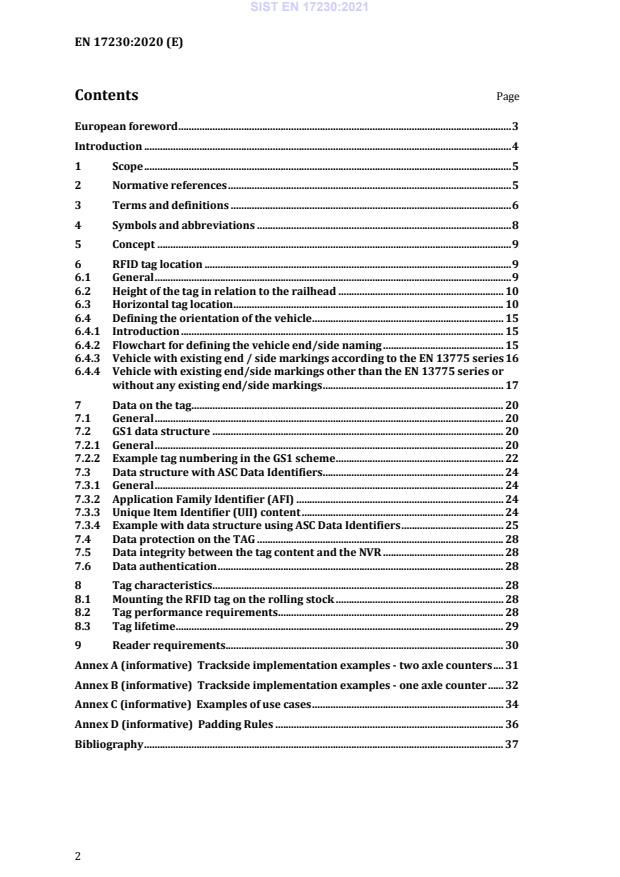
Contents Page
European foreword . 3
Introduction . 4
1 Scope . 5
2 Normative references . 5
3 Terms and definitions . 6
4 Symbols and abbreviations . 8
5 Concept . 9
6 RFID tag location . 9
6.1 General . 9
6.2 Height of the tag in relation to the railhead . 10
6.3 Horizontal tag location . 10
6.4 Defining the orientation of the vehicle . 15
6.4.1 Introduction . 15
6.4.2 Flowchart for defining the vehicle end/side naming . 15
6.4.3 Vehicle with existing end / side markings according to the EN 13775 series 16
6.4.4 Vehicle with existing end/side markings other than the EN 13775 series or
without any existing end/side markings . 17
7 Data on the tag . 20
7.1 General . 20
7.2 GS1 data structure . 20
7.2.1 General . 20
7.2.2 Example tag numbering in the GS1 scheme . 22
7.3 Data structure with ASC Data Identifiers . 24
7.3.1 General . 24
7.3.2 Application Family Identifier (AFI) . 24
7.3.3 Unique Item Identifier (UII) content . 24
7.3.4 Example with data structure using ASC Data Identifiers . 25
7.4 Data protection on the TAG . 28
7.5 Data integrity between the tag content and the NVR . 28
7.6 Data authentication . 28
8 Tag characteristics . 28
8.1 Mounting the RFID tag on the rolling stock . 28
8.2 Tag performance requirements . 28
8.3 Tag lifetime . 29
9 Reader requirements . 30
Annex A (informative) Trackside implementation examples - two axle counters . 31
Annex B (informative) Trackside implementation examples - one axle counter . 32
Annex C (informative) Examples of use cases . 34
Annex D (informative) Padding Rules . 36
Bibliography . 37
European foreword
This document (EN 17230:2020) has been prepared by Technical Committee CEN/TC 225 “AIDC
Technologies”, the secretariat of which is held by TSE.
This European Standard shall be given the status of a national standard, either by publication of
an identical text or by endorsement, at the latest by May 2021, and conflicting national standards
shall be withdrawn at the latest May 2021.
Attention is drawn to the possibility that some of the elements of this document may be the
subject of patent rights. CEN shall not be held responsible for identifying any or all such patent
rights.
According to the CEN-CENELEC Internal Regulations, the national standards organisations of the
following countries are bound to implement this European Standard: Austria, Belgium, Bulgaria,
Croatia, Cyprus, Czech Republic, Denmark, Estonia, Finland, France, Germany, Greece, Hungary,
Iceland, Ireland, Italy, Latvia, Lithuania, Luxembourg, Malta, Netherlands, Norway, Poland,
Portugal, Republic of North Macedonia, Romania, Serbia, Slovakia, Slovenia, Spain, Sweden,
Switzerland, Turkey and the United Kingdom.
Introduction
The aim of this document is to describe the implementation of the European Vehicle Number
(EVN) of the railway rolling stock in an electronic format via the ISO/IEC 18000-63 UHF Radio
Frequency Identification (RFID) technology in order to enable a consistent approach for an
interoperable implementation.
Furthermore, the authors of this document recognize that there exists today rolling stock which
uses other numbering schemes than the EVN, for example in the Baltic States. Some of these cases
are addressed in this document for informative purposes.
1 Scope
The RFID tag location, tag data content and functional requirements have been developed for
application on the main line railway networks. Other networks (such as metro) could apply to
this document but are outside of its scope.
This document contains:
— description of the RFID tag installation location;
— description of the RFID tag data content;
— description of the functional requirements in relation to the RFID tag track side reading
performance.
2 Normative references
The following documents are referred to in the text in such a way that some or all of their content
constitutes requirements of this document. For dated references, only the edition cited applies.
For undated references, the latest edition of the referenced document (including any
amendments) applies.
EN 13775-1, Railway applications - Measuring of new and modified freight wagons - Part 1:
Measuring principles
EN 14067-1:2003, Railway applications - Aerodynamics - Part 1: Symbols and units
EN 50125-3:2003, Railway applications - Environmental conditions for equipment - Part 3:
Equipment for signalling and telecommunications
ETSI EN 302 208, Electromagnetic compatibility and Radio spectrum Matters (ERM); Radio
Frequency Identification Equipment operating in the band 865 MHz to 868 MHz with power levels
up to 2 W and in the band 915 MHz to 921 MHz with power levels up to 4 W
ISO/IEC 15459 (all parts), Information technology - Automatic identification and data capture
techniques - Unique identification
ISO/IEC 18000-63, Information technology - Radio frequency identification for item management -
Part 63: Parameters for air interface communications at 860 MHz to 960 MHz Type C
ISO/IEC 19762, Information technology - Automatic identification and data capture (AIDC)
techniques - Harmonized vocabulary
ISO/IEC 20248, Information technology - Automatic identification and data capture techniques -
Data structures - Digital signature meta structure
3 Terms and definitions
For the purposes of this document, the terms and definitions given in ISO/IEC 19762 and the
following apply.
ISO and IEC maintain terminological databases for use in standardization at the following
addresses:
• IEC Electropedia: available at http://www.electropedia.org/
• ISO Online browsing platform: available at https://www.iso.org/obp
3.1
vehicle
railway vehicle suitable for operation on wheels on railway lines, with or without traction;
composed of one or more structural and functional subsystems; carrying its own EVN
3.2
unit
generic term used to name the rolling stock which is subject to the application of this standard,
which may be composed of several vehicles
3.3
train
operational formation consisting of one or more units
3.4
fixed formation
train formation that can only be reconfigured within a workshop environment
3.5
trainset
fixed formation that can operate as a train; not intended to be reconfigured, except within a
workshop environment; composed of only motored or of motored and non-motored vehicles
3.6
network
lines, stations, terminals, and all kinds of fixed equipment needed to ensure safe and continuous
operation of the/a railway system
3.7
keeper
natural or legal person, who, being the owner of a vehicle or having the right to use it, exploits the
vehicle as a means of transport and is registered as such in a vehicle register
Note 1 to entry: Keeper is also defined in point (21) of Article 2 of Directive (EU) 2016/797.
3.8
ECM
entity in charge of maintenance
Note 1 to entry: Entity in charge of maintenance is also defined in point (28) of Article 2 of Directive (EU)
2016/797.
3.9
infrastructure manager
rail infrastructure manager
Note 1 to entry: Rail infrastructure manager is also defined in point (44) of Article 2 of Directive (EU)
2016/797.
3.10
railway undertaking
public or private undertaking, the activity of which is to provide transport of goods and/or
passengers by rail on the basis that the undertaking is to ensure traction; this also includes
undertakings which provide traction only
Note 1 to entry: Railway undertaking is also defined in point (45) of Article 2 of Directive (EU) 2016/797.
3.11
vehicle end
vehicle extremities in longitudinal direction (along the x-axis according to the coordinate system
defined in EN 14067-1:2003)
3.12
vehicle side
vehicle’s exterior surface in lateral direction (along the y-axis according to the coordinate system
defined in EN 14067-1:2003), reaching from one vehicle end to the other and from vehicle bottom
to vehicle top
3.13
running gear
wheelsets, bogies and associated suspension components
3.14
articulated vehicle with a shared running gear
system of articulation where each vehicle has its own secondary suspension but shares the
running gear with an adjacent vehicle (often referred to as Jacobs bogie)
Note 1 to entry: Typically, each car body is supported at 4 points. Trains made up of vehicles of this type
are a particular type of fixed formation train.
3.15
European vehicle number
EVN
unique 12-digit vehicle identification number, which is assigned to each rail vehicle on the
European Community Rail Network
Note 1 to entry: The European vehicle number is also defined in Article 46 of Directive (EU) 2016/797.
3.16
8-digit Russian vehicle number
unique 8-digit vehicle identification number, which is assigned to each rail vehicle on the Rail
Network of the Commonwealth of Independent States (CIS)
Note 1 to entry The 8-digit Russian vehicle number can be defined according to [The Permanent
Working Group for the Railway Administrative Offices Information Exchange at the Railway Transport IT
Specialists Committee and The Directorate for the Railway Transport Council of the Member States of the
Commonwealth of Independent States (CIS): S ZhA 8001 16, Minutes of 2016 – Reference Guide 8-Digit
Numbering System for 1,520 mm Track Gauge for Passenger Railway Vehicles. 2016] and [The Railway
Transport IT Specialists Committee: -Minutes No. 32 dated 29th April 2005 – Reference Guide 8-Digit
Numbering System for 1,520 mm Track Gauge for Freight Railway Vehicles. 2005]
4 Symbols and abbreviations
For the purposes of the present document, the following abbreviations apply:
AC Alternating Current
AFI Application Family Identifier
ASC Accredited Standards Committee
CSM Common Safety Method
ECM Entity in Charge of Maintenance
EMC Electro Magnetic Compatibility
EPC Electronic Product Code
EUAR European Union Agency for Railways
ECVVR European Centralized Virtual Vehicle Register
EVN European Vehicle Number
GIAI Global Individual Asset Identifier
MH10 Material Handling committee 10
NVR National Vehicle Register
RFID Radio Frequency Identification
TSI Technical Specification for Interoperability
UHF Ultra High Frequency
UII Unique Item Identifier
5 Concept
The concept is to identify rolling stock automatically based on UHF RFID tags. The main focus of
this standard is to clarify applications using fixed track side readers.
Each RFID tag contains a globally unique asset reference encoded according to the Clause 7.
This standard aims to achieve global uniqueness and interoperability.
RFID tag content used in rolling stock identification shall not overlap with any other globally
unique identifier coded into RFID tags.
6 RFID tag location
6.1 General
Each vehicle shall be tagged with two UHF RFID tags according to ISO/IEC 18000-63.
While all other encoded information on the two tags per vehicle is 100 % identical, the content of
the two tags differ only by an encoded end/side information. On one tag per vehicle the encoded
end/side information is “1”, on the other one the encoded end/side information is “2”. For further
details see Clause 7.
The RFID tag location is to be implemented as in the subclauses 6.2 and 6.3. If this is not possible,
the implementation should be done into a location closest to the area fulfilling the functional
requirements set in this standard.
The physical interactions between the reader and the tag, the protocols and the commands, and
the collision arbitration schemes, shall conform to ISO/IEC 18000-63.
Subclause 6.4 explains how to use/relate the end/side information on the tag in order to create a
correlation between them and the already existing physical agreed end/side markings of the
vehicle.
6.2 Height of the tag in relation to the railhead
Key
A1 allowed minimum height
A2 allowed maximum height
BC bogie centre axis / bogie pin
VE 1 vehicle end 1
VE 2 vehicle end 2
VC vehicle centre axis
Figure 1 — Allowed range of vertical tag positions
In Figure 1 above, A1 and A2 are respectively the minimum and maximum height above rail for
positioning the centres of the tags in all conditions of wagon loading and suspension movement:
A1 = 500 mm
A2 = 1300 mm for vehicles with maximum speed > 100 km/h, 1800 mm for vehicles with
maximum speed < = 100km/h.
When planning reader installations, it is recommended to take in account that there might be
existing vehicle implementations outside this range
If the installation is done outside the range A1 - A2, the trackside reading performance as in the
paragraph 8.2 Tag performance requirements cannot be guaranteed.
6.3 Horizontal tag location
The horizontal range of allowed tag positions for vehicle ends which cannot be leading on the
main line, is limited from the left vehicle end to the vehicle centre axis (see area B1 in Figure 2).
Regarding the horizontal range of allowed tag positions for vehicle ends which can be leading on
the main line, the tag shall be installed in relation to the horizontal axis in the area B2 in Figure 3
respectively Figure 4.
On vehicles without bogies (for example two-axle wagons or two-axle shunting engines (see
Annex A)) which have vehicle ends, that can be leading on the main line, the RFID tags at these
vehicle ends shall be installed at least 0,6 m behind the first axle towards the centre of the vehicle
(see area B2 in Figure 5).
Note 1 When planning reader installations, please take into account that there might be older vehicle
implementations outside this range.
Note 2 The limitation of horizontal tag positions for vehicle ends which can be leading on the main line
is meant to allow reader layouts with one reader and one axle counter for tracks with alternating direction
of traffic (see Annex B).
Key
A1 allowed minimum height
A2 allowed maximum height
B1 allowed horizontal tag positioning range for vehicle ends, which cannot be leading on the
main line
BC bogie centre axis / bogie pin
VE 1 vehicle end 1
VE 2 vehicle end 2
VC vehicle centre axis
Figure 2 — Allowed range of vertical tag positions for vehicles, which cannot be leading
on the main line (first angle projection)
Key
A1 allowed minimum height
A2 allowed maximum height
B2 allowed horizontal tag positioning range for vehicle ends, which can be leading on the main
line
BC bogie centre axis / bogie pin
VE 1 vehicle end 1
VE 2 vehicle end 2
VC vehicle centre axis
Figure 3 — Allowed range of vertical tag positions for vehicles, which can be leading on
the main line – Case A: End 1 and end 2 can be leading on the main line (first angle
projection)
Key
A1 allowed minimum height
A2 allowed maximum height
B1 allowed horizontal tag positioning range for vehicle ends, which cannot be leading on the
main line
B2 allowed horizontal tag positioning range for vehicle ends, which can be leading on the main
line
BC bogie centre axis / bogie pin
VE 1 vehicle end 1
VE 2 vehicle end 2
VC vehicle centre axis
Figure 4 — Allowed range of vertical tag positions for vehicles, which can be leading on
the main line – Case B: Only end 2 can be leading on the main line (first angle projection)
Key
A1 allowed minimum height
A2 allowed maximum height
B1 allowed horizontal tag positioning range for vehicle ends, which cannot be leading on the
main line
B2 allowed horizontal tag positioning range for vehicle ends, which can be leading on the main
line
VE 1 vehicle end 1
VE 2 vehicle end 2
VC vehicle centre axis
WA wheel axle
Figure 5 — Special case – Allowed range of vertical tag positions for vehicles with single
axles instead of bogies, which can be leading on the main line – in the case shown, only
end 2 of the vehicle can be leading on the main line (first angle projection)
6.4 Defining the orientation of the vehicle
6.4.1 Introduction
The Clause 6.4 gives information on how to identify orientation of a vehicle. Clause 6.4.3 is
mandatory for vehicles constructed according to EN 13775-1. For all others Clause 6.4.4 provides
a recommendation on how to use the end/side indications on the tag to create a correlation
between them and the physical characteristics of the vehicle. On those vehicles, the end/side
indicator of the tag should be correlated to the first possible element of the following hierarchy
of vehicle characteristics:
1. Possibly existing vehicle end markings;
2. Possibly existing vehicle side markings;
3. Possibly existing axle numbering schemes.
6.4.2 Flowchart for defining the vehicle end/side naming
The implementer shall work through the sections below in the order given until one is found
which matches the particular vehicle under consideration (see Figure 6).
Figure 6 — Procedure to define end / side information in the tags
6.4.3 Vehicle with existing end / side markings according to the EN 13775 series
Each vehicle constructed according to the EN 13775 series has a constructional end 1, an end 2,
a left side, and a right side according to Figure 7. The end/side information is either physically
marked on the vehicle or at least apparent from the dedicated constructional drawings.
On those vehicles, the tag with the end/side information “1” shall be mounted on side L towards
vehicle end 1, the tag with the end/side information “2” on side R towards vehicle end 2,
respectively (Figure 7).
For details, concerning vertical and horizontal tag position, see subclauses 6.2 and 6.3.
Key
Y tag with end/side information “1”
X tag with end/side information “2”
Figure 7 — Vehicle end/side indication according to the EN 13775 series with correlation
of tag information
6.4.4 Vehicle with existing end/side markings other than the EN 13775 series or without
any existing end/side markings
6.4.4.1 Vehicles with existing end markings A/B or 1/2
On vehicles for which end markings A/B or 1/2 already exist, the tag with the end/side
information “1” is recommended to be mounted towards end A or 1, and the tag with the end/side
information “2” towards end B or 2, respectively (Figure 8).
For details, concerning vertical and horizontal tag position, see subclauses 6.2 and 6.3.
Tag position in picture only shown characteristically; for details see subclauses 6.2 and 6.3.
Key
Y tag with end/side information “1”
X tag with end/side information “2”
* A or 1
** B or 2
Figure 8 — Vehicle with end marking A/B and recommended correlation of tag
information
6.4.4.2 Vehicles with existing side marking A/B
On vehicles for which side markings A/B already exist, the tag with the end/side information “2”
is recommend be mounted on side A, the tag with the end/side information “1” on side B,
respectively (Figure 9); see also GS1 Guideline AutoID in Rail.
For details, concerning vertical and horizontal tag position, see subclauses 6.2 and 6.3.
Tag position in picture only shown characteristically; for details see subclauses 6.2 and 6.3.
Key
Y tag with end/side information “1”
X tag with end/side information “2”
Figure 9 — Vehicle with side marking A/B and recommended correlation of tag
information
6.4.4.3 Vehicles with any other or without existing end/side markings
On vehicles for which any other end/side markings already exist or without any existing end/side
markings, the entity mounting the tags may freely define which tag to mount towards which
physical vehicle end, respectively (Figure 10).
If no meaningful correlation to existing end or side marki
...
Questions, Comments and Discussion
Ask us and Technical Secretary will try to provide an answer. You can facilitate discussion about the standard in here.
Loading comments...