


oSIST prEN 50625-1:2025
(Main)Collection, logistics & treatment requirements for WEEE - Part 1: General treatment requirements
Collection, logistics & treatment requirements for WEEE - Part 1: General treatment requirements
This document sets general requirements for the treatment of waste electrical and electronic equipment (WEEE) except for preparing for re-use. The requirements for the treatment process preparing for re-use are described in EN 50614:2020. This document is supplemented, for example by standards covering specific equipment.
NOTE 1 This document is intended to cover WEEE arising from electrical and electronic equipment as listed under Annex III of Directive 2012/19/EU.
NOTE 2 For the purposes of this document, treatment includes recovery or disposal operations, including preparation prior to recovery or disposal.
This document addresses all operators involved in the treatment including related handling, sorting, and storage of WEEE.
This document applies to operators processing WEEE and non-WEEE at the same facility and in the same process, regardless the size of the WEEE-related activities.
Sammlung, Logistik und Behandlung von Elektro- und Elektronik-Altgeräten (WEEE) - Teil 1: Allgemeine Anforderungen an die Behandlung
Exigences de collecte, logistique et traitement pour les déchets d’équipements électriques et électroniques (DEEE) - Partie 1: Exigences générales du traitement
Zahteve za zbiranje, logistiko in obdelavo odpadne električne in elektronske opreme (WEEE) - 1. del: Splošne zahteve za obdelavo
General Information
- Status
- Not Published
- Public Enquiry End Date
- 31-Dec-2025
- Technical Committee
- ITIV - Electronics assembly technology and Environmental standardization
- Current Stage
- 4020 - Public enquire (PE) (Adopted Project)
- Start Date
- 28-Oct-2025
- Due Date
- 17-Mar-2026
- Completion Date
- 05-Dec-2025

Relations
- Effective Date
- 16-Jul-2024
Overview
oSIST prEN 50625-1:2025 establishes the general requirements for the collection, logistics, and treatment of waste electrical and electronic equipment (WEEE), with the exception of processes preparing items for re-use (covered by EN 50614:2020). Published by SIST, this standard is intended for all operators involved in handling, sorting, storing, and treating WEEE, including those processing both WEEE and non-WEEE in the same facility. It supports the environmental principles outlined in Directive 2012/19/EU and aims to prevent pollution, enhance recycling and recovery, and ensure the safety of people and the environment.
The requirements apply to a broad range of activities, from the organizational and administrative framework to technical aspects of WEEE treatment. As part of a series, this standard is designed to harmonize with supplementary standards addressing specific equipment or treatment processes.
Key Topics
- Management and Organization: Outlines the need for robust management systems to address the environmental, safety, and quality dimensions of WEEE treatment activities. Operators are encouraged to integrate these requirements into existing management models to ease compliance and oversight.
- Technical Infrastructure: Specifies the infrastructural and technological prerequisites of treatment facilities. Emphasizes risk assessment, fire prevention (including risks from lithium batteries), and site security to prevent unauthorized access and theft.
- Training and Competence: Mandates comprehensive training for all personnel in safety, emergency response, and WEEE treatment operations, ensuring effectiveness through regular evaluation.
- Handling, Storage, and Monitoring: Requires suitable storage-often weatherproof-especially for items like gas discharge lamps, CRT equipment, and batteries. Monitoring obligations extend to documenting the origin, processing, and final destination of WEEE and its derived fractions.
- Treatment Operations: Addresses steps such as receiving WEEE, de-pollution (removal of hazardous substances and components), sorting, and preparation for further recovery or disposal.
- Recovery and Recycling Documentation: Establishes procedures for tracking recycling and recovery targets, including documentation of material flows and final processing stages to support regulatory compliance and sustainable resource management.
Applications
This standard is practically applicable in a range of professional settings where electrical or electronic waste is managed, including:
- WEEE Treatment Operators: Ensures that operators meet harmonized standards for handling, sorting, storage, and processing, regardless of facility size or mixed-waste activities.
- Recycling Facilities: Guides operators in the separation, monitoring, and treatment of WEEE fractions (such as metals, plastics, batteries, and hazardous components), improving recovery rates and minimizing environmental impact.
- Producers and Compliance Schemes: Supports producers of electrical and electronic products in meeting their extended producer responsibility (EPR) and legal obligations tied to WEEE directives.
- Regulatory Authorities: Assists with inspection, monitoring, and enforcement by providing clear criteria for proper WEEE management, documentation, and reporting.
By standardizing these practices, oSIST prEN 50625-1:2025 enables higher rates of recycling and recovery, mitigates negative environmental effects, supports a circular economy, and helps organizations demonstrate compliance with both European and national legislation.
Related Standards
Several closely related and supplementary standards offer further requirements for specific product groups or processes:
- EN 50614:2020: Preparing for re-use of WEEE
- EN 50625-2-1:2014: Lamps
- EN 50625-2-2:2015: Flat panel displays and cathode ray tubes
- EN 50625-2-3:2017: Temperature exchange equipment
- EN 50625-2-4:2017: Photovoltaic panels
- CLC/TS 50625-4:2017: Collection and logistics specifics
- CLC/TS 50625-5:2017: Final processing stages
For organizations involved in WEEE treatment, it is crucial to reference these related standards to ensure comprehensive and compliant operations across all product categories and lifecycle stages.
Keywords: WEEE, waste electrical and electronic equipment, recycling, treatment requirements, logistics, collection, de-pollution, environmental compliance, electrical and electronic waste, SIST standard, Directive 2012/19/EU, recovery, storage, safety, sustainability, circular economy.
Get Certified
Connect with accredited certification bodies for this standard

IMQ S.p.A. (Certification)
Italian electrical product certification.

SLG Prüf- und Zertifizierungs GmbH
German testing and certification body.

UL Solutions
Global safety science company with testing, inspection and certification.
Sponsored listings
Frequently Asked Questions
oSIST prEN 50625-1:2025 is a draft published by the Slovenian Institute for Standardization (SIST). Its full title is "Collection, logistics & treatment requirements for WEEE - Part 1: General treatment requirements". This standard covers: This document sets general requirements for the treatment of waste electrical and electronic equipment (WEEE) except for preparing for re-use. The requirements for the treatment process preparing for re-use are described in EN 50614:2020. This document is supplemented, for example by standards covering specific equipment. NOTE 1 This document is intended to cover WEEE arising from electrical and electronic equipment as listed under Annex III of Directive 2012/19/EU. NOTE 2 For the purposes of this document, treatment includes recovery or disposal operations, including preparation prior to recovery or disposal. This document addresses all operators involved in the treatment including related handling, sorting, and storage of WEEE. This document applies to operators processing WEEE and non-WEEE at the same facility and in the same process, regardless the size of the WEEE-related activities.
This document sets general requirements for the treatment of waste electrical and electronic equipment (WEEE) except for preparing for re-use. The requirements for the treatment process preparing for re-use are described in EN 50614:2020. This document is supplemented, for example by standards covering specific equipment. NOTE 1 This document is intended to cover WEEE arising from electrical and electronic equipment as listed under Annex III of Directive 2012/19/EU. NOTE 2 For the purposes of this document, treatment includes recovery or disposal operations, including preparation prior to recovery or disposal. This document addresses all operators involved in the treatment including related handling, sorting, and storage of WEEE. This document applies to operators processing WEEE and non-WEEE at the same facility and in the same process, regardless the size of the WEEE-related activities.
oSIST prEN 50625-1:2025 is classified under the following ICS (International Classification for Standards) categories: 13.030.99 - Other standards related to wastes; 29.020 - Electrical engineering in general; 29.100.01 - Components for electrical equipment in general; 31.020 - Electronic components in general; 31.220.01 - Electromechanical components in general. The ICS classification helps identify the subject area and facilitates finding related standards.
oSIST prEN 50625-1:2025 has the following relationships with other standards: It is inter standard links to SIST EN 50625-1:2014. Understanding these relationships helps ensure you are using the most current and applicable version of the standard.
oSIST prEN 50625-1:2025 is associated with the following European legislation: EU Directives/Regulations: 2012/19/EU; Standardization Mandates: M/518. When a standard is cited in the Official Journal of the European Union, products manufactured in conformity with it benefit from a presumption of conformity with the essential requirements of the corresponding EU directive or regulation.
oSIST prEN 50625-1:2025 is available in PDF format for immediate download after purchase. The document can be added to your cart and obtained through the secure checkout process. Digital delivery ensures instant access to the complete standard document.
Standards Content (Sample)
SLOVENSKI STANDARD
01-december-2025
Zahteve za zbiranje, logistiko in obdelavo odpadne električne in elektronske
opreme (WEEE) - 1. del: Splošne zahteve za obdelavo
Collection, logistics & treatment requirements for WEEE - Part 1: General treatment
requirements
Sammlung, Logistik und Behandlung von Elektro- und Elektronik-Altgeräten (WEEE) -
Teil 1: Allgemeine Anforderungen an die Behandlung
Exigences de collecte, logistique et traitement pour les déchets d’équipements
électriques et électroniques (DEEE) - Partie 1: Exigences générales du traitement
Ta slovenski standard je istoveten z: prEN 50625-1:2025
ICS:
13.030.99 Drugi standardi v zvezi z Other standards related to
odpadki wastes
29.020 Elektrotehnika na splošno Electrical engineering in
general
31.020 Elektronske komponente na Electronic components in
splošno general
2003-01.Slovenski inštitut za standardizacijo. Razmnoževanje celote ali delov tega standarda ni dovoljeno.
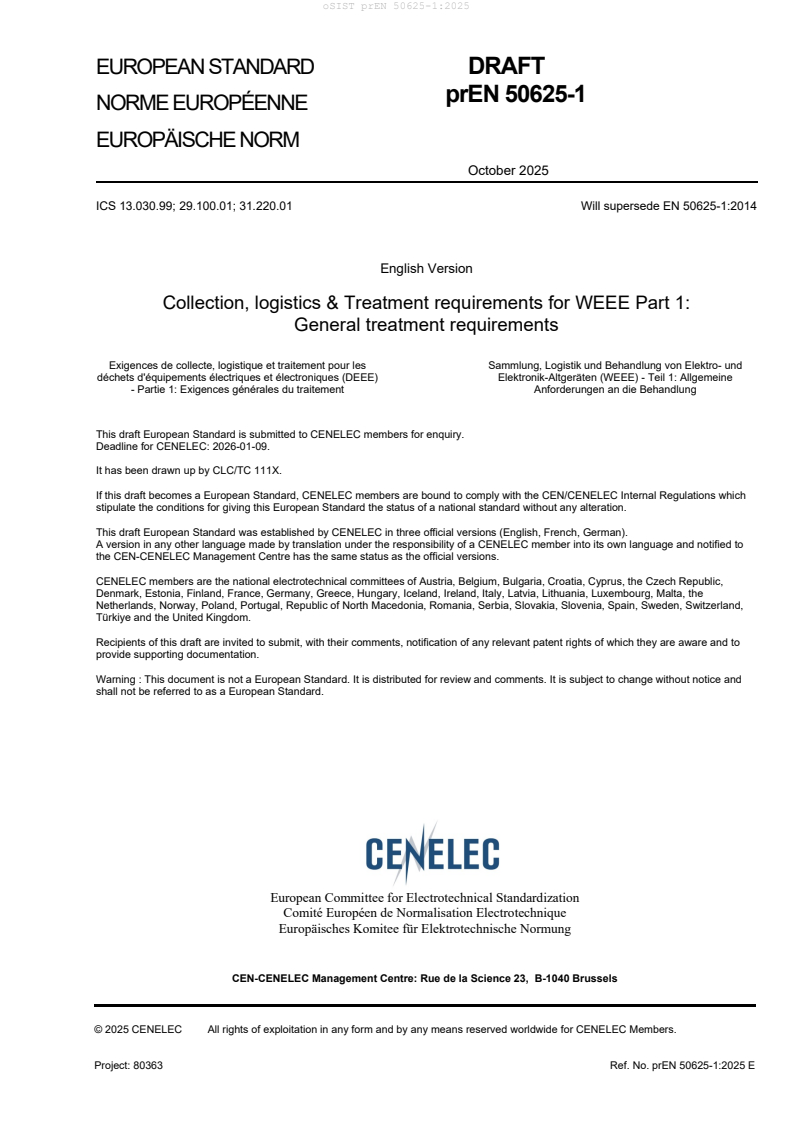
EUROPEAN STANDARD DRAFT
prEN 50625-1
NORME EUROPÉENNE
EUROPÄISCHE NORM
October 2025
ICS 13.030.99; 29.100.01; 31.220.01 Will supersede EN 50625-1:2014
English Version
Collection, logistics & Treatment requirements for WEEE Part 1:
General treatment requirements
Exigences de collecte, logistique et traitement pour les Sammlung, Logistik und Behandlung von Elektro- und
déchets d'équipements électriques et électroniques (DEEE) Elektronik-Altgeräten (WEEE) - Teil 1: Allgemeine
- Partie 1: Exigences générales du traitement Anforderungen an die Behandlung
This draft European Standard is submitted to CENELEC members for enquiry.
Deadline for CENELEC: 2026-01-09.
It has been drawn up by CLC/TC 111X.
If this draft becomes a European Standard, CENELEC members are bound to comply with the CEN/CENELEC Internal Regulations which
stipulate the conditions for giving this European Standard the status of a national standard without any alteration.
This draft European Standard was established by CENELEC in three official versions (English, French, German).
A version in any other language made by translation under the responsibility of a CENELEC member into its own language and notified to
the CEN-CENELEC Management Centre has the same status as the official versions.
CENELEC members are the national electrotechnical committees of Austria, Belgium, Bulgaria, Croatia, Cyprus, the Czech Republic,
Denmark, Estonia, Finland, France, Germany, Greece, Hungary, Iceland, Ireland, Italy, Latvia, Lithuania, Luxembourg, Malta, the
Netherlands, Norway, Poland, Portugal, Republic of North Macedonia, Romania, Serbia, Slovakia, Slovenia, Spain, Sweden, Switzerland,
Türkiye and the United Kingdom.
Recipients of this draft are invited to submit, with their comments, notification of any relevant patent rights of which they are aware and to
provide supporting documentation.
Warning : This document is not a European Standard. It is distributed for review and comments. It is subject to change without notice and
shall not be referred to as a European Standard.
European Committee for Electrotechnical Standardization
Comité Européen de Normalisation Electrotechnique
Europäisches Komitee für Elektrotechnische Normung
CEN-CENELEC Management Centre: Rue de la Science 23, B-1040 Brussels
© 2025 CENELEC All rights of exploitation in any form and by any means reserved worldwide for CENELEC Members.
Project: 80363 Ref. No. prEN 50625-1:2025 E
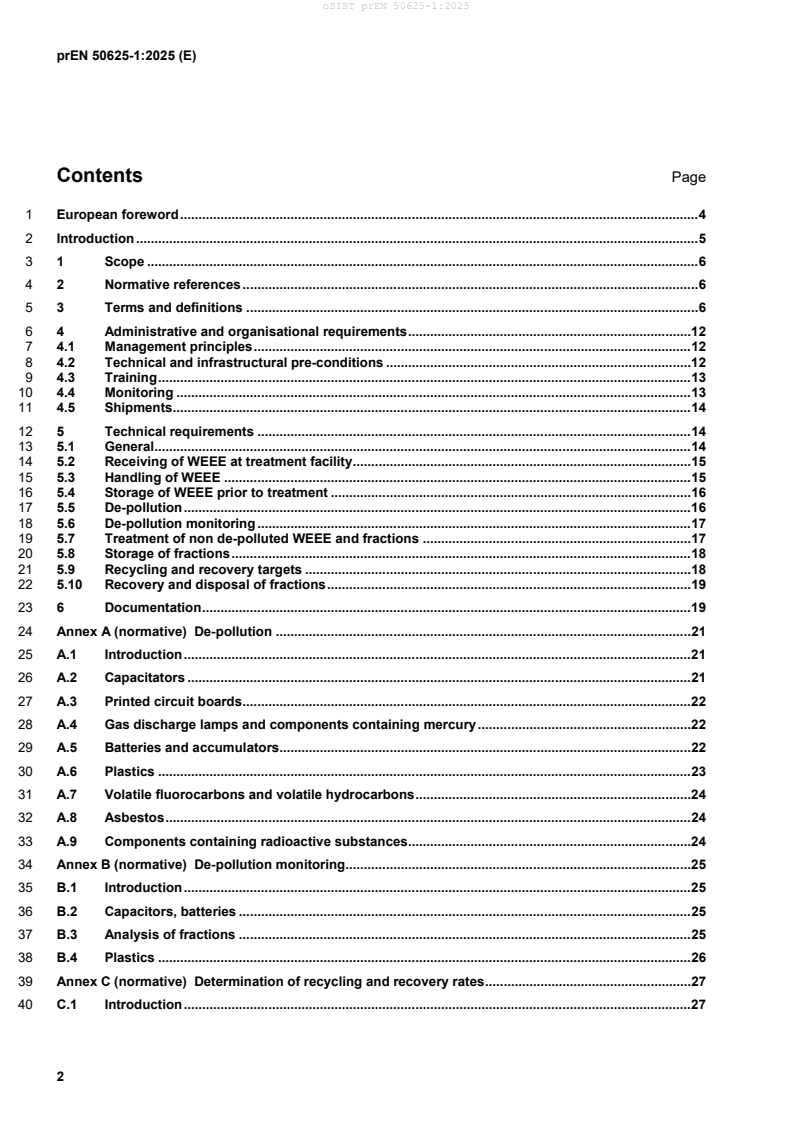
Contents Page
1 European foreword . 4
2 Introduction . 5
3 1 Scope . 6
4 2 Normative references . 6
5 3 Terms and definitions . 6
6 4 Administrative and organisational requirements . 12
7 4.1 Management principles . 12
8 4.2 Technical and infrastructural pre-conditions . 12
9 4.3 Training . 13
10 4.4 Monitoring . 13
11 4.5 Shipments. 14
12 5 Technical requirements . 14
13 5.1 General . 14
14 5.2 Receiving of WEEE at treatment facility . 15
15 5.3 Handling of WEEE . 15
16 5.4 Storage of WEEE prior to treatment . 16
17 5.5 De-pollution . 16
18 5.6 De-pollution monitoring . 17
19 5.7 Treatment of non de-polluted WEEE and fractions . 17
20 5.8 Storage of fractions . 18
21 5.9 Recycling and recovery targets . 18
22 5.10 Recovery and disposal of fractions . 19
23 6 Documentation . 19
24 Annex A (normative) De-pollution . 21
25 A.1 Introduction . 21
26 A.2 Capacitators . 21
27 A.3 Printed circuit boards . 22
28 A.4 Gas discharge lamps and components containing mercury . 22
29 A.5 Batteries and accumulators. 22
30 A.6 Plastics . 23
31 A.7 Volatile fluorocarbons and volatile hydrocarbons . 24
32 A.8 Asbestos . 24
33 A.9 Components containing radioactive substances. 24
34 Annex B (normative) De-pollution monitoring . 25
35 B.1 Introduction . 25
36 B.2 Capacitors, batteries . 25
37 B.3 Analysis of fractions . 25
38 B.4 Plastics . 26
39 Annex C (normative) Determination of recycling and recovery rates . 27
40 C.1 Introduction . 27
41 C.2 Principles . 27
42 C.3 Calculation . 28
43 C.4 Documentation . 29
44 C.5 Classification of final use of fractions . 30
45 Annex D (normative) Requirements concerning batch tests. 31
46 D.1 Introduction . 31
47 D.2 Input material . 31
48 D.3 Processing . 32
49 D.4 Output fractions . 32
50 D.5 Documentation and validation . 33
51 Annex E (normative) Void . 34
52 Annex F (informative) Materials and components of WEEE requiring selective treatment . 35
53 Annex G (informative) Documentation for downstream monitoring and establishment of
54 recycling and recovery rates . 37
55 G.1 Information requirements . 37
56 Bibliography . 38
57 European foreword
58 This document (prEN 50625-1:2025) has been prepared by CLC/TC 111X “Environmental aspects for
59 electrical and electronic products and systems”.
60 This document is currently submitted to the Enquiry.
61 The following dates are proposed:
• latest date by which the existence of this (doa) dav + 6 months
document has to be announced at national
level
• latest date by which this document has to be (dop) dav + 12 months
implemented at national level by publication of
an identical national standard or by
endorsement
• latest date by which the national standards (dow) dav + 36 months
conflicting with this document have to be (to be confirmed or
withdrawn modified when voting)
62 This document will supersede EN 50625-1:2014 and all of its amendments and corrigenda (if any).
63 prEN 50625-1:2025 includes the following significant technical changes with respect to EN 50625-1:2014:
64 — …
65 — …
66 This document has been prepared under a standardization request addressed to CENELEC by the European
67 Commission. The Standing Committee of the EFTA States subsequently approves these requests for its
68 Member States.
69 Introduction
70 This document aims to assist organisations in:
71 — achieving effective and efficient treatment of waste electrical and electronic equipment (WEEE) in order
72 to prevent pollution and minimize emissions;
73 — promoting increased recycling to facilitate a circular economy;
74 — promoting high quality recovery;
75 — preventing inappropriate disposal of WEEE and fractions thereof;
76 — assuring protection of human health and safety, and the environment;
77 — preventing shipments of WEEE to operators whose operations fail to comply with this normative
78 document or a comparable set of requirements.
79 This document supports the objectives of the Community's environment policy. These aim to preserve, protect
80 and improve the quality of the environment, protect human health and utilize natural resources prudently and
81 rationally. That policy is based on the precautionary principle and the maxims that preventive action to
82 minimize environmental damage should, where possible, be rectified at source and the polluter should pay.
83 The requirements of this document are applicable to all types of WEEE. It is supported by other standards
84 covering particular treatment requirements for:
85 — lamps (EN 50625-2-1:2014, CLC/TS 50625-3-2:2016),
86 — flat panel displays (FPD), cathode ray tubes (CRT) (EN 50625-2-2:2015, CLC/TS 50625-3-3:2017),
87 — temperature exchange equipment (EN 50625-2-3:2017, CLC/TS 50625-3-4:2017),
88 — photovoltaic panels (EN 50625-2-4:2017, CLC/TS 50625-3-5:2017),
89 — collection and logistics (CLC/TS 50625-4:2017),
90 — final processing CLC/TS 50625-5:2017),
91 — preparing for re-use (EN 50614: 2020).
92 Additionally this document is supported by a technical report which provides a more detailed comparison
93 between normative treatment requirements derived directly from the legal text of Directive 2012/19/EC,
94 especially Annex VII, and between informative treatment requirements going beyond the strict requirements of
95 Directive 2012/19/EC.
96 This document has been prepared in order to support European legislation and so uses some of the terms
97 defined in European law. In order to ensure that the definitions used in this document are identical to those
98 defined by law these terms are identified as 'void', indicating that this document does not contain a definition,
99 and a 'Note to entry' that identifies which law contains the legal definition and the term as defined in that law.
100 EN 50625-1:2014 was revised in and replaced by this edition to improve the clarity of requirements, to update
101 outdated references, to align with technological developments and to clarify relationships and boundaries with
102 the CLC/TS 50625 series and EN 50625 series and EN 50614.
103 1 Scope
104 This document sets general requirements for the treatment of waste electrical and electronic equipment
105 (WEEE) except for preparing for re-use. The requirements for the treatment process preparing for re-use are
106 described in EN 50614:2020. This document is supplemented, for example by standards covering specific
107 equipment.
108 NOTE 1 This document is intended to cover WEEE arising from electrical and electronic equipment as listed under
109 Annex III of Directive 2012/19/EU.
110 NOTE 2 For the purposes of this document, treatment includes recovery or disposal operations, including preparation
111 prior to recovery or disposal.
112 This document addresses all operators involved in the treatment including related handling, sorting, and
113 storage of WEEE.
114 This document applies to operators processing WEEE and non-WEEE at the same facility and in the same
115 process, regardless the size of the WEEE-related activities.
116 2 Normative references
117 The following documents are referred to in the text in such a way that some or all of their content constitutes
118 requirements of this document. For dated references, only the edition cited applies. For undated references,
119 the latest edition of the referenced document (including any amendments) applies.
120 CLC/TS 50625-3-1:2015, Collection, logistics & treatment requirements for WEEE - Part 3-1: Specification for
121 de-pollution - General
122 EN 50625-2-3:2017, Collection, logistics & treatment requirements for WEEE - Part 2-3: Treatment
123 requirements for temperature exchange equipment and other WEEE containing VFC and/or VHC
124 3 Terms and definitions
125 For the purposes of this document, the following terms and definitions apply.
126 3.1
127 acceptor
128 organisation that physically and/or contractually takes ownership of fractions derived from WEEE, after
129 processing has been carried out by a treatment operator
130 Note 1 to entry: For the purposes of this document, this definition also applies to acceptors processing fractions derived
131 from WEEE and other waste at the same facility.
132 Note 2 to entry: Acceptors may include first acceptor (that directly accepts one or more fractions from the treatment
133 operators), downstream acceptor (every acceptor in the processing chain following after the first acceptor), and final
134 acceptor (acceptor where the final processing step takes place).
135 3.2
136 backlight
137 part of the flat panel display, used with certain flat panel display technologies, that illuminates the flat panel to
138 make the image visible
139 3.3
140 batch
141 definite and well-defined amount of WEEE or fractions thereof
142 3.4
143 batch test
144 procedure where a batch is processed to determine the composition of the resulting output fractions and de-
145 pollution performance
146 3.5
147 category
148 group of WEEE to describe types of electrical and electronic equipment within its scope
149 Note 1 to entry: When used in this document, the word “category” should be construed as applying in a comparable
150 manner.
151 Note 2 to entry: WEEE are listed in Directive 2012/19/EU, Annex III.
152 3.6
153 component
154 constituent part of a device which cannot be physically divided into smaller parts without losing its particular
155 function
156 [SOURCE: IEV 151-11-21]
157 3.7
158 cathode ray tube
159 CRT
160 component used to display images comprising a vacuum tube and integral fluorescent screen
161 3.8
162 CRT equipment
163 equipment containing at least one cathode ray tube
164 3.9
165 collection
166 gathering of WEEE, including the preliminary sorting and preliminary storage of WEEE for the purposes of
167 transport to a logistics facility or a treatment facility
168 Note 1 to entry: The term “collection” is adapted from Directive 2008/98/EC. “Collection” means the gathering of waste,
169 including the preliminary sorting and preliminary storage of waste for the purposes of transport to a waste treatment
170 facility.
171 3.10
172 collection facility
173 location designated for the gathering of WEEE to facilitate separate collection
174 Note 1 to entry: Collection facilities and their operators are typically registered, listed, or otherwise approved or
175 designated in accordance with the national legislation implementing Directive 2012/19/EU and Directive 2008/98/EU.
176 Note 2 to entry: A collection facility is different from a collection point. For the definition of the collection point see the
177 CLC/TS 50625-4.
178 3.11
179 de-pollution
180 selective treatment during which certain substances, mixtures and components are removed from the WEEE
181 stream
182 Note 1 to entry: Annex F identifies which (certain) substances, mixtures and components shall be removed and treated
183 from separately collected WEEE, the process being de-pollution.
184 Note 2 to entry: For the purposes of this document, de-pollution is concerned only with the removal of substances,
185 mixtures and components that are hazardous or substances of concern.
186 3.12
187 disposal
188 void
189 Note 1 to entry: Directive 2008/98/EC defines disposal: “‘disposal’ means any operation which is not recovery even
190 where the operation has as a secondary consequence the reclamation of substances or energy. Annex I sets out a non-
191 exhaustive list of disposal operations”.
192 3.13
193 end-of-waste
194 result of treatment whereby the resulting fractions are no longer classified as waste
195 Note 1 to entry: Fractions that cease to become waste, following a recovery or recycling operation in compliance with
196 specific criteria according to Article 6 of Directive 2008/98/EC, are regarded as secondary materials and so have achieved
197 end-of-waste status.
198 3.14
199 energy recovery
200 production of useful energy through direct and controlled combustion or other processing of waste
201 Note 1 to entry: Energy recovery is a recovery operation where the material is used principally as a fuel or other means
202 to generate energy, see R1 of Annex II of Directive 2008/98/EC.
203 3.15
204 flat panel
205 that part of the flat panel display where the image is produced
206 3.16
207 flat panel display
208 FPD
209 assembly of components that use technologies that produce and display an image without the use of cathode
210 ray tubes
211 Note 1 to entry: The term “flat panel module” is also used as an alternative to the term flat panel display.
212 3.17
213 FPD equipment
214 equipment using a flat panel display having a display screen larger than 100 cm
215 EXAMPLES LCD TV, plasma TV, LCD screens and monitors, and notebooks
216 3.18
217 fraction
218 separate output stream generated by the treatment of WEEE
219 3.19
220 hazardous waste
221 void
222 Note 1 to entry: The term “hazardous waste” – “waste which exhibits one or more hazardous properties” is defined in
223 Directive 2008/98/EC; the properties of hazardous waste are described in Annex III of Directive 2008/98/EC.
224 3.20
225 lamp
226 electric light source, for general or special lighting purposes, but excluding filament bulbs
227 Note 1 to entry: General lighting can include straight and compact fluorescent lamps, high intensity discharge lamps –
228 including high pressure sodium and metal halide lamps, low pressure sodium lamps, and Light Emitting Diodes (including
229 organic). Special lighting is provided by lamps for the purpose of spreading or controlling light (UV lamps, projection
230 lamps, xenon lamps, etc.). A non-exhaustive list can be found in Directive 2012/19/EU.
231 3.21
232 gas discharge
233 void
234 Note 1 to entry: Commission Regulation (EU) 2019/2020 of 1 October 2019 laying down ecodesign requirements for
235 light sources and separate control gears pursuant to Directive 2009/125/EC of the European Parliament and of the Council
236 and repealing Commission Regulations (EC) No 244/2009, (EC) No 245/2009 and (EU) No 1194/2012 (Text with EEA
237 relevance.) contains the following: “gas discharge’ means a phenomenon where light is produced, directly or indirectly, by
238 an electric discharge through a gas, plasma, metal vapour or mixture of gases and vapours;
239 Note 2 to entry: Examples of lamps featuring gas discharge technology include straight fluorescent lamps, compact
240 fluorescent lamps, fluorescent lamps, high intensity discharge lamps – including pressure sodium lamps and metal halide
241 lamps, low pressure sodium lamps, and exclude LED lamps and filament lamps.
242 Note 3 to entry: Some backlighting lamps (typically non-LED types), as mentioned in Annex F and Directive 2012/19/EU
243 Annex VII, contain mercury.
244 3.22
245 logistics
246 planning, implementing and controlling of the transportation, handling, preliminary storage and/or preliminary
247 sorting of WEEE from the point of origin to point of delivery
248 [SOURCE: CLC/TS 50625-4:2017, 3.10, modified]
249 3.23
250 logistics facility
251 facility where an operator performs receiving and preparing for transportation to WEEE treatment operators
252 3.24
253 material recovery
254 void
255 Note 1 to entry: Decision 2011/753/EU contains the following: “’material recovery’ means any recovery operation,
256 excluding energy recovery and the reprocessing into materials which are to be used as fuel”.
257 3.25
258 national competent authority
259 body appointed in accordance with the prevailing laws of a Member State to execute various functions
260 Note 1 to entry: Examples of such functions include performing market surveillance and issuing licences or permits
261 3.26
262 operator
263 entity that performs one or more processes on WEEE
264 Note 1 to entry: Processes on WEEE could include collection, logistics, handling, shipping, sorting, storage, transport,
265 trading, treatment, or preparing for re-use.
266 Note 2 to entry: For the purposes of this document, this definition applies to operators processing WEEE and non-WEEE
267 at the same facility and in the same process, regardless the size of the WEEE related activities.
268 3.27
269 photovoltaic panel
270 PV panel
271 equipment intended to be permanently installed to a fixed installation that converts solar radiation into
272 electrical energy
273 3.28
274 preparing for re-use
275 void
276 Note 1 to entry: Directive 2008/98/EC contains the following: “‘preparing for re-use’ means checking, cleaning or
277 repairing recovery operations, by which products or components of products that have become waste are prepared so that
278 they can be re-used without any other pre-processing”.
279 3.29
280 recovery
281 void
282 Note 1 to entry: Directive 2008/98/EC contains the following: “‘recovery’ means any operation the principal result of
283 which is waste serving a useful purpose by replacing other materials which would otherwise have been used to fulfil a
284 particular function, or waste being prepared to fulfil that function, in the plant or in the wider economy. Annex II sets out a
285 non-exhaustive list of recovery operations”.
286 3.30
287 recycling
288 void
289 Note 1 to entry: Directive 2008/98/EC contains the following: “‘recycling’ means any recovery operation by which waste
290 materials are reprocessed into products, materials or substances whether for the original or other purposes. It includes the
291 reprocessing of organic material but does not include energy recovery and the reprocessing into materials that are to be
292 used as fuels or for backfilling operations”.
293 3.31
294 removal
295 void
296 Note 1 to entry: Directive 2012/19/EU contains the following: “‘removal’ means manual, mechanical, chemical or
297 metallurgic handling with the result that hazardous substances, mixtures and components are contained in an identifiable
298 stream or are an identifiable part of a stream within the treatment process. A substance, mixture or component is
299 identifiable if it can be monitored to verify environmentally safe treatment”.
300 Note 2 to entry: Where used in this standard, it is essential that the word “remove” be construed as having a meaning
301 that corresponds to the defined word “removal”.
302 3.32
303 re-use
304 void
305 Note 1 to entry: Directive 2008/98/EC contains the following: “‘re-use’ means any operation by which products or
306 components that are not waste are used again for the same purpose for which they were conceived”.
307 3.33
308 storage
309 process whereby WEEE is selected and placed in a particular location awaiting treatment or preparing for re-
310 use
311 3.34
312 temperature exchange equipment
313 equipment using fluids other than water for temperature exchange
314 Note 1 to entry: This is a category of electrical and electronic equipment covered by Directive 2012/19/EU. This Directive
315 does not define what is meant by “temperature exchange equipment” but Annex IV contains the following non-exhaustive
316 list: refrigerators, freezers, equipment which automatically delivers cold products, air conditioning equipment,
317 dehumidifying equipment, heat pumps, radiators containing oil and other temperature exchange equipment using fluids
318 other than water for the temperature exchange. If this term is clarified further by the European Commission or the Courts
319 then it is essential that the term as used in this standard is construed in the same way as those clarifications.
320 3.35
321 treatment
322 void
323 Note 1 to entry: Directive 2008/98/EC contains the following: “‘treatment’ means recovery or disposal operations,
324 including preparation prior to recovery or disposal”.
325 Note 2 to entry: Requirements for the treatment operation of preparing for re-use are set out in EN 50614.
326 3.36
327 treatment facility
328 location where WEEE undergoes treatment
329 3.37
330 treatment operator
331 operator responsible for the treatment of WEEE
332 3.38
333 volatile fluorocarbon
334 VFC
335 organic chemical compound consisting of carbon and fluorine atoms (in some cases also with chlorine and/or
336 hydrogen), which is able to change phase when used as a refrigerant or produce cells in plastic structure of an
337 insulating foam when used as a blowing agent
338 Note 1 to entry: Common commercial designations for these materials are R12, R11 for CFCs, R22, R141b for HCFCs
339 and R134a, R410A, R407C, R32, R1234yf and R1234ze for HFCs.
340 Note 2 to entry: Chemically, volatile fluorocarbons could be either alkyl halides or alkene halides.
341 Note 3 to entry: CFC, HCFC, HFC and HC are all VOCs – Volatile Organic Compounds.
342 Note 4 to entry: Annex F and Directive 2012/19/EU Annex VII part 2 refers to ‘foam’ rather than ‘insulating foam’, as
343 used in the above definition.
344 3.39
345 volatile hydrocarbon
346 VHC
347 organic chemical compound consisting entirely of hydrogen and carbon which is able to change phase when
348 used as a refrigerant or produce cells in plastic structure of an insulating foam when used as a blowing agent
349 Note 1 to entry: Common designations for volatile hydrocarbons are R290 for propane, R600a for isobutane, R1270 for
350 propene and RC601 for cyclopentane. Mixtures of VHC are also possible.
351 Note 2 to entry: Annex F and Directive 2012/19/EU Annex VII part 2 refers to ‘foam’ rather than ‘insulating foam’, as
352 used in the above definition.
353 3.40
354 waste
355 void
356 Note 1 to entry: Directive 2008/98/EC contains the following: “‘waste’ means any substance or object which the holder
357 discards or intends or is required to discard”.
358 3.41
359 waste electrical and electronic equipment
360 WEEE
361 void
362 Note 1 to entry: Directive 2012/19/EU contains the following: “‘waste electrical and electronic equipment’ or ‘WEEE’
363 means electrical or electronic equipment which is waste within the meaning of Article 3(1) of Directive 2008/98/EC,
364 including all components, subassemblies and consumables which are part of the product at the time of discarding”.
365 Note 2 to entry: Considering note 1 to entry, this standard covers whole equipment discarded as WEEE and fractions
366 thereof.
367 Note 3 to entry: For the purposes of this document the terms equipment and appliances have the same meaning.
368 4 Administrative and organisational requirements
369 4.1 Management principles
370 The treatment operator shall ensure that a management system is in place for all WEEE-related activities in
371 the fields of health, safety, environment and quality.
372 The treatment operator shall demonstrate continuous improvement of their WEEE-related activities by a
373 review and management process. This management process shall be updated or revised as changes occur to
374 the activities of the treatment operator and evaluated in order to monitor its effectiveness.
375 The treatment operator shall establish and maintain a procedure in order to identify legal requirements that
376 are applicable to the environmental, health and safety aspects of all activities, services and processes
377 undertaken at the treatment facility.
378 NOTE 1 A register of the treatment operator’s activities and related legal provisions could be maintained together with
379 valid permits required by all relevant authorities.
380 It is recommended that treatment operators integrate the implementation of this standard into any existing
381 management system to facilitate easy review and inspection.
382 4.2 Technical and infrastructural pre-conditions
383 The treatment operator shall possess infrastructure, in terms of size, technologies installed, fire safety and
384 characteristics of the operations, that is suitable for the activities performed on site. Suitability of the site shall
385 be assessed by a risk management process for all tasks performed on site and include the identification of
386 hazards, the assessment of risk and, where appropriate, the elimination or reduction of the risk, and
387 documentation of the process.
388 This risk assessment shall include the identification of those locations and activities that require the use of
389 personal protective equipment and procedures to be followed.
390 NOTE 1 Directive 89/391/EEC provides requirements for the safety and health for the protection of workers at work.
391 NOTE 2 Risk assessment includes the identification of fire risks, e.g. from Li-ion batteries.
392 NOTE 3 Measures to address fire risks include surveillance of risk areas, also during closing hours of the facility (e.g.
393 remote surveillance, patrols etc.)
394 Treatment facilities including storage areas shall be designed, organized, and maintained to provide safe
395 access to, and egress from, the site. Treatment facilities including storage areas shall be secured to prevent
396 access by unauthorized persons, to prevent damage to and theft of WEEE and components.
397 Weatherproof covering shall be required for the areas where:
398 — whole equipment and/or components, intended for preparing for re-use are stored and/or prepared for re-
399 use, or;
400 — WEEE containing or suspected of containing batteries with lithium (except button cells) is stored.
401 — WEEE and fractions thereof that can cause emissions that are hazardous to the environment is stored
402 and/or treated.
403 The treatment operator shall, at all times, provide weatherproof covering for the following types of WEEE; gas
404 discharge lamps and equipment containing gas discharge lamps, CRT equipment, flat panel displays and flat
405 panel display equipment.
406 Requirements for the storage of WEEE prior to treatment, including requirements for weatherproof covering,
407 are given in 5.4.
408 4.3 Training
409 All persons at the treatment facility shall be made familiar with the environmental, health, safety and fire
410 prevention policy of the treatment facility. Employees and contractors involved in operations shall be
411 instructed and trained to perform the tasks assigned to them.
412 Training shall include emergency (e.g. fires) response planning, occupational health and safety measures,
413 and training for the relevant operations performed on site. The effectiveness and suitability of training shall be
414 checked regularly. Training programmes shall be delivered at a level suitable to the trainee in form, manner
415 and language.
416 Employee training materials and information including technical guidance documents, risk assessments,
417 safety statements, information charts, information tables, photos or examples of components of WEEE, and
418 safety data sheets for hazardous chemical components shall be available at the work place and be easily
419 accessible at all times.
420 Where the risk assessment has identified the need for personal protective equipment (PPE) training in the
421 proper use of that PPE shall be provided.
422 4.4 Monitoring
423 The treatment operator shall record the origin of each consignment of WEEE accepted at the treatment
424 facility.
425 NOTE 1 The origin of each consignment is typically location and reference details of the collection facility or logistics
426 facility.
427 The treatment operator shall record the downstream treatment of WEEE and fractions thereof until end-of-
428 waste status is reached or until the WEEE is prepared for re-use, recycled, recovered, or disposed of.
429 Documentation, see Clause 6, shall record treatment in accordance with Clause 5.
430 NOTE 2 Downstream monitoring requirements also apply where the acceptor is a dealer or broker, and when shipped
431 across borders.
432 The treatment operator shall maintain the following records from the output fractions resulting from the
433 treatment process:
434 — for fractions that have reached end-of-waste status, only data on the composition of the fractions;
435 — for metal fractions which contain less than 2 % of non-metal fractions, data on the mass of the output
436 fraction, and the type of treatment technology(ies);
437 — for non-metal fractions containing less than 2 % of other materials data on the mass of the output fraction,
438 information on the first acceptor and the final treatment technology(ies);
439 NOTE 3 The number 2 % is taken as a value which is considered to be sufficiently low when calculating recycling and
440 recovery rates. It is not intended to represent a value that will be acceptable to downstream treatment operators. For
441 calculation of output fractions see D.4.
442 — for fractions which are classified as hazardous according to the European list of wastes; and/or fractions
443 containing materials and components covered by Annex F, data on the mass of the output fraction,
444 information on the first acceptor and the downstream acceptor(s) of the fractions, and the final treatment
445 technology(ies);
446 — for all other fractions, the mass of the output fraction, information on the first acceptor, composition of the
447 fractions and the final treatment technology(ies) shall be recorded;
448 — for final fractions being forwarded for energy recovery or disposal, the final treatment technology,
449 information on the downstream acceptor(s), composition of the fractions and the final treatment
450 technology(ies) shall be recorded.
451 An overview of documentation required for downstream monitoring and the determination of recycling and
452 recovery rates is given in Annex G.
453 The information recorded on acceptors shall include the following details: name, address of treatment facility,
454 treatment technology and permit issued by the national competent authority.
455 NOTE 4 The documentation of downstream monitoring for the output fractions means the provision of information
456 regarding each acceptor and not to each shipment.
457 NOTE 5 Regulations 333/2011, 1179/2012 and 715/2013 establish the criteria for determining when certain types of
458 materials obtained from waste cease to be waste under Directive 2008/98/EC.
459 NOTE 6 The European List of Waste (Commission Decision 2000/532/EC) provides a harmonized list of waste.
460 NOTE 7 Final treatment technology means the process used for final treatment of materials, e.g. smelting, incineration
461 with or without energy recovery, plastic recycling.
462 NOTE 8 Examples of fractions containing materials and components covered by Annex F include washing machines
463 with only the motor taken out (where these still contain Annex F components); and a non-ferrous stream containing
464 electrolyte capacitors having a height or diameter > 25 mm or proportionately similar volume.
465 4.5 Shipments
466 No treatment operator shall initiate or contribute to shipments of WEEE, or fractions thereof, which would
467 result in treatment that is not in compliance with this standard.
468 NOTE 1 Regulatory requirements for cross border shipments, including monitoring, are covered in Regulation
469 1013/2006/EC and Article 10 of Directive 2012/19/EU.
470 NOTE 2 Council Directive 2006/117/EURATOM defines requirements for the supervision and control of shipments of
471 radioactive waste between Member States and into and out of the Community.
472 WEEE selected for “preparing for reuse” should preferably be sent to an operator working according to
473 EN 50614 “preparing for reuse”.
474 5 Technical requirements
475 5.1 General
476 WEEE shall be handled and stored with due care in order to avoid release of hazardous substances into air,
477 water, or soil, as a result of damage and/or leakage.
478 NOTE 1 Handling includes loading and unloading.
479 During handling and storage attention shall be given but not limited to:
480 — temperature exchange equipment (to avoid damage to the temperature exchange system);
481 — CRT equipment (to avoid implosion and/or emissions of fluorescent coatings);
482 — gas discharge lamps, appliances containing gas discharge lamps and appliances containing mercury
483 switches (to avoid breakage resulting in the release of mercury);
484 — smoke detectors (as they may contain radioactive components);
485 — appliances containing oil and other fluids within an internal circuit, or capacitors containing mineral or
486 synthetic oil (to avoid spillages and other emissions);
487 — photovoltaic panels (to prevent injury from broken glass and electrocution caused through contact with
488 hazardous voltages generated when the panels are exposed to light).
489 — appliances containing:
490 o asbestos or refractory ceramic fibres (to avoid release of asbestos or refractory ceramic fibres); or
491 o consumables containing toner and ink; or
492 o batteries with lithium, with the exception of button cells;
493 NOTE 2 Appliances that contain gas discharge lamps include sun beds and flat panel display equipment.
494 NOTE 3 Appliances that can contain asbestos include heaters and stoves.
495 NOTE 4 Vacuum insulation panels, e.g. used in fridges and freezers, can contain ceramic fibres as a bulking agent.
496 The treatment operator shall demonstrate how confidential a
...