


SIST EN 13615:2004
(Main)Methods for the analysis of ingot tin - Determination of impurity element contents in tin grades 99,90 % and 99,85 % by atomic spectrometry
Methods for the analysis of ingot tin - Determination of impurity element contents in tin grades 99,90 % and 99,85 % by atomic spectrometry
This European Standard specifies atomic spectroscopic methods (Atomic Absorption Spectrometry (AAS) or inductively coupled plasma Atomic Emission Spectrometry (ICP-AES)) intended for the analysis of ingot tin. It is written for use by experienced analysts familiar with atomic spectrometric techniques..
Verfahren für die Analyse von Zinn in Masseln - Bestimmung des Gehaltes an Verunreinigungselementen in Zinn der Reinheitsgrade 99,90 % und 99,85 % durch Atomspektrometrie
Diese Europäische Norm legt Verfahren für die Analyse von Zinn in Masseln mit Hilfe der Atomspektrometrie (Atomabsorptionsspektrometrie (AAS) oder Atomemissionsspektrometrie mit induktiv gekoppeltem Plasma (ICP-AES)) fest. Sie wurde für erfahrene Analytiker erarbeitet, die mit den Verfahren der Atomspektrometrie vertraut sind.
Méthodes d'analyse des lingots d'étain - Détermination des teneurs en impuretés dans l'étain de qualité 99,90 % et 99,85 % par spectrométrie atomique
La présente Norme européenne décrit les méthodes de spectrométrie atomique [spectrométrie d'absorption atomique (SAA), ou spectrométrie d'émission à plasma induit par haute fréquence (SEP-SEA)] destinées à l'analyse des lingots d'étain. Elle a été rédigée afin d'être utilisée par des analystes expérimentés et rompus aux techniques de spectrométrie atomique.
Metode za analizo kositrovih ingotov – Določevanje nečistoč v kositru s čistostjo 99,90 % in 99,85 % z atomsko spektrometrijo
General Information
- Status
- Published
- Publication Date
- 31-Dec-2003
- Technical Committee
- INEK - Nonferrous metals
- Current Stage
- 6060 - National Implementation/Publication (Adopted Project)
- Start Date
- 01-Jan-2004
- Due Date
- 01-Jan-2004
- Completion Date
- 01-Jan-2004



Relations
- Effective Date
- 28-Jan-2026
- Effective Date
- 22-Dec-2008
Overview
SIST EN 13615:2004 is a European standard developed by the Slovenski inštitut za standardizacijo (SIST) that details robust methods for the analysis of ingot tin. Specifically, it prescribes atomic spectrometric techniques-Atomic Absorption Spectrometry (AAS) and Inductively Coupled Plasma Atomic Emission Spectrometry (ICP-AES)-for determining the content of impurity elements in tin ingots with purity grades of 99.90% and 99.85%. This standard is essential for laboratories and industries concerned with the quality control and chemical analysis of tin and tin alloys, ensuring traceability and comparability in the analytical results of impurity determination.
Key Topics
- Analytical Scope: Covers the detection and quantification of impurities in high-purity ingot tin through atomic spectrometric methods.
- Relevant Tin Grades: Applicable to tin grades with 99.90% and 99.85% purity.
- Spectrometric Techniques: Includes methodology for both Atomic Absorption Spectrometry (AAS) and Inductively Coupled Plasma Atomic Emission Spectrometry (ICP-AES), allowing flexibility depending on laboratory capabilities.
- Sample Preparation: Guidelines for sample dissolution using specific acid mixtures to ensure accurate detection of trace elements.
- Calibration and Reference Materials: Use of certified reference materials (CRM) and calibration solutions to achieve precision and accuracy.
- Instrument Performance: Normative annexes specify minimum performance criteria for both AAS and ICP-AES instruments, referencing checks for linearity, precision, and stability.
- Reporting Requirements: Specifies the mandatory information for analytical test reports, including sample identification, method reference, results, test date, and observations.
Applications
Industrial Quality Control
- Tin Production: Assists tin manufacturers in verifying purity levels of their products before distribution.
- Alloy Production: Essential for industries where tin is used as an alloying element, such as in solder and bronze production, to ensure that impurity levels meet regulatory and performance standards.
Analytical Laboratories
- Routine Analysis: Used by laboratories specializing in chemical analysis of metals to conduct reliable and standardized assays of ingot tin.
- Interlaboratory Comparisons: Supports consistency across different laboratories by providing uniform procedures for sample preparation, instrument calibration, and measurement.
Regulatory Compliance
- Standard Certification: Facilitates manufacturers and importers in complying with European and international standards regarding metal purity.
- Traceability and Documentation: Enables the creation of comprehensive documentation and traceable records for batch analysis and product certification.
Related Standards
Professionals referencing SIST EN 13615:2004 should also consider the following related standards for comprehensive coverage in the chemical analysis of metals:
- EN 610: Tin and tin alloys – Ingot tin (provides sampling procedures).
- ISO 7530-1: Nickel alloys - Flame atomic absorption spectrometric analysis - Part 1: General requirements and sample dissolution.
- ISO/CD 12235-1: Guidelines for the use of ICP-AES for metals analysis.
- ISO/CD 13204-1: Guidelines for the use of flame AAS for metals analysis.
These standards collectively support best practices in the accurate determination of impurities in tin and other metals, ensuring data reliability and product quality in the metallurgy sector.
Keywords: SIST EN 13615:2004, tin analysis, impurity determination, atomic absorption spectrometry, ICP-AES, ingot tin, metal purity, standard methods, chemical analysis, European standard, laboratory procedures, quality control, tin grades.
Get Certified
Connect with accredited certification bodies for this standard

Element Materials Technology
Materials testing and product certification.

Inštitut za kovinske materiale in tehnologije
Institute of Metals and Technology. Materials testing, metallurgical analysis, NDT.
Sponsored listings
Frequently Asked Questions
SIST EN 13615:2004 is a standard published by the Slovenian Institute for Standardization (SIST). Its full title is "Methods for the analysis of ingot tin - Determination of impurity element contents in tin grades 99,90 % and 99,85 % by atomic spectrometry". This standard covers: This European Standard specifies atomic spectroscopic methods (Atomic Absorption Spectrometry (AAS) or inductively coupled plasma Atomic Emission Spectrometry (ICP-AES)) intended for the analysis of ingot tin. It is written for use by experienced analysts familiar with atomic spectrometric techniques..
This European Standard specifies atomic spectroscopic methods (Atomic Absorption Spectrometry (AAS) or inductively coupled plasma Atomic Emission Spectrometry (ICP-AES)) intended for the analysis of ingot tin. It is written for use by experienced analysts familiar with atomic spectrometric techniques..
SIST EN 13615:2004 is classified under the following ICS (International Classification for Standards) categories: 77.040.30 - Chemical analysis of metals; 77.150.60 - Lead, zinc and tin products. The ICS classification helps identify the subject area and facilitates finding related standards.
SIST EN 13615:2004 has the following relationships with other standards: It is inter standard links to SIST EN 610:1998, SIST EN 13615:2004/AC:2004. Understanding these relationships helps ensure you are using the most current and applicable version of the standard.
SIST EN 13615:2004 is available in PDF format for immediate download after purchase. The document can be added to your cart and obtained through the secure checkout process. Digital delivery ensures instant access to the complete standard document.
Standards Content (Sample)
2003-01.Slovenski inštitut za standardizacijo. Razmnoževanje celote ali delov tega standarda ni dovoljeno.Verfahren für die Analyse von Zinn in Masseln - Bestimmung des Gehaltes an Verunreinigungselementen in Zinn der Reinheitsgrade 99,90 % und 99,85 % durch AtomspektrometrieMéthodes d'analyse des lingots d'étain - Détermination des teneurs en impuretés dans l'étain de qualité 99,90 % et 99,85 % par spectrométrie atomiqueMethods for the analysis of ingot tin - Determination of impurity element contents in tin grades 99,90 % and 99,85 % by atomic spectrometry77.150.60L]GHONLLead, zinc and tin products77.040.30Kemijska analiza kovinChemical analysis of metalsICS:Ta slovenski standard je istoveten z:EN 13615:2001SIST EN 13615:2004en01-januar-2004SIST EN 13615:2004SLOVENSKI
STANDARD
EUROPEAN STANDARDNORME EUROPÉENNEEUROPÄISCHE NORMEN 13615December 2001ICS 77.040.30; 77.150.60English versionMethods for the analysis of ingot tin - Determination of impurityelement contents in tin grades 99,90 % and 99,85 % by atomicspectrometryMéthodes pour l'analyse des lingots d'étain - Déterminationdes teneurs en impuretés dans l'étain de qualité 99,90 % et99,85 % par spectrométrie atomiqueVerfahren für die Analyse von Zinn in Masseln -Bestimmung des Gehaltes an Verunreinigungselementen inZinn der Reinheitsgrade 99,90 % und 99,85 % durchAtomspektrometrieThis European Standard was approved by CEN on 5 October 2001.CEN members are bound to comply with the CEN/CENELEC Internal Regulations which stipulate the conditions for giving this EuropeanStandard the status of a national standard without any alteration. Up-to-date lists and bibliographical references concerning such nationalstandards may be obtained on application to the Management Centre or to any CEN member.This European Standard exists in three official versions (English, French, German). A version in any other language made by translationunder the responsibility of a CEN member into its own language and notified to the Management Centre has the same status as the officialversions.CEN members are the national standards bodies of Austria, Belgium, Czech Republic, Denmark, Finland, France, Germany, Greece,Iceland, Ireland, Italy, Luxembourg, Netherlands, Norway, Portugal, Spain, Sweden, Switzerland and United Kingdom.EUROPEAN COMMITTEE FOR STANDARDIZATIONCOMITÉ EUROPÉEN DE NORMALISATIONEUROPÄISCHES KOMITEE FÜR NORMUNGManagement Centre: rue de Stassart, 36
B-1050 Brussels© 2001 CENAll rights of exploitation in any form and by any means reservedworldwide for CEN national Members.Ref. No. EN 13615:2001 ESIST EN 13615:2004
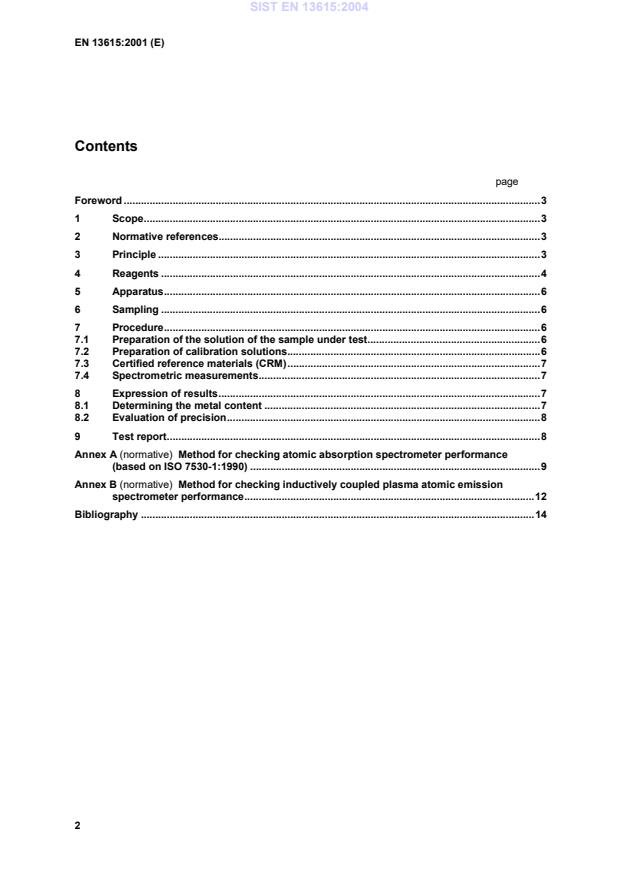
Method for checking atomic absorption spectrometer performance(based on ISO 7530-1:1990).9Annex B (normative)
Method for checking inductively coupled plasma atomic emissionspectrometer performance.12Bibliography.14SIST EN 13615:2004
1,18 g/ml).4.3Dilute hydrochloric acid (1 + 1). Dilute 100 ml hydrochloric acid (4.2) with 100 ml water.WARNINGThe acid should added to the water for safety reasons.4.4Dilute hydrochloric acid (1 + 19). Dilute 10 ml hydrochloric acid (4.2) with 190 ml water.4.5Nitric acid, (
1,42 g/ml).4.6Sulphuric acid, (
1,84 g/ml).4.7Tartaric acid or citric acid.4.8Acid mixture. Add 250 ml hydrochloric acid (4.2) to 250 ml water. Cool. Add 250 ml nitric acid (4.5)and 50 g tartaric (or citric) acid (4.7). Dilute to 1 l with water.4.9Dilute nitric acid (1 + 1). Add 100 ml nitric acid (4.5) to 100 ml water.4.10Dilute nitric acid (1 + 4). Add 50 ml nitric acid (4.5) to 200 ml water.4.11Dilute nitric acid (1 + 9). Add 25 ml nitric acid (4.5) to 225 ml water.4.12Dilute nitric acid (1 %). Dilute 5 ml nitric acid (4.5) up to 500 ml.4.13Standard solutions of metals. Freshly purchased standard metal solutions may be used orstandard metal solutions should be made up as follows (4.13.1 to 4.13.25).4.13.1Standard antimony solution (1 ml contains 1 mg Sb). Place 0,10 g Sb in 5 ml sulphuricacid (4.6) and heat to complete dissolution. Cool. Carefully add approximately 10 ml water and coolagain. Transfer to a 100 ml volumetric flask with dilute hydrochloric acid (1 + 1) (4.3).4.13.2Standard antimony solution (1 ml contains 0,2 mg Sb). Transfer 10,00 ml of Sb solution 4.13.1to a 50 ml volumetric flask and make up to volume with dilute hydrochloric acid (1 + 1) (4.3).4.13.3Standard copper solution (1 ml contains 1 mg Cu). Dissolve 0,10 g Cu in 10 ml dilute nitricacid (1 + 4) (4.9) and transfer to a 100 ml volumetric flask. Make up to volume with water and mix.4.13.4Standard copper solution (1 ml contains 0,2 mg Cu). Transfer 10,00 ml of Cu solution 4.13.3to a 50 ml volumetric flask and make up to volume with water and mix.4.13.5Standard lead solution (1 ml contains 1 mg Pb). Dissolve 0,10 g Pb in 10 ml dilute nitric acid(1 + 4) (4.10) and transfer to a 100 ml volumetric flask. Make up to volume with water and mix.4.13.6Standard lead solution (1 ml contains 0,1 mg Pb). Transfer 5,00 ml of Pb solution 4.13.5 to a50 ml volumetric flask and make up to volume with water and mix.4.13.7Standard bismuth solution (1 ml contains 1 mg Bi). Dissolve 0,10 g Bi in 10 ml dilute nitricacid (1 + 1) (4.9) and transfer to a 100 ml volumetric flask. Make up to volume with water and mix.SIST EN 13615:2004
0,1 g high purity tin (4.14) into each of 7 250 mlbeakers. Add 20 ml of the acid mixture (4.8) and warm to dissolve. Cool and transfer to a 100 mlvolumetric flask and add the amounts of the standard metal solutions shown in Table 1.Finally make up to the mark with dilute hydrochloric acid (4.4).SIST EN 13615:2004
...