


SIST EN 50527-2-3:2022
(Main)Procedure for the assessment of the exposure to electromagnetic fields of workers bearing active implantable medical devices - Part 2-3: Specific assessment for workers with implantable neurostimulators
Procedure for the assessment of the exposure to electromagnetic fields of workers bearing active implantable medical devices - Part 2-3: Specific assessment for workers with implantable neurostimulators
This document provides the procedure for the specific assessment required in EN 50527 1:2016, Annex A, for workers with implanted neurostimulator systems (NS), specifically of the type used for spinal cord stimulation (SCS).
It is recognized that implantable neurostimulators have been developed for a wide variety of clinical applications, however the SCS devices within the scope of this document represent the largest segment of the implantable neurostimulator applications thus far.
NOTE 1 If the worker has other Active Implantable Medical Devices (AIMDs) implanted additionally, they are assessed separately according to EN 50527 1 or other particular standards within the EN 50527 series.
The purpose of the specific assessment is to determine the risk for workers with implanted SCS devices arising from exposure to electromagnetic fields (EMF) at the workplace. The assessment includes the likelihood of clinically significant effects.
NOTE 2 This document does not address risks from contact currents, or the effects upon any associated non-implantable devices (e.g. Patient Programmers).
The techniques described in the different approaches can also be used for the assessment of publicly accessible areas.
The frequency range to be observed is from 0 Hz to 3 GHz. Above 3 GHz no interference with the devices within the scope of this document is expected to occur.
NOTE 3 The rationale for limiting the observation range to 3 GHz can be found in ISO 14708 3 [1].
NOTE 4 Further information concerning the functions of neurostimulator systems can be found at https://www.aans.org/Patients/Neurosurgical-Conditions-and-Treatments/Spinal-Cord-Stimulation.
Verfahren zur Beurteilung der Exposition von Arbeitnehmern mit aktiven implantierbaren medizinischen Geräten gegenüber elektromagnetischen Feldern - Teil 2-3: Besondere Beurteilung für Arbeitnehmer mit implantierbaren Neurostimulatoren
Procédure pour l'évaluation de l'exposition des travailleurs porteurs de dispositifs médicaux implantables actifs aux champs électromagnétiques - Partie 2-3 : Evaluation spécifique aux travailleurs porteurs de neurostimulateurs implantés
Le présent document fournit la procédure d’évaluation spécifique exigée dans l’Annexe A de l’EN 50527 1:2016, pour les travailleurs porteurs de systèmes neurostimulateurs (SN) implantés, spécifiquement du type utilisé pour la stimulation médullaire (SM).
Il est admis que des neurostimulateurs implantables ont été développés pour un grand nombre d’applications cliniques; toutefois, les dispositifs de SM qui relèvent du domaine d’application du présent document représentent jusqu’à présent le plus grand segment des applications de neurostimulateurs implantables.
NOTE 1 Si le travailleur porte, en plus, d’autres dispositifs médicaux implantables actifs (DMIA) implantés, ceux-ci sont évalués de manière individuelle conformément à l’EN 50527 1 ou à d’autres normes particulières de la série EN 50527.
Cette évaluation spécifique a pour objet de déterminer, pour des travailleurs porteurs de dispositifs de SM implantés, le risque qui provient de l’exposition aux champs électromagnétiques (EMF – electromagnetic fields) sur le lieu de travail. L’évaluation comprend la probabilité d’effets cliniquement significatifs.
NOTE 2 Le présent document ne traite pas des risques vis-à-vis des courants de contact ni des effets sur tout dispositif non implantable associé (par exemple, un dispositif de programmation du patient).
Les techniques décrites dans les différentes approches peuvent aussi être utilisées pour l’évaluation des zones accessibles au public.
La plage de fréquences à observer comprend le spectre entre 0 Hz et 3 GHz. Au-dessus de 3 GHz, aucune interférence n’est réputée se produire avec les dispositifs qui relèvent du domaine d’application du présent document.
NOTE 3 La justification de la limitation de la plage d’observation à 3 GHz peut être consultée dans l’ISO 14708 3 [1].
NOTE 4 Des informations complémentaires relatives aux fonctions des systèmes neurostimulateurs peuvent être consultées à l’adresse https://www.aans.org/Patients/Neurosurgical-Conditions-and-Treatments/Spinal-Cord-Stimulation.
Postopek ocenjevanja izpostavljenosti delavcev z aktivnimi medicinskimi vsadki elektromagnetnim poljem - 2-3. del: Specifično ocenjevanje delavcev z vsadljivimi nevrostimulatorji
Ta evropski standard podaja postopek specifičnega ocenjevanja v skladu z dodatkom A standarda EN 50527 1:2015 za delavce z vsajenimi nevrostimulatorji (npr. v hrbtenjači, globoko v možganih, v mrežnici in mehurju). Ponuja različne pristope za izvedbo ocenjevanja tveganja, uporabiti pa je treba najprimernejšega. Če delavec dodatno uporablja druge aktivne medicinske vsadke (AIMD), mora biti ocenjen ločeno.
General Information
- Status
- Published
- Public Enquiry End Date
- 27-Feb-2020
- Publication Date
- 02-Dec-2021
- Technical Committee
- INIR - Electromagnetic fields in human enviornment
- Current Stage
- 6060 - National Implementation/Publication (Adopted Project)
- Start Date
- 16-Nov-2021
- Due Date
- 21-Jan-2022
- Completion Date
- 03-Dec-2021
Standard: EN 50527-2-3:2021
Title: Procedure for the assessment of the exposure to electromagnetic fields of workers bearing active implantable medical devices - Part 2-3: Specific assessment for workers with implantable neurostimulators
Overview
EN 50527-2-3:2021 provides a structured, workplace-focused procedure to assess the risk from electromagnetic fields (EMF) for workers implanted with neurostimulator systems - specifically spinal cord stimulation (SCS) devices. The standard defines a specific assessment process required by EN 50527-1:2016 (Annex A) to determine the likelihood of clinically significant effects (unintended nerve stimulation or tissue damage) caused by EMF exposure in the frequency range 0 Hz to 3 GHz. It excludes assessment of contact currents and effects on non‑implantable equipment (e.g., patient programmers). Above 3 GHz, interference is not expected (see ISO 14708-3).
Key topics and technical requirements
- Phased assessment process: The standard structures the assessment into clear phases:
- Phase 0: Exclusion criteria based on medical history and physician warnings.
- Phase 1: Consideration of device type, lead configuration and SCS therapy characteristics.
- Phase 2a / 2b / 2c: EMF comparison against Action Levels and device-specific thresholds, and reassessment using known lead characteristics.
- Risk metrics: Uses NSR (Nerve Stimulation Risk) and TDR (Tissue Damage Risk) indicators to quantify potential clinical effects from external EMF.
- Assessment levels and conversion: Defines assessment levels for electric and magnetic fields, and procedures to convert workplace measurements into values usable for SCS risk evaluation.
- Modeling guidance: Informative annexes (D and E) give modelling techniques, tissue conductivities, electrode factors and detailed calculation methods for induced voltages/currents and internal electric fields.
- Documentation requirements: Specifies information to record for a compliant specific assessment and links to device-specific replacement tables (Annex A).
Practical applications
- Assessing EMF safety for workers with implanted spinal cord stimulators in industrial, medical and public environments.
- Determining safe proximity rules and work restrictions around EMF sources (e.g., MRI exclusion zones, industrial RF equipment).
- Supporting occupational health & safety (OH&S) management systems and employer risk assessments to protect AIMD-bearing employees.
- Informing procurement and workplace design decisions where EMF sources are present.
Who uses this standard
- Occupational health & safety managers and safety officers
- EMF/health physicists and workplace assessors
- Medical device manufacturers and clinical engineers
- Employers with staff implanted with neurostimulators
- Regulators and certification bodies
- Clinical teams advising implanted patients on workplace safety
Related standards
- EN 50527-1:2016 (general AIMD worker assessment procedure)
- Other parts of the EN 50527 series for different AIMD types
- ISO 14708-3 (rationale for frequency limit above 3 GHz)
Keywords: EN 50527-2-3:2021, electromagnetic fields, implantable neurostimulators, spinal cord stimulation, SCS, NSR, TDR, EMF workplace assessment, AIMD occupational safety.



Frequently Asked Questions
SIST EN 50527-2-3:2022 is a standard published by the Slovenian Institute for Standardization (SIST). Its full title is "Procedure for the assessment of the exposure to electromagnetic fields of workers bearing active implantable medical devices - Part 2-3: Specific assessment for workers with implantable neurostimulators". This standard covers: This document provides the procedure for the specific assessment required in EN 50527 1:2016, Annex A, for workers with implanted neurostimulator systems (NS), specifically of the type used for spinal cord stimulation (SCS). It is recognized that implantable neurostimulators have been developed for a wide variety of clinical applications, however the SCS devices within the scope of this document represent the largest segment of the implantable neurostimulator applications thus far. NOTE 1 If the worker has other Active Implantable Medical Devices (AIMDs) implanted additionally, they are assessed separately according to EN 50527 1 or other particular standards within the EN 50527 series. The purpose of the specific assessment is to determine the risk for workers with implanted SCS devices arising from exposure to electromagnetic fields (EMF) at the workplace. The assessment includes the likelihood of clinically significant effects. NOTE 2 This document does not address risks from contact currents, or the effects upon any associated non-implantable devices (e.g. Patient Programmers). The techniques described in the different approaches can also be used for the assessment of publicly accessible areas. The frequency range to be observed is from 0 Hz to 3 GHz. Above 3 GHz no interference with the devices within the scope of this document is expected to occur. NOTE 3 The rationale for limiting the observation range to 3 GHz can be found in ISO 14708 3 [1]. NOTE 4 Further information concerning the functions of neurostimulator systems can be found at https://www.aans.org/Patients/Neurosurgical-Conditions-and-Treatments/Spinal-Cord-Stimulation.
This document provides the procedure for the specific assessment required in EN 50527 1:2016, Annex A, for workers with implanted neurostimulator systems (NS), specifically of the type used for spinal cord stimulation (SCS). It is recognized that implantable neurostimulators have been developed for a wide variety of clinical applications, however the SCS devices within the scope of this document represent the largest segment of the implantable neurostimulator applications thus far. NOTE 1 If the worker has other Active Implantable Medical Devices (AIMDs) implanted additionally, they are assessed separately according to EN 50527 1 or other particular standards within the EN 50527 series. The purpose of the specific assessment is to determine the risk for workers with implanted SCS devices arising from exposure to electromagnetic fields (EMF) at the workplace. The assessment includes the likelihood of clinically significant effects. NOTE 2 This document does not address risks from contact currents, or the effects upon any associated non-implantable devices (e.g. Patient Programmers). The techniques described in the different approaches can also be used for the assessment of publicly accessible areas. The frequency range to be observed is from 0 Hz to 3 GHz. Above 3 GHz no interference with the devices within the scope of this document is expected to occur. NOTE 3 The rationale for limiting the observation range to 3 GHz can be found in ISO 14708 3 [1]. NOTE 4 Further information concerning the functions of neurostimulator systems can be found at https://www.aans.org/Patients/Neurosurgical-Conditions-and-Treatments/Spinal-Cord-Stimulation.
SIST EN 50527-2-3:2022 is classified under the following ICS (International Classification for Standards) categories: 11.040.40 - Implants for surgery, prosthetics and orthotics; 17.240 - Radiation measurements. The ICS classification helps identify the subject area and facilitates finding related standards.
SIST EN 50527-2-3:2022 is associated with the following European legislation: EU Directives/Regulations: 2013/35/EU; Standardization Mandates: M/351. When a standard is cited in the Official Journal of the European Union, products manufactured in conformity with it benefit from a presumption of conformity with the essential requirements of the corresponding EU directive or regulation.
SIST EN 50527-2-3:2022 is available in PDF format for immediate download after purchase. The document can be added to your cart and obtained through the secure checkout process. Digital delivery ensures instant access to the complete standard document.
Standards Content (Sample)
SLOVENSKI STANDARD
01-januar-2022
Postopek ocenjevanja izpostavljenosti delavcev z aktivnimi medicinskimi vsadki
elektromagnetnim poljem - 2-3. del: Specifično ocenjevanje delavcev z vsadljivimi
nevrostimulatorji
Procedure for the assessment of the exposure to electromagnetic fields of workers
bearing active implantable medical devices - Part 2-3: Specific assessment for workers
with implantable neurostimulators
Ta slovenski standard je istoveten z: EN 50527-2-3:2021
ICS:
11.040.40 Implantanti za kirurgijo, Implants for surgery,
protetiko in ortetiko prosthetics and orthotics
17.240 Merjenje sevanja Radiation measurements
2003-01.Slovenski inštitut za standardizacijo. Razmnoževanje celote ali delov tega standarda ni dovoljeno.
EUROPEAN STANDARD EN 50527-2-3
NORME EUROPÉENNE
EUROPÄISCHE NORM October 2021
ICS 17.240; 11.040.40
English Version
Procedure for the assessment of the exposure to
electromagnetic fields of workers bearing active implantable
medical devices - Part 2-3: Specific assessment for workers with
implantable neurostimulators
Procédure pour l'évaluation de l'exposition des travailleurs Verfahren zur Beurteilung der Exposition von
porteurs de dispositifs médicaux implantables actifs aux Arbeitnehmern mit aktiven implantierbaren medizinischen
champs électromagnétiques - Partie 2-3 : Evaluation Geräten gegenüber elektromagnetischen Feldern - Teil 2-3:
spécifique aux travailleurs porteurs de neurostimulateurs Besondere Beurteilung für Arbeitnehmer mit
implantés implantierbaren Neurostimulatoren
This European Standard was approved by CENELEC on 2021-08-09. CENELEC members are bound to comply with the CEN/CENELEC
Internal Regulations which stipulate the conditions for giving this European Standard the status of a national standard without any alteration.
Up-to-date lists and bibliographical references concerning such national standards may be obtained on application to the CEN-CENELEC
Management Centre or to any CENELEC member.
This European Standard exists in three official versions (English, French, German). A version in any other language made by translation
under the responsibility of a CENELEC member into its own language and notified to the CEN-CENELEC Management Centre has the
same status as the official versions.
CENELEC members are the national electrotechnical committees of Austria, Belgium, Bulgaria, Croatia, Cyprus, the Czech Republic,
Denmark, Estonia, Finland, France, Germany, Greece, Hungary, Iceland, Ireland, Italy, Latvia, Lithuania, Luxembourg, Malta, the
Netherlands, Norway, Poland, Portugal, Republic of North Macedonia, Romania, Serbia, Slovakia, Slovenia, Spain, Sweden, Switzerland,
Turkey and the United Kingdom.
European Committee for Electrotechnical Standardization
Comité Européen de Normalisation Electrotechnique
Europäisches Komitee für Elektrotechnische Normung
CEN-CENELEC Management Centre: Rue de la Science 23, B-1040 Brussels
© 2021 CENELEC All rights of exploitation in any form and by any means reserved worldwide for CENELEC Members.
Ref. No. EN 50527-2-3:2021 E
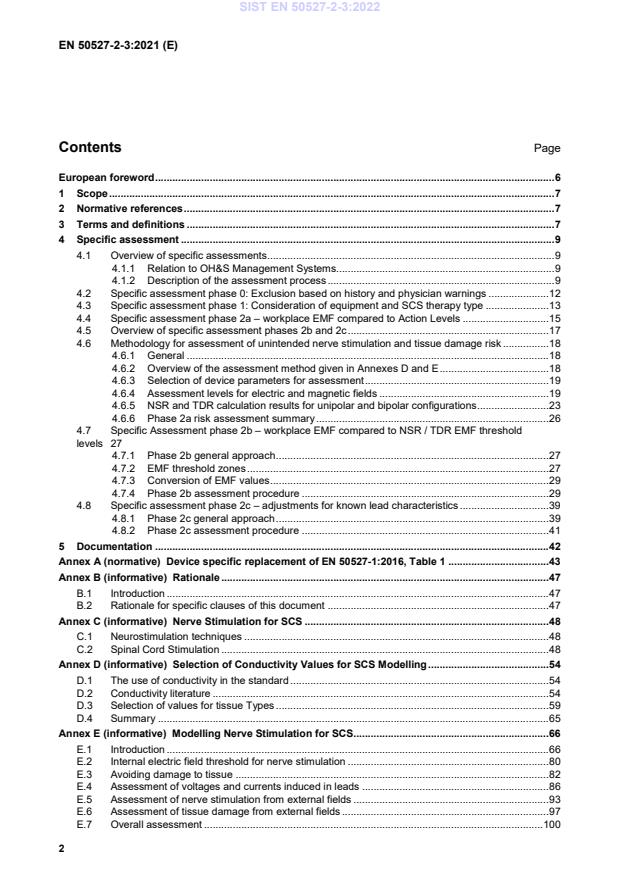
Contents Page
European foreword . 6
1 Scope . 7
2 Normative references . 7
3 Terms and definitions . 7
4 Specific assessment . 9
4.1 Overview of specific assessments . 9
4.1.1 Relation to OH&S Management Systems. 9
4.1.2 Description of the assessment process . 9
4.2 Specific assessment phase 0: Exclusion based on history and physician warnings . 12
4.3 Specific assessment phase 1: Consideration of equipment and SCS therapy type . 13
4.4 Specific assessment phase 2a – workplace EMF compared to Action Levels . 15
4.5 Overview of specific assessment phases 2b and 2c . 17
4.6 Methodology for assessment of unintended nerve stimulation and tissue damage risk . 18
4.6.1 General . 18
4.6.2 Overview of the assessment method given in Annexes D and E . 18
4.6.3 Selection of device parameters for assessment . 19
4.6.4 Assessment levels for electric and magnetic fields . 19
4.6.5 NSR and TDR calculation results for unipolar and bipolar configurations . 23
4.6.6 Phase 2a risk assessment summary . 26
4.7 Specific Assessment phase 2b – workplace EMF compared to NSR / TDR EMF threshold
levels 27
4.7.1 Phase 2b general approach . 27
4.7.2 EMF threshold zones . 27
4.7.3 Conversion of EMF values . 29
4.7.4 Phase 2b assessment procedure . 29
4.8 Specific assessment phase 2c – adjustments for known lead characteristics . 39
4.8.1 Phase 2c general approach . 39
4.8.2 Phase 2c assessment procedure . 41
5 Documentation . 42
Annex A (normative) Device specific replacement of EN 50527-1:2016, Table 1 . 43
Annex B (informative) Rationale . 47
B.1 Introduction . 47
B.2 Rationale for specific clauses of this document . 47
Annex C (informative) Nerve Stimulation for SCS . 48
C.1 Neurostimulation techniques . 48
C.2 Spinal Cord Stimulation . 48
Annex D (informative) Selection of Conductivity Values for SCS Modelling . 54
D.1 The use of conductivity in the standard . 54
D.2 Conductivity literature . 54
D.3 Selection of values for tissue Types . 59
D.4 Summary . 65
Annex E (informative) Modelling Nerve Stimulation for SCS. 66
E.1 Introduction . 66
E.2 Internal electric field threshold for nerve stimulation . 80
E.3 Avoiding damage to tissue . 82
E.4 Assessment of voltages and currents induced in leads . 86
E.5 Assessment of nerve stimulation from external fields . 93
E.6 Assessment of tissue damage from external fields . 97
E.7 Overall assessment . 100
Annex F (informative) Electrode factor for non-isotropic tissue . 101
F.1 Application to isotropic tissue . 101
F.2 Application to non-isotropic tissue . 103
Bibliography . 105
Figures
Figure 1 — Overview of the assessment process . 11
Figure 2 — Summary of assessment exclusion criteria . 12
Figure 3 — Specific assessment phase 1 . 14
Figure 4 — Specific assessment phase 2a — Initial assessment of risk of unintended nerve stimulation or
tissue damage . 17
Figure 5 — Magnetic field assessment levels as selected (also Figure E.14) . 21
Figure 6 — Electric field assessment levels as selected (also Figure E.16) . 22
Figure 7 — Values of NSR for assessed electric field exposures . 23
Figure 8 — Values of TDR for assessed electric field exposures . 24
Figure 9 — Values of NSR for assessed magnetic field exposures . 25
Figure 10 — Values of TDR for assessed magnetic field exposures . 26
Figure 11 — Maximum E-field for cylindrical-type bipolar lead stimulation . 31
Figure 12 — Maximum E-field for paddle-type bipolar lead stimulation . 32
Figure 13 — Maximum B-field for bipolar single lead stimulation . 33
Figure 14 — Maximum B-field for bipolar two lead stimulation . 34
Figure 15 — Maximum E-field for unipolar lead stimulation . 35
Figure 16 — Maximum E-field for unipolar lead stimulation (1 MHz to 100 MHz) . 36
Figure 17 — Maximum B-field for unipolar lead stimulation . 37
Figure 18 — Maximum B-field for unipolar lead stimulation (100 MHz to 5 GHz). 38
Figure 19 — Specific assessment phase 2c —Re-assessment of tissue damage risk using known lead
characteristics . 40
Figure C.1 — Typical implantations of spinal cord stimulation devices . 49
Figure C.2 — Leads and electrodes for spinal cord stimulation — Paddle leads have flat electrodes and
percutaneous leads have cylindrical electrodes . 50
Figure C.3 — Cross section of spine showing the different regions . 52
Figure D.1 — Conductivity values from 1996 modelled data . 55
Figure D.2 — Conductivities for cerebrospinal tissues (2007 data) . 57
Figure D.3 — Conductivities for cerebrospinal tissues (1996 and 2009 data) . 58
Figure D.4 — Conductivity for fat (not infiltrated, average infiltrated, fully infiltrated) . 60
Figure D.5 — Cross section of spine showing the different regions . 62
Figure D.6 — Layers of tissue adjacent to spinal cord . 63
Figure D.7 — Variation of directional conductivities and their ratio with frequency and the anisotropy factor 64
Figure D.8 — Values of frequency dependent parameters related to conductivity as used in Annex E . 65
Figure E.1 — Simplified linear circuit model for isolated patch of excitable membrane. From Reilly 1998. . 67
Figure E.2 — Calculated strength-duration relationship for square-wave mono-phasic current pulse. From
Reilly 1998. . 68
Figure E.3 — Representation of myelinated nerve . 69
Figure E.4 — Electric model for linear cable. From Reilly 1998. . 69
Figure E.5 — Equivalent circuit models for excitable membranes. From Reilly 1998. . 70
Figure E.6 — Strength-duration curves for myelinated nerve model with mono-phasic stimuli. Point
electrodes within an infinite homogeneous medium . 72
Figure E.7 — Illustration of the effect of altering separation between electrode and nerve . 73
Figure E.8 — Electrode Factor Multiplier. 77
Figure E.9 — Strength-duration curve for electric field square wave pulse, exponentially decaying pulse,
sinewave . 78
Figure E.10 — Variation of internal electric field (peak) sensitivity threshold with frequency . 79
Figure E.11 — ICNIRP 1998 and 2010 Basic Restrictions . 80
Figure E.12 — ICNIRP 2010 Occupational Basic Restriction . 81
Figure E.13 — Variation of maximum current with frequency, expressed as a ratio to the low frequency value
for fully infiltrated fat . 85
Figure E.14 — Magnetic field assessment levels . 88
Figure E.15 — Voltages (rms) induced by magnetic field for the two assessment levels lines and three loop
areas . 89
Figure E.16 — Electric field assessment levels . 92
Figure E.17 — Voltages (rms) induced by external electric field for the three reference levels and three
electrode spacings . 93
Figure E.18 — NSR for magnetic field exposure . 95
Figure E.19 — NSR for Electric Field exposure . 96
Figure E.20 — TDR for magnetic field exposure . 98
Figure E.21 — TDR for electric field exposure . 99
Tables
Table 1 — Device parameters used for phase 2a and 2b assessments . 19
Table 2 — Assessment levels . 20
Table 3 — Phase 2a assessment summary . 26
Table 4 — Description of exposure zones for phase 2b assessment procedure . 28
Table 5 — Applicable zone charts for bipolar stimulation . 29
Table 6 — Applicable zone charts for unipolar stimulation . 30
Table 7 — Information necessary to proceed with phase 2c . 39
Table 8 — NSR modifiers for field levels in Zones 2b, 2c, or 2d . 41
Table 9 — Example calculations for phase 2c assessment . 41
Table A.1 — Compliant workplaces and equipment with exceptions . 43
Table C.1 — Summary of maximum values of key dimensions . 51
Table C.2 — Types of connection . 53
Table D.1 — Conductivity of fat and CSF from 50 kg pigs at selected frequencies. 56
Table D.2 — Measurements illustrating the variation of conductivity with age for pigs . 56
Table D.3 — Conductivity information required . 59
Table D.4 — Conductivities of fat in S/m . 61
Table D.5 — Conductivities in CSF in S/m . 61
Table D.6 — Cerebrospinal tissues: thickness and materials types . 62
Table E.1 — Basic case parameters used in SENN model . 71
Table E.2 — ICNIRP 2010 Occupational Basic Restriction for in situ electric field . 81
Table E.3 — Multiplying factors for higher levels of stimulation . 82
Table E.4 — Maximum allowable electrode current for different electrode areas and averaging volumes
0.5
where σ = 0.085 S/m. (Values vary as σ ) . 84
Table E.5 — Exposure Levels used for the assessments . 87
Table E.6 — Maximum NSR from magnetic field exposures . 95
Table E.7 — Maximum NSR from electric field exposures . 97
Table E.8 Maximum TDR from magnetic field exposures . 98
Table E.9 — Maximum TDR from electric field exposures . 99
Table E.10 — Overall assessment summary . 100
European foreword
This document (EN 50527-2-3:2021) has been prepared by CLC/TC 106X “Electromagnetic fields in the
human environment”.
The following dates are fixed:
• latest date by which this document has to be (dop) 2022-08-09
implemented at national level by publication of
an identical national standard or by
endorsement
• latest date by which the national standards (dow) 2024-08-09
conflicting with this document have to be
withdrawn
Attention is drawn to the possibility that some of the elements of this document may be the subject of patent
rights. CENELEC shall not be held responsible for identifying any or all such patent rights.
This document has been prepared under a Standardization Request given to CENELEC by the European
Commission and the European Free Trade Association.
Any feedback and questions on this document should be directed to the users’ national committee. A complete
listing of these bodies can be found on the CENELEC website.
1 Scope
This document provides the procedure for the specific assessment required in EN 50527-1:2016, Annex A, for
workers with implanted neurostimulator systems (NS), specifically of the type used for spinal cord stimulation
(SCS).
It is recognized that implantable neurostimulators have been developed for a wide variety of clinical
applications, however the SCS devices within the scope of this document represent the largest segment of the
implantable neurostimulator applications thus far.
NOTE 1 If the worker has other Active Implantable Medical Devices (AIMDs) implanted additionally, they are assessed
separately according to EN 50527-1 or other particular standards within the EN 50527 series.
The purpose of the specific assessment is to determine the risk for workers with implanted SCS devices arising
from exposure to electromagnetic fields (EMF) at the workplace. The assessment includes the likelihood of
clinically significant effects.
NOTE 2 This document does not address risks from contact currents, or the effects upon any associated non-
implantable devices (e.g. Patient Programmers).
The techniques described in the different approaches can also be used for the assessment of publicly
accessible areas.
The frequency range to be observed is from 0 Hz to 3 GHz. Above 3 GHz no interference with the devices
within the scope of this document is expected to occur.
NOTE 3 The rationale for limiting the observation range to 3 GHz can be found in ISO 14708-3 [1].
NOTE 4 Further information concerning the functions of neurostimulator systems can be found at
https://www.aans.org/Patients/Neurosurgical-Conditions-and-Treatments/Spinal-Cord-Stimulation.
2 Normative references
The following documents are referred to in the text in such a way that some or all of their content constitutes
requirements of this document. For dated references, only the edition cited applies. For undated references,
the latest edition of the referenced document (including any amendments) applies.
EN 50527-1:2016, Procedure for the assessment of the exposure to electromagnetic fields of workers bearing
active implantable medical devices - Part 1: General
3 Terms and definitions
For the purposes of this document, the terms and definitions given in EN 50527-1:2016 and the following apply.
ISO and IEC maintain terminological databases for use in standardization at the following addresses:
— IEC Electropedia: available at https://www.electropedia.org/
— ISO Online browsing platform: available at https://www.iso.org/obp
3.1
implantable pulse generator
IPG
part of the active implantable medical device, including the power supply and electronic circuit that produces
an electrical output
3.2
neurostimulator system
NS
active implantable medical device comprising an implantable pulse generator and therapy delivering electrodes
usually part of implanted electrical leads that are intended to deliver therapy to a patient by electrically
stimulating certain nerve structures, along with an associated external patient programming device
3.3
electrode
electrically conducting part (usually the termination of a lead) which is designed to form an interface with body
tissue or body fluid
3.4
bipolar lead
lead with at least two electrodes that are electrically isolated from each other
3.5
AIMD-Employee
worker with an active implantable medical device
Note 1 to entry: For the purposes of this document, the term AIMD-Employee refers to the patient whose implant consists
of a neurostimulator system of the type intended for spinal cord stimulation.
3.6
assessment team
team consisting of:
— employer and if applicable, his occupational health and safety experts and/or occupational physician;
— AIMD-Employee and his responsible physician;
— (technical and medical) experts as necessary, e.g. manufacturer of the device
3.7
unipolar stimulation
stimulation using a single electrode with reference to the outer shell of the implantable pulse generator
3.8
single lead bipolar stimulation
stimulation using two or more adjacent electrodes of a single lead structure
Note 1 to entry: Leads for use with SCS devices typically have a minimum of 8 electrodes.
3.9
two lead bipolar stimulation
stimulation using two or more electrodes located on two separate leads that are implanted in close proximity
to one another
3.10
device
implanted spinal cord stimulator
3.11
electromagnetic field
EMF
alternating electric field, alternating magnetic field, or radio wave between
1 Hz and 3 GHz whether continuous, pulsed, or modulated in space or time
3.12
spinal cord stimulator
SCS
neurostimulator system designed specifically for stimulation of the human spinal cord to treat chronic pain by
electrically stimulating the spinal cord but not the Dorsal Root Ganglion (DRG)
3.13
General Public Reference Level
GPRL
measurable level of electric or magnetic field strength given in Council Recommendation 1999/519/EC for the
general public environment, exposure to which is not considered harmful for persons not bearing an active
implant
3.14
nerve stimulation ratio
NSR
ratio of the electric field at the spinal cord induced by external electromagnetic fields, to the electric field level
below which the AIMD-Employee is not expected to perceive nervous system stimulation
3.15
tissue damage ratio
TDR
ratio of the electrode current induced by external electromagnetic fields, to the current for a given electrode
area below which the AIMD-Employee is not expected to undergo any damage to the tissues surrounding the
implanted electrode
4 Specific assessment
4.1 Overview of specific assessments
4.1.1 Relation to OH&S Management Systems
Nonionizing radiation is a hazard to the health of workers. Whether this hazard constitutes a risk is determined
in the process of hazard identification and risk assessment (e.g. ISO 45001:2018, 6.1.2 [2], and
OHSAS 18001, 4.3.1 [3]). Assessing this hazard on all workplaces should be integrated into the organization’s
process of risk assessment for occupational safety and health. In that process, the general aspects for AIMD-
Employees shall be considered, regardless if an AIMD-Employee is actually present at that workplace.
The organization has to plan and foresee the repetition of the hazard evaluation and risk assessment at a
definite interval. If there is a change of the work-system at the workplace (i.e. new machinery, new installations
producing EMF, or a change in the configuration of the implant) the risk assessment according to this document
shall be repeated.
4.1.2 Description of the assessment process
Spinal Cord Stimulation (SCS) is generally used for chronic pain reduction. The stimulation does not provide
therapy in direct relation to AIMD-Employee safety, so changes to therapy, or turning therapy off, does not
pose a specific risk to the AIMD-Employee. It is noted that an AIMD-Employee can also receive therapy
changes which can appear as a “shock” or “jolt” due to abrupt movements such as coughing and laughing as
well as from postural changes such as standing up from seating, or vice versa. These are not significant direct
risk situations to the AIMD-Employee, but there can be indirect implications due to the nature of the occupation
or positioning. Such indirect risks might include for example, dropping a tool, losing balance, unintended
exposure to dangerous situations, etc. A workplace risk assessment needs to consider a balance of the
benefits of continued employment, and the possible effects assessed in this document, both direct and indirect,
due to the nature of the employment.
The risks to an AIMD-Employee resulting from exposure to EMF in the workplace include the categories of
effects upon the implanted device, as well as the possibility of clinically significant effects upon the AIMD-
Employee as further described below:
— The implanted SCS can itself be influenced in a way that leads to temporary or permanent loss of therapy,
or delivery of a corrupted form of therapy that might not meet the needs of the patient such that they might
be unable to carry out their employee functions. ISO 14708-3 [1] is the product standard that addresses
the risks of malfunction and damage to the SCS NS when exposed to EMF. The working group has
deemed the risks to the AIMD-Employee related to malfunction and device damage to be acceptable, and
they are therefore not assessed by this document. See C.2 for additional rationale.
— The AIMD-Employee might experience unintended effects upon their nervous system due to nerve
stimulation arising from induced currents in their implanted lead system resulting from exposure to external
EMF. These effects can include unpleasant sensations, up to and including “shocking” and “jolting”,
— The induced currents might be of sufficient magnitude to cause tissue damage. This risk would occur at
higher exposure levels and where the EMF frequencies are high enough that they would not be perceived
by the AIMD-Employee.
To address these risks, this document describes a multi-phase risk assessment as summarized in Figure 1.
— Exclusion from further assessment based upon a consideration of prior history
— Exclusion from further assessment based upon a survey of the equipment in the workplace
— Exclusion from further assessment if the AIMD-Employee has a SCS with a mode of operation that the
AIMD-Employee can activate that temporarily prevents current flow in the stimulation leads (and thereby
discontinues therapy delivery) while at the workplace. Reliance on this exclusion would be dependent
upon the ability of the AIMD-Employee to tolerate the lack of therapy while still carrying out their assigned
work tasks. See also C.2.7.
— Assessment of the likelihood that the induced current arising from the EMF environment of the workplace
will exceed the stimulation threshold (i.e. limit of perceived stimulation) for the spinal cord portion of the
human nervous system.
— Assessment of the likelihood that the induced current arising from the EMF environment of the workplace
could cause damage to the tissues of the spinal cord. This risk is present when the characteristics of the
induced currents are such that they are not perceived by the AIMD-Employee yet are of sufficient
magnitude to result in a level of deposited power as to cause tissue damage as a result of tissue heating.
The underlying approach is first to allow work without restriction if it can be determined that no unintended
nerve stimulation and no tissue damage would occur,
Figure 1 — Overview of the assessment process
4.2 Specific assessment phase 0: Exclusion based on history and physician warnings
Further risk assessment is not necessary if a history of uninfluenced behaviour at the workplace exists and a
responsible physician has confirmed that this history is sufficient to exclude clinically significant interaction.
The conditions for uninfluenced behaviour are provided in EN 50527-1:2016.
When a SCS NS is tested according to ISO 14708-3, the manufacturer is required to provide in the
accompanying documents “warnings or precautions to be taken to prevent adverse effects to the patient due
to hazards associated with electromagnetic disturbances”. These are generic warnings for the specific model
of SCS and intended to instruct the patient about risks they might encounter in their daily lives. They are not
specific to a particular patient’s implant scenario, in that SCS devices such as those covered by this document
do not contain sensing functions, and therefore no associated sensitivity settings that a physician might adjust
that would affect the immunity to electromagnetic interference.
Figure 2 summarizes the situations where further risk assessment is unnecessary, and where further
assessment (beginning with 4.3) is required. To apply these exclusions, the assessment team first needs to
list all equipment used by the AIMD-Employee in the workplace, and then compare that list to Table A.1 in
Annex A. The team should consider how the equipment is used by the AIMD-Employee, as well as what history
(if it exists) relative to interaction between the equipment and the AIMD-Employee’s SCS.
For equipment included in and used according to Table A.1:
History
Warnings
Un-Influenced Influenced
No History available
Behaviour Behaviour
Warning from responsible
No 1 3 1
physician or given in
patient instructions for
Yes 2 3 3
use?
For equipment not included in or not used according to Table A.1, further risk assessment
according to 4.3 is required
Legend
1 Further risk assessment unnecessary-proceed to Clause 5
Further risk assessment is not required if responsible physician has confirmed
2 that this history is sufficient to exclude clinically significant interaction-proceed
to Clause 5, otherwise to 4.3.
3 Further risk assessment according to 4.3 is required
Figure 2 — Summary of assessment exclusion criteria
4.3 Specific assessment phase 1: Consideration of equipment and SCS therapy type
This phase of the assessment is undertaken when the exclusions described in 4.2 cannot be applied. This is
the case when there is a history of influenced behaviour or one of the following three conditions exists:
a) there is equipment present in the workplace that is not included in Table A.1;
b) there is equipment present in the workplace that is not used in accordance with Table A.1;
c) all equipment at the workplace is listed in Table A.1 and is used accordingly, but the AIMD-Employee has
received warning(s) from the responsible physician (or listed in their Patient Instructions for Use) that their
device might be susceptible to EMF associated with one or more of these workplace equipment items.
Figure 3 depicts phase 1 of the specific assessment. The steps to be taken are based upon a consideration of
equipment in the workplace and consultation with the responsible physician and / or the Patient Instructions
for Use.
Information relevant to the equipment or other field generating sources under consideration shall be collected
to answer sufficiently the following two questions:
— can it be determined that the clinically significant effects described in 4.1.2 will not occur as a result of
expected exposure to the equipment under consideration? If so, no further assessment is required, and
documentation of the result can proceed, as required in Clause 5;
— can it be determined that the AIMD-Employee can return to the workplace only with restrictions placed on
the work tasks or areas of access? If so, no further assessment is required, and documentation of the
work restrictions can proceed as required in Clause 5.
When neither of these questions can be answered positively, the assessment continues to phase 2a according
to 4.4.
The intent of this subclause is to find and utilize information that might already exist and that allows the
assessment to be completed without further, costlier and time-consuming effort. It is recommended that
experts who are likely to have such information be contacted. Examples of such experts are the device
manufacturer, equipment manufacturer, employer’s technical department, consultants, or others skilled in EMF
effects with implanted devices.
Figure 3 — Specific assessment phase 1
4.4 Specific assessment phase 2a – workplace EMF compared to Action Levels
When steps of the specific assessment phase 1 shown in Figure 3 have been followed but fail to mitigate or
to dismiss risk to the AIMD-Employee arising from prior history, specific equipment or physician warnings, then
phase 2 assessment shall be performed.
Phase 2 assessment is divided into three subphases (2a, 2b and 2c). Phase 2a as depicted in Figure 4 shall
be performed first. The goal of Phase 2a assessment is to determine if the risks of unintended nerve stimulation
and of tissue damage are acceptable based upon a consideration only of the workplace EMF levels relative to
the Action Levels (ALs) defined in the EMF Directive [4] and the type of stimulation in use for the AIMD-
Employee. The basis for phase 2a assessment results from the analysis and methodology summarized in 4.6,
and detailed in Annexes C, D, E, and F.
This phase 2a of the assessment avoids further mathematical analysis on the part of the assessment team
and can lead to a conclusion of no work restrictions for a majority of AIMD-Employees.
Phase 2a assessment is carried out in the following steps:
Step 1: Determine the levels of EMF associated with the equipment in question.
This determination is ordinarily done by performing an EMF site survey wherein the fields are measured directly
in the workplace at the separation distances expected in daily exposure for the AIMD-Employee. Such
measurements should account for seasonal variations (if any), as well as measurement at lesser distances to
better understand the boundaries where higher exposures might occur.
The assessment of risks for SCS devices forms part of the risk assessment required under Article 4 of the
EMF Directive [4]. Article 4.5(d) relates specifically to workers with active implantable medical devices. Article
4.1 requires the employer to assess all risks for workers arising from electromagnetic fields at the workplace
and, if necessary, measure or calculate the levels of EMF to which workers are exposed. These assessments
are carried out, either by measurement or calculation in relation to ALs and Exposure Limit Values (ELVs)
which are specified in the annexes of the Directive. Extensive supporting material on performing these
measurements is provided in [5] and [6]. Other useful information is included in the other two volumes of the
latter publication.
As a result, employers already know which regions of the workplace have fields that do not exceed the ALs
specified in the EMF Directive. In practice this applies to most workplaces. More particularly they will know
whether their workplace includes areas where the fields might exceed the ALs, and they are required to apply
protective measures in those regions. There will therefore normally be no requirement to make a separate
assessment of exposure for workers with implanted SCS devices.
Step 2: Determine stimulation type
Collect information concerning the specific implant situation. For this phase 2a, it is only necessary to know
the type of stimulation in use (unipolar, bipolar single-lead, or bipolar two-lead). This can generally be obtained
from the responsible physician.
Step 3: Compare workplace EMF levels to the assessed ALs
Compare the EMF field levels determined in step 1 against the ALs (blue lines) in Figure 5 and Figure 6 at all
frequencies. If the AL values are not exceeded, proceed to step 4. Otherwise, for any frequency at which the
field exceeds the ALs, record the frequency and associated field type and level. Then proceed with the specific
assessment phase 2b described in 4.5.
Step 4: Consideration of stimulation type
If the type of stimulation in use for the AIMD-Employee is not unipolar, then the AIMD-Employee is allowed to
work without restrictions. Proceed to Clause 5 to document the results. If the type of stimulation is unipolar,
proceed to step 5.
Step 5: Exclusion by changing stimulation to bipolar
It is possible that the AIMD-Employee was implanted with a lead system capable of bipolar stimulation, yet for
some reason, the implanting physician programmed the IPG to a unipolar stimulation mode. As an alternative
to proceeding with phases 2b and (if necessary) 2c, the responsible physician can be consulted about the
possibility of changing the stimulation programming to a bipolar mode. If the physician agrees, this can be
performed, and the AIMD-Employee may work without restrictions, and the assessment proceeds to Clause 5.
If the responsible physician cannot be contacted, or if they indicate reprogramming is not clinically appropriate,
...
Questions, Comments and Discussion
Ask us and Technical Secretary will try to provide an answer. You can facilitate discussion about the standard in here.
Loading comments...