


SIST EN 16798-13:2018
(Main)Energy performance of buildings - Ventilation for buildings - Part 13: Calculation of cooling systems (Module M4-8) - Generation
Energy performance of buildings - Ventilation for buildings - Part 13: Calculation of cooling systems (Module M4-8) - Generation
This European Standard covers the calculation of the operational parameters and the energy consumption of cooling generation systems. The cooling generation consists of:
- cooling generators like compression and absorption chillers;
- other (generic) generator types such as ground or surface water or direct use of ground heat from boreholes; and
- different types of heat rejection (dry, wet, hybrid with outdoor air, other sink types).
The methods cover:
- the possibility of heat recovery of heat to be rejected for the use of heating and/or domestic hot water production, through the use of an interface to the M3-1 standard; and
- a multi generator calculation.
The document does not cover the cooling emission, distribution and storage systems, which are covered by the Module M4-5, M4-6 and M4-7 standards, respectively. It is directly connected to the general part of the cooling systems, the M4-1 standard.
Table 1 shows the relative position of this standard within the set of EPB standards in the context of the modular structure as set out in prEN ISO 52000 1:2015.
NOTE 1 In FprCEN ISO/TR 52000 2 the same table can be found, with, for each module, the numbers of the relevant EPB standards and accompanying Technical Reports that are published or in preparation.
NOTE 2 The modules represent EPB standards, although one EPB standard might cover more than one module and one module might be covered by more than one EPB standard, for instance a simplified and a detailed method respectively. See also Clause 2 and Tables A.1 and B.1.
Table 1 - Position of this standard (in casu M4–8) within the modular structure of the set of EPB standards
...
Energetische Bewertung von Gebäuden - Lüftung von Gebäuden - Teil 13: Berechnung von Kühlsystemen (Modul M4-8) - Erzeugung
Diese Europäische Norm deckt die Betriebsparameter und den Energieverbrauch von Kühlenergie-Erzeugungssystemen ab. Die Kälteerzeugung umfasst:
Kälteerzeuger, wie Kompressions- und Absorptionskältemaschinen;
weiteren (generische) Erzeuger-Typen, wie z. B. Boden- oder Oberflächenwasser oder Direktnutzung von Bodenwärme aus Bohrlöchern; und
verschiedenen Arten der Wärmeabgabe (trocken, nass, Hybrid mit Außenluft, weitere Wärmesenken).
Die Verfahren decken Folgendes ab:
die Möglichkeit der Wärmerückgewinnung von Wärme, die für die Nutzung zur Heizung und/oder zur häuslichen Wassererwärmung abzugeben ist, durch die Verwendung einer Schnittstelle zur M3 1-Norm und
einer Multi Erzeuger-Berechnung.
Das Dokument behandelt nicht die Kälteemission, -verteilung und –speicherung, die jeweils durch die Normen zu den Modulen M4-5, M4-6 und M4-7 abgedeckt werden. Es ist direkt verbunden mit dem allgemeinen Teil der Kälteanlagen, der Norm zum Modul M4-1.
Tabelle 1 zeigt die relative Position dieser Norm innerhalb des EPB Normenpakets im Kontext der in EN ISO 52000 1:2017 dargelegten modularen Struktur.
ANMERKUNG 1 In CEN ISO/TR 52000-2 ist die gleiche Tabelle zu finden, die für jedes Modul die Nummern der relevanten EPB-Normen und der zugehörigen Technischen Berichte enthält, die bereits veröffentlicht wurden oder sich in Vorbereitung befinden.
ANMERKUNG 2 Die Module stellen EPB-Normen dar, auch wenn eine EPB-Norm mehr als ein Modul abdecken kann und ein Modul von mehr als einer EPB-Norm abgedeckt sein kann, wie es sich zum Beispiel bei einem vereinfachten und einem detaillierteren Verfahren verhält. Siehe auch Abschnitt 2 und Tabellen A.1 und B.1
Performance énergétique des bâtiments - Partie 13: Module M4-8 - Calcul des systèmes de refroidissement - Génération
La présente Norme européenne couvre le calcul des paramètres de fonctionnement et de la consommation énergétique des systèmes de génération de froid. La génération de froid consiste en :
- des générateurs de froid tels que des groupes d’eau glacée à compression et à absorption ;
- d'autres types de générateur (génériques) tels que l'eau souterraine, l'eau de surface ou l'utilisation directe de la chaleur du sol à partir de forages ;
- différent types de rejet de chaleur (sèche, humide, hybride avec l'air extérieur, autres types de puits de chaleur).
Les méthodes couvrent :
- la possibilité de récupération de la chaleur devant être rejetée à des fins de chauffage et/ou production d'eau chaude sanitaire, par l'utilisation d'une interface conforme à la norme M3-1 ; et
- un calcul de générateur multiple.
Le document ne couvre pas les systèmes d'émission, de distribution ou de stockage de froid, qui sont respectivement couverts par les normes des Modules M4-5, M4-6 et M4-7. Il est directement lié à la partie générale relative aux systèmes de refroidissement, à savoir la norme M4-1.
Le Tableau 1 indique la position relative de la présente norme dans l’ensemble de normes PEB dans le cadre de la structure modulaire donnée dans l’EN ISO 52000-1:2017.
NOTE 1 Le même tableau figure dans le CEN ISO/TR 52000-2 avec, pour chaque module, le numéro des normes PEB correspondantes et les Rapports Techniques associés qui sont publiés ou en cours d'élaboration.
NOTE 2 Les modules représentent des normes PEB, bien qu'une norme PEB puisse couvrir plus d'un module et qu'un module puisse être couvert par plusieurs normes PEB, par exemple une méthode simplifiée et détaillée respectivement. Voir également l'Article 2 et les Tableaux A.1 et B.1.
Energijske lastnosti stavb - Prezračevanje stavb - 13. del: Izračun za hladilne sisteme - Modul M4-8 - Proizvodnja
Področje uporabe tega evropskega standarda je:
– opredelitev postopka za ugotavljanje načina uporabe računskih metod za določanje temperatur, obremenitev in energijskih zahtev za hlajenje v postopku načrtovanja;
– opis računskih metod za določanje temperatur, obremenitev in energijskih zahtev za hlajenje;
– podajanje smernic za države članice za nacionalno uporabo tega standarda.
Ta standard zajema izračunavanje hlajenja klimatskih naprav. Upošteva hladilni sistem, ki lahko deluje na podlagi stiskanja in absorpcije, kot tudi druge vrste agregatov. Ne zajema pa področij emisij, porazdelitve in shranjevanja hlajenja, ki so zajeta v zadevnih standardih prEN 15316-2, 15316-3 in prEN XXXXX-15.
Preglednica 1 prikazuje relativen položaj tega standarda v sklopu standardov EN EPB.
General Information
- Status
- Published
- Public Enquiry End Date
- 01-Mar-2015
- Publication Date
- 13-Jun-2018
- Technical Committee
- OGS - Heating for buildings
- Current Stage
- 6060 - National Implementation/Publication (Adopted Project)
- Start Date
- 12-Dec-2017
- Due Date
- 16-Feb-2018
- Completion Date
- 14-Jun-2018
Relations
- Effective Date
- 01-Jul-2018
Overview
SIST EN 16798-13:2018 - "Energy performance of buildings - Ventilation for buildings - Part 13: Calculation of cooling systems (Module M4‑8) - Generation" defines standardized methods to calculate the operational parameters and energy consumption of cooling generation systems. It focuses on the generation side (Module M4‑8) and covers a range of generator and sink types while excluding emission, distribution and storage subsystems (covered by M4‑5, M4‑6 and M4‑7).
Key topics and technical scope
- Cooling generators covered: compression chillers, absorption chillers and other generator types (e.g., ground or surface water systems, direct use of ground heat from boreholes).
- Heat rejection (sinks): dry, wet, hybrid (with outdoor air) and other sink types.
- Heat recovery: includes the option to recover rejected heat for heating and domestic hot water via an interface to Module M3‑1.
- Multi‑generator calculation: methods support systems with multiple generation units and interactions.
- Calculation methods: the standard provides at least two calculation methods (Method 1 and Method 2) with defined inputs, time intervals and outputs.
- Input categories: product technical data, system design/configuration, operating conditions, constants/physical data and selected defaults.
- Documentation & templates: Annex A contains a normative input/data‑selection template; Annex B supplies informative default choices.
- Quality and compliance: contains sections on quality control and compliance checks to support verification and regulatory use.
Practical applications and users
SIST EN 16798‑13:2018 is intended for professionals involved in the energy performance assessment and design of HVAC and ventilation systems, including:
- HVAC engineers and system designers performing energy modelling of cooling generation;
- Energy assessors and certifiers preparing building energy performance (EPB) reports;
- Regulators and authorities defining national/regional calculation rules or compliance checks;
- Software developers and programmers implementing EPB modular calculation engines;
- Facility managers and consultants evaluating heat recovery options and multi‑generator operation strategies.
Practical uses include calculating annual and operational energy consumption for cooling generation, assessing the benefit of heat recovery, comparing generator technologies (compression vs absorption vs ground‑source), and producing inputs for whole‑building EPB assessments.
Related standards (modular EPB context)
- Directly linked to: M4‑1 (general part for cooling systems) and the wider set of EPB standards (see prEN ISO 52000‑1:2015 for the modular structure).
- Excludes: M4‑5, M4‑6, M4‑7 (cooling emission, distribution and storage).
- Complementary guidance: normative templates and interpretation technical reports in the EN 16798 series support consistent national implementation.
Keywords: SIST EN 16798-13:2018, energy performance of buildings, calculation of cooling systems, cooling generation, M4-8, HVAC energy modelling, compression chillers, absorption chillers, heat rejection, heat recovery, EPB standards.



Frequently Asked Questions
SIST EN 16798-13:2018 is a standard published by the Slovenian Institute for Standardization (SIST). Its full title is "Energy performance of buildings - Ventilation for buildings - Part 13: Calculation of cooling systems (Module M4-8) - Generation". This standard covers: This European Standard covers the calculation of the operational parameters and the energy consumption of cooling generation systems. The cooling generation consists of: - cooling generators like compression and absorption chillers; - other (generic) generator types such as ground or surface water or direct use of ground heat from boreholes; and - different types of heat rejection (dry, wet, hybrid with outdoor air, other sink types). The methods cover: - the possibility of heat recovery of heat to be rejected for the use of heating and/or domestic hot water production, through the use of an interface to the M3-1 standard; and - a multi generator calculation. The document does not cover the cooling emission, distribution and storage systems, which are covered by the Module M4-5, M4-6 and M4-7 standards, respectively. It is directly connected to the general part of the cooling systems, the M4-1 standard. Table 1 shows the relative position of this standard within the set of EPB standards in the context of the modular structure as set out in prEN ISO 52000 1:2015. NOTE 1 In FprCEN ISO/TR 52000 2 the same table can be found, with, for each module, the numbers of the relevant EPB standards and accompanying Technical Reports that are published or in preparation. NOTE 2 The modules represent EPB standards, although one EPB standard might cover more than one module and one module might be covered by more than one EPB standard, for instance a simplified and a detailed method respectively. See also Clause 2 and Tables A.1 and B.1. Table 1 - Position of this standard (in casu M4–8) within the modular structure of the set of EPB standards ...
This European Standard covers the calculation of the operational parameters and the energy consumption of cooling generation systems. The cooling generation consists of: - cooling generators like compression and absorption chillers; - other (generic) generator types such as ground or surface water or direct use of ground heat from boreholes; and - different types of heat rejection (dry, wet, hybrid with outdoor air, other sink types). The methods cover: - the possibility of heat recovery of heat to be rejected for the use of heating and/or domestic hot water production, through the use of an interface to the M3-1 standard; and - a multi generator calculation. The document does not cover the cooling emission, distribution and storage systems, which are covered by the Module M4-5, M4-6 and M4-7 standards, respectively. It is directly connected to the general part of the cooling systems, the M4-1 standard. Table 1 shows the relative position of this standard within the set of EPB standards in the context of the modular structure as set out in prEN ISO 52000 1:2015. NOTE 1 In FprCEN ISO/TR 52000 2 the same table can be found, with, for each module, the numbers of the relevant EPB standards and accompanying Technical Reports that are published or in preparation. NOTE 2 The modules represent EPB standards, although one EPB standard might cover more than one module and one module might be covered by more than one EPB standard, for instance a simplified and a detailed method respectively. See also Clause 2 and Tables A.1 and B.1. Table 1 - Position of this standard (in casu M4–8) within the modular structure of the set of EPB standards ...
SIST EN 16798-13:2018 is classified under the following ICS (International Classification for Standards) categories: 91.140.30 - Ventilation and air-conditioning systems. The ICS classification helps identify the subject area and facilitates finding related standards.
SIST EN 16798-13:2018 has the following relationships with other standards: It is inter standard links to SIST EN 15243:2007. Understanding these relationships helps ensure you are using the most current and applicable version of the standard.
SIST EN 16798-13:2018 is associated with the following European legislation: EU Directives/Regulations: 2010/31/EU; Standardization Mandates: M/480. When a standard is cited in the Official Journal of the European Union, products manufactured in conformity with it benefit from a presumption of conformity with the essential requirements of the corresponding EU directive or regulation.
SIST EN 16798-13:2018 is available in PDF format for immediate download after purchase. The document can be added to your cart and obtained through the secure checkout process. Digital delivery ensures instant access to the complete standard document.
Standards Content (Sample)
2003-01.Slovenski inštitut za standardizacijo. Razmnoževanje celote ali delov tega standarda ni dovoljeno.Energetische Bewertung von Gebäuden - Lüftung von Gebäuden - Teil 13: Berechnung von Kühlsystemen (Modul M4-8) - ErzeugungPerformance énergétique des bâtiments - Partie 13: Module M4-8 - Calcul des systèmes de refroidissement - GénérationEnergy performance of buildings - Ventilation for buildings - Part 13: Calculation of cooling systems (Module M4-8) - Generation91.140.30VLVWHPLVentilation and air-conditioning systemsICS:Ta slovenski standard je istoveten z:EN 16798-13:2017SIST EN 16798-13:2018en,fr,de01-julij-2018SIST EN 16798-13:2018SLOVENSKI
STANDARDSIST EN 15243:20071DGRPHãþD
EUROPEAN STANDARD NORME EUROPÉENNE EUROPÄISCHE NORM
EN 16798-13
June
t r s y ICS
{ sä s t rä s râ
{ sä s v rä u r Supersedes EN
s w t v uã t r r yEnglish Version
Energy performance of buildings æ Part
s uã Module M væ z æ Calculation of cooling systems æ Generation Performance énergétique des bâtiments æ Partie
s uã Module M væ z æ Calcul des systèmes de refroidissement æ Génération
Energieeffizienz
von Gebäuden æ Teil
s uã M væ z Modul æBerechnung der Kühlsysteme æ Erzeugung This European Standard was approved by CEN on
t y February
t r s yä
egulations which stipulate the conditions for giving this European Standard the status of a national standard without any alterationä Upætoædate lists and bibliographical references concerning such national standards may be obtained on application to the CENæCENELEC Management Centre or to any CEN memberä
translation under the responsibility of a CEN member into its own language and notified to the CENæCENELEC Management Centre has the same status as the official versionsä
CEN members are the national standards bodies of Austriaá Belgiumá Bulgariaá Croatiaá Cyprusá Czech Republicá Denmarká Estoniaá Finlandá Former Yugoslav Republic of Macedoniaá Franceá Germanyá Greeceá Hungaryá Icelandá Irelandá Italyá Latviaá Lithuaniaá Luxembourgá Maltaá Netherlandsá Norwayá Polandá Portugalá Romaniaá Serbiaá Slovakiaá Sloveniaá Spainá Swedená Switzerlandá Turkey and United Kingdomä
EUROPEAN COMMITTEE FOR STANDARDIZATION COMITÉ EUROPÉEN DE NORMALISATION EUROPÄISCHES KOMITEE FÜR NORMUNG
CEN-CENELEC Management Centre:
Avenue Marnix 17,
B-1000 Brussels
t r s y CEN All rights of exploitation in any form and by any means reserved worldwide for CEN national Membersä Refä Noä EN
s x y { zæ s uã t r s y ESIST EN 16798-13:2018
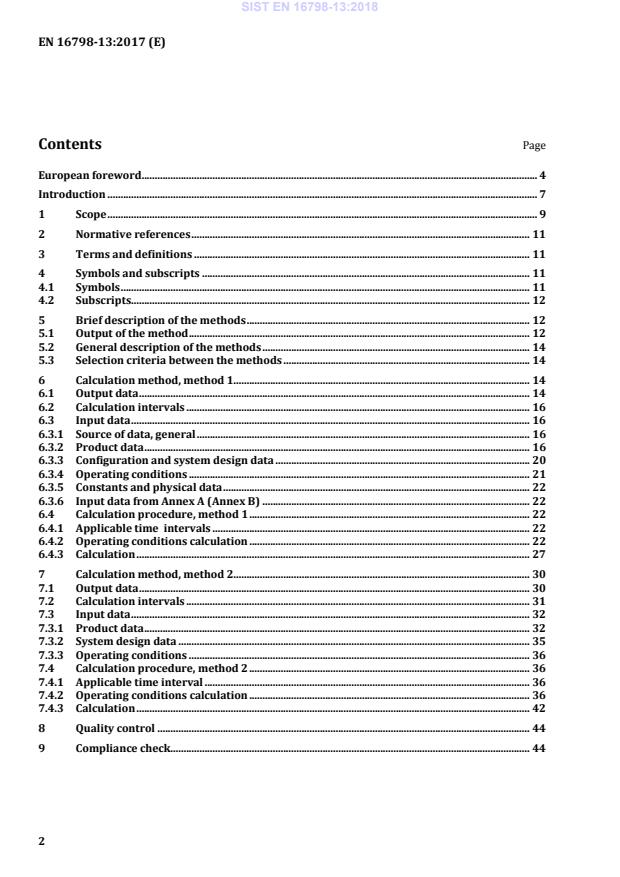
intervals . 22 6.4.2 Operating conditions calculation . 22 6.4.3 Calculation . 27 7 Calculation method, method 2. 30 7.1 Output data . 30 7.2 Calculation intervals . 31 7.3 Input data . 32 7.3.1 Product data . 32 7.3.2 System design data . 35 7.3.3 Operating conditions . 36 7.4 Calculation procedure, method 2 . 36 7.4.1 Applicable time interval . 36 7.4.2 Operating conditions calculation . 36 7.4.3 Calculation . 42 8 Quality control . 44 9 Compliance check. 44 SIST EN 16798-13:2018
Input and method selection data sheet — Template . 45 A.1 General . 45 A.2 References . 46 A.3 Input data method 1 . 46 A.3.1 Product description data . 46 A.3.2 Product technical data tables . 46 A.3.3 System design data . 47 A.4 Input data method 2 . 48 A.4.1 Product description data . 48 A.4.2 Product technical data . 48 A.4.3 System design data . 48 Annex B (informative)
Input and method selection data sheet — Default choices . 55 B.1 General . 55 B.2 References . 56 B.3 Input data method 1 . 56 B.3.1 Product description data . 56 B.3.2 Product technical data tables . 56 B.3.3 System design data . 57 B.4 Input data method 2 . 58 B.4.1 Product description data . 58 B.4.2 Product technical data . 58 B.4.3 System design data . 59 Bibliography . 67
EN Number Recast EPBD EN Number Title EN 15251 EN 16798-1 Energy performance of buildings – Ventilation for buildings – Part 1:
Indoor environmental input parameters for design and assessment of energy performance of buildings addressing indoor air quality, thermal environment, lighting and acoustics (Module M1-6)
N/A CEN/TR 16798-2 Energy performance of buildings – Ventilation for buildings – Part 2: Interpretation of the requirements in EN 16798-1
– Indoor environmental input parameters for design and assessment of energy performance of buildings addressing indoor air quality, thermal environment, lighting and acoustics (Module M1-6)
EN 13779 EN 16798-3 Energy performance of buildings – Ventilation for buildings – Part 3: For non-residential buildings – Performance requirements for ventilation and room-conditioning systems (Modules M5-1, M5-4)
Part 4: Interpretation of the requirements in EN 16798- 3 – For non-residential buildings – Performance requirements for ventilation and room-conditioning systems (Modules M5-1, M5-4)
EN 15241 EN 16798-5-1 Energy performance of buildings – Ventilation for buildings – Part 5-1: Calculation methods for energy requirements of ventilation and air conditioning systems (Modules M5-6, M5-8, M6-5, M6-8, M7-5, M7-8)
– Method 1: Distribution and generation
EN 15241 EN 16798-5-2 Energy performance of buildings – Ventilation for buildings – Part 5-2: Calculation methods for energy requirements of ventilation systems (Modules M5-6.2, M5-8.2) – Method 2: Distribution and generation
N/A CEN/TR 16798-6 Energy performance of buildings – Ventilation for buildings – Part 6: Interpretation of the requirements in EN 16798-5–1 and EN 16798-5-2 – Calculation methods for energy requirements of ventilation and air conditioning systems (Modules M5-6, M5-8, M 6-5, M6-8 , M7-5, M7-8) EN 15242 EN 16798-7 Energy performance of buildings – Ventilation for buildings – Part 7: Calculation methods for the determination of air flow rates in buildings including infiltration (Module M5-5)
N/A CEN/TR 16798-8 Energy performance of buildings – Ventilation for buildings – Part 8: Interpretation of the requirements in EN 16798-7 – Calculation methods for the determination of air flow rates in buildings including infiltration – (Module M5-5)
EN 15243 EN 16798-9
Energy performance of buildings – Ventilation for buildings – Part 9: Calculation methods for energy requirements of cooling systems
(Modules M4-1, M4-4, M4-9) – General
N/A CEN/TR 16798-10 Energy performance of buildings – Ventilation for buildings – Part 10: Interpretation of the requirements in EN 16798-9 – Calculation methods for energy requirements of cooling systems (Module M4-1,M4-4, M4-9) – General
EN 15243 EN 16798-13 Energy performance of buildings – Ventilation for buildings – Part 13: Calculation of cooling systems (Module M4-8) – Generation SIST EN 16798-13:2018
N/A CEN/TR 16798-16 Energy performance of buildings – Ventilation for buildings – Part 16: Interpretation of the requirements in EN 16798-15 –
Calculation of cooling systems (Module M4-7) – Storage EN 15239 and EN 15240 EN 16798-17 Energy performance of buildings – Ventilation for buildings – Part 17: Guidelines for inspection of ventilation
and
air- conditioning systems (Module M4-11, M5-11, M6-11, M7-11)
N/A CEN/TR 16798-18 Energy performance of buildings – Ventilation for buildings –
Part 18: Interpretation of the requirements in EN 16798-17 – Guidelines for inspection of ventilation and
air-conditioning systems (Module M4-11, M5-11, M6-11, M7-11) According to the CEN-CENELEC Internal Regulations, the national standards organizations of the following countries are bound to implement this European Standard: Austria, Belgium, Bulgaria, Croatia, Cyprus, Czech Republic, Denmark, Estonia, Finland, Former Yugoslav Republic of Macedonia, France, Germany, Greece, Hungary, Iceland, Ireland, Italy, Latvia, Lithuania, Luxembourg, Malta, Netherlands, Norway, Poland, Portugal, Romania, Serbia, Slovakia, Slovenia, Spain, Sweden, Switzerland, Turkey and the United Kingdom. SIST EN 16798-13:2018
Overarching Building (as such) Technical Building Systems
Submodule
Descriptions
Descriptions
Descriptions
Heating
Cooling
Ventilation
Humidification
Dehumidification
Domestic Hot water
Lighting
Building automation and
control
PV, wind, . sub1 M1 M2
M3 M4 M5 M6 M7 M8 M9 M10 M11 1 General General General
2 Common terms and definitions; symbols, units and subscripts Building Energy Needs Needs
a
3 Applications (Free) Indoor Conditions without Systems Maximum Load and Power
4 Ways to Express Energy Performance Ways to Express Energy Performance Ways to Express Energy Performance
5 Building categories and Building Boundaries Heat Transfer by Transmission Emission and control
6 Building Occupancy and Operating Conditions Heat Transfer by Infiltration and Ventilation Distribution and control
7 Aggregation of Energy Services and Energy Carriers Internal Heat Gains Storage and control
8 Building zoning Solar Heat Gains Generation and control
EN 16798-13
9 Calculated Energy Performance Building Dynamics (thermal mass) Load dispatching and operating conditions
10 Measured Energy Performance Measured Energy Performance Measured Energy Performance
11 Inspection Inspection Inspection
12 Ways to Express Indoor Comfort
BMS
13 External Environment Conditions
14 Economic Calculation
a The shaded modules are not applicable. SIST EN 16798-13:2018
Key A driving component M desorber B condenser
C expansion valve 1 basic thermodynamic circuit D evaporator 2 air-cooled condenser E cooling water pump 3 water-cooled condenser F cooling tower 3–1 dry heat rejection G chilled water pump 3–2 wet heat rejection H cooling emission (from chilled water) 3–3 hybrid heat rejection I cooling emission (from refrigerant) 4 compression type system J compressor 5 absorption type system K absorber 6 direct evaporation L solvent pump 7 indirect evaporation (i.e. chiller) Figure 1 — System design options covered within this standard SIST EN 16798-13:2018
«30—20 M4–1 Yes Required absorption cooling generation heat input QH;C;gen;abs;in;req Q_C_gen_abs_in_req kWh 0— » M3–1 Yes Required supply temperature of absorption generation heat input ÍH;C;gen;abs;in;req theta_H_C_abs_in_req °C 0— » M3–1 Yes Recoverable heat of the cooling generation system QC;gen;out;rbl Q_C_gen_out_rbl kWh 0— » M3–1 Yes Max. temperature level of recoverable heat ÍC,gen;out;max theta_C_gen_out_max °C 15—50 M3–1 Yes Required energy to be extracted by the generation system QC;gen;in;req Q_C_gen_in_req kWh 0— » M10–12 Yes Number of generators ngen eta_gen — 1—10 M10–12 no Maximum heat extraction of generator j at the current calculation interval QC;gen;in;max,j Q_C_gen_in_max(j) kWh 0— » M10–12 Yes a
Practical range, informative. b
Informative. c
“Varying”: value may vary over time: different values per time interval, for instance: hourly values or monthly values (not constant values over the year). SIST EN 16798-13:2018
local No Nominal thermal power extracted from chilled water circuit C;gen;n kW 0— » local No Nominal energy efficiency ratio EERn — 0—100 EN 14511 No Condensor cooling water/air inlet temperature at nominal conditions Ícond;in;n °C 0— » local No Evaporator chilled water outlet temperature at nominal conditions ÍC; evap;out;n °C 0— » local No Energy efficiency at part load condition A EERA — 0—100 EN 14825 No Part load ratio A fC;PL;A % 0—100 EN 14825 No Evaporator chilled water outlet temperature at part load condition A ÍC; evap;out;A °C
«30—20 EN 14825 No Condensor cooling water/air inlet temperature part load condition A Ícond;in;A °C 0—100 EN 14825 No Energy efficiency at part load condition B EERB — 0—100 EN 14825 No Part load ratio B fC;PL;B % 0—100 EN 14825 No Evaporator chilled water outlet temperature at part load condition B ÍC;evap;out;B °C
«30—20 EN 14825 No Condensor cooling water/air inlet temperature at part load condition B Ícond;in;B °C 0—100 EN 14825 No Energy efficiency at part load condition C EERC — 0—100 EN 14825 No Part load ratio C fC;PL;C % 0—100 EN 14825 No Evaporator chilled water outlet temperature at part load condition C ÍC;evap;out;C °C
«30—20 EN 14825 No Condensor cooling water/air inlet temperature at part load condition C Ícond;in;C °C 0—100 EN 14825 No Energy efficiency at part load condition D EERD — 0—100 EN 14825 No SIST EN 16798-13:2018
«30—20 EN 14825 No Condensor cooling water/air inlet temperature at part load condition D Ícond;in;D °C 0—100 EN 14825 No Energy efficiency at 5th measured point EER5 — 0—100 local No Part load ratio at 5th measured point fC;PL;5 % 0—100 local No Evaporator chilled water outlet temperature at 5th measured point ÍC;evap;out;5 °C
«30—20 local No Condensor cooling water/air inlet temperature at 5th measured point Ícond;in;5 °C 0—100 local No Minimum part load ratio of the generator fC;PL;min % 0—100 local No Coefficient for the calculation of absorption chiller characteristics C5 — 0—100 local No Coefficient for the calculation of absorption chiller characteristics C6 — 0—100 local No Coefficient for the calculation of absorption chiller characteristics C7 — 0—100 local No Condenser input limit temperature Ícond;in;lim °C 0—100 local No Specific electrical power consumption of the heat rejection system in dry operation phr;el;dry kW/kW 0—100 local No Specific electrical power consumption of the heat rejection system in wet operation phr;el;wet kW/kW 0—100 local No Specific electrical power consumption of the heat rejection system type OTHER phr;el;oth kW/kW 0—100 local No Electric power consumption of control device i (sensors, actuators, controllers) Pel;C;ctrl,i kW 0— » local No a
Practical range, informative. b
For instance EPB module or (e.g. product) standard or “local” (type, geometry). c
“Varying”: value may vary over time: different values per time interval, for instance: hourly values or monthly values (not constant values over the year). If default data are given on a national basis, they shall be defined in a national annex following the template in Annex A; proposed default data are given in Annex B. 6.3.2.2.2 Compressor chiller characteristics 6.3.2.2.2.1 Characteristics based on EN 14825 values The coefficients C1, C2, C3, C4 and the correction temperature difference Ícorr used for the compression chiller part load behaviour calculation in Formulae (9) and (20a) shall be obtained by solving the linear system of five equations: SIST EN 16798-13:2018
(1) where EERA, B, C, D - are the energy efficiency ratios from test measurements for the part load conditions A, B, C and D in accordance with EN 14825; ÍC;evap;out;A, B, C, D °C are the evaporator outlet temperatures corresponding to the part load conditions A, B, C and D in accordance with EN 14825; ÍC;cond;in;A, B, C, D °C are the condenser inlet temperatures corresponding to the part load conditions A, B, C and D in accordance with EN 14825; fC;PL;A, B, C, D % are the part load ratios for the part load conditions A, B, C and D in accordance with EN 14825; EER5 - is the energy efficiency ratio at the 5th measuring point; ÍC;evap;out;5 °C is the evaporator outlet temperatures corresponding to the EER5 value; ÍC;cond;in;5 °C is the condenser inlet temperatures corresponding to the EER5 value; fC;PL;5 % is the part load ratio corresponding to the EER5 value; EERn - is the nominal energy efficiency ratio. NOTE 1 For the method to solve the equation system of Formula (1) see the spreadsheet in the accompanying TR. The EER5 value shall be obtained from a fifth measurement point (supplementary to those four required by EN 14825), which shall be chosen at a part load ratio of fC;PL;5 = fC;PL;C, but with the temperature of cooling water supplied to the condenser of ÍC;cond;in;5 = ÍC;cond;in;A. If no such measured value is available, it is approximated according to Formula (2). Aout;evap;C;Ain;cond;C,Cout;evap;C;Cin;cond;C,C5ϑϑϑϑ−−=EEREER (2) NOTE 2 With Formula (2) the Ícorr is 0. NOTE 3 Alternatively the performance can be described by interpolation tabled values, if more detailed data are provided. SIST EN 16798-13:2018
M1–13 Yes Ambient air wet-bulb temperature Íe,wb °C
M1–13 Yes Required cooling energy to be extracted by the generation system QC;gen;in;req kWh
M4–1d Yes Required generation outlet temperature ÍC;gen;out;req °C
M4–1 Yes Recovered heat of the cooling generation system QC;gen;out;rd kWh
M3–1 Ye
...
Questions, Comments and Discussion
Ask us and Technical Secretary will try to provide an answer. You can facilitate discussion about the standard in here.
Loading comments...