


SIST EN 17625:2026
(Main)Rooftop units - Testing and rating at standard rating conditions and part load conditions for calculation of seasonal performance
Rooftop units - Testing and rating at standard rating conditions and part load conditions for calculation of seasonal performance
This document specifies the terms and definitions, the test conditions and the test methods for the rating and performance of rooftop units. It also specifies the determination of capacities and the calculation methods considering rooftop units features, such as free cooling and air flow mixtures, for the determination of seasonal energy efficiencies in cooling and heating.
This document covers only space heating and/or cooling for comfort applications (process applications are outside the scope of this document). It applies to air-to-air and water(brine)-to-air rooftop units with electrically driven compressor(s), which may be equipped with a supplementary heater using electrical resistance or combustion of fossil fuel. This document does not cover rooftop units with remote condensers.
This document covers the features of free cooling, mixing air flows (on both sides) and internal heat recovery, as illustrated in Annex A. Annex B provides additional definitions and methods for determining seasonal performances for space cooling/heating with a minimum mixture of outdoor air and recycled air.
Dachgeräte - Prüfung und Bewertung unter Standardbedingungen und Teillastbedingungen zur Berechnung der jahreszeitlichen Leistun
Dieses Dokument legt die Begriffe, die Prüfbedingungen und die Prüfverfahren für die Bewertung und die Leistung von Dachgeräten fest. Es legt zudem die Leistungsbestimmung und die Berechnungsverfahren unter Berücksichtigung der Merkmale von Dachgeräten, wie freie Kühlung und Mischung von Luftströmen, zur Ermittlung der saisonalen Arbeitszahl bei Kühl- und Heizbetrieb fest.
Dieses Dokument behandelt nur Raumheizung und/oder kühlung für Komfortzwecke (Prozessanwendungen liegen nicht im Anwendungsbereich dieses Dokuments). Es ist anwendbar für Luft/Luft- und Wasser/Sole-Luft-Dachgeräte mit elektrisch angetriebenem/n Verdichter(n), die mit einem zusätzlichen Heizgerät ausgestattet sein können und einen elektrischen Widerstand oder die Verbrennung fossiler Brennstoffe verwenden. Dieses Dokument behandelt keine Dachgeräte mit getrennt angeordnetem Verflüssiger.
Dieses Dokument behandelt die Merkmale freie Kühlung, Mischung von Luftströmen (auf beiden Seiten) und interne Wärmerückgewinnung, wie in Anhang A dargestellt. Anhang B enthält zusätzliche Definitionen und Verfahren für die Bestimmung der saisonalen Leistungen für die Kühlung/Heizung von Räumen mindestens mit einem Gemisch aus Außenluft und Umluft.
Unités de toiture - Essais et détermination des performances nominales et à charge partielle pour le calcul de performances saisonnières
Le présent document spécifie les termes et définitions, les conditions d'essai et les méthodes d'essai pour évaluer les performances des unités de toiture. Il spécifie également la détermination des puissances thermiques et les méthodes de calcul tenant compte des caractéristiques des unités de toiture, telles que le refroidissement naturel et les mélanges de flux d'air, pour la détermination des efficacités énergétiques saisonnières en matière de refroidissement et de chauffage.
Le présent document ne couvre que le chauffage et/ou le refroidissement des locaux pour les applications de confort (les applications industrielles ne sont pas couvertes par le présent document). Il s'applique aux unités de toiture air/air et eau (glycolée)/air avec compresseur(s) entraîné(s) par moteur électrique, qui peuvent être équipées d'un dispositif de chauffage d'appoint utilisant la résistance électrique ou la combustion de combustibles fossiles. Le présent document ne couvre pas les unités de toiture avec condenseurs séparés.
Le présent document couvre les caractéristiques du refroidissement naturel, du mélange de flux d'air (des deux côtés) et de la récupération de chaleur interne, comme illustré à l'Annexe A. L'Annexe B fournit des définitions et des méthodes supplémentaires pour déterminer les performances saisonnières pour le refroidissement/chauffage des locaux avec un mélange minimum d'air extérieur et d'air recyclé.
Strešne enote - Preskušanje in ocenitev pri standardnih nazivnih pogojih in pogojih delne obremenitve za izračun letnega učinka
Ta dokument določa izraze in definicije, preskusne pogoje ter preskusne metode za ocenitev in izračun učinka strešnih enot. Opredeljuje tudi ugotavljanje zmogljivosti in metode izračuna ob upoštevanju značilnosti strešnih enot, kot sta prosto hlajenje in mešanje zračnih tokov, s čimer se določi letna energetska učinkovitost pri hlajenju in ogrevanju. Ta dokument zajema samo ogrevanje in/ali hlajenje prostorov za namene udobja (uporaba v procesih ne spada na področje uporabe tega dokumenta). Uporablja se za strešne enote zrak-zrak in voda (slanica)-zrak z električnim kompresorjem, ki so lahko opremljene z dodatnim grelnikom, ki deluje na podlagi električne upornosti ali zgorevanja fosilnih goriv. Ta dokument ne zajema strešnih enot z ločenimi kondenzatorji. V tem dokumentu so zajete funkcije prostega hlajenja, mešanja zračnih tokov (na obeh straneh) in notranje rekuperacije toplote, kot je prikazano v dodatku A. Dodatek B vsebuje dodatne definicije in metode za določanje letnih učinkov pri hlajenju/ogrevanju prostorov z minimalno mešanico zunanjega in recikliranega zraka.
General Information
- Status
- Published
- Public Enquiry End Date
- 31-Oct-2024
- Publication Date
- 19-Nov-2025
- Technical Committee
- OGS - Heating for buildings
- Current Stage
- 6060 - National Implementation/Publication (Adopted Project)
- Start Date
- 19-Nov-2025
- Due Date
- 24-Jan-2026
- Completion Date
- 20-Nov-2025
Relations
- Effective Date
- 28-Jan-2026
- Effective Date
- 28-Jan-2026
Overview
SIST EN 17625:2026 specifies test methods, rating procedures and calculation methods for rooftop units (RTUs) to determine seasonal performance in space cooling and heating for comfort applications. The standard covers terminology, test conditions at standard rating and part‑load conditions, apparatus and measurement procedures, plus methods to calculate seasonal efficiencies such as SEER and SCOP. It applies to air‑to‑air and water(brine)‑to‑air rooftop units with electrically driven compressors and optional supplementary heaters (electrical resistance or fossil‑fuel combustion). Remote condenser units and non‑comfort (process) applications are excluded.
Key topics and technical requirements
- Scope & definitions: Terms and symbols specific to rooftop units, free cooling, mixing air flows and internal heat recovery.
- Test conditions: Standard rating points and a set of defined part‑load conditions for both cooling and heating modes.
- Test apparatus & installation: Requirements for test rooms, duct connections, measuring points and measurement uncertainties.
- Settings & control: Procedures for setting supply air, outdoor heat exchanger and water‑source conditions (incl. integrated pumps).
- Capacity and power calculations: Methods to determine cooling/heating capacities and to apply power‑input corrections (fans, pumps, etc.).
- Capacity test methods: Stepwise procedures (steady state, defrost cycles, transient and equilibrium periods) for air‑source and water‑source units.
- Electrical power measurements: Tests for thermostat‑off, standby, crankcase heater and off modes.
- Seasonal performance calculations: Detailed calculation of SEER/SEERF, SCOP/SCOPF, seasonal efficiencies and determination of degradation coefficients for part‑load behavior.
- Special features: Explicit treatment of free cooling, air flow mixing (two/three/four damper configurations) and internal heat recovery (Annex A).
- Informative and normative annexes: Annex B addresses minimum outdoor/recycled air mixtures; Annex C describes an indoor‑air enthalpy testing method; Annex D shows example test layouts.
Practical applications & users
- Manufacturers: for product development, factory testing and performance declarations.
- Independent test laboratories: to verify ratings under standardized conditions.
- HVAC designers / consultants: for accurate load matching and seasonal energy modelling.
- Specifiers / building owners / facility managers: to compare RTUs by SEER/SCOP and to select efficient equipment for comfort cooling/heating.
- Regulators and certification bodies: to establish compliance, energy labelling and procurement criteria.
Related standards
SIST EN 17625:2026 integrates with broader HVAC, ventilation and energy performance standards (CEN/ISO frameworks) that cover measurement methods, testing protocols and building energy calculations. Users should consult applicable national and European standards for complementary test procedures and regulatory requirements.
Keywords: rooftop units, testing and rating, seasonal performance, SEER, SCOP, free cooling, air flow mixtures, air‑to‑air rooftop unit, water‑to‑air rooftop unit, part‑load testing.

Get Certified
Connect with accredited certification bodies for this standard

ICC Evaluation Service
Building products evaluation and certification.

QAI Laboratories
Building and construction product testing and certification.

Aboma Certification B.V.
Specialized in construction, metal, and transport sectors.
Sponsored listings
Frequently Asked Questions
SIST EN 17625:2026 is a standard published by the Slovenian Institute for Standardization (SIST). Its full title is "Rooftop units - Testing and rating at standard rating conditions and part load conditions for calculation of seasonal performance". This standard covers: This document specifies the terms and definitions, the test conditions and the test methods for the rating and performance of rooftop units. It also specifies the determination of capacities and the calculation methods considering rooftop units features, such as free cooling and air flow mixtures, for the determination of seasonal energy efficiencies in cooling and heating. This document covers only space heating and/or cooling for comfort applications (process applications are outside the scope of this document). It applies to air-to-air and water(brine)-to-air rooftop units with electrically driven compressor(s), which may be equipped with a supplementary heater using electrical resistance or combustion of fossil fuel. This document does not cover rooftop units with remote condensers. This document covers the features of free cooling, mixing air flows (on both sides) and internal heat recovery, as illustrated in Annex A. Annex B provides additional definitions and methods for determining seasonal performances for space cooling/heating with a minimum mixture of outdoor air and recycled air.
This document specifies the terms and definitions, the test conditions and the test methods for the rating and performance of rooftop units. It also specifies the determination of capacities and the calculation methods considering rooftop units features, such as free cooling and air flow mixtures, for the determination of seasonal energy efficiencies in cooling and heating. This document covers only space heating and/or cooling for comfort applications (process applications are outside the scope of this document). It applies to air-to-air and water(brine)-to-air rooftop units with electrically driven compressor(s), which may be equipped with a supplementary heater using electrical resistance or combustion of fossil fuel. This document does not cover rooftop units with remote condensers. This document covers the features of free cooling, mixing air flows (on both sides) and internal heat recovery, as illustrated in Annex A. Annex B provides additional definitions and methods for determining seasonal performances for space cooling/heating with a minimum mixture of outdoor air and recycled air.
SIST EN 17625:2026 is classified under the following ICS (International Classification for Standards) categories: 91.140.30 - Ventilation and air-conditioning systems. The ICS classification helps identify the subject area and facilitates finding related standards.
SIST EN 17625:2026 has the following relationships with other standards: It is inter standard links to SIST EN 14511-3:2022, SIST EN 14511-1:2022. Understanding these relationships helps ensure you are using the most current and applicable version of the standard.
SIST EN 17625:2026 is associated with the following European legislation: EU Directives/Regulations: 2016/2281. When a standard is cited in the Official Journal of the European Union, products manufactured in conformity with it benefit from a presumption of conformity with the essential requirements of the corresponding EU directive or regulation.
SIST EN 17625:2026 is available in PDF format for immediate download after purchase. The document can be added to your cart and obtained through the secure checkout process. Digital delivery ensures instant access to the complete standard document.
Standards Content (Sample)
SLOVENSKI STANDARD
01-januar-2026
Strešne enote - Preskušanje in ocenitev pri standardnih nazivnih pogojih in
pogojih delne obremenitve za izračun letnega učinka
Rooftop units - Testing and rating at standard rating conditions and part load conditions
for calculation of seasonal performance
Dachgeräte - Prüfung und Bewertung unter Standardbedingungen und
Teillastbedingungen zur Berechnung der jahreszeitlichen Leistun
Unités de toiture - Essais et détermination des performances nominales et à charge
partielle pour le calcul de performances saisonnières
Ta slovenski standard je istoveten z: EN 17625:2025
ICS:
91.140.30 Prezračevalni in klimatski Ventilation and air-
sistemi conditioning systems
2003-01.Slovenski inštitut za standardizacijo. Razmnoževanje celote ali delov tega standarda ni dovoljeno.
EN 17625
EUROPEAN STANDARD
NORME EUROPÉENNE
November 2025
EUROPÄISCHE NORM
ICS 91.140.30
English Version
Rooftop units - Testing and rating at standard rating
conditions and part load conditions for calculation of
seasonal performance
Unités de toiture - Essais et détermination des Dachgeräte - Prüfung und Bewertung unter
performances nominales et des performances à charge Standardbedingungen und Teillastbedingungen zur
partielle pour le calcul de performances saisonnières Berechnung der jahreszeitlichen Leistun
This European Standard was approved by CEN on 5 October 2025.
CEN members are bound to comply with the CEN/CENELEC Internal Regulations which stipulate the conditions for giving this
European Standard the status of a national standard without any alteration. Up-to-date lists and bibliographical references
concerning such national standards may be obtained on application to the CEN-CENELEC Management Centre or to any CEN
member.
This European Standard exists in three official versions (English, French, German). A version in any other language made by
translation under the responsibility of a CEN member into its own language and notified to the CEN-CENELEC Management
Centre has the same status as the official versions.
CEN members are the national standards bodies of Austria, Belgium, Bulgaria, Croatia, Cyprus, Czech Republic, Denmark, Estonia,
Finland, France, Germany, Greece, Hungary, Iceland, Ireland, Italy, Latvia, Lithuania, Luxembourg, Malta, Netherlands, Norway,
Poland, Portugal, Republic of North Macedonia, Romania, Serbia, Slovakia, Slovenia, Spain, Sweden, Switzerland, Türkiye and
United Kingdom.
EUROPEAN COMMITTEE FOR STANDARDIZATION
COMITÉ EUROPÉEN DE NORMALISATION
EUROPÄISCHES KOMITEE FÜR NORMUNG
CEN-CENELEC Management Centre: Rue de la Science 23, B-1040 Brussels
© 2025 CEN All rights of exploitation in any form and by any means reserved Ref. No. EN 17625:2025 E
worldwide for CEN national Members.
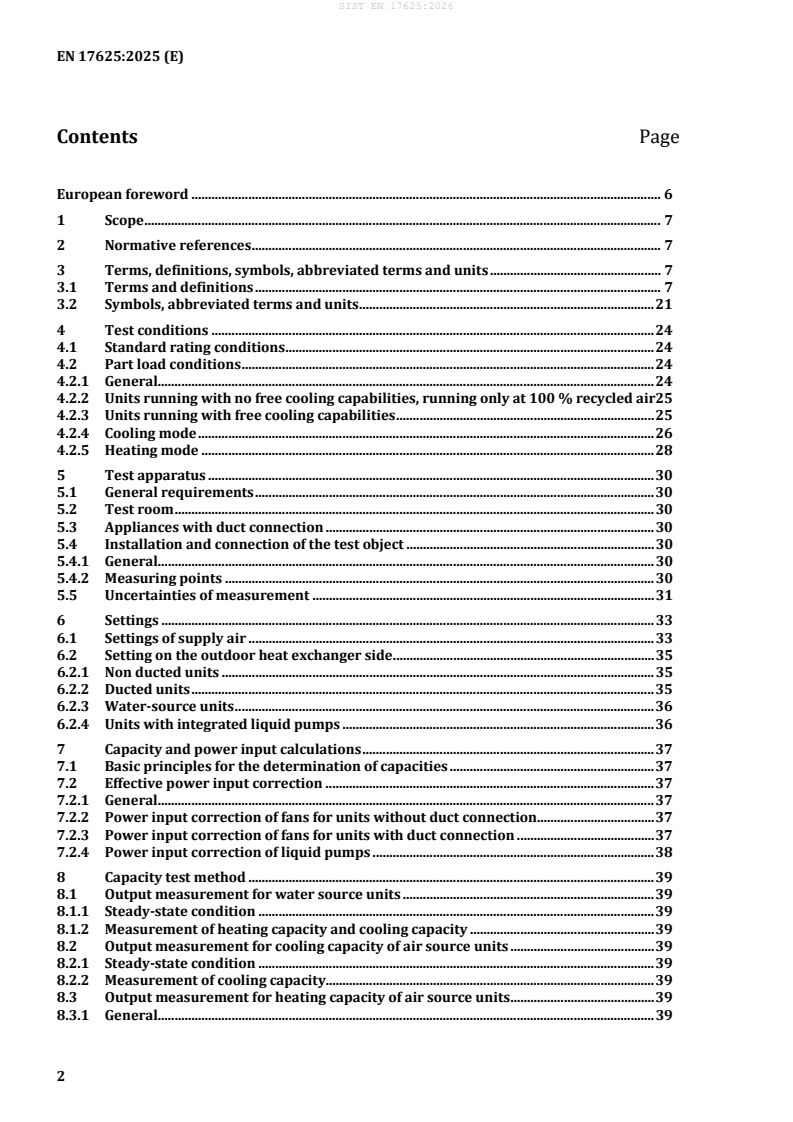
Contents Page
European foreword . 6
1 Scope . 7
2 Normative references . 7
3 Terms, definitions, symbols, abbreviated terms and units . 7
3.1 Terms and definitions . 7
3.2 Symbols, abbreviated terms and units . 21
4 Test conditions . 24
4.1 Standard rating conditions . 24
4.2 Part load conditions . 24
4.2.1 General. 24
4.2.2 Units running with no free cooling capabilities, running only at 100 % recycled air 25
4.2.3 Units running with free cooling capabilities . 25
4.2.4 Cooling mode . 26
4.2.5 Heating mode . 28
5 Test apparatus . 30
5.1 General requirements . 30
5.2 Test room . 30
5.3 Appliances with duct connection . 30
5.4 Installation and connection of the test object . 30
5.4.1 General. 30
5.4.2 Measuring points . 30
5.5 Uncertainties of measurement . 31
6 Settings . 33
6.1 Settings of supply air . 33
6.2 Setting on the outdoor heat exchanger side . 35
6.2.1 Non ducted units . 35
6.2.2 Ducted units . 35
6.2.3 Water-source units . 36
6.2.4 Units with integrated liquid pumps . 36
7 Capacity and power input calculations . 37
7.1 Basic principles for the determination of capacities . 37
7.2 Effective power input correction . 37
7.2.1 General. 37
7.2.2 Power input correction of fans for units without duct connection. 37
7.2.3 Power input correction of fans for units with duct connection . 37
7.2.4 Power input correction of liquid pumps . 38
8 Capacity test method . 39
8.1 Output measurement for water source units . 39
8.1.1 Steady-state condition . 39
8.1.2 Measurement of heating capacity and cooling capacity . 39
8.2 Output measurement for cooling capacity of air source units . 39
8.2.1 Steady-state condition . 39
8.2.2 Measurement of cooling capacity. 39
8.3 Output measurement for heating capacity of air source units . 39
8.3.1 General. 39
8.3.2 Step 1: Preconditioning . 41
8.3.3 Step 2: End of defrost cycle. 42
8.3.4 Step 3: Equilibrium period . 42
8.3.5 Step 5: Data collection . 42
8.3.6 Step 4: Defrost cycle . 43
8.3.7 Step 6: Steady-state operation . 43
8.3.8 Step 7: Transient operation . 43
8.4 Permissible deviations . 44
8.5 Test results. 46
8.5.1 Data to be recorded . 46
8.5.2 Cooling capacity calculation . 48
8.5.3 Heating capacity calculation . 49
8.5.4 Effective power input calculation . 49
9 Test methods for electric power input during thermostat-off mode, standby mode and
crankcase heater mode and off mode . 50
9.1 Uncertainties of measurement . 50
9.2 Measurement of electric power input during thermostat-off mode . 50
9.3 Measurement of the electric power input during standby mode . 50
9.4 Measurement of the electric power input during crankcase heater mode . 51
9.5 Measurement of the electric power input during off mode . 51
10 Seasonal performances . 51
10.1 Calculation of SEER, SEER , SEER and SEER . 51
F on on,F
10.1.1 General formula for calculation of SEER . 51
10.1.2 Calculation of the reference annual cooling demand Q . 51
C
10.1.3 Calculation of the reference annual energy consumption for cooling Q . 52
CE
10.1.4 Calculation of SEER . 52
on
10.1.5 Calculation of SEER . 53
F
10.1.6 Calculation of the reference annual energy consumption for cooling Q . 53
CE,F
10.1.7 Calculation of SEER . 53
on,F
10.1.8 Calculation procedure for determination of EER values at part load conditions . 54
bin
10.2 Calculation of SCOP, SCOP and SCOP . 56
on net
10.2.1 General formula for calculation of SCOP . 56
10.2.2 Calculation of the reference annual heating demand Q . 56
H
10.2.3 Calculation of the annual energy consumption for heating Q . 57
HE
10.2.4 Calculation of SCOP and SCOP . 57
on net
10.2.5 Calculation procedure for determination of COP values at part load conditions . 59
bin
10.3 Calculation of seasonal efficiencies . 60
10.3.1 Calculation of the seasonal space cooling efficiency ηs,c . 60
10.3.2 Calculation of the seasonal space cooling efficiency with free-cooling mode η . 61
s,cF
10.3.3 Calculation of the seasonal space heating efficiency η . 61
s,h
10.4 Determination of the degradation coefficients C and C . 61
dc dh
10.4.1 General . 61
10.4.2 Air-to-air units – Cooling mode . 62
10.4.3 Air-to-air units – Heating mode . 63
10.4.4 Water(brine)-to-air units – Cooling mode . 63
10.4.5 Water(brine)-to-air units – Heating mode . 63
11 Test report . 63
11.1 General information . 63
11.2 Additional information . 64
11.3 Rating test results . 64
11.3.1 General . 64
11.3.2 Seasonal test results . 65
11.4 Specific information of the unit . 65
Annex A (informative) Illustration of rooftop units' configurations . 66
A.1 General. 66
A.2 Two-damper rooftop unit . 66
A.3 Three-damper rooftop unit . 67
A.4 Four-damper rooftop unit . 70
Annex B (informative) Space cooling/heating function’s seasonal cooling/heating
efficiencies while working with a minimum mixture of outdoor air and recycled air
................................................................................................................................................................... 72
B.1 General. 72
B.2 Definitions . 72
B.3 Calculation of the outdoor air load . 73
B.4 Calculation of outdoor air + building loads . 75
B.5 Test conditions . 76
B.6 Setting of the amount of outdoor air flow rate . 76
B.7 Seasonal performance . 80
Annex C (normative) Indoor air enthalpy method for testing rooftop units . 82
C.1 General. 82
C.2 Cooling and heating capacities from the indoor air enthalpy method . 82
C.3 Heating/Cooling capacity calculations . 84
C.4 Black box approach . 88
Annex D (informative) Examples of testing layout for rooftop units . 92
D.1 General. 92
D.2 Single room test set-up . 92
D.3 Two-rooms’ test set-up . 94
Annex E (informative) Symbols used in Annexes A, C and D . 97
Annex F (normative) Determination of the liquid pump efficiency . 99
F.1 General. 99
F.2 Hydraulic power of the liquid pump . 99
F.3 Efficiency of integrated pumps . 99
F.4 Efficiency of non-integrated pumps . 102
Annex G (normative) Air flow rate measurement . 103
G.1 General. 103
G.2 Test installation . 103
G.3 Test conditions . 103
G.4 Air flow measurement. 103
Annex H (normative) Climate bins and hours . 104
H.1 Bin limit temperature . 104
H.2 Cooling . 104
H.3 Heating . 105
H.4 Hours for active, thermostat-off, standby and off modes . 106
H.5 Hours used for crankcase heater mode . 107
Bibliography . 108
European foreword
This document (EN 17625:2025) has been prepared by Technical Committee CEN/TC 113 “Heat pumps
and air conditioning units”, the secretariat of which is held by UNE.
This European Standard shall be given the status of a national standard, either by publication of an
identical text or by endorsement, at the latest by May 2026, and conflicting national standards shall be
withdrawn at the latest by May 2026.
Attention is drawn to the possibility that some of the elements of this document may be the subject of
patent rights. CEN shall not be held responsible for identifying any or all such patent rights.
Any feedback and questions on this document should be directed to the users’ national standards body.
A complete listing of these bodies can be found on the CEN website.
According to the CEN-CENELEC Internal Regulations, the national standards organisations of the
following countries are bound to implement this European Standard: Austria, Belgium, Bulgaria, Croatia,
Cyprus, Czech Republic, Denmark, Estonia, Finland, France, Germany, Greece, Hungary, Iceland, Ireland,
Italy, Latvia, Lithuania, Luxembourg, Malta, Netherlands, Norway, Poland, Portugal, Republic of North
Macedonia, Romania, Serbia, Slovakia, Slovenia, Spain, Sweden, Switzerland, Türkiye and the United
Kingdom.
1 Scope
This document specifies the terms and definitions, the test conditions and the test methods for the rating
and performance of rooftop units. It also specifies the determination of capacities and the calculation
methods considering rooftop units features, such as free cooling and air flow mixtures, for the
determination of seasonal energy efficiencies in cooling and heating.
This document covers only space heating and/or cooling for comfort applications (process applications
are outside the scope of this document). It applies to air-to-air and water(brine)-to-air rooftop units with
electrically driven compressor(s), which may be equipped with a supplementary heater using electrical
resistance or combustion of fossil fuel. This document does not cover rooftop units with remote
condensers.
This document covers the features of free cooling, mixing air flows (on both sides) and internal heat
recovery, as illustrated in Annex A. Annex B provides additional definitions and methods for determining
seasonal performances for space cooling/heating with a minimum mixture of outdoor air and recycled
air.
2 Normative references
The following documents are referred to in the text in such a way that some or all of their content
constitutes requirements of this document. For dated references, only the edition cited applies. For
undated references, the latest edition of the referenced document (including any amendments) applies.
EN 14511-1:2022, Air conditioners, liquid chilling packages and heat pumps for space heating and cooling
and process chillers, with electrically driven compressors - Part 1: Terms and definitions
EN 14511-3:2022, Air conditioners, liquid chilling packages and heat pumps for space heating and cooling
and process chillers, with electrically driven compressors - Part 3: Test methods
3 Terms, definitions, symbols, abbreviated terms and units
3.1 Terms and definitions
For the purposes of this document, the following terms and definitions apply.
ISO and IEC maintain terminology databases for use in standardization at the following addresses:
— ISO Online browsing platform: available at https://www.iso.org/obp/
— IEC Electropedia: available at https://www.electropedia.org/
3.1.1
rooftop
air conditioning unit which main function is space cooling or heating, or both, using a vapour compression
cycle driven by electric compressor(s) and in which the evaporator, compressor(s), condenser and
supplementary heaters are integrated into a single package, that can be provided on one or two separate
frames
Note 1 to entry: Rooftop units use recycled air or a mixture of recycled air and outdoor air on the indoor heat
exchanger, and outdoor air or a mixture of outdoor air and extracted air on the outdoor heat exchanger, with
capability of free cooling and may be equipped with a heat recovery system to benefit from the extracted air.
Note 2 to entry: Air mixtures ratio can vary from 0 % to 100 %.
Note 3 to entry: It can have means for cleaning and/or dehumidifying the air.
3.1.2
supply air
air leaving the rooftop unit for entering the space that is to be air-conditioned
3.1.3
extracted air
air removed from the conditioned space and rejected outdoors without entering the indoor nor the
outdoor heat exchanger
Note 1 to entry: The extracted air may be entering a heat recovery device to enhance the efficiency of the unit.
3.1.4
recycled air
air from the air-conditioned space entering the indoor heat exchanger
3.1.5
exhaust air
air from the air-conditioned space entering the outdoor heat exchanger
3.1.6
2-damper rooftop
rooftop including indoor fan(s) for air supply, one damper on the recycled air circuit and one damper on
the outdoor air circuit that allow to vary the ratio of outdoor air into the indoor heat exchanger from 0 %
to 100 %
Note 1 to entry: See Figure A.1.
3.1.7
3-damper rooftop
rooftop including fan(s) for air supply and fan(s) for air extraction, one damper on the recycled air circuit,
one damper on the outdoor air circuit and a third damper on the extract air circuit ahead of the air
extraction fan, with both fans functioning simultaneously that allow to vary the ratio of outdoor air into
the indoor heat exchanger from 0 % to 100 %
Note 1 to entry: The extracted air can be mixed with outdoor air before entering the outdoor heat exchanger.
Note 2 to entry: See Figures A.2, A.3 and A.4.
3.1.8
4-damper rooftop
rooftop equipped with four dampers for providing mixtures of outdoor air and exhaust air at the inlet of
both outdoor and indoor heat exchangers that allow to vary independently the ratio of outdoor air
entering both heat exchangers from 0 % to 100 %
Note 1 to entry: See Figures A.5 and A.6.
3.1.9
free cooling
operation mode of the rooftop in which the cooling capacity is partially or totally provided by direct
supply of outdoor air or of a mixture of outdoor air/recycled air to air-conditioned space, with or without
using the thermodynamic cycle
3.1.10
heat recovery device
any device capable to recover an amount of energy from the extracted air for the purpose of improving
the overall rooftop efficiency
3.1.11
available external static pressure difference
Δ
pe
positive pressure difference measured between the air (or water) outlet section and the air (or water)
inlet section of the unit, which is available for overcoming the pressure drop of any additional ducted air
(or water) circuit
Note 1 to entry: Expressed in Pa.
3.1.12
conversion coefficient
CC
coefficient for power generation efficiency
Note 1 to entry: The value of CC to apply can be found in the relevant regulation, or is 2,5 by default.
3.1.13
design load
P
design
space cooling (P ) or space heating (P ) load declared by the manufacturer at T or T
designc designh designc designh
conditions respectively
Note 1 to entry: It is possible to calculate the SEER/ SEERF/SEERon/SEERon,F or SCOP/SCOPon/SCOPnet of a unit for
more than one Pdesign value.
Note 2 to entry: Expressed in kW.
3.1.14
capacity ratio
CR
cooling (or heating) part load or full load divided by the declared cooling (or heating) capacity of the unit
at the same temperature conditions
Note 1 to entry: Expressed in kW/kW.
3.1.15
part load ratio
pl(T )
j
bin temperature minus 16 °C divided by the reference design temperature minus 16 °C
3.1.16
declared capacity
cooling (Pdc) or heating (Pdh) capacity a unit can provide at any temperature condition A, B, C, C', D, E1,
E2, E, F or G, as declared by the manufacturer
Note 1 to entry: Expressed in kW.
Note 2 to entry: This is the capacity provided by the rooftop running in the active mode or free cooling mode
without supplementary heaters, even if those are integrated in the unit.
3.1.17
capacity control
ability of the unit to change its capacity by changing the volumetric flow rate of the refrigerant
Note 1 to entry: Units are indicated as “fixed” if the unit cannot change its volumetric flow rate, “staged” if the
volumetric flow rate is changed or varied in series of not more than two steps, or “variable” if the volumetric flow
rate is changed or varied in series of three or more steps.
3.1.18
temperature controls
equipment that interfaces with the end-user regarding the values and timing of the desired indoor
temperature, and communicates relevant data to an interface of the space heater or the space cooling
unit such as a central processing unit, thus helping to regulate the indoor temperature(s)
3.1.19
reactivation function
function facilitating the activation of other modes, including active mode, by remote switch including
remote control, internal sensor, timer to a condition providing additional functions, including the main
function, but excluding thermostats
3.1.20
information or status display
continuous function providing information or indicating the status of the equipment on a display,
including clocks
3.1.21
outdoor air
air from the outdoor environment
3.1.22
outdoor air ratio
OAR
ratio of outdoor air volume and supply air volume at standard air conditions
3.1.23
climate conditions
temperature conditions characteristic for a specific location
3.1.24
average climate
temperature conditions characteristic for the city of Strasbourg for the heating season
3.1.25
colder climate
temperature conditions characteristic for the city of Helsinki for the heating season
3.1.26
warmer climate
temperature conditions characteristic for the city of Athens for the heating season
3.1.27
bin
j
outdoor temperature interval of 1 K
3.1.28
bin hours
h
j
hours per season for which an outdoor temperature occurs for each bin j
3.1.29
bin temperature
T
j
outdoor air dry bulb temperature at bin j
Note 1 to entry: Expressed in °C.
Note 2 to entry: The relative humidity may be indicated by a corresponding wet bulb temperature.
3.1.30
bin limit temperature
temperature in the bin for which no more heating or cooling is required
Note 1 to entry: Expressed in °C.
Note 2 to entry: The bin limit temperature equals 16 °C for all climates in space cooling and space heating
applications.
3.1.31
active mode
mode corresponding to the hours with a space cooling or heating load of the building and whereby the
cooling or heating function of the unit is activated
Note 1 to entry: This condition may involve on/off-cycling of the unit in order to reach or maintain a required
indoor air temperature.
3.1.32
active cooling
operation of the rooftop in which the cooling capacity is only provided by the use of thermodynamic cycle
3.1.33
energy efficiency ratio
EER
ratio of the total cooling capacity to the effective power input of the unit
Note 1 to entry: Expressed in kW/kW.
3.1.34
cooling mode
operation of the rooftop providing space cooling by means of the active cooling or free cooling, where
relevant
3.1.35
reference cooling season
set of operating conditions describing per bin the combination of outdoor temperatures and the number
of hours these temperatures occur for cooling and for which the unit is declared fit for purpose
3.1.36
reference design conditions for space cooling
T
designc
temperature conditions at 35 °C dry bulb (24 °C wet bulb) outdoor temperature and 27 °C dry bulb (19 °C
wet bulb) indoor temperature
Note 1 to entry: Expressed in °C.
3.1.37
reference annual cooling demand
Q
C
reference cooling demand to be used as basis for calculation of SEER/SEER and calculated as the product
F
of the design load for cooling (P ) and the equivalent active mode hours for cooling (H )
designc CE
Note 1 to entry: Expressed in kWh
3.1.38
equivalent active mode hours for cooling
H
CE
assumed annual number of hours the unit must provide the design load for space cooling (P ) in order
designc
to satisfy the reference annual space cooling demand
Note 1 to entry: Expressed in h.
3.1.39
part load for cooling
P (T )
c j
cooling load at a specific bin temperature T , calculated as the design load multiplied by the part load ratio
j
Note 1 to entry: Expressed in kW.
3.1.40
annual energy consumption for space cooling
Q
CE
energy consumption required to meet the reference annual space cooling demand and calculated as the
reference annual space cooling demand divided by the active mode seasonal energy efficiency ratio
(SEER ) and the energy consumption of the unit for thermostat-off-, standby-, off- and crankcase heater
on
mode during the cooling season
Note 1 to entry: Expressed in kWh.
3.1.41
energy efficiency ratio at part load
EER
bin
energy efficiency ratio EER , corrected with the degradation coefficient, where applicable
d
Note 1 to entry: Expressed in kW/kW.
3.1.42
energy efficiency ratio at declared capacity
EER
d
declared cooling capacity of the unit divided by the effective power input of a unit at specific temperature
conditions A, B, C, C', D, E1 and E2 where applicable
Note 1 to entry: Expressed in kW/kW.
3.1.43
bin-specific energy efficiency ratio
EER (T )
bin j
energy efficiency ratio specific for every bin j with outdoor temperature T in a season
j
Note 1 to entry: Expressed in kW/kW.
3.1.44
active mode seasonal energy efficiency ratio
SEER
on
average energy efficiency ratio of the unit in active mode for the space cooling function, determined from
(T )) and weighted by the bin hours where the
part load and bin-specific energy efficiency ratios (EERbin j
bin condition occurs
Note 1 to entry: For calculation of SEER , the energy consumption during thermostat-off mode, standby mode, off
on
mode and that of the crankcase heater is excluded.
Note 2 to entry: Expressed in kWh/kWh.
3.1.45
seasonal energy efficiency ratio
SEER
overall energy efficiency ratio of the unit, representative for the whole cooling season for units with no
free cooling capabilities running at 100% recycled air
Note 1 to entry: The seasonal energy efficiency ratio is calculated as the reference annual cooling demand QC
divided by the annual energy consumption for cooling QCE.
Note 2 to entry: Expressed in kWh/kWh.
3.1.46
seasonal space cooling energy efficiency
η
s,c
energy efficiency of a space cooling unit while meeting the space cooling demand for the cooling season
Note 1 to entry: Expressed in %.
3.1.47
cycling interval capacity for cooling
P
cycc
(time-weighted) average cooling capacity output over the cycling interval test
Note 1 to entry: Expressed in kW.
3.1.48
degradation coefficient for cooling mode
C
dc
measure of efficiency loss due to the cycling for cooling mode
Note 1 to entry: If Cdc is not determined by measurement then the default degradation coefficient is 0,25.
3.1.49
cycling interval efficiency for cooling
EER
cyc
average energy efficiency ratio over the cycling interval test (compressor switching on and off)
Note 1 to entry: The cycling interval efficiency for cooling is calculated as the integrated cooling capacity over the
interval divided by the integrated power input over that same interval.
Note 2 to entry: Expressed in kWh/kWh.
3.1.50
free cooling temperature
T
free
highest outdoor temperature at which the thermodynamic cycle is switched off and the cooling capacity
is provided by outdoor air or a mixture of outdoor and recycled air only
Note 1 to entry: For temperatures below or equal than Tfree, the thermodynamic cycle is switched off .
Note 2 to entry: Tfree, is declared by the manufacturer of the rooftop.
Note 3 to entry: Expressed in °C.
3.1.51
annual energy consumption for space cooling with free cooling mode
Q
CE,F
energy consumption required to meet the reference annual space cooling demand including free cooling
mode and calculated as the reference annual space cooling demand divided by the active mode seasonal
energy efficiency ratio with free cooling mode (SEER ) and the energy consumption of the unit for
on,F
thermostat-off-, standby-, off- and crankcase heater mode during the cooling season
Note 1 to entry: Expressed in kWh.
3.1.52
active mode seasonal energy efficiency ratio with free cooling mode
SEER
on,F
average energy efficiency ratio of the unit in active mode for the space cooling function and with free
cooling capabilities running at 100% recycled air above T temperature, determined from part load and
free
bin-specific energy efficiency ratios (EER (T )) and weighted by the bin hours where the bin condition
bin j
occurs
Note 1 to entry: For calculation of SEERon,F, the energy consumption during thermostat-off mode, standby mode, off
mode and that of the crankcase heater is excluded.
Note 2 to entry: Expressed in kWh/kWh.
3.1.53
seasonal energy efficiency ratio with free cooling mode
SEER
F
overall energy efficiency ratio of the unit, representative for the whole cooling season for units with free
cooling capabilities running at 100% recycled air above T temperature
free
Note 1 to entry: SEER is calculated as the reference annual cooling demand Q divided by the annual energy
F C
consumption for cooling Q .
CE,F
Note 2 to entry: Expressed in kWh/kWh.
3.1.54
bivalent temperature
T
biv
lowest outdoor bin temperature point at which the unit is declared to have a capacity able to meet 100 %
of the heating load without supplementary heater, whether it is integrated in the unit or not
Note 1 to entry: Expressed in °C.
Note 2 to entry: Below this temperature, the unit may still provide capacity, but additional supplementary heating
is necessary to fulfil the full heating load.
Note 3 to entry: The value of T is an integer value.
biv
3.1.55
operation limit temperature
TOL
outdoor bin temperature below which the unit will not be able to deliver any heating capacity and the
declared capacity is equal to zero
Note 1 to entry: Expressed in °C.
3.1.56
coefficient of performance
COP
ratio of the heating capacity to the effective power input of the unit
Note 1 to entry: Expressed in kW/kW.
3.1.57
heating mode
operation of the rooftop providing space heating by means of the thermodynamic cycle and
supplementary heater, where relevant
3.1.58
reference heating season(s)
set of operating conditions describing per bin the combination of outdoor temperatures and the number
of hours these temperatures occur for heating and for which the unit is declared fit for purpose
Note 1 to entry: There are three reference heating seasons: “A” average, “C” colder and “W” warmer.
3.1.59
reference design conditions for space heating
T
designh
temperature conditions for average, colder and warmer climates
Note 1 to entry: Expressed in °C.
3.1.60
reference annual heating demand(s)
Q
H
reference heating demand for a designated heating season, to be used as basis for calculation of SCOP and
calculated as the product of the design load for heating (P ) and the equivalent active mode hours for
designh
heating (H )
HE
Note 1 to entry: There are three reference heating demands: “A” average, “C” colder and “W” warmer,
corresponding to the three reference heating seasons.
Note 2 to entry: Expressed in kWh.
3.1.61
equivalent active mode hours for heating
H
HE
assumed annual number of hours the unit must provide the design load for heating (P ) in order to
designh
satisfy the reference annual heating demand
Note 1 to entry: Expressed in h.
3.1.62
part load for heating
P (T )
h j
heating load at a specific bin temperature T , calculated as the design load multiplied by the part load ratio
j
Note 1 to entry: Expressed in kW.
3.1.63
annual energy consumption for heating
Q
HE
energy consumption required to meet the reference annual heating demand for a designated heating
season and calculated as the reference annual heating demand divided by the active mode seasonal
coefficient of performance (SCOP ) and the energy consumption of the unit for thermostat-off-, standby,
on
off- and crankcase heater mode during the heating season
Note 1 to entry: Expressed in kWh.
3.1.64
coefficient of performance at part load
COP
bin
coefficient of performance COP , corrected with the degradation coefficient, where applicable
d
Note 1 to entry: Expressed in kW/kW.
3.1.65
coefficient of performance at declared capacity
COPd
declared heating capacity of the unit divided by the effective power input of the unit at specific
temperature conditions, A, B, C, D, E, F and G, where applicable
Note 1 to entry: Expressed
...
Questions, Comments and Discussion
Ask us and Technical Secretary will try to provide an answer. You can facilitate discussion about the standard in here.
Loading comments...