


SIST EN 15780:2025
(Main)Ventilation for buildings - Ductwork - Cleanliness of ventilation systems
Ventilation for buildings - Ductwork - Cleanliness of ventilation systems
This document specifies general requirements and gives guidelines for ventilation systems except for industrial, medical and laboratory facilities.
This document also specifies cleanliness criteria and procedures necessary in assessing and maintaining the cleanliness of ventilation systems over their lifetime from design and installation to maintenance.
This document is applicable to both new and existing ventilation systems with, and without, air conditioning and kitchen extract systems.
Lüftung von Gebäuden - Luftleitungen - Sauberkeit von Lüftungsanlagen
Dieses Dokument legt allgemeine Anforderungen fest und enthält Richtlinien für Lüftungsanlagen, außer für Industrie-, Medizin- und Laboreinrichtungen.
Dieses Dokument legt außerdem Kriterien für die Sauberkeit und Verfahren fest, die zur Bewertung und Instandhaltung der Sauberkeit von Lüftungsanlagen über ihre Lebensdauer hinweg, von der Auslegung über die Installation bis zur Wartung, notwendig sind.
Dieses Dokument ist anwendbar für neue und bestehende Lüftungsanlagen mit und ohne Klimatisierung und Küchenabluftanlagen.
Ventilation des bâtiments - Réseaux de conduits - Propreté des systèmes de ventilation
Le présent document spécifie les exigences générales et donne les lignes directrices pour les systèmes de ventilation à l’exclusion des installations industrielles, médicales et de laboratoire.
Le présent document spécifie également les critères de propreté et les modes opératoires nécessaires à l'évaluation et au maintien de la propreté des systèmes de ventilation tout au long de leur durée de vie, depuis la conception et l'installation jusqu'à l'entretien.
Le présent document est applicable aux systèmes de ventilation neufs et existants avec, et sans, conditionnement d'air et systèmes d’extraction de cuisine.
Prezračevanje stavb - Kanali - Čistoča prezračevalnih sistemov
Ta dokument podaja splošne zahteve in smernice za prezračevalne sisteme, razen za industrijske, zdravstvene in laboratorijske objekte. Določa tudi merila čistoče in postopke za presojo in vzdrževanje čistoče prezračevalnih sistemov v njihovi celotni življenjski dobi, od načrtovanja in namestitve do vzdrževanja. Ta dokument se uporablja tako za nove kot obstoječe prezračevalne sisteme s sistemi za klimatizacijo in odvod zraka v kuhinji ter brez njih.
General Information
- Status
- Published
- Public Enquiry End Date
- 30-Apr-2024
- Publication Date
- 19-Aug-2025
- Technical Committee
- OGS - Heating for buildings
- Current Stage
- 6060 - National Implementation/Publication (Adopted Project)
- Start Date
- 04-Aug-2025
- Due Date
- 09-Oct-2025
- Completion Date
- 20-Aug-2025
Relations
- Replaced By
SIST EN 15780:2012 - Ventilation for buildings - Ductwork - Cleanliness of ventilation systems - Effective Date
- 01-Sep-2025
Overview
EN 15780:2025 - published by CEN - is the European standard for ventilation for buildings focused on ductwork cleanliness. It defines general requirements, cleanliness criteria and procedures to assess and maintain the cleanliness of ventilation systems throughout their lifetime: from design and installation to commissioning and ongoing maintenance. The standard applies to both new and existing ventilation systems (with or without air conditioning) and now explicitly includes kitchen extract ventilation systems. It does not cover industrial, medical or laboratory facilities.
Key topics and technical requirements
- Cleanliness quality classes - define expected cleanliness levels from project outset and are specified in handing-over documentation.
- Assessment methods - visual inspection is the first step; objective measurements are used when needed. Annexes provide test procedures (e.g., vacuum test, wiping test) and measurement guidance.
- Cleaning criteria and post-clean verification - acceptable post-clean level is defined (no loose dust or visible adhered grease) and measurement methods accompany target values.
- Cleaning planning and intervals - methodology to decide when cleaning is required, based on inspection and documented criteria; inspection intervals should be defined in system documentation.
- Design for maintainability - requirements for access/cleaning panels, airtightness, drainage and material choices; design information must consider intended cleaning methods (e.g., restrictions for wet cleaning).
- Documentation and reporting - handing-over information must include cleanliness class, measurement methods, recommended cleaning procedures and inspection plans; cleaning reports and evaluation procedures are specified.
- Informative annexes - practical guidance and specific methods (Annexes A–K) cover air handling units, filters, humidifiers, kitchen extract systems, wiping and vacuum test methods, and measurement techniques.
Practical applications and users
- Building services engineers and HVAC designers: to specify cleanliness quality class, access provision and maintainable layouts.
- Facility managers and maintenance teams: for planned inspection regimes, cleaning intervals and verification procedures.
- Cleaning contractors and commissioning agents: to follow standardized cleaning plans, measurement methods and produce compliant cleaning reports.
- Consultants, compliance officers and building owners: for contract specifications, handing-over checks and dispute resolution where objective cleanliness measurement is required.
Related standards
EN 15780:2025 references and aligns with other standards such as EN 12792, EN 12097, EN 12599, EN 13053, EN 16798-3/17 and product standards like EN 16282-6 for related terminology and installation/commissioning guidance.
Keywords: EN 15780:2025, ventilation for buildings, ductwork cleanliness, cleanliness criteria, ventilation system maintenance, kitchen extract ventilation, air handling units, cleaning plan, inspection methods.

Frequently Asked Questions
SIST EN 15780:2025 is a standard published by the Slovenian Institute for Standardization (SIST). Its full title is "Ventilation for buildings - Ductwork - Cleanliness of ventilation systems". This standard covers: This document specifies general requirements and gives guidelines for ventilation systems except for industrial, medical and laboratory facilities. This document also specifies cleanliness criteria and procedures necessary in assessing and maintaining the cleanliness of ventilation systems over their lifetime from design and installation to maintenance. This document is applicable to both new and existing ventilation systems with, and without, air conditioning and kitchen extract systems.
This document specifies general requirements and gives guidelines for ventilation systems except for industrial, medical and laboratory facilities. This document also specifies cleanliness criteria and procedures necessary in assessing and maintaining the cleanliness of ventilation systems over their lifetime from design and installation to maintenance. This document is applicable to both new and existing ventilation systems with, and without, air conditioning and kitchen extract systems.
SIST EN 15780:2025 is classified under the following ICS (International Classification for Standards) categories: 91.060.40 - Chimneys, shafts, ducts; 91.140.30 - Ventilation and air-conditioning systems. The ICS classification helps identify the subject area and facilitates finding related standards.
SIST EN 15780:2025 has the following relationships with other standards: It is inter standard links to SIST EN 15780:2012. Understanding these relationships helps ensure you are using the most current and applicable version of the standard.
SIST EN 15780:2025 is available in PDF format for immediate download after purchase. The document can be added to your cart and obtained through the secure checkout process. Digital delivery ensures instant access to the complete standard document.
Standards Content (Sample)
SLOVENSKI STANDARD
01-september-2025
Prezračevanje stavb - Kanali - Čistoča prezračevalnih sistemov
Ventilation for buildings - Ductwork - Cleanliness of ventilation systems
Lüftung von Gebäuden - Luftleitungen - Sauberkeit von Lüftungsanlagen
Ventilation des bâtiments - Réseaux de conduits - Propreté des systèmes de ventilation
Ta slovenski standard je istoveten z: EN 15780:2025
ICS:
91.060.40 Dimniki, jaški, kanali Chimneys, shafts, ducts
91.140.30 Prezračevalni in klimatski Ventilation and air-
sistemi conditioning systems
2003-01.Slovenski inštitut za standardizacijo. Razmnoževanje celote ali delov tega standarda ni dovoljeno.
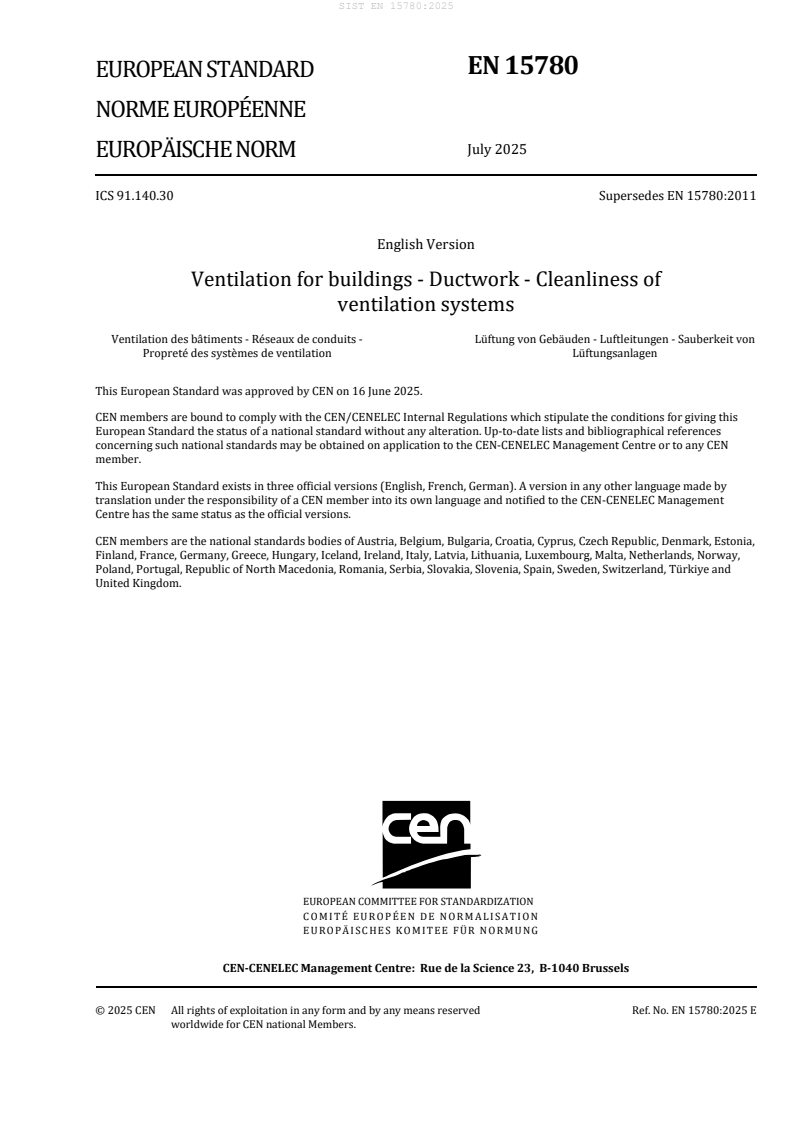
EN 15780
EUROPEAN STANDARD
NORME EUROPÉENNE
July 2025
EUROPÄISCHE NORM
ICS 91.140.30 Supersedes EN 15780:2011
English Version
Ventilation for buildings - Ductwork - Cleanliness of
ventilation systems
Ventilation des bâtiments - Réseaux de conduits - Lüftung von Gebäuden - Luftleitungen - Sauberkeit von
Propreté des systèmes de ventilation Lüftungsanlagen
This European Standard was approved by CEN on 16 June 2025.
CEN members are bound to comply with the CEN/CENELEC Internal Regulations which stipulate the conditions for giving this
European Standard the status of a national standard without any alteration. Up-to-date lists and bibliographical references
concerning such national standards may be obtained on application to the CEN-CENELEC Management Centre or to any CEN
member.
This European Standard exists in three official versions (English, French, German). A version in any other language made by
translation under the responsibility of a CEN member into its own language and notified to the CEN-CENELEC Management
Centre has the same status as the official versions.
CEN members are the national standards bodies of Austria, Belgium, Bulgaria, Croatia, Cyprus, Czech Republic, Denmark, Estonia,
Finland, France, Germany, Greece, Hungary, Iceland, Ireland, Italy, Latvia, Lithuania, Luxembourg, Malta, Netherlands, Norway,
Poland, Portugal, Republic of North Macedonia, Romania, Serbia, Slovakia, Slovenia, Spain, Sweden, Switzerland, Türkiye and
United Kingdom.
EUROPEAN COMMITTEE FOR STANDARDIZATION
COMITÉ EUROPÉEN DE NORMALISATION
EUROPÄISCHES KOMITEE FÜR NORMUNG
CEN-CENELEC Management Centre: Rue de la Science 23, B-1040 Brussels
© 2025 CEN All rights of exploitation in any form and by any means reserved Ref. No. EN 15780:2025 E
worldwide for CEN national Members.
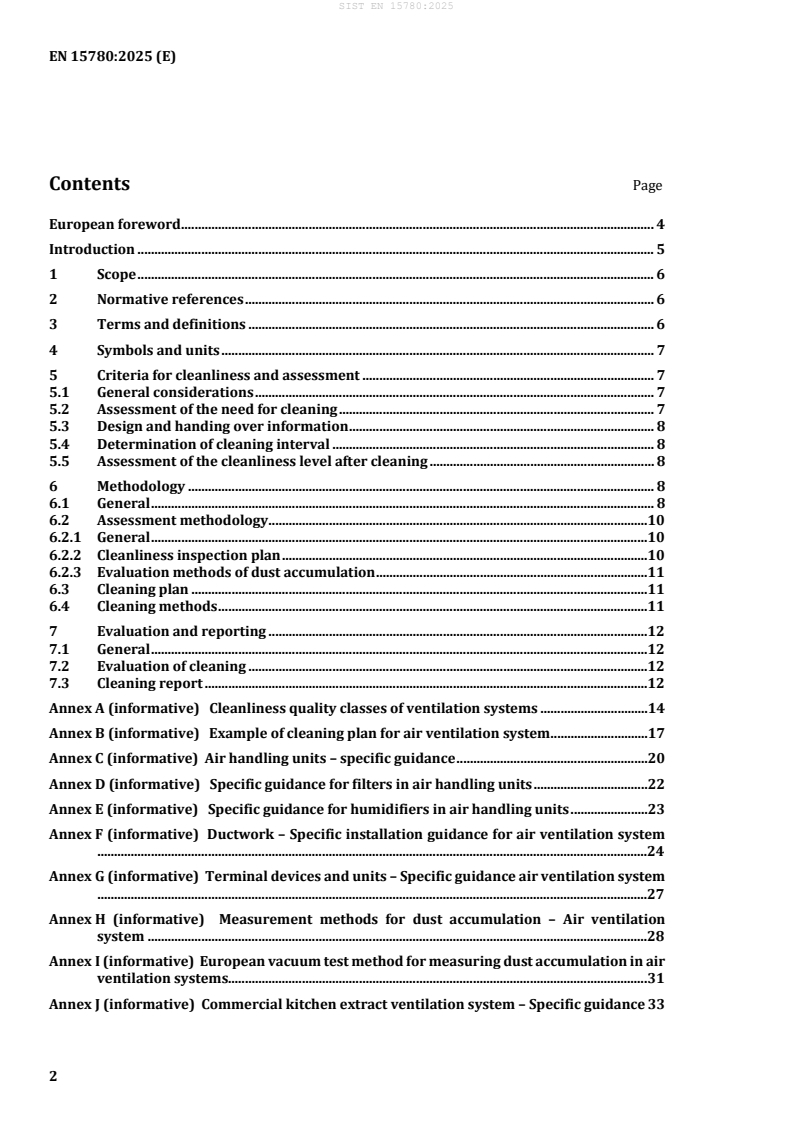
Contents Page
European foreword . 4
Introduction . 5
1 Scope . 6
2 Normative references . 6
3 Terms and definitions . 6
4 Symbols and units . 7
5 Criteria for cleanliness and assessment . 7
5.1 General considerations . 7
5.2 Assessment of the need for cleaning . 7
5.3 Design and handing over information . 8
5.4 Determination of cleaning interval . 8
5.5 Assessment of the cleanliness level after cleaning . 8
6 Methodology . 8
6.1 General . 8
6.2 Assessment methodology .10
6.2.1 General .10
6.2.2 Cleanliness inspection plan .10
6.2.3 Evaluation methods of dust accumulation .11
6.3 Cleaning plan .11
6.4 Cleaning methods .11
7 Evaluation and reporting .12
7.1 General .12
7.2 Evaluation of cleaning .12
7.3 Cleaning report .12
Annex A (informative) Cleanliness quality classes of ventilation systems .14
Annex B (informative) Example of cleaning plan for air ventilation system .17
Annex C (informative) Air handling units – specific guidance .20
Annex D (informative) Specific guidance for filters in air handling units .22
Annex E (informative) Specific guidance for humidifiers in air handling units .23
Annex F (informative) Ductwork – Specific installation guidance for air ventilation system
....................................................................................................................................................................24
Annex G (informative) Terminal devices and units – Specific guidance air ventilation system
....................................................................................................................................................................27
Annex H (informative) Measurement methods for dust accumulation – Air ventilation
system .28
Annex I (informative) European vacuum test method for measuring dust accumulation in air
ventilation systems.31
Annex J (informative) Commercial kitchen extract ventilation system – Specific guidance 33
Annex K (informative) Wiping test method to evaluate cleanliness on site . 41
Bibliography . 43
European foreword
This document (EN 15780:2025) has been prepared by Technical Committee CEN/TC 156 “Ventilation
for buildings”, the secretariat of which is held by BSI.
This European Standard shall be given the status of a national standard, either by publication of an
identical text or by endorsement, at the latest by January 2026, and conflicting national standards shall
be withdrawn at the latest by January 2026.
Attention is drawn to the possibility that some of the elements of this document may be the subject of
patent rights. CEN shall not be held responsible for identifying any or all such patent rights.
This document supersedes EN 15780:2011.
— addition of kitchen extract ventilation system (Annex J);
— addition of wiping test method to evaluate cleanliness on site (Annex K).
Any feedback and questions on this document should be directed to the users’ national standards body.
A complete listing of these bodies can be found on the CEN website.
According to the CEN-CENELEC Internal Regulations, the national standards organisations of the
following countries are bound to implement this European Standard: Austria, Belgium, Bulgaria, Croatia,
Cyprus, Czech Republic, Denmark, Estonia, Finland, France, Germany, Greece, Hungary, Iceland, Ireland,
Italy, Latvia, Lithuania, Luxembourg, Malta, Netherlands, Norway, Poland, Portugal, Republic of North
Macedonia, Romania, Serbia, Slovakia, Slovenia, Spain, Sweden, Switzerland, Türkiye and the United
Kingdom.
Introduction
This document provides test methods and classifications for cleanliness in ventilation systems.
This document is made with informative annexes that can be revised, completed and further added in
future revisions of this document for specific system types, and products or applications in the system.
See Annexes A, B, C, D, E, F, G, H, I, J and K for further information.
1 Scope
This document specifies general requirements and gives guidelines for ventilation systems except for
industrial, medical and laboratory facilities.
This document also specifies cleanliness criteria and procedures necessary in assessing and maintaining
the cleanliness of ventilation systems over their lifetime from design and installation to maintenance.
This document is applicable to both new and existing ventilation systems with, and without, air
conditioning and kitchen extract systems.
2 Normative references
The following documents are referred to in the text in such a way that some or all of their content
constitutes requirements of this document. For dated references, only the edition cited applies. For
undated references, the latest edition of the referenced document (including any amendments) applies.
EN 12792, Ventilation for buildings — Symbols, terminology and graphical symbols
3 Terms and definitions
For the purposes of this document, the following terms and definitions apply.
ISO and IEC maintain terminology databases for use in standardization at the following addresses:
— ISO Online browsing platform: available at https://www.iso.org/obp/
— IEC Electropedia: available at https://www.electropedia.org/
3.1
acceptable cleanliness level
amount of dust or other contaminants not to be exceeded according to the specified measurement
method
3.2
acceptable post-clean level
no loose dust (clean-swept condition) or no adhered grease deposits are detected visually on the duct
surface after cleaning and the system can reach an acceptable cleanliness level according to a specified
measurement method
Note 1 to entry: In case of conflict (for example, between the building owner and the user), or uncertainty, objective
methods are needed to assess the cleanliness/dirtiness.
3.3
cleanliness
state or amount of pollution according to specification and a particular measurement method
Note1 to entry: Cleanliness is not absolute; it is defined by limit values.
3.4
dirtiness
value above limit value for cleanliness
3.5
grease separator
device for the efficient separation of airborne solid or liquid particles, based on the effect of mechanical
forces that deflect the particles out of the airflow
[SOURCE: EN 16282-6:2020, definition 3.2, modified – term “separator” is replaced by “grease
separator”]
4 Symbols and units
For the purpose of this document, the symbols and units in EN 12792 apply.
5 Criteria for cleanliness and assessment
5.1 General considerations
The key issue is to design, build and maintain the whole ventilation system so that it can be kept clean
enough during the whole lifetime of the system. The requirements in this document, as well as the
methodology described in Clause 6, apply to the ductwork but can be also applied to air handling units
according to EN 13053, entire systems and kitchen extract systems. Therefore, it is necessary to specify
the cleanliness quality class from the beginning and include in the specification both design and
installation issues, and means to maintain a sufficiently clean ventilation system for the its whole lifetime.
The design and installation document should include the following, which are described in EN 16798-3,
EN 16798-17, and EN 12599:
a) cleanliness quality class;
b) cleanliness criteria and measurement method;
c) production of the system components;
d) delivery to site;
e) site storage;
f) installation;
g) airtightness;
h) protection of components after installation;
i) handing over the system;
j) inspection.
5.2 Assessment of the need for cleaning
Cleanliness of ventilation systems is a part of proper maintenance of the ventilation systems. Mostly the
inspection of the cleanliness can arise from two purposes:
a) to check if ventilation system is dirty and needs to be cleaned (exceeding of a “target level” of
cleanliness);
b) to evaluate cleanliness after the cleaning work.
NOTE The assessment methodology is presented in 6.2.
For existing buildings, the inspection shall include a study of existing documentation regarding
cleanliness and ductwork/ventilation system that requires cleaning. The inspection can result in
recommendations in updating these documents.
5.3 Design and handing over information
In the handing-over documents according to EN 12599, the cleanliness quality class, cleanliness criteria
and measurement methods shall be specified. Recommendations for cleaning methods and guidelines for
reaching the points to be cleaned shall also be given.
The design information shall consider the expected cleaning method. Where the system has been
designed to be cleaned by wet cleaning methods, warning regarding conditions and restrictions of use
should be given. For example, wet methods are applicable only where ducts are sufficiently moisture-
tight, internal surfaces are smooth, and slope and drainage arrangements have been provided so that
fluid and contaminant can be evacuated.
A sufficient number of access/cleaning panels shall be provided in the ductwork. The position and size of
each opening shall be marked clearly in the as-built drawings. Additionally, special care shall be taken
regarding obstacles to cleaning such as dampers, sound attenuators which are mounted in the ducts. In
many cases additional cleaning panels are needed after or before such obstacle. Requirements for
location of and distance between access panels are presented in EN 12097 and EN 16798-3.
5.4 Determination of cleaning interval
The cleaning interval shall be determined by reference to the cleanliness or dirtiness of the system.
Cleanliness or dirtiness shall in the first instance be assessed visually and this may be confirmed by means
of measurement, see Annexes A and K for dry dust. See Annex J for kitchen extract systems.
The inspection interval to determine the need for cleaning shall be specified in the system documentation
in order to assist with maintenance planning or design considerations related to cleaning methods.
5.5 Assessment of the cleanliness level after cleaning
Methods for assessment of the cleanliness level before cleaning also be applied after cleaning.
The preferred methods for assessment of the cleanliness level after cleaning are given in Annex A. See
Annex J for kitchen extract systems.
6 Methodology
6.1 General
Clause 5 refers to ducted ventilation, for air ventilation systems. See Annex J for kitchen extract systems.
Figure 1 presents a procedure to control and maintain cleanliness of ventilation system. It does not
include the design stages or selection and specification of the system, or any of its components.
The system shall be first checked visually, both in assessing the need for cleaning and in verification of
the result of cleaning. Measurements are needed if the visual inspection results in disagreement or
uncertainty about cleanliness or need for cleaning, see Figure 1.
The number and location of objective measurements can be specified in advance as part of the cleaning
or inspection plan.
Figure 1 — Schematic flow chart for procedures to maintain cleanliness of ventilation system
If the components are certified for cleanliness or the cleanliness after production is otherwise verified,
and if the cleanliness instructions are properly documented, the commissioning may be reduced to
checking the documentation and sample-checking of the system cleanliness (compliance with the
documentation), see 6.2.2.
The methods applied for objective measurements and verifications shall be consistent so that the result
of inspection is acceptable and give reliable grounds for decision making for cleaning work of the system
when needed. Verification after cleaning is needed for quality control of the cleaning work, and to verify
the cleaning result.
NOTE Examples of acceptable levels of cleanliness (or dirtiness) are explained in Annexes A, J and K.
Objective methods are needed if any guidelines or demands on cleanliness are set in official or in
voluntary documents. The methods to evaluate the cleanliness vary. Target values for the cleaning shall
be accompanied by a description of the measurement method.
6.2 Assessment methodology
6.2.1 General
The characteristics of the contamination shall be assessed in order to determine if cleaning is required
and if so, which method shall be used.
System components are considered as polluted when visual inspection and/or analytical verification give
evidence of unacceptable dust level, microbial, or other contamination, see Annex H. The characteristics
of the contamination shall be assessed to determine if cleaning is required and if so, which method shall
be used. Dust accumulation and the type of pollutants, such as “bacterial growth”, should determine the
need for cleaning, cleaning methods to be used and the required environmental controls.
Elements to be inspected for cleanliness start from the outdoor air intake and should include:
a) Air Handling Units (AHU), including all their components and sections: outdoor air intake, any mixing
sections, fan section, filters, plenums, heating and cooling coils, condensate trays, sound attenuators,
heat recovery section, and humidifier section including droplet eliminators;
b) supply air ductwork, including all types of terminal devices and terminal units, sound attenuators,
duct-mounted heating and cooling coils, dampers and valves;
c) extract and exhaust air ductwork, including all types of components;
d) recirculation ductwork, including all types of components;
e) fresh air intake ductwork.
6.2.2 Cleanliness inspection plan
The inspection plan shall consist of the following information:
a) maintenance plan and reports, including cleanliness quality class and measurement methods;
b) determining which systems will be inspected;
c) determining where to inspect and sample;
d) choosing equipment and tools.
Additionally, the inspection plan describes the requirements of the specific qualification and experience
for inspectors before they are authorized to carry out inspection work. The assessment frequency shall
be specified.
Recommendations for assessment frequency are given in Annex A. To obtain objective results, a
representative number of samples from representative parts and sites in the ventilation system should
be selected for evaluation of the cleanliness of the whole system.
A sound method for choosing sites, or taking samples, is to select areas where the dust deposits are
obvious or liable to cause reduced indoor air quality (IAQ). For inspecting and sampling, the ventilation
system can be divided in two parts, the ductwork and the rest of the system. Before inspection or
sampling, the sites should be selected at random with the aid of the design documents. The sampling sites
in the ductwork should be selected from the main duct starting from the AHU, main ducts, and branch
ducts. The sampling sites should include straight duct lengths and ducts with changes of direction or
terminations. In the rest of the system, filters or humidifiers give a good indication of the cleaning needs.
System cleanliness inspections should also refer to other parts of the system as described in 6.2.1, and
with particular reference to critical components such as filters and wet areas.
6.2.3 Evaluation methods of dust accumulation
There are different methods to evaluate cleanliness of ventilation systems. The simplest methods are
based on visual inspection of the cleanliness of the ventilation system combined with the use of some
special instrumentation. The advanced techniques can give relatively accurate results that are
comparable to given limit values.
NOTE The various methods available are discussed in Annex H. In Annex A, preferred measurement methods
which relate to various cleanliness quality classes, and to post-clean verification of cleanliness, and limit values are
given. For normal ventilation systems, Annex K describes methods and standards for simple onsite measurement
of dry dust; Annex J describes methods and standards for kitchen extract systems.
6.3 Cleaning plan
If, as assessed according to 6.2, cleaning is needed, a cleaning plan shall be provided. The cleaning plan
shall include:
a) a summary of the assessment including the list of the systems and parts that need to be cleaned;
b) detailed time schedule of cleaning;
c) cleaning methods to be applied;
d) description of how access will be gained to ducts and equipment not visible in the rooms (ducts, air
handling units);
e) list of components to be removed for cleaning, and components to be replaced (when relevant);
f) protection of the rooms in which the cleaning equipment is used;
g) how and when the occupants are informed (including protection and safety considerations);
h) microbiological considerations when relevant, including considerations for the use of disinfection;
i) criteria to assess the need for involvement of a specialist on microbiological issues; technical data,
including an estimate of the present level of dust and impurities, and target levels for cleanliness
after cleaning; see Annexes A, J and K;
j) evaluation methods for cleanliness after cleaning.
One example of technical cleaning plan is presented in Annex B.
6.4 Cleaning methods
Cleaning methods shall be sufficient to achieve the required level of cleanliness without damage to the
system, to building users’ health and safety, and to the environment.
7 Evaluation and reporting
7.1 General
Clause 7 refers to ducted ventilation, for air ventilation systems. Kitchen extract systems are dealt within
Annex J.
7.2 Evaluation of cleaning
The final evaluation of cleaning shall be made after all parts of the ductwork or system subject to cleaning
have been assessed as visually clean. Duct sections not cleaned sufficiently shall be listed in the cleaning
report including the reason why the sections were not cleaned, and with clear markings on the ductwork
drawings in order to inform the operator/end-user that some duct sections were not cleaned sufficiently.
This information can be used as basis for risk analysis and/or maintenance plan and/or rearrangement
of duct sections, if deemed necessary.
The methods and limit value for post-clean verification of cleanliness are given in Annex A, J or K. Methods
may be selected voluntarily by agreement of parties to a cleaning contract.
7.3 Cleaning report
The report shall include the following:
a) details of the company executing the cleaning including:
1) the address and name,
2) name and competency of the responsible person of issuing the cleaning report,
3) the date of the inspection, cleaning and evaluation;
b) details of the object (building, ventilation system, etc.) including:
1) the address, name, or other unique identifier of the property,
2) the owner, manager, or responsible person of the building;
c) list of the documents provided, including documentation of the product certificates and
manufacturer's or supplier's instructions, whenever available;
d) details of the systems inspected including physical descriptions of the systems subject to inspection
and cleaning;
e) inventory of equipment;
f) methods and equipment used for cleaning, and assessment before and after cleaning (visual,
measured) including:
1) results of assessment before cleaning,
2) scope of cleaning (entire system/ part of system),
3) results of assessment after cleaning,
4) photographic evidence before and after cleaning including location of each sampling point,
5) a clear statement, including location, of any sections of ductwork not sufficiently cleaned;
g) documentation of the methods and equipment.
Annex A
(informative)
Cleanliness quality classes of ventilation systems
A.1 General
Annex A gives a summary of three cleanliness quality classes. It is a key issue to pay attention to
cleanliness in design of systems, and especially in component selection and specification. Application
examples are presented in A.2, and more specific applications are presented in Annexes C, D, E and F. See
Annex J for cleanliness limit values for kitchen extract ducts. The following four major contaminants from
all components can deteriorate IAQ and should be limited:
a) residues of lubricant oils from duct manufacture;
b) dust accumulated during manufacture and installation or debris from construction;
c) dust accumulated during operation;
d) deposited microorganisms, particularly when pathogenic species are present, and conditions are
favourable for their survival and growth during storage, installation and operation.
A.2 Application in general
The cleanliness quality classes are given in Table A.1.
Table A.1 — Cleanliness quality classes
Cleanliness
Examples of typical interiors and
quality
buildings
class
Rooms with only intermittent occupancy,
Low for example, storage rooms, technical
rooms
Offices, hotels, restaurants, schools,
theatres, residential homes, shopping
Medium areas, exhibition buildings, sport
buildings, general areas in hospitals and
general working areas in industries
Laboratories, treatment areas in
High
hospitals, high quality offices
A.3 Assessment frequency recommendation
Assessment frequency described in Table A.2 should be considered as the minimum recommendation.
The necessity of increasing the frequency depends on the environment conditions, on the activity and on
mechanical and human conditions in both building and its surroundings.
In most cases inspection frequency should be specified rather than cleaning frequency. Inspection should
be regular, cleaning subject to inspection.
Table A.2 — Inspection intervals according to cleanliness quality class, in months
a
Quality class AHU Humidifiers Ducts Terminals
Filters
Low 24 12 12 48 48
Medium 12 12 6 24 24
b
High 12 6 6 12 12
a
Filters should be inspected and maintained according to the manufacturer’s recommendations,
with these intervals as the minimum ones.
b
Outdoor air ductwork may in some cases require more frequent inspection.
Air handling units equipped with humidification or adiabatic cooling systems or located in mild and wet
weather conditions should be assessed at least twice a year, whatever the use of the building.
A.4 Cleanliness quality class measurements air ventilation system
The vacuum test method detailed in Annex I is derived from the vacuum test method whereby a
gravimetric result is achieved, see Annex I for details of the European test method. Annex K describes an
additional test method which is suitable for circular, flat-oval and rectangular sheet metal duct types.
For internally lined, or other irregular and porous surface, ductwork, the vacuum test method is not
applicable. Other methods such as gel tape method can be used. Further work is necessary to establish
comparable limit values using these methods, however voluntary agreements may be made.
To comply with the cleanliness quality classification samples should show results below the limit values
given in Table A.3, which shows limits according to measurements from the test method according to
Annex I.
NOTE 1 See REHVA Cleanliness of Ventilation Systems, Figures 15 and 16 for illustration of visual comparison to
measured levels.
Table A.3 — Acceptable cleanliness levels
Acceptable cleanliness
level Acceptable cleanliness
Cleanliness
Acceptable post-clean
level
quality
Supply ductwork,
level
class
recirculation, and Extract ductwork
secondary air ductwork
2 2 2
Low < 4,5 g/m < 9,0 g/m < 0,3 g/m
2 2 2
Medium
< 3,0 g/m < 9,0 g/m < 0,3 g/m
2 2 2
High < 0,6 g/m < 9,0 g/m < 0,3 g/m
After cleaning the ductwork, and other relevant products or applications in the system all surfaces should
be visibly clean and capable of meeting the required acceptable post-clean level.
NOTE 2 Other criteria can be voluntarily agreed such as chemical standards, for example, absence of chlorides
after fire restoration work, freedom from asbestos fibres, microbiological or radiological contaminants.
A.5 Acceptable cleanliness level for new ductwork
Acceptable dust accumulation for new ductwork specifies acceptable cleanliness levels as handed over
from builder to user. In practice this means the quantity of fouling, which is deemed acceptable, see
Table A.4.
Table A.4 — Acceptable cleanliness accumulation levels in new ductwork
Acceptable cleanliness
Acceptable cleanliness
Cleanliness
level
level
quality
Supply, recirculation, or
class
Extract ductwork
secondary air ductwork
2 2
Low
< 0,9 g/m < 1,8 g/m
2 2
Medium
< 0,6 g/m < 1,8 g/m
2 2
High
< 0,3 g/m < 0,9 g/m
Annex B
(informative)
Example of cleaning plan for air ventilation system
B.1 General
Annex B presents one example of a cleaning plan for dry dust. The cleaning plan is needed in case the
assessment reveals a need for cleaning. The actions listed in the right column in Table B.1 are always
optional, and other actions may be included in the cleaning plan.
B.2 Cleaning plan
The cleaning plan is not conclusive and new technologies can be available to ensure acceptable post-clean
level, see Tables B.1 and B.2. The examples of actions are drawn up case by case as the result of
assessment.
When drafting the cleaning plan see manufacturer’s recommendations for equipment included in the
cleaning plan.
Table B.1 — Cleaning plan for air ventilation system
WORK TARGET ACTIONS
Cleaning of coils Achieving design air 1. Brush and vacuum
volume and thermal 2. Apply appropriate chemical cleaning
solution
Exchange
3. Brush
4. Rinse with pressurized water
5. Clean with compressed air
Drainage/condensate tray Removing the focus of 1. Brush and vacuum to dry
cleaning
infection and nutrients 2. Apply detergent disinfection product
that support 3. Brush
microbial contamination 4. Rinse and dry
Fan cleaning Achieving design air 1. Brush and vacuum
volume and a reduction 2. Apply appropriate chemical cleaning
solution
of the dirtiness of the
3. Brush
System downstream
4. Rinse and dry
5. Clean with compressed air for all
blades and casing
WORK TARGET ACTIONS
Panels cleaning Avoiding airborne Metallic:
contaminants in the
1. Brush and vacuum to dry
ductwork
a b
2. Apply disinfection product
3. Brush
4. Rinse and dry
Lined with porous insulators:
1. Brush and vacuum to dry
2. Sealer product application for fibre
sealing
Anti-corrosion treatment Avoiding corrosion or 1. Brush manually
corrosion increasing 2. Brush mechanically
3. Vacuum suction of the total oxide
dust
4. Apply Anti-corrosion product
a b
System disinfection Reducing microbial
1. Apply disinfection spray or gas
contamination to a
specified level.
a
Disinfection should only be utilized when demonstrated to be necessary and if a risk assessment
demonstrates the safety of the procedure for workers, system users, environment and the system itself.
b
Disinfection products and substances shall be in accordance with the Biocidal Products Regulation (EU)
528/2012 (BPR).
Table B.2 — Cleaning plan for air conditioning system
WORK TARGET ACTIONS
Cleaning of the extract air ducts Removing dust, microbial 1. If existing openings such as
contamination and maintaining access panels and other
efficiency. openings are insufficient, then
install new access panels or
Always begin from the
removable sections of ductwork
end of the air duct if the
to permit cleaning
system is to be re-used
2. Direct vacuum extraction or
during the course of the
dislodging by means such as
work
brushing or cleaning with
compressed air in combination
with air/dust extraction
Cleaning of extract air terminals Removing dust, microbial 1. Disassemble where necessary
contamination and maintaining
2. Brush and vacuum
efficiency
3. Clean with compressed air
4. Apply detergent/solvent if
necessary and vacuum
5. Rinse and dry if wet methods
used
6. Re-assemble
WORK TARGET ACTIONS
AHU cleaning Removing dust 1. Apply the air ventilation
system cleaning protocol
Diffusers cleaning Removing dust 1. Disassembly where necessary
2. Brush and vacuum
3. Compressed air
4. Detergent/solvent if
necessary and vacuuming
5. Rinse and dry if wet methods
used
6. Re-assembly
Supply air duct Removing dust, microbial 1. If existing openings such as
contamination and maintaining access panels and other
efficiency openings are insufficient then
install new access panels or
Always begin from the
removable sections of ductwork
beginning of the air duct, if the
to permit cleaning
system is to be re-used
2. Direct vacuum extraction or
during the course of the
dislodging by means such as
work
brushing or cleaning with
compressed air in combination
with air/dust extraction
Post-clean verification To confirm that expected Verify that the acceptable post-
outcome has been achieved and clean level has been achieved by
to record the cleanliness status
1. Visual inspection
of the system
2. Vacuum test to confirm
measured level
Annex C
(informative)
Air handling units – specific guidance
C.1 General
In manufacturing and construction, special attention should be paid to the following aspects:
a) complete cleaning before shipment;
b) during transportation and storage, sealing of the AHU in such a way that contamination is avoided;
c) preserve units during installation in such a way that contamination is avoided;
d) inspection, and if necessary, cleaning, after installation;
e) if risk of condensation, the risk of waterborne contaminants in the ventilation system shall be
considered. See EN 13053 for more information.
C.2 Recommendations for all cleanliness quality classes
Casing, including accessibility/access panels
EN 1886 gives requirements and recommendations for AHU casing, taking also into account hygiene and
cleanliness aspects, including the following aspects:
a) construction and materials;
b) accessibility to all components for cleaning and maintenance;
c) protection of components from the weather.
The ingress of unfiltered air through casing leakage can cause hygiene problems. The tightness classes in
EN 1886 are recommended as a minimum. All components of the AHU shall be accessible for cleaning and
maintenance.
Filters
The recommendations given in Annex D also apply for filters and filter sections in air handling units.
Humidifiers
The recommendations given in Annex E apply also for humidifiers and humidification sections in air
handling units.
Air heating and cooling coils
EN 13053 gives requirements and recommendations for heating and cooling coils in AHU's, including:
a) construction of the coils, including maximum recommended fin depth and minimum distance
between fins;
b) special requirements for cleanliness of cooling coils that are designed to dehumidify, including, for
example, location, materials, and accessibility.
If the inspection reveals a need for cleaning, the coil surfaces are cleaned according to the instructions. If
no instructions are available, it is preferred to use dry methods, such as vacuum cleaning or pressurized
air. The result of cleaning can be assessed either by visual inspection or, if feasible, checking the coil
pressure drop at the operating air flow.
For cooling coil sections, the same requirements for drainage, cleaning, materials, and disinfection apply
as for humidifiers, see Annex E.
Sound attenuators
See EN 13053.
Fan position and cleaning, including fan motors
The position of the fans in the air-handling unit is important so that proper pressure conditions are
maintained to avoid any risks of leakage of contaminated air. This is especially important for units where
transfer of particles and gases are possible within the heat recovery section.
The fans and fan motors are cleaned by dry methods: brushing, vacuum or compressed air.
Units for advanced cleanliness quality class
EN 13053 gives extended hygiene requirements for air handling units for special applications, including:
a) accessibility for cleaning purposes;
b) smoothness of surfaces;
c) inspection windows and lights;
d) drainage and prevention of condensation.
C.3 Inspection aspects
It is recommended to look at filters and filter sections, as well as humidifiers and humidifier sections at
the early stage of the system inspection for cleanliness, because the condition of these components is
generally a good indicator of need for cleaning, see Annexes D and E.
Annex D
(informative)
Specific guidance for filters in air handling units
Filter clogging or bad filter efficiency, or both, have a negative impact on indoor air quality and increase
energy consumption of the ventilation system. The side wall on the service side of the filter section should
be equipped with an inspection panel. The width and height of the panel should be greater than the
external dimensions of the replaceable filter elements. There should be sufficient free space to the side of
the access panel, and immediately upstream of front access filters, to allow unrestricted access for filter
removal and replacement.
The condition of the filters and the filter section is generally a good indicator of need for cleaning, so it is
recommended to ensure that filter quality, integrity of fitting and maintenance is assessed at the
beginning of the inspection. Filters should be removed for AHU cleaning, preferably also replaced in
connection with AHU cleaning. After the AHU cleaning, cleanliness, fitting and function of filters should
be checked. See EN 16798-3, EN 13053 and EN ISO 16890-1 for further guidance.
Annex E
(informative)
Specific guidance for humidifiers in air handling units
The cleanliness of humidifiers and associated sections of AHU or duct is critical to good hygiene because
the ready availability of moisture will strongly encourage microbiological growth. The condition of the
humidifiers is a good indicator of need for cleaning; therefore, humidifiers should be checked at an early
stage of the inspection.
For humidifiers for normal applications, the requirements and recommendations given in EN 13053 shall
apply. These include:
a) selection of materials;
b) air filtering upstream;
c) limit values for bacteria content;
d) water treatment;
e) overflow;
f) use of disinfectants;
g) arrangements to avoid droplet impingement;
h) surface finishing of the humidifier casing;
i) inspection and maintenance, including recording.
For additional aspects for humidifiers for special applications, EN 13053 apply.
Annex F
(informative)
Ductwork – Specific installation guidance for air ventilation system
F.1 Acceptable cleanliness level for new ductwork
Acceptable cleanliness levels for new ductwork specifies acceptable cleanliness levels as handed over
from builder to user. In practice this means the quantity of fouling which is deemed acceptable. See
Tables A.4 and K.1.
Since construction sites inevitably are dusty workplaces, there are practical difficulties in keeping duct
systems clean. If specified levels of cleanliness are required it can be necessary to carry out deliberate
post-installation cleaning immediately before commissioning to achieve specified and measurable levels
of cleanliness.
F.2 Protection, delivery and installation (PDI)
F.2.1 General
Tables F.1 and F.2 give guidance for the preparation and protection of ductwork during manufacturing
and installation with a view to minimizing unnecessary contamination of duct systems.
Table F.1 — Recommendations
Protection
Protection Post-
Factory during Site Cap off
PDI Level during installation
seal site clean on site
transit clean
storage
Risers
Basic PDI No No No No No
only
Not unless
Intermediate
No No Yes Yes Yes shown to be
PDI
necessary
Advanced PDI Yes No Yes Yes Yes Yes
Table F.2 — Locations
Quality Class Examples of typical interiors and buildings
Rooms with only intermittent occupancy, for example, storage
Basic PDI
rooms and technical rooms
Offices, hotels, restaurants, schools, theatres, residential homes,
Intermediate
shopping areas, exhibition buildings, sport buildings, general
PDI
areas in hospitals and general working areas in industries
Laboratories, treatment areas in hospitals and high quality
Ad
...
Questions, Comments and Discussion
Ask us and Technical Secretary will try to provide an answer. You can facilitate discussion about the standard in here.
Loading comments...